
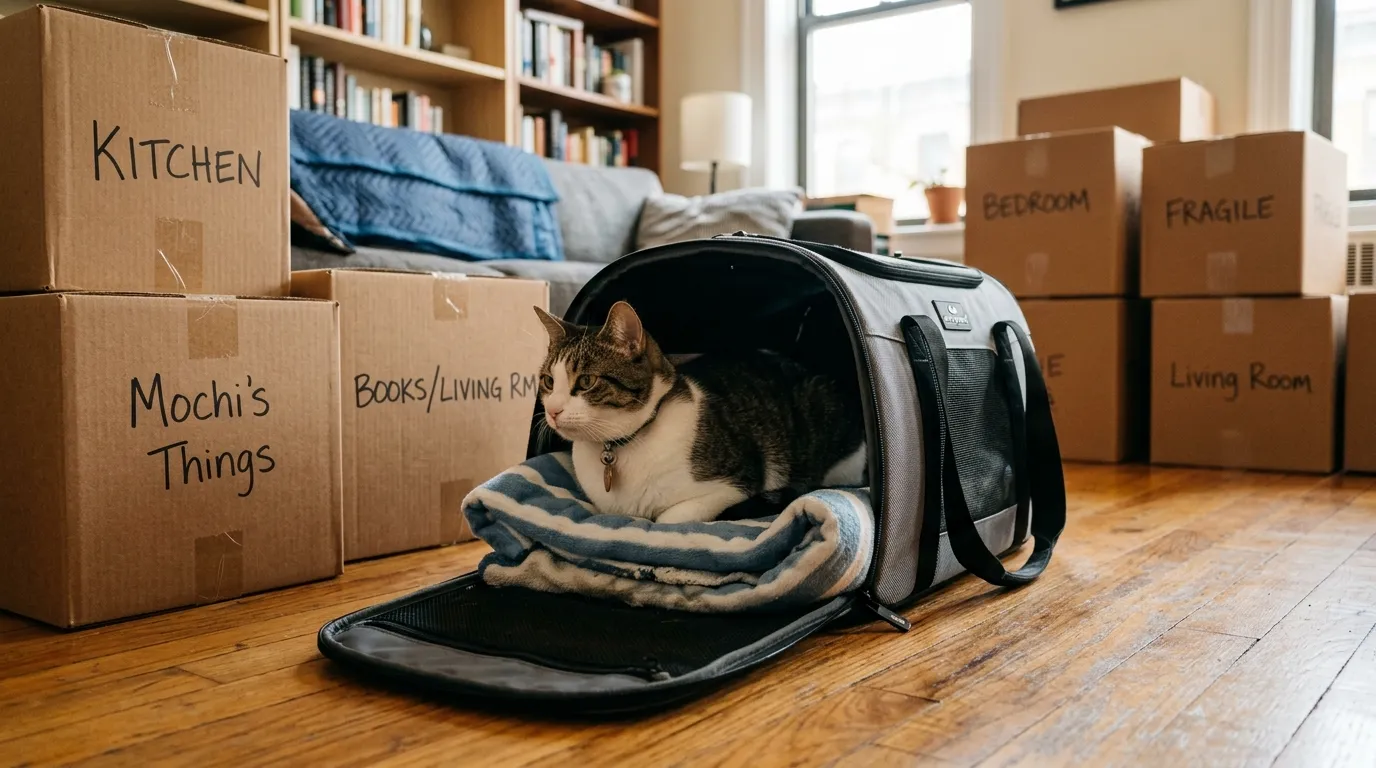
My cat spent three days under the bathroom vanity after my first move. I spent those same three days sliding food under the cabinet and talking to a piece of furniture like it might answer back. What I’ve learned from that move and every one since is that the outcome gets decided in the 48 hours before your cat ever sees the new apartment, not after. Moving to a new apartment with a cat is easy to get right when you follow a sequence, and reliably hard when you wing it. This guide covers the full timeline: the lease and building check, two weeks out, moving day itself, and the first two weeks in the new place.
Short answer: condition the carrier two weeks ahead, keep your cat in one closed room during loading, drive her yourself in a secured carrier, and set up a safe room with her own scent before she walks in. Then leave her alone until she decides to come out. Most cats are eating normally within 24 hours and exploring within one to two weeks.
Moving Timeline at a Glance
| Before you sign or move in | Get the pet policy in writing, check windows, balconies and noise, pick the room that will become the safe room |
| 2 weeks before | Carrier conditioning, gather scent soakers, update ID and microchip address, book a vet check if your cat gets anxious |
| Moving day | Confine the cat to one room or board her, transport in a carrier in your own vehicle |
| Arrival day | Cat-proof the room first, then set up the safe room with scent soakers and mixed litter before the carrier comes in |
| Days 3 to 7 | Cat decompresses; watch for normal eating and litter box use |
| Week 2 onward | Gradual room-by-room expansion; cat stays fully indoors, including away from balconies and screened windows |
Before You Move In: Check the Lease and the Building
Most of the advice online starts at the carrier. In an apartment, it should start at the lease, because the building decides a few things for you before your cat is involved at all.
- Pet policy in writing: pet deposits, monthly pet rent, and clauses about damage to floors or screens vary by landlord. Get the terms on paper, and add your cat to the lease or an addendum so there’s no dispute at move-out.
- Windows and balcony: look at how screens are seated and how high the unit is. A fourth-floor apartment with loose screens needs more work than a ground-floor one.
- Noise: stand in the unit for ten minutes and listen. Thin walls, a loud hallway, or a street-facing bedroom will all reach your cat louder than they reach you.
- Elevator and hallway layout: know the route from your car to your door, since the carrier will travel it with your cat inside.
- Safe room choice: pick it now. A bathroom or small bedroom with a door that closes fully works best, with few gaps behind fixtures.
Renting limits what you can change, so favor fixes that don’t need drilling: tension-rod window guards, cord covers, adhesive-free netting where the lease allows it, and furniture placed to block gaps. If this is your first rental with a cat, our guide to your first apartment with a cat covers the wider setup.
Two Weeks Before Moving to a New Apartment with a Cat
Condition the Carrier
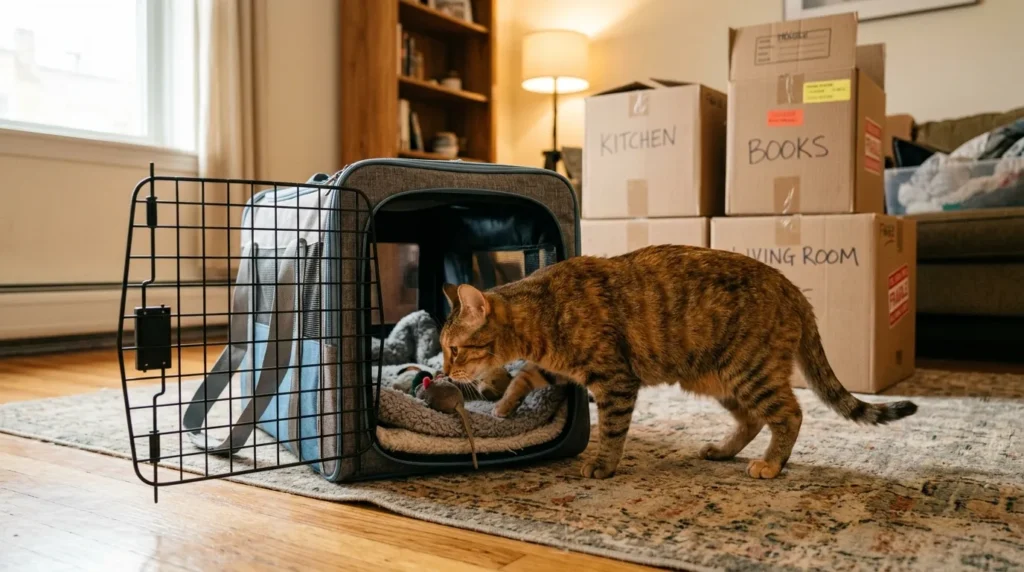
Two weeks out, turn the carrier into a neutral resting spot instead of the emergency vehicle that only shows up for vet trips. A cat who walks into her own carrier on moving day is having a completely different experience than one who gets chased and grabbed. Here’s the sequence I use:
- Remove the door, or prop it open, and leave the carrier in a room she already uses.
- Drop familiar bedding inside, ideally something that smells like you.
- Feed one daily meal right at the carrier entrance.
- Over three or four days, move the bowl further in until she eats with her whole body inside.
- Once she’s comfortable, close the door for a minute or two while she eats, then open it again. Build up from there.
- Pick a carrier with a top opening if you can. It’s far easier to lift a cat out than to pull her out of a front door.
Gather Your Scent Soakers
Do this during the same window. Scent soakers carry your cat’s established territory scent into the new place: the old bed, whichever blanket she sleeps on most, the scratching post, clothing you’ve slept in, and a scoop of used litter mixed into the fresh box. They’re the chemical signature of the old apartment, and bringing them along helps the new space register faster as safe. Keep them in a sealed bag or bin until you arrive so the smell doesn’t fade in the truck.
Update the Microchip and ID Tag
Update the microchip registry and the ID tag with the new address before moving day, not after. A cat who bolts in a brand-new neighborhood has no route memory to fall back on, unlike one who escapes somewhere familiar. Use an elasticized, breakaway-buckle collar specifically, so it releases if she gets caught on something while exploring. The updated address on that tag is the only real safety net if she gets out during the move.
Book a Vet Visit if Your Cat Is Anxious
If your cat is naturally anxious, or you’re facing a long-distance move, book a vet visit in this same two-week window. A vet can flag any health issues worth addressing before the stress of a move compounds them, and can talk through anti-anxiety medication for the drive if it’s genuinely needed. This step gets skipped constantly and it shouldn’t be, especially for moves longer than a couple of hours. Ask for a copy of her records while you’re there, and check that her vaccines are current. If you’re unsure what she needs, see whether indoor cats need vaccinations.
Pack a Cat Moving Day Kit
Pack this in one bag that rides with you, not in a box that ends up at the bottom of a stack:
- Food for at least three days, plus the bowls she already uses
- A jug of water from the old place, if she’s picky (switching water slowly is easier on her stomach)
- Litter, a scoop, a spare box, and waste bags
- Any medication, and a copy of vet records and vaccination history
- Paper towels, a spare towel to cover the carrier, and a few puppy pads in case of an accident in transit
- A recent photo of her, in case she gets out
- The scent soakers, sealed in a bag
Local Move vs. Long-Distance Move: What Changes for Your Cat?
Distance changes the plan more than most owners expect. Here’s how the two differ in practice.
| Factor | Local Move (under 2 hours) | Long-Distance Move |
|---|---|---|
| Sedation | Usually not needed | Worth a vet conversation, especially if carrier conditioning didn’t go well |
| Carrier time | Short enough that food/water breaks aren’t critical | Plan water breaks every few hours; skip food until you’ve arrived |
| Litter in transit | Not needed | Offer a small travel litter box during a long stop, with the car doors closed |
| Overnight stops | Rare | Keep the cat in the carrier or a secured bathroom, never loose in an unfamiliar hotel room |
| Vet records | Optional to transfer immediately | Transfer records and find a new vet before you need one |
| Climate change | Rarely a factor | Adjust the safe room’s heating or cooling ahead of arrival if the climate shifted a lot |
Driving Your Cat to the New Apartment
Secure the carrier so it can’t slide or tip. The back seat with a seat belt through the carrier handle works, and so does the floor behind a front seat. Keep it out of direct sun, keep the car at a steady, comfortable temperature, and never leave her alone in a parked car, even for a quick stop. A towel draped over most of the carrier cuts the visual stimulation that stresses many cats. Talk to her in a normal voice. Skip the radio at high volume.
Moving Day: Keep the Cat Out of the Chaos
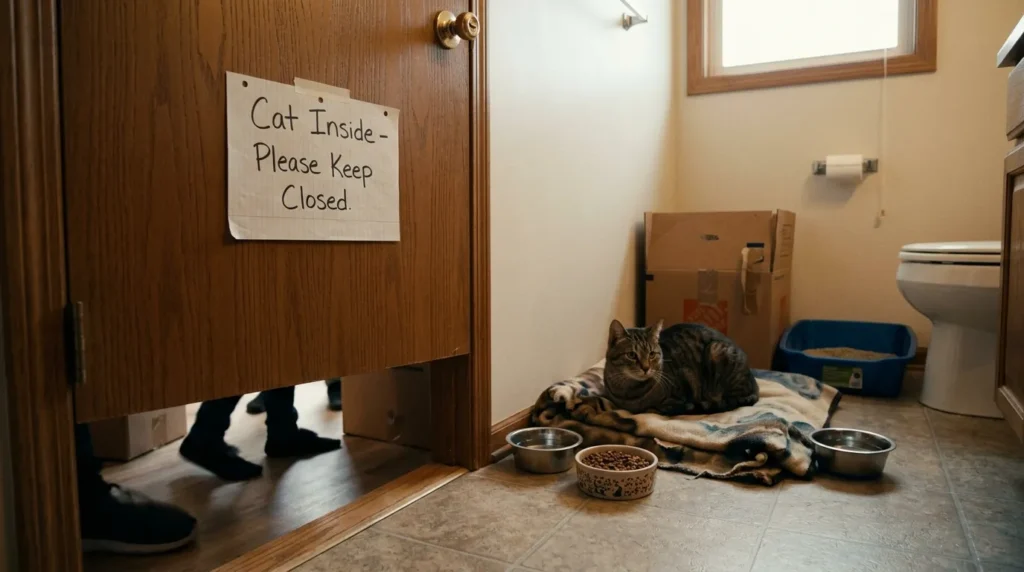
Confine the cat to one room at the old apartment before any doors open for movers, and before a single box goes out. A bathroom works, or a bedroom with a sign taped to the door reading something like “Cat inside, please keep closed.” Put food, water, a litter box, and familiar bedding in there, and leave her for the entire loading process. An open-door, high-noise moving day is one of the highest escape-risk periods an apartment cat will ever face, and a cat who bolts mid-move is genuinely hard to get back.
If your cat is especially anxious, or your building’s hallways and elevators make confinement risky, boarding her for the day is a legitimate alternative to the closed-room method. It removes the escape risk entirely and lets the movers work without a locked door in their way.
Transport her in the carrier as the last item loaded, or the first item carried into the new place. Never put a cat in a moving truck. The carrier rides in your own vehicle, with your voice nearby if that’s possible. For moves under two hours, most cats don’t need sedation. For longer moves where carrier conditioning didn’t go smoothly, have that vet conversation about anxiety medication before the move, not the morning of.
Moving Day Order of Operations
- Close her into the safe room at the old place before the movers arrive, with the sign on the door.
- Pack her room last, and leave her bedding, litter box, and bowls in place until everything else is out.
- Do a final headcount on every door and window before you open the front door.
- Load the carrier into your own vehicle, then go get her. Carry her out when the hallway is quiet.
- Drive straight to the new apartment. Skip errands.
- Carry her directly into the prepared safe room, then close the door.
Arriving: The Safe Room Strategy That Actually Works
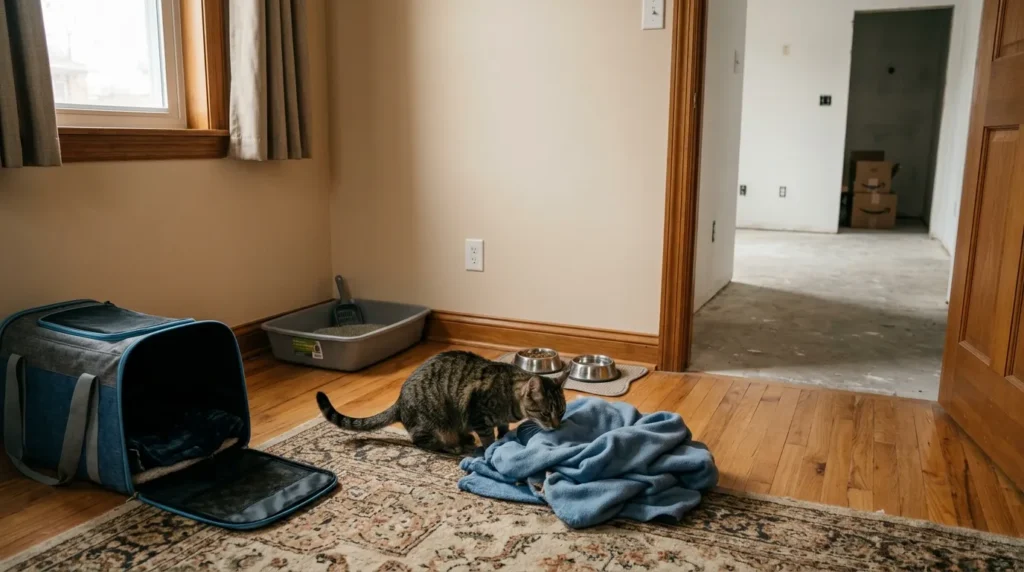
Before the carrier crosses the threshold, walk the safe room and check it for hazards. Get down on your hands and knees, actually, since that’s closer to your cat’s eye level and it reveals gaps behind furniture, exposed cables, and loose window screens you’d otherwise miss standing up. This single check catches most of the accidents that happen in the first week.
Set up the safe room before the cat carrier ever comes through the door. It’s the most important step in the entire move, and it takes about ten minutes done properly. Bring in the scent-soaked bedding, build the litter box with a mix of old and new litter, put the food and water bowls in roughly the same spatial layout they had before, and leave the open carrier in a corner as an extra hiding option.
Safe Room Setup Checklist
- Litter box on one side, food and water on the other, never next to each other
- Scent-soaked bedding and a worn shirt in a quiet corner
- The open carrier, door off, as a hiding spot
- At least one hiding place she can fit into: a covered box, a cat cave, or a towel draped over a chair
- The scratching post she already knows
- A synthetic pheromone diffuser plugged in, if you use one
- A window she can’t push open, with a secure screen
- Toys she’s used to, but not a pile of new ones

Release the cat into the room and close the door. Don’t follow her in right away, and don’t hover by the door either. Let her investigate the familiar smells on her own timeline, and check back every 30 minutes or so. Most cats spend the first day under the bed or inside the carrier, then start moving around more freely by day two. Eating and using the litter box on day one is a good sign. Not eating for the first 12 to 18 hours is normal. Not eating past 24 hours needs gentle intervention, warmed food first, a vet call if that doesn’t work.
A synthetic pheromone diffuser, Feliway is the common brand, plugged in near the safe room can take some edge off in those first few days. It works best next to the scent soakers, not as a replacement for them. Nothing substitutes for your cat’s own established scent.
ASPCA guidance on moving with cats puts the safe room phase anywhere from three days to two weeks, depending on the cat’s baseline confidence and how much actually changed: noise level, neighborhood, household size. Pushing the expansion before she signals readiness, through normal eating, consistent litter use, and interest in the door, sets you back instead of moving you forward. Once she’s settled into that territory, the physical layout around her starts to matter just as much. Our pillar guide to keeping a cat happy in an apartment covers that long-term setup once the adjustment stress is behind you.
What Is Normal in the First 24 Hours?
| Behavior | Normal | Call the vet |
|---|---|---|
| Hiding | Under the bed or in the carrier for most of day one | Still fully hidden and refusing everything after two weeks |
| Eating | Little or nothing for the first 12 to 18 hours | Nothing for 24 hours without improvement from warmed food; same-day call by 36 to 48 hours |
| Litter box | Uses it once or twice, often at night | No urine at all in 24 hours, or straining in the box |
| Sound | More meowing, especially at night | Non-stop crying or panting that doesn’t ease |
| Grooming | Skips it for a day or two | Obsessive licking that leaves bare patches |
Apartment-Specific Safety Checklist Before You Let Her Roam
Apartments carry hazards a house doesn’t, and it’s worth a dedicated pass before expansion begins. Do it on your hands and knees, one room at a time. Our apartment cat-proofing checklist goes room by room if you want the full version.
- Window screens: check every screen is intact and firmly seated, especially above the ground floor. A cat pushing against a loose screen is a real fall risk.
- Balconies: keep the balcony door closed and locked until you’ve cat-proofed it with netting or a secured screen, even for a cat that’s never shown interest in heights before.
- Gaps and vents: check behind the stove, dryer vents, and any open ductwork; cats can wedge into spaces that look impossibly small.
- Appliances: look inside the washer, dryer, and dishwasher before you close them. Cats climb into warm, enclosed spaces.
- Cords and blind pulls: bundle loose cables and tie up looped blind cords. A looped cord is a strangling risk.
- Plants: if you’re bringing houseplants, check each one against a toxic plant list. Lilies are especially dangerous to cats, so keep them out of the apartment entirely.
- Small objects: pick up hair ties, rubber bands, string, and loose thread. Cats swallow them.
- Hallways and elevators: if your building has shared hallways, treat the front door as a two-person job on move-in day, since a single door opening is enough for an escape.
- Cleaning residue: if the previous tenant had pets, a deep clean of carpets and baseboards removes lingering scent markers that can trigger anxious spraying or scratching in a new cat. Avoid strong-smelling floor cleaners in her safe room. Our guide to getting rid of cat smell in an apartment covers what works.
[Image placeholder: a labeled photo or graphic of a cat-proofed apartment corner showing a secured window screen, bundled cords, and a covered balcony door.]
Noise, Neighbors, and Shared Walls
A house gives a cat a handful of sounds. An apartment gives her footsteps overhead, doors in the hallway, elevator chimes, and a neighbor’s television. Most cats adjust within a couple of weeks, but you can speed it up. Run a white noise machine or a low fan in the safe room so sudden sounds register less sharply. Put her bed against an interior wall, not the one shared with the hallway. Give her a vertical perch near a window with a view that’s calm, not directly over a busy street. For more ways to lower background stress, see how to reduce stress in indoor cats.
Vocal cats raise a second issue: night yowling in the first week is common after a move, and thin walls carry it. A heads-up to your closest neighbors that you’ve just moved in with a cat and the first few nights may be loud saves awkward conversations later. If the yowling continues past the first couple of weeks, read why indoor cats meow so much and why cats run around at night.
Expanding the Territory: How and When to Open the Apartment?
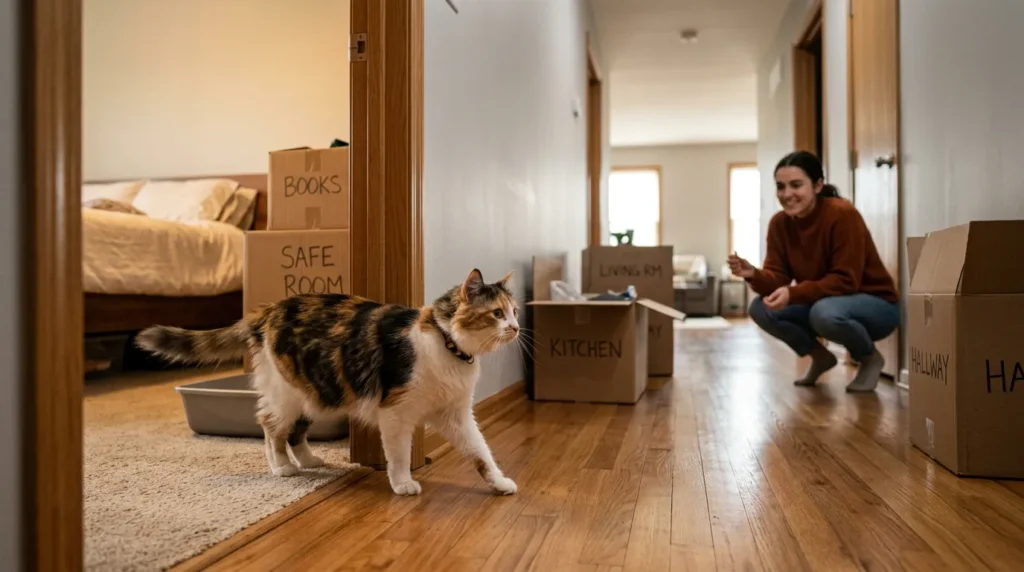
Open the safe room door for the first time only after three consecutive days of normal eating and consistent litter box use inside that room. Don’t pull her out. Leave the door open and let her pick the moment. Most cats study the doorway for an hour or two before taking that first step into the wider apartment, and a treat trail from the door toward a specific spot in the next room speeds that first exploration along.
Add one room at a time, spaced out over several days, rather than throwing open the whole apartment at once. A cat who leaves the safe room straight into a full open floor plan faces a disorienting territorial challenge instead of a manageable next step. One extra room every two or three days gives her time to claim that space’s scent and layout before she takes on more.
Keep her fully indoors for at least two weeks after arrival, even if she had outdoor access before. Route memory doesn’t carry over to a new location, and a cat let outside too soon has no behavioral map to find her way back if she wanders. Two weeks of indoor settling lets the new apartment’s scent anchor as home before she meets the world outside it, balconies and hallway windows included.
The First Two Weeks, Day by Day
Treat this as a rough guide. A confident cat will skip ahead, and an anxious one will take longer, which is fine.
| Days | What you’re doing | What you should see |
|---|---|---|
| Day 1 | Release her into the safe room, check in every 30 minutes without hovering | Hiding, light eating or none, a litter box visit or two |
| Days 2 to 3 | Keep the routine identical to the old apartment: same feeding times, same play session | More movement in the room, steadier eating |
| Days 4 to 6 | Short, calm visits. Sit on the floor, read, ignore her | She comes to sniff you or lets you sit closer |
| Days 5 to 7 | After three days of normal eating and litter use, open the door and let her choose | Short trips to the doorway, then the next room |
| Days 7 to 10 | Add one room every two or three days, with scent soakers placed in each | Longer explorations, retreats to the safe room as home base |
| Days 10 to 14 | Reintroduce play, window perches, and her regular enrichment | Grooming, playing, sleeping in the open |
Moving to a New Apartment with a Cat and Other Pets
If You Have Two Cats
Move them together, in separate carriers, and give them the same safe room if they normally share space. If they usually keep apart, give each a separate room. A cat that gets stressed in a move sometimes redirects that stress at her housemate, so watch for swatting, hissing, or one cat blocking the other from the litter box in the first week. Put out one more litter box than you have cats. Our guide to two cats in a small apartment covers space planning, and feeding multiple cats separately helps if mealtimes get tense. If the tension turns into real fighting, read indoor cat aggression: causes and solutions.
If You Have a Dog
Keep the dog out of the cat’s safe room entirely until she’s venturing out on her own. Introduce them through a baby gate or a cracked door first, so they can smell each other without chasing. Walk the dog before the cat’s first expansion trip so he’s calm.
Signs Your Cat Is Struggling After the Move and What to Do?
Normal post-move adjustment looks like hiding, eating less, and vocalizing more for the first three to seven days. Those resolve as scent familiarity builds. A cat still showing them past two weeks, despite the gradual approach and the scent soakers, is telling you the stress response hasn’t resolved on its own and needs attention.
Watch for two things specifically. First, litter box avoidance in a cat who’d previously been reliable: eliminating outside the box in a new apartment almost always signals territorial anxiety, not a sudden litter preference change. Add a second box in a different room (see where to put a litter box in a small apartment) and stick with familiar litter until it settles. Second, total appetite loss past 36 to 48 hours. Cats who stop eating entirely for more than two days risk hepatic lipidosis, regardless of why the appetite loss started, so this one needs a same-day vet call, not a wait-and-see approach.
Other signals worth a vet call: straining in the litter box or no urine in 24 hours (an emergency, especially in male cats), vomiting or diarrhea that lasts more than a day, and hiding combined with labored breathing. Subtler signs are easy to miss, so how to tell if a cat is in pain is worth a read.
This article is for informational purposes only. Always consult your vet if you have concerns about your cat’s health.
The Mistake That Extends the Adjustment Period by Weeks
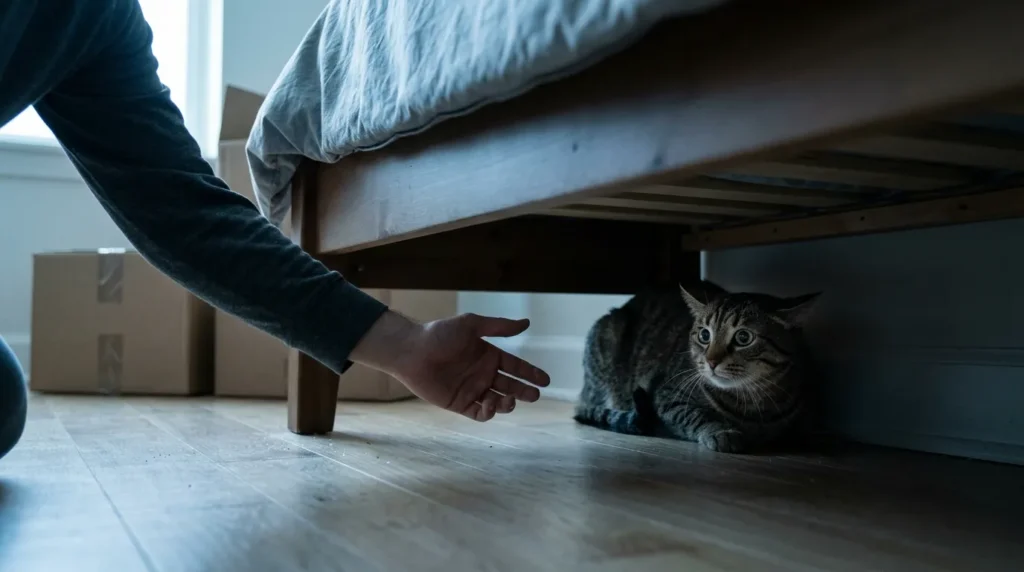
The most common mistake is forcing the cat out of hiding because the owner is the one who’s worried. A cat under the bed in a new apartment isn’t suffering. She’s doing exactly what her instincts call for: staying concealed in a small space while she processes a massive environmental change. Pulling her out doesn’t speed anything up. It resets the stress clock and teaches her that hiding in this apartment doesn’t actually buy her safety.
Leave her wherever she’s hiding. Put food and water within reach of that spot instead of across the room. Sit nearby without direct eye contact or attempts to interact. Cats accept new environments through gradual, voluntary exploration, and forcing any part of that interrupts the whole process. A cat who takes two full weeks to come out on her own terms ends up better off than one who gets pulled out repeatedly and has to restart the decompression clock each time.
Insight: every cat owner I know who had a genuinely bad move made the same call. They panicked around day three, still hiding, and started forcing contact to reassure themselves rather than the cat. Day three hiding is normal. Day ten, eating and playing, is the actual goal. Patience is what connects those two points, and there’s no shortcut through it.
Other Mistakes Worth Avoiding
- Letting her out of the carrier in the open apartment: always open the carrier inside the closed safe room.
- Replacing everything at once: a new bed, new litter, new food, and new toys in the same week strips away every familiar anchor. Change one thing at a time, later.
- Washing her bedding before the move: the smell is the point. Leave it alone.
- Skipping the ID update: a missing address on the microchip makes a recovered cat much harder to return.
- Rushing the vet search: find a clinic near the new place in the first week, before a problem forces you to guess.
[Image placeholder: a calendar-style infographic of the first 14 days, with the safe room phase, first door opening, and one-room-at-a-time expansion marked.]
Frequently Asked Questions
How long does it take for a cat to adjust to a new apartment?
Most cats show real behavioral normalization within one to two weeks when the safe room strategy and scent soakers are used correctly. Confident, outgoing cats often settle in three to five days. Anxious or senior cats can take three to four weeks, and that’s still within normal range. A cat who’s new to your home follows a different timeline; see how long a new cat takes to adjust.
Should I let my cat roam the new apartment right away?
No. Full roaming on day one produces territorial overwhelm, not faster acceptance. A cat meeting unfamiliar smells in every direction at once tends to show it through hiding, litter box avoidance, and appetite loss. The safe room approach shortens the total adjustment time even though it looks slower at the start.
How do I keep my cat calm during the move?
Condition the carrier two weeks ahead, keep her in a quiet closed room while the movers work, and cover the carrier with a light towel in the car. Bring her scent soakers, keep your voice steady, and drive straight to the new place. If she’s very anxious, ask your vet about medication before moving day, not the morning of.
How long should I keep my cat in one room after moving?
Plan on at least three days, and open the door only after three consecutive days of normal eating and litter box use. Many cats need a week. Some need two. Let her behavior set the date, not the calendar.
My cat won’t eat after moving to the new apartment. What should I do?
Offer warmed wet food in the safe room, near her hiding spot rather than at the bowl’s usual position. Appetite loss for 12 to 18 hours is normal after a big territorial disruption. Past 36 hours, call the vet, since extended food refusal risks liver problems in cats regardless of the underlying cause.
My cat is hiding under the bed after the move. Is that normal?
Yes. Hiding is the most common stress response and it usually lasts three to seven days. Leave her there, keep food and water within reach, and sit nearby without eye contact. Call the vet if she’s still hidden and refusing food after two weeks. Our post on why a new cat hides all day covers the same stress response in more detail.
Can a pheromone diffuser help a cat adjust to a new apartment?
It can take the edge off, but it’s a support tool, not a substitute for the basics. Scent soakers, a consistent feeding schedule, and a properly set up safe room do most of the actual work. A diffuser adds a small layer of calm on top.
How do I help my cat feel safe in the new apartment?
Spread familiar-smelling objects through each new room before she accesses it. Worn clothing left in specific spots works as a territorial anchor, since she links your scent to safety rather than threat. Keep the exact same feeding schedule and play schedule from day one.
Should I board my cat during the actual move?
It’s a reasonable option if she’s especially anxious or your building layout makes a closed room risky during loading. Boarding removes the escape risk entirely, at the cost of one extra day of disruption before she meets the new apartment. Either approach works as long as the safe room is ready before she arrives.
How do I stop my cat from escaping during the move itself?
Confine her to one closed room with a sign on the door before movers arrive, and treat every door opening on move-in day as a two-person job. Most escapes happen through a door left open for a few seconds during loading or unloading, not through anything dramatic.
Should I sedate my cat for the move?
For a move under two hours, most cats don’t need it. For long drives, or a cat who panics in the carrier, talk to your vet well ahead of time. Never give human medication, and never try a sedative for the first time on moving day without your vet’s guidance.
What if my cat starts peeing outside the litter box after the move?
Rule out a medical cause first if it continues beyond a few days, especially if she strains or goes often. Otherwise it’s usually territorial stress. Add a second box in a different room, keep the same litter, clean accidents with an enzyme cleaner, and slow down the expansion.
Is it safe to let my cat on the balcony once she’s settled?
Not without netting or a secured screen first, even for a cat with no prior interest in heights. New environments change behavior in ways you can’t predict, and an unsecured balcony is one of the more serious apartment-specific risks in this whole process.
Do older cats and kittens need a different approach?
Senior cats usually need more time and a lower-effort setup: a litter box with a low entry, a bed near a heat source, and a longer safe room phase. Kittens bounce back quicker but get into more trouble, so kitten-proof the apartment thoroughly and supervise every room expansion. If a kitten stops eating, see what to do when a new kitten isn’t eating.
Settling In for the Long Term
This process holds together on three things: carrier conditioning weeks ahead of the move, a safe room ready before the cat ever enters the apartment, and resisting the urge to force any part of it along. Get those three right and you’re looking at a settled cat within one to two weeks in most cases. Once she moves through the whole apartment with confidence, that’s the moment to build out the vertical territory and window enrichment that makes the new place stimulating, not just familiar. The physical layout shapes her behavioral health every day after the move, and what that long-term environment should include for an indoor cat is the natural next read once the adjustment stress is behind you. For the daily structure that keeps her settled well past the move, our indoor cat care pillar guide and indoor cat behavior guide cover routine, enrichment, and the vocal and territorial signals worth knowing once the new normal sets in.

Written by Mishu
A passionate cat lover and indoor living enthusiast, Mishu is the founder and voice behind Indoor Living Cat – a go-to resource for cat owners who want to create the happiest, healthiest life for their feline companions indoors.
View Full Profile