
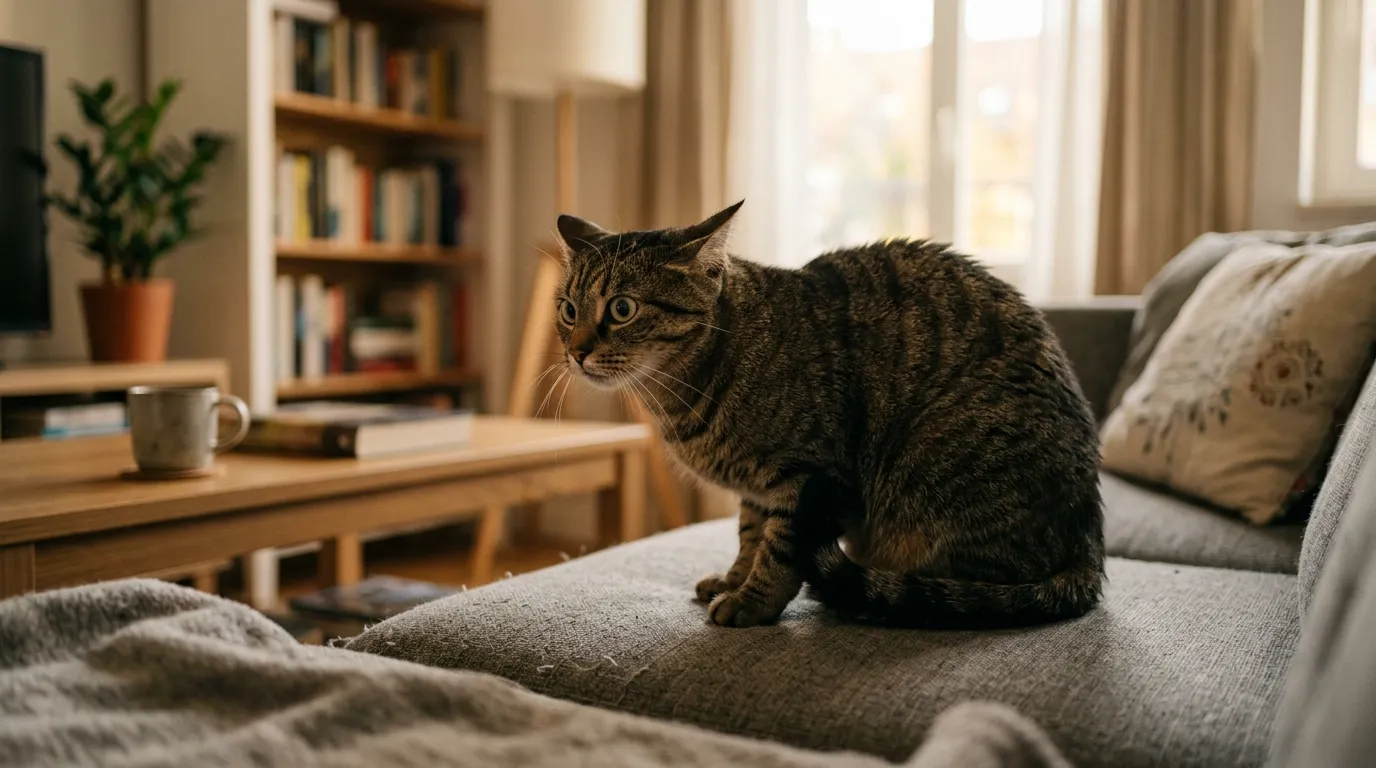
The thing no one warned me about was how fast it happens. My cat went from purring to a full bite in three seconds during what I thought was a calm petting session, and for a week I could not identify what I had done wrong. Understanding indoor cat aggression causes and solutions starts with accepting that aggression in cats is always a communication, never a malfunction. Seven distinct types exist, and each one needs a different response.
This article covers each type on its own, explains the refractory period that most guides skip, and names the one owner response that makes every type worse over time.
Indoor cat aggression causes and solutions depend on which type you’re dealing with: redirected aggression from window triggers, overstimulation during petting, play aggression from unmet prey drive, pain-related defense, territorial conflict in multi-cat homes, fear aggression, and maternal protection. Each type has its own trigger and its own fix. The one thing that makes all seven worse is any physical punishment or high-arousal response from you.
The 7 Types of Indoor Cat Aggression at a Glance
Before the deep dive, here’s the quick-reference version. Each row links down to the full section.
| Type | Common Cause | Fastest Fix |
|---|---|---|
| Redirected | Arousal from a window trigger, aimed at whoever is nearby | Block the view, give full separation for hours |
| Overstimulation | Petting past the cat’s personal threshold | Count strokes, stop before the early warning signs |
| Play aggression | Unmet predatory drive, usually in cats under 3 | Two 15-minute wand toy sessions a day |
| Pain-related | Injury, dental disease, arthritis | Vet exam before any behavior work |
| Territorial | Resource or space competition between cats | More vertical territory, separate resource stations |
| Fear-based | A specific person, object, or handling method | Slow desensitization, never forced contact |
| Maternal | A nursing mother protecting kittens | Distance and minimal handling near the nest |
Redirected aggression is the most misunderstood of the seven because the attack looks completely unprovoked. Your cat sees a stray cat or bird through the window, her adrenaline spikes to hunting levels, and when you approach in that state she redirects the arousal at you. The window was the trigger. You were the available target. Two separate events that happen to land close together in time.
Overstimulation aggression is the second most common type, and it produces bites during what should be a pleasant interaction. Cats have a petting threshold that varies by individual and by day, and when that threshold gets crossed the nervous system flips from pleasant stimulation to aversive overload. The bite that ends the petting session is a boundary communication that arrived because earlier, subtler signals got missed.
Play aggression, pain-related defense, and territorial conflict each follow their own trigger pattern. Play aggression shows up most in young cats who weren’t socialized with littermates past eight weeks, or who don’t get enough daily predatory play. Pain-related defense appears when specific body areas are touched, and it often has no behavioral fix at all because the real problem is medical. Territorial conflict in multi-cat apartments usually comes from too little three-dimensional space, not floor space.
Understanding the behavioral patterns behind your indoor cat’s behavior gives you the diagnostic framework to identify which type you’re dealing with before picking a response. Treating redirected aggression the way you’d treat overstimulation makes both situations worse.
Redirected Aggression: The Type That Looks Most Random
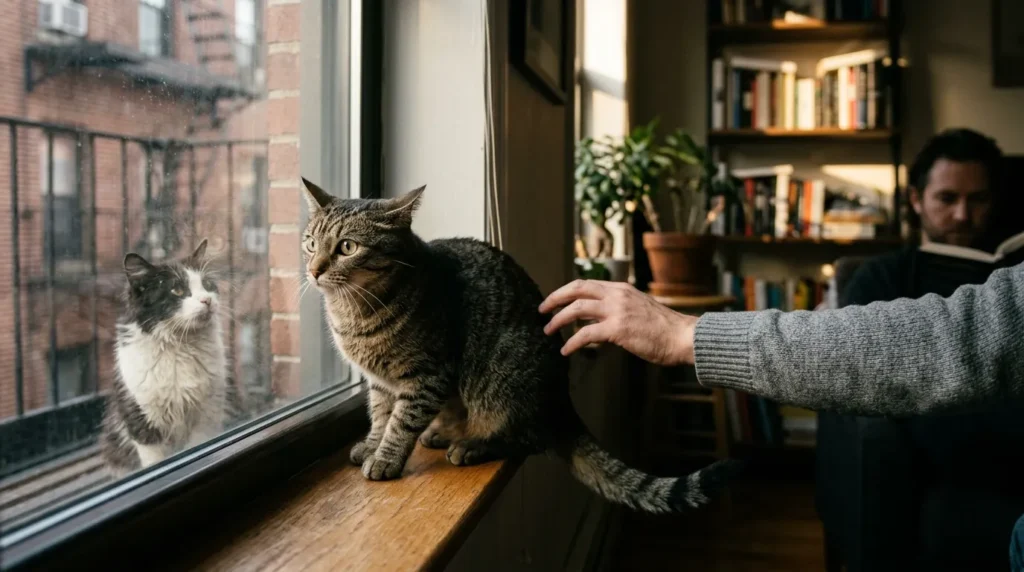
Redirected aggression is aggression aimed at a bystander when the real trigger is out of reach. A cat who’s been watching a stray cat through a window for twenty minutes has adrenaline levels close to a cat mid-hunt. Her nervous system is fully primed for conflict. When you walk past and reach for her in that state, she doesn’t recalibrate and clock you as safe. She registers the contact as an attack, still running on the arousal from before.
The fix has two parts. First, prevention: learn to spot window-triggered arousal, a rigid posture, a low slow-moving tail, dilated pupils, and don’t approach or touch her until the trigger’s been gone for a while. Second, environmental: blocking the specific window view with opaque film, frosted contact paper, or furniture placement removes the trigger without cutting off her natural light.

According to ASPCA guidance on feline aggression management, redirected aggression can stay elevated well after the trigger disappears. Veterinary sources on the subject describe recovery times ranging anywhere from a couple of hours to several days, and occasionally longer, depending on the cat and how intense the trigger was. That stretch of lingering arousal is the refractory period, and it’s the most important concept in indoor cat aggression that most owners never learn about.
The Refractory Period: Why Aggression Outlasts the Trigger
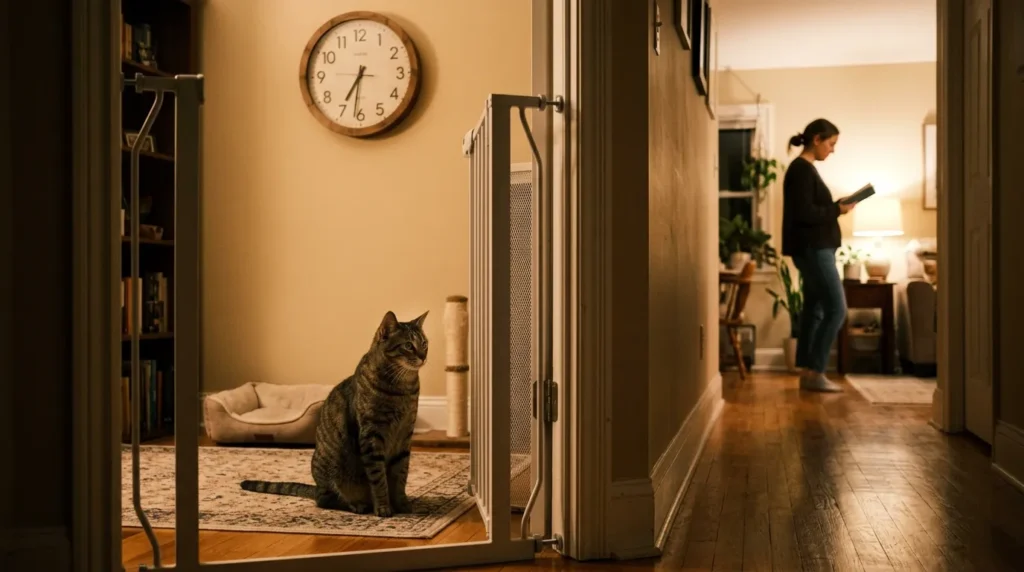
The refractory period is the window of elevated neurological arousal that follows any real aggressive event. During it, the cat’s nervous system stays primed for more aggression even after the original trigger is gone, and even after she looks calm on the outside. This stretch can run anywhere from a couple of hours to several days, occasionally longer in severe cases, and it depends on the individual cat’s temperament, how intense the triggering event was, and whether anything else stirs her up during recovery.
This matters in practice. Owners who get bitten from redirected aggression and then try to calm or reconnect with the cat within the first hour are very likely to get bitten again, because the cat hasn’t recovered yet. The right response is full visual separation, no interaction, for a minimum of two to three hours after any real aggressive episode. Quiet, calm coexistence in separate rooms, no eye contact, no approach, lets the arousal drop on its own.
Providing your indoor cat with vertical territory and safe retreat spaces throughout your apartment matters here too, because a cat with retreat options will often self-isolate the right way. A cat with no elevated retreat spots in a small apartment has nowhere to decompress, and she may stay in your space still worked up, which sets up more incidents.
Overstimulation: Reading the Signals Before Every Bite
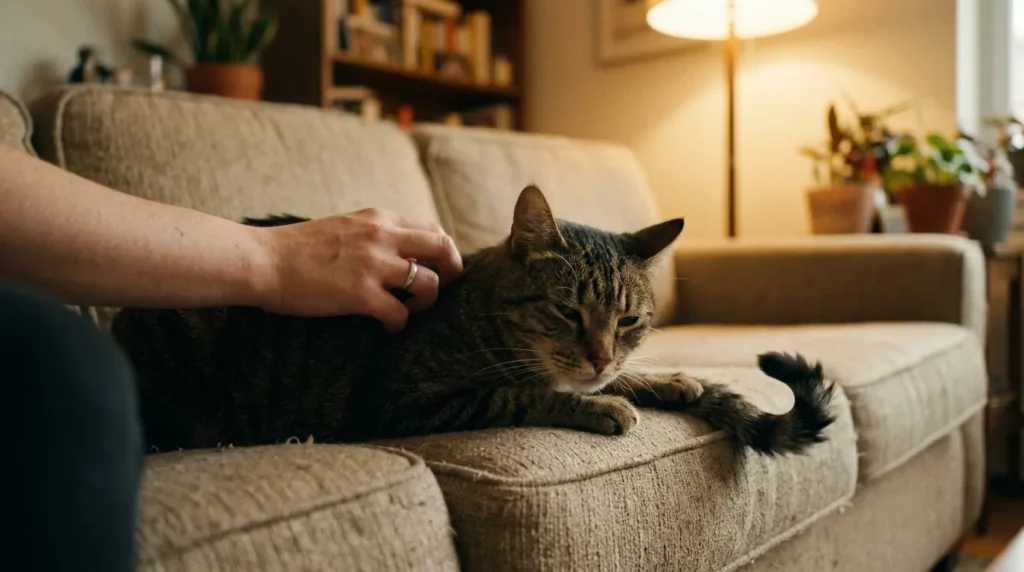
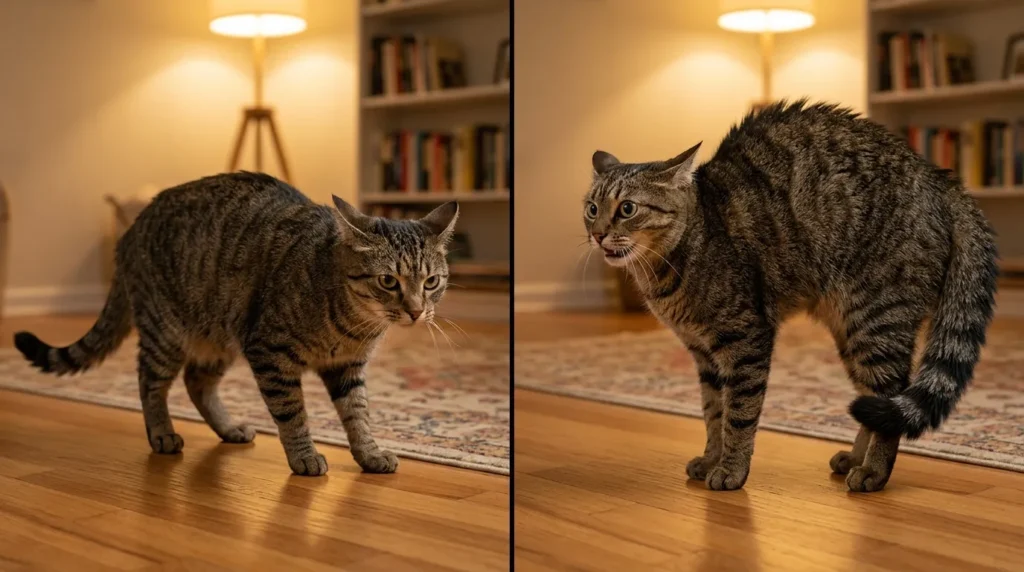
Petting-induced overstimulation produces bites that feel sudden because owners miss the warning sequence that always comes first. The tail starts to twitch or lash. The ears rotate back or flatten a little. The skin along the back may ripple. She shifts her weight, or turns her head toward your hand. These show up in sequence over seconds to minutes, and the bite lands after every one of them got ignored.
| Stage | What You’ll See | What To Do |
|---|---|---|
| Early | Tail tip twitching, ears at half-mast | Slow down, watch closely, keep petting light |
| Mid | Skin ripples along the back, weight shift | Stop petting now, don’t wait for confirmation |
| Late | Head turns toward your hand, ears flatten | Withdraw your hand fully, end the session |
| Missed | Bite or swat | Stay still, withdraw calmly, no punishment |
Learning your specific cat’s petting threshold, instead of applying a general time limit, is the most effective prevention there is. Some cats tolerate long sessions easily. Others hit their limit after thirty seconds of contact in one specific spot. Track where in the interaction the early signals show up and stop before that point. Done consistently, this produces a cat who gradually tolerates longer sessions, because the interaction becomes predictable instead of an unpredictable overload.
Straight Talk: the single most effective thing you can do for overstimulation biting is count your petting strokes. Not metaphorically. Literally count. Most cats have a specific number after which the signals start. My cat’s number was seven strokes on the flank. Knowing that number and stopping at five changed the interaction completely.
Play Aggression: Why Your Ankles Are Being Hunted
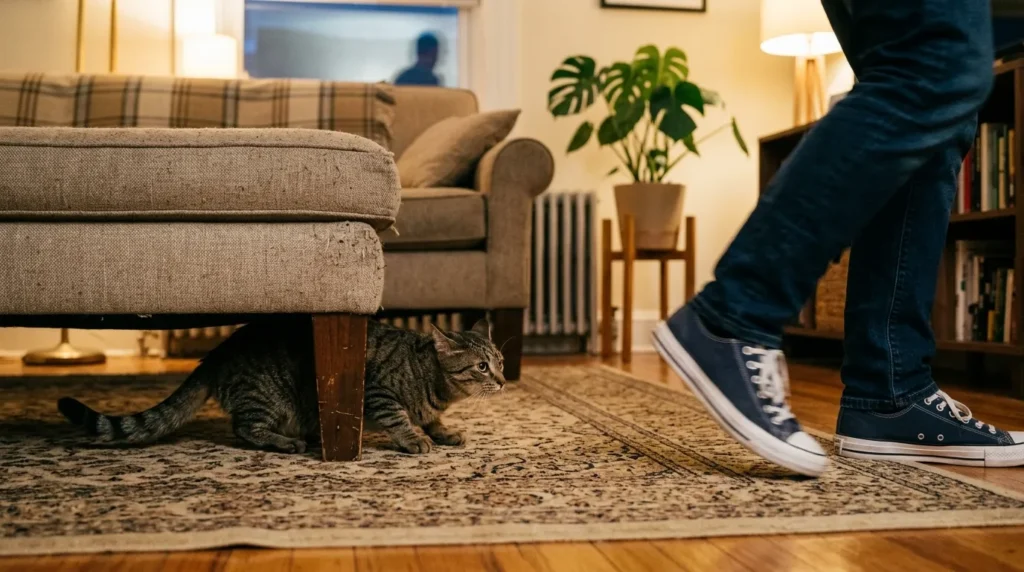
Play aggression targets moving feet, hands, and ankles because they trigger the predatory motion detection system in cats who don’t have enough appropriate prey targets around them. It shows up most in cats under three years old, in single-cat households with no feline sparring partner, and in homes where play sessions are short or irregular. A cat ambushing your ankles daily hasn’t been hunting enough with actual toys.
The fix is systematic: fifteen minutes of wand toy play, twice a day, that takes the cat through the full predatory sequence, stalk, pounce, catch. This isn’t optional play. It’s the biological completion of a drive that will redirect to your feet if it doesn’t have a proper target. After the session, the cat should look tired, panting a little or lying down on her own. That level of output is what actually resets the prey drive.
Enrichment that satisfies your indoor cat’s hunting instincts between active play sessions also takes pressure off and reduces ankle ambushes. Puzzle feeders that require physical work to get at food stretch the predatory engagement past the play session and into meal time. Managing your cat’s feeding schedule so meals follow play sessions copies the hunt-catch-eat sequence that naturally winds down predatory arousal. Keeping a well-managed litter box environment cuts background territorial stress that amplifies play aggression in cats already dealing with resource competition. Managing apartment space thoughtfully, with multiple high-traffic play corridors, gives cats movement outlets that reduce the frustration that escalates play into aggression.
Territorial Aggression in Multi-Cat Apartments
[Image placeholder: two cats posturing near a shared food bowl or litter box in a small apartment]
Territorial aggression shows up as stalking, blocking hallways, staring contests, or outright fights between cats who share a home, and it gets worse in tight apartment layouts where cats can’t avoid each other. The trigger usually isn’t the other cat’s personality. It’s resource geography: one litter box for three cats, one feeding station in a single narrow kitchen, one favorite window perch.
The fix is spatial, not social. Set up separate resource stations, food, water, litter, resting spots, spread across different rooms or different levels so no cat has to pass through another cat’s claimed area to reach basics. The rule of thumb from shelter behavior programs is one litter box per cat plus one extra, placed in different locations rather than lined up side by side. Vertical space matters here too. Cat trees, wall shelves, and window perches at different heights let cats claim separate territory without leaving the room, which cuts the number of forced face-to-face standoffs.
If two cats who got along suddenly start fighting, don’t assume personality changed. Check first whether a redirected aggression episode happened between them, since one attack during peak arousal can flip a peaceful pair into an ongoing conflict.
Fear Aggression: When Your Cat Is Defending, Not Attacking
Fear aggression is defensive, not offensive, and the body language gives it away. A fearful cat crouches low, flattens her ears sideways or back, tucks her tail, and may hiss or swat with claws retracted before things escalate. Compare that to the confident, forward-leaning posture of offensive aggression, and the difference is obvious once you know to look for it.
Common triggers include unfamiliar visitors, a trip to the vet, loud noises, sudden movement toward her, or being cornered with no exit route. The fix is distance and choice. Never force interaction with a fearful cat. Let her approach on her own schedule, keep a clear escape path open at all times, and pair the scary thing with something good, a treat, calm praise, at a distance she can tolerate without reacting. Cornering a fearful cat “to get it over with” almost always produces a bite, because you’ve removed her only other option.
Maternal Aggression: Protecting the Nest
A nursing mother cat guarding her kittens is one of the most predictable forms of feline aggression, and also one of the shortest-lived. She may hiss, swat, or bite anyone, including familiar people and other household pets, who gets too close to the nest in the first few weeks after birth. This is hormonally driven and temporary, not a sign of a newly aggressive cat.
The fix is simple: give her space. Set the nest up somewhere quiet and low-traffic, limit handling of the kittens to brief, necessary checks, and let her control access. Maternal aggression typically eases as the kittens wean and gain independence, usually by six to eight weeks. If it doesn’t ease, or if it’s paired with signs of illness, a vet check is worth it since mastitis and other postpartum complications can also drive defensive behavior.
The Mistake That Makes Every Type of Aggression Worse

The mistake that increases all seven types of indoor cat aggression over time is any high-arousal response from you to the event itself. Yelling, hissing back, spraying water, physically pushing or striking the cat, any punishment she experiences as threatening, all share the same mechanism: they raise her perceived threat level at the exact moment her nervous system is already spiked. The result is escalation, not communication.
Punishment-based responses to aggression produce fear-based aggression as a secondary pattern. A cat who learns that showing aggression gets her a threatening owner response starts showing aggression earlier in the warning sequence. Owners then see cats who “bite with no warning,” when really the cat is adapting rationally to an environment that’s grown more threatening, not getting worse on her own.
The right response to any aggressive episode is immediate stillness, then calm withdrawal without eye contact. That tells her the behavior ended the interaction, without adding a threat signal to a nervous system that’s already in high arousal. Stick with this for two to four weeks and you’ll see a measurable drop in how often it happens, because the behavior stops producing an escalating outcome.
Good indoor cat care practices built around predictable routines and low-stress environments lower the baseline arousal that makes all seven types more likely to trigger in the first place. Monitoring your cat’s health regularly catches pain-based aggression before it turns into a learned pattern. Regular gentle grooming builds physical handling trust that cuts down on defensive aggression during contact that has to happen anyway.
When Indoor Cat Aggression Needs a Vet Visit First
A sudden, dramatic shift in aggression in a previously calm cat over age seven needs a physical exam before any behavior plan. Hyperthyroidism, dental disease, arthritis, neurological conditions, and various chronic pain states all show up as increased aggression before anything else. Behavior modification does nothing for pain-based aggression, and it delays the actual fix.
Book a vet visit, not a behaviorist, if you see:
- Aggression that appears only when a specific body area is touched
- New aggression paired with appetite loss, litter box avoidance, or weight change
- A senior cat showing aggression for the first time in her life
- Aggression that started suddenly with no clear behavioral trigger
- Any bite that breaks skin, which carries real infection risk and needs cleaning regardless of cause
This article is for informational purposes only. Always consult your vet if you have concerns about your cat’s health.
Bite Inhibition and Injury Risk: What Owners Get Wrong
Cat bites carry a higher infection risk than most owners expect, higher than dog bites in some comparisons, because a cat’s narrow teeth puncture deep and seal the wound around bacteria instead of leaving it open to drain. Any bite that breaks skin is worth washing right away with soap and water, and a bite on a hand, wrist, or joint deserves a same-day call to your doctor, not a wait-and-see approach, since infection can set in fast in those areas.
Bite inhibition, how gently or hard a cat controls her bite, is partly learned in kittenhood from play with littermates and partly individual. A kitten taken from her litter too early sometimes never learns to soften her bite during play, which is a separate issue from the seven aggression types above and usually needs its own redirection training with appropriate toys instead of hands.
Quick Checklist: Which Type Am I Dealing With?
- ☑ Happened right after a window or outdoor animal sighting: redirected
- ☑ Happened mid-petting session with warning signs beforehand: overstimulation
- ☑ Targets moving feet or hands, cat under 3: play aggression
- ☑ Only when one specific area is touched: pain-related, see a vet
- ☑ Between cats sharing tight resources: territorial
- ☑ Low crouch, flattened ears, tucked tail, cornered: fear-based
- ☑ Nursing mother near her kittens: maternal, temporary
- ☒ Sudden change in a senior cat with no clear trigger: vet exam first, always
Frequently Asked Questions About Indoor Cat Aggression
Why is my indoor cat suddenly aggressive when she never was before?
Rule out pain first. Sudden aggression changes in previously calm cats are medical until proven otherwise. Once pain and illness are cleared, a sudden change in the environment is the next most likely cause.
Should I punish my cat for biting me?
No. Punishment increases fear and produces more aggression over time, not less. Walk away calmly without eye contact. That response works better than any correction, and it doesn’t create secondary fear-based aggression.
How long does redirected aggression last after the trigger?
It varies by cat, but plan on a couple of hours at minimum and possibly several days for a serious episode. Don’t approach or touch a cat who was just agitated by a window encounter for at least two to three hours, even if she looks calm.
My two cats suddenly started fighting after living together peacefully. Why?
Most sudden multi-cat conflict follows a redirected aggression event, where one cat attacked the other during peak arousal and the social bond between them took the hit. Separate them fully and start a structured reintroduction, beginning with scent swapping through a closed door.
Can a male indoor cat become aggressive after being neutered?
Neutering cuts testosterone-driven territorial and inter-male aggression a lot in most cats within two to four weeks. It doesn’t touch redirected aggression, pain-based aggression, or learned behavioral aggression, since none of those are hormonally driven.
Is aggression more common in certain cat breeds?
Individual temperament and early socialization explain far more of the variation than breed does. Some breeds get a reputation for being more vocal or reactive, but the seven trigger types above apply across every breed, and the fix is the same regardless of pedigree.
How do I introduce a new cat without triggering territorial aggression?
Go slow. Keep the new cat in a separate room with her own food, water, and litter for the first week or more, swap scented bedding between the cats before any visual contact, and only allow supervised, short visual introductions once both cats are calm around the scent swap. Rushing this step is the most common cause of territorial fights that never fully resolve.
Can stress alone cause a cat to become aggressive?
Yes. A stressed cat has a lower threshold for every other trigger on this list, so the same window sighting or petting session that she’d normally shrug off can push her into aggression when she’s already stressed from something unrelated, like a recent move or a new pet.
Indoor cat aggression breaks down into seven types: redirected aggression from inaccessible triggers, overstimulation during petting, play aggression from unmet predatory drive, pain-related defense, territorial conflict in multi-cat apartments, fear aggression, and maternal protection. Each type needs its own response. The refractory period following an aggressive episode can run from a couple of hours to several days, during which the cat stays primed for more aggression. Punishment-based responses make all seven types worse over time. Sudden aggression changes in cats over age seven need a vet exam before any behavior work, and any bite that breaks skin should be washed immediately given the infection risk.
Aggression is one piece of the larger picture covered in our indoor cat behavior guide, and it sits alongside broader indoor cat care practices that lower baseline stress for every cat, not just aggressive ones. For the specific pieces that support the fixes above, see our guides on enrichment, apartment living, health monitoring, and litter box setup.

Written by Mishu
A passionate cat lover and indoor living enthusiast, Mishu is the founder and voice behind Indoor Living Cat – a go-to resource for cat owners who want to create the happiest, healthiest life for their feline companions indoors.
View Full Profile