
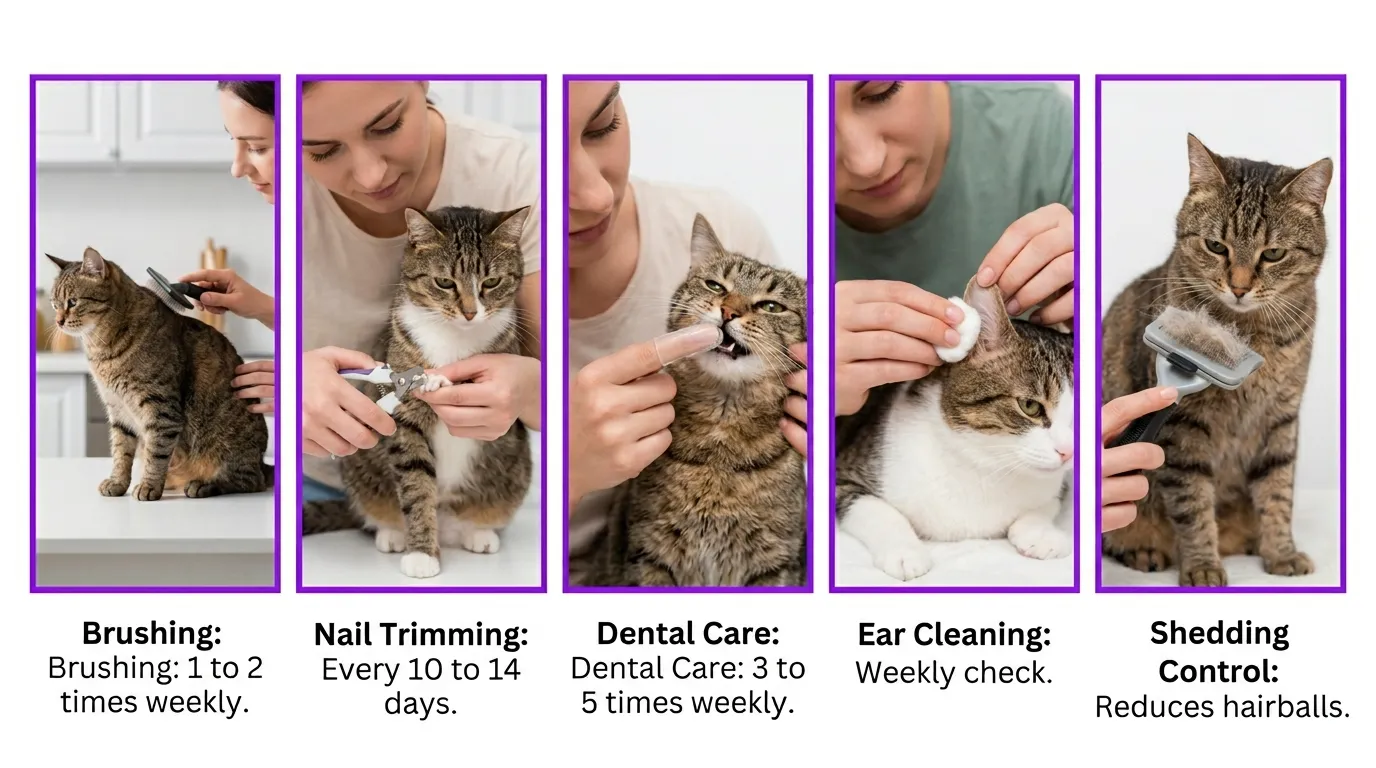
Knowing how to groom an indoor cat at home is one of the most practical skills you can develop as a cat owner and it takes less time than most people expect. Whether you’re grooming a cat at home for the first time or trying to fix a routine that isn’t working, the basics come down to four habits done on a schedule.
Indoor cat grooming is the practice of regularly brushing the coat, trimming the nails, cleaning the ears and maintaining dental hygiene to keep a cat healthy, reduce shedding and catch early signs of skin or health problems. According to the ASPCA, regular grooming reduces hairball frequency, prevents painful matting in long-haired cats and gives owners a consistent opportunity to check for lumps, parasites and coat changes that may indicate health issues.
My own cat never tolerated nail trimming until I switched to doing one paw per session immediately after a long play session when she was genuinely tired. The same cat that would squirm and bite during full nail trims sat completely still when I limited each session to four nails and followed every clip with a treat.
This guide covers every aspect of how to groom an indoor cat at home: brushing frequency by coat type, nail trimming technique, dental and ear care, managing shedding and dandruff, bathing when necessary, the tools you actually need and how to handle cats that resist grooming. Every section connects to a deeper resource for the specific topic you need most right now.
To groom an indoor cat at home: brush short-haired cats once or twice weekly and long-haired cats daily, trim nails every 10 to 14 days, brush teeth three to five times weekly with cat-safe enzymatic toothpaste, clean ears weekly and check for wax or debris. Keep all sessions short: five to ten minutes maximum. Always end with a treat. Never force grooming on a stressed cat.
Indoor Cat Grooming Schedule at a Glance
Before you get into the how, here’s the how often. This table is the one page you can bookmark and check when you can’t remember when you last did something.
| Grooming Task | Short-Haired Cats | Long-Haired Cats | Session Length |
|---|---|---|---|
| Brushing | 1 to 2 times per week | Daily | 5 to 10 minutes |
| Nail trimming | Every 10 to 14 days | Every 10 to 14 days | 2 to 5 minutes |
| Teeth brushing | 3 to 5 times per week | 3 to 5 times per week | 1 to 2 minutes |
| Ear check | Weekly visual check | Weekly visual check | Under 1 minute |
| Deshedding tool | Twice weekly | Twice weekly | 5 to 10 minutes |
| Bathing | Only when needed | Only when needed | 10 to 15 minutes |
Why Grooming an Indoor Cat at Home Actually Matters?
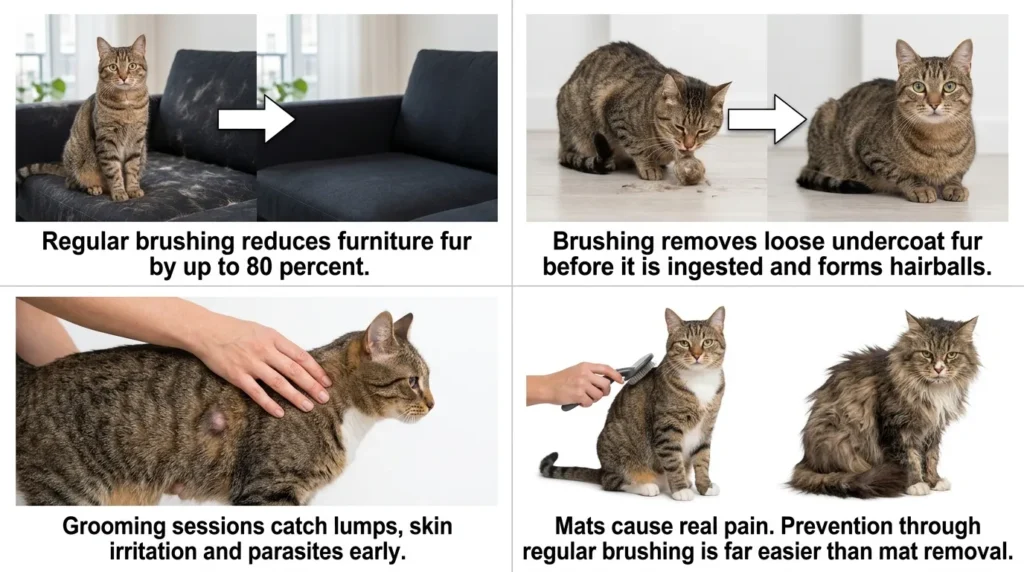
Grooming an indoor cat at home is not just about appearance. It is a health practice that produces measurable benefits for both the cat and the household. Indoor cats shed year-round in climate-controlled environments because they lack the seasonal daylight cues that regulate outdoor cat shedding cycles.
The four reasons regular grooming matters specifically for indoor cats:
- Hairball prevention: loose undercoat fur that is not removed by brushing gets swallowed during self-grooming and forms hairballs. Daily brushing of long-haired cats and twice-weekly brushing of short-haired cats reduces hairball frequency significantly.
- Mat prevention: mats form in low-activity areas including the armpits, groin, behind the ears and at the base of the tail. Mats pull the skin painfully and can trap moisture that leads to skin infections.
- Early health detection: grooming sessions are when owners notice lumps, skin changes, ear debris, dental odor and coat quality shifts that indicate underlying health issues.
- Bonding: a calm regular grooming routine builds trust and makes veterinary handling significantly less stressful for cats that are habituated to being touched all over.
| Owner’s Tip
The grooming session is the most reliable full-body health check you can do between vet visits. I run my hands along my cat’s spine, ribs and armpits every time I brush her. I have found two small skin masses at stages early enough that the vet called them non-concerning. Without the regular contact of grooming I would not have found either one until they were larger. The brush is the diagnostic tool. The health check happens because you are already there. |
How to Groom an Indoor Cat at Home? Brushing Step by Step
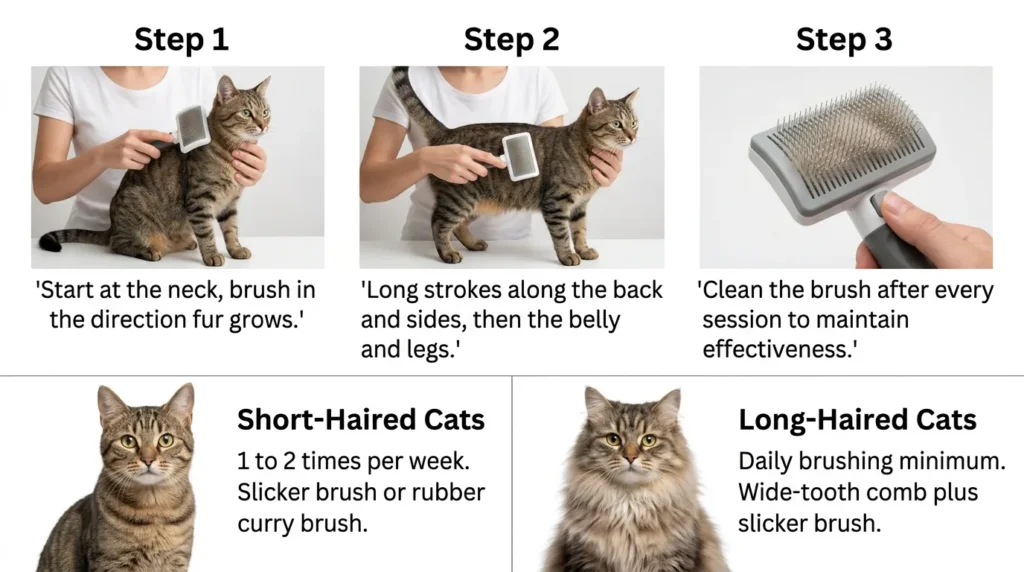
Brushing is the foundation of how to groom an indoor cat at home and the step that makes every other grooming task easier. A cat that is comfortable being brushed is a cat that is comfortable being touched, which makes nail trimming, dental care and vet handling significantly less stressful.
The correct brushing technique for most cats:
- Start at the neck and work toward the tail, always brushing in the direction the fur grows.
- Use long slow strokes. Fast scrubbing movements overstimulate cats and end sessions prematurely.
- Include the belly and armpits, where mats most commonly form, but approach these areas gently and only when the cat is relaxed.
- Check behind the ears and at the base of the tail as you go. These are the highest-mat-risk areas on most cats.
- Keep the total session to five to ten minutes. Stop before the cat shows any overstimulation signs: tail flicking, flattened ears or skin rippling.
Knowing how often to brush indoor cat depends entirely on coat length. Short-haired cats need brushing once or twice per week to manage shedding and distribute skin oils. Long-haired cats need daily brushing to prevent the mats that form within 48 to 72 hours of missed sessions in high-friction areas.
What You Need: A Basic Indoor Cat Grooming Kit

You don’t need a professional setup to groom a cat at home well. Most of what works can fit in a small drawer. Here’s the short list that covers every task above:
- Slicker brush or bristle brush — for everyday brushing on most coat types.
- Deshedding tool — pulls loose undercoat that a regular brush leaves behind, best used once or twice a week.
- Grooming glove — the easiest starting tool for a cat that resists brushes.
- Scissor-style or guillotine cat nail clippers — never human clippers, which crush rather than cut.
- Nail grinder — optional, useful for cats that flinch at the clipping sound.
- Styptic powder or cornstarch — for the rare nail trim that nicks the quick.
- Finger toothbrush and enzymatic cat toothpaste — never human toothpaste, which is toxic to cats.
- Dry cotton balls — for wiping the outer ear when needed. Nothing goes into the ear canal.
- Cat-safe shampoo — only needed if bathing becomes necessary.
- A dedicated treat — used only during grooming, so your cat starts to connect the tools with something good.
This is the full basic kit and it’s genuinely enough for the entire routine below. You don’t need a lion cut clipper set or a grooming table unless you’re dealing with a heavily matted long-haired cat, which is covered in the professional grooming section further down.
How to Trim Cat Nails at Home? The Safe Technique for Indoor Cats
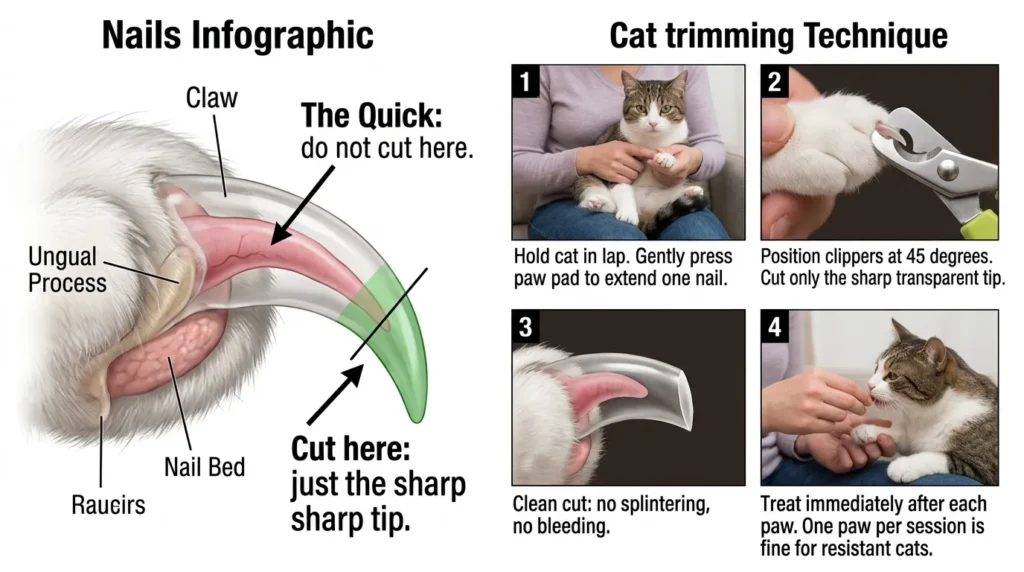 Nail trimming is the grooming task indoor cat owners dread most and the one they need most often. Indoor cats do not wear their nails down naturally the way outdoor cats do on rough surfaces. Without regular trimming, indoor cat nails grow into a curve that eventually catches on fabric, carpet and skin, causing injury and pain.
The trimming schedule for indoor cats is every 10 to 14 days. This is more frequent than most owners realize. If you wait until the nails are visibly curved and hooking on things, you are already behind schedule.
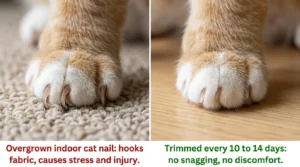 The most important safety rule in nail trimming is understanding the quick. The quick is the pink blood vessel visible inside the nail. Cutting into it causes pain and bleeding. Only cut the sharp transparent curved tip of the nail, staying at least 2 millimeters from where the pink starts.
For cats that resist nail trimming, the one-paw-per-session approach works reliably. Trim four to five nails, give a treat and stop. The cat does not associate the experience with prolonged restraint and tolerates it more readily next time. Within a few weeks most cats accept full sessions if started this way.
The right tools for indoor cat nail trimming:
- Scissor-style or guillotine nail clippers designed specifically for cats. Human nail clippers crush the nail rather than cutting cleanly.
- A nail grinder is an alternative for cats that flinch at the clipping sound. It files the nail gradually rather than snapping through it.
- High-value treats kept exclusively for nail trimming sessions. The association between the tool and the treat changes the cat’s response within two to three weeks.
If you nick the quick: apply styptic powder or plain cornstarch to the tip and hold gentle pressure with a dry cloth for 30 to 60 seconds. Most bleeding stops within a minute. Skip trimming any more nails that session. Your cat needs a calm recovery, not a second attempt.
Dental Care and Ear Cleaning for Indoor Cats: What Most Owners Skip?
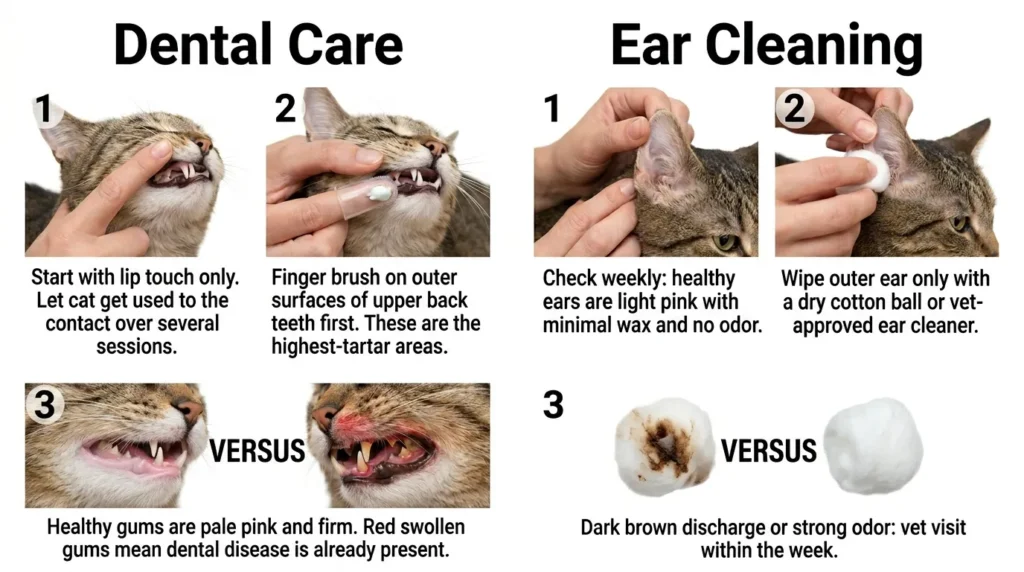
Dental disease affects approximately 70 percent of cats by age three according to the American Veterinary Dental Society. Knowing how to brush cat teeth at home is one of the highest-impact grooming skills for long-term cat health and one of the most consistently skipped ones.
Daily brushing with cat-safe enzymatic toothpaste is the gold standard. Three to five times per week is the practical minimum that produces measurable tartar reduction. Human toothpaste is toxic to cats. Only use enzymatic toothpaste specifically formulated for cats, available at any pet store.
The desensitization sequence for cats that resist dental brushing:
- Week 1: touch the cat’s lips daily without attempting to open the mouth. Treat after every touch.
- Week 2: gently lift the lip and touch the outer tooth surface with your finger. Treat immediately.
- Week 3: introduce the finger brush with a tiny amount of cat toothpaste. Touch one or two teeth. Treat.
- Week 4 onward: gradually increase the number of teeth covered per session as the cat’s tolerance builds.
Knowing how to clean cat ears at home is simpler than most owners expect. Healthy cat ears need very little intervention. A weekly visual check is the right baseline. If the ears look clean and smell neutral, do nothing. If there is visible dark brown wax buildup or any odor, wipe the outer ear canal opening gently with a dry cotton ball. Never insert anything into the ear canal itself.
Managing Indoor Cat Shedding and Dandruff at Home

Knowing why is my indoor cat shedding so much starts with understanding that indoor cats shed year-round rather than seasonally. Outdoor cats respond to natural daylight changes by growing a winter coat and shedding it in spring. Indoor cats in climate-controlled environments have no such signal and maintain a perpetual moderate shedding cycle throughout the year.
The practical approach to how to reduce cat shedding in house focuses on removing loose fur from the coat before it reaches furniture and floors. A deshedding tool used twice weekly removes significantly more loose undercoat than a standard brush and produces a visible reduction in household fur within one to two weeks of consistent use.
Why Does My Cat Have Dandruff?
Small white flakes in the coat almost always mean one thing first: dry skin. Cats living in centrally heated apartments spend the winter in low-humidity air, and that dries out the skin the same way it dries out yours. This is the cat dandruff question most owners are actually asking, and it’s the easiest version to fix.
The most common causes, roughly in order of likelihood:
- Low indoor humidity — the leading cause in heated apartments during fall and winter.
- Insufficient hydration — cats on an all-dry-food diet take in less water overall than cats getting wet food.
- Infrequent brushing — dead skin cells and loose fur build up instead of being removed.
- Obesity — an overweight cat may not be able to reach and groom parts of its own back and hindquarters.
- Allergies or parasites — less common, but the cause if flaking comes with scratching, redness or hair loss.
The most effective fixes for dry-skin dandruff are adding an omega-3 supplement to the diet, increasing wet food in meals for better hydration and running a humidifier in the main living space during winter months. Most cases improve within four to six weeks of consistent changes.
Knowing how to get rid of cat dandruff also requires ruling out underlying causes. Dandruff accompanied by excessive scratching, hair loss or skin redness is not dry skin. It is a vet visit. Dandruff alone without scratching in a well-hydrated cat is almost always diet and humidity related.
Grooming by Life Stage: Kittens, Adults and Senior Cats
Grooming needs don’t stay the same for the life of the cat. A six-month-old kitten, a four-year-old adult and a fourteen-year-old senior need different handling even though the tools stay the same.
| Life Stage | What Changes | Practical Adjustment |
|---|---|---|
| Kittens (under 1 year) | Still forming associations with handling. Nails are thin and grow fast. | Start short, positive sessions as early as 8 to 10 weeks. Check nails weekly since they grow faster than an adult cat’s. |
| Adults (1 to 10 years) | Established coat and behavior patterns. Most resistant cats fall in this range because habits are already set. | Follow the standard schedule above. Use desensitization if grooming was never introduced early. |
| Seniors (10+ years) | Reduced flexibility makes self-grooming harder, especially reaching the back and hindquarters. Joint pain can make handling more sensitive. | Increase brushing frequency to cover spots the cat can no longer reach. Handle joints gently and watch for grooming-related pain, which can signal arthritis. |
A senior cat that suddenly stops self-grooming in certain spots, or that develops mats along the lower back and hindquarters for the first time, is usually telling you it can no longer reach that far. That’s a mobility signal worth mentioning to your vet, not just a grooming gap to fill.
How to Groom a Cat That Hates Being Touched?
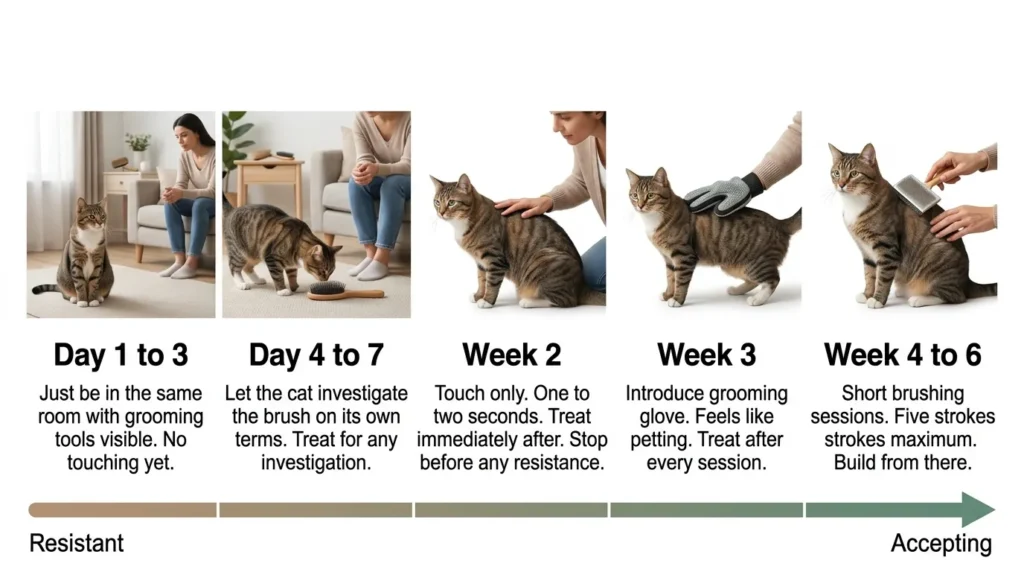
A cat that hates being touched for grooming is not a permanently difficult cat. It is a cat that has not been desensitized to handling and needs a gradual approach rather than a faster one. Forcing grooming on a resistant cat creates lasting negative associations that make every future session harder.
Knowing how to groom cat that hates being touched requires slowing down further than feels necessary. Most owners move too fast through the desensitization process. The goal for the first several sessions is not to groom the cat. The goal is to associate grooming tools and touch with something positive.
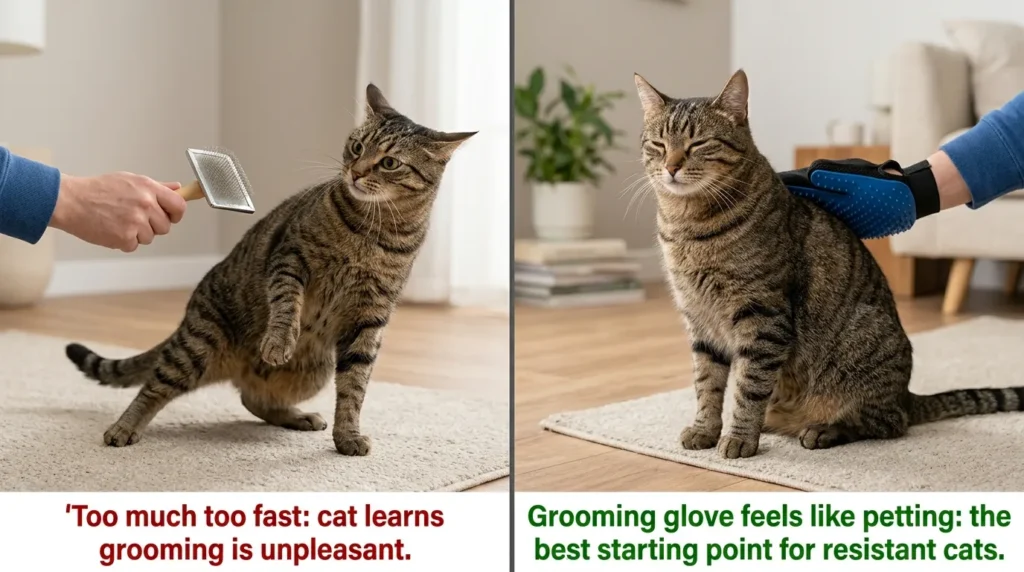
The grooming glove is the most effective starting tool for cats that resist brushes. It feels identical to being petted, which most cats accept even when they will not accept a brush near their coat. Once a cat is comfortable with the glove touching its fur in all areas, transitioning to a bristle brush is straightforward because the physical contact has already been normalized.
The five rules that make grooming sessions work for resistant cats:
- Keep the session shorter than the cat’s tolerance limit. Stop before any resistance signal appears.
- Always end on a positive moment: one successful stroke, a treat, then stop. Never end on a struggle.
- Groom immediately after active play when the cat is tired and relaxed rather than trying to groom a wide-awake cat mid-afternoon.
- Never restrain the cat physically. If the cat can leave, it will eventually stay because it is choosing to, which is the entire goal.
- Use a different high-value treat only during grooming sessions. The treat becomes a grooming-specific reward the cat anticipates.
| Owner’s Tip
The resistant cat I groomed most successfully was one that refused to be touched at all for the first three weeks. I sat on the floor near her every evening without trying to touch her. I let her sniff my hands and the brush. On day 22 she sat down beside me during one of these sessions and pressed her head against my hand. That was the beginning of her becoming a cat that actively headbutts the brush when she sees it come out. Patience is not just a technique here. It is the whole method. |
How to Bathe a Cat That Hates Water: When and How to Do It
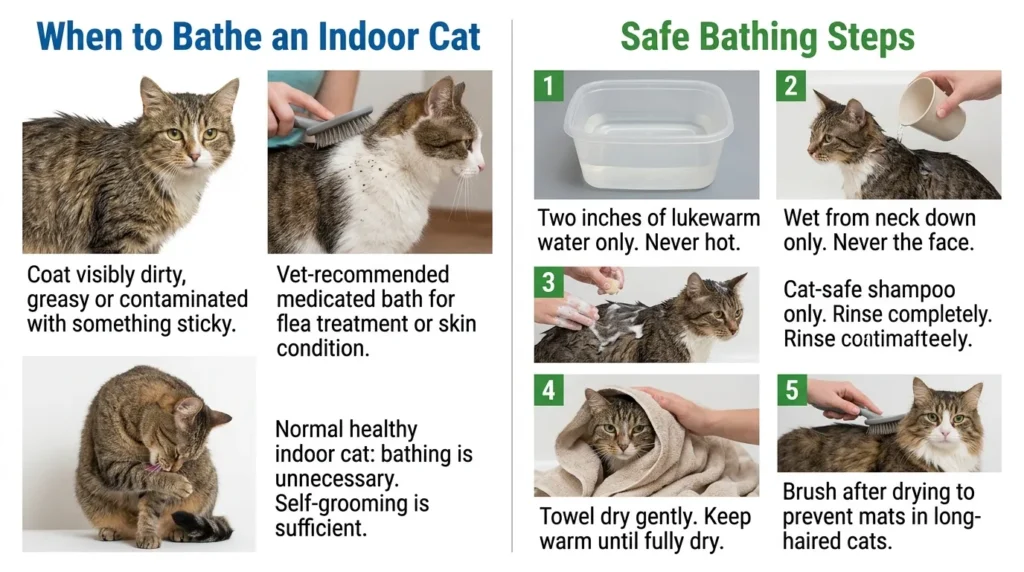
Most healthy indoor cats never need a bath. Cats are among the most effective self-groomers in the animal kingdom and their saliva contains compounds that clean and condition the coat. Bathing is not a routine grooming task. It is an occasional intervention for specific situations.
Knowing how to bathe a cat that hates water matters when it actually becomes necessary: a coat contaminated with something the cat should not ingest during self-grooming, a medicated bath recommended by a vet for a skin condition or a cat that is elderly or obese and can no longer reach parts of its own coat.
The safe bathing protocol for indoor cats:
- Fill a basin or sink with two inches of lukewarm water. Never hot. Never cold.
- Wet the coat from the neck down using a cup, not a shower head. The sound and pressure of a spray head causes immediate panic in most cats.
- Apply a small amount of cat-safe shampoo and lather in the direction fur grows. Never use human shampoo. The pH is wrong for cat skin.
- Rinse thoroughly until the water runs completely clear. Shampoo residue irritates the skin.
- Wrap in a large dry towel and gently press rather than rub. Keep the cat warm in a draft-free room until fully dry.
- Brush long-haired cats after drying to prevent mat formation in the damp coat.
Everything We Cover on Indoor Cat Grooming at Home: Your Full Resource Library
Each article below covers one specific grooming topic in full detail. Find the one that matches your most immediate situation and start there.
How Often to Brush an Indoor Cat
Brushing frequency is the grooming variable that most indoor cat owners get wrong, usually by doing it too rarely for their cat’s coat type. This article provides the exact weekly schedule by coat length and season, explains which brush types work best for each coat category and covers the signs that tell you your current brushing schedule is insufficient.
Get the complete frequency guide in our article on how often to brush indoor cat.
How to Trim Cat Nails at Home Without Stress
Nail trimming is the grooming task with the highest error rate among new cat owners and the most consistent source of cat-owner conflict during grooming. This article provides the exact anatomical knowledge you need to trim safely, the step-by-step session structure for both cooperative and resistant cats and what to do immediately if you accidentally cut the quick.
Master the technique with our complete guide on how to trim cat nails at home.
How to Bathe a Cat That Hates Water
Most indoor cats never need a bath but when they do the situation is stressful for both owner and cat without the right technique. This article covers the specific situations that genuinely require bathing, the preparation steps that make the process calmer, the exact water temperature and product choices and how to towel dry a cat without creating a traumatic experience.
Get the full safe method in our guide on how to bathe a cat that hates water.
Why Is My Indoor Cat Shedding So Much?
Year-round shedding in indoor cats surprises most new owners who expected seasonal shedding patterns similar to outdoor cats. This article explains the specific biology behind why indoor cats shed differently, the dietary and environmental factors that increase shedding beyond normal levels and when increased shedding is a sign of a health condition rather than a grooming issue.
Find the cause in our article on why is my indoor cat shedding so much.
How to Reduce Cat Shedding in Your House
Reducing shedding in a small apartment requires a combination of approaches working together: regular deshedding brushing, dietary omega-3 supplementation, humidity management and the right cleaning tools for furniture and floors. This article provides a complete shedding reduction plan with specific product recommendations and realistic timelines for visible improvement.
Build your shedding reduction system with our guide on how to reduce cat shedding in house.
How to Clean Cat Ears at Home
Ear cleaning is the grooming task most owners either skip entirely or do incorrectly by inserting things too far into the ear canal. This article covers what a healthy ear looks like versus an ear that needs veterinary attention, the correct cleaning technique for the outer ear and the specific signs that indicate ear mites, infection or polyps requiring professional diagnosis.
Learn the safe approach in our guide on how to clean cat ears at home.
Do Indoor Cats Need Professional Grooming?
Most indoor cats manage well with home grooming but there are specific situations where a professional groomer or vet groomer is the right call. This article identifies those situations clearly: mats too severe to safely remove at home, cats too resistant for owner grooming, long-haired cats requiring lion cuts and elderly cats with reduced self-grooming ability.
Find out when professional help is needed in our article on do indoor cats need professional grooming.
How to Get Rid of Cat Dandruff
Cat dandruff is more common in apartment cats than most owners realize and it has specific causes that differ from human dandruff. This article identifies the three most common causes in indoor cats, distinguishes dry skin dandruff from allergic and parasitic causes and provides the dietary and environmental changes that resolve most cases within four to six weeks.
Solve the problem with our complete guide on how to get rid of cat dandruff.
How to Brush Your Cat’s Teeth at Home
Dental brushing is the grooming task with the highest long-term health impact and the steepest learning curve for both cat and owner. This article provides the complete four-week desensitization plan that takes a cat from refusing to open its mouth to tolerating a full brushing session, with specific product recommendations and technique details for each stage.
Start the dental brushing habit with our guide on how to brush cat teeth at home.
How to Groom a Cat That Hates Being Touched
A cat that resists all physical contact requires a specific patience-based approach that most grooming articles do not take the time to cover in enough detail. This article provides a six-week desensitization plan built around trust-building rather than restraint, with specific behavioral markers that tell you when the cat is ready to progress to the next stage.
Learn the trust-first approach in our guide on how to groom cat that hates being touched.
| Owner’s Tip
Every article in the resource library above is written for apartment and small-home cat owners who need practical techniques that work in a compact space without professional equipment. IndoorLivingCat.com covers the full grooming topic specifically for real indoor cat ownership situations. The pattern I see in every successful cat grooming routine is the same: short sessions, consistent timing, high-value treats and stopping before the cat asks to stop. The owners who try to complete a full grooming session in one sitting with an unwilling cat are the ones who end up with cats that hide when the brush comes out. The owners who do four nails today and three tomorrow have cats that sit still for full sessions by month two. |
The Most Common Indoor Cat Grooming Mistakes
The most common indoor cat grooming mistake is trying to complete too much in a single session. Attempting a full nail trim, brushing and ear check all at once overwhelms the majority of cats and creates a lasting negative association with grooming tools and handling. Short focused sessions always produce better results than comprehensive ones that exhaust the cat’s tolerance.
The second most common mistake is waiting until a problem is visible before starting a grooming routine. Mats that have already formed in long fur require painful removal. Nails that have grown into a curve cause real discomfort when they snag. Tartar that has built up over years requires professional dental cleaning under anesthesia. Starting the routine before problems appear is dramatically easier than fixing the problems after they occur.
The third mistake is using human grooming products on cats. Human shampoo, human toothpaste and human nail clippers are all wrong for cats for different reasons. Cat skin has a different pH than human skin. Human toothpaste contains xylitol and fluoride which are toxic to cats. Human nail clippers crush cat nails rather than cutting them cleanly, causing splitting that makes the next trimming session more difficult.
Frequently Asked Questions About Grooming an Indoor Cat at Home
How do I groom my cat at home if I’ve never done it before?
Start with brushing, not nails or teeth. Pick a grooming glove or a soft brush, keep the first sessions to a minute or two, and end every single one with a treat before your cat wants to leave. Once brushing is a normal part of the week, layer in nail trims, then dental care. Trying to build the whole routine in one week is the most common reason it falls apart.
How do I get my cat used to being brushed if it hates it?
Start with a grooming glove rather than a brush. The glove feels identical to being petted and most cats that reject brushes accept gloves immediately. Once your cat is comfortable with the glove touching every part of its body including the belly and legs, introduce a soft bristle brush for one or two strokes with a treat immediately after. Build from there one or two strokes per session until the cat accepts longer sessions. The process takes two to six weeks depending on the cat’s starting comfort level.
How often do indoor cats actually need their nails trimmed?
Every 10 to 14 days for most adult indoor cats. This is more frequent than most owners expect. Indoor cats do not wear their nails down on rough outdoor surfaces so nails grow continuously into a curve that eventually causes snagging and discomfort. If you can hear the nails clicking on hard floors or find them catching on fabric regularly, your cat is already overdue. Set a calendar reminder every two weeks and make it part of the regular routine rather than a reactive task.
Do I really need to brush my indoor cat’s teeth?
Yes, ideally three to five times per week. Dental disease affects 70 percent of cats by age three and causes chronic pain that cats cannot verbalize. Daily brushing with cat-safe enzymatic toothpaste is the most effective prevention available at home. If your cat will not accept brushing yet, VOHC-approved dental treats and water additives provide some benefit as a supplement but are not a replacement for brushing. Start the desensitization process early and build gradually. Consult your vet about your cat’s specific dental status.
Why does my cat have dandruff?
In most cases, dry skin from low indoor humidity, especially during heating season. Insufficient water intake and infrequent brushing make it worse. An omega-3 supplement, more wet food and a humidifier resolve most cases within four to six weeks. If the flaking comes with scratching, redness or hair loss, that’s a different problem and it’s worth a vet visit rather than a home fix.
What should I do if I cut my cat’s nail too short and it bleeds?
Apply styptic powder or cornstarch directly to the nail tip and hold gentle pressure with a dry cloth for 30 to 60 seconds. The bleeding stops quickly in most cases. Keep the cat calm and off dirty surfaces for 15 minutes. Do not attempt to trim more nails in the same session. The cat will have associated the experience with discomfort and needs a positive recovery period before the next session. Cutting the quick once does not cause lasting damage but it does require rebuilding trust before the next nail trim.
How much does professional cat grooming cost compared to doing it at home?
Professional cat grooming typically runs higher than a single at-home session’s cost in tools, since you’re paying per visit rather than for a brush and clippers that last years. The at-home kit above is a one-time cost that covers most cats indefinitely. Professional grooming still makes sense for severe mats, lion cuts on long-haired cats, or cats too stressed for home handling, where the price buys expertise and equipment you don’t have.
How do I know when my cat needs a professional groomer instead of home grooming?
Go to a professional groomer when: mats are too tight or too numerous to safely remove at home without scissors near skin, your cat becomes aggressive or panicked during home grooming sessions rather than simply uncomfortable, a long-haired cat needs a lion cut to reset a severely matted coat or an elderly or obese cat can no longer be safely handled at home for grooming purposes. Professional groomers and vet groomers are also appropriate for cats with skin conditions requiring medicated baths.
Conclusion
Knowing how to groom an indoor cat at home comes down to three consistent practices: brushing on a schedule appropriate for your cat’s coat type, trimming nails every 10 to 14 days before they grow into a curve and building toward dental brushing three to five times weekly. Add a basic kit, adjust for your cat’s life stage and these three habits address the most common indoor cat grooming problems before they become painful or expensive.
If you are starting from scratch, begin with brushing. It is the least invasive grooming task and the one that builds the handling tolerance your cat needs for nail trimming and dental care. Our guide on how often to brush indoor cat gives you the exact frequency and technique for your specific cat’s coat type.
Indoor cats require brushing once or twice weekly for short coats and daily for long coats. Nail trimming is needed every 10 to 14 days because indoor cats do not wear nails down naturally. Dental brushing with cat-safe enzymatic toothpaste three to five times weekly prevents dental disease which affects 70 percent of cats by age 3. Ear cleaning involves a weekly visual check and gentle outer-ear wipe when needed. Cat dandruff is usually caused by low indoor humidity and low water intake and typically improves within four to six weeks with an omega-3 supplement, more wet food and a humidifier. Grooming needs shift by life stage: kittens need early positive handling, seniors need more brushing help since they can no longer reach every part of their coat. Most healthy indoor cats never need bathing. Grooming sessions should be five to ten minutes maximum with treats after every session.