
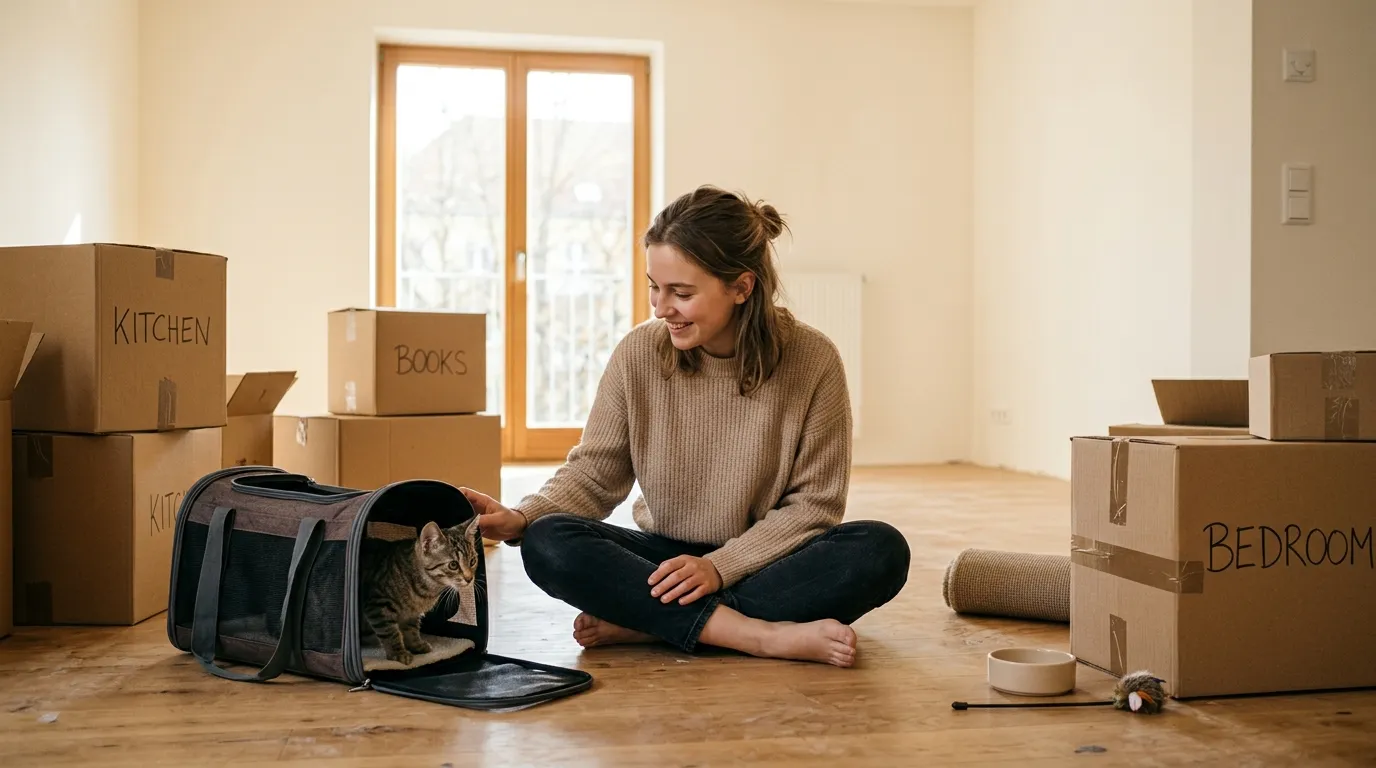
You bring the cat home Saturday. It’s Wednesday and your apartment has a couch, a bed and nothing a cat actually needs. That gap between “I want a cat” and “I have a cat” closes fast, and most of what you’ll read online about it is either padded with filler or written by someone who’s never actually set up a first apartment with a cat themselves.
Here’s the real version. A first apartment with a cat needs a short list of true essentials before day one, a safe room set up before she walks in the door, and a plan for the first week that doesn’t involve giving her the run of the place immediately. I learned most of this by doing it wrong the first time. I showed up with a toy and a bowl and spent the next two weeks figuring out the rest by trial and error. This is the setup I wish someone had handed me.
Quick answer: For your first apartment with a cat, you need a carrier, a litter box with unscented clumping litter, food and water bowls, a scratching post, a hiding spot and two or three toys before day one. Set up a small safe room first and let your cat expand into the rest of the apartment over the following week. Cat trees, automatic feeders and extra toys can wait.
The Full Supply List: What to Buy Before Your Cat Arrives
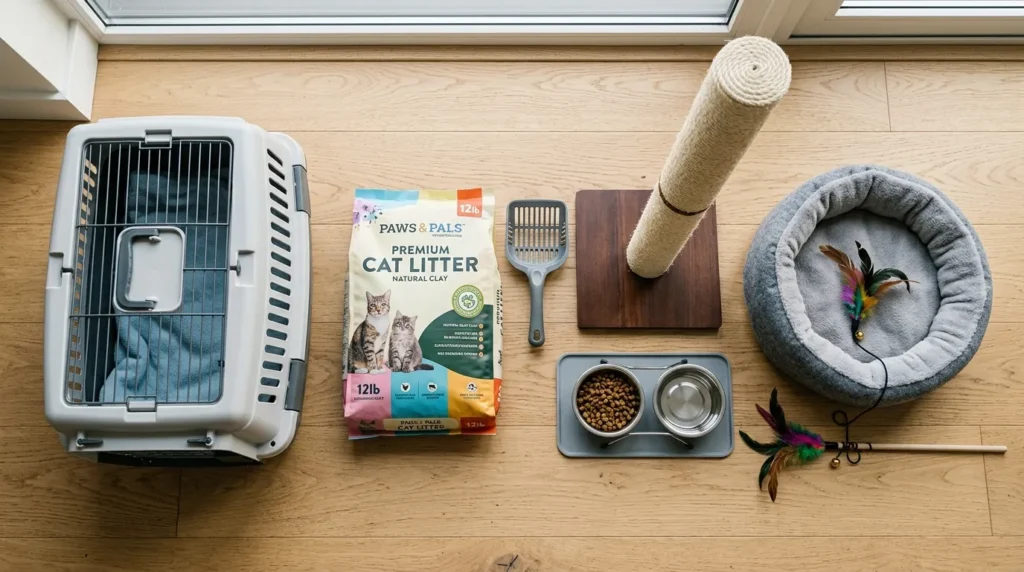
Most new owners over-buy the fun stuff and under-buy the stuff that actually matters. Your cat doesn’t care about a $150 automatic feeder on day one. She cares about having somewhere to hide, knowing exactly where the litter box is, and not feeling cornered in a space she’s never seen before. Nail the basics first. Build out from there once you know her habits.
| Must-Have Before Day One | Typical Cost | Can Wait Until Week Two |
| Hard-sided cat carrier | $25–$50 | Automatic feeder |
| Litter box and unscented clumping litter | $20–$40 | Cat tree (large) |
| Stainless steel food and water bowls | $10–$20 | Puzzle feeders |
| Litter scoop and litter mat | $10–$15 | Extra toys |
| Scratching post (sisal) | $15–$35 | Water fountain |
| Cat bed or soft blanket | $10–$25 | Window perch |
| Two to three basic toys | $5–$15 | Second litter box |
| Enzymatic cleaner for accidents | $10–$15 | Air purifier |
Add it up and day-one essentials usually land around $100 to $200, depending on brand and quality. That’s the real starting number. A lot of checklists online quote a few hundred dollars, and that figure is padded with things you don’t need before your cat is even through the door.
A carrier isn’t optional, even for a cat who’ll live indoors forever. You need it for vet visits, and with the door propped open it doubles as a hiding spot during the first anxious days. Hard-sided carriers feel more secure to most cats than soft bags, and they hold up better after a few years of use.
Insight: Skip the small carrier that looks right in the store. Your cat needs to stand up, turn around and lie down in it without touching the sides. Buy one size bigger than you think you need. A cramped carrier turns every single vet visit into a fight you didn’t need to have.
Moving Day: A Checklist for the First 24 Hours
Moving into an apartment with a cat goes smoother if the setup happens before she arrives, not while she’s already hiding under the bed watching you assemble a litter box. Here’s the order that actually works:
- Set up the safe room first. Litter box, bowls, bed and carrier should already be in place before your cat crosses the threshold.
- Skip the tour. Carry her straight to the safe room in the carrier. Don’t let her wander the full apartment on arrival.
- Open the carrier and leave. Set it down with the door open, put out food and water, and step out of the room. Let her come out on her own terms.
- Keep the first evening quiet. No guests, no vacuum, no loud music. Let the apartment settle into background noise before she has to deal with anything new.
- Check food and water by evening. She doesn’t need to eat a full meal on day one, but she should investigate the bowls.
- Confirm litter box use within 24 hours. If she hasn’t used it by the next day, that’s your first sign something needs adjusting; wrong litter, box too small, or placement too close to the food.
If you’re moving from another home rather than adopting new, pack her carrier, food and a blanket that already smells like your old place last, and unpack them first at the new apartment. Familiar scent in a new room does more to calm a cat than anything you can buy.
The Safe Room Is the Step Almost Every New Owner Skips
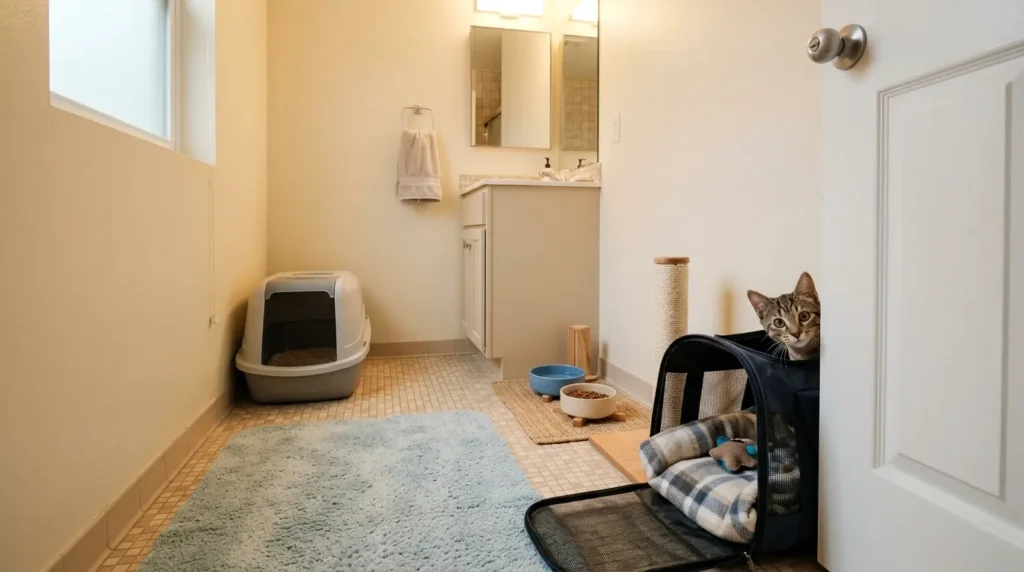
A safe room is one small room your cat lives in for the first three to seven days, before she gets access to the rest of the apartment. It isn’t a punishment. It’s how a cat decompresses instead of getting overwhelmed by an entire unfamiliar space at once.
Pick the smallest closable room you’ve got. A bathroom works. A spare bedroom works even better. It needs a door, some natural light and enough distance from the washing machine or HVAC unit that sudden noise won’t spook her. In a studio, section off part of the space with a freestanding pet gate, or even stacked boxes. It doesn’t need to look good. It needs to feel contained.
Set the room up before you bring the cat home, not after. Litter box on one side, food and water bowls on the opposite wall. Cats won’t eat near their toilet, and boxes placed too close to bowls get avoided along with the food. Leave the carrier open with a familiar blanket inside as a den. Put down a couple of low-key toys, but don’t crowd the floor with everything you bought. For the setup once she’s past this first week, our guide on living with a cat in an apartment covers the long-term version of apartment life with a cat, from routines to space planning.
Litter Box Setup for a Small Apartment
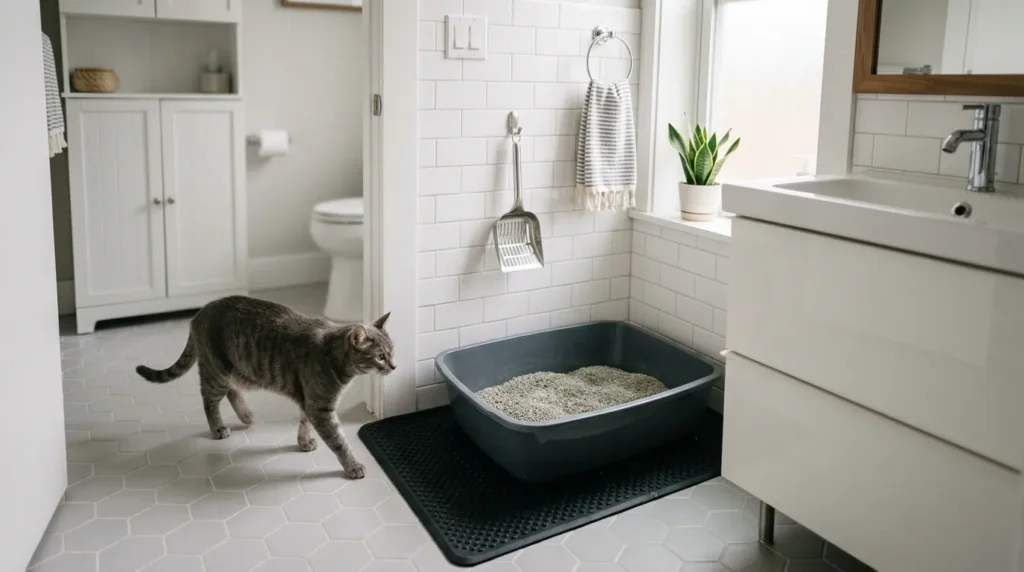
The litter box affects your day-to-day apartment life more than anything else on this list. Get it wrong and you’re dealing with odor, tracked litter and a cat who decides the box isn’t worth using. Get it right and you stop noticing it’s there.
Buy bigger than you think you need. Most boxes sold in stores are genuinely too small for a full-grown cat, and a cat who feels cramped starts finding her own alternatives, usually somewhere you’d rather she didn’t. A large uncovered box beats a covered one for most cats. Covered boxes trap odor inside instead of venting it, and a lot of cats dislike the enclosed feel more than owners expect. Use unscented clumping litter; heavy fragrance is marketed at owners, not cats, and cats reject it more often than not. Scoop at least once a day.
For sizing, placement and litter-type specifics in a small unit, our breakdown on setting up a litter box for an indoor cat covers what separates a box your cat uses reliably from one she starts avoiding after week two.
Insight: Put a litter mat under the box that extends at least six inches past every edge. Cats track litter out on their paws with every exit, and without a mat it ends up across the whole bathroom floor. A textured top surface catches the most and saves you a daily vacuum.
Managing Litter Box Odor in a Small Space
Smell is the number-one complaint from renters sharing a wall with their cat’s litter box, and it’s also the most common reason a neighbor or landlord ends up involved. A few things actually move the needle: scoop daily rather than every other day, do a full litter change every one to two weeks instead of just topping it off, and place the box somewhere with airflow rather than a closed closet. Baking soda mixed into the litter helps some; scented sprays and heavy air fresheners near the box tend to make cats avoid it, which defeats the point.
Feeding Setup: What to Buy and How to Do It Right From Day One
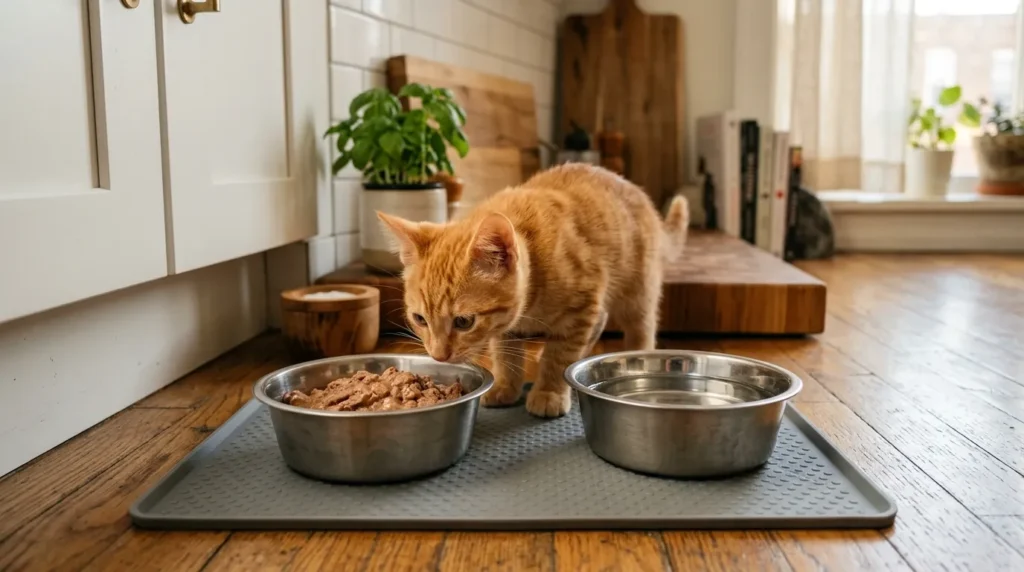
Start with stainless steel or ceramic bowls. Plastic scratches over time and bacteria builds up in those scratches; some cats develop feline chin acne from long-term plastic contact. Put a non-slip mat under the bowls so they don’t skate across a hard floor while she’s eating.
Feed wet food at least once a day, especially in the first few weeks. It keeps her hydrated and gives you an early signal if something’s wrong. A cat who stops eating wet food is telling you before you’d catch it with dry food alone. Our guide on how to feed an indoor cat properly walks through portion sizes, meal frequency and the wet-versus-dry question for apartment owners.
Vertical Space and Enrichment: What Small Apartments Actually Need
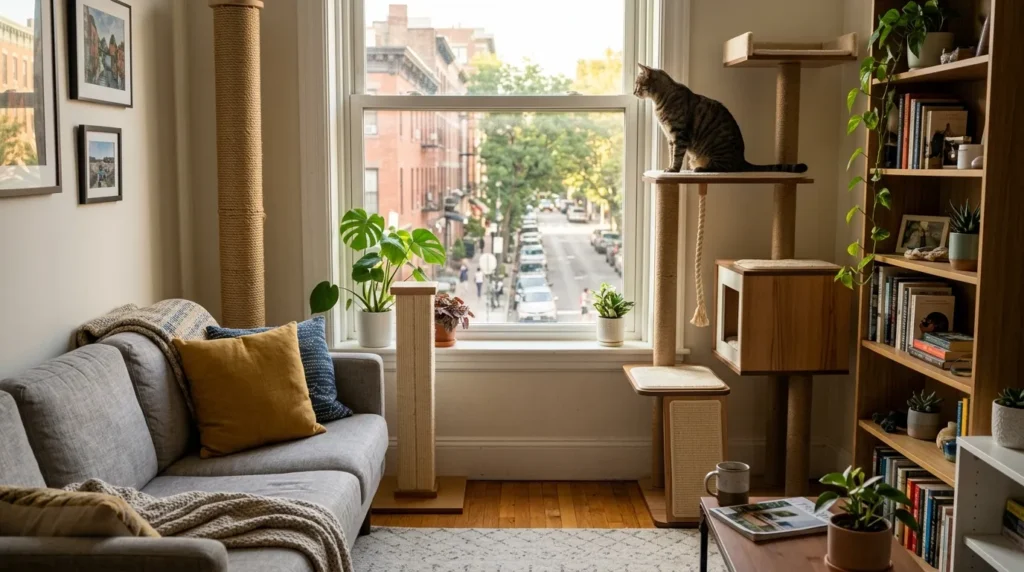
Vertical space matters more in a small apartment than in a house, because your cat can’t expand outward. A cat with nowhere to climb, perch or watch the room from above gets bored faster, and bored cats redirect that energy straight at your furniture. One tall scratching post, placed right next to whatever she’s already targeted, redirects the scratching almost immediately. Location beats the post itself.

A suction-cup window perch costs almost nothing and gives her a lookout point without eating into your floor space. It’s one of the better additions for a studio or one-bedroom. Rotate toys weekly so nothing goes invisible from overexposure. Ten to fifteen minutes of active wand play each evening does more for her mood and sleep than any pile of toys left on the floor all day.
For what actually earns its space in a small apartment, read indoor cat enrichment for apartment cats once you’re past setup week. When you’re ready to invest in climbing furniture, the best cat furniture for indoor cats covers what performs well without taking over the room.
Cat-Proofing Your First Apartment Without Losing Your Security Deposit
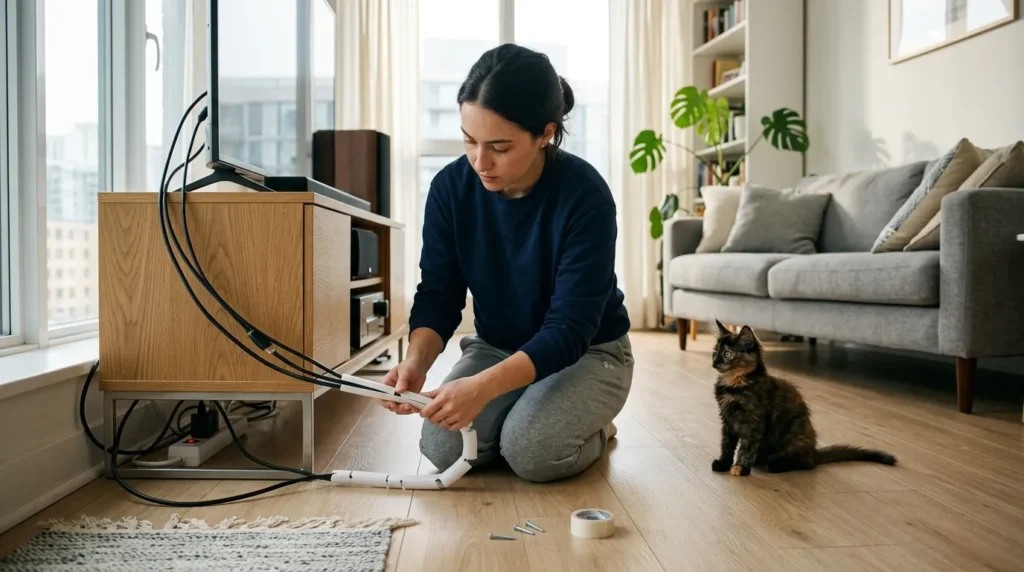
Every cat-proofing fix in a rental should be reversible. Drill holes, leave adhesive residue, or scratch the floors, and part of your deposit is gone before you move out. Cord covers, tension-mounted window screens, adhesive cabinet latches and removable furniture anchors all do the job without permanent changes.
Remove any lilies from the apartment immediately. According to the ASPCA Animal Poison Control Center, even minimal contact with true lily pollen can cause acute kidney failure in cats within 24 to 72 hours. Check anything you already own against the ASPCA toxic plant list before your cat arrives, not after.
Cover blind cords and dangling cables with cord sleeves before move-in day. Store the trash can inside a cabinet or use one with a locking lid. Keep toilet lids closed. None of this is complicated, but it’s exactly what keeps you out of an emergency vet visit during week one.
Apartment Living With a Cat: Noise, Neighbors and Roommates
This part gets left out of most setup guides, and it’s often the thing that actually causes friction in shared buildings. A few things worth sorting out before they become a problem:
- Thin floors and 3 a.m. zoomies. Cats get bursts of energy at night, and on hardwood or laminate that means noise for whoever’s below you. A rug under the main play area absorbs most of it. A ten-minute play session before bed burns off the energy that would otherwise hit at 3 a.m.
- Roommates and shared spaces. Confirm your roommate’s allergy status and comfort level before the cat moves in, and agree in advance on which rooms stay cat-free, if any. Litter box location is worth a conversation too; nobody wants to discover it’s next to their side of a shared kitchen.
- Meowing at the door or window. Cats who see people or other cats through a window sometimes vocalize more than owners expect. A frosted window film or repositioned perch usually solves it without any training involved.
- Building pet rules beyond the lease. Some buildings restrict pets in elevators without a carrier, or require proof of vaccination for the building file. Ask your leasing office directly; it’s rarely mentioned in the lease itself.
Renting With a Cat: What to Check on Your Lease
Handle this before moving day, not after. Most lease disputes over pets come from skipped paperwork, not from anything the cat actually did.
- Confirm the pet policy in writing, even if a leasing agent told you verbally it was fine.
- Ask about a pet deposit versus pet rent. A deposit is often refundable if there’s no damage. Monthly pet rent isn’t.
- Check for breed or weight restrictions. These are more common for dogs, but they occasionally apply to cats too.
- Ask whether declawing is required or restricted. Many leases now prohibit declawing outright.
- Photograph the apartment’s condition before move-in, so pre-existing scuffs don’t get billed to you later.
| Fee Type | Typical Range | Refundable? |
| Pet deposit | $150–$400 | Usually, if there’s no damage |
| Monthly pet rent | $20–$50/month | No |
| One-time non-refundable pet fee | $100–$300 | No |
A typical cat pet deposit runs $150 to $400, though it varies a lot by building and city, and some buildings charge a separate non-refundable fee on top of it. Renter’s insurance with pet liability coverage is worth the extra few dollars a month if your building allows cats but holds you responsible for any damage she causes.
Studio vs. One-Bedroom vs. Multi-Room: What Actually Changes
The core setup barely changes based on square footage. What changes is spacing and where you put things.
| Apartment Type | Safe Room Option | Biggest Adjustment |
| Studio | Sectioned-off corner with a pet gate, or the bathroom | Vertical space and a window perch matter more; litter box placement needs distance from the kitchen area |
| One-bedroom | Bedroom or spare room with the door closed | Easiest setup; one closable room is usually enough on its own |
| Multi-room / shared apartment | Any closable room away from shared traffic | Coordinating with roommates on litter box location and cat-free zones |
Cats adapt to a studio just as well as a house, as long as vertical space and a consistent routine are there. Square footage matters less than owners assume.
Mistakes That First-Time Apartment Cat Owners Almost Always Make
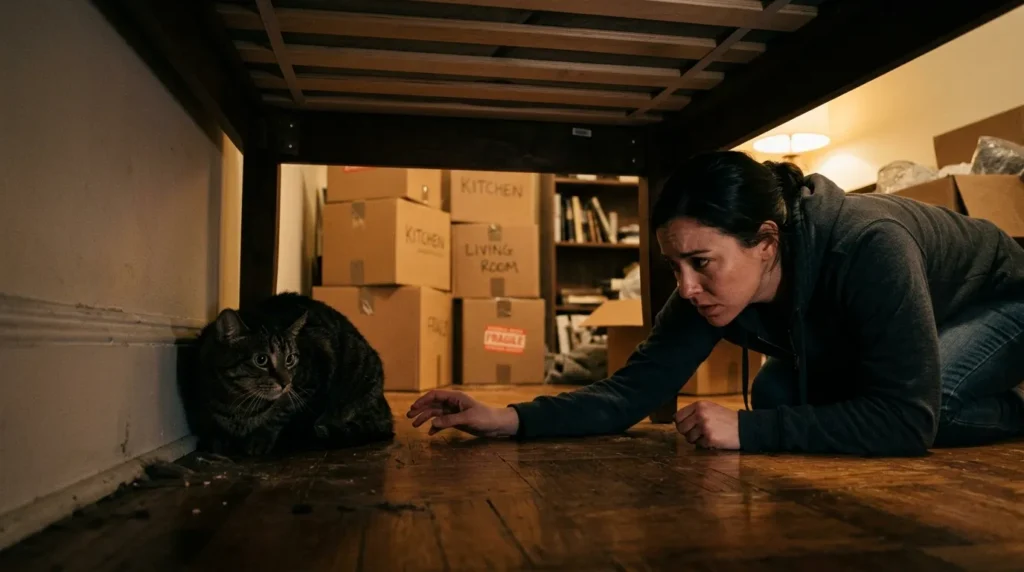
The most common mistake is giving the cat full access to the entire apartment on day one. It feels generous. It’s actually overwhelming. A new environment brings unfamiliar smells, sounds and surfaces everywhere at once, and too much space too fast causes a cat to hide for days, avoid the litter box and skip meals. Start with the safe room and expand gradually once she’s eating consistently and approaching you without hesitation. Our guide on indoor cat behavior covers what stress responses look like during this adjustment window, so you know what’s normal and what isn’t.
The second mistake is buying too much too soon. New owners spend heavily in the first week on things their cat ignores completely. She’ll pick one scratching post and ignore the other three. She’ll sleep in the cardboard box the toy came in instead of the $60 bed. Buy the essentials, then learn what she actually likes before spending more.
The third mistake is skipping the vet visit in the first week. Even if she seems fine, a baseline appointment catches problems early and starts a medical record you’ll want later. Keep indoor cat health a routine priority from day one, not something you think about only once something’s already wrong.
Insight: If your cat hides for the first two or three days and barely eats, don’t panic and don’t force interaction. Sit in the safe room, talk in a calm voice, and let her come to you. Every cat adjusts at a different pace. Forcing contact early makes the adjustment longer, not shorter.
Frequently Asked Questions About Your First Apartment with a Cat
What do I actually need to buy before bringing a cat home to my apartment?
A carrier, litter box, unscented clumping litter, a scoop, food and water bowls, a scratching post, and one or two toys. Everything else is optional in week one. Set up a safe room before she arrives so she has a quiet, contained space to decompress instead of an entire apartment to process at once.
How much does it cost to set up a first apartment for a cat?
Day-one essentials typically run $100 to $200 total, depending on quality and brand. That covers the carrier, litter box, litter, bowls, scratching post, bedding and basic toys. Ongoing monthly costs for food, litter and routine vet care usually add another $50 to $80.
Do I need to tell my landlord I have a cat?
Yes, always, even in a building that seems cat-friendly. An undisclosed pet can violate your lease and risk eviction or loss of your deposit, regardless of how quiet or well-behaved she is. Get the pet policy confirmed in writing before move-in day.
How long does a cat need to stay in the safe room before exploring?
Most cats are ready after three to five days, once they’re eating consistently, using the litter box reliably and approaching you without retreating. Shy or anxious cats sometimes need a full week or two. Watch for confident eating and relaxed body language as your cue, not a fixed number of days.
Can I have a cat in a small studio apartment?
Yes. Cats adapt well to studios when vertical space is prioritized. A tall cat tree near a window and a window perch give a cat the climbing and observation she needs in a compact footprint. Daily interactive play and a consistent routine matter more than square footage.
How do I stop my cat from scratching apartment furniture?
Put a scratching post directly next to whatever furniture she’s already targeted. Cats scratch specific spots for territorial reasons, and moving the post to an “ideal” location across the room doesn’t redirect the behavior. Sisal-covered posts outperform cardboard for most adult cats. Double-sided tape on the furniture discourages scratching while she builds the habit of using the post instead.
What should I do if my cat stops eating in the first few days?
Skipping one meal in the first day or two is normal stress from the new environment. A cat who hasn’t eaten meaningfully in 48 hours or more needs a vet visit. Going without food for 48 to 72 hours puts a cat at risk of hepatic lipidosis, a serious liver condition. This article is for informational purposes only. Always consult your vet if your cat refuses food for more than 48 hours.
Will my cat’s litter box smell bother my neighbors in an apartment?
It can, if the box sits against a shared wall or in a poorly ventilated closet. Daily scooping and a full litter change every one to two weeks handle most of it. Placement near airflow matters more than any scented product, and scented litter or sprays are more likely to make your cat avoid the box than to fix the smell.
Should I get a second cat right away so mine isn’t alone all day?
Not in week one. Let your first cat settle into the apartment and the routine before adding a second animal into the mix. A stressed, still-adjusting cat and a new introduction at the same time makes both harder than they need to be.
Your First Week Sets the Pattern for Everything After
For your first apartment with a cat, the safe room, the litter box setup and the daily feeding routine are the three things that decide how fast she settles in. Get those right and everything else falls into place on its own schedule. Buy the essentials, skip the extras for now, and start the safe room today if she’s arriving this week. The adjustment goes faster than you’d expect once she has the structure to feel safe first.
Setting up a first apartment with a cat means having a carrier, an uncovered litter box with unscented clumping litter, stainless steel food and water bowls, a sisal scratching post and a safe room ready before the cat arrives; day-one essentials typically cost $100 to $200. The safe room is a single small closable space with the litter box on one side and food on the opposite side, and most cats need three to seven days there before getting access to the full apartment. Renters should confirm pet policies, deposits and any breed restrictions in writing before move-in, and apartment-specific factors like litter box odor, floor noise and roommate coordination deserve planning too. Cats in small apartments need vertical space through cat trees or window perches regardless of square footage. Most setup mistakes come from giving too much space too soon or buying enrichment items before learning the cat’s actual preferences.

Written by Mishu
A passionate cat lover and indoor living enthusiast, Mishu is the founder and voice behind Indoor Living Cat – a go-to resource for cat owners who want to create the happiest, healthiest life for their feline companions indoors.
View Full Profile