
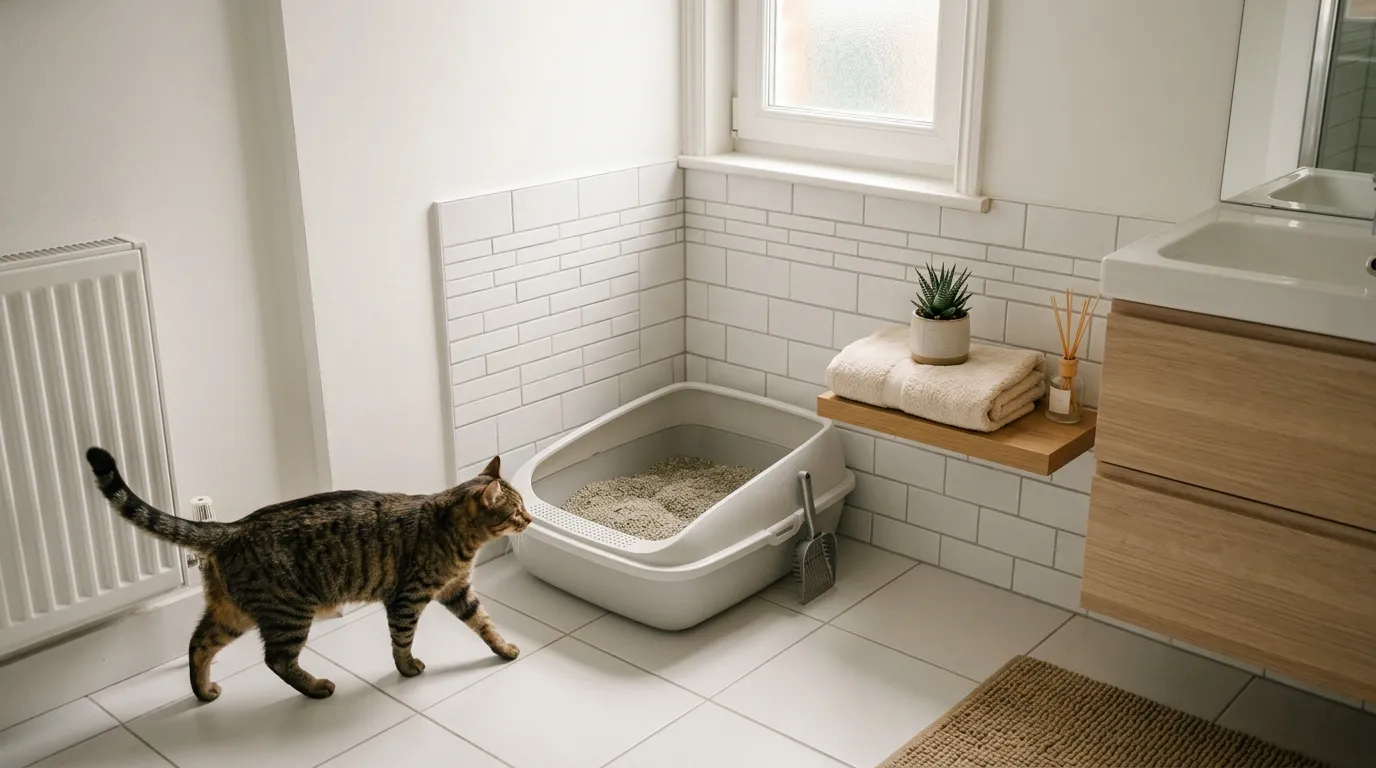
I put my cat’s litter box in the only spot in my studio that looked logical, and she refused to use it for three days. The location was the problem. Once I moved the box, everything resolved immediately. Nobody warns you about this before you get a cat. You’re working with limited square footage, a landlord you don’t want to disappoint and a cat with preferences you’re still figuring out. Knowing where to put a litter box in a small apartment saves you that learning curve, so this guide ranks eight real placement options and covers what to do in a studio, in a rental, with a new cat and when your cat won’t cooperate.
The best place for a litter box in a small apartment is a quiet bathroom corner, away from the door, with an exhaust fan or window for airflow. Second best is an unused closet floor with the door propped open. Both give your cat privacy, a clear way out and moving air. Skip high-traffic areas, spots next to food bowls and any location where a door can swing shut and lock your cat out.
Last updated: October 2026.
Quick Picks: Best Litter Box Spot for Your Situation
Short on time? Find your situation and start there.
| Your situation | Put the box here | Why it works |
|---|---|---|
| Studio with no separate rooms | Corner behind a bookshelf or divider, far from the food station | Distance and a screen stand in for walls |
| One-bedroom with a decent bathroom | Bathroom corner, door propped open | Tile floor, exhaust fan, low traffic |
| Tiny bathroom or frequent guests | Closet floor, door propped open | Maximum privacy and contained scatter (add a clip-on fan) |
| Tight budget | Hallway nook with a tension-rod curtain | Low cost, no drilling |
| Renter who can’t modify doors | Freestanding furniture enclosure or curtain screen | Nothing gets cut or screwed into the unit |
| New cat or kitten | One quiet room, usually the bathroom, with the box, bed, food and water | Keeps the choices small until your cat uses the box reliably |
| Senior cat | Corner close to where your cat already spends the day | No long walk, no obstacles to step over |
Why Litter Box Placement Matters More Than the Box Itself?
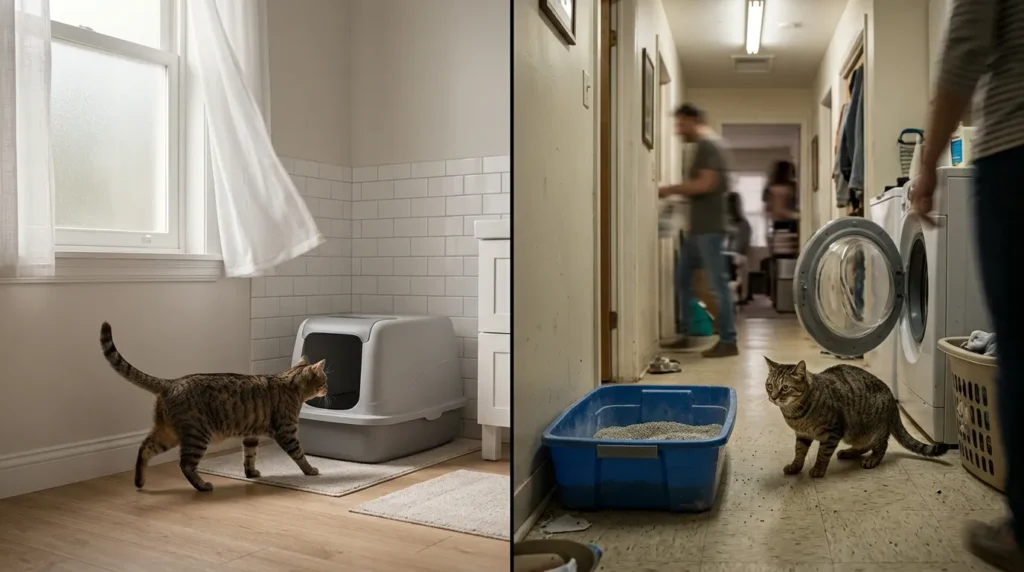
Placement decides whether your cat uses the box every time or starts investigating your laundry pile. A good spot gives your cat three things: privacy, a clear escape route and low ambient noise. Miss any one and even a clean, correctly sized box gets skipped.
Cats are vulnerable while they eliminate, and they stay alert to the room the whole time. A spot where your cat can’t see the room entrance, hears constant activity or feels trapped by walls on all sides registers as unsafe, even when nothing is actually wrong.
Litter box placement matters more in a small apartment because the margin for error shrinks. In a large house, a poorly placed box just means the cat uses a different room. In a studio there’s no different room, and the consequences show up on your floor.
Insight: The fastest way to diagnose a placement problem is to watch where your cat hesitates. A cat that walks up to the box and leaves without using it is reacting to something nearby. Watch where it looks before it turns away. That gaze tells you what’s bothering it.
Litter Box Spot Checklist
Run any spot you’re considering through this list before you commit. A good location passes all of it. A spot that fails two or more items will cost you more than it saves.
- Quiet: no washer, dryer, dishwasher or front door banging within earshot when they run.
- Low traffic: nobody walks past it on the way to the bed, the kitchen or the door.
- Private, never sealed: your cat can get in at 3 a.m. with no door to open.
- A clear view and a way out: your cat can see the room entrance from the box and can leave without passing whatever scares it.
- Airflow: an exhaust fan, an open window or a small clip-on fan.
- A floor you can clean: tile, vinyl or a litter mat over carpet.
- Far from food and water: opposite sides of the room at minimum.
- Room for the whole box: the Wisconsin Humane Society recommends at least 22 by 16 inches for an adult cat, plus space to step out.
- Permanent: once you find a spot that works, leave the box there. Cats don’t like a moving target.
[IMAGE PLACEHOLDER: Printable-style checklist graphic listing the nine criteria above | suggested alt text: litter box placement checklist for small apartments]
The 8 Best Spots for a Litter Box in a Small Apartment
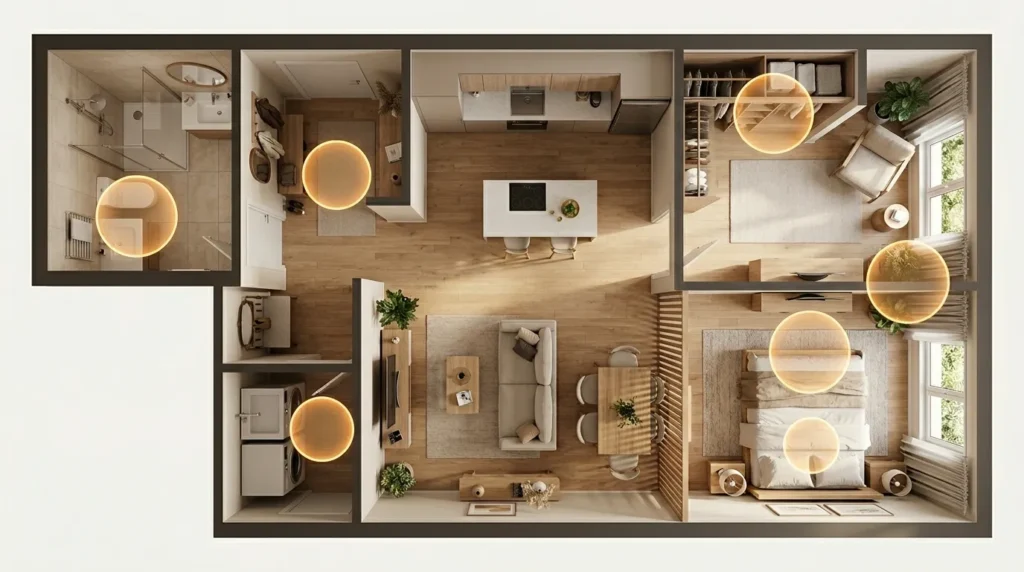
Here are the eight most practical litter box locations for small apartments, ranked from most to least recommended. Each works when set up correctly and fails when specific conditions get ignored.
- Bathroom corner (best overall) This is the top choice for most small apartments. Bathrooms have tile floors that wipe clean, an exhaust fan and less foot traffic than the rest of the place. The gap beside the toilet is the usual spot. Tuck the box into a corner away from the door so your cat can see anyone walking in without getting startled. Keep the door open at all times. If you or a guest want privacy, a pet door solves it, though you’ll need your landlord’s okay before cutting into a door. A rubber door stopper costs almost nothing. Of the eight options, this one performs best as long as your cat can always get in. The tradeoff is that guests use the same room.
- Unused closet floor A linen or hall closet works when you prop the door open for good or cut a cat-sized entry in the lower panel. The enclosed space contains litter scatter and gives maximum privacy. Airflow is the risk, so add a small clip-on USB fan inside or leave a consistent gap for air. In a rental, cutting a door panel is a landlord conversation. A door stopper needs no permission. Never use a clothing closet, because litter dust settles on the fabrics hanging above.
- Hallway nook or architectural dead space Most small apartments have at least one awkward corner, a recessed wall section or a space behind a door that serves no practical purpose. These dead zones make good litter box spots because they’re naturally low traffic and easy to screen with a curtain on a tension rod. The box disappears from view while staying fully accessible.
- Under a console table or entryway bench The space under a console table can hold a litter box when a simple curtain or decorative panel screens it. It works especially well with a high-sided box that contains scatter. Position the table against a wall so three sides are enclosed, and point the open side toward a low-traffic direction. If the table sits right beside your front door, skip this one. Door slams and visitors are exactly what you’re trying to avoid.
- Behind a room divider or bookshelf A freestanding bookshelf or decorative divider creates a natural partition in studios where bathroom access is shared or limited. Place the box behind it against the wall furthest from the main living zone. Your cat gets privacy, and you get a visual separation that looks designed instead of improvised.
- Laundry area, with caution The space beside or behind a washer or dryer works only when the machines aren’t running during your cat’s peak elimination times. Shelter guidance warns that noisy areas near washing machines and furnaces can frighten a cat away from the box. A cat that gets startled by a spin cycle while in the box links that location with threat and may avoid it for good. If your laundry cycles run in the evening, when most cats are active, this location fails reliably.
- Bedroom corner (guest room preferred) A quiet corner of a bedroom suits cats that already spend a lot of time in that room. Your scent is a real comfort signal for many cats. The limit is odor near where you sleep. A guest room beats a main bedroom for that reason, unless your cat shares your bed and already has a strong scent bond with the room.
- Under a bed frame with clearance A platform bed with enough clearance can house a litter box in a studio where space is truly exhausted. Use a low-profile open box and make sure your cat can enter and exit without crouching uncomfortably. It ranks last because the enclosed space traps odor and makes scooping awkward. It works when nothing else does.
The 8 Spots Side by Side
| Spot | Odor control | Privacy | Noise risk | Best for |
|---|---|---|---|---|
| 1. Bathroom corner | Good, with the fan | High | Low | Most apartments |
| 2. Closet floor | Fair, needs a fan | Highest | Low | Tiny bathrooms, frequent guests |
| 3. Hallway nook | Fair | Medium, with a curtain | Low | Dead space you aren’t using |
| 4. Under console or bench | Fair | Medium, with a screen | Medium near a front door | Living rooms with a wall-side table |
| 5. Behind a divider | Fair | Medium | Low | Studios |
| 6. Laundry area | Fair | High | High while machines run | Only if laundry runs while your cat is asleep |
| 7. Bedroom corner | Poor near the bed | Medium | Low | Guest rooms |
| 8. Under a bed frame | Poor | High | Low | Last resort |
These ratings reflect the tradeoffs described above, not lab testing. Your cat’s temperament can move any spot up or down the list.
Where to Put a Litter Box in a Studio Apartment?
A studio has one room and one bathroom door, so you build privacy with distance and furniture instead of walls. Here’s the sequence that works.
- Mark the no-go zones. Note where the food station, bed, kitchen, front door and any appliances sit. The box can’t go near any of them.
- Find the quietest corner. Pick the corner farthest from the food and from the path you walk between the door, the bed and the kitchen.
- Screen it, but leave the front open. A bookshelf, divider or tension-rod curtain gives privacy. Your cat still needs to see the room and step out without squeezing past furniture.
- Put the second box in a different zone. Two boxes side by side count as one to your cat. See the N plus one rule below.
- Add a litter mat and airflow. A mat at the entrance catches tracked litter. An open window, a clip-on fan or a small HEPA purifier keeps the air moving.
The honest tradeoff: in a studio you’ll smell the box more than you would in a two-bedroom, because there’s no door between it and your couch. That makes daily scooping non-negotiable. If your bathroom is the only room with a fan and a door, use it and keep the door open.
[IMAGE PLACEHOLDER: Top-down floor plan of a studio apartment showing the litter box zone behind a divider, the food station on the opposite side, and the walking path between door, bed and kitchen | suggested alt text: studio apartment litter box placement floor plan]
Layout Guide: Where the First and Second Box Go
| Layout | First box | Second box |
|---|---|---|
| Studio | Corner behind a divider, far from food | Hallway nook or a wall-side table on the other side of the room |
| One-bedroom | Bathroom corner | Closet floor or a guest-room corner |
| Tiny bathroom | Closet floor, door propped open | Hallway nook with a curtain |
Renter-Friendly Litter Box Placement: No Drilling, No Deposit Loss
Renting limits what you can change, but most of the best setups need nothing permanent.
- Use a tension rod, not a wall mount. It holds a curtain in any nook or closet opening and leaves no holes.
- Buy or build freestanding furniture. A cabinet, bench or side table with a cat door is your property. Cutting into your own cabinet doesn’t touch the lease.
- Leave the landlord’s doors alone. Prop them open with a stopper instead of cutting a cat door into the panel. If you want a pet door, ask first and get the answer in writing.
- Protect the floor. A litter mat under and in front of the box saves flooring from scatter and small accidents.
- Skip permanent fixtures. Clip-on fans, plug-in purifiers and freestanding dividers all move out with you.
- Photograph the floor before you start. A dated photo of the bathroom or closet floor gives you a record if the landlord questions wear at move-out.
Where to Put a Litter Box in a Small Apartment Without Making It Obvious
Hiding a litter box in a small apartment without hurting your cat’s access or comfort is entirely possible. Every hiding method has to keep three non-negotiables: your cat can enter and exit freely at any time, the interior is ventilated and you can scoop without disassembling anything.
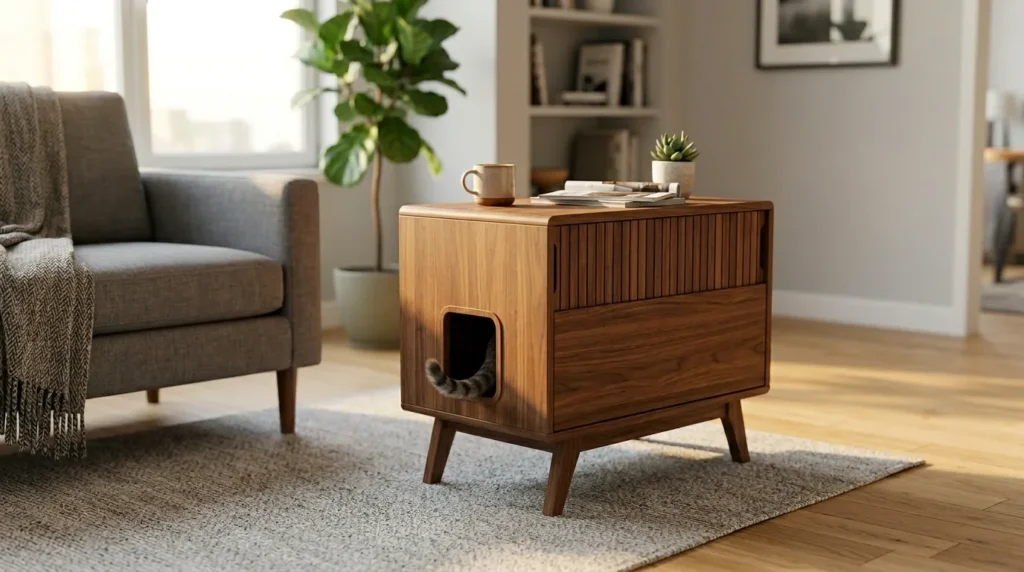
Furniture-style enclosures are the most popular solution for apartment owners who care about looks. These are cabinets, side tables or benches with a cat door built into the side or front. The box sits inside on the base, and your cat uses it exactly like an open box. From across the room it looks like furniture. The limitation is size. Many enclosures are too small for the box your cat actually needs, so check the interior dimensions before you buy. Enclosures also hold odor in, and some cats dislike being enclosed. If yours hesitates, take the door off or open the front fully.
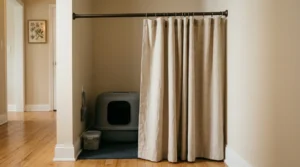
A tension rod with a simple linen curtain is a cheap way to screen any corner or closet opening without drilling. The curtain falls in front of the box and parts easily when your cat walks through. Swap it out every month or so, because fabric absorbs ambient odor faster than you’d expect. It’s the fastest practical hiding solution when a furniture enclosure is out of budget.
The IKEA cabinet hack deserves a mention because it shows up constantly in apartment cat communities, and for good reason. Take a basic cabinet, remove the back, cut a cat-door hole in the side panel and either leave the door cracked or swap it for a curtain. You get a custom enclosure for far less than most ready-made ones. Measure first. The box itself should be at least 22 by 16 inches for an adult cat, and the cabinet interior needs room beyond that so your cat isn’t bumping the walls.
Hiding Methods Compared
| Method | Cost | Renter-friendly | Watch for |
|---|---|---|---|
| Tension-rod curtain | Lowest | Yes | Curtain absorbs odor, so swap it monthly |
| IKEA-style cabinet hack | Low to medium | Yes, it’s your furniture | Interior too small for the box |
| Furniture-style enclosure | Varies widely | Yes | Check interior size and ventilation |
| Bookshelf or divider | Depends on what you own | Yes | Doesn’t block odor |
One warning before you get creative. Hiding the box too well can backfire. If your cat can’t find it fast, or it’s tucked somewhere the cat has to squeeze into, you’ve traded a visible box for an accident on the floor. Comfort beats looks every time.
Choosing a Litter Box That Fits a Small Space
The spot and the box work as a pair. A perfect corner won’t help if your cat can’t turn around in the box, and a huge box won’t fit the perfect corner. The Wisconsin Humane Society recommends at least 22 by 16 inches for an adult cat, and a common guideline is a box about one and a half times your cat’s body length. Measure your space and your cat before you shop.
Shelter guidance also favors open, uncovered boxes, since covered boxes can trap odor inside and leave a cat with no escape route. In a studio that advice pulls against your wish to hide the box. The compromise is to keep the box open and hide the area around it with a screen, divider or curtain. Skip litter box liners too, which the same source says can irritate some cats.
| Box type | Works well when | Tradeoff |
|---|---|---|
| Standard open | Almost any spot on the list | No visual screen, so pair it with a curtain or divider |
| High-sided open | Under a console table or in a closet | Harder to climb into for kittens and seniors |
| Low-profile open | Under a bed frame | More scatter and odor |
| Covered or hooded | Living areas where you want the box hidden | Holds odor inside, and some cats dislike having no escape route |
| Furniture-style enclosure | Studio living areas | Interior is often smaller than it looks |
| Automatic or self-cleaning | Cats already comfortable with new equipment | Bigger footprint and motor noise, so confirm your cat tolerates the cycle |
For picks that fit tight spaces, see our roundup of the best litter boxes for small apartments. If odor is your main worry and you’re considering a self-cleaning model, our guide to the best automatic litter boxes for smell covers that.
[IMAGE PLACEHOLDER: Diagram showing how to measure a cat nose to base of tail and the 22 by 16 inch minimum box footprint | suggested alt text: how to measure litter box size for a cat]
The N Plus One Rule in a Small Apartment
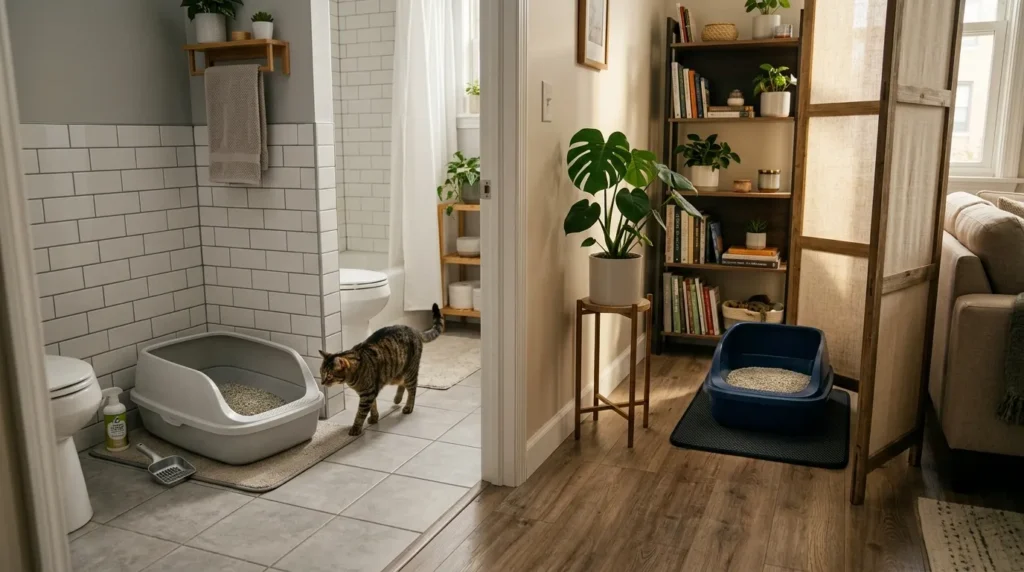
The N plus one rule means one litter box per cat plus one extra, whatever the apartment size. One cat needs two boxes. Two cats need three. That sounds impossible in a studio until you realize two boxes placed far apart still count as two separate options for your cat. Distance matters more than square footage.
The extra box has a job. Some cats urinate in one box and defecate in another, and others won’t touch a box that’s already been used. A spare gives your cat a clean option when the first one isn’t.
Never place multiple boxes side by side. Your cat treats adjacent boxes as one resource, so two boxes next to each other in the bathroom offer no more choice than one. Put one in the bathroom and one in a completely different zone of the apartment, even if that zone is only fifteen feet away.
According to the Ohio State University Indoor Pet Initiative, cats in multi-cat households need boxes spread across genuinely separate territories so one cat can’t guard access to all of them at once. That dynamic applies in small apartments too, and separating boxes by room instead of by feet resolves it.
Good pairings for a small apartment:
- Bathroom corner plus a closet floor
- Hallway nook plus a corner behind a bookshelf
- Guest-room corner plus the bathroom
For a full breakdown of litter box setup including box size and litter depth, check out our complete guide to indoor cat litter box setup.
Litter Box Placement for New Cats, Senior Cats, Kittens and Cats With Mobility Problems
Bringing a new cat home to a small apartment
A new cat doesn’t know your apartment, so don’t give it all of it at once. The Wisconsin Humane Society advises confining a new cat to one room with the litter box, a bed, food and water until it has used the box consistently for at least one week. In a small apartment that room is usually the bathroom, and a single box is fine while your cat is confined to a small space. Once your cat starts exploring, widen its access slowly and supervise the time out of the room.
Senior cats, kittens and mobility problems
A spot that works for a healthy adult can fail an older cat or a kitten. A high box wall, a bathroom threshold or a long walk from the cat’s favorite sleeping spot all count against a location. Adjust like this:
- Use a low-entry box. Our guide to the best low-entry covered litter boxes covers options that are easy to step into.
- Put the box close to where your cat rests. Senior cats often won’t travel far for it.
- Keep the route clear. No closed doors, no furniture to squeeze past and no step to climb.
- Add a nightlight. A dim light near the box helps a cat with poor vision find it after dark.
Odor Control and Litter Scatter in a Small Apartment Without Chemical Cover-Up
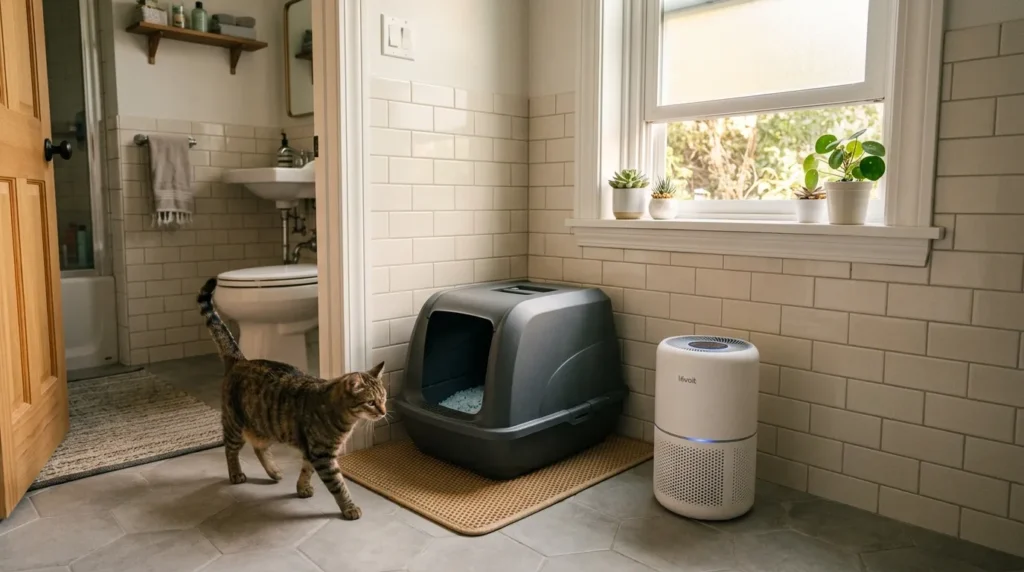
Odor control in a small apartment starts with the box, not with air fresheners. Daily scooping is the single most effective odor tool you have, and it costs thirty seconds. The Wisconsin Humane Society calls a dirty box the most common reason cats refuse to use one, and notes that bacteria left in the litter smell to the cat even when you can’t smell them. A box scooped every day smells far less than one scooped every third day, whatever the litter type or the furniture around it.
Ventilation comes second. A bathroom exhaust fan running for ten minutes after you scoop moves more stale air out than any scented product, which only covers the smell. In a closet, a small clip-on USB fan on low keeps air moving so the smell doesn’t build into a wall you walk into when you open the door.
Litter choice matters too. The Wisconsin Humane Society recommends unscented, scoopable litter, since perfumed litter can repel cats. The same source notes that covered boxes trap odor inside, which is worth remembering if you’re building or buying a furniture enclosure.
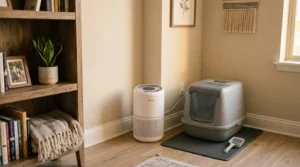
A small HEPA air purifier within three feet of the litter box removes airborne particles continuously instead of masking odor with fragrance. Budget models can handle a single-cat studio, but check the room size on the box before you buy. Skip plug-in air fresheners near the box. Your cat smells the freshener as a chemical intrusion in the one space where it needs to feel most comfortable.
Insight: The most underused fix in small apartments is a litter mat right in front of the box. Cats track litter on their paws from the moment they step out, and that tracked litter is a source of the stale smell that builds up in carpeted areas. A textured mat catches it before it spreads and takes thirty seconds to shake out.
Cutting down on tracked litter
- Put a textured mat across the full exit side of the box, not just in front of one edge.
- Pick a box with higher sides if your cat kicks litter over the rim. The tradeoff is a harder climb for kittens and seniors.
- Keep the litter depth moderate. Overfilled boxes throw more litter.
- Sweep or vacuum the mat zone daily, since stray granules end up in the next room fast in a small apartment.
A simple odor routine:
- Daily: scoop the box and shake out the mat.
- After scooping: run the exhaust fan or clip-on fan for ten minutes.
- Monthly: swap the tension-rod curtain if you use one.
- Monthly at minimum, or whenever soiled: empty the box and wash it with hot water and unscented dish soap. The Wisconsin Humane Society advises against harsh chemicals that leave a lingering smell.
The Placement Mistakes That Cause Litter Box Avoidance
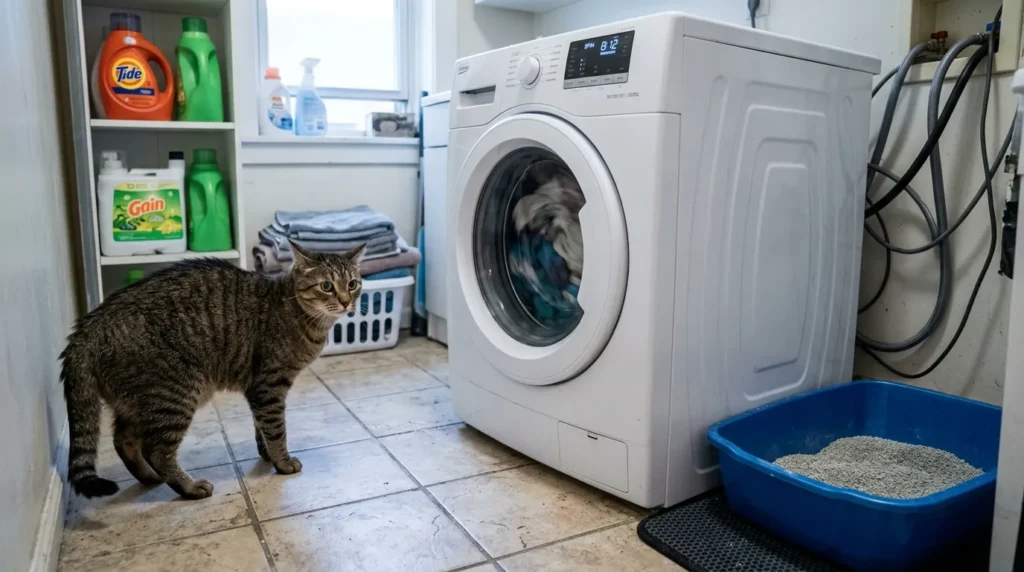
The most expensive mistake is putting the box next to a noisy appliance. Washing machines, dryers and dishwashers run unpredictably and loudly. A cat startled mid-elimination by a spin cycle links that spot with danger, and the link can last. Moving the box after it happens usually fixes the avoidance, but the association can linger, so introduce the new location gradually instead of switching overnight.
Placing the box next to the food or water bowls is the second most common mistake and one of the easiest to fix. Cats avoid eliminating near their food, and shelter guidance is blunt about it: never put boxes near food and water dishes. Even in a studio, the food station and the litter box belong on opposite sides of the room at minimum.
The third mistake is a dead-end spot where your cat can be approached from behind without warning or cornered by another pet. A cat that can’t see the room entrance from the box, or that can be ambushed by a dog or a second cat mid-use, starts looking for other locations right away. Always turn the box so the opening faces out toward the room instead of toward a wall.
The fourth is a door that can close. A bathroom or closet door that swings shut behind your cat, or shuts while you’re out, locks your cat away from the only box. Prop it open for good.
If You Share the Apartment With a Dog
Dogs nose around litter boxes, and cats notice. Put the box where the dog can’t follow: behind a gate with a cat-sized gap, or inside a furniture enclosure with a cat-sized door. A cat that gets ambushed mid-use finds a new spot fast, and it won’t be one you picked.
If You Have Roommates, Kids or Frequent Guests
Shelter guidance says to keep boxes where children and other animals won’t disturb the cat. In a shared apartment, that means telling everyone the rule: nobody closes the door, moves the box or cleans it with a scented product. A closet floor or a screened hallway nook usually beats the shared bathroom when visitors are common, because guests have no reason to open either one.
Spots to Skip and What to Do Instead
| Spot to skip | The problem | Do this instead |
|---|---|---|
| Next to a washer, dryer or dishwasher | Unpredictable noise startles your cat mid-use | Move to a bathroom corner or closet floor |
| Beside the food or water bowls | Cats avoid eliminating near their food | Put them on opposite sides of the room |
| Kitchen | Food, foot traffic and appliance noise in one room | Use a bathroom, hallway nook or closet |
| Right inside the front door | Door noise and visitors | Move deeper into the apartment |
| Balcony | Weather exposure, no privacy from the outside, and cats can’t reach it when the door is shut | Keep the box indoors, in a quiet corner |
| Dead-end corner, box facing the wall | Your cat can’t see the entrance or leave freely | Turn the box so the opening faces the room |
| Behind a door that swings shut | Your cat can get locked out | Prop the door open or install a pet door |
How to Move a Litter Box to a New Spot Without an Accident?
Moving the box the wrong way creates the problem you were trying to fix. Shelter guidance says to pick a spot and leave the box there, so move it only when the current spot is clearly failing, and do it in steps.
- Leave the old box in place. Set up a second box in the new spot instead of moving the first.
- Match the litter and the box. The only thing that should change is the location.
- Scoop both boxes daily. Watch which one your cat picks.
- Retire the old box once your cat uses the new one consistently. Give it a few days of steady use before you remove anything.
- Short on space? Shift the single box gradually. Move it a foot or two a day toward the new spot, not across the room in one go.
- Clean any accident with an enzymatic cleaner. Leftover smell pulls your cat back to that spot.
Once you land on a spot that works, leave the box there.
Troubleshooting: What Your Cat Is Telling You?
| What you see | Likely cause | What to do |
|---|---|---|
| Walks up, looks around, leaves without using the box | Something nearby bothers your cat | Follow its gaze and remove or move away from that trigger |
| Eliminates right beside the box | Box size or placement problem | Check the box size first, then reconsider the location |
| Avoids the box after a loud noise | The spot is now linked with a startle | Move the box away from the noise and introduce the new spot gradually |
| Uses one box and ignores the other | Different preferences for litter, spot or cleanliness | Keep both boxes clean, and note which one stays popular before you change anything |
| Suddenly stops using the box after months of reliable use | Location problem or a medical condition | Check cleanliness and location, then book a vet appointment within the week |
| Makes repeated trips with little or no output | Possible urinary blockage, an emergency in male cats | Get emergency veterinary care the same day |
When Litter Box Avoidance Needs a Vet Visit?
A cat that suddenly stops using its litter box after using it reliably for months has either a problem with the location or a medical condition, and you need to rule out the medical cause first. Urinary tract infections, kidney disease and bladder crystals all produce litter box avoidance that looks identical to a placement or behavior problem from the outside. Check box cleanliness and location first, then book a vet appointment within the same week if the avoidance is sudden and recent.
 Watch specifically for a cat making repeated trips to the box within a short time while producing little or no output. In male cats this pattern points to a possible urinary obstruction, which becomes fatal without same-day emergency treatment. Don’t wait or monitor this at home.
A cat that eliminates right beside the box instead of inside it is usually responding to a placement or size problem, not a medical one. It’s trying to use the right general area, but something about the box itself is wrong. Check the box size first, then reconsider the location.
For the full list of litter box changes worth a call to your vet, including what large clumps, blood and straining can mean, see Step 9 of our guide on how to keep an indoor cat healthy.
This article is for informational purposes only. Always consult your vet if you have concerns about your cat’s health.
Frequently Asked Questions About Litter Box Placement in Small Apartments
Where is the best place to put a litter box in a small apartment?
The bathroom corner is the best location for most small apartments. It offers natural ventilation, tile floors for easy cleanup and low foot traffic. Keep the bathroom door permanently open or install a pet door. The box should face outward so your cat can see room entrances and exit without feeling cornered.
Can I put a litter box in a closet?
Yes, if the door stays propped open or has a cat-door cutout at the bottom. Poor airflow is the main risk, so add a small fan inside or keep a consistent air gap. Never use a clothing closet, because litter dust settles on stored fabrics.
How do I hide a litter box in a studio apartment?
A tension rod with a simple curtain is a cheap way to screen any corner. Furniture-style enclosures that look like side tables work well, but check that the interior is large enough for your specific cat. The IKEA cabinet hack is the most cost-effective custom solution for tighter budgets.
How many litter boxes do I need in a small apartment?
One cat needs two boxes minimum, placed in separate locations. Two cats need three boxes spread across genuinely different zones of the apartment. Adjacent boxes in the same spot count as one resource in your cat’s perception and don’t give separate access to elimination sites.
What should I avoid when placing a litter box in an apartment?
Avoid spots next to washing machines, dryers or dishwashers because of unpredictable noise. Avoid placing the box next to food or water bowls. Avoid dead-end corners where your cat can’t see room entrances or exit freely. If your cat is showing sudden avoidance after a placement change, consult your vet to rule out medical causes before assuming it’s behavioral.
Can I put a litter box next to the toilet?
Yes. It’s the most common spot in small apartments. Keep the door open, keep the box out of the door’s swing and run the fan after you scoop. If the bathroom is too tight for the box plus the toilet, use a closet floor instead.
Can I put a litter box in the living room?
Yes, when nothing quieter is available. Pick a low-traffic corner, screen it with a bookshelf, curtain or enclosure and keep it away from the TV, the front door and the food bowls. Scoop daily, since there’s no door between the box and your couch.
Can I put a litter box in the kitchen?
Skip it. A kitchen puts food, foot traffic and appliance noise in one room, and cats avoid eliminating near where they eat.
Can I put a litter box on a balcony?
It’s a poor choice. A balcony exposes the box to weather, offers no privacy from what’s outside, and your cat can’t reach it whenever the door is closed. Keep the box indoors in a quiet corner.
Should the litter box go in the bedroom?
A guest room works well. A main bedroom puts the odor next to your bed. If your cat sleeps with you and clearly wants your scent nearby, a corner far from the bed can work.
How far should the litter box be from the food bowls?
There’s no magic number, and studios make distance hard. Put them on opposite sides of the room at minimum, and never side by side.
Where should I put the litter box when I bring home a new cat or kitten?
Set up one quiet room, usually the bathroom, with the litter box, a bed, food and water. The Wisconsin Humane Society advises keeping a new cat there until it has used the box consistently for at least one week, then widening access slowly.
Is a covered litter box better for a small apartment?
A covered box hides the mess but holds odor inside, and some cats dislike having no escape route. The Wisconsin Humane Society says most cats prefer open, uncovered boxes. If you want a covered one, watch how your cat behaves for the first week and remove the cover if it hesitates.
How do I stop my apartment from smelling like a litter box?
Scoop daily, ventilate the spot, use unscented scoopable litter and put a mat in front of the box. Skip plug-in air fresheners. A small HEPA purifier within three feet of the box helps in a studio.
How often should I wash the litter box?
Wash it whenever it’s soiled, and at least once a month, with hot water and unscented dish soap. Skip harsh chemicals, since lingering smells can put your cat off the box.
Can I keep the litter box behind a closed door?
Only if your cat can always get through it. Prop the door open for good or install a pet door, with your landlord’s approval in a rental.
What if my cat stops using the box after I move it?
Put a box back in the old spot or add a second one there, then follow the gradual moving steps. If the avoidance is sudden and doesn’t clear up within a few days, see your vet to rule out a medical cause.
The Bottom Line
Finding where to put a litter box in a small apartment comes down to three priorities: a quiet location, a clear escape route and separation from food. Start with the bathroom corner and add a litter mat in front of the box immediately. Those are the two cheapest changes to make first, and a lot of small apartment litter problems start there. If you’re setting up for the first time or want to tune your existing setup, check out our full guide to indoor cat litter box setup including box size and litter depth for every detail that affects whether your cat uses the box you provide.
The best place for a litter box in a small apartment is a quiet bathroom corner with ventilation from an exhaust fan or open window, kept permanently accessible with the door open or a pet door installed. Second best is an unused closet floor with consistent airflow. The box must sit away from food bowls, noisy appliances and dead-end corners where your cat can’t monitor room entrances. One cat needs two boxes in separate locations. Two cats need three boxes spread across genuinely different apartment zones. A new cat starts in one quiet room until it uses the box reliably. Daily scooping and a litter mat in front of the box prevent most odor and scatter problems in compact living spaces.
Sources and further reading
- Ohio State University Indoor Pet Initiative: Litter Boxes
- Wisconsin Humane Society: Litter Box Success

Written by Mishu
A passionate cat lover and indoor living enthusiast, Mishu is the founder and voice behind Indoor Living Cat – a go-to resource for cat owners who want to create the happiest, healthiest life for their feline companions indoors.
View Full Profile