
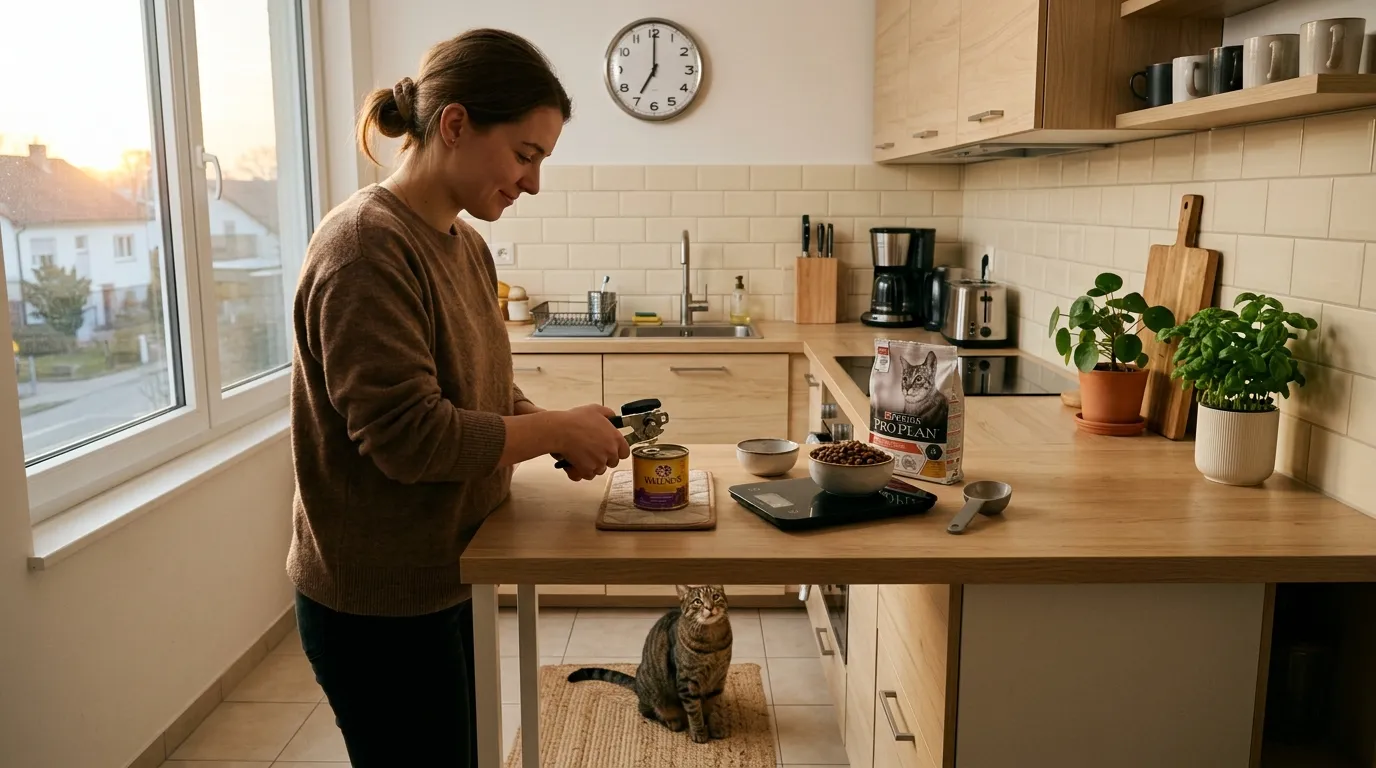
The best feeding schedule for indoor cats is two to three measured meals a day, spaced six to eight hours apart, served at the same times every day. My cat used to pace the kitchen from 4am onward, and I could not figure out why until I moved her last meal forty-five minutes later. The pacing stopped that same week. That is what the right schedule does. It settles a cat down and makes them easier to live with in a small apartment. This guide covers the exact timing, age-based structure, and daily routine that works for most indoor cats, plus the mistakes that quietly undo a good schedule.
Two to three meals, roughly six to eight hours apart, at consistent times. Morning around 7am and evening around 7pm covers most adults. Kittens need three to four meals a day. Never leave dry food out all day in a small apartment. It leads to weight gain faster than most owners expect.
Why Indoor Cats Need a Structured Schedule More Than Outdoor Cats Do
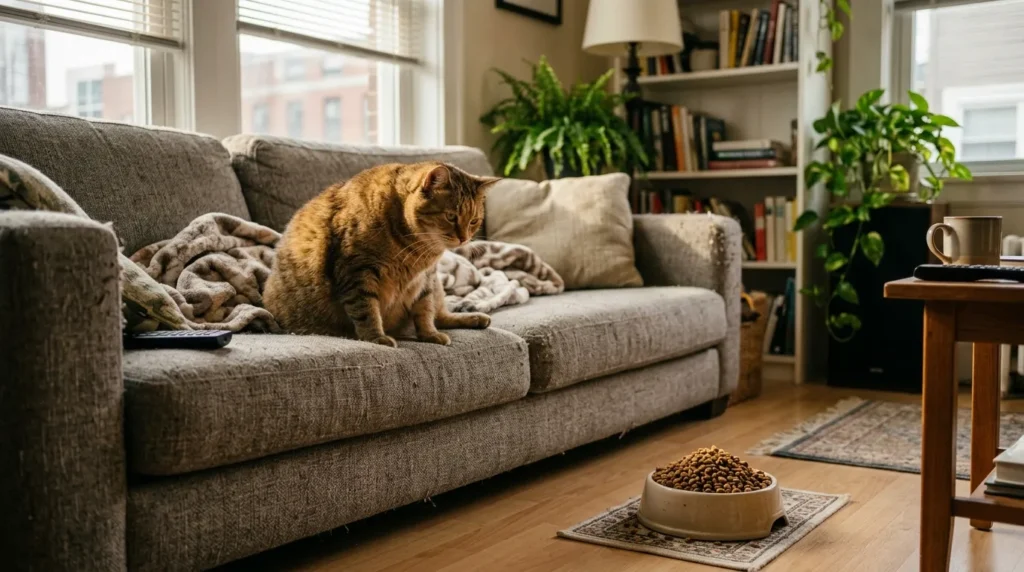
A structured indoor cat feeding schedule matters more for apartment cats than for outdoor cats, because outdoor cats burn real calories hunting and roaming. Indoor cats have no equivalent. They eat when food is available, and boredom sends them to the bowl almost as often as real hunger does. That is one of the trickier parts of keeping a cat healthy in a small apartment with limited room to burn energy.
Without a schedule, a sedentary indoor cat on free-fed dry food will usually eat past their calorie needs within a few months. The weight creeps on slowly enough that most owners miss it until the vet mentions it at a checkup. A timed schedule stops this because you control exactly how much goes in the bowl and when.
There is a behavioral payoff too, one most owners do not expect. Cats on a reliable schedule get calmer between meals. They learn food is coming on time, so they stop shadowing you around the kitchen looking for cues. That drop in food-anxiety is worth building even before you factor in weight control.
The Best Feeding Schedule for Indoor Cats by Age and Life Stage
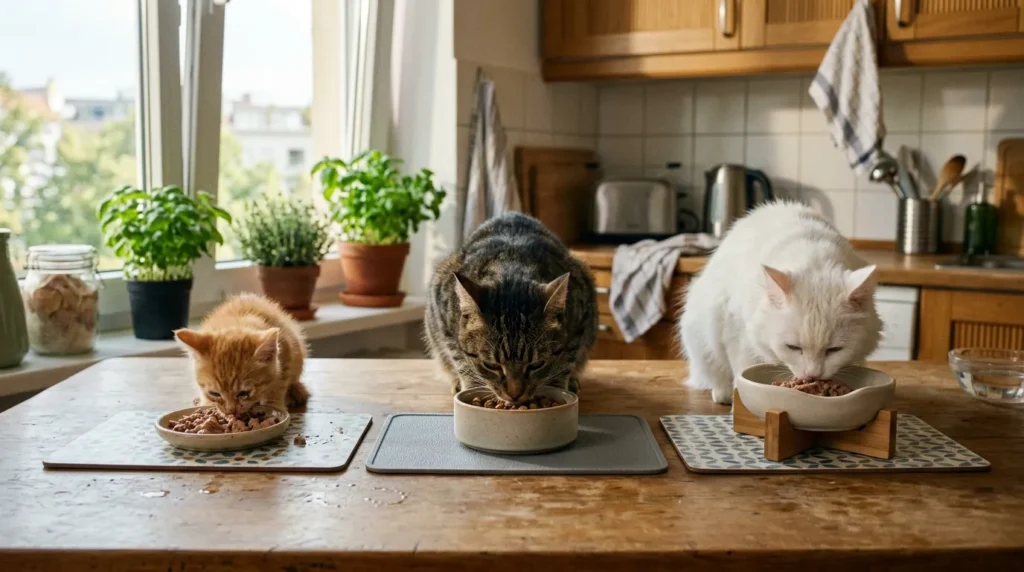
A kitten’s nutritional needs are nothing like an adult cat’s, and a senior’s digestion works differently again. Here is the age-based structure that lines up with current veterinary guidance:
| Life Stage | Age | Meals Per Day | Meal Timing | Key Focus |
| Young kitten | Under 12 weeks | 4 to 6 | Every 3 to 4 hours | Growth support, prevent hypoglycemia |
| Kitten | 3 to 6 months | 3 to 4 | Every 5 to 6 hours | Controlled growth, portion awareness |
| Adolescent | 6 to 12 months | 3 | Every 6 hours | Transitioning toward adult pattern |
| Adult neutered indoor | 1 to 10 years | 2 to 3 | Every 6 to 8 hours | Weight maintenance, consistency |
| Senior | 7 to 10 years | 2 to 3 | Every 6 to 8 hours | Easier digestion, appetite monitoring |
| Geriatric | 11 years and older | 3 to 4 | Every 4 to 6 hours | Smaller portions, kidney and muscle support |
Kittens under six months need the most frequent meals. Their stomachs are small, and their calorie needs per pound run two to three times higher than an adult cat’s. Skip too many meals at that age and blood sugar can drop, causing weakness or lethargy. Four meals a day, from weaning through six months, is the safe standard for indoor kittens with no access to prey.
Senior cats aged seven and up often do better on three smaller meals than two big ones. Smaller portions digest more easily and keep energy steadier through the day as metabolism slows down. Geriatric cats past eleven may need four meals, since appetite gets less predictable and kidneys need more frequent hydration from wet food.
Sample Daily Feeding Schedules That Work for Apartment Cat Owners
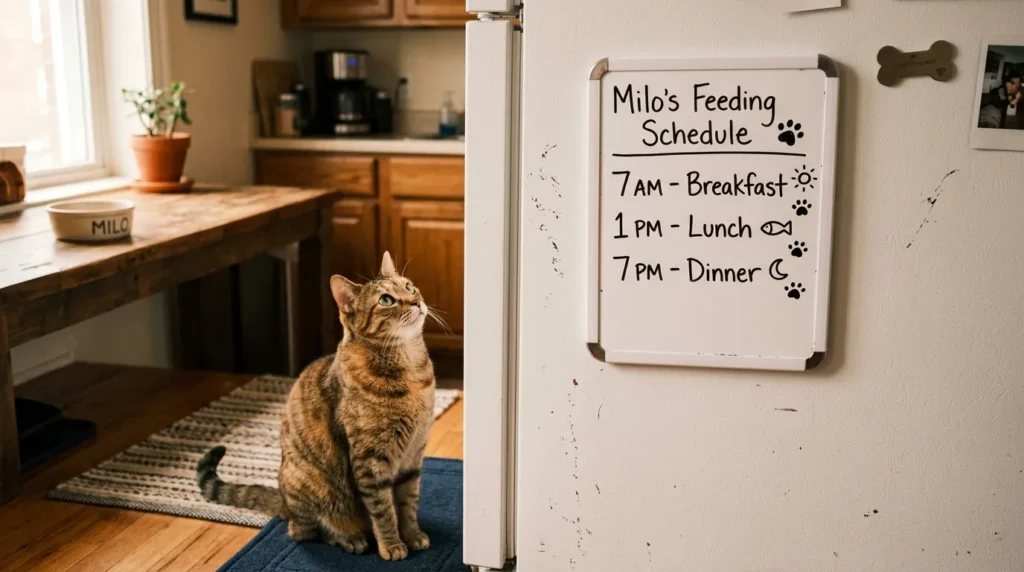
A practical two-meal schedule for a typical adult: 7am when you wake up, 7pm before you wind down. That twelve-hour gap keeps hunger signals low all day without the long overnight stretch that makes cats restless and vocal before dawn.
For cats that beg hard between meals, try three: 7am, 1pm with a timed feeder if you are out at work, and 7pm. That shrinks the longest gap from twelve hours to six and cuts out most of the hunger-driven pestering.
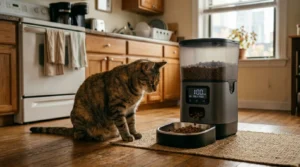
The last meal’s timing matters most for overnight calm. Cats are crepuscular, meaning they are naturally most active at dawn and dusk. A full evening meal right before your bedtime meets that dusk activity peak and makes an early wake-up call far less likely. Ten to fifteen minutes of active play right before dinner mimics the natural hunt-catch-eat cycle. Owners who stick with this for a week usually see noticeably calmer nights.
A few feeder options make the midday gap easier to hold to:
- Manual bowl on a phone-alarm schedule, best if someone is usually home
- Basic timed dispenser for one or two set feeding times a day
- App-controlled feeder with portion tracking, useful for multi-cat homes or irregular work hours
Insight If you work long hours and cannot be home midday, a timed feeder set for 1pm handles the gap reliably. What matters is that your cat hears the feeder go off at the same time daily, rather than waiting for you to appear in the kitchen. Once they learn food comes from the feeder on a schedule, the 5am wake-up calls mostly stop.
Two-Meal vs Three-Meal Schedule: Which Fits Your Cat
Both schedules work. The right one depends on your cat’s begging habits and your own daily routine.
| Schedule | Pros | Cons | Best For |
| Two meals a day | Simple to remember, fits a standard work schedule, easy portion math | Twelve-hour gap can trigger begging in cats with a fast metabolism | Most healthy adult cats, owners who are home morning and evening |
| Three meals a day | Shorter gaps reduce begging, easier on digestion for seniors and kittens | Needs a timed feeder or someone home midday | Persistent beggers, seniors, kittens, multi-cat homes |
If you are unsure which to start with, two meals is the simpler baseline. Add a third only if your cat is still vocal or pacing between the morning and evening meal after two weeks of consistent timing.
How Meal Timing Connects to Portion Size and Weight Control
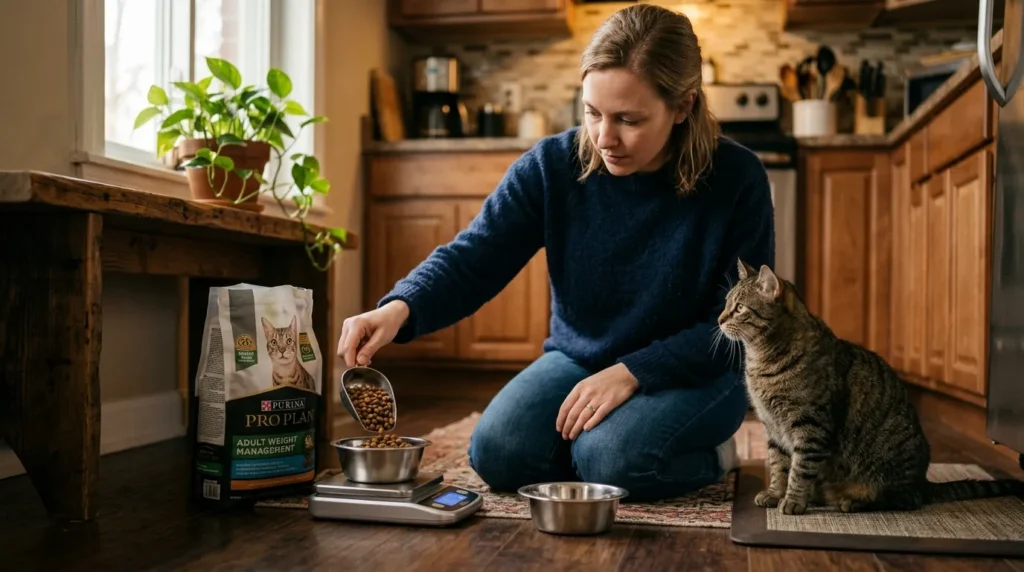
Portion control only works inside a structured schedule, because free-fed food cannot be measured accurately. Once you commit to two or three set meals, you can work out a daily calorie target, divide it by meal count, and know exactly what goes in the bowl each time. That precision, not switching foods and hoping for a different result, is what actually manages weight.
A typical ten-pound neutered adult indoor cat needs roughly 200 to 250 calories a day, depending on activity level. Split across two meals, that is 100 to 125 calories each. Split across three, it is closer to 70 to 85 calories per meal. Those amounts look small in the bowl, especially with dry food, but they are appropriate for a cat that spends most of the day on the sofa. Knowing the math stops the urge to add more just because the portion looks skimpy.
For the full breakdown, including how to translate calorie targets into wet and dry food amounts and adjust for weight, see this guide on how to feed an indoor cat properly. It is the most practical reference for turning the schedule into numbers that fit your specific cat.
The Best Feeding Schedule for Indoor Cats That Use Wet and Dry Food Together
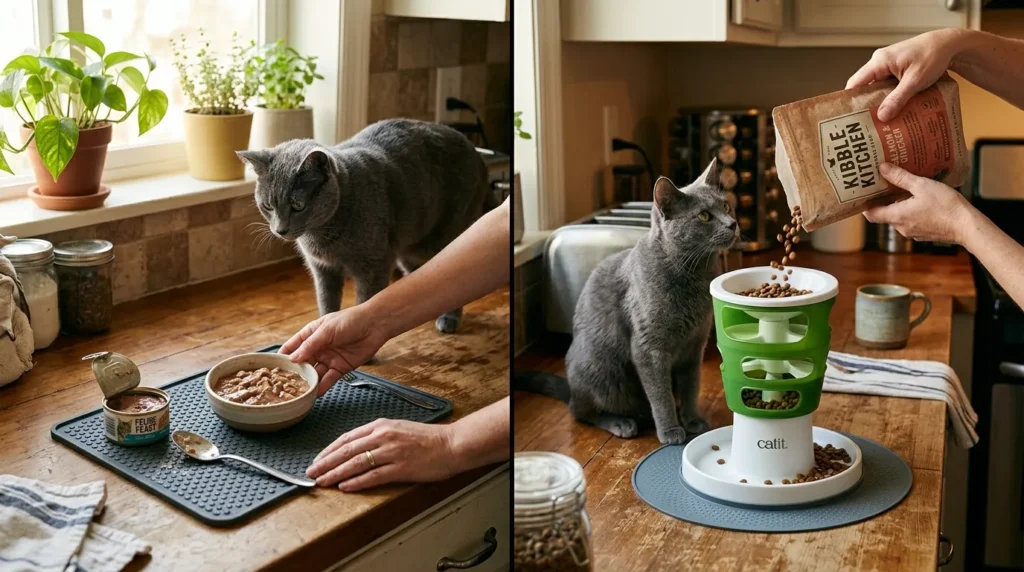
Combination feeding works well when each food type gets its own job in the schedule, instead of being mixed or swapped randomly. Wet food fits the structured morning and evening meals best. It delivers more hydration and protein, and it has to be eaten within a few hours before it spoils. Dry food fits the midday slot, where a puzzle feeder can slow eating down and give a bored indoor cat something to work for.
That split gives your cat the urinary health and fullness benefits of wet food at the main meals, while the midday dry portion does double duty as enrichment. Cats with access to puzzle feeders during the day show noticeably less boredom-driven pacing before dinner. How you offer food matters almost as much as when. For cats spending long stretches alone, this guide on indoor cat enrichment covers food-based enrichment tools that slot into a scheduled routine.
According to the Cornell Feline Health Center, indoor cats eating mostly dry food drink noticeably less water than cats on wet food, and that chronic low moisture intake feeds urinary tract problems over time. Scheduling wet food as a primary meal, not an occasional treat, addresses this directly with no supplements needed.
Insight Keep wet and dry food at separate meal times rather than mixing them in one bowl. Wet food masks the smell and texture of dry kibble, which cuts down how much your cat engages with a puzzle feeder. Separate meals let each food type do its job.
Adjusting the Schedule for Senior Indoor Cats and Multi-Cat Households
Senior cats aged seven and up need a schedule adjustment even if they look healthy and eat normally, because digestion gets less efficient and calorie needs shift. Most healthy seniors do well on three smaller meals instead of two big ones. Smaller portions are easier to process and keep energy steadier, without the crash that follows one large meal digested too fast.
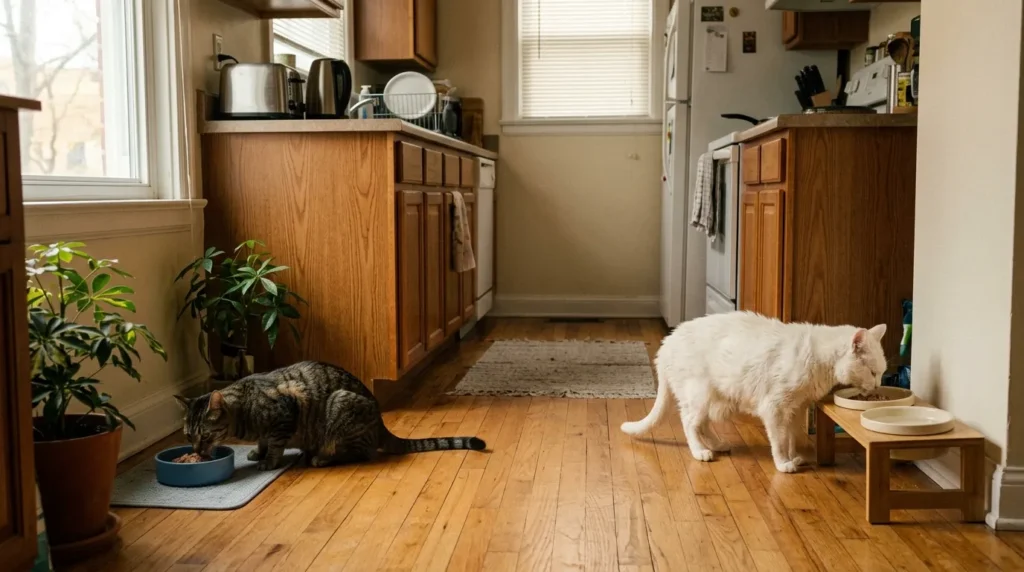
In multi-cat apartments, the fix is spatial, not about timing. Feed each cat at a separate station, in a different spot, at the same time, rather than from a shared bowl. Cats eating side by side tend to eat faster out of competition, and the faster eater often finishes both bowls if one cat wanders off early. Separate stations solve this without you having to supervise every meal. Indoor cat behavior around shared resources and social stress in small apartments is covered in more depth there.
Common Feeding Schedule Mistakes That Undermine the Routine

The most common mistake is inconsistent timing. Feed at 7am one morning and 9:30am the next, because your weekend differs from your weekday, and your cat learns mealtime is a guess. Cats respond by starting food-seeking behavior earlier each day, until the anxiety runs all morning instead of just the last twenty minutes before the meal. Staying within thirty minutes of the target time produces the calmest results.
The second mistake is feeding in response to begging between meals. That builds a direct loop: begging produces food, so the begging gets worse within a week. The better response is distraction through play, not an early meal or a treat. A five-minute wand toy session redirects the energy without teaching the wrong lesson.
The third mistake is setting a schedule once and never revisiting it. What worked at age two may need adjusting at seven, and again at eleven, as metabolism and digestion change. Weigh your cat monthly and treat gradual weight creep, or weight loss, as your cue to revisit portions and timing, rather than waiting for the annual vet visit to catch it.
A quick way to check if your current schedule is actually working:
- Your cat is quiet between meals, not pacing or vocalizing
- Bowls are cleaned within 20 to 30 minutes at each meal
- Weight has stayed within a pound over the last month
- Your cat shows up near the feeding spot shortly before mealtime
If two or more of these are missing, the schedule needs a small adjustment before you change the food itself.
Insight The weekend drift problem is easy to fix. Set a phone alarm for both meal times, seven days a week, until the routine runs on autopilot. Most cats start showing up at the feeding station a few minutes before the alarm within two or three weeks. That is your sign the schedule has become their internal clock too.
When Changes in Eating Habits Signal Something Worth Investigating
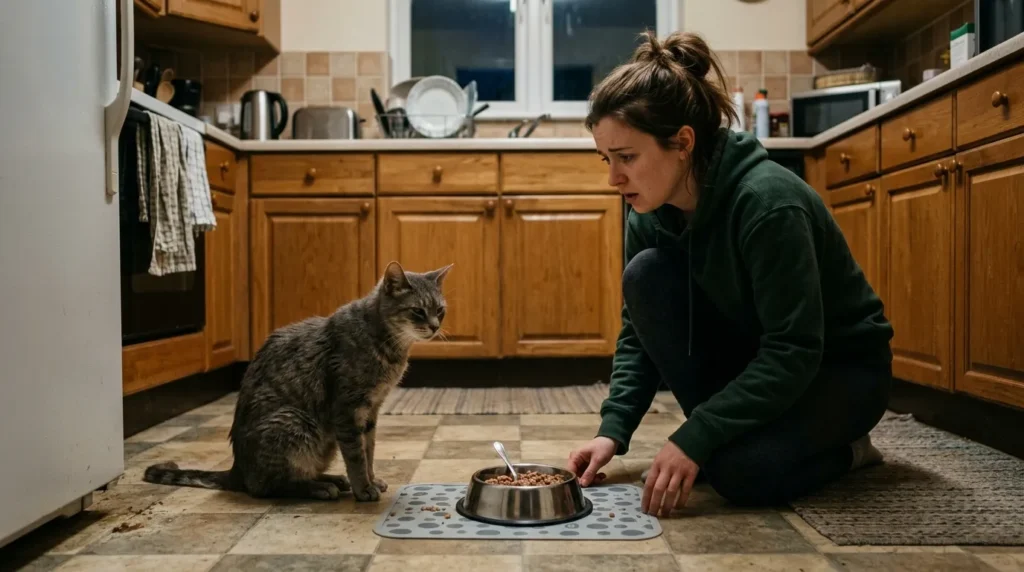
A cat that reliably finishes every meal and then leaves food untouched for two or more days in a row is telling you something. One skipped meal, from stress, a hot day, or a new smell in the apartment, is not a concern on its own. A pattern over several days is different.
Sudden appetite increase paired with visible weight loss is a classic early sign of hyperthyroidism in cats over eight. The cat eats more but loses weight, because the condition speeds up metabolism faster than food can keep up. Diabetes can look similar. Both are treatable when caught early, but get worse fast if missed for months. General indoor cat health monitoring, including weight checks and water intake, catches most of these changes before they become emergencies.
Watch for these combinations specifically:
- Reduced appetite plus increased water consumption
- Weight loss with normal or increased appetite
- Vomiting right after eating, more than twice in a week
Any of these, alongside a change in eating pattern, needs a vet visit within a few days, not a schedule adjustment.
This article is for informational purposes only. Always consult your vet if your cat shows changes in appetite, weight, or eating behavior.
Frequently Asked Questions About the Best Feeding Schedule for Indoor Cats
What is the ideal gap between meals for an indoor cat?
Six to eight hours is ideal for most adult indoor cats. This matches how long it takes the stomach to empty, and it avoids both the prolonged hunger that causes anxious behavior and the too-frequent meals that turn some cats into selective eaters. On a two-meal schedule, twelve hours is the maximum gap before hunger signals get disruptive for most cats.
Is it okay to vary meal times on weekends?
Up to thirty minutes off the regular time is generally fine. Shifts of two or more hours undermine the schedule, because your cat starts feeling real hunger before the delayed meal shows up, and spends that extra time food-seeking. If your weekend routine differs a lot from weekdays, a timed feeder set for the same time daily solves it completely.
Should I feed wet food in the morning or evening?
Both, ideally. If you can only manage one wet meal a day, make it the evening one. Evening wet food meets the post-dusk hunger peak that fits a cat’s crepuscular nature, and the extra moisture before overnight helps dilute urine concentration. Morning wet food has the edge of a guaranteed fresh hydration start to the day.
Is once-a-day feeding okay for an adult indoor cat?
It works for some healthy adults, but it is not the best default. One large meal creates a long overnight gap that often triggers early begging or vomiting from an overfull stomach eaten too fast. Two or three smaller meals spread the same calories more evenly and cause fewer behavior problems.
My indoor cat finishes their meal in two minutes and then begs immediately, what does that mean?
Fast eating followed by immediate begging usually means the portion is genuinely too small for your cat’s calorie needs, or the food has low satiety value. Check whether the daily calorie total matches your cat’s ideal weight before assuming the portion is right. If the calories check out, add a puzzle feeder for the dry portion to slow eating and stretch out fullness.
Can I leave wet food out all day for my indoor cat?
No. Wet food left at room temperature becomes unsafe within two to four hours, and most cats reject it before that anyway once it dries out and loses flavor. Wet food needs scheduled meal timing by design. If you need midday feeding while you are out, use dry food in a timed feeder for that meal and save wet food for the morning and evening meals you can supervise.
Build the Schedule Today and Stick to It
The best feeding schedule for indoor cats is two to three meals at consistent times every day, with portions set by calorie target rather than how full the bowl looks. Start with morning and evening meals twelve hours apart, and add a midday timed-feeder portion if your cat shows hunger-driven pacing or begging between those two. Matching the evening meal to your cat’s natural dusk activity peak makes the biggest difference to overnight calm. Get the timing consistent first. The portions and food type matter, but a cat that trusts the clock settles faster than one chasing a moving target.
The best feeding schedule for indoor cats is two to three measured meals a day, six to eight hours apart, at consistent times. Adult indoor cats do best on meals at 7am and 7pm at minimum, with an optional midday third meal via timed feeder. Kittens under six months need three to four meals daily. Senior cats aged seven and up do better on three smaller meals for easier digestion. Wet food should only be served at scheduled meals due to spoilage risk within two to four hours. Free-feeding dry food all day causes weight gain in most sedentary indoor apartment cats within a few months.

Written by Mishu
A passionate cat lover and indoor living enthusiast, Mishu is the founder and voice behind Indoor Living Cat – a go-to resource for cat owners who want to create the happiest, healthiest life for their feline companions indoors.
View Full Profile