
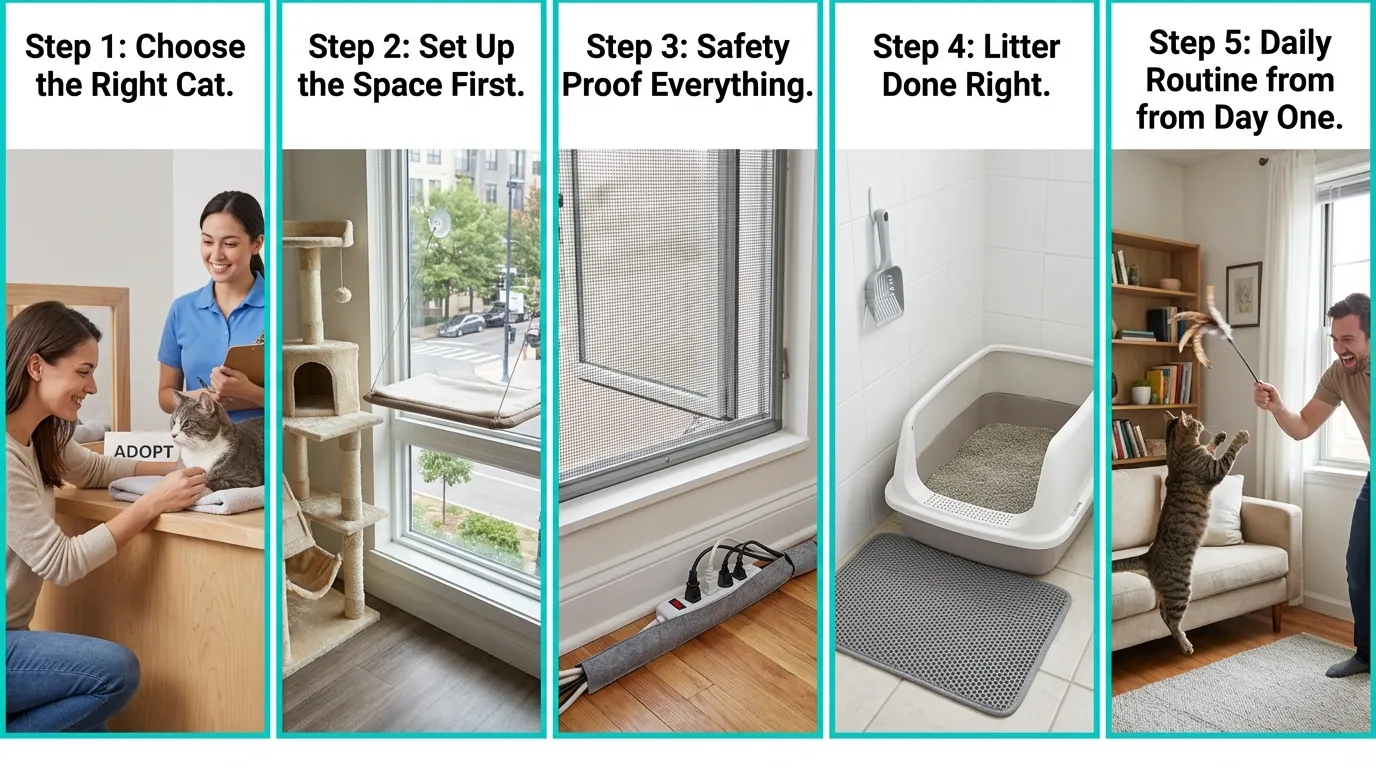
Knowing how to have a cat in an apartment is not complicated, but it requires doing the right things in the right order before your cat comes home.
Having a cat in an apartment means providing a confined indoor space with adequate vertical territory, a correctly positioned litter setup, daily enrichment and a consistent routine that keeps a cat physically and behaviorally healthy without outdoor access. According to the American Association of Feline Practitioners, indoor cats in properly set up environments live 12 to 18 years on average, far longer than cats with outdoor access.
When I brought my first cat into a 480-square-foot apartment I spent the first two weeks fixing mistakes that could have been avoided if I had known what to set up before she arrived. The litter box was in the wrong room, the water was too close to the food and I had not thought about vertical space at all. Every one of those mistakes was corrected once I understood what cats actually need in a small space.
This guide covers every step of cat apartment living: choosing the right cat, whether your space is even big enough, preparing the apartment, the first week, litter and odor management, enrichment, safety, dealing with landlords and building a routine that holds up long-term. Every section connects to a deeper resource for the specific topic you need most right now.
To have a cat in an apartment successfully, choose a calm adult cat or low-energy breed, set up a tall cat tree and vertical space before your cat arrives, position the litter box in a private location away from food, establish a twice-daily feeding and play schedule from day one and safety-proof windows and cords before move-in. The setup done before your cat arrives determines 80 percent of how well the arrangement works.
How to Have a Cat in Apartment: What to Do Before You Bring One Home?
The single most important insight about how to have a cat in an apartment is this: the setup you create before your cat arrives determines how smoothly the first months go. Most new owners buy a cat first and figure out the living arrangement afterward. That sequence creates avoidable problems.
A cat introduced to a properly set up space adapts within days. One introduced to an unprepared space spends weeks exploring unsafe or inappropriate areas and settling into habits in the wrong locations, habits that can take months to undo.
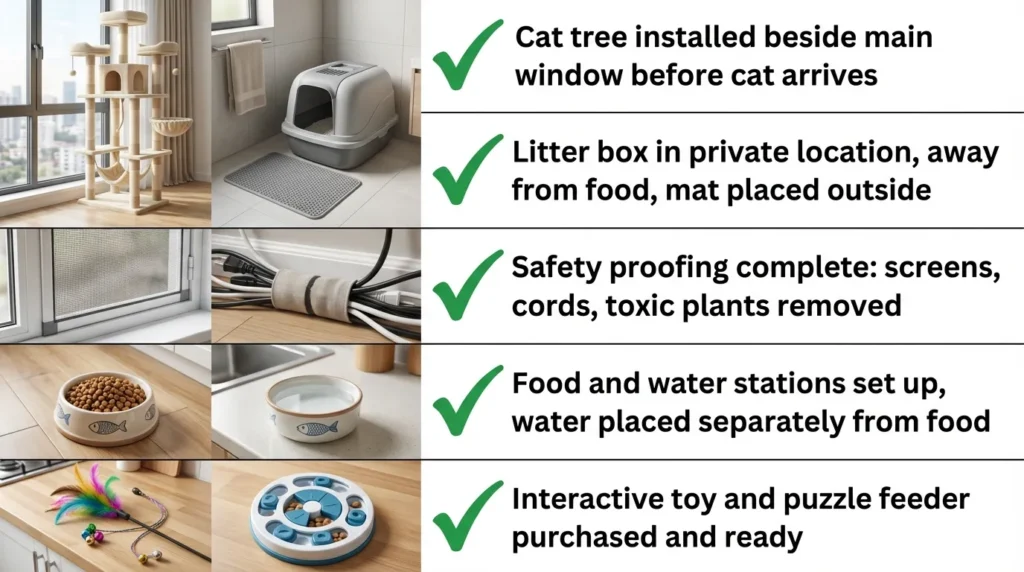
Complete these steps before your cat comes home:
- Install a tall cat tree of at least 60 inches beside your main window. This is your cat’s primary territory. Have it ready before day one.
- Position the litter box in a private low-traffic location, ideally a bathroom or quiet corner, at least 10 feet from any food or water.
- Place a litter mat outside the box and keep scooping supplies beside it. Build the daily scooping habit before the cat arrives.
- Secure windows with stops or reinforced screens. Cover all exposed electrical cords with cable management sleeves.
- Remove or relocate all toxic houseplants. The ASPCA maintains a complete toxic plant list at aspca.org.
- Set up separate food and water stations in different locations. Place a water fountain or wide flat water bowl well away from the food bowl.
| Owner’s Tip
Most of the advice about having a cat in an apartment focuses on what to do once the cat is home. The advice that actually saves you the most difficulty is what to do the week before. Spend two hours setting up the environment correctly before your cat arrives and you will skip most of the behavioral problems that trip up new apartment cat owners in the first 30 days. |
Is There a Minimum Apartment Size for a Cat?
[IMAGE PLACEHOLDER: infographic comparing a studio, one-bedroom and two-bedroom apartment layout with cat setup elements marked in each]
There is no official minimum apartment size for a cat, and no housing authority or veterinary body sets one. I get asked this constantly, and the honest answer surprises people: a 350-square-foot studio with a full vertical setup is a better home for a cat than a 1,500-square-foot apartment with none. Square footage is not the variable that matters. Usable vertical territory is.
Cats climb, perch and survey from height in the wild. An apartment that gives a cat three or four feet of climbable vertical space along one wall functions like a much bigger home, because the cat is using square footage you are not using yourself.
That said, size does change what you should plan for:
| Apartment Size | Is It Enough for a Cat? | What You Need to Add |
|---|---|---|
| Studio (300–500 sq ft) | Yes, for one calm adult cat | Full vertical setup: tall cat tree by the window, wall-mounted shelves, a window perch. Litter box in the bathroom or a screened corner, away from the bed and kitchen. |
| One-bedroom (500–800 sq ft) | Yes, for one or two cats | A dedicated litter zone separate from the living area. Vertical space is still the priority, not floor space. |
| Two-bedroom or larger | Yes, comfortably supports two or more cats | One litter box per cat plus one extra, spread across at least two rooms. Separate feeding stations if the cats do not eat well together. |
If you are asking “can I have a cat in an apartment” because your space is small, the answer is almost always yes. The exceptions are apartments with no safe window ledge or wall space for vertical furniture at all, or households already over the density a landlord’s pet policy allows. Check your lease before you check your square footage.
Choosing the Right Cat for Apartment Living
[IMAGE PLACEHOLDER: side-by-side comparison of a calm low-energy cat breed resting on a windowsill versus a high-energy breed mid-jump]
The cat you choose predicts more about your daily experience than any piece of furniture you buy. A high-energy cat in a small apartment without enough stimulation gets destructive fast. A calm cat in the same space settles in within a week.
Adult cats between 2 and 4 years old are the better pick for a first apartment cat. Their personality is already set, so you know exactly what you are bringing home. Kittens are wonderful, but they go through 12 to 18 months of high-energy, exploratory behavior that is harder to manage in 500 square feet than in a house with a yard.
Low-energy, apartment-friendly breeds and temperaments to look for:
- British Shorthair: calm, independent, tolerates being alone well.
- Ragdoll: affectionate but low-activity, does well in small spaces.
- Persian: sedate and content with a quiet indoor routine.
- Domestic shorthair adults from a shelter: often the most reliable pick, since shelter staff can tell you the cat’s actual temperament rather than a breed generalization.
Breeds that need more room to run before they thrive in an apartment:
- Bengal: high energy, needs daily active play or redirects that energy into destructive behavior.
- Abyssinian: constantly active, does best with a large vertical circuit and a second cat for company.
- Siamese: vocal and demanding of interaction, not a fit for owners who are out 10-plus hours a day.
None of this rules a high-energy breed out of apartment life. It just means the setup and the daily play commitment have to be non-negotiable, not optional. For a full breakdown by energy level and vocalization, see our guide to best cat breeds for apartment living. This is general guidance, not medical advice. A vet or shelter behaviorist can help you match a specific cat to your specific routine.
The First Week With a Cat in an Apartment: How to Start Right?
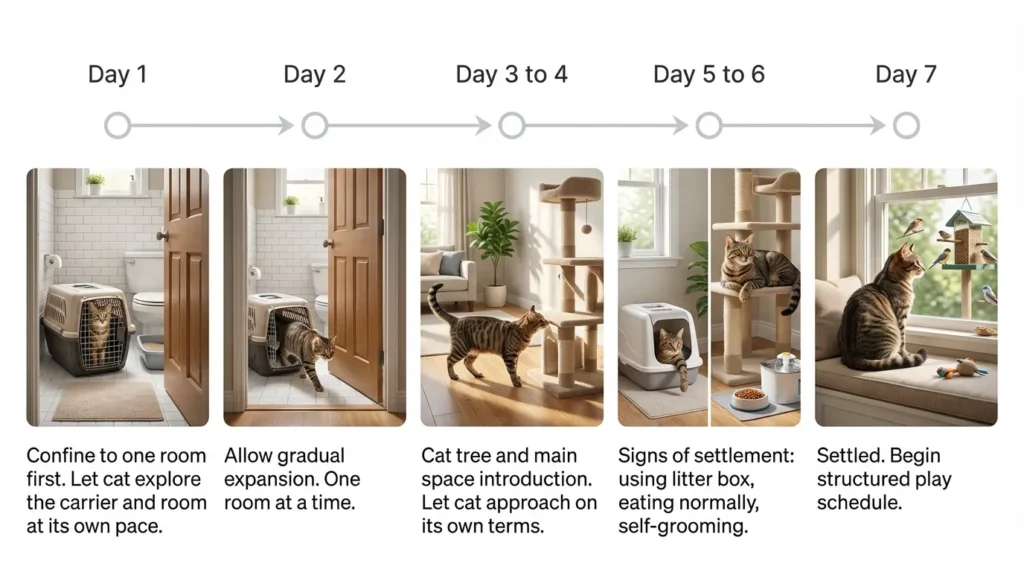
The first week with a new cat in an apartment sets the behavioral foundation for everything that follows. A cat introduced too quickly to the full apartment becomes overwhelmed. A cat given a structured, gradual introduction settles faster and develops fewer anxiety-based behaviors in the months ahead.
Start with confinement to one room. This is the most important and most frequently skipped step when bringing a cat home to an apartment. Put your new cat in a single room with the litter box, food, water and a hiding spot. Let the cat explore and settle there before expanding access to the rest of the apartment.
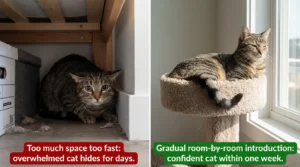
Most new cats need 3 to 5 days in the single room before they show confident exploration behavior: walking upright rather than crouching, approaching you voluntarily and grooming themselves normally. These are your signals that your cat is ready to explore the next room.
Do not rush the timeline. A cat that takes 7 days to settle when given a gradual introduction is calmer long-term than one given free access immediately and left to spend two weeks hiding under furniture trying to map an overwhelming space.
Key first-week rules that make the biggest difference:
- Keep the litter box in the same location from day one. Moving it after a cat has memorized its location causes avoidance accidents.
- Feed at the same times every day from the first meal. Routine is the fastest way to reduce new-environment anxiety in cats.
- Do not force interaction. Sit on the floor in the cat’s room and let it approach you. This builds trust three times faster than picking the cat up.
- Begin short play sessions from day three using a wand toy. Active play establishes bonding and starts the routine that prevents behavioral problems later.
Setting Up Your Apartment Space So Your Cat Actually Uses It
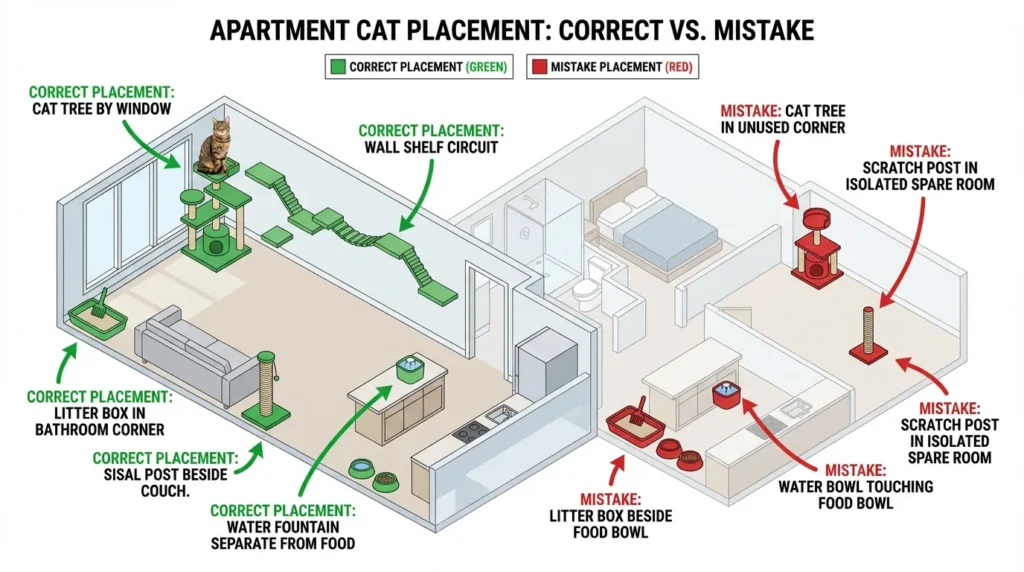
Getting your cat set up in a small apartment means thinking about three things at once: where your cat will sleep, where it will scratch and where it will watch its territory from above. Most apartment cat setups address one of these. A complete setup addresses all three, and the difference in your cat’s behavior shows up within the first week.
Vertical space is the non-negotiable foundation. Cats experience their environment vertically, not horizontally. A cat with floor-to-ceiling territory in a 400-square-foot studio has more functional living space than a cat with a 1,200-square-foot apartment that only offers floor-level access.
The space elements that matter most, in order of impact:
- Tall cat tree of at least 60 inches, positioned beside the window your cat gravitates toward naturally.
- Sisal scratching post placed beside the piece of furniture your cat is already scratching. Not in a corner. Beside the target.
- Window perch with an outdoor bird feeder mounted outside: hours of passive stimulation daily with zero effort after the initial setup.
- Wall-mounted shelves at staggered heights along one wall: creates a complete climbing circuit using wall space your furniture cannot occupy.
- One cardboard box or paper bag changed every two weeks: free, zero floor space and registers as novel territory every time.
Litter Box Setup and Smell Control When You Have a Cat in an Apartment
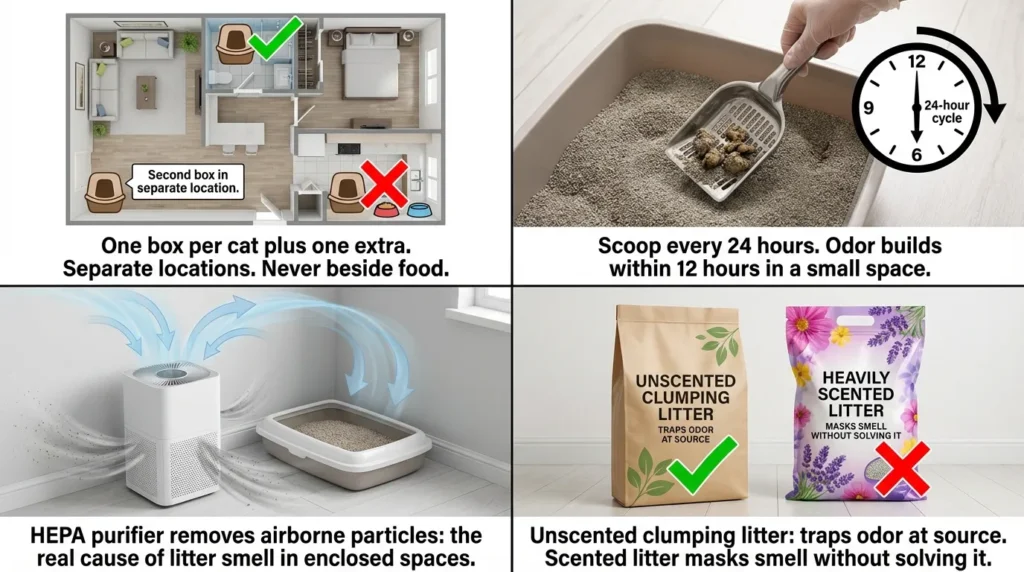
Litter management is the single biggest practical concern for anyone learning how to have a cat in an apartment, and it is the one area where doing it right from the start makes the whole arrangement sustainable long-term.
Knowing how to get rid of cat smell in an apartment starts before the smell appears. The combination that eliminates litter odor in small spaces is unscented clumping litter, daily scooping, a litter box large enough for your cat to turn around fully inside and a HEPA air purifier within 6 feet of the box.
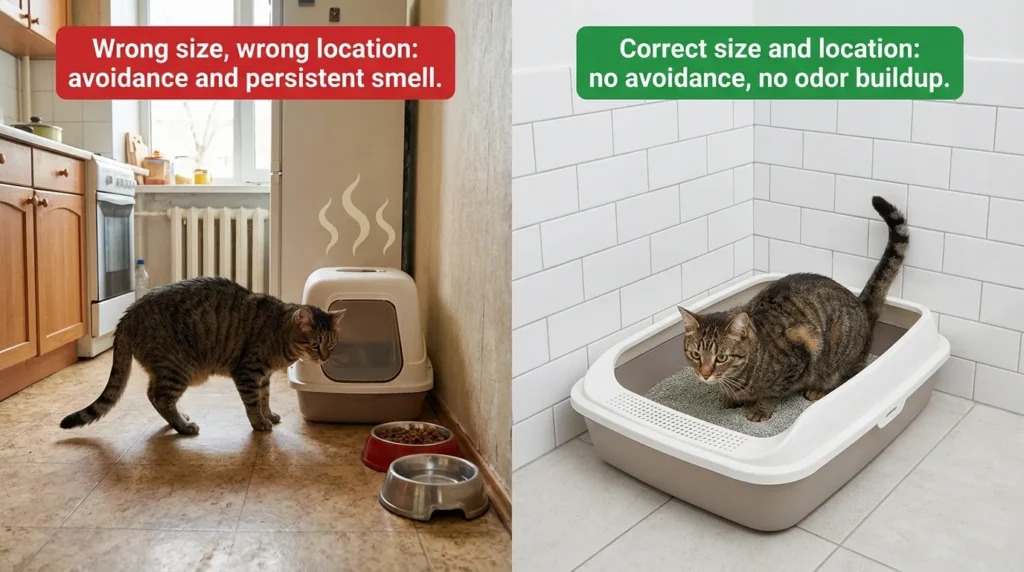
The litter rule that no apartment cat owner can afford to skip: one box per cat, plus one extra, in at least two separate locations. That is not excessive. It is the minimum that prevents the territorial litter avoidance that causes cats to eliminate outside the box.
The complete odor management system for apartment cat owners:
- Large uncovered litter box: at least 1.5 times the length of your cat. Covered boxes trap odor and deter use.
- Unscented clumping litter: never scented. Scented litter adds fragrance to odor instead of eliminating the source.
- Scoop every 24 hours without exception. In a small space, 48 hours is too long.
- Full litter change every 7 to 14 days depending on cat count.
- HEPA air purifier within 6 feet of the litter area: removes the airborne particles that create litter smell in enclosed spaces.
- Litter mat outside every box: captures 80 percent of tracking before it spreads through the apartment.
Building a Daily Routine When You Have a Cat in an Apartment
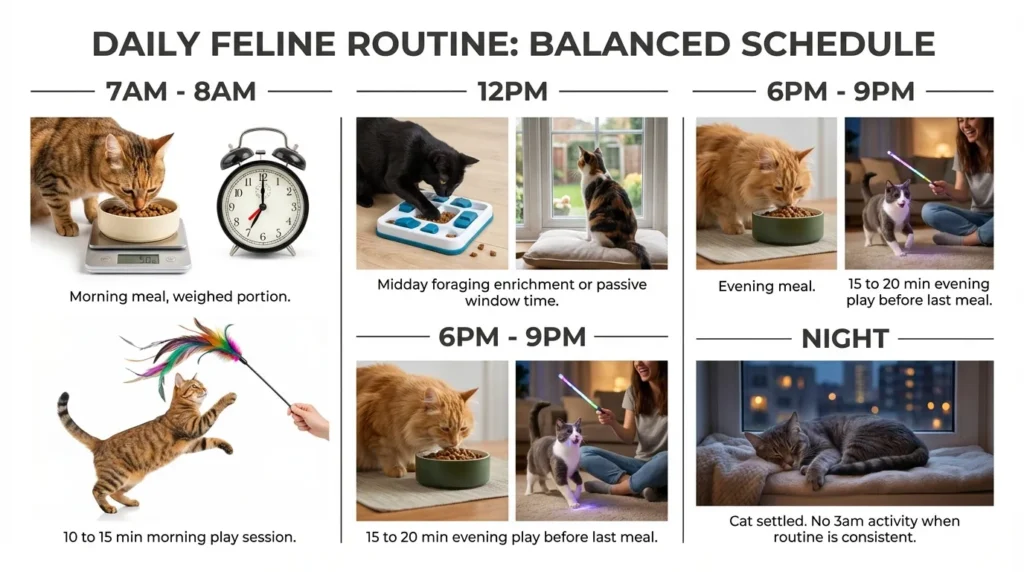
Knowing how to keep cat happy studio apartment comes down to one principle: predictability. A cat that knows exactly when meals are coming, when play happens and when you go to bed develops the calm, settled behavior that makes apartment living genuinely pleasant for both the cat and the owner.
The daily routine for an apartment cat does not need to be complicated. The two non-negotiable elements are two measured meals per day at consistent times and at least 15 minutes of active interactive play before the evening meal. Everything else builds on top of those two foundations.
The daily enrichment elements that keep apartment cats behaviorally healthy:
- Morning meal at a consistent time every day, weighed on a kitchen scale, not estimated.
- 10 to 15 minutes of wand toy play in the morning if your schedule allows, or saving both sessions for evening.
- Passive enrichment during your work hours: window perch with bird feeder, puzzle feeder at one meal, cat grass on a windowsill.
- 15 to 20 minutes of evening wand toy play immediately before the final meal of the day.
- Toy rotation every 3 to 4 days. Store toys out of sight between sessions. Novelty is the most effective engagement tool available.
| Owner’s Tip
The play-then-feed sequence in the evening eliminated every behavioral problem my cat had in the apartment within two weeks of implementation. She stopped waking me up at 3am, stopped knocking things off shelves at midnight and stopped meowing at the bedroom door. The sequence replicates the natural hunt-eat-sleep cycle. A cat that completes that cycle has no reason to be active at night. It is the single highest-impact behavioral change available to any apartment cat owner. |
How to Have a Cat in an Apartment? Dealing With Landlords and Leases

The landlord conversation is the step most people have after deciding to get a cat rather than before. Having it first saves significant problems. Knowing the pet policy of your current or future apartment before you commit to a cat is the practical starting point.
Most US apartment landlords allow cats with a pet deposit ranging from $200 to $500 and sometimes a monthly pet rent of $25 to $75. These are negotiable in many cases, especially with private landlords or in markets with lower demand. A well-prepared tenant with documentation is in a much stronger negotiating position than one who simply asks permission verbally.
What to prepare before approaching a landlord about having a cat:
- A pet resume: one page with your cat’s photo, age, vaccination records, spay/neuter certificate and a note from a previous landlord confirming no damage.
- Offer to provide renter’s insurance with pet liability coverage included. This directly addresses the landlord’s primary concern.
- Offer a higher security deposit or a professional carpet cleaning clause at move-out. This removes the financial risk objection.
- Mention the indoor-only lifestyle explicitly. Landlords’ main cat concerns are scratching, odor and escape. Each of these is addressed by an indoor-only setup with proper furniture.
- Get everything in writing. A verbal approval that is not in the lease is not enforceable and creates future conflict.
Apartment Safety Checklist Before Your Cat Comes Home
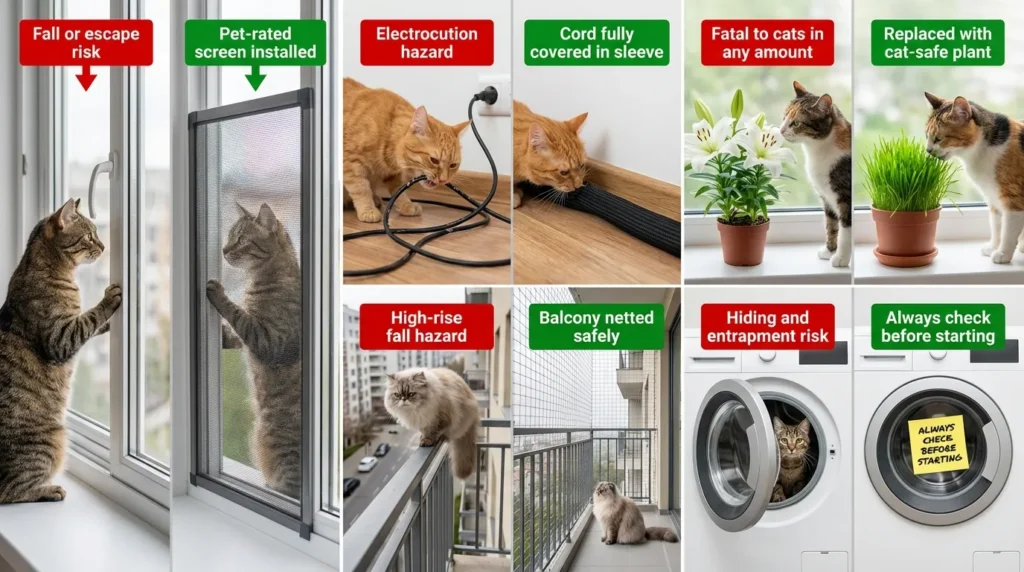
The apartment cat proofing checklist is not optional, and it should be finished before your cat sets foot in the apartment. Most of the hazards that injure or kill apartment cats are preventable in under two hours of preparation.
Window security is the highest-priority safety task in any apartment above ground level. A determined cat moving at speed can push through an unsecured screen. Window stops limit how far a window opens, and pet-rated screens are built to hold a jumping cat without giving way.
Non-negotiable safety steps before any cat enters an apartment:
- Secure all windows with stops or reinforced pet-rated screens.
- Cover all exposed electrical cords with cable management sleeves.
- Remove or relocate all toxic plants. Lilies are fatal. Pothos is toxic. Check every plant against the ASPCA list.
- Install balcony mesh netting or a catio structure if the apartment has any outdoor access.
- Check inside washing machines, dryers and refrigerators before every use. Cats investigate dark enclosed spaces, especially new ones.
- Remove or contain small swallowable objects: rubber bands, hair ties, plastic bags, twist ties and coins.
Everything We Cover on Having a Cat in an Apartment: Your Full Resource Library
Find the one that matches your most immediate question and start there.
How to Keep a Cat Happy in a Studio Apartment?
A studio presents the tightest space challenge for a cat owner and it is fully solvable. This article covers the specific layout decisions, enrichment priorities and daily habits that keep a cat behaviorally healthy in under 500 square feet, with practical guidance for the constraints unique to single-room living.
Get the full studio-specific guide in our article on how to keep cat happy studio apartment.
The Complete Apartment Cat Proofing Checklist
Most apartment cat owners skip the safety preparation step entirely because no one explains it clearly before the cat arrives. This article provides a room-by-room safety checklist with specific product recommendations, installation instructions and renter-friendly alternatives for every hazard.
Complete your safety setup with our full apartment cat proofing checklist.
How to Get Rid of Cat Smell in an Apartment?
Cat smell in an apartment has three distinct sources, and each requires a different solution. This article identifies all three and gives you the specific daily habits, product recommendations and air quality strategies that remove odor at the source rather than masking it.
Get the complete odor elimination system in our guide to how to get rid of cat smell in apartment.
Best Cat Breeds for Apartment Living
The breed you choose predicts more about your day-to-day apartment experience than almost any setup decision. This article covers the top apartment-compatible breeds with specific notes on energy level, vocalization, independence and what each one actually demands from an owner living in a small space.
Find your ideal breed in our guide to best cat breeds for apartment living.
Is It OK to Have a Cat in a Small Apartment?
This is the question almost every new apartment cat owner searches, and the answer needs more nuance than a simple yes. This article looks at the welfare research, names the specific conditions that make a small apartment genuinely good for a cat and explains which setup features are non-negotiable regardless of size.
Get the full honest answer in our article on is it ok to have cat in small apartment.
How to Set Up Cat Space in a Small Apartment?
Setting up a proper cat environment in a small space requires specific decisions about furniture placement, litter location and enrichment station positioning. This article provides a room-by-room setup guide with exact placement logic, measurement recommendations and budget-friendly renter alternatives.
Build the right setup from the start with our guide to how to set up cat space in small apartment.
Moving to a New Apartment With a Cat
Moving is one of the most stressful events in a cat’s life, and how the transition is handled determines how quickly your cat settles. This article covers the week-before preparation, the move-day protocol, the room introduction sequence and the specific behavioral signals that tell you your cat is adjusting well.
Plan a stress-free move with our guide on moving to new apartment with cat.
How to Keep Your Apartment Clean With a Cat?
A clean apartment and a cat require specific systems for fur, litter and dander that most first-time owners never set up because the guidance is scattered. This article provides a complete weekly maintenance routine with specific tool recommendations and realistic time estimates for small spaces.
Get the complete cleaning system in our article on how to keep apartment clean with cat.
First Apartment With a Cat: Everything You Need to Buy
The first-time apartment cat shopping list that circulates online is usually either too long or missing the items that genuinely matter. This article provides a prioritized list with specific product categories, honest cost estimates and clear guidance on what must be ready before your cat arrives versus what can wait.
Shop smart with our complete guide to first apartment with a cat what you need.
Two Cats in a Small Apartment: What It Actually Requires?
Two cats in a small apartment can coexist peacefully or become a source of constant stress depending entirely on how resources are distributed and how the introduction is managed. This article covers the resource math, the introduction protocol and the vertical space configurations that allow two cats to share a small space without territorial conflict.
Set up your two-cat home correctly with our guide to two cats in small apartment.
| Owner’s Tip
Every article above links back to this guide when you want the full picture again. That two-way connection is exactly how the topic cluster works and how each article gains ranking strength from the others. Everything on IndoorLivingCat.com is written specifically for people keeping cats in small US apartments and homes. Not generic cat advice adapted from large-home guidance. Small-space specific from the first sentence of every article. |
The Most Common Mistakes When Having a Cat in an Apartment
The most common mistake when having a cat in an apartment for the first time is giving the cat access to the entire space immediately. This seems kind but it produces anxiety in most cats. A new cat in a new space needs to map and claim territory gradually. Starting with one room and expanding access as the cat shows confidence is the protocol that produces settled, calm apartment cats.
The second most common mistake is placing the cat tree in the wrong location. A cat tree in a corner away from windows is decorative. A cat tree beside a window with an outdoor view is functional territory. The exact same piece of furniture in two different positions produces completely different levels of use.
The third mistake is treating litter box placement as an afterthought. The litter box location is one of the most important decisions in the entire apartment setup. It must be private, quiet, accessible at all times and physically separate from food and water. Getting this right from day one prevents the litter avoidance issues that are among the most frustrating behavioral problems in apartment cats.
The fourth mistake is picking the wrong cat for the space and then blaming the apartment. A high-energy breed left alone for 10 hours a day in 500 square feet with no vertical setup will scratch furniture and yowl at night regardless of how nice the apartment is. That is a mismatch between cat and setup, not proof that apartments are bad for cats.
Frequently Asked Questions About Having a Cat in an Apartment
Can I have a cat in an apartment?
Yes, in almost every case. Check your lease for a pet clause or breed and weight restrictions first, then focus your energy on the setup: vertical space, a properly placed litter box and a daily routine. The apartment itself is rarely the limiting factor. The setup and the landlord’s policy are.
Can cats live in apartments?
Yes. Cats are territorial rather than distance-roaming animals, which is why they adapt well to a fixed indoor space when that space includes height, hiding spots and a predictable routine. Indoor apartment cats also live 12 to 18 years on average, well past the 2 to 5 years typical for cats with regular outdoor access.
Is there a minimum apartment size for a cat?
No. There is no square footage cutoff below which a cat cannot live comfortably. A well set up 350-square-foot studio works better for a cat than a large apartment with no vertical furniture or enrichment. See the size comparison table above for what to prioritize at each apartment size.
Can I have a cat in a studio apartment?
Yes. A studio apartment is a workable environment for one cat when the setup is correct. The priority is vertical space, not floor space. A tall cat tree beside the main window, wall-mounted shelves creating a climbing circuit and a window perch give a cat in a studio more functional territory than a poorly set up larger apartment. Most behavioral problems in studio-cat situations trace back to insufficient vertical territory, not the studio’s size.
Is it cruel to keep a cat in an apartment?
No, when the environment is set up correctly and the daily routine includes adequate enrichment. Indoor apartment cats live 12 to 18 years on average compared to 2 to 5 years for cats that go outdoors regularly. The indoor environment protects cats from vehicles, predators and infectious disease. A well-enriched apartment cat is not disadvantaged by the absence of outdoor access. Cruelty in indoor cat keeping comes from neglecting enrichment needs, not from the apartment itself.
How do I introduce a cat to a new apartment for the first time?
Confine your new cat to one room with the litter box, food, water and a hiding spot for the first three to five days. Let the cat explore that space fully before expanding access. Avoid forcing interaction. Sit on the floor in the room and let the cat approach you on its own timeline. Begin short wand toy sessions from day three. Expand to the next room only when your cat is displaying confident body language: upright walking, normal eating and voluntary grooming.
What do I say to my landlord when asking to get a cat?
Prepare a pet resume before the conversation: vet records, vaccination certificate, spay/neuter confirmation and a brief note on your cat’s indoor-only lifestyle. Offer a higher security deposit or a professional carpet cleaning clause at move-out. Mention renter’s insurance with pet liability coverage. Frame the conversation around reducing the landlord’s financial risk rather than asking for a favor. Private landlords tend to be more flexible than corporate property management companies.
Should I get a kitten or adult cat for my first apartment?
An adult cat of 2 to 4 years is the better choice for a first apartment. Their personality is already established, so you know what you are getting. Adult cats are calmer, less destructive and require less intensive supervision than kittens, who are in an exploratory, high-energy phase for 12 to 18 months. A calm adult rescue cat from a shelter is often the most reliable apartment choice available, regardless of breed. This is informational guidance. Your vet can advise on what suits your specific lifestyle.
How long can I leave a cat alone in an apartment?
Most adult cats tolerate being alone for 8 to 10 hours without behavioral problems when the apartment has adequate passive enrichment: a window perch, foraging options and accessible hiding spots. Beyond 10 hours, the absence of interaction starts to produce anxiety in some cats. Kittens under 6 months should not be left alone for more than 4 to 6 hours. If your work schedule regularly exceeds 10 hours, passive enrichment setup becomes non-optional, and a second cat companion is worth considering.
The One Step That Changes Everything
Knowing how to have a cat in an apartment successfully comes down to three things done consistently from the beginning: set up the vertical space and safety features before your cat arrives, position the litter box correctly from day one and build the play-then-feed evening routine in the first week. These three actions address 90 percent of the behavioral and practical problems that make apartment cat ownership difficult.
If you are preparing your apartment right now, the first apartment with a cat what you need guide gives you the complete prioritized shopping list and setup order so you know exactly what to buy and what to do before your cat comes home.
To have a cat in an apartment successfully: install a cat tree of at least 60 inches before the cat arrives, position one litter box per cat plus one extra in private locations away from food, scoop every 24 hours and use a HEPA air purifier near the litter area. There is no minimum apartment size for a cat; vertical space matters more than square footage, and a small, well-set-up studio works better than a large, unfurnished apartment. Confine new cats to one room for three to five days before expanding access. Choose a calm adult cat or low-energy breed for a first apartment cat. Feed two measured meals daily and provide 15 to 30 minutes of wand toy play before the evening meal. Indoor apartment cats live 12 to 18 years with proper setup.