

I learned how to set up cat space in a small apartment slowly and expensively, by buying things in the wrong order. First purchase: a wide three-tier cat tree that ate a third of my living room floor. My cat used one shelf on it twice, then ignored the whole thing for good. What I figured out after that is that this has nothing to do with adding more furniture to the floor. It’s about using the walls, the windows, and the layout you already have to build distinct zones that match a cat’s actual behavioral needs, not just zones that look like enrichment in a product photo. Here’s the six-step process, in the order that actually produces results.
The Six-Step Setup Order
Set up cat space in a small apartment in this sequence: map the three key zones before buying anything, install two to three wall shelves at different heights near the most active window, position a narrow cat tree at that window as the access route, add a hidden litter station in a quiet corner, and create one floor-level hiding spot from a plain cardboard box. That five-element foundation covers every behavioral need a single apartment cat has, and it holds up just as well in a 400-square-foot studio as it does in a two-bedroom.
Step 1: Map the Space Before Buying Anything

Start with ten minutes of looking at the space rather than ordering cat furniture. Stand in the center of the apartment and identify three things: which window sees the most outdoor activity, which wall has the longest uninterrupted vertical run from floor to ceiling, and which corner stays quietest and least trafficked through the day. Those three spots are where the entire setup will live.
The window with outdoor activity becomes the anchor point for what I think of as the cat’s vertical superhighway. Every part of the climbing route points toward it, since that’s what makes the high perches worth using instead of decorative. A shelf at ceiling height beside a blank wall gets visited once. The same shelf beside a window with birds outside gets used for hours a day.
The quiet corner becomes the litter station. In a small apartment, the box needs to sit as far as possible from where you sleep and eat, while still offering a clear approach path the cat can survey before committing to using it. Cats approach a litter box cautiously, and one shoved into an exposed, high-traffic spot gets used under protest, then eventually avoided altogether.
Step 2: Install Vertical Territory Before Anything Else
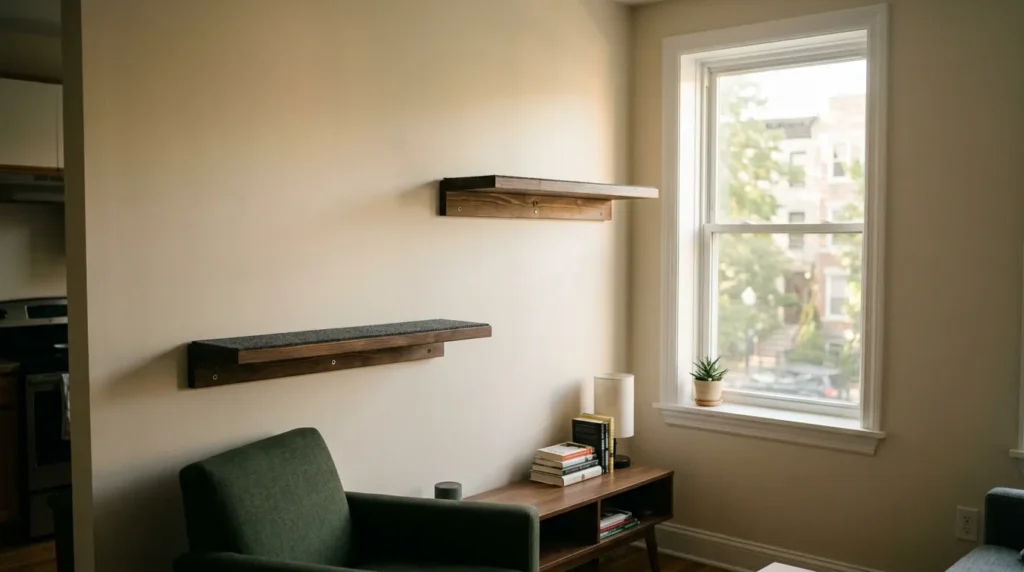
Vertical territory goes in first because it sets the quality ceiling for everything else in the space. Two wall shelves at different heights, connected by a cat tree, deliver more behavioral value than any amount of floor-level furniture, since they give the cat distinct elevated territories rather than more of the same flat height. Put the higher shelf around head height and the lower one at hip height, spaced so she can jump between them in a single comfortable stride.
A quick note if you’re renting and nervous about this: most leases allow small anchor holes, and a handful of properly filled screw holes rarely shows up as a deposit issue. Find the studs before you mark anything, and anchor into solid framing rather than drywall alone. A shelf that flexes or drops under a jumping cat won’t get used again, no matter where you put it, and patching two or three small holes at move-out takes about ten minutes with spackle.
Width matters more than most people expect. A shelf sixteen to twenty inches wide lets her lie flat across it, which produces hour-long resting sessions instead of brief visits. A shelf that’s only ten inches wide forces an alert, upright sit that’s physically uncomfortable to hold for long, and she’ll abandon it within minutes.
Step 3: Position the Cat Tree as an Access Route, Not a Centerpiece
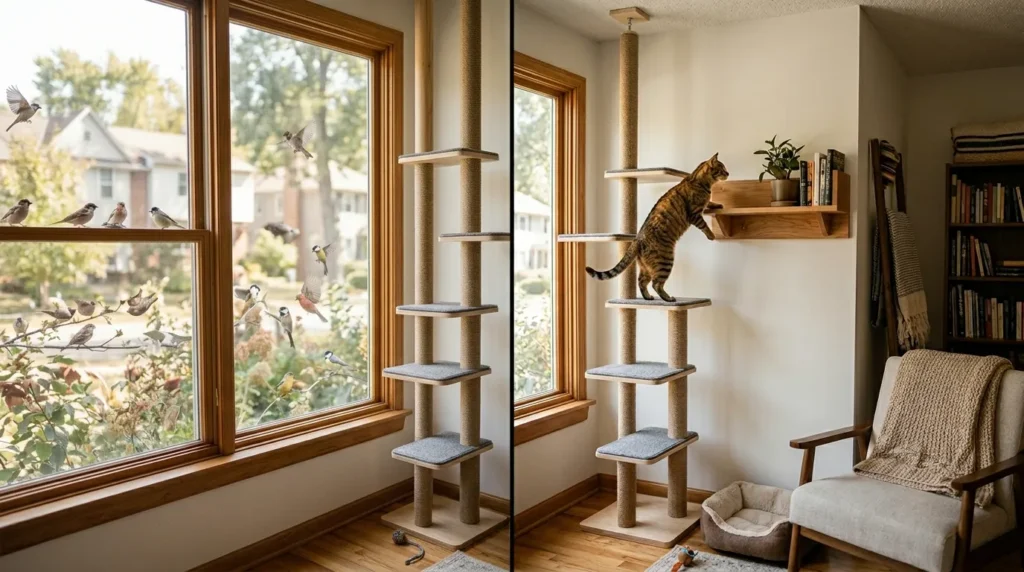
In a small apartment, the cat tree works as a bridge from floor to wall shelves, not as its own destination. Set it right beside the shelf at its lowest level, so she can step from the tree platform to the shelf in one move. That completes a climbing system from floor to ceiling without asking for any difficult jumps along the way.
A narrow floor-to-ceiling tension tree takes under two square feet of floor space and reaches heights a wide freestanding tree can’t match. The tension mount skips the wide weighted base, which is usually where cat trees waste the most floor space in a small apartment. Install it in the corner where the window wall meets the adjacent wall, anchored against two surfaces so it doesn’t sway under her weight.
The goal is one clean route: floor, tree platform, lower shelf, higher shelf, window perch. A cat who can run that whole path without a gap or an intimidating jump will use it constantly. A route with one bad jump in it gets used up to that jump and no further.
Step 4: Set Up the Window Station as the Reward at the Top
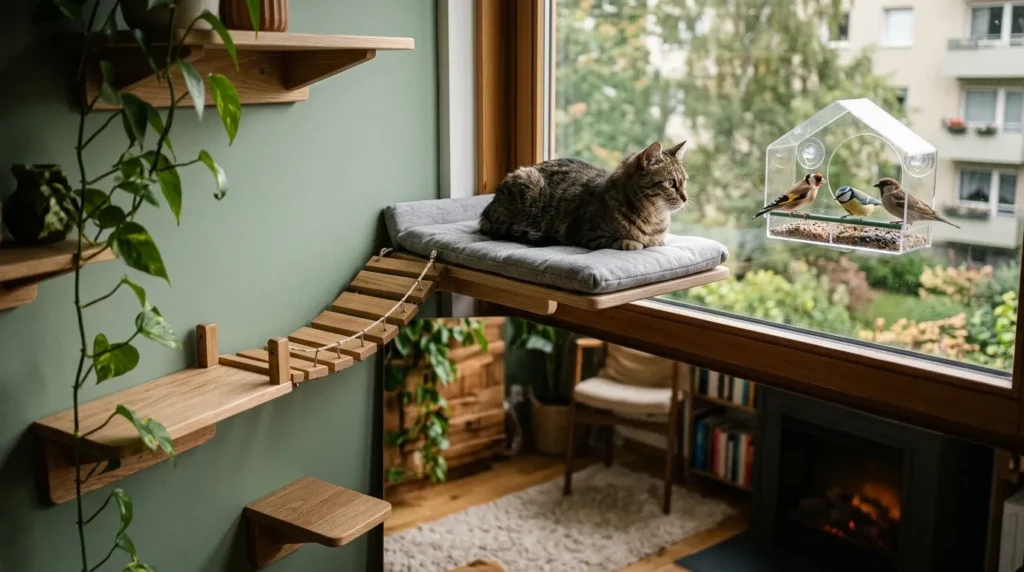
The window station is what makes the whole climbing route worth repeating daily. A padded perch at the top, with a bird feeder mounted outside the glass, turns the highest point in the apartment into an active enrichment zone instead of a dead end. She climbs the route, arrives at the window, and finds birds arriving on their own unpredictable schedule.
A suction-cup bird feeder on the outside of the glass runs under twenty dollars and needs no landlord sign-off. Mount it five to eight inches from the window so birds land roughly at her eye level while she’s on the perch. That closeness is what produces real predatory tracking, not just passive glancing at distant movement.
The window station and the route leading to it are the core architecture of a well-built small-apartment cat space. Choosing cat furniture that fits a small apartment’s vertical constraints while covering her full behavioral range is the single highest-impact decision in this whole setup. Width and floor footprint matter far less than how high it goes and how close it sits to a window.
Step 5: Create One Good Hiding Spot and Stop There
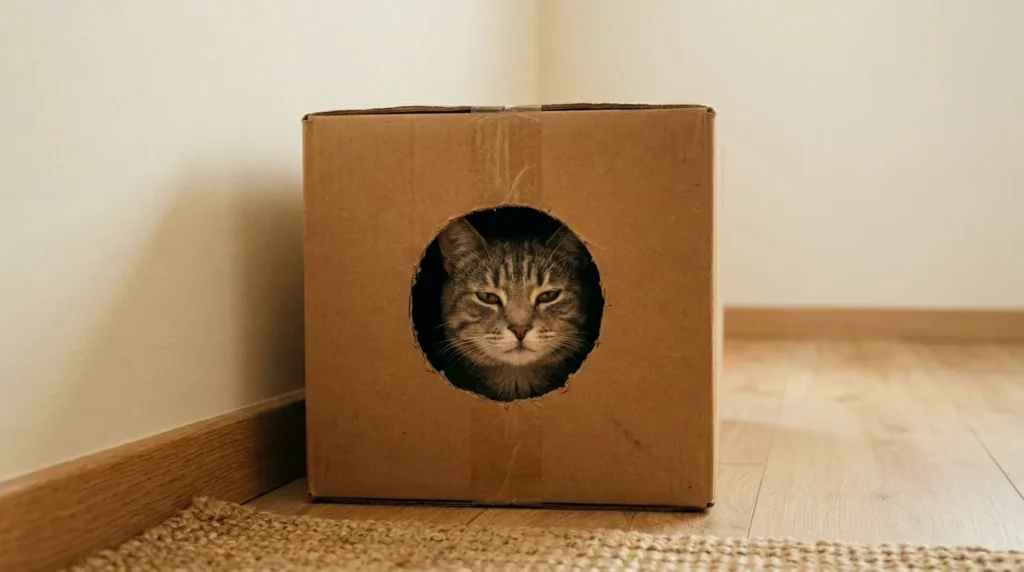
Every cat wants one floor-level spot she can retreat to for concealment without any climbing involved. In a small apartment, this doesn’t need to be a purchase. A medium cardboard box with a circular hole cut in one side, set in the quietest corner, gives the same behavioral payoff as an expensive cat cave: a dark, enclosed space with a single entrance and a clear sightline back into the room.
Resist adding more than one. A single good hiding spot placed correctly gets used constantly. Three mediocre ones scattered through the apartment add clutter without adding behavioral value, since she’ll pick one and ignore the rest. In a small space, anything that doesn’t earn its keep through consistent use is just eating into your own living room for nothing in return.
Insight: the cardboard box isn’t a cheap stand-in for real cat furniture. After years of watching apartment cats use their spaces, the box in the corner consistently outlasts purchased cat caves in terms of actual daily use. Cats favor boxes specifically because the cardboard holds their scent, the cut entry gives them control over who approaches, and the low cost means you can swap it for a fresh one every month. Buy the box last, once everything else is set up. Skip the purchased cave.
Multi-Cat Studio Setup: Why Two Cats Need More Than Twice the Space
If you’re setting this up for more than one cat in a small footprint, the plan above needs one adjustment: resources scale up faster than floor space does. The standard guideline is one litter box per cat, plus one extra, so two cats means three boxes, not two, even in a studio where that feels excessive. The same logic applies to food and water stations. Two cats sharing one bowl and one box in tight quarters is a common setup for resource guarding and stress, even between cats who otherwise get along fine.
The fix isn’t more floor space, since you don’t have any to give. It’s more distinct elevated zones, so each cat has somewhere to retreat that isn’t contested. Two cats with three separate perches at different heights coexist far more easily than two cats sharing one big shelf, even if the total square footage of shelf space is identical.
Step 6: Place the Litter Station Last and Treat It as Permanent
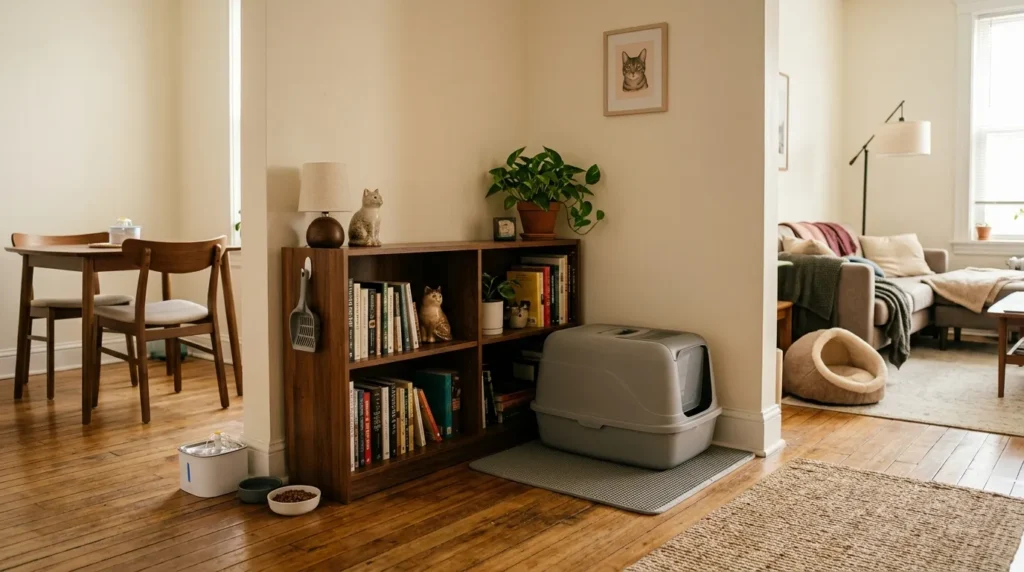
Place the litter station after everything else, since its location is the one part of this setup that has to stay permanent. Moving the box once she’s settled into a routine produces litter avoidance that looks like a behavior problem but is really just disorientation. Pick the right spot once and leave it there.
The right spot in a small apartment checks three boxes at once: it’s the point farthest from sleeping and eating areas, it has a clear approach visible from multiple directions so she can see the room while she’s using it, and she doesn’t have to cross a zone where she might get startled or cornered by a person to reach it. A low room divider or bookshelf placed beside the box, not around it, gives visual privacy without blocking the approach.
If floor space is genuinely tight, a top-entry litter box or one built into a bench or low cabinet saves real square footage and cuts down on tracked litter, though it’s worth skipping for senior cats or anyone with joint issues, since the higher entry can be harder to manage.
The complete cat space setup in a small apartment covers five behavioral zones across a compact footprint: the vertical climbing route, the window enrichment station, the quiet hiding spot, the litter station, and the active play area in the open center. That last zone costs nothing. It’s just the clear floor space you keep open for a daily wand toy session, which ties the whole layout together. Our guide to what a thriving indoor cat needs from its living space goes past the physical setup into the daily routine that makes all of this actually work for the animal living in it.
The Mistake That Wastes the Whole Setup
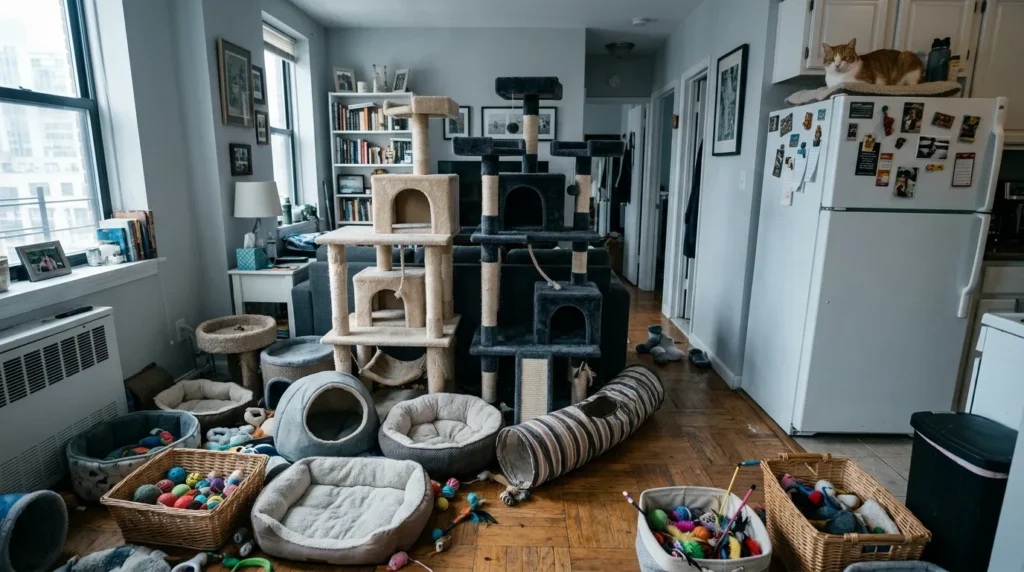
The mistake that undoes this whole approach is piling up floor-level furniture instead of building vertical territory. Most owners start with a floor bed, add a second cat tree next to the first, add a tunnel, add a play mat, and eventually lose a real chunk of the apartment’s living space to objects the cat uses intermittently, if at all. The floor can’t expand. The walls can.
Every extra piece of floor furniture in a small apartment costs living quality without meaningfully growing the cat’s territory. A cat with one floor hiding spot and three distinct elevated positions has more usable territory, from her perspective, than a cat with five floor objects and no vertical access at all. Build upward first. Add floor items only once the vertical system is finished and only when a specific behavioral need is still unmet.
Frequently Asked Questions
What is the most important thing to set up first in a small apartment for a cat?
The vertical route to the most active window. A single wall shelf beside that window, with a bird feeder outside, changes a cat’s experience of the apartment more than any other single addition. Everything else builds on top of that foundation, but the window station is where the payoff is highest per dollar and per square foot of floor you’re not giving up.
How many cat trees do I need in a small apartment?
One narrow floor-to-ceiling tension tree, used as an access route to the wall shelves, is the right amount for most small apartments. A second tree adds floor footprint without adding much vertical territory if it sits at a similar height to the first. Two distinct wall shelves at different heights, connected by one access tree, cover more ground behaviorally than two standalone trees of the same height ever would.
Can I set up cat space in a small apartment without drilling holes?
Mostly, yes. Floor-to-ceiling tension trees need no drilling. Suction-cup window perches need no drilling. A cardboard box hiding spot needs no drilling. The one spot where renter-friendly alternatives genuinely fall short is wall shelves. Heavy-duty adhesive strips rated for the weight exist, but they fail more often than stud-anchored brackets, and a shelf that drops once under a jumping cat permanently kills her trust in that surface.
Do I need my landlord’s permission to install cat shelves?
Check your specific lease, since terms vary, but small anchor holes are typically treated the same as any picture-hanging hardware. Filling two or three screw holes with spackle at move-out is a quick fix, and it’s worth asking your landlord directly before you drill if your lease is silent on the topic, rather than guessing.
How many litter boxes do I need for a cat in a small apartment?
One per cat plus one extra is the standard guideline, so a single-cat studio still does best with two boxes, and two cats need three. It feels like a lot of real estate to give up in a small space, but litter box competition is one of the more common causes of stress and inappropriate elimination in multi-cat homes.
Is it cruel to keep a cat in a studio apartment?
No, as long as the space actually meets her behavioral needs. Cats respond to available territory, not raw square footage, and a well-designed studio with real vertical space, a window view, and daily play often serves a cat better than a large house with none of that structure.
How do I keep a small apartment cat space from feeling cluttered?
One rule: everything in the space earns a spot by getting used at least once a day, or it leaves. A cat that hasn’t touched a piece of furniture within two weeks of its introduction isn’t going to start. Move the item to a new location once before removing it for good. Five items she actually uses beat twenty she ignores, every time.
Conclusion
How to set up cat space in a small apartment comes down to a specific order: map the three zones before buying anything, install wall shelves as the first physical step, position the cat tree as an access route rather than a centerpiece, and place the litter station permanently in the quietest corner. Those steps, done in that sequence, produce a fully functional cat space in most small apartments for under one hundred fifty dollars. Start today by finding the window with the most outdoor activity and marking where the first shelf goes. Everything else follows from that one decision.
This guide sits under our Cat in Apartment pillar, alongside sub-pillar guides on indoor cat enrichment, the best cat furniture for small spaces, and indoor cat behavior. Together they cover the physical setup and the daily routine that makes a small apartment genuinely work for the cat living in it.

Written by Mishu
A passionate cat lover and indoor living enthusiast, Mishu is the founder and voice behind Indoor Living Cat – a go-to resource for cat owners who want to create the happiest, healthiest life for their feline companions indoors.
View Full Profile