
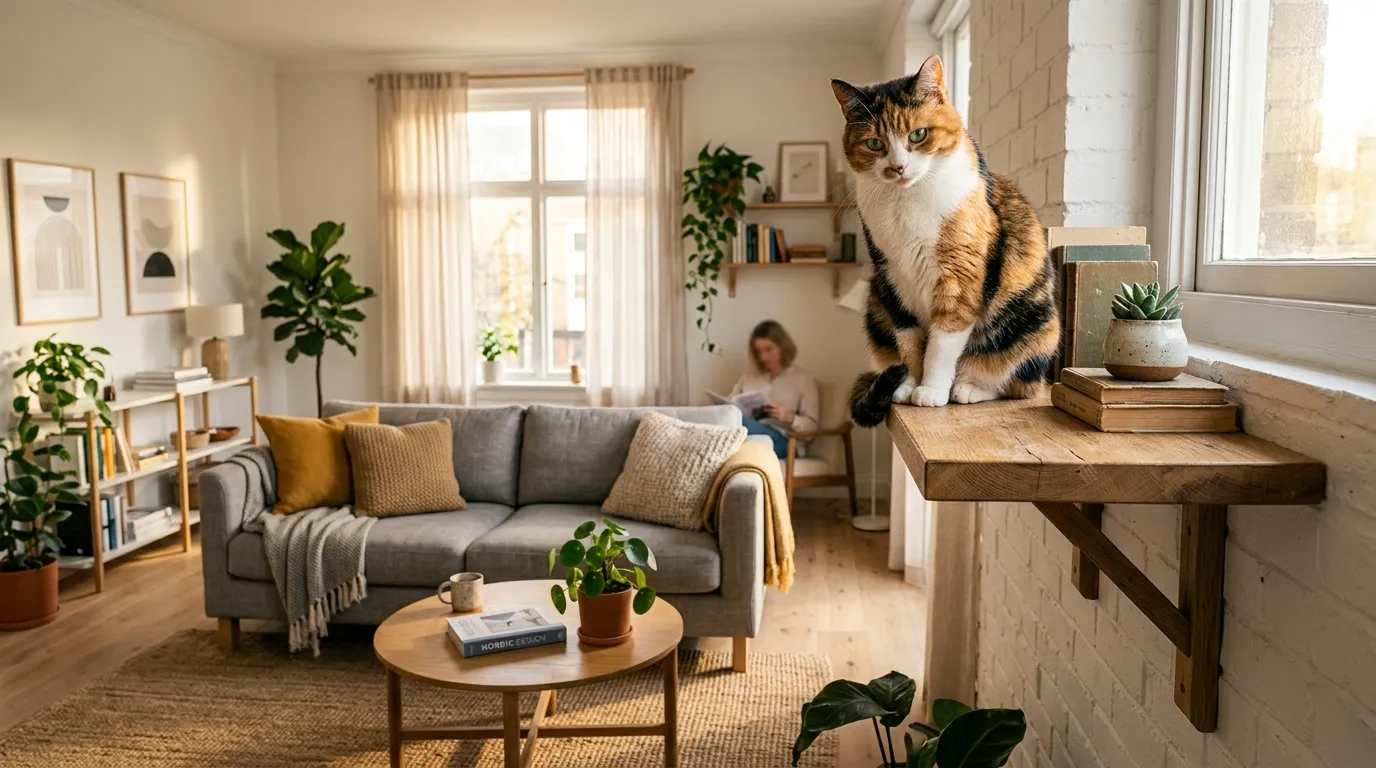
My cat used to bolt across the living room floor every time someone knocked on the door. Not a normal startle, a full sprint under the bed that lasted twenty minutes. Nothing about her health had changed. What changed her behavior was three wall shelves I installed above the doorway, staggered at different heights, leading up to the top of a bookcase. Within a week she stopped running. She just climbed and watched from up there instead.
That is what vertical space does for an indoor cat. It is not decoration and it is not a nice-to-have if your budget allows for it. A cat with nowhere to go but the floor lives in a state of low-grade alert most of the day, because every sound, every guest, and every other pet is a threat with no clear escape. Give that same cat height, and a huge chunk of that stress disappears. This guide covers what height actually does to a cat’s body and brain, how much of it you need, and how to build it into an apartment without putting a single hole in the wall if you rent.
Vertical space gives indoor cats a high vantage point to watch their territory, cuts stress caused by floor-level threats, and works their muscles through climbing and jumping. In homes with more than one cat, it resolves rank disputes without a single fight breaking out. Even one solid perch by a window changes a cat’s baseline stress level, and you can measure the difference in how much they hide.
Why Vertical Space for Indoor Cats Is a Biological Necessity
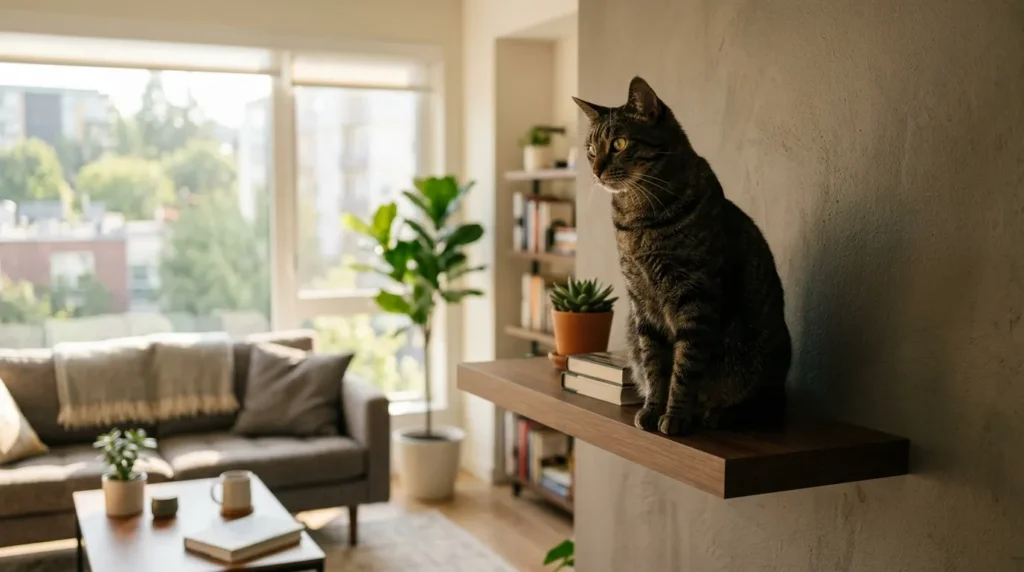
Cats look for height because their wild ancestors needed it to survive. A high spot kept them out of reach of ground predators and gave them a clear line of sight to spot prey before making a move. Your indoor cat still runs on that same wiring, even though the scariest thing in your apartment is probably the vacuum cleaner.
A cat with no access to height stays on edge in a way you can watch happen in real time. Every noise, every sudden movement, every other animal in the house becomes a bigger deal than it should be, because there is no route upward and away from it. Over weeks and months that can turn into hiding, over-grooming, spraying, or litter box avoidance. None of those are personality flaws. They are what a nervous system does when it never gets to relax.
So height is not something your cat would merely enjoy. It is one of the few things that decides how safe they feel for every hour they spend in your home.
How Much Vertical Space Does a Cat Actually Need?
There is no single magic number, but there is a floor you should not go below. One cat needs at minimum one elevated perch in the main living space and one near a window. Multi-cat homes need more, and the math is simple: each cat should have access to its own high spot without having to pass another cat to reach it.
Height and spacing matter almost as much as the total number of perches. A shelf mounted too low does nothing your cat’s own jump already covers. A shelf mounted too high with no step in between just gets ignored.
| Cat Type | Recommended Perch Height | Shelf Spacing | Minimum Perches |
| Adult, healthy | 4 to 7 feet off the floor | 12 to 18 inches between steps | 1 to 2 per cat |
| Kitten | 2 to 4 feet off the floor | 8 to 12 inches between steps | 1, low and stable |
| Senior or arthritic | 2 to 4 feet, with a ramp option | 6 to 10 inches between steps | 1, close to the floor |
| Multi-cat household | Mixed heights, 3 to 8 feet | Varies by connection point | 1 per cat, minimum |
Use this as a starting point, not a rulebook. Watch where your own cat already tries to climb; that tells you more about the right height for your home than any table does.
3 Real Benefits of Vertical Space for Indoor Cats
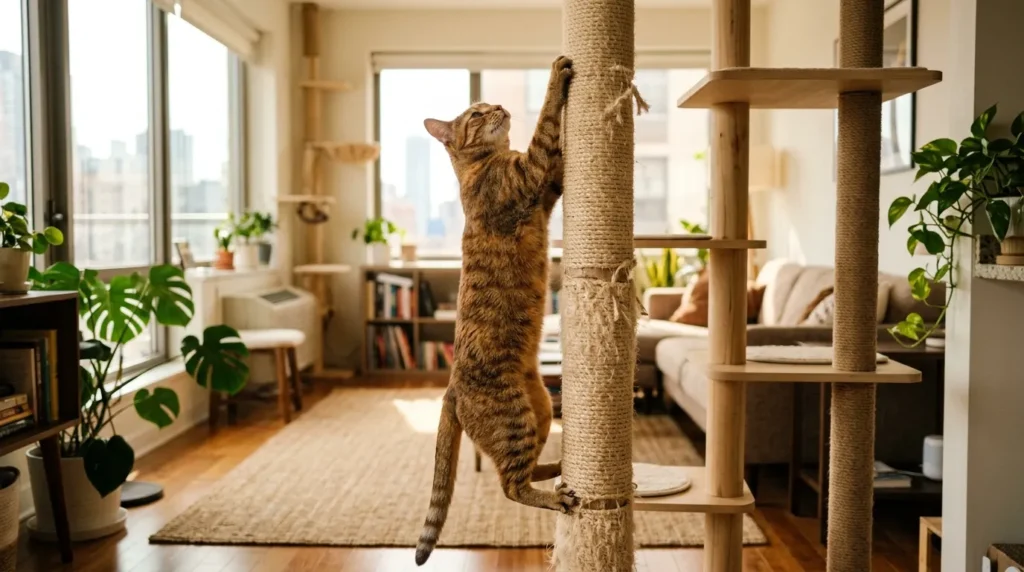
The clearest benefit is a drop in stress-related behavior. The Ohio State University Indoor Cat Initiative lists environmental enrichment, including vertical territory, among the changes that reduce illness and behavior problems in indoor cats. That is not a marketing line. It means the shelf above your couch is doing work a vet visit cannot undo on its own.
The second benefit is physical. Climbing and jumping work muscle groups a cat barely touches walking from the food bowl to the sofa all day. A cat that scales shelves regularly builds stronger hind legs, keeps better balance as it ages, and tends to stay closer to a healthy weight than one that never leaves the floor.
The third benefit is space you already own. Your apartment has the same square footage no matter what you put in it. Add wall shelves and a tall tree, though, and you have doubled the territory your cat can actually use, without moving anywhere or knocking down a wall.
| Benefit | Impact on Cat | Why It Works |
| Mental | Less anxiety and hiding | Height moves the cat away from floor-level threats |
| Physical | Stronger muscles, healthier weight | Climbing works the core and hindquarters |
| Social | Less conflict in multi-cat homes | Rank gets settled through height, not fights |
Stress Reduction and the Exit Route Your Cat Needs
A vertical path with only one way down can be almost as stressful as no path at all. If your cat climbs up and there is a single route back to the floor, a more confident cat can sit right at the bottom and block it. That traps the first cat instead of calming it. Build every route with at least two ways up and two ways back down, and this problem mostly solves itself.
Why Cats Seek Heat and How Height Delivers It
Warm air rises, so the air near your ceiling runs a few degrees warmer than the draft at floor level. Cats run a higher resting body temperature than we do and burn real energy staying warm. A perch near the ceiling in winter gives your cat a free warm spot, no heating bill required.
How to Map Your Apartment for Maximum Vertical Territory
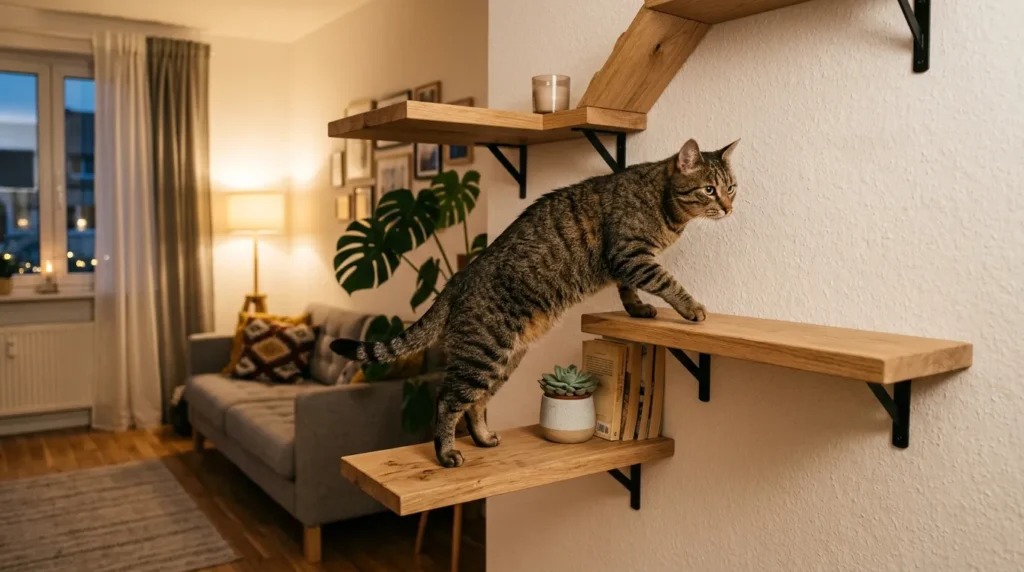
Mapping your space starts with looking at your walls the way your cat already does: as unused ground. Start with the surfaces your cat gravitates to on its own, like the top of the fridge, a bookshelf, or a window ledge. Those are your anchor points. Connect them with smaller shelves and you get a continuous path running around the room instead of a few isolated islands.
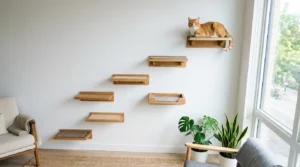
You do not need a spare room or a big budget for any of this. Three or four shelves staggered along one wall give your cat more usable territory than an entire room they can only walk through. Look at every wall in your home this way and you will find more room than you expected.
See best cat furniture for indoor cats for wall-mounted options that fit your interior instead of turning your living room into a cat store display.
Owner’s Honest Take: The biggest mistake I see is buying one cat tree and calling the job done. One tree is a start, not a system. Your cat needs a path it can travel without ever touching the floor. Think less “piece of furniture” and more “second floor, built just for the cat.”
Rental-Safe Ways to Add Vertical Space Without Drilling
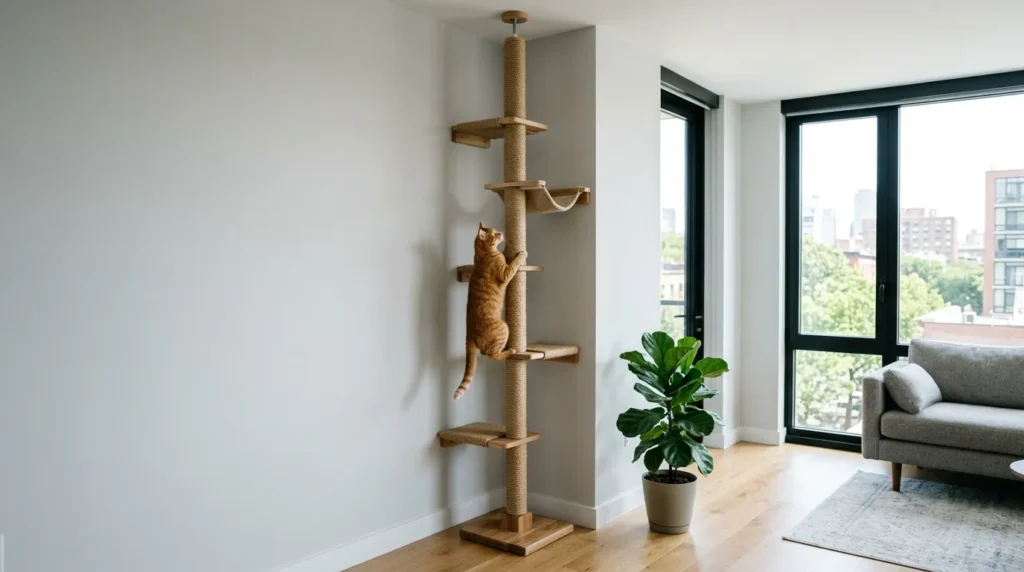
Renters have more real options than most people think, and none of them require patching a wall when you move out.
- Tension-mounted floor-to-ceiling trees. These use pressure between the floor and ceiling to stay upright, with zero wall damage. Choose a model with a wide base and tighten the tension rod fully before your cat tests it. Most hold well past 15 pounds when set up correctly, but check the specific product’s weight rating first.
- Heavy freestanding bookshelves. A deep, stable bookshelf next to a windowsill next to the top of a wardrobe becomes a three-stop route your cat will use daily, with nothing to install at all.
- Command-strip or adhesive shelves. Rated for lighter loads, so check the packaging’s weight limit against your cat’s size before trusting one at height. Fine for a small cat or a low step; risky for a large cat on a shelf six feet up.
- Over-the-door perches. These hook over the top of a standard door and add a landing spot without any hardware in the wall at all. Good for a spare step between two taller pieces.
For a full enrichment setup that goes beyond just height, see indoor cat enrichment for ways to pair vertical access with play and mental stimulation in a small apartment.
DIY Shelves vs. Store-Bought Cat Trees: Which Should You Choose?
Both routes work. The right one depends on your budget, your tools, and how much you want to customize the layout.
| Factor | DIY Wall Shelves | Store-Bought Cat Tree |
| Upfront cost | Lower, especially with scrap wood or floating shelf kits | Higher, more for tall or sisal-wrapped models |
| Setup time | A full afternoon per wall, plus drying time for anchors | Usually under an hour to assemble |
| Renter-friendly | Only with removable mounting; drilled shelves leave holes | Yes, especially tension-mounted or freestanding models |
| Customization | Full control over height, spacing, and layout | Limited to the product’s fixed design |
| Best for | Owners with a specific wall layout or an odd-shaped room | Owners who want something stable out of the box today |
Plenty of owners end up using both: a store-bought tree as the stable anchor piece, with a couple of DIY shelves bridging it to a windowsill or bookcase.
Multi-Cat Homes: Using Height to Stop the Fighting
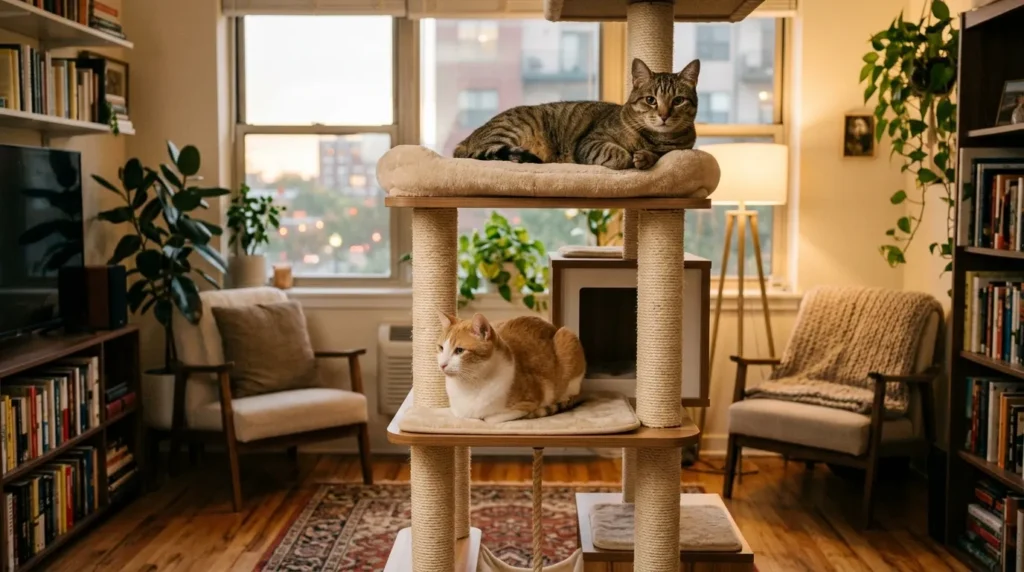
In a multi-cat home, height works as a communication system. The cat sitting in the highest spot is announcing rank without a single swipe. That only keeps the peace, though, when there are enough high spots for every cat to claim one of their own.
With only one high perch in the house, one cat controls it and the rest stay stuck in low-level stress on the floor. Add more perches at different heights and the hierarchy tends to settle on its own. Each cat finds a level it likes, and the tension you’d otherwise see at ground level drops off noticeably.
As a rough rule, plan for one dedicated high perch per cat, plus one extra shared spot. Two cats means at least three total landing points somewhere in the home.
Owner’s Honest Take: If two cats keep fighting, check first whether one is blocking the other’s route down before you assume it’s a personality clash. Nine times out of ten I’ve seen, it’s a space problem, not a compatibility problem. Add a second perch and a second exit route and the fighting often stops inside a week.
Vertical Space for Kittens and Senior Cats
A setup built for a healthy adult cat is not automatically safe for a kitten or an older cat, and this is where a lot of owners get hurt cats instead of happy ones.
Kittens have the reflexes for climbing well before they have the judgment for it. Keep their perches low, under four feet, until they are fully grown and clearly landing with control instead of just falling and getting lucky. A padded surface underneath any kitten climbing spot is cheap insurance.
Senior cats and cats with arthritis still want height. What changes is how they get there. A tall tree with no steps in between just gets abandoned once jumping starts to hurt. Add a footstool, a low ottoman, or a ramp beside the main perch so an older cat can climb in stages instead of making one long jump. Watch for hesitation at a jump they used to make without thinking; that is often the first visible sign of joint pain.
The Most Common Mistakes Cat Owners Make With Vertical Space
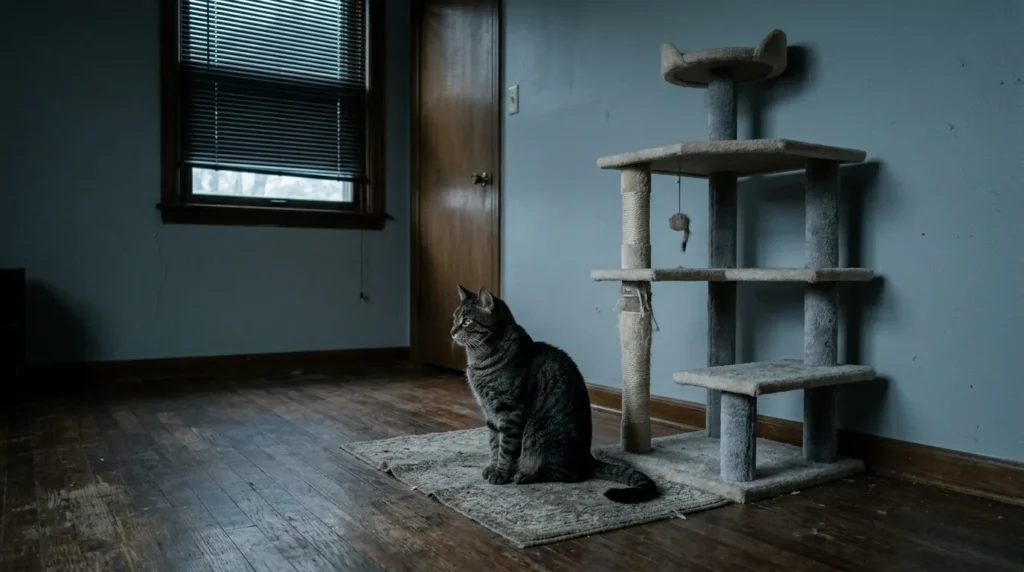
The most common mistake is placing a cat tree in the wrong room. A tree in a spare bedroom or a hallway corner might as well not exist to your cat emotionally. Cats want height in the rooms where you actually live and move, because they want to watch their whole social territory, not a storage closet.
The second mistake is buying something that wobbles. One shaky landing is enough to teach a cat the structure is not safe, and it will not go back. Push on every new shelf or tree with one hand before your cat ever sets a paw on it.
The third mistake is ignoring weight limits. A shelf rated for an 8-pound cat will eventually fail under a 15-pound one, even if it looks fine the first few times. Check the rated capacity of anything you install, not just how sturdy it feels when you push on it once.
All three are fixable today. Move the tree into the living room, anchor or replace anything that shifts, and match the hardware to your actual cat’s weight instead of an average one.
Safety Checklist Before Your Cat Climbs
Run through this before you consider a new shelf or tree finished:
- Push firmly on every shelf and platform with one hand; nothing should shift or flex
- Confirm the weight rating covers your specific cat, not just an average adult cat
- Space steps no more than 12 to 18 inches apart for an adult, closer for a kitten or senior
- Build at least two routes up and two routes down on any connected path
- Keep the first year of installation checked monthly; brackets and tension rods can loosen over time
- Avoid placing perches directly above hard floors, tile, or glass surfaces where a fall would be worse
FAQ
Why does my cat always want to be up high?
It is wired-in survival behavior. Height gives a cat a clear view of its whole territory and takes it out of range of ground-level threats.
How much vertical space does an indoor cat need?
At minimum, one high perch in the main living area and one near a window. Multi-cat homes need one dedicated perch per cat, plus an extra shared spot.
Can vertical space really reduce cat stress?
Yes. The Ohio State University Indoor Cat Initiative includes vertical territory as part of the environmental enrichment that measurably reduces stress-related illness in indoor cats.
What if I rent and can’t put holes in the walls?
Use a tension-mounted floor-to-ceiling pole, a heavy freestanding bookshelf, or an over-the-door perch. None of these need drilling and all work for most cat sizes.
Does my senior cat still need vertical access?
Yes, but they need stepping stones to reach it. Put a footstool or low shelf beside the main perch so they can climb in stages instead of making one long jump that strains their joints.
Will adding cat shelves stop my cats from fighting?
In most territory-based fighting, yes. Multiple high spots let each cat claim its own level, and floor-level tension usually drops within a couple of weeks.
How much weight can a cat shelf hold?
It depends entirely on the product and the mounting method. Check the manufacturer’s stated weight limit and match it to your actual cat, not an average cat, especially for adhesive or command-strip shelves.
At what age can a kitten start using cat shelves?
Kittens can start climbing low platforms, under two feet, once they’re steady on their feet, usually around 8 to 10 weeks. Save taller shelves for after they’re fully grown and landing with control.
Do cat shelves work in apartments with low ceilings?
Yes. You do not need a floor-to-ceiling setup to get the benefit. Three or four staggered shelves at 3 to 6 feet still give a cat a usable elevated path in a room with an 8-foot ceiling.
Height is the single highest-impact change you can make for an anxious, restless, or destructive indoor cat. Move whatever vertical surface you already own into the room where you spend most of your time, then add one shelf above it to create a second level. That two-step change alone tends to show results within days. When you’re ready to build a full system, best cat furniture for indoor cats covers everything from budget wall shelves to a complete apartment catification setup.
Vertical space for indoor cats is rooted in feline survival instinct, not decoration. Cats need elevated territory to feel secure, lower stress-linked behaviors like over-grooming and hiding, and settle social rank in multi-cat homes without fighting. A minimum setup is one high perch in the main living area and one near a window; multi-cat homes need one dedicated perch per cat plus a shared spot. Recommended perch height for a healthy adult cat runs 4 to 7 feet, with 12 to 18 inches between steps; kittens and senior cats need lower, closer-spaced steps. Wall-mounted shelves, tension-mounted floor-to-ceiling poles, over-the-door perches, and multi-tier cat trees all work, including in rental apartments with no drilling. Weight limits, wobble-testing, and at least two exit routes per path are the main safety factors owners overlook.

Written by Mishu
A passionate cat lover and indoor living enthusiast, Mishu is the founder and voice behind Indoor Living Cat – a go-to resource for cat owners who want to create the happiest, healthiest life for their feline companions indoors.
View Full Profile