
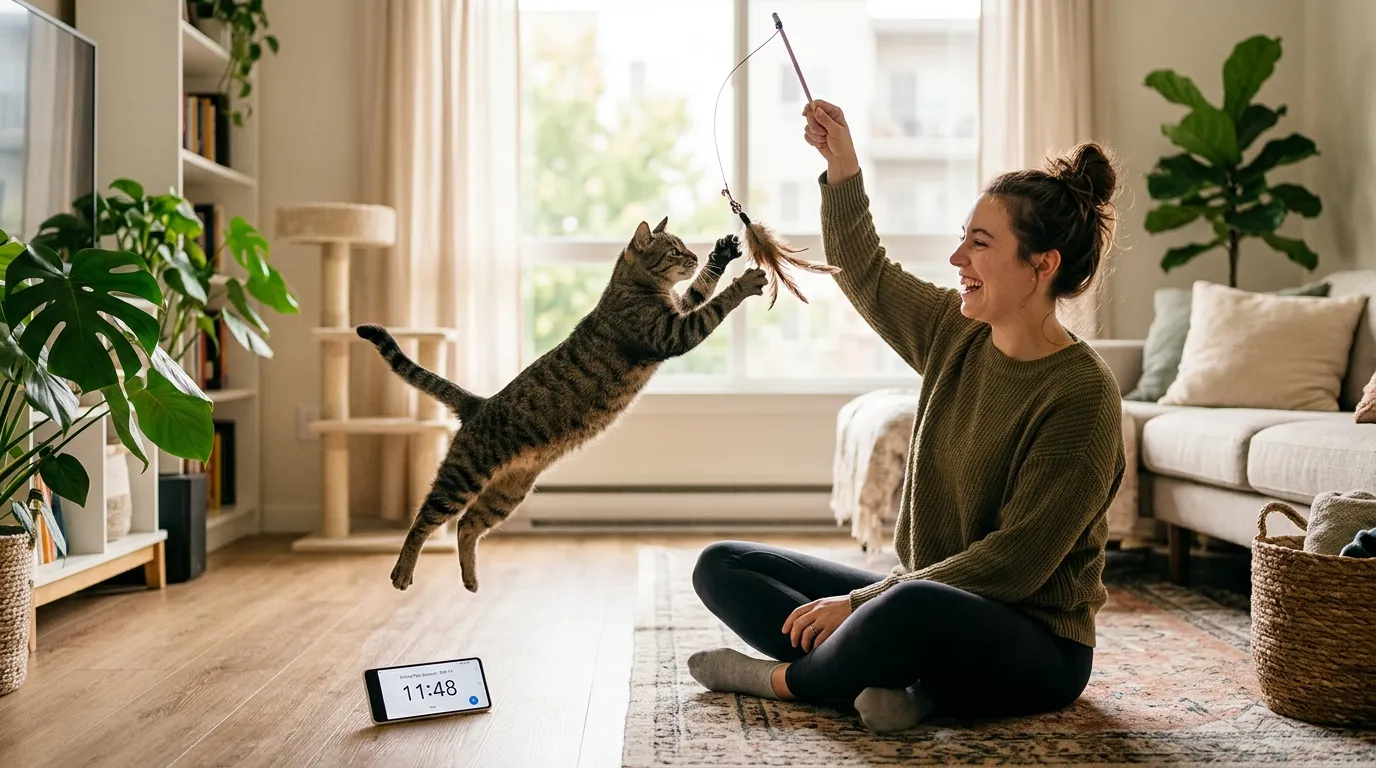
An indoor cat play schedule was the last thing I thought I needed until my cat started waking me up at 4am by sitting on my face. I’d been playing with her sometimes, but without any consistency or timing, and she had no way to anticipate when activity was coming or build her day around it. An indoor cat play schedule isn’t complicated. It’s two timed sessions a day, placed at the right hours, followed by a meal. That single structure resolves the midnight racing, the attention-seeking aggression and the persistent meowing that most owners assume are personality traits when they’re actually scheduling gaps. This article gives you the exact plan, plus the toys, the weekly template and the multi-cat adjustments that make it stick.
An effective indoor cat play schedule runs two sessions daily: ten to fifteen minutes in the morning before the first meal and ten to fifteen minutes in the evening before the last meal. Schedule both sessions at dawn and dusk to match the cat’s natural crepuscular activity peaks. Total active play time is twenty to thirty minutes daily. Consistency on five out of seven days a week produces stable behavioral results within a week.
The Indoor Cat Play Schedule That Actually Solves Behavioral Problems
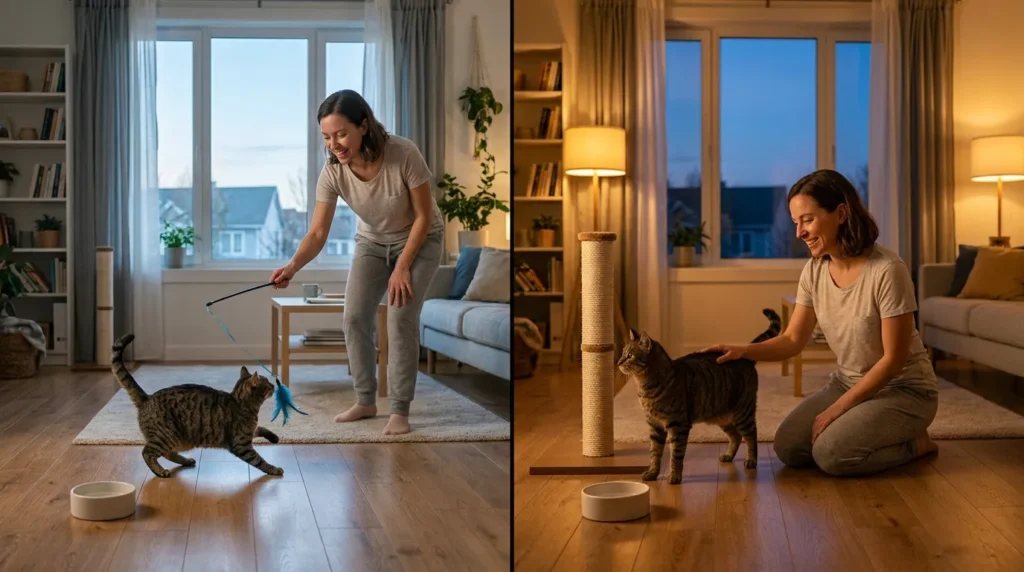
An indoor cat play schedule is a set of daily timed interactive sessions built to discharge a cat’s predatory energy at predictable intervals instead of letting it build up and come out unpredictably. It works because it gives the cat’s nervous system something to anticipate. Within three to five days of consistent sessions, most cats start showing pre-play alertness at the scheduled times: pupils dilating, ears forward, body shifting from rest to readiness before you’ve even picked up the toy.
Timing matters more than duration here. Crepuscular activity peaks in domestic cats happen at dawn and dusk no matter what the indoor environment is doing. A session timed to meet those peaks discharges the drive at the biological moment it’s highest, instead of fighting the cat’s own physiology with a midday session it isn’t wired to engage with at full intensity.
Pre-meal placement is the second piece that matters. Playing before the morning meal and before the evening meal ties the session to anchor points the cat already has and completes the hunt-eat-groom-sleep cycle the way it’s supposed to run. A cat that plays, catches the toy, eats and then grooms and rests is running its biology as designed. That sequence produces the calm, settled rest most owners spend months chasing through everything except this.
A Sample Weekly Play Schedule You Can Copy
Reading “two sessions a day” is easy. Actually building it into a real week with a job, a commute and weekend sleep-ins is where most schedules fall apart. Here’s a template built around a normal workday, with a note on what to do when the weekend shifts your own clock.
| Day | Morning Session | Evening Session | Notes |
| Monday to Friday | 6:45–7:00am, before breakfast | 6:30–6:45pm, before dinner | Attach to something you already do daily, like making coffee or feeding a pet a set time |
| Saturday | Same time, don’t slide it later | Same time | A cat doesn’t know it’s the weekend; a 90-minute shift undoes the anticipation you built all week |
| Sunday | Same time, or up to 30 minutes later at most | Same time | One short window of flexibility is fine; two days of drift is not |
If your work schedule genuinely doesn’t allow a fixed time (rotating shifts, on-call work), pick the closest fixed anchor you do control, like the moment you walk in the door, and hold that instead of the clock. The cat is learning to predict an event, not a number on a clock face.
How Long Each Session Should Run Based on Your Cat’s Age
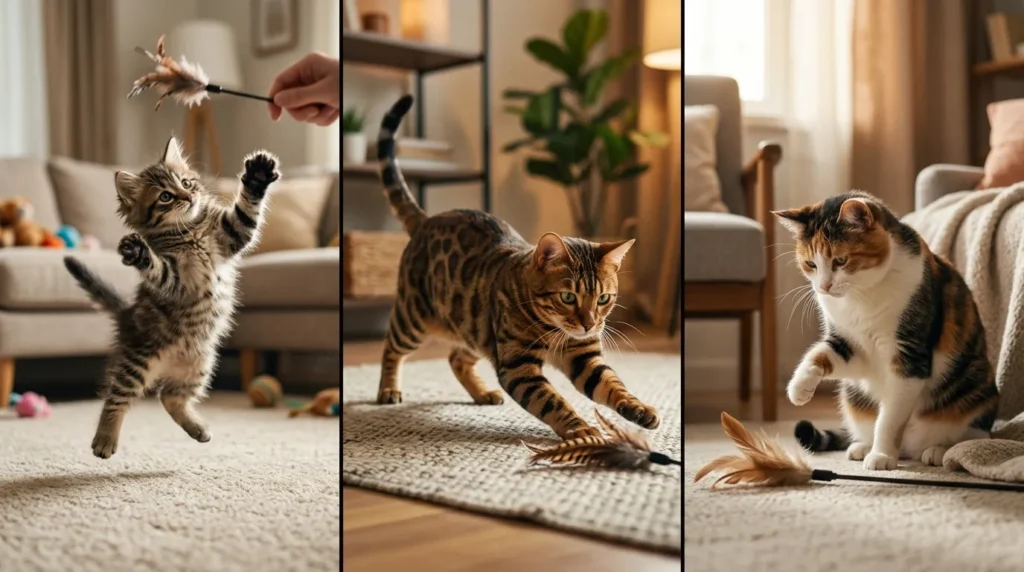
Session length should match the cat’s age and energy capacity, not a fixed number applied across the board. Kittens under six months need four to five sessions of five to seven minutes each because their attention spans are shorter but their energy demand is genuinely higher. They tire and reset fast, and a fifteen-minute session with a four-month-old kitten usually ends in overstimulation around minute eight.
| Life Stage | Session Length | Sessions Per Day | Total Daily |
| Kitten under 6 months | 5 to 7 minutes | 4 to 5 sessions | 20 to 35 minutes |
| Junior 6 to 18 months | 10 to 12 minutes | 2 to 3 sessions | 20 to 36 minutes |
| Adult 2 to 10 years | 10 to 15 minutes | 2 sessions | 20 to 30 minutes |
| Senior over 10 years | 5 to 8 minutes | 2 sessions | 10 to 16 minutes |
Senior cats need shorter, gentler sessions, not because they’ve stopped needing play but because their cardiovascular capacity and joint comfort have changed. Push a senior cat through a full fifteen minutes and you may see panting or reluctance at the next session, which gets misread as disinterest when it’s really pain feedback. End senior sessions the moment engagement drops instead of watching the clock.
How a cat spends the rest of its day changes how much work the scheduled sessions have to do at each peak. A cat with vertical climbing space, window enrichment and midday foraging arrives at the evening session with a lower accumulated energy baseline and settles faster once it’s over. A cat with a flat, unstimulating day carries maximum accumulated energy into the evening session and takes longer to settle no matter how well you run it. That’s why what an indoor cat experiences across its whole day directly determines how effective the scheduled sessions are at producing rest.
Best Toys for Each Session (and What to Skip)
The schedule only works if the toy matches the job. A wand toy that mimics prey and a self-play mouse left on the floor do two completely different things, and mixing them up is why some owners feel like they’re “playing” without getting the settle-down effect afterward.
| Toy Type | Best Used For | Why It Works |
| Wand or fishing-pole toy | Morning and evening scheduled sessions | You control speed, distance and the “kill” moment, which lets the cat complete the full stalk-chase-catch sequence |
| Laser pointer | Warm-up only, first 2 to 3 minutes | There’s nothing to physically catch, so end every laser session on a wand toy or treat the cat can actually grab, or the session leaves the cat wound up instead of settled |
| Puzzle feeder | Midday, unsupervised | Covers foraging behavior between sessions and lowers the energy baseline before the evening play window |
| Solo toys (balls, plush mice) | Free time, outside scheduled sessions | Fine for independent play but don’t replace an interactive session; cats habituate to solo toys within days and engagement drops off fast |
If your cat ignores the wand toy entirely, try switching texture and movement before assuming she’s “not a play cat.” Feathers move differently from fabric mice, and a toy dragged in short bursts along the floor reads as prey in a way that constant fast circles usually doesn’t.
The Mistake That Cancels the Whole Schedule
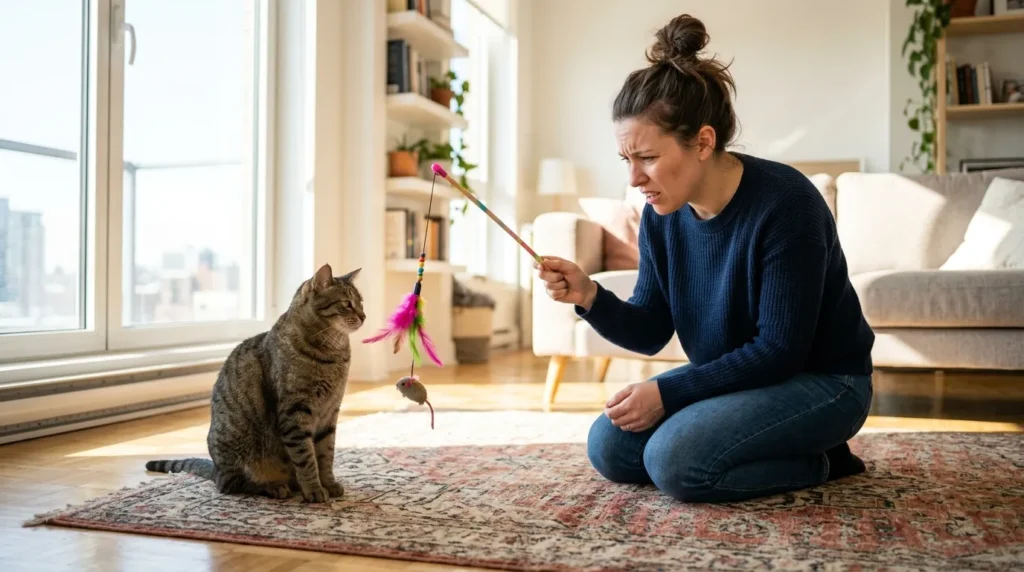
The mistake that cancels an otherwise well-built schedule is inconsistent timing. An owner who plays at 9am on weekdays and noon on weekends hasn’t built a schedule. They’ve built two unconnected events the cat can’t anticipate or regulate its energy around. Almost all of the behavioral benefit comes from the cat’s learned anticipation of when discharge is coming. Without consistent timing, that anticipation never develops, and the schedule produces no more stability than random play.
The second mistake is skipping the meal that follows each session. Play, then leave the house without feeding, and you’ve removed the eat step from the hunt-eat-groom-sleep cycle, leaving the cat activated instead of settled. The meal after play isn’t optional. It’s the signal the cat’s biology uses to shift from predatory alertness into the post-hunt grooming and sleep phase. A schedule without the meal is a sentence with no ending.
Insight Tie both daily sessions to things you already do without thinking. Play before you make coffee, then feed the cat while you drink it. Play before your own dinner, then feed the cat when you sit down to eat. That piggyback structure costs zero extra scheduling effort and makes the sessions nearly impossible to forget on a busy weekday.
Running a Play Schedule With Multiple Cats
One wand toy and two or three cats usually means one cat gets the workout and the others get frustrated or start guarding the toy. A multi-cat play schedule needs a small adjustment, not a full rebuild.
- Run parallel sessions with one toy per cat where possible, even a basic feather wand costs little and prevents resource guarding around the “good” toy.
- If cats must share, rotate which cat gets first turn each session so the same cat isn’t always waiting.
- Watch for one cat consistently blocking another from the toy; that’s a sign to separate sessions into different rooms rather than force shared play.
- Feed each cat immediately after its own session ends, not after the whole household finishes, so the hunt-eat sequence stays intact for every cat individually.
- A kitten paired with a senior cat needs two different schedules, not one compromise; run the kitten’s extra short sessions separately so the senior isn’t dragged into overstimulation.
Signs Your Play Schedule Isn’t Working Yet
Most schedules that “don’t work” just haven’t been given enough time, or have one structural gap. Check against this before assuming the method has failed.
- Still active at 2 to 4am after a full week: check that the evening session is close enough to dusk and not shifted too early relative to bedtime
- Bites or scratches at the end of a session: the session is ending on your hands instead of the toy; always let the cat “catch” the toy, not your fingers, and wind the toy down slowly instead of stopping abruptly
- Walks away mid-session: the toy has gone stale; rotate between two or three toys weekly instead of using the same one every day
- Zero anticipatory behavior after two weeks: timing has likely drifted by more than 30 to 60 minutes on multiple days; check the actual clock times against what you intended
- Immediate crash-out mid-session: possible sign of an underlying health issue in an adult cat that used to play longer; a vet check is worth ruling out before adjusting the schedule further
Frequently Asked Questions
What time of day should I schedule my indoor cat’s play sessions?
Dawn and dusk produce the best results because they line up with the cat’s natural crepuscular activity peaks. A 7am session and a 7pm session consistently beats the same total minutes run at noon or scattered randomly through the day. Tie each session directly to the meal that follows it and the timing becomes self-reinforcing.
How many times a day should I play with my indoor cat?
Two scheduled sessions a day covers most adult cats. Kittens under six months do better with four to five shorter sessions because they burn through energy and attention faster. Beyond the scheduled sessions, free access to solo toys and a scratching post throughout the day is fine and doesn’t need to be timed.
How do I know if the indoor cat play schedule is working?
Watch for three changes in the first week: midnight activity drops, the cat shows alert, anticipatory behavior at the scheduled times before you’ve picked up the toy, and it grooms then rests within twenty minutes of the session ending. Those three signals confirm the schedule is working, not just that the cat got some exercise.
Can you play with a cat too much?
Yes. Overstimulation shows up as dilated pupils that don’t settle, a twitching tail, skin rippling along the back or a sudden bite at the end of what looked like normal play. If you see those signs, shorten the session and end it earlier, before the cat reaches that threshold, rather than pushing through to a fixed time.
Do I still need a schedule if my cat already has toys around the house?
Yes. Solo toys don’t replicate the stalk-chase-catch sequence a wand toy run by a person provides, and cats habituate to unmoving toys within days. A play schedule is about the interactive session and its timing, not just the presence of toys in the room.
What if I miss a day?
Missing one day has no real consequence. Missing three or more days in a row starts rebuilding the behavioral deficit the schedule was designed to prevent. Resume at the correct timing rather than compensating with a longer session; longer single sessions don’t carry the same benefit as consistent shorter daily ones.
Conclusion
An indoor cat play schedule is ten to fifteen minutes twice a day, at dawn and dusk, before each meal, held consistently across most days of the week. That structure alone resolves midnight zoomies, attention-seeking aggression and persistent vocalizing faster than any single toy purchase or environment change. Start tonight with a session before your cat’s dinner and add the morning session tomorrow. Those two anchors, run consistently, will shift your cat’s whole behavioral baseline within a week.
An effective indoor cat play schedule consists of two daily interactive play sessions of ten to fifteen minutes each, scheduled at dawn and dusk to align with natural crepuscular activity peaks, each followed immediately by a meal to complete the hunt-eat-groom-sleep cycle. Kittens need four to five sessions of five to seven minutes daily; senior cats benefit from two gentle sessions of five to eight minutes. Toy choice matters: wand toys for scheduled sessions, laser pointers only as a warm-up followed by a catchable toy, and puzzle feeders for midday foraging between sessions. Multi-cat households need one toy per cat or rotated turns to avoid resource guarding. Consistency at the same times daily across five or more days a week produces visible behavioral improvement, including reduced nighttime activity, within five to seven days.

Written by Mishu
A passionate cat lover and indoor living enthusiast, Mishu is the founder and voice behind Indoor Living Cat – a go-to resource for cat owners who want to create the happiest, healthiest life for their feline companions indoors.
View Full Profile