
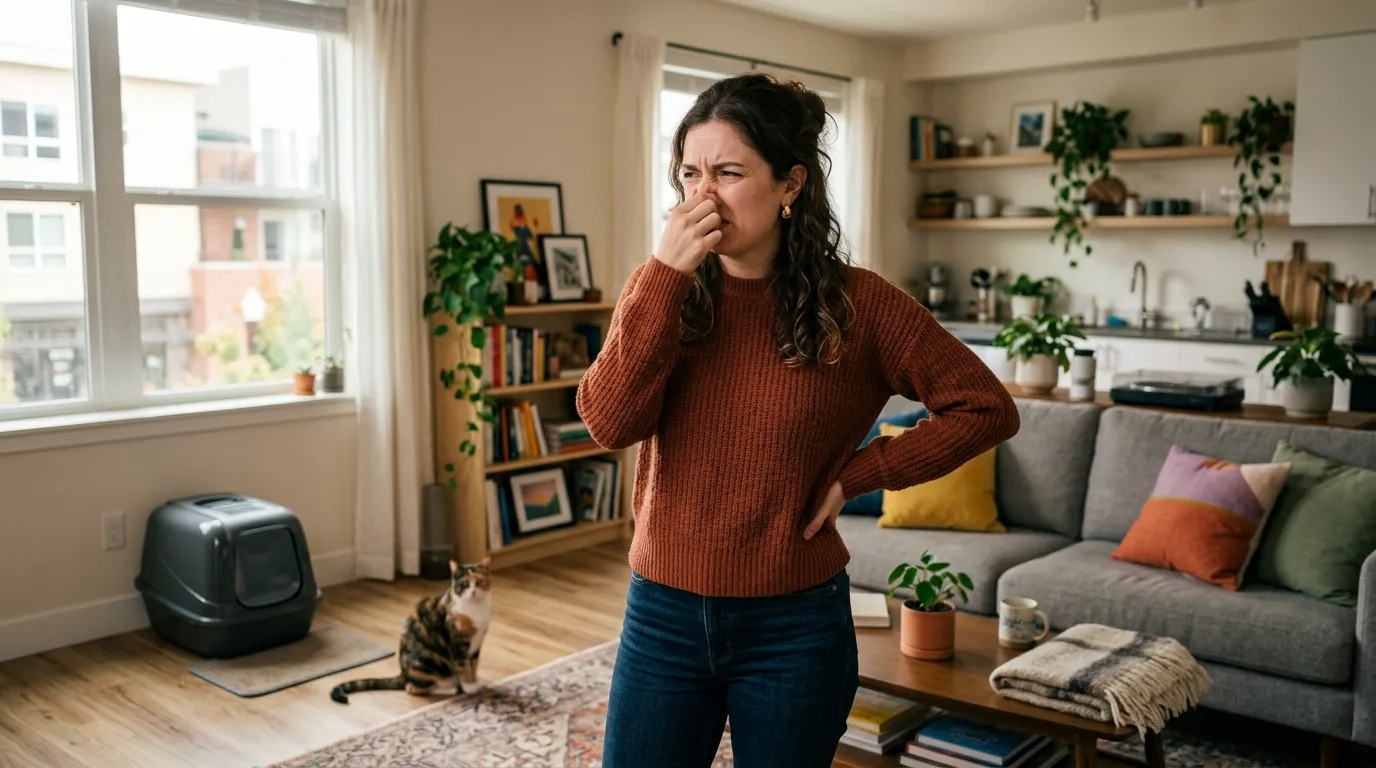
You cleaned your apartment top to bottom and the smell is still there. That is the maddening part of cat odor. It does not respond to regular cleaning the way other smells do. Knowing how to get rid of cat smell in an apartment comes down to one idea: eliminate the source, do not cover it.
I figured this out after months of burning candles and spraying air freshener, thinking that would somehow fix it. It did nothing. What actually worked was treating the litter box, finding hidden spots with a blacklight, and using the right cleaner for the job. This guide walks through every step, so you stop masking the problem and start solving it.
Quick answer: Scoop the litter box daily and wash it weekly. Find hidden urine spots with a UV blacklight and treat them with an enzymatic cleaner, not vinegar alone. Run an air purifier with an activated carbon filter. Most apartment cat odors clear within a week of consistent, source-focused cleaning.
Cat Smell Removal Checklist: What to Do This Week
Before you start, gather what you need. You cannot solve this with candles and hope.
- A UV blacklight flashlight, under ten dollars online
- An enzymatic cleaner, not a scented spray
- Baking soda
- An air purifier with a HEPA and activated carbon filter
- Scoop the litter box today, and every day going forward.
- Do a full box wash tonight with hot water and mild soap.
- Turn off the lights and blacklight-scan floors, baseboards, and furniture legs.
- Soak every marked spot generously with enzymatic cleaner and let it air-dry.
- Set up an air purifier near the litter box and run it continuously.
- Open windows for 15 to 20 minutes daily for cross-ventilation.
- Brush your cat three to four times this week if she sheds heavily.
Do these seven things and most apartments smell noticeably better within days. Here is why each one matters.
The Litter Box Causes Most of the Smell in Your Apartment
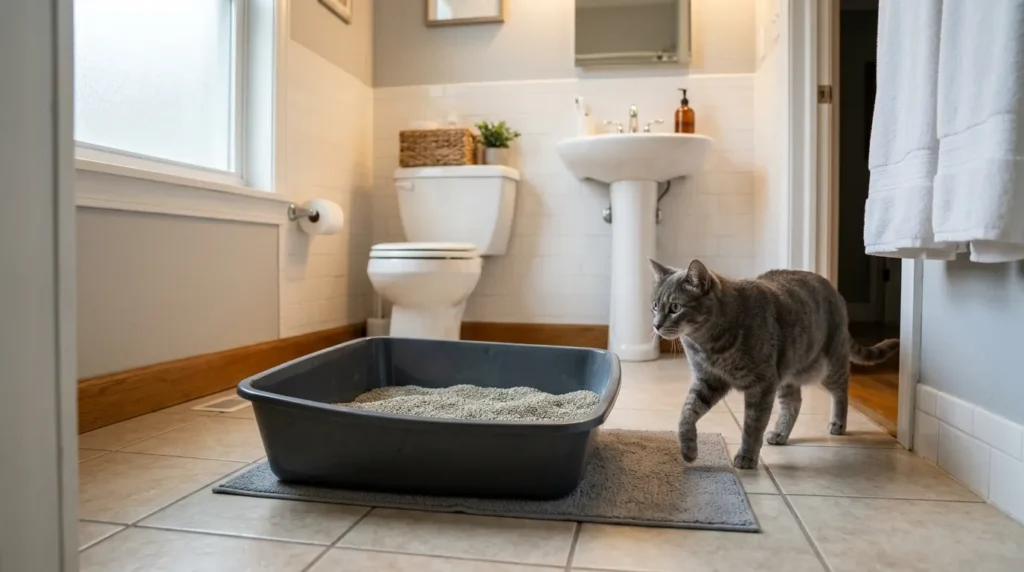
The litter box drives cat smell in almost every apartment. A box scooped once a day in a 500-square-foot unit might as well sit open in the middle of the room. Smell radiates fast in a small space. Scoop at least once a day. In a multi-cat home, scoop twice. Our guide on exactly how often to scoop a litter box breaks the timing down by household size if once a day still is not cutting it.
Once a week, dump everything out and wash the box with hot water and mild dish soap. Skip bleach and strong disinfectants. The fumes linger in the litter, and cats are sensitive to them. Once it dries fully, add a thin layer of baking soda at the bottom before pouring fresh litter back in.
Location matters too. An enclosed corner traps odor instead of letting it disperse. A spot near a window or bathroom vent, with some airflow, makes a real difference. For setup, sizing, and placement details, our guide on choosing and setting up an indoor cat litter box covers what actually works in smaller spaces. If daily scooping is more than your schedule allows, our roundup of the best automatic litter boxes for smell covers which models actually seal waste well enough to matter in a small apartment, rather than just moving the smell around.
Insight: The single biggest litter box mistake in apartments is a box that is too small. Most store-bought boxes do not fit a full-grown cat. Use a large storage tote with one side cut down as an entry point. It holds more litter, traps less odor per square inch, and your cat will actually use it right.
How to Find Hidden Cat Urine Spots Before You Clean Anything
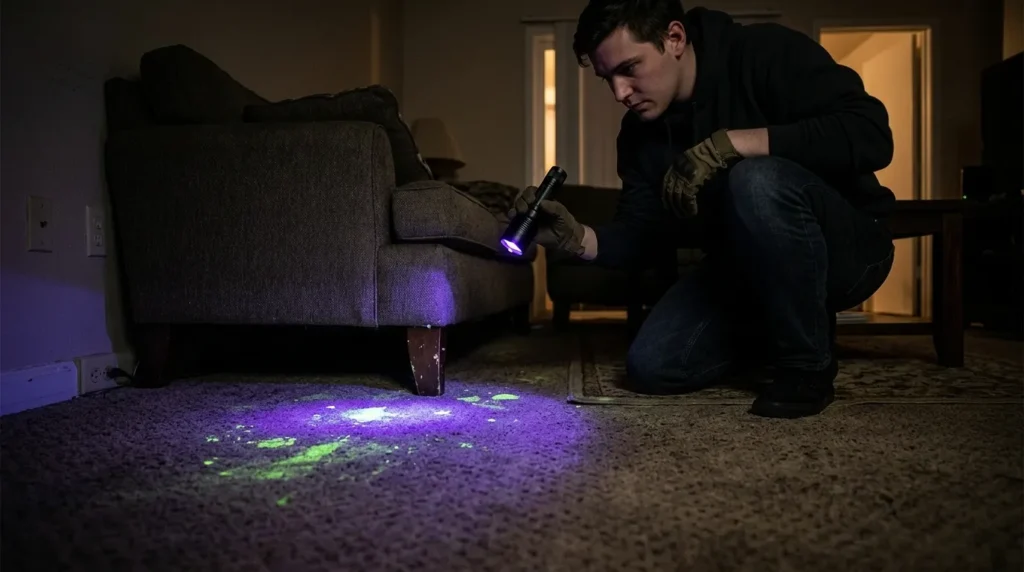
Most cat owners skip blacklight detection, then wonder why the smell keeps coming back. Cat urine dries invisible on hard floors, baseboards, rugs, and furniture, but it does not go away. It sits there releasing ammonia into the air every time humidity rises. A UV flashlight makes hidden spots glow yellow-green in the dark.
Turn off every light and scan the floor, baseboards, furniture sides, curtain hems, and the wall around the litter box. Mark each spot with tape before you turn the lights back on, so you do not lose track of where they are.
Old spots that have sat for months need a generous soak, not a surface spray. Pour enough to saturate the area beyond the visible stain. Urine soaks into the pad or subfloor, and the cleaner needs to reach that depth to work. Let it air-dry fully before deciding if a second application is needed.
Enzymatic Cleaner vs Baking Soda and Vinegar: What the Smell Actually Responds To
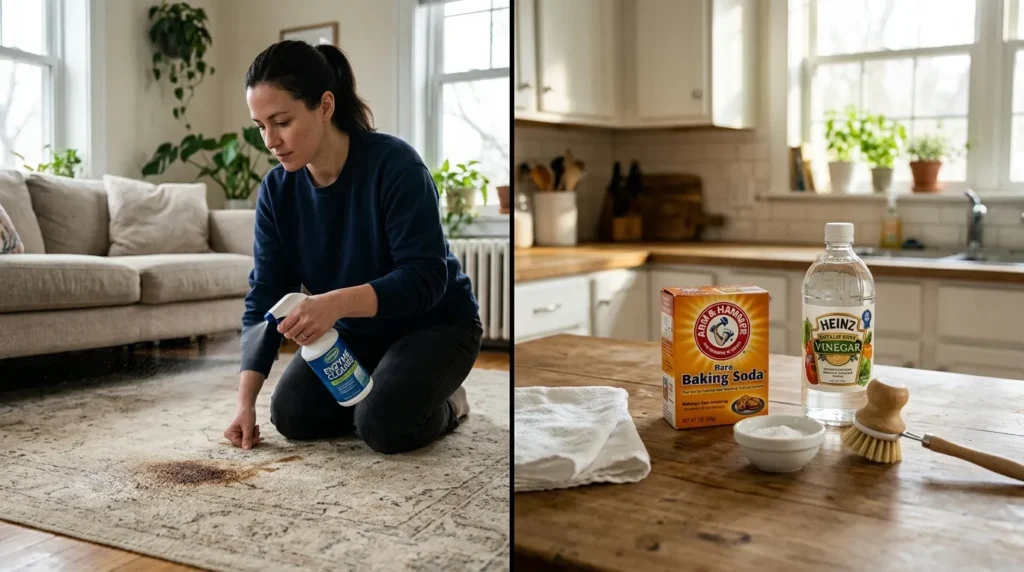
An enzymatic cleaner works through biological enzymes that break down uric acid crystals, the part of cat urine behind that sharp ammonia smell. Vinegar and baking soda neutralize surface odor for a while, but they do not touch uric acid. The smell returns within days because the crystals are still there.
| Method | Works on | Permanent | Best for |
| Enzymatic cleaner | Uric acid crystals | Yes | Carpets, rugs, fabric, old stains |
| Vinegar and water | Surface ammonia | No | Hard floors, daily maintenance |
| Baking soda | Surface absorption | No | Deodorizing after enzyme treatment |
| Hydrogen peroxide and dish soap | Visible stains | Partial | Light stains on hard surfaces, test first |
For hard floors like hardwood, tile, or laminate, a 50/50 white vinegar and water solution works fine for routine cleaning. For anything that absorbed urine, use enzymatic cleaner and let it fully dry before you check the result. Do not follow an enzymatic cleaner with vinegar. The acid disrupts the enzymes while they still need to work.
Insight: People pour on enzymatic cleaner, wipe it up after five minutes, and wonder why it failed. Enzymes need time and moisture to break down uric acid. Pour generously, lay a damp cloth over the spot to slow evaporation, and leave it for at least 15 minutes. That extra time is what separates a real result from a repeat problem.
Treating Couches, Mattresses, and Other Fabric Furniture
Soft furniture holds cat smell longer than almost anything else in an apartment, and it needs a different approach than a hard floor or an open rug. Urine soaks into cushion foam and mattress padding the same way it soaks into carpet pad, and a surface wipe never reaches it.
Start with anything removable. Strip cushion covers and washable throws and run them through a hot wash cycle with regular detergent, no fabric softener, since softener coats fibers in a way that can trap remaining odor underneath a fresh scent. For the foam or padding itself, blot up any wet urine first with paper towels, then saturate the spot with enzymatic cleaner exactly as you would a rug, and press a dry towel down firmly to help pull moisture and cleaner through the layers rather than just sitting on top.
A wet vacuum or upholstery extractor speeds this up considerably if you have access to one, since it pulls both the urine and the cleaner out of the padding rather than leaving both to air dry slowly inside the cushion. For a mattress, a specific enzymatic mattress treatment followed by a full day of air drying, ideally with a fan running and the room ventilated, prevents the trapped-moisture smell that shows up if you reassemble bedding too soon. A cushion or mattress pad that has taken repeated soakings over months sometimes cannot be fully saved. At that point replacing the pad costs less than fighting a smell that will not fully leave the foam.
How to Fix Apartment Air That Feels Permanently Stale
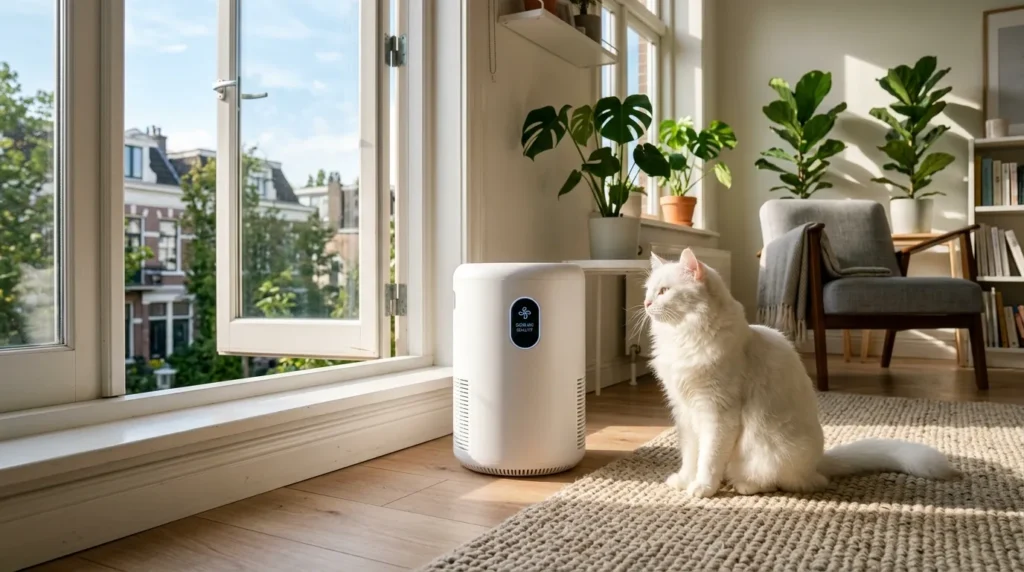
The airborne part of cat smell comes from dander, fur particles, and ammonia vapor circulating in a closed apartment. Opening windows daily for cross-ventilation helps immediately. Even 15 to 20 minutes of fresh air clears a surprising amount of the stale odor that builds up overnight.
An air purifier with both a HEPA filter and an activated carbon layer handles what ventilation cannot. HEPA catches dander and hair. Carbon absorbs the odor those particles carry. Running one near the litter box and another in the main living area covers most units under 800 square feet.
Skip plug-in air fresheners and scented candles as your main strategy. They do not remove smell. They add a competing scent on top of it, and some cats find strong artificial fragrance genuinely stressful. Bowls of baking soda or activated charcoal bags in corners absorb ambient odor passively. Replace them about once a week.
Diet and Grooming Affect How Strong Your Apartment Smells
A cat eating low-quality food produces stronger-smelling waste, both in the litter box and in her skin oils. A diet with real hydration and quality protein produces urine that is more diluted and far less pungent. Wet food or a water fountain that gets your cat drinking more makes a real difference to litter box smell over time. Our guide on how to feed an indoor cat properly lays out the diet and health connection in more depth.
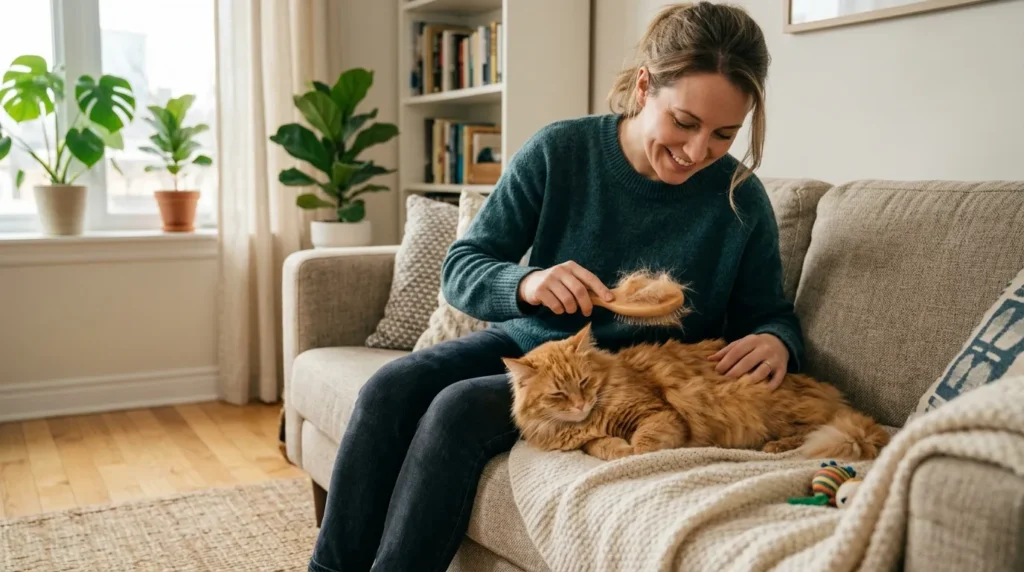
Regular brushing removes loose fur and dander before it lands on every surface in your apartment. A cat that sheds heavily and never gets brushed constantly deposits dander-coated fur on floors, furniture, and bedding, and all of it holds odor. Brushing three to four times a week for a medium or long-haired cat makes a measurable difference within two weeks. For the full approach to keeping a cat clean without a fight, see this breakdown on how to groom an indoor cat at home. A waterless shampoo session once every few weeks helps too, especially for cats that resist a full bath. Our guide on bathing a cat that hates water covers foam and wipe-based options that cut dander and skin-oil odor without a fight in the sink.
When Cat Marking Is the Real Source and Cleaning Alone Will Not Fix It
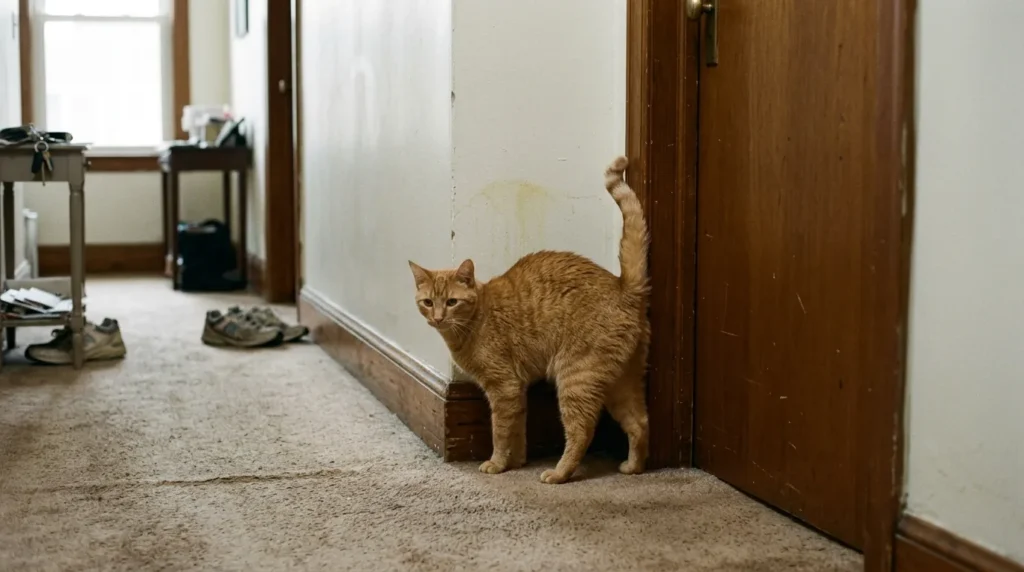
Marking spray is not the same as regular urination, and it does not smell the same either. Intact male cats spray most, but spayed and neutered cats mark under stress too. If the smell has a sharp, musky quality, and you are finding small spots on vertical surfaces like walls, door frames, and furniture legs, that is marking, not litter box overflow.
Enzymatic cleaner handles the smell, but it does not stop the behavior behind it. New pets, new people, changes at home, or even noise from neighbors in a shared building can all trigger marking. Our guide on indoor cat behavior covers why cats do this and what actually addresses it, useful if cleaning a spot does not stop your cat from returning to it. A calmer, more predictable routine through indoor cat enrichment often lowers the stress that drives marking in the first place. Shared walls add extra pressure on cats who are already sensitive. If you want the full context of what apartment life does to a cat’s stress levels, this guide on living with a cat in an apartment covers what most owners overlook, including how small-space living specifically affects odor management, which our piece on keeping a cat in a small apartment covers from the box-placement side as well.
Insight: If your cat keeps returning to the same spot after a thorough enzymatic clean, put her food bowl right there. Cats will not spray where they eat. It works faster than any repellent spray, and it costs nothing.
Renting? What to Know Before You Move Out
Cat odor is one of the most common reasons renters lose part of a security deposit, and it is almost entirely preventable with the steps above done consistently rather than as a last-minute scramble before a move-out inspection.
Do the full blacklight scan at least a month before you move, not the week of. Old urine in carpet padding or subfloor sometimes needs more than one enzymatic treatment cycle to fully clear, and finding that out with time to spare beats finding out during a walkthrough. Keep receipts for any enzymatic cleaner or professional carpet treatment you use. Documentation showing you actively treated the issue helps if a landlord disputes the outcome.
If carpet has taken heavy, repeated soaking in one spot, a professional carpet cleaning with pet-odor treatment, done a few weeks before move-out, is often worth the cost against the deposit you would otherwise lose. Ask specifically for enzymatic pet treatment rather than a standard steam clean, since a standard clean alone will not touch uric acid that has soaked into the pad.
Common Mistakes That Keep the Cat Smell Coming Back
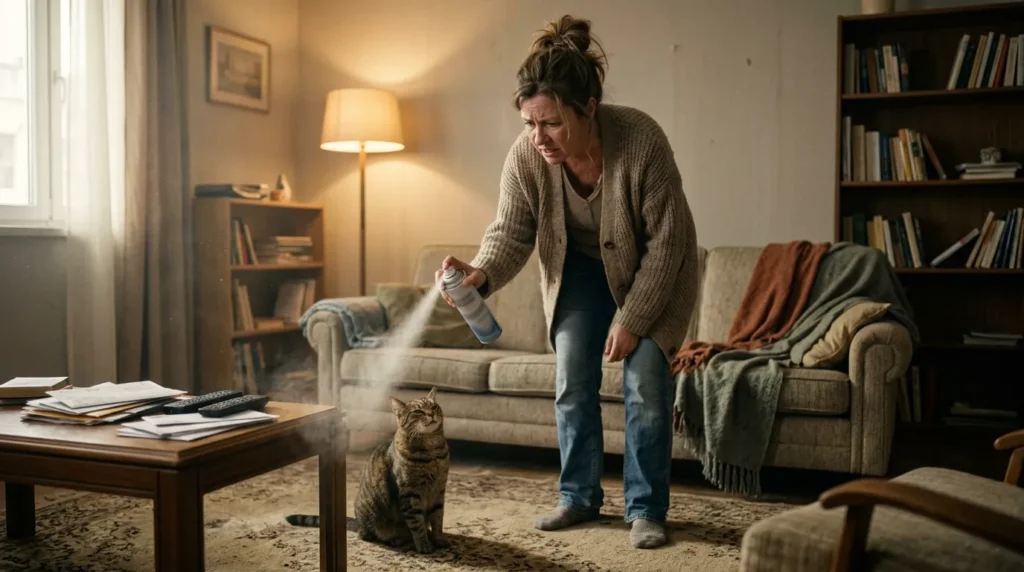
The most common mistake is using air freshener as the main strategy. Spraying lavender scent over cat urine does not neutralize anything. It creates a combination smell that is somehow worse than either one alone. The source is still there. You just added to it.
The second mistake is using ammonia-based cleaners on urine spots. Cat urine contains ammonia, and cleaning with an ammonia product tells your cat that spot has been refreshed for her. She will go back to it. Check the label before using any standard floor cleaner on a urine spot.
The third mistake is under-applying enzymatic cleaner. A light surface spray on a spot that soaked into a rug pad does almost nothing. The cleaner needs to reach the same depth the urine reached. For old carpet spots, pour enough that the surface feels slightly damp after you press a cloth firmly on it.
If you have been doing all of this consistently and the smell still will not quit, the cause is usually one specific thing you have not checked yet. Our guide on why litter boxes smell after cleaning walks through the exact culprits, from litter type to box material holding onto odor at a level normal washing will not reach.
A sudden change in how strong or sweet your cat’s urine smells is worth watching too. It is not always a cleaning problem. If the odor shifts sharply, or she is urinating outside the box more than usual, that can point to a health issue rather than a housekeeping one. Our guide on indoor cat health covers the changes worth tracking month to month, so you catch a medical cause before it becomes a bigger problem.
Frequently Asked Questions About Getting Rid of Cat Smell in Apartments
Does vinegar permanently remove cat urine smell?
No. Vinegar neutralizes ammonia odor on the surface for a while, but it does not break down uric acid crystals underneath. The smell comes back when humidity rises or the area warms up. Use enzymatic cleaner on urine spots, and save vinegar for routine hard floor maintenance between deeper cleanings.
How long does cat smell take to go away after cleaning?
With daily litter scooping, enzymatic treatment on every urine spot, and an air purifier running, most apartment odors drop noticeably within three to five days and are largely gone within two weeks. Old or large urine deposits sometimes need a second round of enzymatic cleaner.
Why does my apartment still smell like cat after cleaning?
You likely have a hidden urine spot you have not treated. Use a UV blacklight in a fully dark room. They glow clearly under UV light. Check under furniture, along baseboards, and on the wall around the litter box. One untreated spot can overpower everything else you cleaned.
Can the smell come from something other than urine?
Yes. Dander, skin oils in the fur, and poor litter hygiene all add to ambient smell without any urine present. A cat who is not brushed regularly deposits dander across every fabric surface in the apartment. Handling grooming and diet alongside cleaning gets you full odor control, not partial improvement.
What is the best litter for odor control in a small apartment?
Clumping clay litter with activated carbon tends to control odor best in tight spaces, since it binds ammonia on contact. Silica gel litter also absorbs moisture well. Whatever you pick, scoop daily. No litter fully makes up for infrequent scooping.
Does neutering stop a cat from spraying?
It reduces the odds a lot, especially in male cats neutered before sexual maturity, but it does not guarantee it stops. Spayed and neutered cats can still mark under stress. If spraying continues after neutering, the trigger is usually environmental, not hormonal.
The apartment smelled like cat before I even moved in. How do I get rid of a previous tenant’s cat smell?
Treat it exactly like your own cat’s odor, starting with a full UV blacklight scan of the carpet, baseboards, and closets before you move furniture in. Previous-tenant urine is often older and more deeply set into carpet pad or subfloor, so budget for a stronger response: a full enzymatic soak on every marked spot, and consider asking your landlord about professional pet-odor carpet treatment before your lease starts, since fixing it before you have furniture in the way is far easier than after.
When should I be concerned that the smell is a health issue?
If your cat’s urine suddenly smells much stronger or sweeter than usual, or she is urinating outside the box often, those are worth a vet visit. Kidney disease, diabetes, and urinary tract infections all change urine smell and volume. This article is for informational purposes only. Always consult your vet if you notice sudden changes in your cat’s elimination habits or urine odor.
Conclusion
Getting rid of cat smell in an apartment is not complicated, but it does need the right order of operations. Treat the litter box first, find every hidden spot with a blacklight, and use an enzymatic cleaner that actually breaks down uric acid. Add an air purifier, handle grooming and diet, and the problem stops being a problem. Start with the litter box today. That one change alone will show a difference by tomorrow morning.
To get rid of cat smell in an apartment, scoop the litter box daily, wash it weekly with mild soap, and add a thin layer of baking soda at the base. Find hidden urine spots with a UV blacklight and treat them with an enzymatic cleaner that breaks down uric acid crystals. Vinegar alone does not remove cat urine smell permanently. Fabric furniture and mattresses need enzymatic treatment plus full air drying, not just a surface wipe, since urine soaks into padding the same way it soaks into carpet. An air purifier with HEPA and activated carbon filtration removes airborne dander and odor particles. Regular grooming and a quality diet cut ambient odor by a wide margin. Renters should treat suspected urine spots weeks before a move-out inspection, since older stains often need more than one enzymatic treatment. Most apartment cat smells clear within two weeks of consistent, source-based cleaning.

Written by Mishu
A passionate cat lover and indoor living enthusiast, Mishu is the founder and voice behind Indoor Living Cat – a go-to resource for cat owners who want to create the happiest, healthiest life for their feline companions indoors.
View Full Profile