
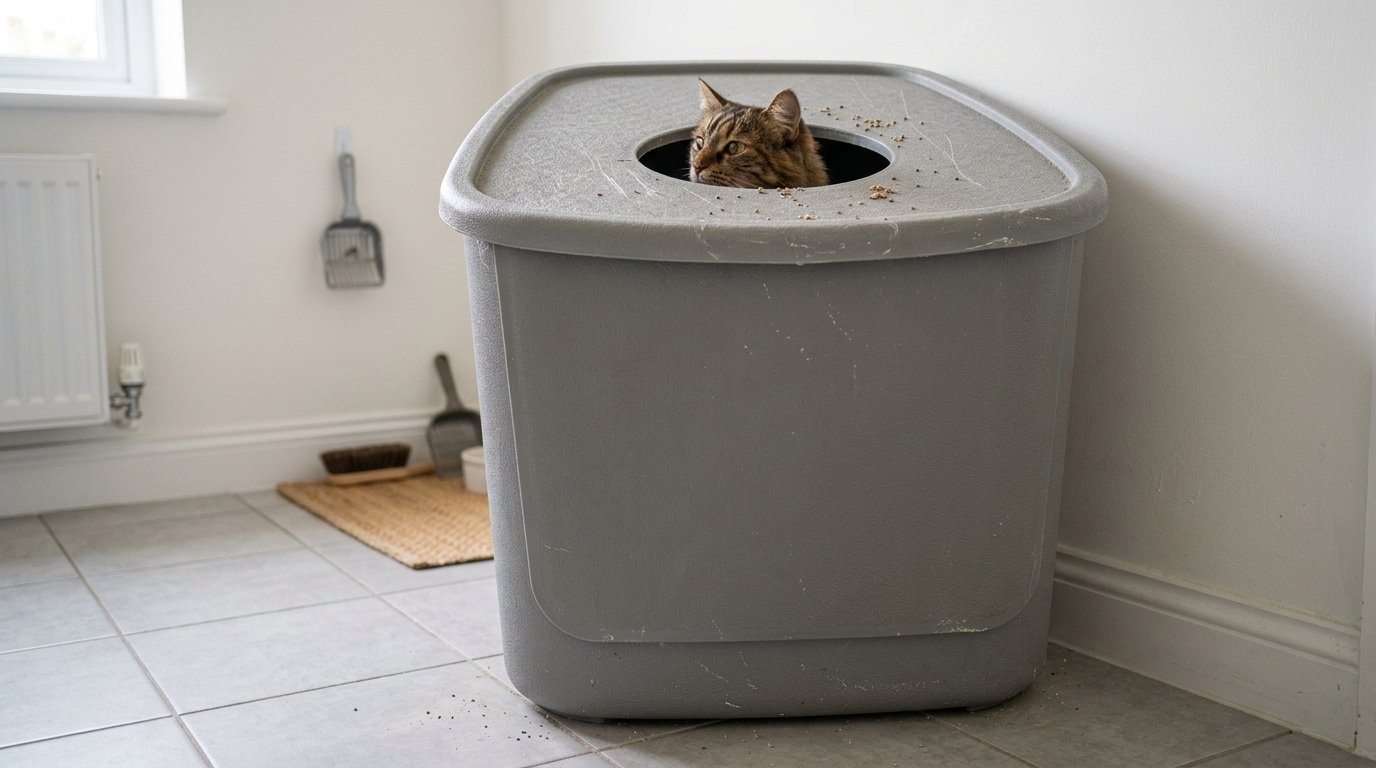
Urine on the wall behind the box. A puddle under the litter you scooped an hour ago. A smell that hits you before you’re even in the room. That’s a high sprayer, and an open pan or a short-walled hood won’t hold it back. A Top Entry Litter Box for High Sprayers seals the sides and sends your cat’s business straight down instead of out. The entry sits on top, the walls run tall, and the seams lock instead of leak, so spray stays inside the shell where it belongs.
Not every top entry box handles spray the same way, though. Some have thin plastic walls that let urine wick through the seams within a year. Others are stainless steel with sealed drawer bases built to survive years of daily spraying, some from more than one cat. Below, we break down six models by wall height, seal quality, material, and entry type, plus how to tell if your cat actually needs this kind of containment and how to get one used to jumping in.
⚡ Quick Verdict
List of Top Entry Litter Box for High Sprayers
| Image | Product | Score | Link |
|---|---|---|---|
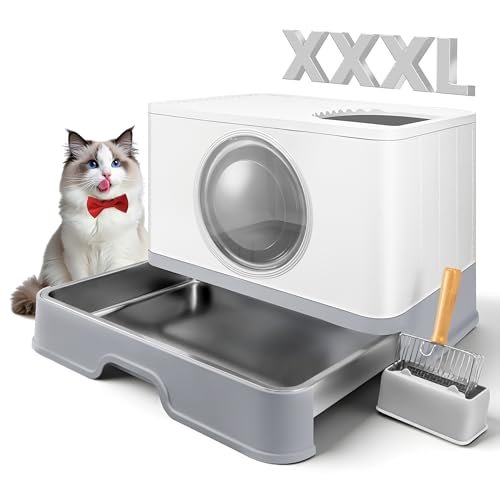 |
XXXL Stainless Steel Litter Box with Lid, Front Entry & Top 🏆 Editor’s Pick |
9.5/10 | View on Amazon Free Shipping & 30-Day Returns |
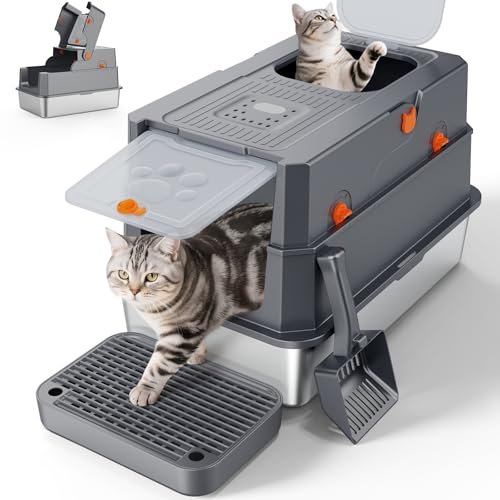 |
FURTIME Stainless Steel Litter Box with Lid, Enclosed Metal 🥈 Runner-Up |
9.2/10 | View on Amazon Free Shipping & 30-Day Returns |
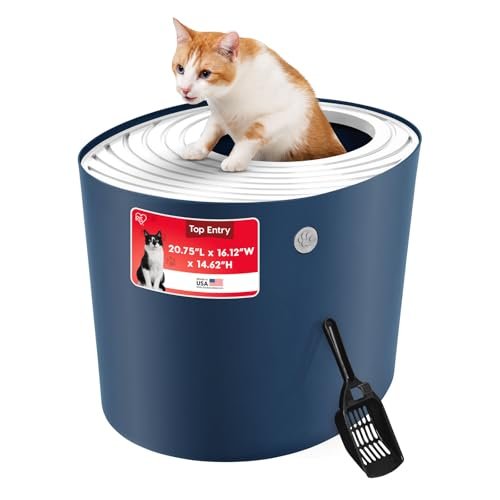 |
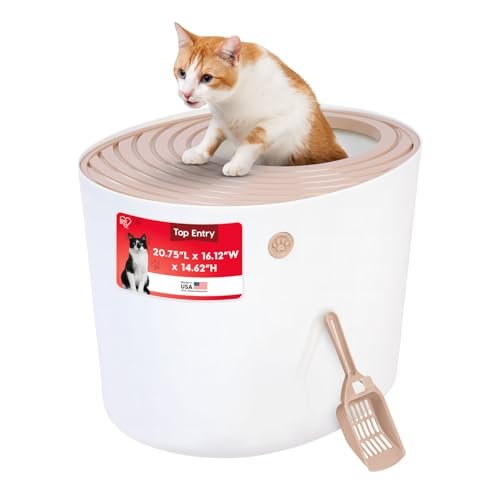
IRIS USA Top Entry Cat Litter Box, Hooded Privacy, Large, Na 🥈 Runner-Up |
7.8/10 | View on Amazon Free Shipping & 30-Day Returns |
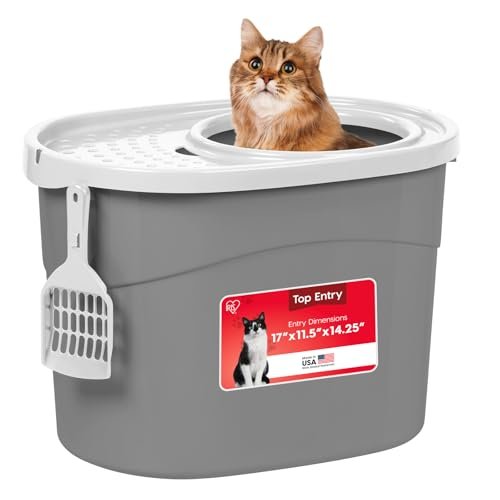 |
IRIS USA Top Entry Cat Litter Box, Hooded Privacy, Large, Gr 🏆 Editor’s Pick |
7.5/10 | View on Amazon Free Shipping & 30-Day Returns |
 |
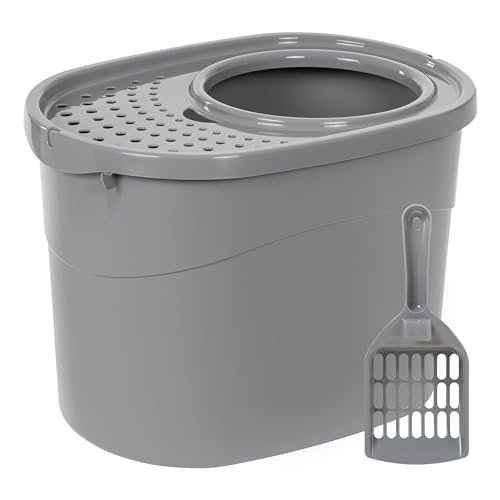
IRIS USA Large Top Entry Cat Litter Box, Hooded Privacy, Bei | 7.2/10 | View on Amazon Free Shipping & 30-Day Returns |
 |
Amazon Basics Large Cat Litter Box with High Sides, Top Entr 💵 Budget Pick |
6.8/10 | View on Amazon Free Shipping & 30-Day Returns |
📋 How We Evaluated
We scored each box against published specs, listed dimensions, and verified buyer feedback across multiple retailers, then weighed wall height, seam and seal quality, material, odor containment, ease of cleaning, and how each one holds up against a cat that sprays while standing. Scores are relative to this specific product set, not a universal rating.
How Many Litter Boxes Do High Sprayers Need in a Multi-Cat Home?
Buying one great top entry litter box, even a sealed, high-walled one, usually isn’t enough on its own if your cat sprays. Vets and feline behaviorists point to the “N+1 rule”: one litter box per cat, plus one extra. Two cats need three boxes. Three cats need four. That spare box matters even more with a sprayer, because a cat guarding territory will mark near a soiled or contested box rather than share it, and spraying is often a territorial signal in the first place.
| Number of Cats | Minimum Litter Boxes (N+1) |
|---|---|
| 1 cat | 2 boxes |
| 2 cats | 3 boxes |
| 3 cats | 4 boxes |
| 4 cats | 5 boxes |
| 5+ cats | One per cat, plus one, or one per established social group plus one |
A few placement rules make the count actually work:
- Spread boxes across different rooms or floors. Cats treat two boxes side by side as one territory, not two options.
- Skip high-traffic spots near washing machines, food bowls, or a noisy furnace. Cats avoid boxes they associate with stress, and stress is one of the biggest triggers for spraying.
- If your cats live in separate social groups (common in homes that merged two cat families), give each group its own set of boxes.
- Large or dominant cats sometimes block access to a single premium box. Having a second top entry unit, even a smaller one, prevents standoffs that lead to a cat marking outside the box instead.
- Keep sealed boxes a few feet clear of walls and soft furnishings where you can. A cat that sprays near a box it feels unsafe in will hit whatever’s closest, and that’s usually the wall behind it.
In practice, that often means one large, sealed top entry litter box as the main station and a second, smaller box elsewhere in the house, rather than trying to make one XXXL unit cover every cat and every spray pattern.
Top Entry vs. Front Entry vs. Open Pan
Top entry isn’t automatically the right call for every household. It’s a tradeoff: less mess and less spray on your walls, more physical effort for your cat. Here’s how the three main styles stack up.
| Factor | Top Entry | Front Entry / Hooded | Open Pan |
|---|---|---|---|
| Handles standing spray | Best | Good | Poor |
| Litter tracking | Best control | Moderate | Worst |
| Good for seniors/kittens | Not ideal | Good | Best |
| Odor containment | Strong | Strong | Weak |
| Keeps dogs out | Best | Moderate | No |
| Ease of cleaning | Slower (lid removal) | Moderate | Fastest |
| Best for | Healthy, agile cats age 1-10 | Most life stages | Kittens, seniors, arthritis |
If your household mixes ages, for example a young cat and a 12-year-old with stiff joints, a dual-entry model like the two top picks below gives both cats a way in without forcing everyone to jump, while still sealing spray inside the shell.
Detailed Reviews
XXXL Stainless Steel Litter Box with Lid, Front Entry & Top 🏆 Editor’s Pick
| Dimensions | 24.25 x 18.11 x 19.21 inches |
| Material | Stainless Steel |
| EntryType | Dual (Front & Top) |
| Capacity | 90L |
What We Found
At 24.25 x 18.11 x 19.21 inches with a 90L capacity, this is one of the largest top entry litter boxes we looked at, and the size shows. Stainless steel doesn’t scratch the way plastic does, so bacteria and odor have nowhere to hide in worn grooves. It’s rust-resistant and wipes clean with a damp cloth in seconds.
The dual-entry setup is one reason it earns the top spot, but the sealed drawer base is why it wins for a spraying cat. Younger, more athletic cats can jump through the top; a front door handles kittens, seniors, or anyone who’d rather not leap. Either way, the drawer slides out for scooping without lifting the whole hood off.
Ninety liters of capacity is enough for a Maine Coon or two or three average cats sharing one station. Sealed edges stop the leaks that plague cheaper plastic pans, which matters most if you’ve got a cat who sprays while standing instead of squatting. It costs more than a plastic box and takes up real floor space, but for a heavy sprayer it’s the closest thing to a set-and-forget solution.
💬 My Take
If you have the floor space and a cat who sprays hard, this is the box to buy once. The sealed base and dual entry solve the two biggest complaints about top-entry designs.
Who It’s For
Owners of large breeds, several cats, or one determined high sprayer will get the most out of this one. The sealed drawer base and tall walls keep spray contained instead of pooling under the box, and because it offers both entries, it works whether your household is all young and agile or includes an aging cat who needs the front door option.
✅ Pros
- Non-porous stainless steel resists odor and rust.
- Sealed drawer base contains spray better than snap-together plastic.
- Dual entry works for cats of different ages and mobility.
❌ Cons
- Costs more than plastic models.
- Large footprint needs dedicated floor space.
- Metal can echo or clang when cats dig.
FURTIME Stainless Steel Litter Box with Lid, Enclosed Metal 🥈 Runner-Up
| Dimensions | 23 x 15 x 15 inches |
| Material | Stainless Steel |
| EntryType | Dual (Front & Top) |
| Features | Deodorizing compartment |
What We Found
The flip-top lid is what sets the FURTIME apart from most enclosed boxes. You don’t have to remove the whole hood to scoop, just flip it back, which saves real time if you’re cleaning multiple boxes a day.
Three layers of shell lock together for a leak-proof seal, and that’s the main reason this box made the list. It’s built for cats who spray while standing rather than squatting, and the locked seams keep that spray from wicking out onto the floor. A built-in compartment holds a charcoal bag, so it’s actively neutralizing ammonia instead of just trapping the smell behind a lid.
Like the top pick, it offers both front and top entry, so age or mobility isn’t a barrier. The steel surface doesn’t stain the way plastic does over months of use. Assembly takes some patience with the locking mechanism, and it’s heavier to move than a plastic box, but day to day it performs like a premium unit.
💬 My Take
The locking seams and charcoal compartment make this one worth the extra assembly time if spraying, not just tracking, is your bigger problem.
Who It’s For
Good fit for owners of high-spraying cats, especially in a small space where odor spreads fast. It also suits anyone who wants stainless steel’s hygiene without giving up a flip-top lid’s convenience.
✅ Pros
- Locking, leak-proof shell keeps spray off the floor.
- Flip-top lid speeds up daily scooping.
- Deodorizing compartment cuts ammonia smell.
❌ Cons
- Assembly is fiddly the first time.
- Heavier than plastic alternatives.
- Priced above basic plastic boxes.
IRIS USA Top Entry Cat Litter Box, Hooded Privacy, Large, Na🥈 Runner-Up
| Dimensions | 20.75 x 16.12 x 14.62 inches |
| Material | Recyclable Plastic |
| EntryType | Top |
| Color | Navy/White |
What We Found
This Navy/White model runs a bit larger than IRIS USA‘s standard gray version, and it’s made in the USA from recyclable plastic, which matters if that’s a priority for you. The interior surface is smooth enough that litter clumps don’t stick during scooping, which cuts real time off daily maintenance.
The grooved lid works like a built-in mat, pulling granules off paws before your cat steps back onto the floor. It won’t eliminate tracking entirely, no lid does, but it noticeably cuts it down. Most adult cats fit through the opening without trouble.
It’s plastic, so it won’t outlast a steel model, and scratches will eventually hold odor. It also isn’t built with sealed seams for heavy spraying, so if your cat sprays hard while standing, you’re better off sizing up to one of the steel models with a sealed base. For most multi-cat homes without a serious sprayer, though, it’s a reliable middle-ground pick.
💬 My Take
Solid, unglamorous, and easy to live with. If your cat sprays lightly and you’re not ready to spend on steel, this is where I’d start.
Who It’s For
Good for households that want a made-in-USA option that manages litter scatter and light spraying without a big price jump. Works well for owners who care about a tidy, functional setup more than premium materials.
✅ Pros
- Made in the USA from recyclable material.
- Grooved lid catches loose litter from paws.
- Smooth interior speeds up cleaning.
❌ Cons
- No sealed seams, so heavy spray can find its way out.
- Lid has to come off for deep cleaning.
- Not a good fit for cats with joint pain.
IRIS USA Top Entry Cat Litter Box, Hooded Privacy, Large, Gr🏆 Editor’s Pick
| Dimensions | 20.5 x 14.75 x 14.38 inches |
| Material | Plastic |
| EntryType | Top |
| Color | Gray/White |
What We Found
At 20.5 x 14.75 x 14.38 inches, this is the most compact box on our list, and the textured lid is built specifically to knock litter off paws before your cat steps out. That smaller footprint makes it a realistic fit for a laundry room or a bathroom corner where a 24-inch box just won’t go.
Because the entry sits up top, dogs generally can’t get into the litter, which solves a real problem in mixed-pet homes. The enclosed hood also gives anxious cats somewhere private to go, which can help with cats who avoid the box when they feel exposed, and exposure is a common spraying trigger. That said, the walls are shorter than the steel models above, so a cat that sprays hard while standing may still reach the seams. It’s better suited to squatters or light sprayers than to a determined wall-sprayer.
For apartment dwellers short on space, the smaller size is the whole point. It still delivers solid tracking control, just not the heaviest-duty spray containment on this list.
💬 My Take
A good pick when floor space is tight and your cat sprays lightly, not the box I’d choose for a heavy, standing sprayer.
Who It’s For
Best for smaller homes where controlling scatter matters most and spraying is mild. Works well for average-sized, agile cats. If a curious dog shares the house, the raised entry keeps the litter area off-limits without needing a separate barrier.
✅ Pros
- Compact footprint fits small spaces.
- Textured lid traps loose litter effectively.
- Elevated entry keeps dogs out.
❌ Cons
- Shorter walls than the steel models, so heavy spray can reach the seams.
- Not a fit for senior cats with mobility issues.
- Lid removal needed for a deep clean.
IRIS USA Large Top Entry Cat Litter Box, Hooded Privacy, Bei
| Dimensions | 20.75 x 16.125 x 14.625 inches |
| Material | Plastic |
| EntryType | Top |
| Color | Beige/White |
What We Found
The beige finish on this one is meant to disappear into a living room rather than look like litter box furniture. It handles spray and scatter well for a plastic box, and the scoop clips onto the side, so it doesn’t end up lost behind the washing machine.
Like the other IRIS models here, the lid is grooved to catch litter from paws on the way out. High walls do a genuinely good job stopping urine spray from reaching the floor, which matters more than people expect with an unneutered or dominant cat. It works best for cats who already jump comfortably; there’s no front-entry option on this model.
It’s a simple design without much beyond the basics, but the basics, including wall height, are done well, and that’s often enough for a moderate sprayer, even if it won’t out-seal the drawer-base steel models above.
💬 My Take
Nothing flashy here, just a clean, neutral box with walls tall enough to earn its spot on this list.
Who It’s For
Fits owners who care about how the litter area looks as much as how well it works, and whose cat sprays but not aggressively. A simple, neutral-toned option for anyone who wants spray and scatter contained without spending on premium materials.
✅ Pros
- Neutral color blends with most decor.
- Built-in scoop clip keeps tools handy.
- High walls stop most spray from reaching the floor.
❌ Cons
- Standard plastic won’t last as long as steel.
- Lid takes some effort to clean thoroughly.
- Top entry only, no front-door option.
Amazon Basics Large Cat Litter Box with High Sides, Top Entr💵 Budget Pick
| Dimensions | 20.5 x 14.75 x 14.38 inches |
| Material | BPA-free Plastic |
| EntryType | Top |
| Color | Grey |
What We Found
This is the cheapest way into a top entry setup on our list, and it doesn’t pretend to be anything more. BPA-free plastic holds up fine under normal use, and the high sides do their job keeping litter and light spray inside the box, even with cats that dig hard before they settle.
A matching scoop stores on the box itself, so cleanup tools stay put instead of wandering off. Pop the top off and scooping is straightforward, nothing to disassemble.
The walls are tall enough for average spraying, but the seams aren’t sealed the way the steel models are, so it’s better as a second box or for a light sprayer than as the main line of defense for a heavy one. It also skips the odor-control extras you get on the steel models, and it’s not the right size for a large breed. For a single average-sized cat, or as a second box once you’ve already spent on a premium main station, it covers the basics without much cost.
💬 My Take
A smart way to add a second or third box under the N+1 rule without spending premium money on every station. Not the one I’d trust alone against a heavy sprayer.
Who It’s For
Good for budget-conscious buyers who want a reliable, no-frills litter box. Best suited to standard-sized cats, light sprayers, and owners adding an extra station rather than a single do-everything box.
✅ Pros
- Low price point.
- Durable BPA-free plastic.
- Storage scoop included.
❌ Cons
- Seams aren’t sealed against heavy spray.
- Not sized for very large cats.
- No built-in odor control features.
What to Look For Before Buying
Picking the right box comes down to your cats, not just the product spec sheet. Think about size, spraying habits, jumping ability, and how much time you actually have to clean before you commit to a large stainless steel unit or a cheap plastic pan.
Size the box to your cat, not the box’s marketing name
A common rule: the box should be at least 1.5 times the length of your longest cat, measured nose to base of tail. An undersized box leads to accidents outside it, no matter how well the lid controls tracking.
| Cat Size | Recommended Box Length |
|---|---|
| Small/medium (under 10 lb) | 18-20 inches |
| Large (10-15 lb) | 20-24 inches |
| Extra-large breeds (Maine Coon, Ragdoll, 15+ lb) | 24+ inches |
Check wall height and seam seals if your cat sprays
A cat spraying while standing can clear an 8 to 10 inch wall without much effort. Look for interior walls of at least fourteen inches on the sprayed side, and a sealed or interlocking base with no exposed seams. A drawer-style base that slides out clean beats a snap-together shell where urine can wick into the plastic edges over time.
Check material durability
Stainless steel wins on hygiene and lifespan, and it holds up better against a heavy sprayer than plastic ever will. Plastic scratches over time, and those scratches hold bacteria and odor no matter how much you scrub. If you go with plastic, plan to replace the box every year or so. Steel’s non-porous surface just stays clean longer.
Match entry accessibility to your cats’ ages
Top-entry-only boxes are excellent for litter and spray containment but tough on seniors, kittens under four months, and any cat recovering from surgery. Confirm your cat can jump comfortably before buying a top-only model. A dual-entry box, like our top two picks, sidesteps the issue entirely.
Rate odor management honestly
Enclosed boxes contain odor better than open pans, full stop. Models with a deodorizing compartment or charcoal filter help further. None of that replaces regular scooping, though; it’s still the single biggest factor in how a room smells.
Verify space requirements before you buy
Measure your floor space before ordering a large unit, and remember your cat needs room to turn around inside it. If you have more than one cat, factor in how many boxes you need total too, not just the size of one box.
Quick buying checklist
- Box length is at least 1.5x your longest cat’s body length
- Interior walls run at least 14 inches on the side your cat sprays toward
- Base is sealed or drawer-style, with no exposed seams where urine can wick out
- Entry style matches every cat’s age and mobility, not just the youngest one
- Material is non-porous (stainless steel) or replaceable within a year (plastic)
- You have enough boxes for the number of cats in the house (N+1 rule)
How to Transition a Cat to a Top Entry Litter Box
Cats don’t automatically trust a new box, especially one that requires jumping in from above. Switching too fast is the most common reason cats start avoiding the litter box altogether, and an avoided box is a box a stressed or territorial cat will spray near instead. Go slow and give them a way out if it doesn’t work.
- Keep the old box running for two weeks. Set the new top entry box up next to it rather than swapping cold turkey.
- Leave the lid off at first. Let your cat use the base like an open pan so the shape and litter feel familiar.
- Add the lid without the entry cover. This gets them used to a hooded space before they need to jump through an opening.
- Test with a low step or ramp. Older or hesitant cats often need a boost the first few times.
- Remove the old box only after you see consistent use. A few days of confident, unprompted use is a better signal than one good visit.
- Watch for avoidance signs. Scratching outside the box, accidents nearby, spraying near the new box, or hesitating at the entry all mean the transition is moving too fast, or that a top entry box isn’t the right fit for that cat.
Frequently Asked Questions
Which top entry litter box is best for a cat that sprays?
Look for stainless steel or a sealed plastic shell with tall interior walls and no exposed seams. Our top two picks, the XXXL stainless steel box and the FURTIME, are built with leak-proof, sealed bases specifically because they handle spraying cats well. Skip short-walled plastic pans if your cat sprays while standing.
Do top entry boxes stop spraying entirely?
They contain the mess, not the behavior itself. Spraying is usually about stress, territory, or an unneutered cat, and a sealed box just keeps it off your walls and floor while you deal with the underlying cause. If spraying is new or getting worse, it’s worth a vet visit.
Are top-entry boxes suitable for all cats?
No. They work best for active, agile cats. Seniors, kittens under four months, and cats with arthritis or recent surgery often struggle with a jump-only entry. Choose a dual-entry or front-entry box for those cats instead.
How often should I clean a stainless steel box?
Scoop it daily, more often in a multi-cat home. Deep-clean with mild soap and water every couple of weeks. Steel resists odor far better than plastic between deep cleans.
Do these boxes really stop litter tracking?
They cut it down noticeably, not to zero. A textured or grooved lid works like a mat, pulling granules off paws as your cat exits. You’ll still want a small tracking mat under the box if hardwood floors are a concern.
How many litter boxes do I need for multiple cats?
Follow the N+1 rule: one box per cat, plus one extra, spread across different rooms rather than clustered together. Two cats need three boxes; three cats need four. See the full breakdown above.
Will a top-entry box keep my dog out?
Most dogs can’t manage the jump-and-drop entry, so yes, it works as a practical barrier for most households.
Are top-entry boxes good for senior cats?
Generally not on their own. Arthritis and stiff joints make jumping into a tall opening difficult or painful. A dual-entry model, or a dedicated low-entry covered box, is a safer choice for aging cats.
🎯 Final Verdict
For a cat that sprays, the XXXL Stainless Steel Litter Box is the one to buy. The sealed drawer base and dual entry contain spray better than anything else on this list, and steel won’t absorb odor into scratched seams the way plastic eventually does.
If you want a more compact, flip-top design with locking seams that hold up just as well against a standing sprayer, the FURTIME box is a close second and worth the extra assembly time. Either one beats a plastic pan on containment and long-term hygiene. Just remember: sealing the box handles the mess, but a cat that sprays often, or has started recently, is telling you something. Stress, an unneutered status, or a territory dispute with another cat are all worth ruling out with a vet.
Prices change often on Amazon, so check the links below for current pricing before you decide.

Written by Mishu
A passionate cat lover and indoor living enthusiast, Mishu is the founder and voice behind Indoor Living Cat – a go-to resource for cat owners who want to create the happiest, healthiest life for their feline companions indoors.
View Full Profile