
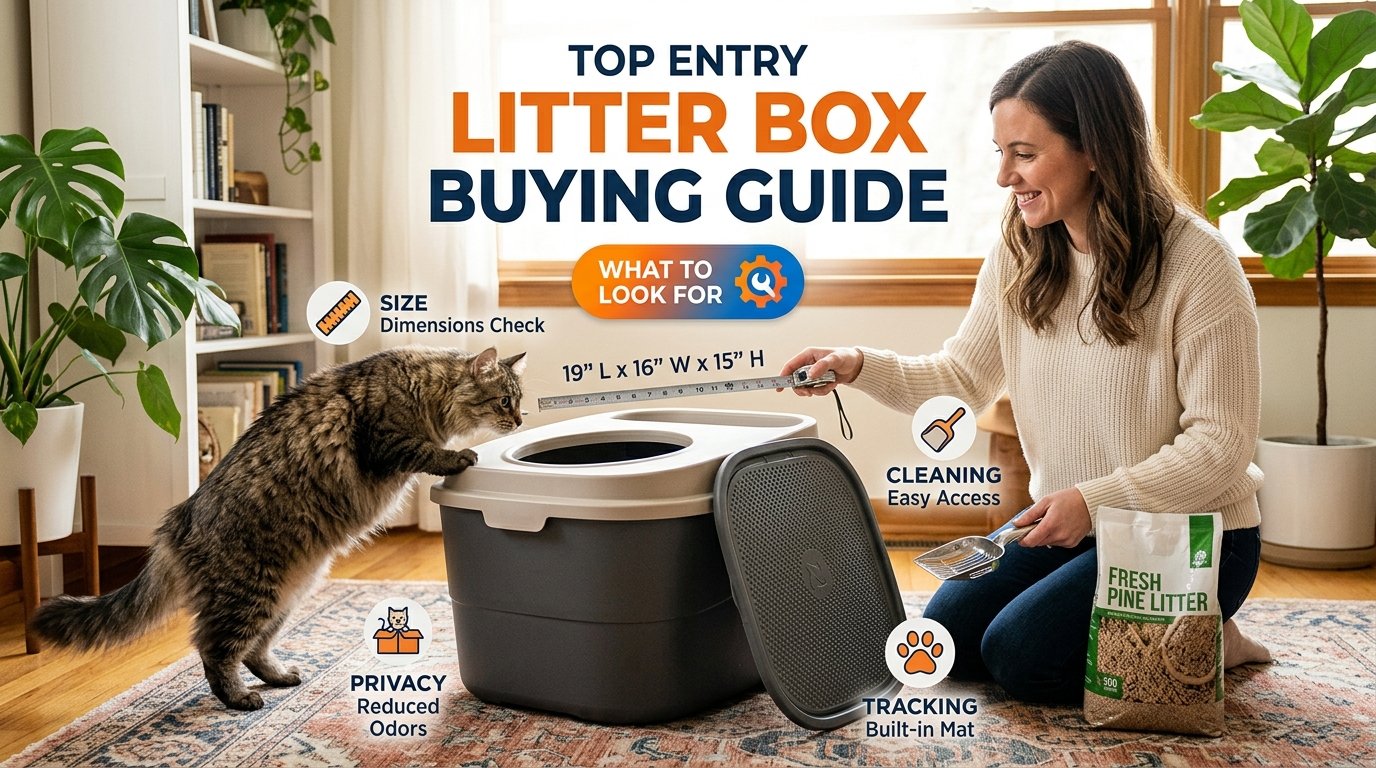
Most of the litter on your floor arrived on your cat’s paws. A top entry litter box makes your cat climb out over a grooved or grated lid, and that lid knocks loose granules back into the pan before they reach the hardwood. It works well for healthy adult cats that dig and kick. It works badly for seniors, young kittens, and big cats who need room, and this top entry litter box buying guide shows you how to tell which group yours belongs to.
Written by [Author Name], [role or hands-on experience with cats]. Last updated September 21, 2026. Some links below are Amazon affiliate links. If you buy through one, we earn a small commission at no extra cost to you.
Top Entry Litter Boxes at a Glance
Here are the five boxes reviewed in this guide, side by side. Full reviews come after the buying checklist, because knowing your cat’s measurements will narrow the list faster than any ranking.
| # | Model | Lid design | Best for | Main tradeoff |
|---|---|---|---|---|
| 1 | IRIS USA Large, Gray/White | Textured lid | Small to medium healthy cats that kick litter | Compact interior; lid comes off for full cleaning |
| 2 | IRIS USA Large, Beige | Holes in the lid work as a built-in mat | Living areas where color matters | Beige shows stains; holes need cleaning |
| 3 | Amazon Basics Large | Filtered lid | Cats that dig hard or spray | Grey shows dust; poor fit for arthritic cats |
| 4 | Arm & Hammer Premium | Grated lid, Microban-treated plastic | Larger cats and odor-sensitive homes | Bigger footprint; replace every 12 months |
| 5 | IRIS USA Large, Beige/White | Grooved lid | Hard floors where stray litter shows | Large footprint; white shows dirt |
Sizes vary even inside IRIS’s own top entry line. IRIS lists one Large model at 20.5 by 14.75 inches and another at 20.8 by 16.1 inches, so read the dimensions on the exact listing you’re about to buy.
How a Top Entry Litter Box Works and Who It Suits?
Open pans let cats kick litter over the rim, and it lands on your floor. A top entry box closes the top and leaves one round opening. Your cat jumps in, does business, and jumps back out across a grooved, grated, or perforated section of the lid that sheds litter from their paws. The tall walls hold kicked litter and sprayed urine inside, and the raised opening slows dogs down. A tall or determined dog can still get a snout in, so treat it as a speed bump, not a lock.
Good fit and poor fit
| Your cat or home | Verdict | Why |
|---|---|---|
| Healthy adult that jumps easily | Good fit | The vertical exit is no effort, and the lid does its job. |
| Heavy digger or litter kicker | Good fit | High walls catch scatter that an open pan would spray across the floor. |
| Cat that sprays | Good fit | Tall walls keep urine inside the box. |
| Home with a dog | Good fit | The raised opening makes the litter harder to reach. |
| Senior cat or cat with arthritis | Poor fit | The jump can hurt, and a cat that hesitates at the rim may start going elsewhere. |
| Kitten still learning to climb | Poor fit | Start with a low-sided open pan and move up later. |
| Large breed such as a Maine Coon | Only if the interior is big | Cats need room to turn around and dig. Check floor dimensions before buying. |
| Anxious cat or multi-cat home | Trial only | Covered boxes take away escape routes, and cats that feel trapped may avoid them. |
Top Entry Litter Box Buying Guide: 8 Things to Check Before You Buy
Work through these in order. Size and entry style decide most outcomes, and the rest is refinement. You’ll need a tape measure and about two minutes with your cat.
1. Size: measure your cat first
Measure from your cat’s nose to the base of the tail. The 2014 AAFP and ISFM house-soiling guidelines recommend a box 1.5 times that length, with a minimum of 22 by 17 inches. A cat that measures 16 inches wants a 24 inch box.
| Nose to base of tail | Box length at 1.5x |
|---|---|
| 12 in | 18 in |
| 14 in | 21 in |
| 16 in | 24 in |
| 18 in | 27 in |
| 20 in | 30 in |
Now compare that with a real listing. IRIS’s Large gray/white model is 20.5 inches long outside, with a 15 by 9.75 inch floor. By the 1.5x rule, that floor suits a cat of about 10 inches, and you’ll see a similar gap on many top entry boxes. Plenty of cats use a box slightly under the guideline without complaint, so treat 1.5x as a target and watch what your cat does. Check that your cat can turn around without brushing the walls and that accidents don’t start showing up beside the box. If either happens, go bigger or switch to an open pan.
2. Opening size and jump height
The opening on IRIS’s Large model is 9.25 inches across, and the box stands 14.5 inches tall. Your cat’s shoulders and chest have to fit through that circle, and their legs have to cover the rise. A stocky cat can feel squeezed by a small opening, and a cat with sore joints will notice every inch of height. Kittens and seniors are the groups that struggle most here.
3. Lid design
Grooves, holes, and grated bars all work the same way: paws drag across an uneven surface and shed litter on the way out. Wide grooves catch coarse granules. Fine litter can slip through small holes and clog them. Whatever the pattern, choose a lid that lifts off in one motion, since you’ll be handling it daily, and plan to clear the grooves or holes once a week.
4. Material and finish
Look for smooth, BPA-free plastic. Once scratches score the interior, they hold bacteria and odor, and scrubbing won’t fully fix it. That’s the reason plastic boxes need replacing about once a year, and Arm & Hammer states twelve months for its model. A stainless steel top entry litter box avoids the scratch problem if you’d rather buy once.
5. Odor control
Enclosed boxes hold smells in, and features like Microban help. Microban treats the plastic surface to slow bacterial growth, so it won’t neutralize a clump sitting in the litter. Scooping still does most of the work. Skip scented litter and strong air fresheners nearby, since cats have a far stronger sense of smell than we do and many reject them.
6. Cleaning access
A box that’s a hassle to open gets scooped less. Look for a removable lid, an opening wide enough to reach in with a scoop, and a scoop hook on the side. Several IRIS models include one, and Amazon Basics has on-board scoop storage.
7. Dogs and other pets
A raised opening keeps most dogs from grazing in the litter and keeps toddlers out of it too. It’s a barrier. Medium and large dogs can still tip their heads in, so if yours treats the box like a snack bar, put it in a room behind a baby gate.
8. Litter type and placement
Heavy, low-dust clumping litter tracks less than light or powdery litter. The Arm & Hammer model is compatible with pine, crystal, and clumping formulas, so check the listing for your box. Put the box in a quiet, low-traffic spot away from washers and dryers, and keep it away from food and water bowls.
Top Entry Litter Box Reviews: 5 Models Compared
We compared these boxes on how well the lid stops tracking, how well the walls hold odor, and how much room a cat gets inside. Specs come from manufacturer listings, and where we don’t have a measurement, we don’t guess. Check the listing dimensions against your cat’s measurements before you order.
|
1
|
IRIS USA Top Entry Cat Litter Box, Hooded Privacy, Large, Gray/White |
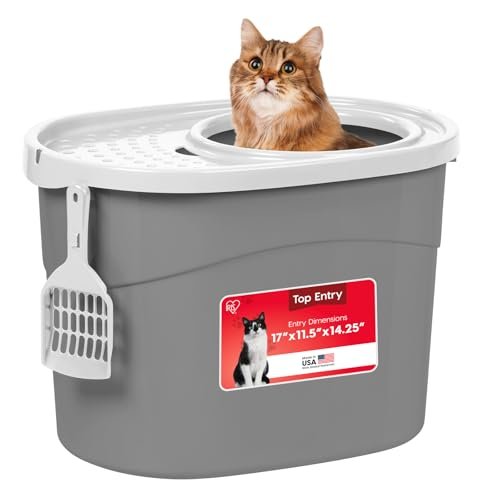
The lid does the work here. Grooves in the plastic make your cat’s paws drag across an uneven surface on the way out, and loose litter drops back into the pan instead of onto your carpet or hardwood. The high walls handle the rest: a cat that digs hard and kicks backward mostly hits plastic.
IRIS lists the outside at 20.5 by 14.75 by 14.5 inches, with a 9.25 inch round opening and a 15 by 9.75 inch floor. That’s compact, which suits a laundry room or a bathroom corner and limits how much space a bigger cat gets. The raised opening makes it harder for a dog to reach the litter. The lid lifts off for scooping and full cleanouts.
Best for: Small to medium healthy cats that kick litter.
How This Can Solve Your Problem
- ✓ Textured lid catches loose litter from paws
- ✓ Enclosed design keeps odors and mess contained
- ✓ Elevated entry makes it harder for dogs to reach the litter
Important Considerations
- • May be too small for very large cat breeds
- • Top entry requires cats to jump up
- • Lid must be removed for complete cleaning
|
2
|
IRIS USA Top Entry Cat Litter Box, Hooded Privacy, Large, Beige |
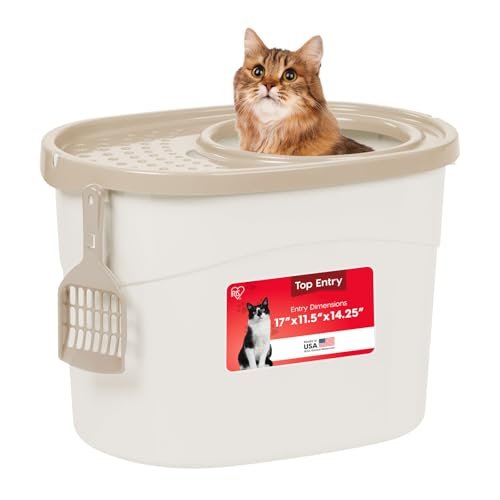
Small holes in this lid act as a built-in mat. As your cat steps across, litter drops through them instead of riding out on their paws. The deep basin and tall walls keep enthusiastic diggers from flinging litter past the rim, and IRIS makes the box in the USA with global materials.
The scoop comes with a hook, so it hangs on the box instead of lying on the floor beside it. Beige blends into most rooms, which matters when the box lives in a hallway or living area. The tradeoff is upkeep: light plastic stains over time, and the lid holes need clearing when litter packs into them. The size suits average cats, so measure yours first.
Best for: Living areas where the box is on show.
How This Can Solve Your Problem
- ✓ Integrated lid holes trap loose granules effectively
- ✓ Includes a convenient scoop with storage hook
- ✓ Neutral beige color fits most home interiors
Important Considerations
- • Beige plastic may show stains over long periods
- • Requires periodic cleaning of the lid holes
- • Not suitable for cats with mobility issues
|
3
|
Amazon Basics Large Cat Litter Box with High Sides, Top Entry, Odor Co |
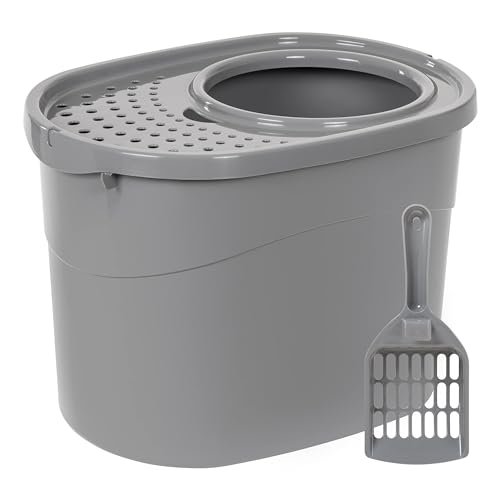
Amazon Basics keeps it plain. The filtered lid catches granules from your cat’s feet as they climb out, the plastic is BPA-free and recyclable, and the high sides keep sprayed urine and kicked litter inside the box. If your cat digs hard or sprays a little, the tall walls are the selling point.
The top lifts off, so checking litter levels and scooping takes seconds. An on-board scoop holder keeps the scoop from wandering. The grey finish hides stains better than beige, though it shows dust more than lighter colors. Owners of older cats should look elsewhere, because the height that keeps litter in also keeps arthritic cats out. Check the listed dimensions against your cat’s length before ordering.
Best for: Cats that dig hard or spray.
How This Can Solve Your Problem
- ✓ Filtered lid reduces litter tracking
- ✓ BPA-free plastic construction
- ✓ Removable top makes daily scooping simple
Important Considerations
- • Grey color might show dust more than lighter colors
- • Lid requires consistent cleaning to keep filters clear
- • Not ideal for senior cats with joint issues
|
4
|
Arm & Hammer Premium Top Entry Litter Box with Filter to Clean Paws an |
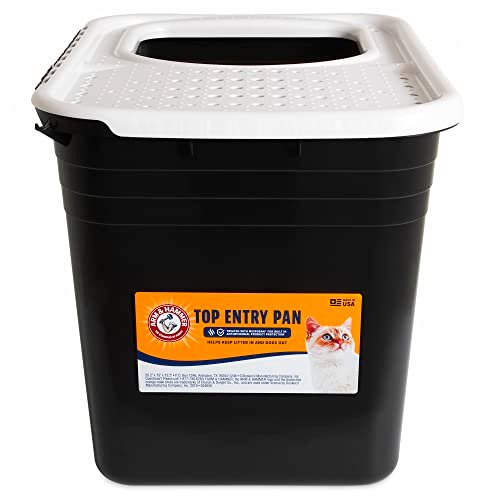
Arm & Hammer builds its box around Microban, an antimicrobial treatment in the plastic that slows bacterial growth on the surface. That helps with the smell of the box itself. It won’t neutralize a clump sitting in the litter, so daily scooping still matters. The grated lid catches loose litter, and the wide entry is meant to fit larger cats.
It’s made with recycled materials and works with pine, crystal, or clumping litter, so you can change litters without changing boxes. The high walls give shy cats privacy and help keep dogs out. Two catches: the footprint is bigger than the IRIS boxes, and the box needs replacing every twelve months. Plan for the floor space and the yearly cost.
Best for: Larger cats and households sensitive to litter odor.
How This Can Solve Your Problem
- ✓ Built-in Microban protection inhibits odor-causing bacteria
- ✓ Wide entry accommodates larger cat breeds comfortably
- ✓ Compatible with various types of cat litter
Important Considerations
- • Requires replacing the entire box every twelve months
- • Larger footprint may take up more floor space
- • Grated lid requires regular cleaning to remain effective
|
5
|
IRIS USA Large Top Entry Cat Litter Box, Hooded Privacy, Beige/White |
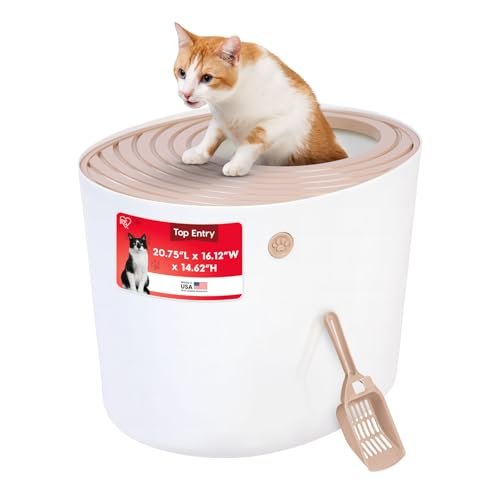
Grooves in this lid are shaped to catch particles from your cat’s paws. That matters most on hardwood or tile, where one stray granule shows up right away. Tall walls and a closed top keep the whole routine out of sight.
A scoop hook mounts on the side, and IRIS calls the interior Large, so your cat gets room to move around. It’s made in the USA with global materials. The beige and white finish looks clean in a bathroom or utility room, but white plastic shows dirt sooner than darker colors. It needs real floor space, and it’s the wrong pick for a cat that prefers open pans.
Best for: Hard floors where stray litter shows.
How This Can Solve Your Problem
- ✓ Grooved lid effectively traps stray litter particles
- ✓ Enclosed design maintains privacy for your cat
- ✓ Included scoop hook keeps tools organized and accessible
Important Considerations
- • Large dimensions require sufficient floor space
- • White areas may show dirt over time
- • Not suitable for cats who prefer open boxes
How to Stop Litter Tracking Beyond the Box
The lid catches most of what your cat carries out. A few habits catch the rest, and they cost less than the box did.
- Choose a top entry box so your cat has to exit vertically across a grooved, grated, or perforated lid.
- Put a textured litter mat under and around the box, wide enough to cover the side your cat steps out on.
- Switch to a heavy, low-dust clumping litter. Light or powdery litter clings to fur and floats off paws.
- Scoop daily, since damp clumps stick to paws and travel.
- Keep the litter about 3 inches deep, so your cat digs without scraping the floor of the pan.
- Sweep or vacuum around the base weekly, and keep a hand vacuum within reach for quick touch-ups.
- Set the box away from the busiest walkway so foot traffic doesn’t spread stray granules.
- Long-haired cat? Pick a larger mat, and ask your vet or groomer about trimming the fur between the toes.
- Clear the lid grooves or holes weekly. Packed litter stops the lid from working.
- Replace the box about once a year, or sooner if the plastic is scratched or cracked.
Photo of a top entry litter box sitting on a textured litter mat in a bathroom or laundry room. Suggested alt text: top entry litter box on a litter mat.
How to Train Your Cat to Use a Top Entry Litter Box
Switching a cat from an open pan to a top entry box goes better as a slow handover. Rush it, and you may end up with a cat that avoids the box entirely.
- Set it up next to the old box. If the lid lifts off, as it does on the IRIS and Amazon Basics models, leave it off for the first few days so your cat meets a familiar open pan.
- Add a step. A low, stable stool or sturdy box beside the pan shortens the jump for the first week.
- Seed it with familiar litter. Scoop a little used litter from the old box into the new one so it smells like theirs.
- Reward every good visit. Put treats nearby, or play with your cat right after they use it. Never push or lift your cat in.
- Put the lid on. Wait until your cat uses the open pan reliably for several days.
- Retire the old box slowly. Keep it available for one to two weeks, then remove it and the step.
- Know when to stop. If your cat avoids the new box after about two weeks, or starts going elsewhere, go back to an open pan and ask your vet to rule out a medical cause.
Photo of a cat using a small step to reach a top entry litter box. Suggested alt text: cat using a step to enter a top entry litter box.
Top Entry vs Front Entry vs Open Pan
Top entry wins on mess control and loses on access. Here’s how the three common styles compare.
| Feature | Top entry | Front entry (hooded) | Open pan |
|---|---|---|---|
| Litter tracking | Lowest | Moderate | Highest |
| Litter scatter from digging | Lowest (high walls, closed top) | Moderate | Highest |
| Access for seniors and kittens | Hardest | Easy | Easiest |
| Room to turn around | Tightest | Moderate | Most |
| Privacy for the cat | High | High | Low |
| Keeps dogs out | Best | Moderate | Poor |
| Odor in the room | Lowest | Low | Highest |
We should be upfront about one thing. Veterinary and shelter guidance leans toward large, uncovered pans, because many cats dislike covered boxes and covers can make cats feel trapped, especially in multi-cat homes. A top entry box earns its place as a mess-control tool for a cat that’s already comfortable in enclosed spaces. For a full breakdown of the trade, read our top entry vs front entry litter box comparison.
How to Care for a Top Entry Litter Box
A clean box is the difference between a cat that uses the top entry design and a cat that finds another spot. This schedule covers the basics.
| Task | How often | Notes |
|---|---|---|
| Scoop waste and clumps | At least once daily | Damp clumps also stick to paws and increase tracking. |
| Check lid grooves or holes | Weekly | Clear packed litter with a dry brush. |
| Vacuum around the base | Weekly, or as needed | Keep a small hand vacuum near the box. |
| Top off the litter | Weekly | Aim for about 3 inches, and adjust if your cat prefers less. |
| Empty and wash the box | Every 1 to 4 weeks | Use mild, unscented dish soap and water. Harsh or scented cleaners can put cats off. |
| Replace the box | About every 12 months | Sooner if the plastic is scratched or cracked. |
Extra tips
- Keep the box away from noisy appliances like washers and dryers.
- Skip scented sprays and strong cleaners around the box. A cat’s nose is far more sensitive than yours.
- Wipe down the lid whenever you scoop, so litter doesn’t build up in the grooves.
- Watch for changes in your cat’s bathroom habits, such as avoiding the box, going outside it, or spending a long time in it. Straining without producing urine can be an emergency, especially in male cats, so call a vet right away.
Common Mistakes When Buying a Top Entry Litter Box
The most common mistake is buying a box that’s too small for the cat. It leads to a frustrated pet and messes on the floor beside the box. Measure your cat and your space before you order.
- Ignoring Cat Size: A cramped box makes cats hang their tail or paws over the edge.
- Skipping the Trial Run: A storage bin with a hole in the lid tells you in a week whether your cat will accept the design.
- Poor Location Choice: A box in a high-traffic spot makes your cat feel exposed, and cats that feel exposed may stop using it.
- Skipping Daily Scooping: Even the best top entry box can’t fix a dirty litter bed that sends waste home on your cat’s paws.
- Using Incorrect Litter: Lightweight or dusty litters track more than heavy clumping varieties.
- Neglecting Lid Cleaning: Once the grooves fill with litter, the lid stops working and tracking resumes.
- Overlooking Mobility: Forcing a senior cat to jump into a top entry box causes stress and joint pain.
- Buying Cheap Plastic: Low-quality plastic cracks and scratches easily, and scratches hold odors.
- Removing the Old Box on Day One: Cats need a fallback while they learn the new one, so keep the old pan out for a week or two.
- Forgetting Replacement Schedules: Plastic degrades and should be replaced about once a year.
Quick Summary: Which Box for Which Cat
- IRIS Large, Gray/White: A textured lid sheds litter from paws. Pick it for a small to medium healthy cat that kicks litter. Get this Solution
- IRIS Large, Beige: Holes in the lid work as a built-in mat, and the scoop hangs on the side. Pick it when the box sits in a living area. Get this Solution
- Amazon Basics Large: BPA-free plastic, a filtered lid, and a removable top. Pick it for a cat that digs hard or sprays. Get this Solution
- Arm & Hammer Premium: Microban-treated plastic and a wide entry. Pick it for a larger cat or an odor-sensitive home, and budget for a replacement every year. Get this Solution
- IRIS Large, Beige/White: A grooved lid and a side scoop hook. Pick it for hardwood or tile floors where stray litter shows. Get this Solution
Frequently Asked Questions
How do I solve litter tracking?
Start with a top entry box so your cat has to climb out over a grooved or grated lid, then add a textured litter mat around the base. Heavy clumping litter and daily scooping handle what’s left.
What causes litter tracking?
Granules stick to paws, toe fur, and damp clumps, and your cat carries them out of the box. Shallow litter, fine or dusty litter, long fur, and busy walkways all make it worse.
Which top entry litter box is best for litter tracking?
A top entry box with a grooved, grated, or perforated lid works best. Among the five reviewed here, the IRIS models use grooves or holes, the Amazon Basics uses a filtered lid, and the Arm & Hammer uses a grated lid. Choose by your cat’s size first and lid style second.
How long does it take to fix litter tracking?
Expect a few days of adjustment while your cat learns the box. Once your cat uses it without hesitation, you should see a cleaner floor within about a week. Keep a mat down during the transition.
Is it worth investing in a top entry litter box?
Yes, if your cat is a healthy adult that digs and kicks. You’ll sweep less, and the box gives your cat privacy. For a senior, a kitten, or a large breed, a low-entry open pan is the better buy.
Do cats like top entry litter boxes?
Some do and some don’t. Young, agile cats and heavy diggers often adapt quickly. Cats that feel trapped in enclosed spaces, or that can’t turn around comfortably, may refuse it. Veterinary guidance generally favors large open pans, so treat a top entry box as something to trial.
Are top entry litter boxes bad for senior cats?
Usually, yes. The jump can hurt cats with arthritis or joint pain, and a cat that hesitates at the rim may start going elsewhere. Choose a low-entry open pan for a senior cat.
Are top entry litter boxes good for large cats?
Only if the interior is big enough for your cat to turn around. Measure from nose to base of tail, multiply by 1.5, and compare that with the floor dimensions on the listing. The Arm & Hammer model has a wide entry designed for larger cats.
Can kittens use a top entry litter box?
Very young kittens usually can’t climb in and out safely. Start with a low-sided open pan, then move to top entry once your kitten jumps easily. Try it with the lid off first.
How do I train my cat to use a top entry litter box?
Leave the old box in place, take the lid off at first, add a small step beside the new box, and reward each use. Put the lid on once your cat uses it reliably. If there’s no progress after about two weeks, go back to an open pan.
Do top entry litter boxes keep dogs out?
They make it harder. The raised opening and closed lid stop most dogs from digging in the litter, but a tall dog can still reach in. Add a baby gate or put the box in a room only your cat can enter.
Do top entry litter boxes smell more?
They smell less in the room and more when you lift the lid. Scoop daily, wash the box every few weeks, and use an unscented litter.
What litter works best in a top entry litter box?
Heavy, low-dust clumping litter. It clumps tightly for easy scooping and clings to paws less. Pine, crystal, and clumping formulas work in many models, but check the listing for yours.
How many litter boxes do I need?
One per cat, plus one extra, placed in different parts of your home. That rule comes from the AAFP and ISFM guidelines, and it applies even if some of your boxes are top entry models.
Sources and Further Reading
- Maddie’s Fund: Inappropriate Elimination in Cats (box number, size, covered boxes, litter and cleaner guidance)
- University of Illinois Veterinary Teaching Hospital handout (1.5x length rule, placement)
- Today’s Veterinary Practice (summary of the 2014 AAFP and ISFM house-soiling guidelines)
- IRIS USA product specifications (Large gray/white dimensions)

Written by Mishu
A passionate cat lover and indoor living enthusiast, Mishu is the founder and voice behind Indoor Living Cat – a go-to resource for cat owners who want to create the happiest, healthiest life for their feline companions indoors.
View Full Profile