
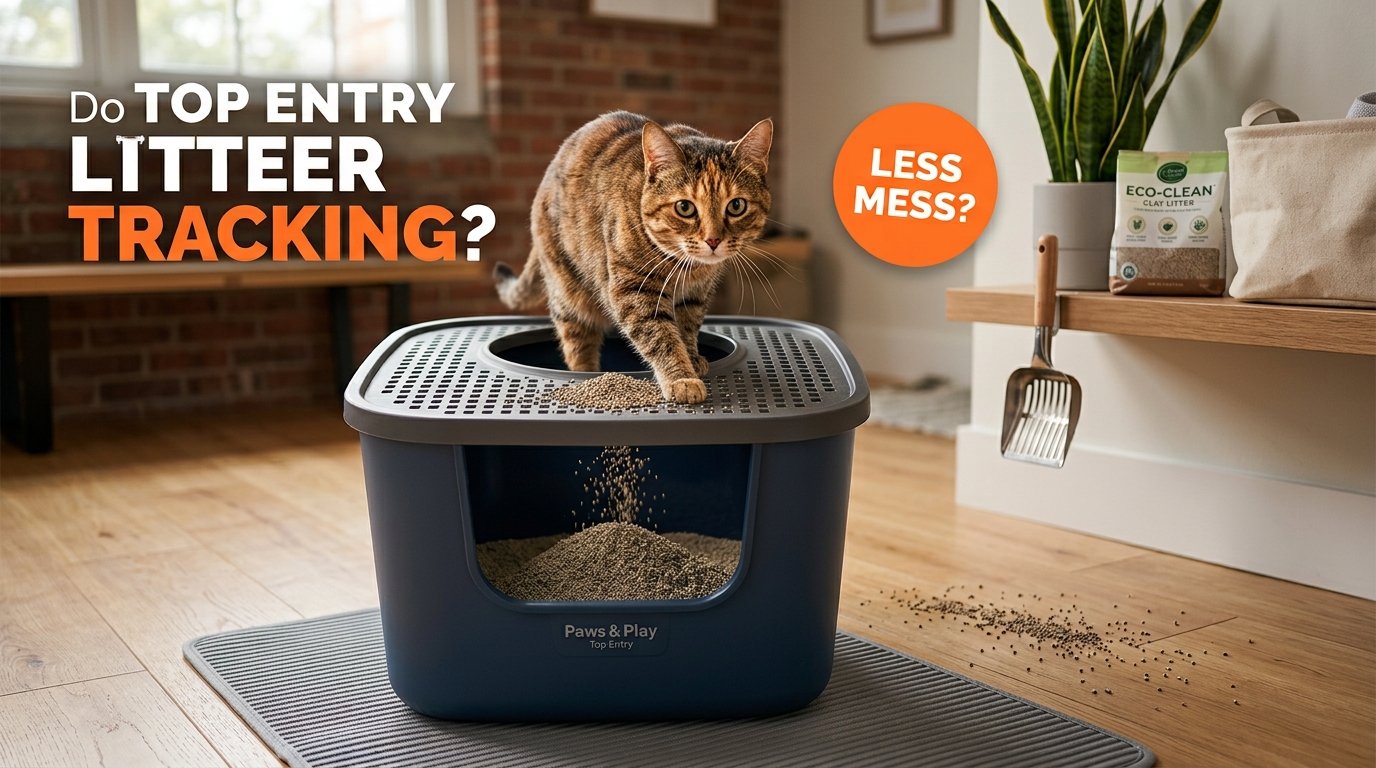
Yes, top entry litter boxes reduce litter tracking for most cats, but they don’t stop it completely. Tall walls keep kicked litter inside, and a grooved or grated lid knocks granules off paws as your cat climbs out. What still escapes depends on your litter, your cat’s paw fur, and how full the lid grooves are.
Retailers advertise cuts of 70 to 90 percent. We couldn’t find an independent test behind those numbers, so this guide sticks to what the designs and manufacturer specs support. You’ll get how the lid works, where it falls short, which cats should skip a top entry box, and how five popular models compare. Odor comes up too, because a box that holds litter in usually holds smell in, for better and worse.
Last updated: September 2026. This post contains Amazon affiliate links. If you buy through them, we may earn a small commission at no extra cost to you.
Quick Answer
- Does it cut tracking? Yes for most cats. The walls contain digging scatter and the lid pulls litter off paws.
- What it won’t fix: fine, dusty litter, fluffy paw fur, and a lid clogged with litter.
- Who should skip it: senior or arthritic cats, kittens that can’t jump yet, and cats too big for the entry hole.
- What to pair it with: large-granule litter, a wide mat, and daily scooping.
Do Top Entry Litter Boxes Reduce Litter Tracking?
For most cats, yes. An open pan has a low rim, so litter flies out while your cat digs and rides out on paws with nothing in the way. A top entry box goes after both problems. The IRIS large model, for example, stands 14.5 inches tall, so most kicked litter hits the wall instead of the floor. Leaving also takes a climb through a hole in the lid.
How the Lid Catches Litter
When your cat steps onto the lid to climb out, the grooves or slots catch granules stuck between the toe pads. Those granules drop back into the pan. It works like a doormat your cat can’t skip, and that’s the edge over a separate mat, since plenty of cats hop right over one.
How Much Does It Actually Reduce Tracking?
Product pages and some retailer guides claim 70 to 90 percent less scatter. Nobody we found published the test behind that range, so we don’t repeat it as fact. Reviews are better evidence. At the time of writing, IRIS’s own page for its Black/Light Gray top entry model shows 4.9 out of 5 across 906 reviews, and even there the review summary says opinions on the lid and the smell vary. The pattern in owner reports is less litter on the floor, not none.
What a Top Entry Box Won’t Fix
- Fine or dusty litter. Small granules cling to paw fur and slip through lid grooves.
- Packed grooves. Litter builds up in the lid’s ridges, and a full groove catches nothing. Wipe or brush the lid often.
- Hard diggers. A cat that flings litter upward can still send granules out through the entry hole.
- Late scooping. A dirty box smells worse when it’s enclosed, and cats that dislike a box tend to bolt out of it. Fast exits scatter more litter.
Other Benefits: Privacy, Spray Control, and Dogs
High walls also catch spray, which is why top entry boxes get recommended for cats that pee against the side. The enclosure gives shy cats a private spot and keeps most dogs away from the litter. Most is the word to watch. A 9.25 inch entry hole won’t stop a small dog from getting its nose in, and one IRIS reviewer said they wished for a riser to keep their dog from sniffing at it. If a dog keeps raiding the box, a baby gate at the door of the room works better than any lid.
Top Entry vs Open and Hooded Litter Boxes
Tracking is only one of the things you’re trading. This table compares the common box styles on the points owners ask about most. The ratings are relative and based on how each design works, not on lab tests.
| Feature | Top entry | Open pan | Hooded, front entry | Open pan + mat |
|---|---|---|---|---|
| Litter on paws | Lower. Lid grooves knock litter off | Highest. Nothing between paws and floor | Medium. Cat steps out with no grate | Medium. Works only if the cat crosses the mat |
| Scatter from digging | Contained by tall walls | Kicked litter clears the rim | Contained by the hood | Not contained |
| Odor | Held in, needs daily scooping | Open air, smell spreads | Held in, still vents at the door | Open air, smell spreads |
| Dog access | Limited. Small dogs can still reach in | Open | Dogs can walk in | Open |
| Easy for seniors and kittens | No. Requires jumping | Yes | Usually, with a step-in entry | Yes |
| Scooping | Lift the lid | Easiest | Lift the hood | Easiest |
The short version: top entry wins on tracking and dog access, open pans win on ease for the cat, and hooded front-entry boxes sit in the middle. For a longer side-by-side, read our top entry vs front entry litter box guide.
Should Your Cat Use a Top Entry Litter Box?
Agility decides this more than any feature list. A top entry box asks your cat to jump onto an edge, drop in, and climb back out, several times a day.
Good Candidates
- Healthy adult cats that jump onto couches and counters without hesitating.
- Hard diggers and kickers that empty a standard pan onto the floor.
- Homes with a dog that snacks from the litter box.
- Small spaces such as a laundry room or bathroom, where a tall, compact footprint fits better.
- Cats that prefer a private spot to go.
Cats That Should Skip It
| Cat | Problem | Better option |
|---|---|---|
| Seniors, or any cat that hesitates before a jump | Jumping and landing load the joints. X-ray studies find signs of osteoarthritis in most older cats, with about 90 percent often cited for cats over 12, and cats hide pain. | Low-entry pan with high back and sides |
| Kittens still learning to jump | May not manage the rim and go on the floor instead. | Low-sided pan until jumping is reliable |
| Large or heavy cats | A 9.25 inch entry and a 15 x 9.75 inch floor (IRIS large model) can feel cramped. PetSmart lists a 20 pound pet weight for it. | Extra-large open, high-sided box |
| Cats recovering from surgery or injury | Jumping is often restricted while they heal. | Low entry until your vet clears jumping |
| Cats that dislike covered boxes | Some cats refuse any enclosed box. | Open high-sided pan plus a large mat |
Multi-cat homes: The usual guidance is one box per cat plus one extra. If your cats are different ages, make at least one of those boxes low entry so the oldest cat always has an easy option.
Best Top Entry Litter Boxes to Reduce Litter Tracking
We compared these five on lid design (grooves, grate, or filter), entry size, scooping access, and how easy they are to clean. Specs come from manufacturer and retailer listings, and listings change, so confirm the details for your color on the Amazon page before buying. IRIS sells its large top entry design in several colors, and three of the picks below are IRIS versions. If that design suits your cat, choose by color and current price.
| Model | Lid design | Standout detail | Main trade-off | Best for |
|---|---|---|---|---|
| 1. IRIS Gray/White | Grooved, removable | 20.5 x 14.75 x 14.5 in, 9.25 in entry (IRIS listing) | Lid comes off for every scoop | Tracking control in a home with a dog |
| 2. IRIS Beige | Holes catch loose particles | Scoop hangs on the side of the pan | Beige shows dirt | Neutral decor in tight spaces |
| 3. Amazon Basics | Filtered lid | BPA-free, recyclable plastic, on-board scoop storage | Gray shows dust, filter wears out | Odor plus tracking |
| 4. Arm & Hammer | Grated lid, Microban | Works with pine, crystal and clumping litter | Brand suggests replacing it every 12 months | Odor-prone homes, bigger cats |
| 5. IRIS Beige/White | Grooved | Scoop hook, 20 lb litter capacity (PetSmart listing) | White areas need frequent wiping | Cats that need room to turn |
Specs shown are from the manufacturer and retailer listings we found. Dimensions can differ by color and model year.
|
1
|
IRIS USA Top Entry Cat Litter Box, Hooded Privacy, Large, Gray/White |
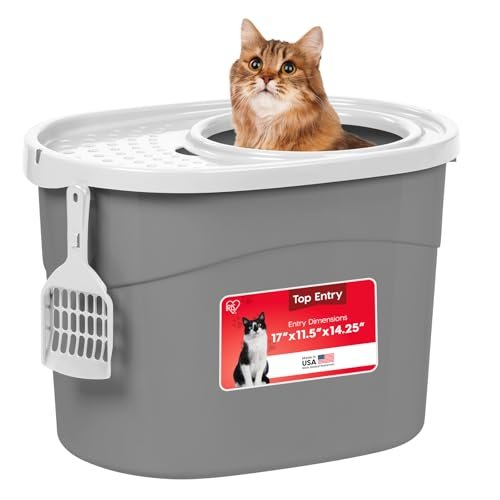
The IRIS USA Top Entry Cat Litter Box in Gray/White is the one to start with if tracking is your main complaint. Grooves molded into the lid catch granules as your cat climbs out, and the tall walls keep kicked litter and spray inside. IRIS says it builds the box in the USA with global materials.
The numbers matter here. IRIS lists the large model at 20.5 x 14.75 x 14.5 inches, with a 9.25 inch entry hole and a 15 x 9.75 inch floor inside. That floor is snug for a big cat, and the hole rules out cats with a wide chest. The lid lifts off for scooping, which is quick, but you need overhead clearance, so it won’t tuck under a low shelf.
What It Does Well
- ✓ Grooved lid knocks loose litter off paws.
- ✓ Tall walls keep spray and kicked litter inside.
- ✓ Elevated entry keeps most dogs out of the waste.
Watch Out For
- • Needs overhead clearance for scooping.
- • Not a fit for cats with mobility problems.
- • Lid comes off for every scoop.
|
2
|
IRIS USA Top Entry Cat Litter Box, Hooded Privacy, Large, Beige |
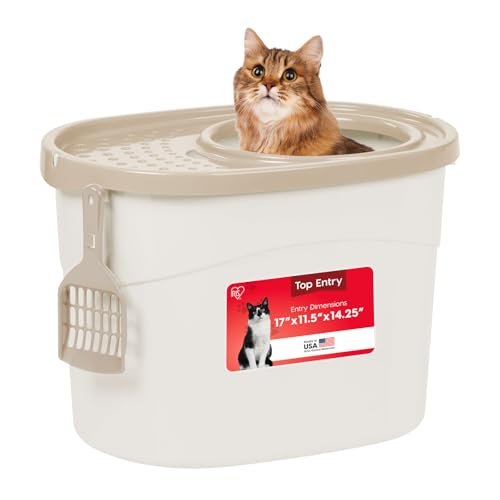
The IRIS USA Top Entry Cat Litter Box in Beige is made in the USA and covers the same ground as the Gray/White version, with a quieter color. Tall walls hold in spraying and digging debris, and holes in the lid catch stray particles before they get to your floor. The enclosed shape also gives cats that like a hidden spot some seclusion.
The scoop attaches to the side of the pan, so you’re not hunting for it at 7 a.m. The size suits most indoor cats and fits into tight corners. It’s fully enclosed, so scoop daily, or the smell stays in the box with your cat. Beige hides litter dust well but shows dirt on the lid over time.
What It Does Well
- ✓ Scoop hook keeps the tool with the box.
- ✓ High walls keep litter from spilling out.
- ✓ Neutral color blends into most rooms.
Watch Out For
- • Beige shows dirt over time.
- • The entry hole may be tight for larger cats.
- • Plastic picks up scoop scratches that hold odor, so plan a full wash every few weeks.
|
3
|
Amazon Basics Large Cat Litter Box with High Sides, Top Entry, Odor Control |
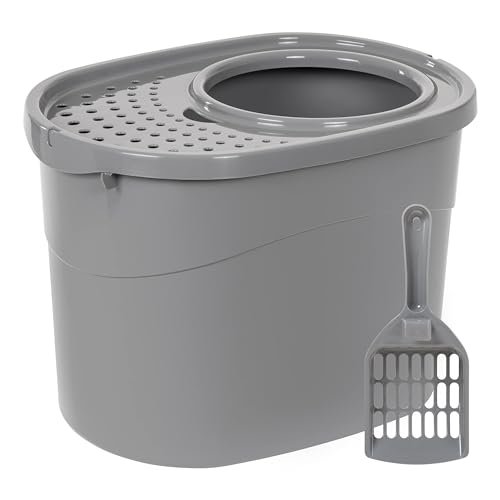
The Amazon Basics Large Cat Litter Box is a plain, sturdy option for owners tired of sweeping. It’s made from BPA-free, recyclable plastic, and the high sides and top entry contain scatter and spray. The included filtered lid does two jobs: it catches loose particles from paws and helps cut odor.
Maintenance is where it does well. The removable top makes checking and scooping fast, and the on-board scoop storage keeps the tool from wandering. The gray color matches most decor. One thing to check before you buy is whether replacement filters are sold, because a filter that can’t be replaced turns odor control into a temporary feature. Large sizing gives bigger cats room to move, though you should still verify the entry diameter against your cat’s chest.
What It Does Well
- ✓ Filtered lid adds odor control on top of the paw-cleaning grooves.
- ✓ BPA-free, recyclable plastic.
- ✓ On-board storage keeps the scoop handy.
Watch Out For
- • Gray finish shows dust clearly.
- • Lid needs care when you lift it off to clean.
- • Filters wear out, so check replacement availability.
- • Not suitable for cats with hip issues.
|
4
|
Arm & Hammer Premium Top Entry Litter Box with Filter to Clean Paws |
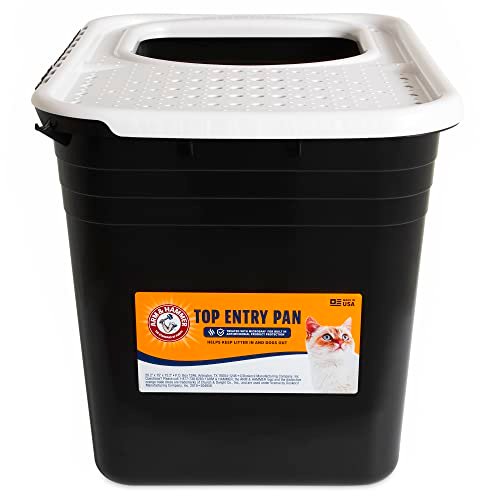
The Arm & Hammer Premium Top Entry Litter Box is built around odor. Microban protection is worked into the plastic and inhibits the growth of odor-causing bacteria on the box’s surface. That helps, but it doesn’t touch the smell coming from the litter itself, so daily scooping still does the heavy lifting. The wide top entry is shaped for larger cats, and the grated lid catches litter from paws on the way out.
It works with pine, crystal, and traditional clumping litter, so you can keep the litter your cat already accepts. That’s useful, because switching litter and box at the same time is a common reason cats refuse a new setup. The plastic is made with recycled materials and washes easily. Arm & Hammer recommends replacing the box every 12 months, which is worth budgeting for.
What It Does Well
- ✓ Microban treatment inhibits odor-causing bacteria on the plastic.
- ✓ Compatible with pine, crystal, and clumping litter.
- ✓ Made from recycled materials.
Watch Out For
- • Brand recommends replacing it every 12 months.
- • Large footprint can be bulky in an apartment.
- • Cats must jump in. There’s no low-entry option.
|
5
|
IRIS USA Large Top Entry Cat Litter Box, Hooded Privacy, Beige/White |
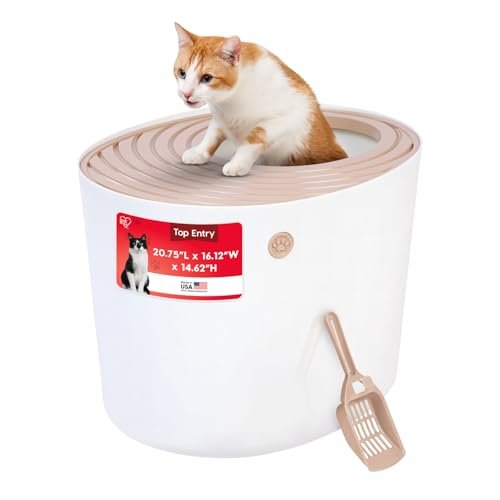
The IRIS USA Large Top Entry Cat Litter Box in Beige/White takes on tracking and odor with the same enclosed design as the other IRIS versions. Tall walls contain spraying and debris, and grooves in the lid catch particles from your cat’s paws as it climbs out. Because it’s fully enclosed, the mess and the smell stay mostly out of sight.
The scoop hooks onto the side of the unit. PetSmart’s listing for the White/Beige version gives a 20.5 x 14.75 x 14.5 inch footprint, a 9.25 inch entry, room for up to 20 pounds of litter, and a 20 pound pet weight. That last number is worth reading twice if your cat is on the heavy side. The larger size gives most cats space to turn and dig away from the entrance, and the box is a fit for smaller homes where smell control matters.
What It Does Well
- ✓ Grooved lid traps litter.
- ✓ Large size gives most cats room to turn.
- ✓ Enclosed design limits odor spread.
Watch Out For
- • Needs space for top entry access.
- • Not ideal for elderly cats with mobility issues.
- • White areas need frequent wiping.
How to Reduce Litter Tracking With a Top Entry Litter Box
Buying the box is half the job. Shallow litter, the wrong granule size, and a lid full of clumps can undo most of what the design gives you. These steps cover setup, litter choice, and getting your cat on board.
Placement and Accessibility
Put the box in a quiet, low-traffic spot where your cat feels safe, on a flat surface so it doesn’t wobble. Leave overhead clearance for lifting the lid, and skip closed closets with no airflow. If your cat has trouble jumping, it may avoid the box altogether, and that’s your cue to switch to a low-entry model.
Litter Management
- Use high-quality clumping litter to keep waste contained and easy to scoop.
- Fill to about 2 to 3 inches, or to the fill line if the box has one. Overfilling gives your cat more to fling toward the entry hole.
- Scoop daily so the box stays clean and the lid grooves don’t fill with old clumps.
Which Litter Tracks Least?
| Litter type | Tracking | What to know |
|---|---|---|
| Fine clumping clay | Higher | Dusty, and fine particles cling to paw fur. |
| Larger-granule or pellet litter (wood, paper, tofu) | Lower | Bigger pieces don’t stick between toe pads. Some cats need time to accept the new feel, and not every pellet clumps. |
| Crystal (silica) | Low | Low dust and doesn’t cling. Some diggers dislike the texture. Arm & Hammer lists crystal as compatible with its box. |
If you switch, mix the new litter into the old over a week or so. A cat that rejects the litter is a bigger problem than tracking.
Add a Mat If You Still See Litter
A textured mat next to the box catches whatever the lid misses. Most mats are too small, and cats step around them. Pick one big enough that your cat takes several steps across it, and vacuum it often so trapped litter doesn’t get redistributed.
Training Your Cat to Use It
If your cat is used to a front-entry box, move slowly. Forcing a cat into a new box leads to stress and accidents around the house.
- Set the new box next to the old one and leave both available.
- Take the lid off at first, so the new box works as a high-sided open pan.
- Add a handful of used litter from the old box so it smells familiar.
- Put the lid back on once your cat uses the open box reliably.
- Retire the old box only after your cat has used the new one every time for at least a few days.
Most cats adjust in a few days to a week. If yours starts going outside the box, drop back a step. If it keeps happening or starts suddenly in a cat that was fine before, call your vet, because pain and urinary problems can cause it.
How to Choose the Right Top Entry Litter Box
Start with your cat’s body and your home’s layout, then look at lid and cleaning details. Privacy-loving cats and cats with mobility limits pull in opposite directions, so be honest about which one you have.
Size Matters
Many behaviorists recommend a box at least 1.5 times your cat’s length, measured from nose to the base of the tail. Most top entry boxes fall short of that. IRIS’s large model has a 15 x 9.75 inch floor, and the rule would call for a much bigger box for an average adult cat. Treat the rule as a target for open pans and use a practical test for lidded ones: your cat should be able to turn a full circle inside with the lid on. Measure your floor space before you order, too.
Entry Size and Jump Height
Check the entry diameter against your cat’s chest, and compare the box height to something your cat already jumps onto. A 14.5 inch box is about the height of a low ottoman. Top entry boxes suit healthy adults and don’t suit senior cats or those with arthritis, so watch for hesitation before jumps.
Lid Design
Grooves, grates, and filtered lids all catch litter, but they clean differently. Deep grooves trap more and take longer to wipe. A grate is easier to shake clean. A filtered lid adds odor control and adds a part to replace.
Odor Control Needs
Look for a filtered lid or treated plastic if odor is a big issue in your home. Filters help trap smells before they reach the room, and smooth, high-quality plastic is less likely to hold odor over time. A smooth interior also makes it easier to scrape away waste without leaving residue behind.
Scooping Access
A removable lid means lifting it off every time, while a hinged lid opens with one hand. If you scoop daily and your space is tight, a hinged or side-opening lid saves effort.
Before You Buy: Checklist
- ☐ My cat jumps onto furniture without hesitating.
- ☐ The entry diameter is wider than my cat’s chest with room to spare.
- ☐ My cat can turn a full circle in the interior floor space.
- ☐ My cat weighs less than the box’s listed limit.
- ☐ I have overhead clearance for lifting the lid.
- ☐ My litter has large granules, or I’m willing to switch.
- ☐ I’ll scoop daily and wash the box every few weeks.
Top Entry Litter Box Prevention Tips
Preventing litter scatter is the main reason to buy a top entry box. Keeping it that way takes a few habits, and your cat’s paws deserve a look too.
Regular Maintenance Cycles
Don’t wait for the box to smell before you clean it. Scoop at least once a day. Cats that dislike a dirty box tend to rush out of it, and fast exits scatter litter. Our guide on how to stop cat litter tracking covers more fixes outside the box itself.
Lid Hygiene
The lid is the part that does the tracking prevention, so keep it working. Wipe it weekly with a pet-safe cleaner to remove dust and stray particles. Clean grooves catch litter, and packed grooves don’t.
Monitor Litter Levels
If the litter is too high, it can spill when your cat jumps in. Aim for 2 to 3 inches, or the fill line. If it’s too low, the cat may hit the bottom of the pan, which is noisy and can discourage use. Look over the box for cracks or damage that can trap litter in hidden crevices.
Check Paws and Fur
Long-haired cats can carry litter in the fur between their toes. A quick trim around the paw pads, or asking your groomer or vet to do it, cuts down what the lid has to catch. A cordless vacuum near the box makes the daily cleanup a 30-second job.
Still Finding Litter on the Floor? Troubleshooting
| What you see | Likely cause | What to try |
|---|---|---|
| A ring of litter around the box | Your cat is flinging litter through the entry hole while digging | Lower the fill to 2 to 3 inches, try a heavier or larger-granule litter, and check that the floor is big enough to dig away from the hole |
| A trail of granules leading away from the box | Fine litter or paw fur is carrying litter past the lid | Switch to larger-granule litter, trim fur around the paw pads, and add a big mat |
| Litter falling off the lid in clumps | Grooves are packed with old litter | Wipe or brush the lid, and do it weekly at minimum |
| Smell in the room | Late scooping or worn filter | Scoop daily, wash the box every few weeks, and replace the filter if your model has one |
| Your cat avoids the box | Jump is too hard, the box is too tight, or something medical | Go back to a lid-off setup, offer a low-entry box, and call your vet if it’s sudden |
Common Mistakes With Top Entry Litter Boxes
Many owners choose a box on looks rather than function, or skip the cat’s mobility needs. These errors cause most returns and most new litter problems.
Ignoring Cat Size
A box that’s too small for a large cat leads to accidents outside it. If your cat can’t move easily, it will go elsewhere. Prioritize the interior dimensions over the exterior footprint.
Neglecting Training
A new box without a transition period leads to stress and accidents. Introduce it gradually using the steps above.
Poor Cleaning Habits
Some owners assume top entry boxes need less cleaning. That’s false. Because the box is enclosed, waste smells stronger if it isn’t scooped daily. A neglected box builds up bacteria and odor, and eventually your cat will stop using it. Stick to a schedule, and skip harsh chemicals that can irritate a cat’s nose or paws.
Overfilling the Pan
More litter isn’t better. Deep litter gives your cat more to kick toward the opening and raises the odds of a mess on the floor.
Buying for a Cat You Used to Have
A box that suited your cat at three years old might not suit it at twelve. Recheck the entry style as your cat ages.
Quick Summary
- IRIS USA Gray/White: grooved lid that pulls litter off paws, plus tall walls and a removable lid. Best if tracking is the top complaint. Get this Solution
- IRIS USA Beige: high walls, a scoop that hangs on the side, and a color that blends in. Best for tight spaces. Get this Solution
- Amazon Basics: BPA-free plastic with a filtered lid that adds odor control. Best if smell and tracking both bother you. Get this Solution
- Arm & Hammer: Microban-treated plastic and a grated lid, with a wide entry for larger cats. Best for odor-prone homes. Get this Solution
- IRIS USA Beige/White: large grooved-lid box with a scoop hook. Best for cats that need room to turn. Get this Solution
Frequently Asked Questions
Do top entry litter boxes reduce litter tracking?
Yes, for most cats. Tall walls contain kicked litter, and the grooved or grated lid knocks granules off paws as your cat climbs out. They don’t stop tracking completely. Fine, dusty litter and fluffy paws still carry some out, and a lid packed with litter stops catching anything.
Do I still need a litter mat with a top entry litter box?
Often, yes, at least at first. A mat catches what the lid misses and costs little. Put it where your cat lands after climbing out, and make it big enough that your cat takes several steps across it before reaching bare floor.
Do top entry litter boxes smell less?
They hold odor better than an open pan because the walls and lid keep the air still, and some models add a filter or Microban-treated plastic. The catch is that an enclosed box traps smell for your cat too, so scoop daily. Filters wear out, and Microban only treats the plastic surface, not the litter.
Do cats like top entry litter boxes?
Many do, mostly for the privacy. Some refuse. Cats with joint pain, kittens that can’t jump reliably, and big cats that feel cramped are the most likely to avoid one. Start with the lid off, mix in some used litter from the old box, and drop back a step if your cat begins going outside the box.
Are top entry litter boxes good for senior cats?
Usually not. Climbing in and out means jumping and landing on joints, and X-ray studies find signs of osteoarthritis in most older cats, with about 90 percent often cited for cats over 12. Cats hide pain, so a senior cat may just stop using the box. A low-entry pan is the safer pick for older cats or any cat that hesitates before a jump.
Will a top entry litter box keep my dog out?
It keeps most dogs out, since a large dog can’t fit through a 9.25 inch entry hole. A small dog can still put its nose in, and some owners report dogs sniffing at the opening. If a small dog is raiding the box, a baby gate at the door of the litter room is the reliable fix.
What size top entry litter box does a large cat need?
Check three numbers: the entry diameter against your cat’s chest width, the interior floor against your cat’s length so it can turn around with the lid on, and the weight limit. IRIS lists a 9.25 inch entry on its large model and PetSmart lists a 20 pound pet weight. Cats near that limit do better in a big, open, high-sided pan.
Can multiple cats share a top entry litter box?
They can, but it’s not ideal. Behaviorists commonly recommend one box per cat plus one extra, and a home with cats of different ages should include at least one low-entry box for the oldest cat.
How often should I clean a top entry litter box?
Scoop at least once a day, wipe the lid weekly with a pet-safe cleaner, and wash the whole box with mild unscented soap and hot water every few weeks when you change the litter. Skip harsh chemicals, since strong smells can put a cat off the box.
Is a top entry litter box worth it?
If tracking is your main complaint and your cat is young and agile, yes. IRIS lists its large top entry models at roughly $25 to $40 on its own site as of September 2026, so the cost of trying one is low. If your cat is older, stiff, or very large, skip it and pick a low-entry box instead.
Sources and Further Reading
- IRIS USA: Top Entry Cat Litter Box, Large, White/Gray (manufacturer specs)
- PetSmart: IRIS Large Top Entry Cat Litter Box, White/Beige (dimensions, pet weight, litter capacity)
- IRIS USA: Top Entry Cat Litter Box, Black/Light Gray (review count and rating)
- Catster: How to Stop Cat Litter Tracking (fill depth, granule size, mats)

Written by Mishu
A passionate cat lover and indoor living enthusiast, Mishu is the founder and voice behind Indoor Living Cat – a go-to resource for cat owners who want to create the happiest, healthiest life for their feline companions indoors.
View Full Profile