
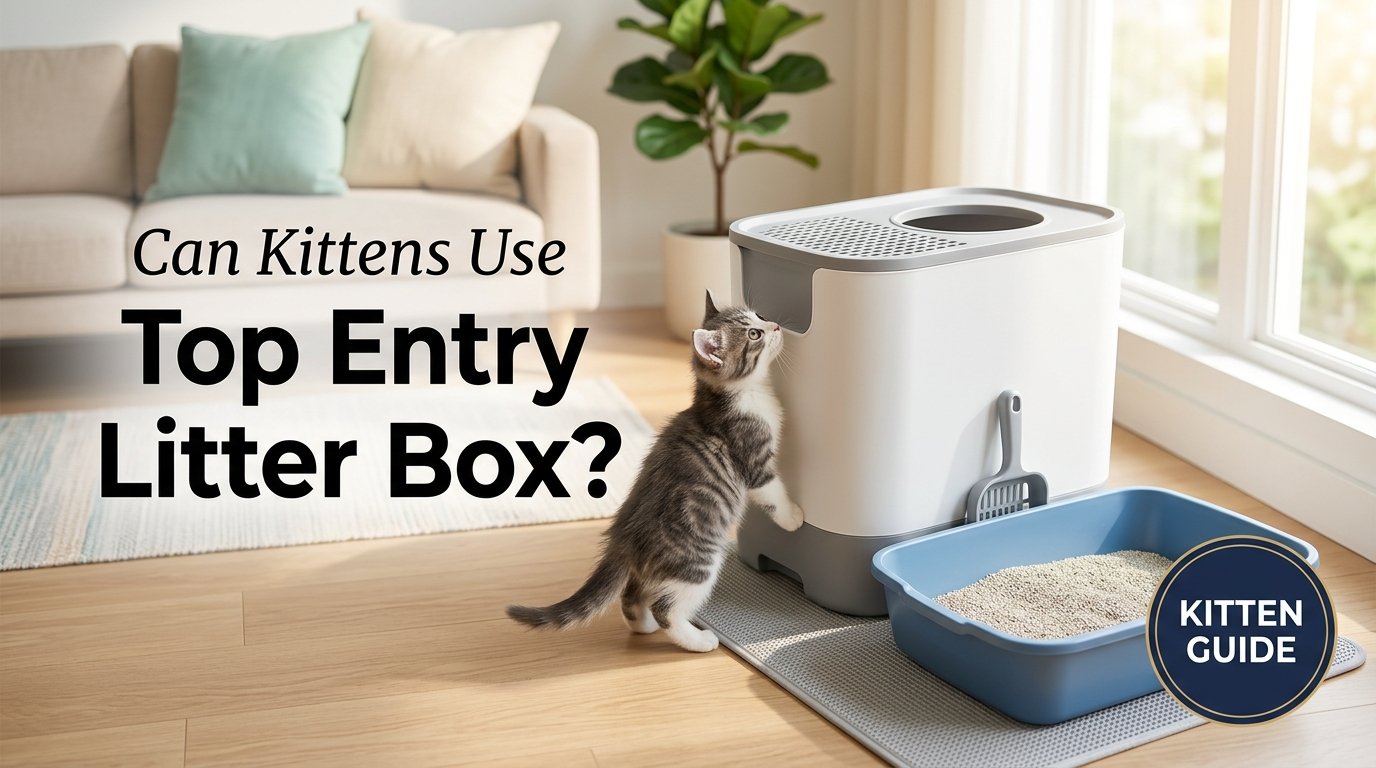
Kittens can use a top entry litter box once they can jump about 14 inches cleanly, and for most that happens somewhere between 4 and 6 months. Before then the box is a wall. Cornell’s Feline Health Center says young kittens and cats with mobility problems need low sides, and the boxes in this guide stand 14.4 to 15 inches tall with the opening on top.
The payoff is real once your cat gets there. Cats kick granules out of open pans and onto hardwood and carpet, and a top entry cat litter box makes them leave through a grated lid that knocks loose particles off their paws. Owners on IRIS’s product pages report a big drop in scatter, though not a total one. The high walls also hold in spray and keep most dogs out. Below you’ll find an age guide, what to use while your kitten is small, five boxes worth buying, and a switching plan.
Can Kittens Use a Top Entry Litter Box?
Yes, on a timeline. A top entry box asks a cat to jump up to the lid, drop in, dig, then climb back out through a 9-inch opening. Adult cats do it without thinking. A kitten who is still learning to judge distances often can’t, and the failure looks the same every time: the box sits unused and the kitten goes on the rug beside it. If that starts, switch back to a low box right away. If accidents continue, book a vet visit, because the 2021 AAHA/AAFP feline life stage guidelines call for evaluating house-soiling kittens for medical causes.
Kitten Age and Entry Height Guide
| Kitten age | Entry height most kittens manage | What to use |
|---|---|---|
| 3 to 8 weeks | About 2 to 3 inches | Small, shallow open tray with 1 to 2 inches of non-clumping litter. Kittens start using a box around 3 to 4 weeks. |
| 8 to 12 weeks | 2 to 3 inches. A 4-inch wall is unreliable. | Low-entry open pan. No lid, no flap. |
| 3 to 4 months | About 4 to 5 inches | Low-entry pan with a taller back and sides to catch scatter. |
| 4 to 6 months | Varies with breed and growth | Keep the low box available and run the jump check below. |
| 6 months and up | Most can handle a 14-inch top entry | Top entry box, with the old box kept close for 1 to 2 weeks. |
These ranges come from published kitten sizing guides, which overlap but don’t agree to the inch. I couldn’t find a veterinary body that publishes a minimum age for top entry boxes, so treat the table as a starting point and let your kitten’s actual jumping decide.
Why Height Is the Problem
Put the numbers side by side. One kitten guide says an 8-week-old clears about 2 to 3 inches comfortably and a 4-month-old about 4 to 5. The IRIS large top entry box measures 14.38 inches tall outside, the Amazon Basics box matches it, and the Arm & Hammer box is 15. A top entry box asks for a jump rather than a step, so the comparison isn’t exact. It still shows why a 4-month-old is often short of the mark.
Suggested alt text: kitten beside a low-entry litter tray and a top entry litter box]
Is Your Kitten Ready? A Practical Checklist
Run through this before you buy. The jump check is a practical test, not a veterinary standard.
- ✓ Your kitten is at least 4 months old. Wait until 6 months for small breeds or slow growers.
- ✓ Jump check: she hops onto a stable 14-inch surface (a sturdy ottoman or step stool) in one try and lands without scrambling.
- ✓ She has used her current low box every time for at least two weeks, with no accidents.
- ✓ She isn’t recovering from surgery or illness. Ask your vet when jumping is safe again after spay or neuter.
- ✓ You have room to keep the old box beside the new one for a week or two.
When to Wait Longer
- Any limp, hesitation on stairs, or history of joint trouble. Cornell notes that cats with joint pain need low sides.
- Big changes already underway, such as a move or a new pet. Stacking a litter box change on top raises the odds of accidents.
- A one-box household. Cornell recommends one box per cat plus one extra, and a spare low box is your safety net during the switch.
What to Use Instead While Your Kitten Is Too Small
Keep it low and boring. Cornell says most cats prefer uncovered boxes, and International Cat Care notes that some cats feel vulnerable in a covered tray with a single exit. For a nervous kitten under 12 weeks, an open pan with a 2 to 3 inch entry is the safest choice.
| Box type | Entry height | Works best for | Trade-off |
|---|---|---|---|
| Open low-entry pan | 2 to 3 inches | Kittens under 12 weeks | Litter flies when they dig. Add a mat. |
| High-back, low-front pan | About 3 to 4 inches | 3 to 4 month kittens who dig hard | The front still lets some litter out. |
| Covered box with a front door | Check the door sill on the model | Older kittens who like privacy | Covers hold odor in, and a creaking flap scares some kittens. Start with the lid or flap off. |
| Top entry box | 14+ inches | Kittens around 5 to 6 months and up | Too tall for small kittens and hard on senior cats. |
Some guides, including Omlet’s, suggest training kittens in the tray you plan to keep so they never refuse a replacement. That advice works only if the kitten can physically reach the box. Height wins. If you’re weighing top entry against a front door design for a grown cat, our top entry vs front entry litter box comparison covers the differences.
If a dog is why you wanted a top entry box, put the kitten’s low box in a room the dog can’t enter until the kitten is ready.
Suggested alt text: low-entry litter box for a young kitten]
Why a Top Entry Litter Box Works Once Your Cat Is Ready
The lid does most of the work. Cats walk over grooves or small holes on the way out, and litter stuck to their paws drops back into the pan. The tall walls hold in spray and standing pee, and the raised opening stops most dogs from reaching the litter. Add the privacy of an enclosed space, and you get a box that suits litter kickers and cats who aim high.
What You Gain
- ✓ Less tracking, because the exit path is textured
- ✓ Spray and standing pee stay inside the walls
- ✓ A dog-resistant opening, with mixed results in practice (see the FAQ)
What You Give Up
- • An at-a-glance view of the litter. Open pans make it easier to spot changes in waste, which Meowant points out as a health-monitoring advantage.
- • Fresh air. Covers hold odor in, so a daily scoop is the minimum, not a bonus.
- • Easy access for kittens, seniors and cats with stiff joints.
Best Top Entry Cat Litter Boxes for Older Kittens and Adult Cats
All five boxes below are plastic, about 20 inches long and 14 to 15 inches tall, so every one of them belongs in the “later” column for a young kitten. If plastic odor bothers you, a stainless steel top entry litter box is the usual alternative. Specs come from manufacturer and retailer listings checked in September 2026 plus owner reviews. This list rests on published information, not hands-on testing.
We may earn a commission if you buy through the links below, at no extra cost to you.
| Model | Outside size (L x W x H) | Opening | Standout feature | Watch out for |
|---|---|---|---|---|
| IRIS USA Large, Gray/White | About 20.5 x 14.75 x 14.5 in | 9.25 in round | Grooved lid that returns litter to the pan | Listed inside floor of 15 x 9.75 in on IRIS’s page |
| IRIS USA Large, Beige | 20.5 x 14.75 x 14.38 in | 9.25 in round | Scoop hook, small holes in the lid | Interior size differs from the gray/white listing |
| Amazon Basics Large | 20.5 x 14.75 x 14.38 in | Not stated in the listing | BPA-free plastic, removable top, onboard scoop storage | Opening and interior sizes aren’t published |
| Arm & Hammer Premium | 20.3 x 15 x 15 in | Wide top opening | Microban-treated plastic, non-slip textured lid | Tallest of the five |
| IRIS USA Large, Beige/White | About 20.4 to 20.8 x 14.75 to 16.1 x 14.3 to 14.6 in | Round, varies by version | Removable grooved lid, rounded pan | Dimensions vary by version. No carry handles. |
|
1
|
IRIS USA Top Entry Cat Litter Box, Hooded Privacy, Large, Gray/White |
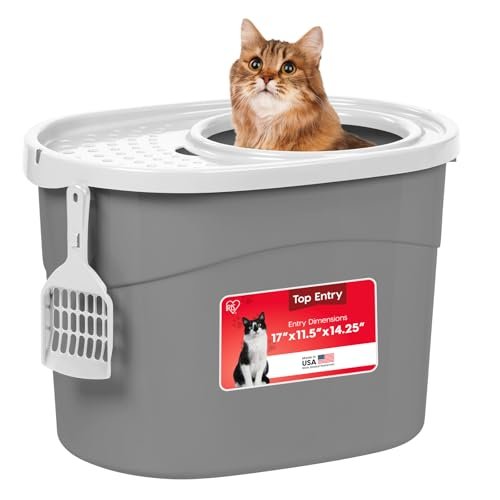
IRIS USA’s large top entry box is the reference design for this category. The lid has grooves and small holes that catch litter on your cat’s paws as they climb out, and the rounded pan has no corners for wet clumps to cling to. IRIS’s own page for a white/gray version lists 20.5 x 14.75 x 14.5 inches outside, a 9.25-inch round opening and a 15 x 9.75 inch floor. It sits in the same family as the covered litter box with top entry designs we compare elsewhere.
Owners on IRIS’s site rate the white/gray version 4.87 out of 5 across 479 reviews (September 2026) and praise the privacy, containment and easy cleaning. Complaints are specific: lid sturdiness varies between buyers, one reviewer had a lid support tab break within a month, and a cat that pees standing up can still hit the underside of the lid, though the urine stays inside the box.
Best for: adult cats and kittens past the 5-month mark in homes with a dog or a heavy digger.
What It Does Well
- ✓ Grooved lid sends stray litter back into the pan
- ✓ High walls hold spray and standing pee
- ✓ Raised opening deters most dogs
- ✓ Rounded pan wipes clean with warm water and mild soap
Important Considerations
- • Needs headroom: about 14.5 inches, plus space to lift the lid off
- • The listed 15 x 9.75 inch floor is short for long cats, so measure yours first
- • Too tall for kittens under roughly 4 to 6 months and hard on seniors with stiff joints
- • Plastic holds odor over time and needs regular washing
|
2
|
IRIS USA Top Entry Cat Litter Box, Hooded Privacy, Large, Beige |
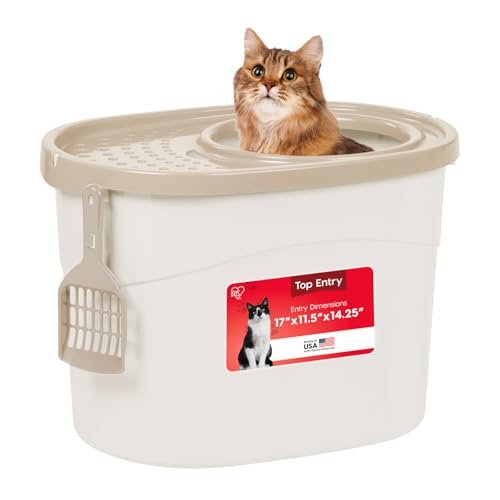
Same family as the pick above in a lighter color. The Amazon listing gives 20.5 x 14.75 x 14.38 inches outside, a 9.25-inch opening and a 17 x 11.5 inch floor. That’s roomier than the 15 x 9.75 inches on IRIS’s page for the white/gray version, and IRIS has sold several builds of this box with slightly different numbers, so check the interior figure for the exact color you order.
The included scoop has a hook that lets it hang off the pan, and the small holes in the lid work as a built-in mat. IRIS reviewers call the scoop flimsy and wish the pan had handles for dumping, which matters more on a box this long.
Best for: households that want the beige finish and a little more floor space inside.
What It Does Well
- ✓ Scoop hangs from the pan, so it stays within reach
- ✓ Small holes in the lid act as a built-in mat
- ✓ Listed 17 x 11.5 inch floor gives a bit more turning room
- ✓ Enclosed walls keep spray off the floor
Important Considerations
- • Standing height is 14.38 inches, well beyond what a 4-month-old clears
- • No carry handles, so emptying a full pan is awkward
- • Scoop gets mixed reviews
- • Listing sizes differ by color, so verify before buying
|
3
|
Amazon Basics Large Cat Litter Box with High Sides, Top Entry, Odor Control |
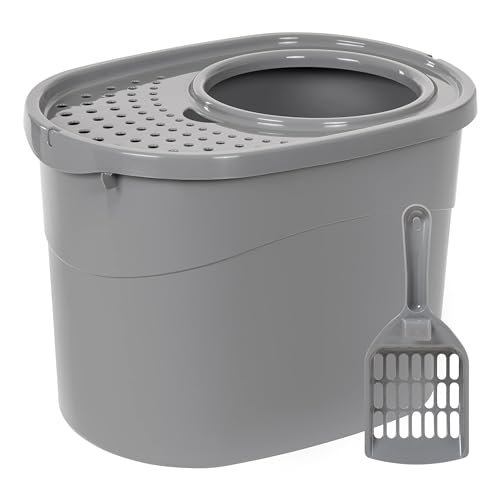
Amazon Basics matches the IRIS footprint on paper at 20.5 x 14.75 x 14.38 inches. The listing names BPA-free, recyclable plastic, a filtered lid, and a removable top for scooping and checking the litter, and the scoop stores on the box.
The listing text I found doesn’t give the opening diameter or the interior size, so pull out a tape measure before assuming it fits a big cat. Outside length always overstates the usable floor, and that holds for every box here.
Best for: buyers who want a store-brand box with BPA-free plastic called out on the label.
What It Does Well
- ✓ BPA-free, recyclable plastic named on the listing
- ✓ Removable top makes scooping and monitoring simple
- ✓ Scoop stores on the box
- ✓ High sides contain spray
Important Considerations
- • Opening and interior dimensions aren’t published in the listing text
- • Same 14.38-inch height, so it’s a later-stage box for kittens
- • Filter details aren’t spelled out, so check the product page
|
4
|
Arm & Hammer Premium Top Entry Litter Box with Filter to Clean Paws and Microban |
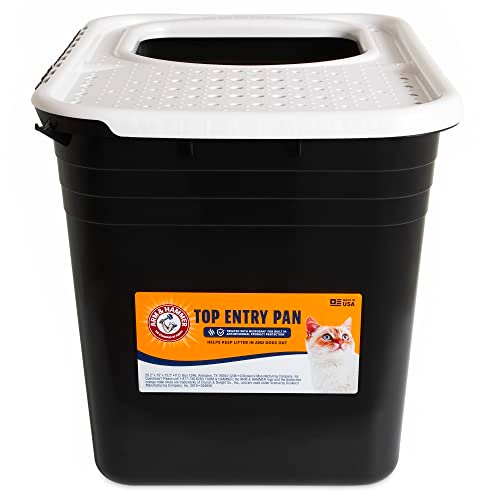
Arm & Hammer’s version is the tallest of the five at 15 inches, on a 20.3 by 15 inch footprint per Pet Supermarket. The lid is textured and non-slip, with cutouts that let stuck litter fall back into the pan. The plastic is treated with Microban, which Petmate says stops odor-causing bacteria from growing on the box itself. That treats the plastic, not the litter, so you still scoop daily.
The brand calls the wide opening a fit for larger cats, says the box is made in the USA from recycled materials, and works with pine, crystal, pellet and clumping litters. It also recommends replacing the box every 12 months, because odors soak into plastic and scratching wears it down.
Best for: larger cats and adult multi-pet homes where odor control on the plastic itself matters.
What It Does Well
- ✓ Microban treatment on the plastic inhibits odor-causing bacteria
- ✓ Textured, non-slip lid with litter-catching cutouts
- ✓ Wide opening suits bigger cats
- ✓ Works with several litter types
Important Considerations
- • At 15 inches tall it’s the hardest of the five for a small kitten to enter
- • Microban doesn’t replace washing
- • Brand recommends replacement every 12 months
|
5
|
IRIS USA Large Top Entry Cat Litter Box, Hooded Privacy, Beige/White |
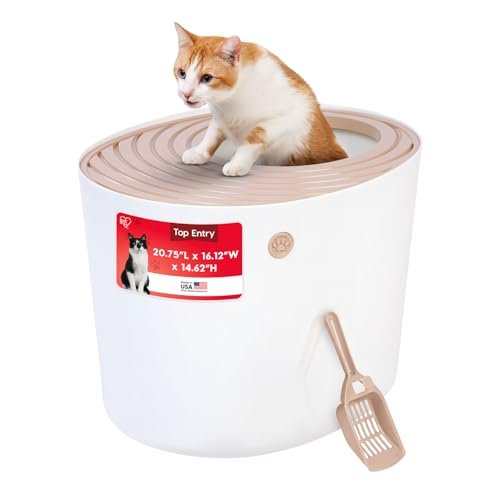
This IRIS version is the rounded one, with a removable grooved lid and a curved pan that wipes down easily. Chewy’s listing says it works with clay, wood, corn, pine and most other litters. IRIS sells several large top entry models with slightly different builds. I found listings from about 20.4 to 20.8 inches long, 14.75 to 16.1 inches wide and 14.3 to 14.6 inches tall, and one gives the opening as 9 inches wide by 10.5 inches high, so confirm the numbers on the version you order.
Owners who’ve written about the round pan mention two annoyances: no handles for dumping, and a curve that makes getting clumps onto the scoop a little harder. Others say the lid pops off easily for cleaning.
Best for: cats over 5 months who dig hard and owners who want a lid that comes off in one piece.
What It Does Well
- ✓ Removable grooved lid catches litter from paws
- ✓ Rounded pan has no corners for wet litter to stick in
- ✓ Compatible with most litter types per Chewy’s listing
Important Considerations
- • Dimensions differ across IRIS versions, so verify before buying
- • Bulky to empty with no handles
- • Curved sides make scooping slower
- • Same 14+ inch height problem for young kittens
How to Switch Your Kitten to a Top Entry Litter Box
When your cat struggles with a new top entry box, the fix is usually placement and patience. Arm & Hammer’s own guidance for cats moving up from a low box follows the same idea: keep the scent familiar and keep a backup box available.
- Confirm readiness. Run the checklist above. If your kitten fails the jump check, wait two weeks and test again.
- Put the new box where the old one sits. Place the old box a few feet away instead of removing it. Pick a quiet, low-traffic spot where your cat feels safe.
- Mix in familiar scent. Fill the new box with fresh litter and add a few scoops of used litter from the old box, as Arm & Hammer suggests.
- Take the lid off at first if your cat hesitates. It helps a nervous cat get used to the base, but the pan is deep, so it won’t rescue a kitten who is too small.
- Show the way in. Gently set your cat on top of the box and offer a treat. Reward each successful visit and keep the praise consistent.
- Watch the first few visits. Struggling with the height, standing outside the box, or going on the floor next to it means back to the low box. Don’t push through.
- Keep the old box for 1 to 2 weeks after your cat uses the new one every time. Then remove it.
- Set up the area. Scoop daily, put a small mat under the box for stray particles, and keep the space around it clear so your cat has room to land.
Suggested alt text: kitten being introduced to a top entry litter box with the lid off]
Troubleshooting Top Entry Litter Box Problems
| Problem | Likely cause | What to try |
|---|---|---|
| Goes on the floor next to the box | Box is too high, or a medical issue | Go back to a low-entry box right away. If accidents continue, see your vet. |
| Refuses to go in | Unfamiliar scent, height, or fear of the enclosure | Remove the lid for a few days, mix in used litter, set the cat on top with a treat, and keep the old box. |
| Urine on the lid or walls | Cats that pee standing up hit the upper walls | Wipe the underside of the lid when you scoop and put a mat under the box for drips. |
| Litter still reaches the floor | Scatter is reduced, not removed, and clumps can wedge in the grooves | Clear the grooves and add a mat beside the box. |
| Box smells | Enclosed design holds odor in, and plastic absorbs smells over time | Scoop daily, wash with mild soap and warm water, and replace annually. Arm & Hammer recommends every 12 months. |
| Cat digs less or scrapes the walls | Interior is too short for the cat | Measure your cat and compare with the 1.5 times rule below. Move to a larger box if needed. |
| Box shifts or the lid rattles | Slick floor or a worn lid tab | Use a non-slip mat under the box and inspect the lid supports. |
Key Factors in Choosing the Right Top Entry Litter Box
Your cat’s size, age and your own floor space decide which box works. Here’s what to check before you buy.
| What to check | Target | Why it matters |
|---|---|---|
| Interior length | 1.5 times your cat’s length from nose to base of tail. Guides put most adult cats at 20 to 24 inches. | A cramped cat misses the box or digs less. Most top entry boxes have interiors around 15 to 20 inches, so measure first. |
| Total height and opening | A height your cat can jump cleanly (about 14 inches for these boxes) and an opening of 9 inches or more | Kittens and stiff seniors struggle here. |
| Lid | Removable, with grooves or holes | A removable lid makes scooping simple, and the texture catches litter from paws. |
| Material | BPA-free plastic that wipes clean. Microban is optional. | Deep scratches can hold bacteria and odor. |
| Scoop storage | Hook or onboard holder | Keeps the scoop within reach. |
| Headroom | About 15 inches, plus space to lift the lid | Under a shelf or in a tight closet, the lid can’t come off. |
Suggested alt text: measuring a cat’s length to choose the right litter box size]
Size Comes First
Size is the biggest factor when choosing a top entry box. Measure your cat from nose to base of tail and multiply by 1.5 to get the minimum interior length. Small cats adapt to compact models, while larger breeds need a spacious interior or they’ll skip the box. For very big cats, a top entry box may not be the right style at all, and International Cat Care notes that large breeds can find smaller hooded trays hard to use.
Material and Maintenance
Look for BPA-free plastic that resists deep scratches, since scratches can harbor bacteria and odors over time. Antimicrobial treatment such as Microban is a bonus that works on the plastic surface, so it supports cleaning rather than replacing it. Ease of maintenance matters just as much. A removable lid or a wide opening saves time every day, and onboard scoop storage keeps your tools together. Finally, look at the lid texture. Deeper grooves catch more litter and mean less sweeping.
Kitten Litter Basics
Many vets suggest non-clumping litter until a kitten is around 3 to 4 months old, because young kittens taste things and clumping clay swells when wet. A veterinarian answering on Petco’s site said there’s no scientific literature showing clumping litter is unsafe for kittens under that age, but still recommended waiting. If your kitten starts eating litter, stop using it and call your vet. Cornell says most cats prefer unscented, fine-textured litter about 1 to 2 inches deep, which is a good default for the top entry box too. Once your cat is past 4 months, a good clumping litter makes waste easy to lift out in one piece.
Top Entry Litter Box Care and Prevention Tips
Litter tracking and odor come back fast when maintenance slips. These habits keep the box working and your cat using it.
- Scoop at least once a day. Cornell warns that cats may avoid a dirty box, and a covered design holds odor in.
- Use a good clumping litter once your kitten is past 4 months so waste comes out in one piece. Before that, stick with non-clumping.
- Keep the area around the box clear so your cat has a safe landing spot when jumping in and out.
- Check the lid grooves regularly and clear out trapped litter, or the tracking control stops working.
- Put the box on a non-slip surface so it doesn’t shift when your cat jumps on it.
- Wash with warm water and mild soap. SNAP notes that harsh chemicals can leave a smell cats reject, so skip perfumed sprays near the box.
- Watch waste habits. Cornell lists medical conditions as a cause of house soiling, so a cat who stops using the box needs a vet check. Lift the lid now and then to look at the litter, since the enclosure hides changes.
- Keep food and water dishes well away from the box.
- Set your kitten in the box after meals and naps, and never punish accidents. The AAHA/AAFP guidelines say cats should never be reprimanded for toileting in the wrong place or taken to the box punitively.
- Follow the one box per cat, plus one extra rule from Cornell if you have more than one cat.
Common Mistakes With Top Entry Litter Boxes
Most problems come from a few avoidable errors. Here’s what goes wrong most often and how to prevent it.
Switching Too Early
The most common kitten mistake is buying the box before the kitten can reach it. A kitten who can’t clear the height will go beside the box and can build a habit of avoiding it. Use the jump check, then decide.
Ignoring Cat Size
A box that’s too small is the next most frequent error. If a cat feels cramped, they may skip the box and leave accidents elsewhere. Check interior dimensions rather than the outer footprint, since a 20.5-inch box can have a much shorter usable floor.
Removing the Old Box Too Soon
Taking away the low box on day one leaves a hesitant cat with nowhere else to go. Keep it for at least a week or two after the new box is in steady use.
Neglecting Deep Cleans
Many owners scoop but never wash. Over time, plastic absorbs odors that scooping can’t remove. A deep clean with mild soap and warm water every few weeks keeps the box sanitary.
Poor Placement
A busy hallway or a spot near loud appliances is a bad home for a litter box. Cats prefer privacy for their bathroom needs, and a box in a noisy area often gets ignored. Choose a quiet, accessible corner.
Changing Litter Suddenly
Cats are creatures of habit, and abrupt changes can cause accidents. Introduce new litter gradually, mixing a little of the new into the old over several days.
Punishing Accidents
Scolding a kitten for a miss teaches her to hide from you, not to use the box. The AAHA/AAFP guidelines are explicit that cats should never be reprimanded for toileting in undesired locations. Clean up, fix the cause, and try again.
Quick Summary
Wait until your kitten is roughly 4 to 6 months old and passes the jump check. Then pick from these.
- IRIS USA Large, Gray/White: grooved lid, 9.25-inch opening, about 14.5 inches tall. The reference pick for litter tracking.
Check the price on Amazon - IRIS USA Large, Beige: the same family with a scoop hook and a listed 17 x 11.5 inch floor. Choose it for the color and the extra interior room.
Check the price on Amazon - Amazon Basics Large: BPA-free plastic, removable top and onboard scoop storage at 20.5 x 14.75 x 14.38 inches. Confirm the opening size first.
Check the price on Amazon - Arm & Hammer Premium: Microban-treated plastic and a non-slip lid at 15 inches tall. Best for bigger cats, worst for small kittens.
Check the price on Amazon - IRIS USA Large, Beige/White: rounded pan with a removable grooved lid. Verify the dimensions on your version.
Check the price on Amazon
Frequently Asked Questions
Can kittens use a top entry litter box?
Yes, once they can jump about 14 inches cleanly, which is around 4 to 6 months for most kittens. Younger kittens can’t reliably clear even a 4-inch wall, so use a low-entry open pan until they’re ready.
What age can a kitten start using a top entry litter box?
Most guides land between 4 and 6 months. Wait for 6 months with small breeds or any kitten who fails the jump check. I couldn’t find a veterinary group that publishes a firm minimum, so your vet’s read on your kitten counts for more than any table.
Can a 3-month-old kitten use a top entry litter box?
Not reliably. One guide says a 4-month-old clears 4 to 5 inches, against 14 inches or more for these boxes. A low-entry pan with a taller back is the better fit at this age.
How do I train a kitten to use a top entry litter box?
Put the box where the old one sat, mix in a few scoops of used litter, and take the lid off if your kitten hesitates. Set her on top with a treat and keep the old box available for a week or two.
Can kittens use a covered litter box?
Some can. Cornell says most cats prefer uncovered boxes, and International Cat Care says some cats feel vulnerable with a single exit. If you try a hooded box, start with the lid or flap off for a few weeks and keep an open box alongside.
Do top entry litter boxes stop litter tracking?
They cut it, they don’t end it. Owners on IRIS’s site describe a large drop in scatter with some litter still reaching the floor. A mat beside the box catches the rest.
What litter is safe for kittens in a top entry box?
Many vets suggest non-clumping, unscented litter until 3 to 4 months, kept about 1 to 2 inches deep. After that, a clumping litter is fine for most kittens, and you should watch for any litter eating during the change.
How big should a top entry litter box be?
Minimum interior length is 1.5 times your cat’s nose-to-base-of-tail length. Most top entry boxes have interiors around 15 to 20 inches, so they fit average cats but can be tight for large breeds.
Are top entry litter boxes good for senior cats?
Usually not. Cornell says elderly cats and cats with joint pain need boxes with low sides, and a 14-inch jump is a lot to ask of stiff joints.
Do top entry litter boxes keep dogs out?
Mostly. One IRIS reviewer says two dogs of 15 to 18 pounds couldn’t get in, though other reviewers say results vary, so don’t treat it as a lock.
How long does it take a cat to adjust to a top entry litter box?
Reviews on IRIS’s site range from about a day to longer for cats used to a low box. Keep the old box until your cat has used the new one every time for a week or two.
Is a top entry litter box worth it?
Yes if litter scatter or a dog is your problem and your cat is over 5 to 6 months, healthy and under the box’s interior length. Skip it for kittens under 4 months, senior cats and very large breeds.
Sources and Further Reading
- Cornell Feline Health Center: Feline Behavior Problems, House Soiling
- Cornell Feline Health Center: Choosing and Caring for Your New Cat
- International Cat Care: Choosing a litter tray for your cat
- AAHA/AAFP 2021 Feline Life Stage Guidelines: General Litter Box Considerations
- Arm & Hammer: Top Entry vs Side Entry Litter Box
- IRIS USA litter box product pages

Written by Mishu
A passionate cat lover and indoor living enthusiast, Mishu is the founder and voice behind Indoor Living Cat – a go-to resource for cat owners who want to create the happiest, healthiest life for their feline companions indoors.
View Full Profile