
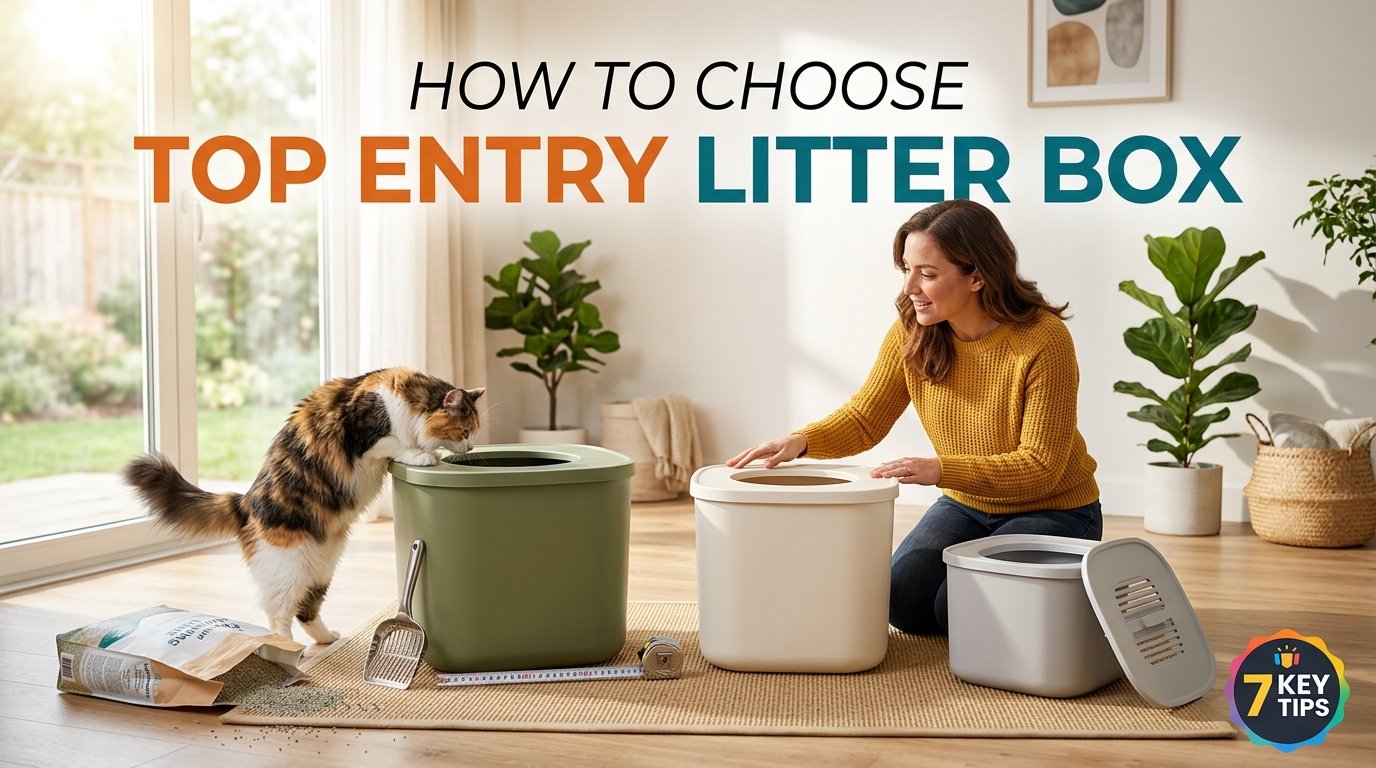
To choose a top entry litter box, measure your cat first, then check three things: the floor length inside the box, the width and height of the entry hole, and how easily the lid comes off for scooping. Get one wrong and you’ll find out on the floor next to the box.
A top entry litter box earns its spot for one reason. Your cat hops in through a hole in the lid, digs behind tall walls, then walks across grooves or small holes on the way out. That walk knocks litter off their paws and back into the pan. The high walls also hold in kicked litter and sprayed urine, and the raised opening makes the litter harder for most dogs to reach.
They aren’t for every cat, though. Seniors, cats with sore joints, and very long cats usually do better in a low-entry pan. This guide shows you how to tell which group yours falls into, compares five models, and covers the setup that gets a cat to actually use the thing.
Quick Answer
- Size: The inside floor should be at least as long as your cat is from nose to base of tail. One and a half times that length is better.
- Entry hole: It needs to clear your cat’s shoulders and head. Models in IRIS’s own top entry line range from 7.9 to 9.25 inches wide.
- Skip it if: your cat is a senior, has arthritis, is a small kitten, or already refuses covered boxes.
- Lid: It should be grooved or perforated, latch firmly, and lift off with one hand.
- Default pick: The IRIS USA Large suits most healthy adult cats. The Arm & Hammer makes more sense if odor is your main complaint.
Last updated September 2026. This post contains affiliate links. If you buy through them, we may earn a commission at no extra cost to you. Dimensions and features come from the manufacturers’ own listings.
Are Top Entry Litter Boxes Worth It?
Litter scatter is a daily chore, and it starts at one moment: your cat stepping out of an open pan with granules stuck to each paw. A top entry box changes that moment. The box stands roughly 14 to 15 inches tall, so kicked litter stays put, and the textured lid catches whatever hitches a ride out.
Every feature has a price, though. Here’s the trade.
| What you get | What it costs you |
|---|---|
| A lid that shakes loose litter off paws | It won’t catch everything. Dusty or fine litter still escapes, so a mat under the box helps. |
| High walls that hold in digging and spraying | A cramped interior. If your cat can’t turn around, they’ll stop using it. |
| Privacy for shy cats | Some cats dislike enclosed spaces and never warm up to it. |
| A raised opening that discourages dogs | It discourages them. A determined dog can still get in, especially a small one. |
| Odors kept behind a lid | Enclosed boxes hold smells in too. Skip a day of scooping and you’ll notice when you lift the lid. |
| A tidy, closed look for bathrooms and laundry rooms | You lift the lid every time you scoop. |
Who Should Skip a Top Entry Litter Box
The Edmonton Humane Society’s 2024 litter box guide advises against top entry boxes. Its reasoning is that they tend to be small and the jump through a narrow hole can be inconvenient or even painful for older cats. We think a blanket ban goes too far, since healthy adult cats often adapt fast. The warning about age and joints is fair, though. Pick a different style if any of these describe your cat:
- Senior cats or cats with arthritis. A box that stands about 14 inches tall asks for a real jump every trip. A low-entry pan is kinder.
- Small kittens. Until they can climb the wall comfortably, use a shallow pan.
- Long or heavy cats. Many top entry boxes have short floors. More on that in the sizing section below.
- Cats that already avoid covered boxes. A lid won’t change their mind.
- Cats recovering from surgery or dealing with a urinary or mobility problem. Ask your vet before switching boxes.
How to Choose a Top Entry Litter Box: 8 Things to Check
Picking one involves more than choosing a color. Your cat’s size, your floor space, and how much daily upkeep you’ll tolerate all matter. Work through these eight checks in order and most of the decision makes itself.
1. Match the Floor Length to Your Cat
A box that’s too small is the fastest way to end up with accidents elsewhere. Vets commonly suggest a box between one and one-and-a-half times your cat’s length. Bond Vet’s Dr. Gabrielle Fadl, quoted by Mental Floss, says a cat should be able to comfortably turn around and dig. Arm & Hammer’s own listing recommends 1.5 times.
Here’s the catch with top entry boxes. Check the inside floor, not the outside dimensions. IRIS lists its Large model at 20.5 x 14.75 x 14.5 inches outside, but the floor is 15 x 9.75 inches. By the one-times rule that fits a cat up to 15 inches from nose to tail base. By the 1.5 rule it fits one about 10 inches long, which is well under a typical adult. Plenty of cats use it happily, and one reviewer on IRIS’s site says a normal-sized cat has room to stand. A long cat like a Maine Coon is the one to worry about.
| Cat length (nose to base of tail) | Minimum floor length (1x) | Comfortable floor length (1.5x) |
|---|---|---|
| 12 in | 12 in | 18 in |
| 14 in | 14 in | 21 in |
| 16 in | 16 in | 24 in |
| 18 in | 18 in | 27 in |
| 20 in | 20 in | 30 in |
The 1.5x column is the ideal. Few top entry boxes reach it for a 16 inch cat or longer, so anything at or above the 1x column is a reasonable target.
2. Check the Entry Hole Width and Clearance
Entry size varies more than you’d expect, even inside one brand. IRIS’s Large lists a 9.25 inch round opening. Its round Litter Genie version lists 9 inches wide by 10.5 inches high. Its square Premium model has a 7.9 by 7.9 inch entry, and one reviewer said their cat had to duck because lid clearance was low.
Measure your cat across the shoulders while standing, then add a couple of inches. If the hole is barely wider than that, your cat will squeeze through once and never return.
3. Be Honest About Jump Height
Every box in this guide stands between about 14 and 15 inches tall. That’s easy for a young, healthy cat. It’s a lot to ask of a cat with stiff hips. If yours hesitates at the couch, choose a low-entry pan. Age alone isn’t the test; watch how your cat moves.
4. Look at the Lid Texture
The lid does the tracking work. Deep grooves or a coarse grate give paws something to scrub against, and small holes let dislodged litter fall back into the pan. Smooth lids do nothing. Also check that the lid latches firmly. Dogs can pry a loose one off, and a lid that shifts under a cat’s landing weight will make them nervous.
5. Make Sure the Lid Comes Off Easily
A removable lid is non-negotiable. If taking it off is tedious, you’ll skip scooping, and odor builds up fast. Test how it feels with one hand, since you’ll usually be holding the scoop in the other. A hook on the side of the box for the scoop helps; three of the five models below include one.
6. Check the Material and Odor Features
Look for BPA-free, sturdy plastic that resists scratching. Scratches trap bacteria and odors over time. Smooth, glossy plastic wipes clean faster. Some boxes, like the Arm & Hammer, are treated with Microban, which limits bacteria growth on the plastic itself. It treats the box, not the litter. Daily scooping still does the real odor work.
7. Plan for Dogs and Other Cats
If you have dogs, a top entry box is your best defense in the litter aisle, but confirm the lid fits tightly. One box won’t cover a multi-cat home either. The usual guideline is one box per cat plus one extra, and cats often avoid a box another cat just used. For a two-cat household, that means three boxes, and they belong in different spots, not lined up in a row.
8. Measure Your Floor Space
Most of these boxes run about 20 inches long. Leave room to lift the lid and to put a mat down. Also think about ventilation. A closet with the door shut is a bad home for an enclosed box.
How to Measure Before You Buy
- Measure your cat from the tip of the nose to the base of the tail with a soft tape or a piece of string.
- Multiply that number by 1 for the minimum floor length and by 1.5 for the ideal.
- Find the inside floor dimension in the listing. If only outside dimensions appear, expect the floor to be several inches shorter.
- Measure across your cat’s shoulders while they stand, and compare it to the entry hole width.
- Measure the spot where the box will go, including space to lift the lid straight up.
Buying Checklist
- ☐ Inside floor length is at least 1x my cat’s length
- ☐ Entry hole clears my cat’s shoulders with room to spare
- ☐ My cat jumps without hesitation and has no joint trouble
- ☐ Lid is grooved, grated or perforated and latches securely
- ☐ Lid comes off with one hand
- ☐ Plastic is BPA-free and smooth enough to wipe clean
- ☐ Scoop hook or storage is included
- ☐ There’s floor space and airflow where the box will live
Best Top Entry Litter Boxes at a Glance
Litter tracking is a constant cleaning burden, and these five models each attack it a little differently. Use the table to narrow the field, then read the full reviews below.
| Model | Best for | Standout feature | Main tradeoff |
|---|---|---|---|
| IRIS USA Large, Gray/White | Most healthy adult cats | Textured lid, 9.25 in round entry, removable lid | 15 x 9.75 in floor is tight for long cats |
| IRIS USA Large, Beige | Light-colored rooms | Small lid holes plus a side hook for the scoop | Shows dirt over time |
| Amazon Basics Large | A no-frills everyday box | BPA-free recyclable plastic, on-board scoop storage | Lid must come fully off for deep cleaning |
| Arm & Hammer Premium | Odor-sensitive homes | Microban-treated plastic, works with pine, crystal and clumping litter | Maker suggests replacing it every 12 months |
| IRIS USA Large, Beige/White | Laundry rooms and bathrooms | Grooved lid, side hook for the scoop | Larger footprint needs more floor space |
How We Picked
We started from the checks above: floor size, entry opening, lid design, ease of scooping and material. Specs come from the manufacturers’ listings, and we read owner reviews for patterns the listings leave out, like low lid clearance or lids that pop loose. IRIS’s own store shows about 4.9 out of 5 from 479 reviews for the black version. Manufacturer-site reviews lean positive, so read that number with that in mind.
[EDITOR NOTE: Add your own experience here. Say which boxes you’ve used, how long, with how many cats, and any problems you hit. First-hand detail is the strongest E-E-A-T signal on the page.]
Top Entry Litter Box Reviews: 5 Solutions For Litter Tracking
Each model below has a grated or textured lid, high walls and a raised entry. What separates them is size, scoop storage, material and odor features. Read the tradeoffs before you click through, because they matter more than the color.
|
1
|
IRIS USA Top Entry Cat Litter Box, Hooded Privacy, Large, Gray/White |
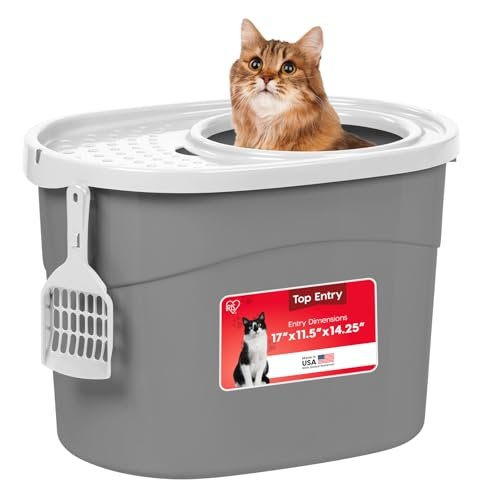
Best for: most healthy adult cats in homes that want less sweeping.
This is the box the other four get measured against. The textured lid works like a doormat for paws. As your cat steps out, loose granules drop back into the pan instead of onto your laundry room floor. IRIS lists the outside at 20.5 x 14.75 x 14.5 inches with a 9.25 inch round entry. Walls that tall keep kicked litter and sprayed urine inside, and the whole thing is made in the USA with global materials.
Daily scooping means lifting the lid, and that’s the cost of the design. Inside, the floor measures 15 x 9.75 inches by IRIS’s numbers, so a long cat may feel cramped. Reviewers on IRIS’s site say a normal-sized cat has room to stand. In multi-pet homes the raised entry makes the litter harder for dogs to reach. The plastic holds up to daily use but needs regular washing so residue doesn’t build up.
What Works
- ✓ Textured lid traps loose litter from paws
- ✓ Enclosed design gives privacy and holds in odors
- ✓ Elevated entry keeps dogs from reaching the litter
What to Watch
- • Requires lifting the lid for daily scooping
- • May be difficult for senior cats to jump into
- • Plastic needs regular washing to prevent buildup
|
2
|
IRIS USA Top Entry Cat Litter Box, Hooded Privacy, Large, Beige |
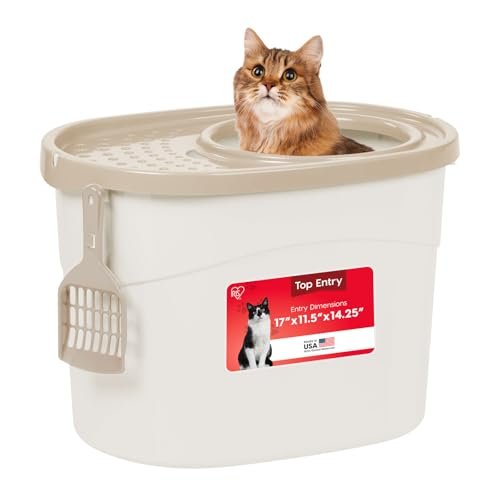
Best for: bathrooms and hallways where a gray box would stand out.
Same idea as the gray version, in a color that fades into light floors and walls. The lid has small holes that catch debris as your cat steps out, which matters most in high-traffic rooms where crumbs of litter show. The enclosed walls give your cat a sense of cover, and keeping waste out of sight limits how far smells travel. Tall sides also keep an enthusiastic digger’s litter where it belongs.
The scoop comes with a storage hook, so you can hang it on the side and stop hunting for it. It’s made in the USA. Check the listing for exact interior measurements before ordering, since IRIS’s top entry line varies by model, and a couple of the tight-fitting ones have low lid clearance. Beige is easy to live with but shows grime, so budget for regular wipe-downs.
What Works
- ✓ Side-mounted hook for easy scoop storage
- ✓ Enclosed design keeps odors and messes out of sight
- ✓ Perforated lid reduces tracking
What to Watch
- • Beige may show dirt over long periods
- • Entry hole may be tight for very large breeds
- • Small lid holes need regular cleaning
|
3
|
Amazon Basics Large Cat Litter Box with High Sides, Top Entry, Odor Co |
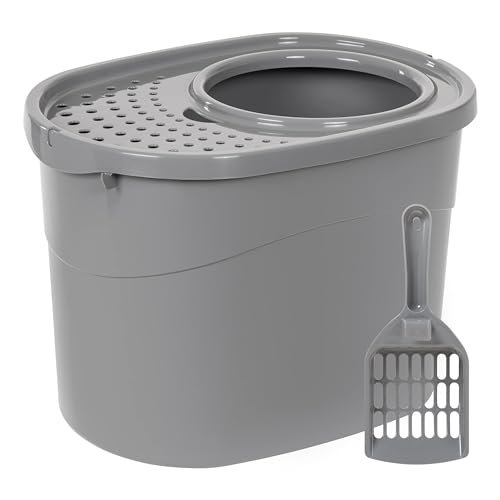
Best for: owners who want a plain, sturdy box without extras.
The Amazon Basics Large keeps things simple. A filtered lid catches particles from your cat’s paws, and the high sides hold in spraying, which helps if yours is a messy cat. The plastic is BPA-free and recyclable, and it copes with daily wear without fuss. Inside, there’s enough room for a cat to move around.
The top lifts off, so checking litter levels or doing a quick scoop takes seconds. Scoop storage is built into the box, which keeps the tool close. The gray finish blends into most rooms, though it won’t suit every color scheme. The tradeoff is deep cleaning: the lid has to come off completely, and the box isn’t right for a cat with mobility issues.
What Works
- ✓ BPA-free, recyclable plastic built for daily use
- ✓ Removable top makes daily scooping quick
- ✓ On-board scoop storage keeps the area tidy
What to Watch
- • Gray may clash with some interiors
- • Lid must come off completely for deep cleaning
- • Not suitable for cats with mobility issues
|
4
|
Arm & Hammer Premium Top Entry Litter Box with Filter to Clean Paws and Microban, Made in USA |
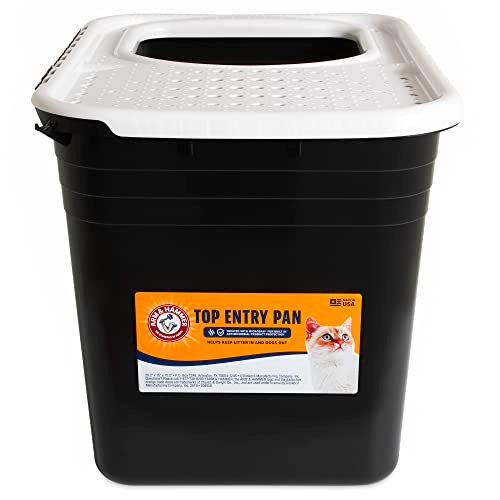
Best for: households where odor is the main complaint.
This one is the odor pick. The plastic is treated with Microban, which limits the growth of odor-causing bacteria on the surface of the box. The wide, grated top collects litter from paws, and the high walls give the privacy cats like. The company says it’s designed for larger cats and made with recycled materials.
It works with pine, crystal and traditional clumping clay, so you don’t have to switch litter to try it. In multi-pet homes, the high sides discourage dogs. The maker recommends replacing the box every 12 months to keep it fresh, which is a real ongoing cost compared with boxes you’d keep for years. Microban treats the plastic only. You still need to scoop daily.
What Works
- ✓ Microban protection limits bacterial odors on the plastic
- ✓ Works with pine, crystal and clumping litter
- ✓ Made with recycled materials
What to Watch
- • Replacement every 12 months is recommended
- • Needs more floor space than smaller models
- • Lid must be lifted for deep cleaning
|
5
|
IRIS USA Large Top Entry Cat Litter Box, Hooded Privacy, Beige/White |
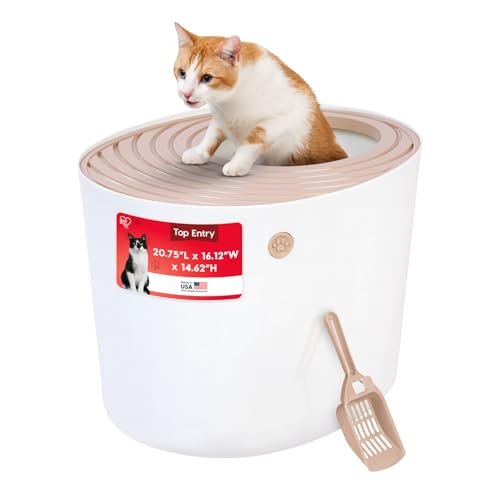
Best for: laundry rooms and bathrooms where you want the box to look like part of the room.
The grooves in this lid catch stray particles from your cat’s feet, which cuts the litter tracked onto your floor. The high walls keep the mess inside, and the closed top hides the litter from view. That’s the appeal in a laundry room or bathroom, where a bare pan looks out of place. If you’re still weighing styles, our guide to choosing a litter box for an indoor cat covers open pans and hooded boxes too.
You can hang the included scoop on the side for quick daily cleanups. The large size gives many cats room to turn around, but it also means a bigger footprint, so measure the spot first. It’s made in the USA. Like the others, it needs consistent scooping, since an enclosed box holds odors until you empty it. See how often you should scoop a litter box for a schedule.
What Works
- ✓ Spacious interior for comfortable movement
- ✓ Grooved lid traps litter for cleaner floors
- ✓ Side-mounted scoop hook for easy organization
What to Watch
- • Larger footprint requires more floor space
- • Top entry may be difficult for elderly cats
- • Requires consistent scooping to maintain freshness
Top Entry vs Front Entry vs Open Pan
A top entry box isn’t the only way to fight scatter. This table shows where it wins and where another style makes more sense. For a deeper look at the first two, read our top entry vs front entry litter box comparison.
| Factor | Top entry | Front entry (hooded) | Open pan |
|---|---|---|---|
| Litter tracking | Lowest | Moderate | Highest |
| Privacy | High | High | Low |
| Senior or arthritic cats | Poor fit | Fine with a low door | Best with a low entry |
| Keeping dogs out | Good deterrent | Weak | None |
| Scooping effort | Lift lid each time | Lift hood or reach in | Easiest |
| Odor | Held in until you open it | Held in until you open it | Spreads freely |
| Cats who refuse it | Some, especially older ones | Some dislike hoods | Rare |
How to Solve Litter Tracking Effectively
Tracking happens at the exit. A standard box lets your cat leap out with granules stuck between their toes. A top entry box changes that by requiring a vertical jump and a walk across a textured surface. The box does half the job. Your setup does the other half.
Follow these steps for the best results:
- Place the box in a low-traffic corner so your cat isn’t startled while using it.
- Keep the lid clean and free of debris.
- Use a high-quality clumping litter to cut dust.
- Clean the lid grooves weekly so they keep catching litter.
- Put a small mat where your cat lands after stepping off the lid.
The lid won’t catch every granule. Fine or dusty litter slips through, and a cat that kicks hard on the way out can still fling some. If your cat digs enthusiastically, choose a model with extra-high walls so nothing flies out mid-dig.
Top Entry Litter Box Setup and Prevention Tips
Where you put the box matters as much as which one you buy. A few habits keep it working:
- Keep the box away from busy areas where your cat could be startled, and away from food and water bowls.
- Place a small mat under and in front of the box as a second layer of defense.
- Keep litter about three inches deep.
- Scoop daily so your cat isn’t digging near the edge to find clean spots.
- Give the box airflow. An enclosed box in a shut closet traps odor.
Depth is where people go wrong. If the litter is too shallow, your cat digs to the bottom and waste sticks to the walls, which is a pain to clean. If the box is too full, granules spill out when the cat jumps. Empty the box, wash it and replace all the litter about once a month. That keeps the plastic from holding smells.
On litter type: a low-dust clumping litter is the safe default. Arm & Hammer says its top entry box also works with pine and crystal. Oversized pellets and dusty litter both make tracking worse.
How to Get Your Cat to Use a Top Entry Litter Box
If you switch from an open box, go slowly. A cat that’s forced into a covered box may protest by using the rug instead.
- Set the new box next to the old one. Don’t take the old one away yet.
- Leave the lid off for a few days so your cat gets used to the space.
- Once your cat is using it comfortably, put the lid on.
- Keep the old box in place until your cat uses the new one every time, then remove it.
If Your Cat Still Refuses
Signs include accidents next to the box, perching on the lid without going in, or digging at the outside. Take the lid off again and see whether the problem stops. If it does, your cat dislikes the enclosure. If it doesn’t, check for a medical cause. A cat that suddenly avoids the box needs a vet visit, since pain or a urinary problem can look like a preference. Some cats simply never accept a top entry design, and going back to a low-entry pan is a fine outcome.
Common Mistakes When Choosing and Using a Top Entry Litter Box
The most common mistake is buying a box that’s too small. If the cat can’t fit comfortably, they leave quickly, often kicking out more litter on the way. These are the others:
- Ignoring the lid: If you never clean the lid grooves, the tracking-prevention feature stops working.
- Wrong litter type: Pellets that are too large, or litter that’s too dusty, make tracking worse.
- Poor location: A box where your cat feels exposed gets used less.
- Skipping maintenance: A full box pushes the cat to the edges, which causes spills.
- Skipping the transition: Swapping boxes overnight can lead to behavior problems. Use the steps above.
- Buying by outside size: The exterior can look huge while the floor inside is short.
How to Clean a Top Entry Litter Box
Plain soap and water is enough for these plastic boxes. Skip harsh cleaners with strong scents, which can put your cat off.
- Daily: Lift the lid and scoop clumps and waste.
- Weekly: Brush or rinse the lid grooves and holes so they keep catching litter.
- Monthly: Empty everything, wash the pan and lid with soap and water, dry them fully, and add fresh litter to about three inches.
- Every so often: Check the plastic for deep scratches. They hold bacteria and odor. Replace the box when they build up (Arm & Hammer suggests 12 months for its model).
Quick Summary
- IRIS USA Large, Gray/White: the default pick for healthy adult cats, with a textured lid and a 9.25 inch round entry. Watch the 15 x 9.75 inch floor if your cat is long.
Get this Solution - IRIS USA Large, Beige: the same idea in a color that suits light rooms, with small lid holes and a scoop hook. It shows dirt sooner.
Get this Solution - Amazon Basics Large: a plain BPA-free box with high sides, a filtered lid and on-board scoop storage.
Get this Solution - Arm & Hammer Premium: Microban-treated plastic and a grated lid for odor-sensitive homes. Plan on replacing it yearly.
Get this Solution - IRIS USA Large, Beige/White: a grooved lid and side scoop hook for laundry rooms and bathrooms, at the cost of a bigger footprint.
Get this Solution
If your cat is a senior or has sore joints, skip all five and pick a low-entry pan. Everyone else should measure the cat, check the interior floor, and pick the lid they can lift with one hand.
Frequently Asked Questions
How do I choose a top entry litter box?
Measure your cat from nose to base of tail and pick a box whose inside floor is at least that long, ideally 1.5 times longer. Then check that the entry hole clears your cat’s shoulders and that the lid comes off easily for daily scooping.
How big should a top entry litter box be?
Your cat needs to turn around and dig without their body touching the walls. Vets suggest a box between one and 1.5 times your cat’s length. Check the interior floor measurement, since it’s often several inches shorter than the outside.
Are top entry litter boxes good for senior cats?
Usually not. The box stands roughly 14 to 15 inches tall, and the jump can be hard on stiff joints. Some shelters advise against top entry boxes for older cats. A low-entry pan is the safer choice.
Do cats like top entry litter boxes?
Many do, especially cats that value privacy, and young, agile cats tend to adapt quickly. Others refuse them. Introduce the box gradually with the lid off first, and keep the old box available until your cat is using the new one.
Do top entry litter boxes keep dogs out?
They make it harder. The raised opening puts the litter out of easy reach for most dogs. A small or determined dog can still get in, and a loose lid makes it easier, so check that the lid latches firmly.
Do top entry litter boxes smell more?
Enclosed boxes hold odors in until you lift the lid, so a skipped day shows up fast. Scoop daily, keep the box ventilated, and wash it monthly. Treated plastic like Microban helps the box itself but doesn’t replace scooping.
Do I still need a litter mat with a top entry box?
A mat is worth having. The lid catches most of what clings to paws, but fine litter and kicked granules can still escape. A small mat catches those.
Can kittens use a top entry litter box?
Only once they can climb in comfortably. A small kitten may not manage a wall of about 14 inches, so start with a shallow pan and switch later.
How many litter boxes do I need?
The standard guideline is one per cat plus one extra, placed in different spots. Three cats means four boxes.
How do I solve the litter tracking?
Use a top entry litter box so your cat has to walk across a textured lid on the way out. That knocks litter off their paws before they reach your floors. A mat and low-dust litter cut what’s left.
What causes the litter tracking?
Loose litter sticks to your cat’s paws as they step out of the box. Open-top boxes let those particles spread through your home. Dusty or very fine litter makes it worse.
Which solution is best for the litter tracking?
For most healthy adult cats, a top entry model with a deep-grooved lid is the best fit. It traps debris while keeping odors and messes inside. Cats with joint problems do better with a low-entry pan and a mat.
How long does it take to fix the litter tracking?
Tracking drops as soon as your cat uses the box. The wait is your cat’s adjustment, which can take a few days or longer, so follow the transition steps and don’t rush it.
Is it worth investing in the litter tracking solutions?
Yes, if your cat accepts the box. A good top entry model cuts the time you spend sweeping and vacuuming around the litter area. If your cat refuses it, the money is wasted, so introduce it gradually and keep your return window in mind.

Written by Mishu
A passionate cat lover and indoor living enthusiast, Mishu is the founder and voice behind Indoor Living Cat – a go-to resource for cat owners who want to create the happiest, healthiest life for their feline companions indoors.
View Full Profile