
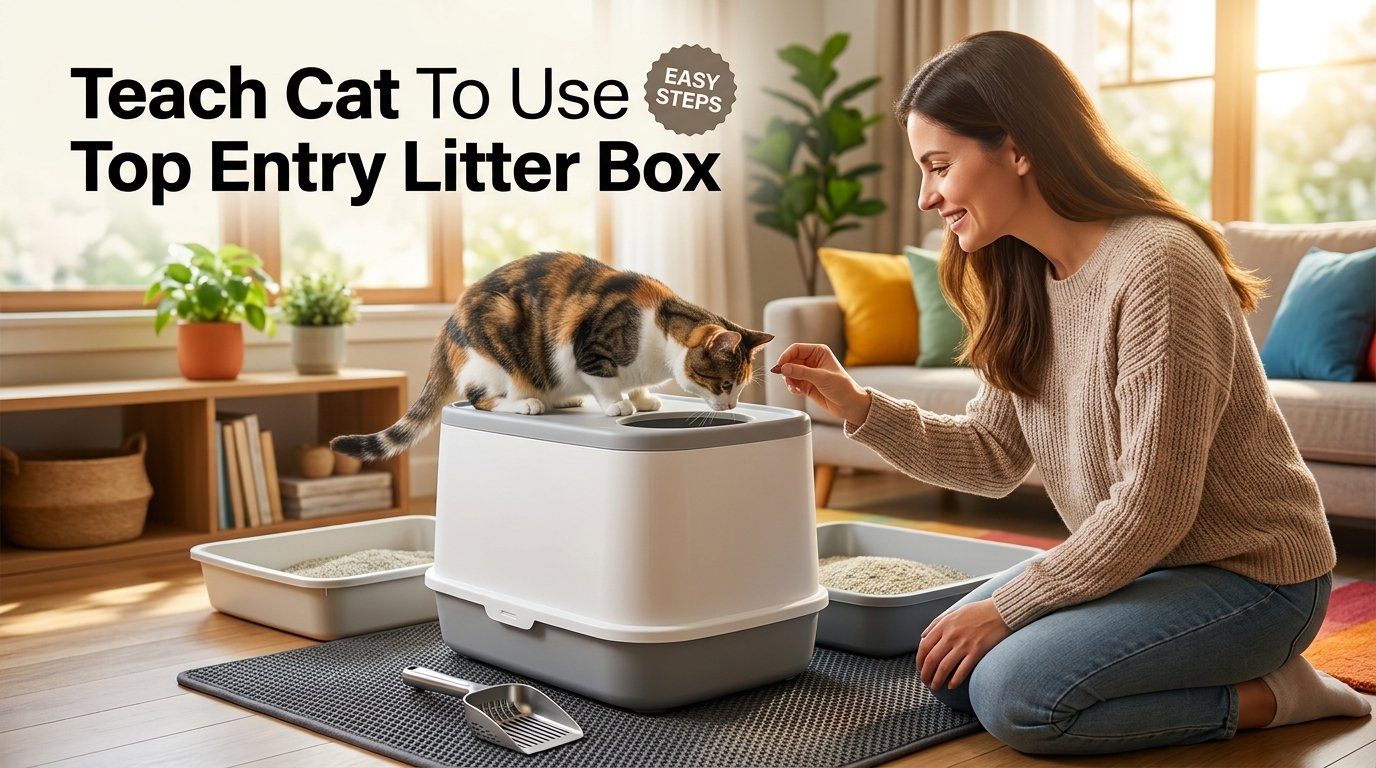
Most cats figure out a top entry litter box within a few days if you take the lid off at first, fill the new box with the litter they already use, and keep their old box nearby until the new one is in steady use. Some cats need two weeks. A few never accept it, and it’s better to plan for that than to be surprised.
The design earns its place in two situations: cats that kick litter across the room, and dogs that treat the pan like a snack bar. The grooved or grated lid knocks litter off paws on the way out, and the high walls catch spray from cats that stand up to pee.
Below you’ll find the step-by-step method, fixes for the most common refusals, a table of which cats suit this style, and five top entry boxes to compare: three IRIS USA colorways, one Amazon Basics model and one Arm & Hammer model. If your cat is already trained and you’re shopping, jump to the product comparison.
Some links on this page are affiliate links, so this site may earn a commission if you buy through them, at no extra cost to you. Specs come from manufacturer and retailer listings checked in September 2026. Confirm size and included accessories on the listing for the exact colorway you order.
In This Guide
How to Teach a Cat to Use a Top Entry Litter Box
Go slower than feels necessary. Cats judge a bathroom by how it smells and how easy it is to leave, and you can set up both before the first visit.
- Measure before you start. The inside of the pan should run about 1.5 times your cat’s nose-to-tail length, a rule Arm & Hammer and vet clinics both repeat. The boxes reviewed below sit 14.4 to 15 inches tall, so your cat also has to make that jump and drop back down.
- Set it where the old box sits. Same room, same corner. Changing the box style and the location together gives your cat two reasons to say no.
- Fill it with the litter your cat already uses. Add about 3 inches and mix in a scoop of used litter from the old box so the smell says “bathroom.” Save any new litter brand for a later week, and skip scented litter, which can overwhelm a cat’s nose.
- Leave the lid off for the first few days. An open pan lets your cat see inside and step in without a jump. This is where a removable lid pays off. The IRIS boxes below release theirs with two buttons.
- Park the old box next to it. Modkat’s published schedule runs three days with the lid off and the old box beside the new one, then puts the lid on, then removes the old box a day later. That’s a sensible template. Stretch each stage if your cat hesitates.
- Show your cat the way in, then back off. Set your cat on the lid, or gently inside the pan, and let it leave if it wants to. A treat on the lid or a pinch of catnip near the opening gives the hole a good reason to exist. Praise quietly when it goes in. Never push or hold a cat inside.
- Remove the old box once the new one is in steady use. Cats pick the familiar option when it’s available. One owner who wrote up her own switch described her cat bolting to the old box the moment its door opened. If the old box keeps winning, take it away sooner and watch for accidents.
Modkat, which sells top entry boxes, says about 85% of cats take to the style. That’s a manufacturer’s estimate, but it matches what owners report: most cats adapt quickly, and a minority refuse outright.
A Sample Training Schedule
| When | What changes | What to watch |
|---|---|---|
| Days 1 to 3 | New box in the old spot, lid off, old box beside it | Sniffing and stepping in both count as progress. Praise, don’t chase. |
| Day 4 | Lid goes on, old box stays | Hesitation at the hole. Put a treat on the lid. |
| Day 5 | Old box removed | Accidents nearby. If they happen, take the lid off again for a few days. |
| Week 2 onward | Normal routine, daily scooping | Any sudden change in habits. See the vet notes below. |
Adapted from Modkat’s published schedule. Cautious cats can take twice as long at each stage, and that’s fine.
[IMAGE PLACEHOLDER: cat perched on a top entry lid, looking into the hole]
Setup Checklist Before Day One
- ✓ Litter about 3 inches deep, unscented, same brand as before
- ✓ A quiet spot that’s easy for your cat to find
- ✓ A litter mat where your cat lands after hopping out
- ✓ Enzyme cleaner for accidents, since regular cleaners can leave a scent that draws your cat back to the same spot
- ✓ Treats within reach, and a plan to scoop daily
Don’t scold. Cats don’t connect a scolding with something they did earlier, and punishment adds fear to a problem that usually started with confusion.
When Your Cat Won’t Use a Top Entry Litter Box
Change one thing at a time so you can tell what helped. Here are the problems that come up most often in owner forums and vet advice.
| What you see | Likely cause | What to try |
|---|---|---|
| Sniffs it and walks away | Unfamiliar smell, or the pan feels cramped | Lid off, add a scoop of used litter, and check the interior size. One TheCatSite owner found a cat rejected a smaller replacement box and went back to normal use when a larger model arrived. |
| Keeps using the old box | The familiar option is still available | Move the old box out sooner than the schedule says, and watch closely for accidents. |
| Pees just outside the new box | Cat aims over the wall, or the entry is uncomfortable | Check litter depth (too much makes the pan shallower than it looks), clean with enzyme cleaner, and consider a low-entry tray for older cats. |
| Pee ends up on the lid or upper walls | Cat stands or aims high | Wipe the lid daily. Several IRIS owners report this. It beats pee on the floor, but it’s still cleanup. |
| Leaps straight through the hole and flings litter | Cat hasn’t learned to land on the lid first | Lure it onto the lid with a treat and reward from that position. |
| Was fine for weeks, then stopped | Dirty box, stress, or a health problem | Scoop, then call your vet if it continues. Arthritis, kidney disease and stress-related bladder inflammation all show up as litter box changes. |
| Fights or avoidance in a multi-cat home | Shared box | One box per cat plus one extra, in separate spots. |
Call your vet if your cat strains, cries in the box, urinates more often than usual, or stops using it suddenly. Rule out medical causes before you treat it as a training problem.
And if the accidents keep coming, stop the experiment. Going back to an open, high-sided tray costs you some litter on the floor. A habit of peeing on the rug costs a lot more to undo.
Which Cats Suit a Top Entry Litter Box
Top entry boxes solve two problems well, scatter and spray, and add one of their own: every visit needs a jump up and a drop down.
| Cat or household | Fit | Why |
|---|---|---|
| Digger or kicker | Good | The lid grooves or grate knock litter off paws, and the walls contain kicks. |
| Cat that stands or aims high when peeing | Good | High walls and a lid catch spray. Expect to wipe the lid. |
| Home with a litter-raiding dog | Good, not guaranteed | Owners are split on how well it works. Determined dogs are the exception. |
| Healthy adult, medium or large | Good if the pan is big enough | Check the interior length against your cat’s body length. |
| Kitten | Usually wait | A 14 to 15 inch lid is a tall climb. Vet-clinic guidance calls for low sides for kittens. |
| Senior or arthritic cat | Poor | Painful joints make high sides and covered entries hard, and that can push a cat to skip the box. |
| Sick or stressed cat | Poor | The extra effort makes an already hard day harder. |
| Multi-cat home | Works with enough boxes | One per cat, plus one extra. |
The critics have a point. Class Act Cats argues that top entry boxes cause enough problems that a high-sided open tray is the better fix for scatter, and I agree for older or already picky cats. If litter tracking is your only complaint, try a tall open pan plus a mat first. Choose top entry when spray, standing pee or a dog is the real issue.
How to Choose a Top Entry Litter Box
The training plan above only works if the box suits your cat. Check these before you buy.
- ✓ Interior length: about 1.5 times your cat’s nose-to-tail length. Measure your cat with a soft tape.
- ✓ Height: the boxes below stand 14.4 to 15 inches. As a rule of thumb, if your cat doesn’t leap onto a couch arm without effort, skip top entry.
- ✓ Entry hole: IRIS lists a 9.25 inch opening. Compare it to your cat’s chest width.
- ✓ Removable lid: you need it for the lid-off training stage and for cleaning.
- ✓ Lid texture and strength: ridges or a grate for paw cleaning, and a weight rating if your cat perches. Cats.com puts the IRIS lid at 20 pounds or less.
- ✓ Materials: wipe-clean plastic. Arm & Hammer uses recycled materials and a Microban antimicrobial additive, if that matters to you.
- ✓ Litter compatibility: Arm & Hammer lists pine, crystal, pellets and clumping litter as fine to use.
- ✓ Return window: no design works for every cat, so buy from a seller with easy returns.
Top Entry vs Front Entry at a Glance
| Feature | Top entry | Front entry |
|---|---|---|
| Litter tracking | The lid catches most loose litter | More tracking, so add a mat |
| Access | Jump up, drop in | Walk in. Better for kittens, seniors and big cats. |
| Dogs | Tall walls and a small opening help | Easy for a dog to reach |
| Odor | Enclosed, and it can hide a smell that would otherwise remind you to scoop | Easier to notice when it needs cleaning |
For a longer comparison, read our guide to top entry vs front entry litter boxes.
Top Entry Litter Boxes Compared
These five share a footprint of roughly 20 inches long, so the real differences are the lid, the materials and what’s in the box. For more on the style, see our guide to covered litter boxes with a top entry.
| Box | Approx. size (L x W x H, inches) | Lid and extras | Good for |
|---|---|---|---|
| 1. IRIS USA Large, Gray/White | 20.5 x 14.75 to 16 x 14.5 | Ridged lid that releases with two buttons. Scoop depends on the version. | Training with a lid-off stage |
| 2. IRIS USA Large, Beige | Same family as #1 | Same lid, beige finish | Rooms where beige blends in |
| 3. Amazon Basics Large | 20.5 x 14.75 x 14.38 | High sides, scoop included | Matching IRIS’s size from another brand |
| 4. Arm & Hammer Premium | 20.3 x 15 x 15 | Grated lid, Microban additive, recycled materials, made in the USA | Homes that want antimicrobial plastic |
| 5. IRIS USA Large, Beige/White | Confirm on the listing | Two-tone beige and white | Matching sets in multi-cat homes |
Five Top Entry Litter Boxes for Training a Cat
Each box below is judged on one question: how well does it support the lid-off, then lid-on transition? For a wider look at the category, our comparison of top entry and front entry designs covers the trade-offs.
|
1
|
IRIS USA Top Entry Cat Litter Box, Hooded Privacy, Large, Gray/White |
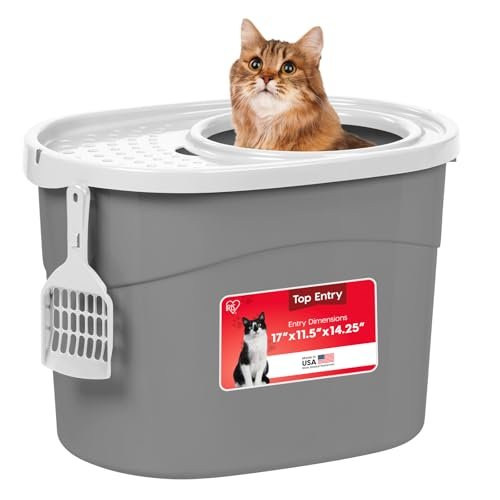
IRIS’s Large top entry box measures about 20.5 inches long and 14.5 inches tall, with an off-center entry hole roughly 9 to 10 inches across that gives your cat a flat spot to land on. The lid releases with two buttons, so the lid-off stage of training is a quick job.
The ridged lid works as a built-in mat. Litter that clings to paws drops back into the pan as your cat climbs out. IRIS sells versions with and without a scoop, so check what ships with the colorway you choose.
Why It Suits a Training Phase
- ✓ Lid comes off with two button presses, so you can run the lid-off phase and reattach it on schedule
- ✓ Ridged lid knocks litter off paws
- ✓ Rated about 4.9 out of 5 across 900+ reviews on IRIS’s own site (manufacturer-hosted, so weigh accordingly)
What to Watch For
- • Cats.com puts the lid’s weight limit at 20 pounds or less, so a big cat that perches there may strain it
- • No carry handles, and one owner calls it bulky to empty
- • One reviewer said a lid catch broke within a month. That’s a single report, but keep the return window in mind
- • Cats.com’s two tester cats refused to use an IRIS top entry box, which is a reminder that no design suits every cat
|
2
|
IRIS USA Top Entry Cat Litter Box, Hooded Privacy, Large, Beige |
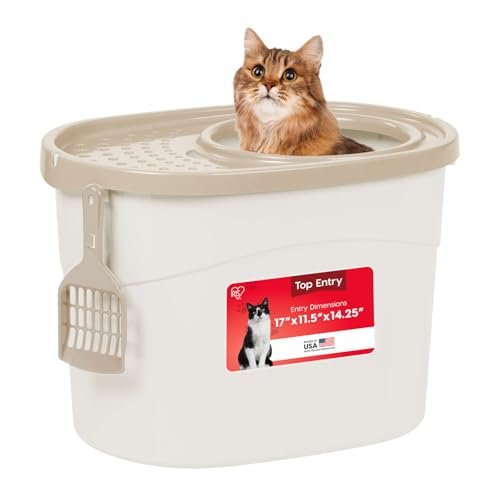
This is the same Large top entry design as the gray and white model, in beige. If the box lives in a living room or bedroom, color is the main reason to pick one over the other.
IRIS’s listings put the length near 20.5 inches and the height near 14.5 inches, though the width varies by listing from about 14.75 to 16.1 inches. Reviewers on IRIS’s site describe the beige as a good size for a full adult cat.
Why It Suits a Training Phase
- ✓ Same removable, ridged lid as the gray and white model
- ✓ Roomy enough that a mid-size adult can turn around inside
What to Watch For
- • Same lid weight limit and lack of handles as the gray and white model
- • Confirm whether a scoop is included in this colorway
|
3
|
Amazon Basics Large Cat Litter Box with High Sides, Top Entry, Odor Control |
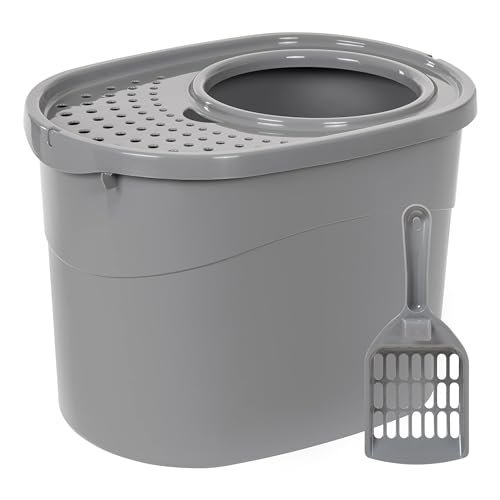
Amazon Basics lists this box at 20.5 x 14.75 x 14.38 inches, which matches the IRIS footprint almost exactly. A scoop is included.
The listing credits the high sides for odor and scatter control. I found no mention of a filter or antimicrobial coating, so scooping does the odor work here.
Why It Suits a Training Phase
- ✓ Size close to the IRIS Large, so the same training plan applies
- ✓ Scoop included
What to Watch For
- • The listing doesn’t spell out how the lid comes off. Check the Q&A if you plan to use the lid-off method
- • “Odor control” in the title refers to the enclosed design, not a filter
|
4
|
Arm & Hammer Premium Top Entry Litter Box with Filter to Clean Paws and Microban |
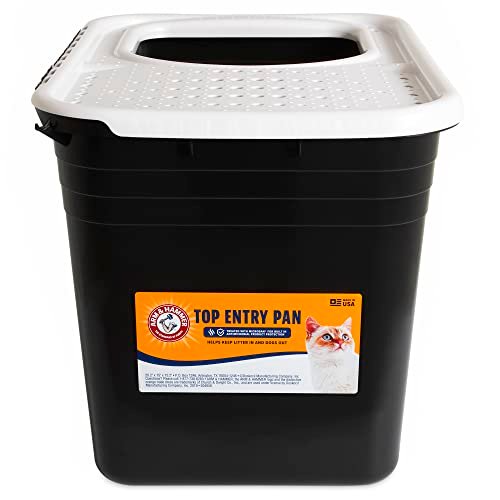
This is the tallest and widest of the five at about 20.3 x 15 x 15 inches. Arm & Hammer treats the plastic with Microban, an antimicrobial additive meant to slow odor-causing bacteria, and says the box uses recycled materials and is made in the USA.
The textured, grated lid lets litter fall back into the pan. The brand also recommends replacing the box every 12 months, since odors can soak into plastic over time.
Why It Suits a Training Phase
- ✓ Wide opening that the brand says suits larger cats
- ✓ Microban treatment on the plastic
- ✓ Recycled materials and US manufacturing, if sustainability matters to you
What to Watch For
- • At 15 inches tall, it’s the highest jump of the five, so it suits agile adults, not kittens or seniors
- • Yearly replacement is an ongoing cost
- • Microban limits bacteria on the plastic. It doesn’t replace daily scooping
|
5
|
IRIS USA Large Top Entry Cat Litter Box, Hooded Privacy, Beige/White |
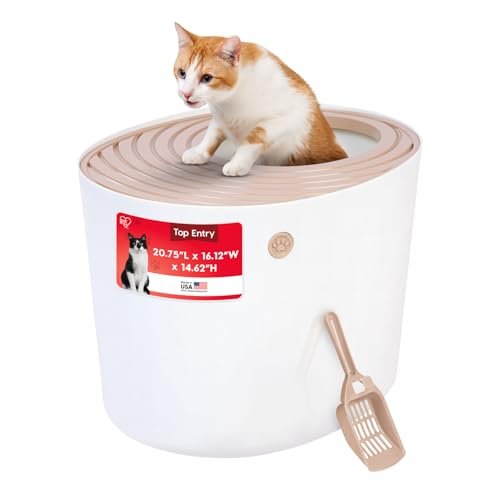
Another colorway of the IRIS Large top entry, this one in two-tone beige and white. It has its own listing, so width and included accessories may differ from the beige model above. Confirm both before you order.
Multi-cat homes need at least one box per cat plus a spare, and matching finishes make buying a set less awkward. That’s the main reason to choose this one.
Why It Suits a Training Phase
- ✓ Same lid design as the other IRIS models, so the lid-off method works
- ✓ Easy to match across several boxes
What to Watch For
- • Same lid weight limit as the other IRIS models
- • Check dimensions on the listing before assuming it matches #1 and #2
[IMAGE PLACEHOLDER: diagram of the 1.5x rule, cat length vs. box interior length]
Quick Summary
- ✓ Easiest lid-off training stage: IRIS USA Large, since the lid releases with two buttons
- ✓ Antimicrobial plastic, US-made, recycled materials: Arm & Hammer Premium
- ✓ Same size as IRIS from another brand, scoop included: Amazon Basics Large
- ✓ Matching colors across several boxes: the beige or beige/white IRIS
For a first-time top entry cat, I’d start with the IRIS Large because the lid is the part you’ll be taking on and off during training. Buy where returns are easy. Some cats will refuse any top entry box, and an open high-sided tray is the fallback.
Frequently Asked Questions
How do I teach my cat to use a top entry litter box?
Start with the lid off, fill the box with your cat’s usual litter plus a scoop of used litter, and place it where the old box was. Keep the old box beside it for about three days, put the lid on, then remove the old box a day later. Use treats on the lid and never force your cat inside. Slow the schedule down if your cat hesitates.
How long does it take a cat to learn a top entry litter box?
Some cats use it the same day. Modkat’s schedule assumes about five days from lid-off to old box gone, and cautious cats can take a couple of weeks or more. Track behavior, not the calendar. If your cat is sniffing, stepping in and using the box without accidents elsewhere, keep moving forward. If accidents start, go back one stage.
Should I keep the old litter box?
Keep it beside the new box for the first few days, then remove it. If it stays, many cats go back to what they know. If your cat has accidents after you remove it, bring the old box back for a few days and try again more slowly.
Can kittens use a top entry litter box?
Very young kittens usually can’t manage a 14 to 15 inch jump, and vet-clinic guidance calls for low sides for kittens. Start them on a low open tray, then move to top entry once they climb on and off furniture without trouble.
Why is my cat peeing outside the top entry litter box?
Common causes are too much litter, a dirty box, a pan that feels cramped, or a cat that stands and aims over the wall. Pain from arthritis and health problems such as kidney disease or bladder inflammation also show up this way. Clean with an enzyme cleaner, scoop daily, and call your vet if the change is sudden.
Do top entry litter boxes keep dogs out?
They keep out many dogs, and several brands sell them for that reason. Owner reports vary, though, so a very determined or large dog may still get to the litter. Test it for a week before you count on it.
What is a top entry litter box and how does it differ from traditional litter boxes?
A top entry litter box has an opening in the lid that cats climb through rather than a side entrance. The design keeps litter inside the box and cuts tracking around the home. It also gives cats privacy, which some find calming. Others need time to adjust to the new way in.
Will my cat be able to use a top entry litter box if they have mobility issues?
Older cats and cats with arthritis often struggle, because they have to jump onto the lid and then drop down into the box. Look for a low-entry model, a ramp or step, or a removable lid. If your cat still hesitates, a low-sided open tray is a better choice. Watch your cat’s comfort and adjust.
How do I keep the top entry litter box clean and odor-free?
Scoop at least once a day, and twice in a busy household. Use a good clumping litter, and put the box in a room with airflow. Some models add a filter or antimicrobial plastic, but those don’t replace scooping. Wash the pan on a regular schedule, and replace it when odors stop coming out. Arm & Hammer suggests every 12 months.
Is a top entry litter box suitable for multiple cats?
Yes, if the pan is big enough for each cat to turn around without feeling cramped. Follow the rule of one box per cat plus one extra to prevent territorial disputes, and watch your cats’ behavior. If conflicts start, add another box in a different room.
What materials should I look for when buying a top entry litter box?
Choose durable, wipe-clean plastic that won’t crack under a cat’s weight. Some brands add antimicrobial treatments, such as Microban on the Arm & Hammer, and others use recycled plastic. A sturdy lid with a secure latch keeps litter from spilling during use.
Sources and Further Reading
- Modkat: transition steps for top entry boxes
- Cats.com: IRIS top entry litter box review
- IRIS USA: Large top entry pan specifications
- Petmate: Arm & Hammer top entry litter box
- PetMD: reasons cats pee outside the litter box
- Independence Veterinary Clinic: litter box training basics
- Class Act Cats: the case against top entry boxes

Written by Mishu
A passionate cat lover and indoor living enthusiast, Mishu is the founder and voice behind Indoor Living Cat – a go-to resource for cat owners who want to create the happiest, healthiest life for their feline companions indoors.
View Full Profile