
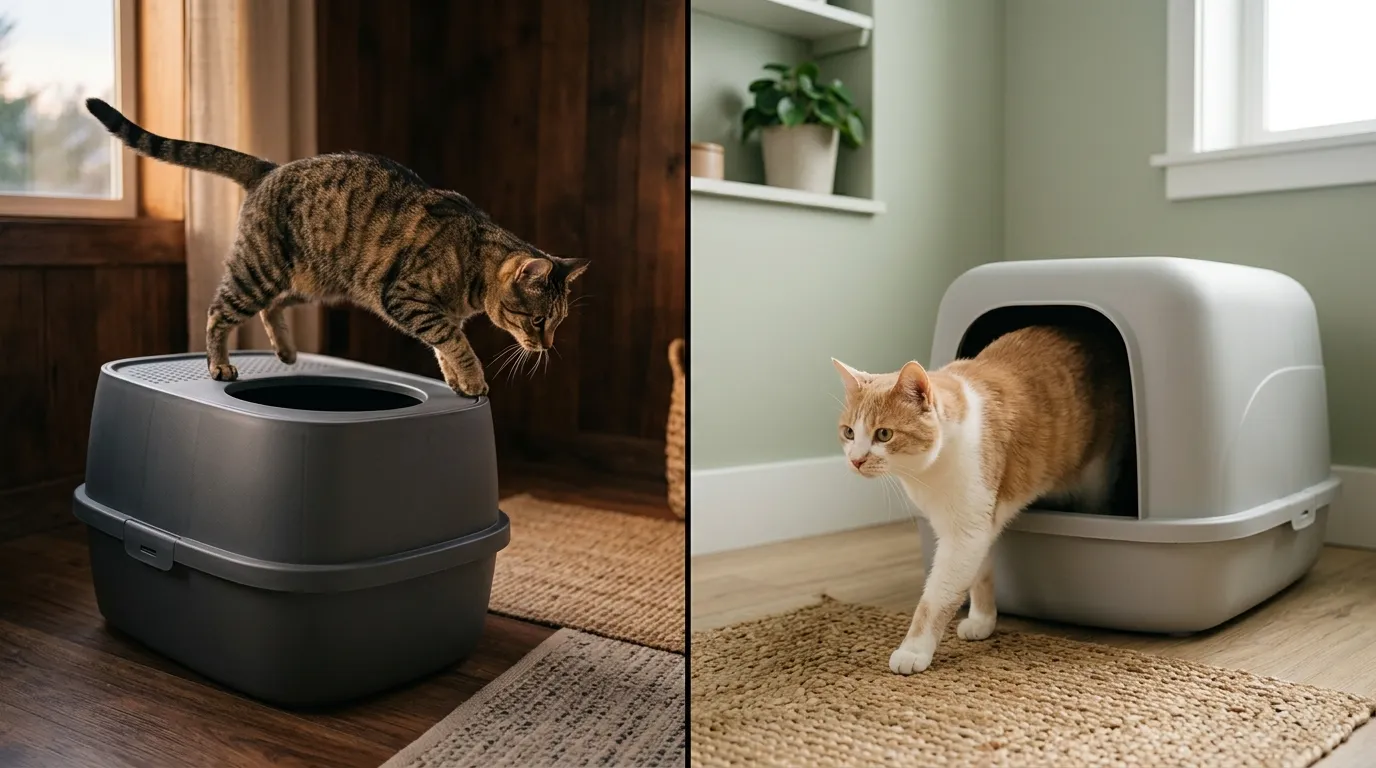
I switched my cat to a top-entry box to stop the litter scatter, and it worked. Then she started going outside the box three times a week. Moving her back to a front-entry box with higher sides fixed both problems at once.
That’s the top entry vs front entry litter box decision in miniature. A design that solves your problem can create one for your cat, so the right choice comes down to her age, mobility and personality rather than which box looks better on a shelf. Below you’ll find a side-by-side comparison, straight answers on whether top entry litter boxes are better, whether they cut tracking and whether cats like them, and a clear verdict.
Short answer Front entry litter boxes win for most cats because they ask nothing of the cat beyond walking in. No jumping, no climbing, so the same box works for a sixteen-week-old kitten, a healthy three-year-old and a fourteen-year-old with stiff hips. Top entry boxes win in two specific cases: containing litter scatter and keeping a dog out. If your cat is a kitten, a senior or has any mobility limit, choose front entry. If she’s young and agile and tracked litter is your biggest problem, a top-entry box is worth testing.
What Is a Top Entry Litter Box and Which Cats Actually Use It?
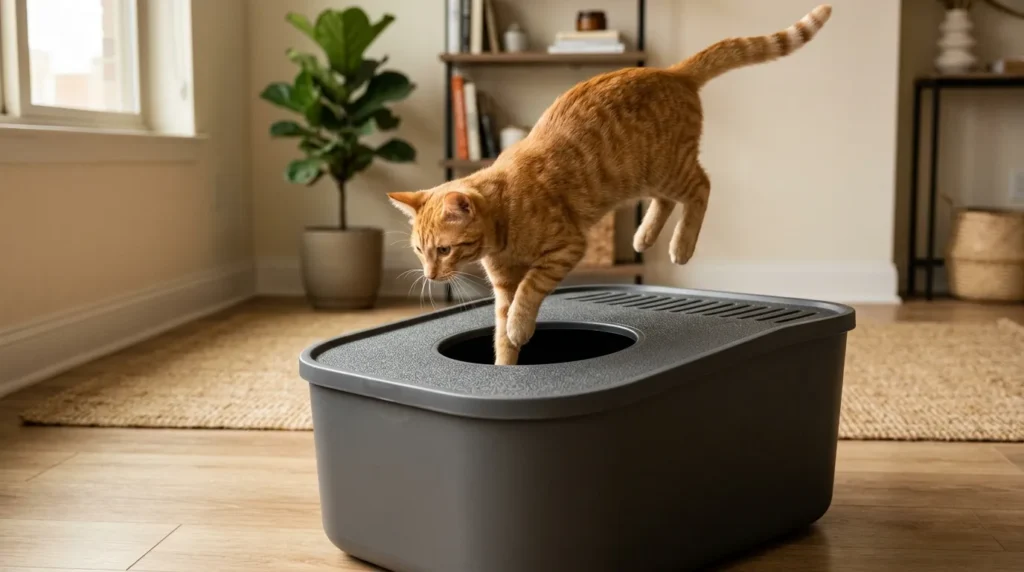
A top-entry litter box is an enclosed box with a hole in the lid instead of a door on the side. Your cat steps onto the lid, drops through the hole and lands in the litter, then climbs back out the same way. Many models have a textured or perforated lid that scrapes litter off her paws on the exit, and that’s the main reason owners buy one.
Top-entry boxes work best for healthy adult cats with no mobility limits. A cat that jumps comfortably usually settles into the routine within one to two weeks. The same box becomes a problem once she develops arthritis, gains weight or reaches senior age and loses the easy jump she had when she first learned it.
Joint disease is far more common than limping suggests. In a Utrecht University study of 100 cats over six years old, 61 percent had osteoarthritis in at least one joint on X-ray, and among cats over fourteen the figure was 82 percent (reviewed in the Journal of Feline Medicine and Surgery). A separate Japanese study screened 101 cats for arthritis and found joint disease on X-ray in 74 percent, yet owners noticed lameness in only two. A cat that crosses the room without a limp can still hurt on the way up to a lid.
What to Check Before You Buy a Top Entry Litter Box
Run through these six points before you spend money:
- Interior length. Feline veterinary guidelines put the minimum at 1.5 times your cat’s length from nose to base of tail. Measure the inside of the box, not the outside.
- Opening width. Her shoulders and chest should pass through without a squeeze. If she has to wriggle, she’ll look for another spot.
- Lid texture. Grooves, ridges or perforations scrape paws. A smooth lid scrapes nothing.
- Rim height. Measure it from the floor, then compare it with a jump you’ve watched her make, such as onto the couch.
- Lid access. A lid that lifts off or hinges wide makes daily scooping easier. A fiddly latch gets old fast.
- Headroom. She needs open space above the box to jump up and drop in, so don’t wedge it under a shelf or vanity.
Are Top Entry Litter Boxes Better?
Better at some jobs and worse at others. A top-entry box beats a front-entry box at keeping litter and urine inside and at keeping a dog out. It loses on access, cleaning and the odds she’s still using it in five years.
The Ohio State University Indoor Pet Initiative reports that cats generally prefer large, uncovered boxes, and that owners tend to choose covered ones to keep a dog out or litter out of sight. Read that way, a top-entry box mostly solves the owner’s problems. Some cats do like the privacy, which is covered in the sections below.
Where Top Entry Is Better
- Litter scatter. Digging and kicking stay inside an enclosed box, and the lid scrapes her paws on the way out.
- Urine spray. A cat that pees standing up hits the enclosure instead of your baseboard.
- Dog access. A dog can’t stroll in and raid the box.
- Privacy. A cat that likes a hidden spot gets one.
Where Front Entry Is Better
- Access. No jump, so kittens, seniors, overweight cats and arthritic cats all manage it.
- Cleaning. You scoop without lifting a lid.
- Odor for the cat. Ohio State notes that covered boxes concentrate odor and that a cat may refuse a covered box that isn’t kept very clean. You smell an overdue open box sooner. She smells an overdue covered box harder.
So top entry is better for a narrow group: healthy adults under seven with no history of avoiding the box, living with a dog or leaving litter across your floor. Everyone else does better with front entry.
Do Top Entry Litter Boxes Reduce Litter Tracking?
Yes, for cats that climb out over the lid. The enclosure keeps most digging and kicking inside, and a textured or perforated lid scrapes loose litter off her paws so it drops back into the box instead of onto your floor. For owners with litter across the kitchen or bathroom, the improvement shows up from day one.
The lid only works if it’s textured. Check for grooves, ridges or perforations before you buy, because a smooth lid does little. And if you run one box of each design, expect the front-entry box to keep tracking litter.
Two Kinds of Mess, Two Different Fixes
Owners lump tracking and scatter together, but they have different causes. Tracking is litter that rides out on her paws. Scatter is litter she throws over the walls while digging. A top-entry box handles both. Cheaper fixes handle one each.
| Fix | What it stops | Tradeoff |
| Top-entry box with a textured lid | Tracking and scatter | Requires a jump. Poor fit for kittens, seniors and overweight cats |
| Large textured mat in front of a front-entry box | Tracking | About ten dollars. Needs shaking out or vacuuming |
| High-sided front-entry box | Scatter | Doesn’t scrape paws. A senior needs a lowered front cutout |
| Bigger box (1.5 times her length or more) | Some scatter | Takes more floor space |
Resist the urge to change litter at the same time. Ohio State advises offering any new litter in a second box beside the old one, because a cat that dislikes the new litter may refuse the box entirely.
Insight A large textured mat in front of a front-entry box solves most paw tracking. The pockets catch litter from her paws the way a perforated lid does, and you keep ground-level access, which matters when she’s twelve. Litter kicked over the rim is a separate problem and needs taller sides. A mat costs about ten dollars. Cleaning the bathroom rug after the wrong box costs more.
Do Cats Like Top Entry Litter Boxes?
Some do. Most cats never asked for one. Ohio State’s Indoor Pet Initiative reports that cats generally prefer large, uncovered boxes, and it also notes that some cats like a covered box for the privacy. A confident, agile adult often takes to a top-entry box within one to two weeks. A shy cat may enjoy the enclosure. Others feel penned in, and a top-entry box gives them one way out, the same way they came in.
Signs Your Cat Accepts or Rejects the Box
| She’s accepting it | She’s rejecting it |
| Steps up and drops in without hesitating | Perches on the lid, circles it or sniffs the hole without going in |
| Digs and covers her waste as she did before | Uses the old box, a rug, a bath mat or a corner of the room instead |
| Clumps in the box each day stay steady | Fewer clumps than usual, which means she’s going somewhere else |
| No new accidents near the box | Rushes out or skips covering |
How to Switch Your Cat to a Top Entry Litter Box
- Keep the front-entry box where it is. Don’t remove it at any point during the trial.
- Set the top-entry box beside it. Same room, same litter, filled to about two inches deep.
- Leave the lid off for the first few days if it detaches. She learns that the box is a toilet before she has to learn the jump.
- Put the lid on and watch for a week. Scoop each box separately and note which one has the clumps.
- Compare after one to two weeks. Consistent use of the top-entry box means it’s a keeper. Steady use of the old box means she’s told you the answer.
- Keep a second box either way. One cat needs two boxes, and the old one stays until she uses the new one consistently.
When Litter Box Avoidance Is a Medical Problem
Sudden avoidance deserves a vet call before you blame the box. In male cats especially, straining, crying while trying to pee, small amounts of bloody urine, peeing in odd places or vomiting can point to a urinary blockage. The University of Illinois College of Veterinary Medicine calls a blocked cat an emergency. Don’t wait a day to see whether it passes.
Insight If she avoids a top-entry box and the vet has cleared her, look at recent illness or injury. Cats avoid places they link to a bad experience, and even a mild urinary tract infection that has since cleared can leave that link with the physical effort of climbing out. Two weeks in a front-entry box often fixes post-illness avoidance that no amount of scrubbing the top-entry box would.
What Is a Front Entry Litter Box and Why Most Cats Prefer It?
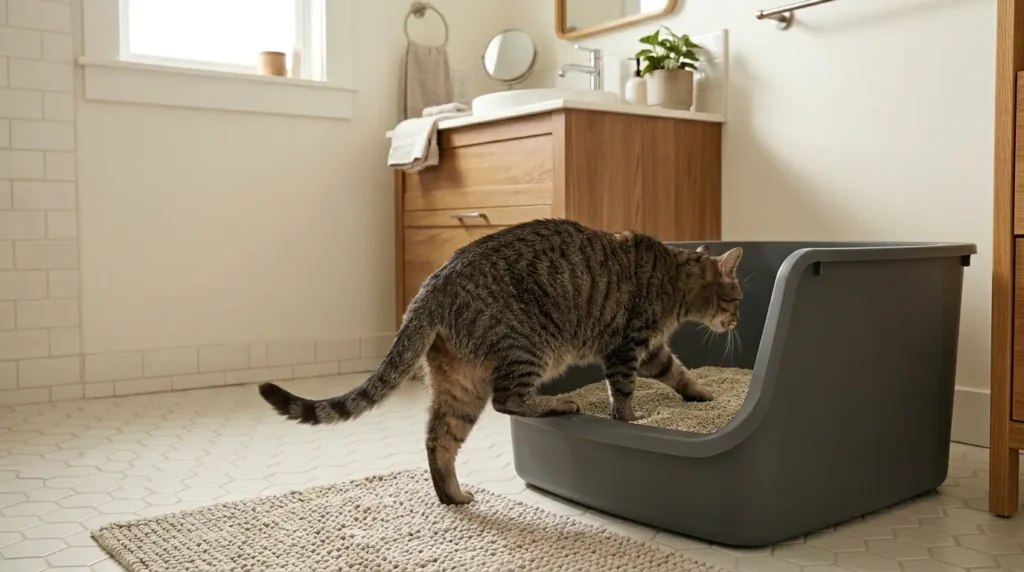
A front-entry litter box is any box the cat enters through an opening at ground level, on the front or the side. That covers three types:
- Fully open boxes with no cover
- High-sided open boxes
- Enclosed boxes with a front door
What they share is access with no jumping, no climbing and nothing beyond the normal step-in height. Veterinarians and feline behaviorists point most cats toward this design for that reason. A front-entry box works the same for a sixteen-week-old kitten, a healthy three-year-old adult and a fourteen-year-old arthritic senior, with no modification. Ohio State’s guidance splits the same way by age: low sides for small kittens and older cats that struggle to get in and out, high sides for cats that scatter litter.
That universal access is why front-entry boxes remain the standard, even though they don’t stop tracking as well.
Litter box avoidance is the main risk when a front-entry box goes unscooped. You notice an overdue open box quickly because the smell reaches your living space, and that’s the one place open boxes lose to top-entry boxes. A covered box hides the same problem from you while it concentrates the odor for the cat, which is why daily scooping matters more with a top-entry box, not less.
A Front Entry Setup That Handles Tracking
- Size. At least 1.5 times her nose-to-base-of-tail length, big enough to stand and turn around in.
- Sides. High walls for a cat that digs and kicks. For a senior, look for a high-sided box with a lowered front cutout. Boxes made for arthritic cats commonly cut the entry down to about 3 to 5 inches.
- Mat. Large and textured, placed where she steps out.
- Litter depth. About two inches, deep enough to dig and bury.
- Routine. Scoop daily and wash weekly with mild dish detergent.
Our guide to indoor cat litter box setup covers sizing and placement for either entry style.
Top Entry vs Front Entry Litter Box: The Honest Comparison
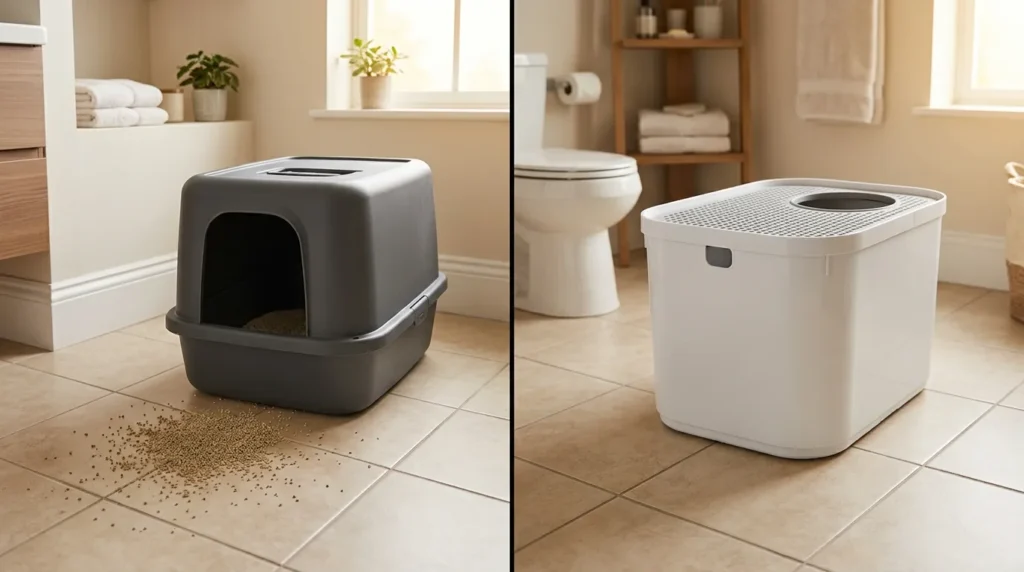
This table compares the two designs on every factor that matters in an apartment:
| Factor | Top Entry | Front Entry |
| Litter tracking control | Excellent | Moderate |
| Jump or climb required | Yes | No |
| Adjustment period | One to two weeks | None for most cats |
| Odor containment in the room | Good | Fair to good when scooped daily |
| Odor concentration for the cat | Higher, so scoop daily | Lower |
| Cat accessibility | Young agile adults only | All ages and mobility levels |
| Urine spray containment | Excellent | Depends on side height |
| Dog-proofing | Excellent | Poor |
| Cleaning ease | Moderate (lid removal required) | Easy (direct scoop access) |
| Senior cat suitability | Poor | Excellent |
| Kitten suitability | Poor | Excellent |
| Overweight cat suitability | Poor | Good |
| Privacy and enclosure feeling | High | Low to moderate |
| Risk of avoidance after illness | High | Low |
The table makes the tradeoff visible. Top entry wins on mess containment and dog-proofing. Front entry wins on everything cat-centric: accessibility, cleaning ease and avoidance risk. The top entry vs front entry litter box debate comes down to whose comfort you’re prioritizing.
According to the Ohio State University Indoor Pet Initiative, cats generally prefer large, uncovered boxes because they’re easier to get into, and low-sided boxes suit kittens and older cats that struggle to get in and out. Top-entry boxes add physical effort. Healthy cats tolerate it, but many reject it once their mobility changes.
Tracking is the usual reason people pick top entry, and a mat handles most of it. The tracking section above shows what each fix stops and what it costs you.
Which Is Better for Your Specific Situation? Top Entry vs Front Entry
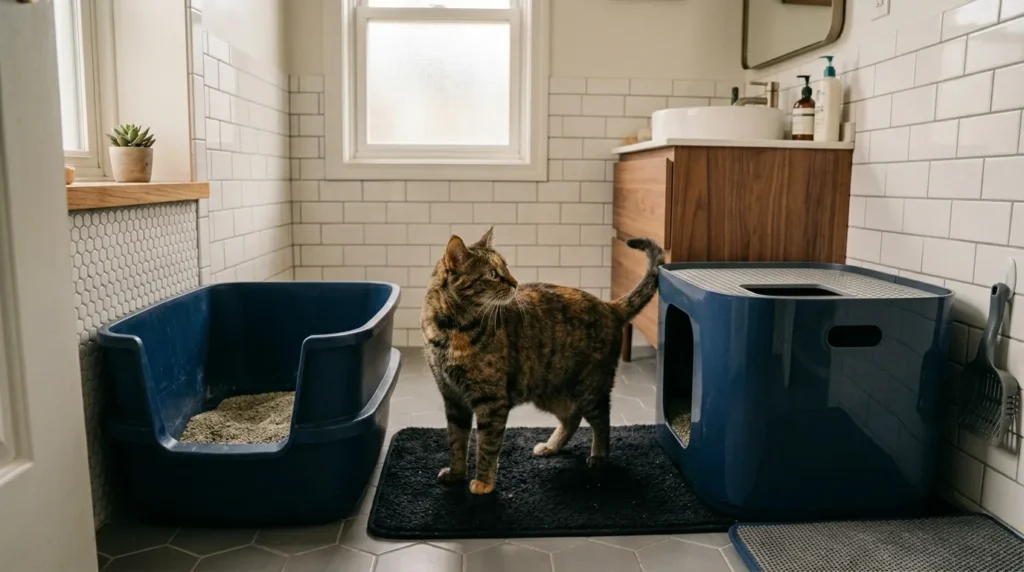
Most households fall into one of three situations. Find yours and the choice mostly makes itself.
Choose Top Entry If the First Point Is True and So Is Either of the Others
- Your cat is a healthy adult under seven years old with no history of litter box avoidance
- Litter on the floor is your biggest daily frustration
- A dog in the household raids the litter box
Those conditions make top entry the right call, and the benefits are real.
Choose Front Entry If Any One of These Is True
- Your cat is a kitten or under six months old
- Your cat is over seven, however healthy she looks now
- She has any history of litter box avoidance, whatever the cause
- She’s overweight
- You’re unsure of her preference and don’t want to risk avoidance during a trial
Front entry covers every one of these with no added risk.
Quick Pick by Situation
| Your situation | Better pick | Why |
| A dog raids the box | Top entry as a second box, or a front-entry box in a gated room | The lid blocks the dog. A gate with a cat-sized gap does the same for an open box |
| She pees standing up and hits the wall or floor behind the box | Top entry, or a front-entry box with tall back and side walls | The enclosure or the extra height catches the stream |
| Large cat | Front entry sized to the 1.5 times rule | A top-entry box has to fit her in length and in opening width. Front entry has one fewer limit |
| Two or more cats | Front entry as the base, plus one extra box | Ohio State’s golden rule is one box per cat plus one |
| Recovering from illness or a stressful change | Front entry | It removes the physical effort while she rebuilds trust in the box |
| Small apartment | Either | The footprints are similar, and a mat with high sides gives the same tidy floor |
Or Run One of Each
Put one of each design in your two-box N plus one setup and watch which your cat uses more. Most cats that will tolerate a top-entry box show a preference within the first week. A cat that consistently skips the top-entry box for the front-entry box is telling you directly which design works for her.
How Many Litter Boxes Do You Need?
Ohio State’s golden rule is one box per cat plus one. One cat needs two boxes and two cats need three. In a home with more than one story, put a box on each level. A second box is also the safest way to trial a top-entry design, since she keeps her old option.
The Mistake People Make When Choosing Between These Two Designs
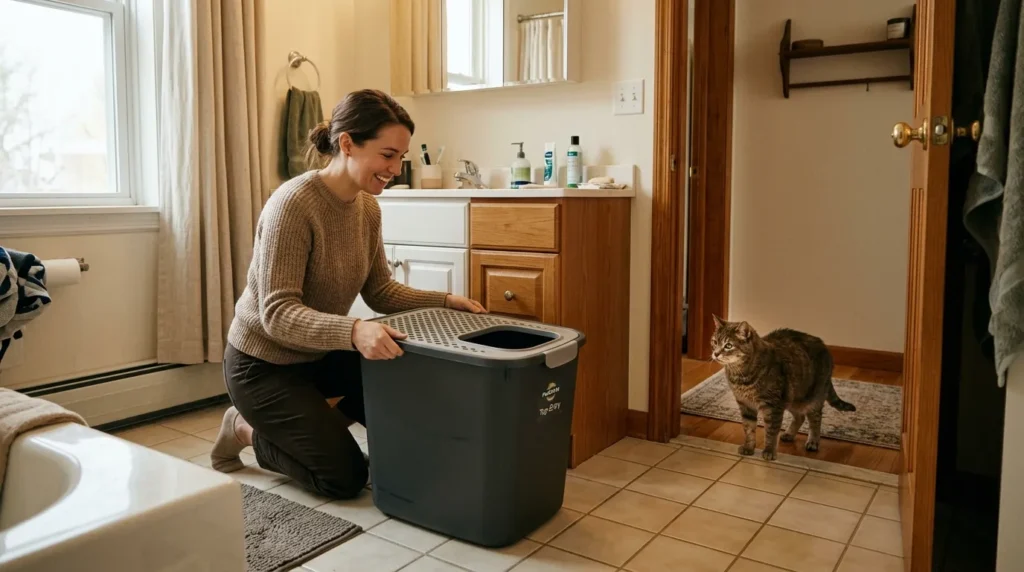
The most common mistake is choosing the box that solves the owner’s problem instead of the one that fits the cat’s body. Litter tracking is your problem. She doesn’t care about litter on the floor. She cares whether elimination is comfortable, easy and free of stress.
Plenty of owners switch to top entry to stop tracking, then spend three weeks working out why the cat now goes on the bathroom rug. The tracking problem was real. The solution didn’t fit that cat. A textured mat and a high-sided front-entry box would have fixed the mess without creating the avoidance.
The second mistake is treating a top-entry box as permanent. A five-year-old that uses one perfectly today should move to front entry somewhere between eight and twelve as her joints stiffen. Plan that switch before she starts refusing, because retraining a cat that has already begun avoiding the box is much harder.
Other Mistakes Worth Avoiding
- Removing the old box on day one. Keep it until she uses the new one consistently, then keep a second box anyway.
- Buying too small. Interior length should be at least 1.5 times her length from nose to base of tail. Many store-bought boxes fall short.
- Changing the box and the litter together. Change one thing at a time so you know which one she’s reacting to.
- Tucking the box into a tight spot. Ohio State warns against places such as under a vanity sink or a low table. She needs to stand and move comfortably.
- Treating a medical problem as a behavior problem. Sudden avoidance calls for a vet visit first.
Our Verdict
Front entry litter boxes are the better default for most apartment cat owners. They work at every life stage, and their main drawback, tracking, mostly disappears with a mat. Top entry boxes suit two groups: households where a dog raids the box, and young adult cats with severe scatter habits and no history of avoidance.
If you’re starting fresh, choose a large high-sided front-entry box as your primary and add a top-entry box as the second box in a two-box setup. Use the first two weeks to let her show you which design she prefers. Size both boxes first with our guide on how to choose the right litter box for your indoor cat, so a too-small box doesn’t muddy the comparison.
Frequently Asked Questions
Is a top entry or front entry litter box better for cats?
Front entry is better for most cats because it works at every age and mobility level without requiring a jump. Top entry is better for young agile cats in households where litter scatter or dog access is a problem. If you’re unsure, choose front entry and add a litter mat to handle tracking.
Do cats like top entry litter boxes?
Some do, but cats generally prefer large, uncovered boxes, according to Ohio State’s Indoor Pet Initiative. Confident, healthy adults often accept a top-entry box within one to two weeks. Shy cats may like the privacy. Cats with joint pain, a history of avoidance or a nervous streak tend to reject it.
Will my cat use a top entry litter box?
Most young healthy adult cats accept a top-entry box within one to two weeks when it’s introduced alongside their existing front-entry box rather than replacing it. Cats with any history of litter box avoidance, mobility limits or senior age often reject it. Never remove the original box until she uses the new one consistently.
How do I get my cat to use a top entry litter box?
Keep her old box in place and set the top-entry box beside it with the same litter. If the lid detaches, leave it off for the first few days, then put it on and compare which box she uses over one to two weeks. The full steps are in the switching section above.
Do top entry litter boxes help with litter tracking?
Yes. The textured or perforated lid scrapes litter off her paws as she climbs out, and the enclosure holds the scatter, so floor litter drops fast. A large textured mat in front of a front-entry box scrapes paws in a similar way at a fraction of the cost and without the jump.
Do top entry litter boxes keep dogs out?
Yes. A dog can’t walk in and dig through the box the way it can with an open one. A very small dog may still reach the hole, so check the opening against your dog before you buy.
Are top entry litter boxes harder to clean?
Slightly. You lift or unlatch the lid to scoop, and grooves in the lid trap litter, which slows the weekly wash. Scoop daily and wash weekly with mild dish detergent, the routine Ohio State recommends for any box.
Can senior cats use top entry litter boxes?
Most senior cats can’t do it reliably. Age-related joint changes reduce jumping comfort before they show up in her daily movement, so a senior that looks mobile may still hurt enough on the jump to start avoiding the box. Front entry with a low lip is always safer for cats over seven, and boxes made for arthritic cats commonly have entry cutouts of about 3 to 5 inches.
Are top entry litter boxes good for large cats?
Only if two measurements fit. The interior length should be at least 1.5 times her nose-to-base-of-tail length, and the opening has to let her shoulders through without a squeeze. If either falls short, choose a large front-entry box instead.
Is a top entry litter box good for small apartments?
Top-entry boxes have a similar floor footprint to equivalent front-entry boxes and offer no real space advantage. They do shrink the scatter zone around the box, which can feel cleaner in a tight space. A high-sided front-entry box with a litter mat gets the same clean floor without the accessibility limit.
Why did my cat stop using her top entry litter box?
If it happened suddenly, call your vet, and treat straining, crying or little urine as an emergency. If the vet finds nothing, check the usual causes: a dirty box, a recent litter change, illness or pain that made the jump hurt, or a spot that has turned noisy or cramped. Put a front-entry box beside the top-entry one for two weeks and see which she picks.
Conclusion
Your cat decides the top entry vs front entry litter box question through her behavior. Start with a large front-entry box, add a mat for tracking and watch her daily clump count for two weeks. If tracking is still a serious problem and she’s young and agile, add a top-entry box as the second box and leave the front-entry box in place. Whichever she uses more is your answer.
Top entry litter boxes reduce litter tracking, scatter and dog access, but they require a jump that creates problems for kittens, senior cats, overweight cats and any cat with a mobility limit. Front entry litter boxes work at every life stage, and their main drawback, more tracking, is mostly solved by a large textured mat and higher sides. Front entry is the safer default for most cat owners. Young, agile, healthy adult cats in dog-sharing households or with heavy scatter habits are the main group for whom top entry is a real improvement. Introduce a top-entry box beside the existing box, keep one extra box per home, and treat sudden avoidance as a reason to call the vet.

Written by Mishu
A passionate cat lover and indoor living enthusiast, Mishu is the founder and voice behind Indoor Living Cat – a go-to resource for cat owners who want to create the happiest, healthiest life for their feline companions indoors.
View Full Profile