
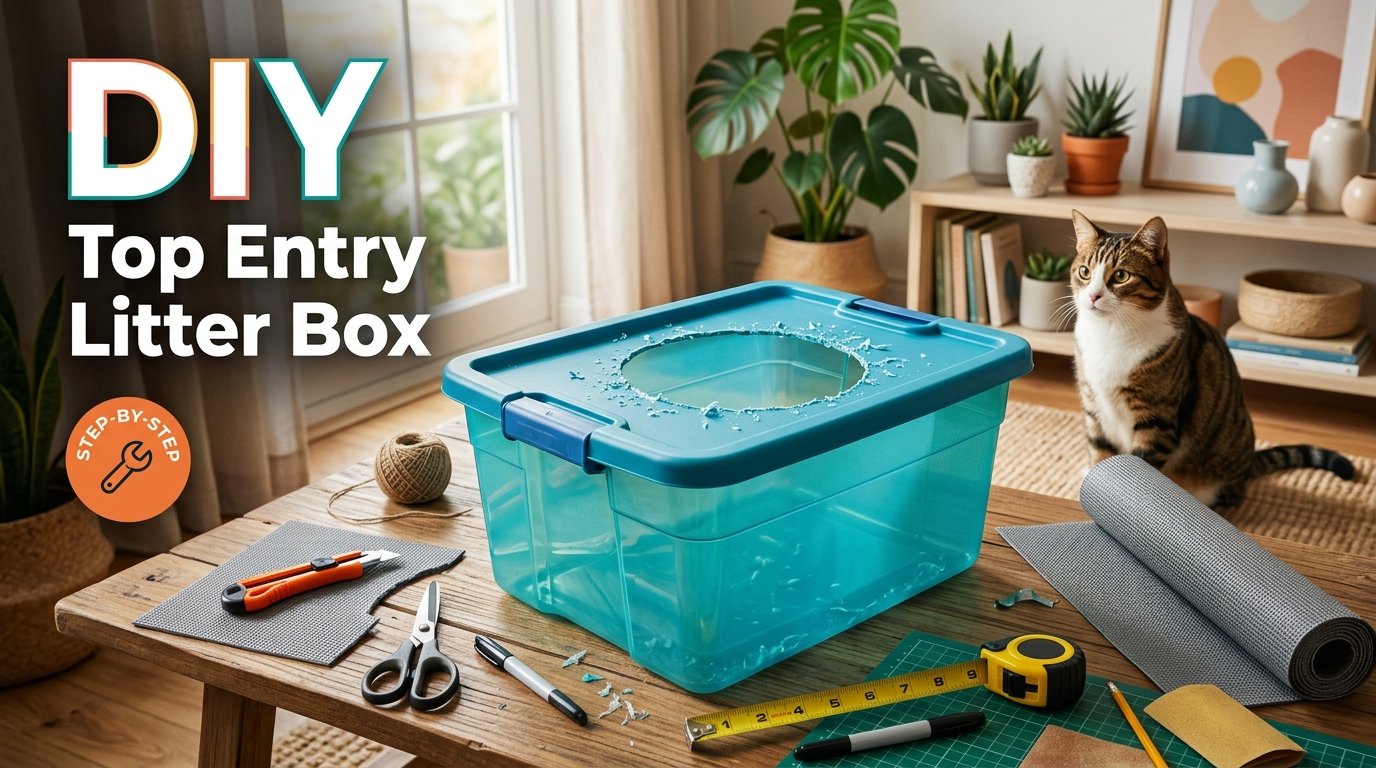
A DIY top entry litter box is a lidded plastic storage tote with a hole cut in the lid. You can build one in about 10 minutes with a utility knife, a marker, and sandpaper. Your cat hops onto the lid, drops through the hole, and the lid catches some of the litter stuck to their paws on the way out. Because the only way in is through the top, it also makes life harder for a dog with a taste for litter.
If litter keeps ending up across your floors, a top entry litter box is one of the cheapest fixes. This guide covers tote sizes, hole dimensions, cutting and safety, and the problems people hit in the first week: odor, a cat who won’t jump in, and sharp edges. I’ve also rounded up five ready-made top entry boxes for anyone who’d rather skip the knife. One warning up front. A homemade top entry box is a poor fit for kittens, seniors, and cats with stiff joints, and I cover a better option for them below.
In this guide
Quick Answer: How to Make a DIY Top Entry Litter Box
- Pick a tote. 16 gallons or larger, with a lid. Its inside floor should be at least 1.5 times your cat’s length.
- Mark the hole. Trace a circle about 9 to 10 inches wide on the lid, or an 11 by 10 inch rectangle for a heavier cat.
- Cut it out. Use a sharp utility knife on soft plastic, or a rotary tool on hard plastic. Wear gloves and goggles.
- Sand the edges. Keep going until nothing catches a fingertip.
- Fill and introduce. Add 2 to 3 inches of litter and keep the old box nearby for a few days.
Is a DIY Top Entry Litter Box Right for Your Cat?
For a healthy adult cat who likes to jump, yes. For a kitten, a senior, or a cat with arthritis, usually no. Here’s the tradeoff in one table.
| What you gain | What it costs you |
|---|---|
| Room to spare. You pick the tote, so a big cat gets a big box. AAHA says most manufactured boxes are too small. | The tote’s height sets the jump. A taller tote holds more litter and makes a longer hop. |
| Low cost. A tote and a blade, usually cheaper than a finished top entry box. | Cut plastic is sharp until you sand it, and that job is yours. |
| Less litter on the floor. High walls and a lid keep flung litter inside. | A closed box holds odor and limits your cat’s view. Some cats refuse it. |
| Dog resistance. A cat-sized hole in the lid keeps most muzzles out. | A small dog that fits the hole can still get in. It isn’t a lock. |
| Easy to adjust. Hole too small? Cut it bigger. | Hole too big? You can’t uncut it. Start small. |
Not every expert likes the design. Joey Lusvardi, a certified cat behavior consultant, ranks an open storage tub above a top entry box for people fighting litter flinging. Tuft & Paw argues that the limited view out of a top entry box makes some cats nervous, especially in multi-cat homes where another cat could ambush them at the exit. Both points are fair. If your cat has ever hesitated at a hooded box, try an open tote first.
Materials and Tools for a Storage Tote Litter Box
| Item | What to get |
|---|---|
| Storage tote with lid | 16 gallons or larger, flat bottom, straight walls. Rubbermaid, Sterilite, and store-brand totes from Target or Walmart all work. |
| Cutting tool | Sharp utility knife or box cutter for soft plastic. Kitchen shears for a thin lid. A Dremel or oscillating multi-tool for hard plastic. |
| Marker and ruler | A dry-erase marker wipes off after the cut. |
| Sandpaper | For smoothing the cut edge. Duct tape over the edge adds a second layer of protection. |
| Safety gear | Cut-resistant gloves and safety goggles. |
| Optional extras | A thin rug and hot glue gun, a drill for small holes, a wooden plank for a ramp, leaf bags for liners. |
| Litter | Whatever your cat already uses. Switching litter and box at once is asking for trouble. |
How to Choose the Right Tote
Size. Measure your cat from nose to the base of the tail and multiply by 1.5. That’s the minimum inside floor length under the 2021 AAHA/AAFP feline life stage guidelines. Measure the inside of the tote, because the outside dimensions on the label run longer. One published DIY build used a 16 gallon tote for two cats. Class Act Cats uses 20 gallon totes. For a large cat, a 105 quart (about 26 gallon) Sterilite latching box is a common recommendation.
Plastic type. Soft, flexible polypropylene cuts easily with a knife. One DIY writer reports that Rubbermaid totes cut cleanly while harder plastics cracked under the blade. Hard-sided totes usually need a Dremel or similar power tool. If you’ve never used one, borrow time at a local tool library instead of guessing.
Lid strength. A flimsy lid is easy to cut, but it can flex under a heavy cat. Modkat rates the lid on its XL box for 30 pounds, which is a handy benchmark. Weigh your cat before you pick a lid.
Clear or opaque. A clear tote shows the whole litter area to anyone walking by. If your cat likes privacy, pick an opaque one.
How to Make a DIY Top Entry Litter Box, Step by Step
Plan on about 10 minutes of cutting and a little longer for sanding and cleanup. Work somewhere you can spare a lid for a few minutes: a workbench, the garage floor, or a towel you don’t like much.
Step 1: Check the tote against your cat
Confirm the inside floor length is at least 1.5 times your cat’s length. The walls also need to be tall enough to cover a standing cat, or the lid can’t do its job of containing litter.
Step 2: Mark the hole on the lid
Use a ruler and a dry-erase marker. Center the outline so your cat has room on both sides of the hole to land before dropping in. A circle looks neater. A rectangle is easier to draw. Round any corners, since sharp inside corners are where plastic tends to crack. Then set your cat on the lid, if they’ll allow it, and check that they’d fit through.
Hole size chart. These are real reference points. Start at the low end and enlarge in small cuts.
| Reference | Opening |
|---|---|
| DIY guides, average adult cat | 8 to 10 inch circle |
| IRIS USA Large top entry box with scoop (manufacturer listing) | 9.25 inch round |
| Modkat XL (manufacturer listing) | 10.25 inches wide |
| PetHelpful DIY build, heavier cat | 11 by 10 inch rectangle |
Too small discourages use, and too big lets in dogs and drops litter kicked up by digging. A cut that starts at 9 inches and grows by half an inch at a time is safer than one you can’t take back.
Step 3: Cut the hole
Put on gloves and goggles first. Shut your cat out of the room, because cats love to “help” with anything involving a box. Set the lid on a stable surface, punch the blade in at the edge of your outline, and cut slowly along the line, keeping your free hand clear and the blade moving away from your body. On soft plastic, the cut goes smoothly once the blade is in. On hard plastic, switch to a rotary tool rather than forcing a knife.
Step 4: Sand the edges smooth
Fix any jagged spots first, then sand the whole cut edge until it feels smooth all the way around. Run a finger along it. If anything catches, sand again. A strip of duct tape over the edge is cheap insurance.
Step 5: Add the upgrades you want
A rug on the lid, a few vent holes, a step for a stiff cat. The upgrades section below covers each one. Skip this step on your first build if you like and add them once you see how your cat uses the box.
Step 6: Fill it and pick a spot
Add 2 to 3 inches of litter. Cats need enough depth to bury waste, and Ohio State’s guidance is about 2 inches. Use leaf bags if you want a liner, since standard garbage bags don’t fit most totes. Set the box in a quiet spot away from food and water, then snap the lid on.
Step 7: Introduce your cat
Place the new box next to the old one and leave the old one available for a few days. You can start with the lid off so your cat gets used to the tote itself, then add the lid and put a few treats on top to encourage the jump. In a multi-cat home, follow the usual rule of one box per cat plus one extra.
Safety note. Cut plastic is sharp, and blades slip. Wear cut-resistant gloves and goggles, and don’t use a tool you haven’t used before. If your cat suddenly avoids any litter box or strains to pee, call your vet. Litter box avoidance can have a medical cause that no box design will fix.
Upgrades for a Homemade Top Entry Litter Box
- ✓ Rug on the lid. Cut a thin rug to fit inside the lid’s edges and hot glue it down. It catches litter as your cat steps across, and some cats find it more inviting.
- ✓ Drilled grate. A ring of small holes around the opening lets stray litter fall back inside, according to one DIY roundup.
- ✓ A second opening. In multi-cat homes, a box with two exits means one cat can’t block the other in. Some owners also report that shy cats dislike a dead end.
- ✓ Step or ramp. A small platform or a plank at the end helps a cat who’s a little stiff. It won’t turn a top entry box into a good choice for a truly arthritic cat.
- ✓ Vent holes. A closed tote holds ammonia. Drilling a few small holes near the top of the walls, above the litter line, lets air move. I couldn’t find testing data on how much this helps, so treat it as a cheap experiment and watch your cat’s reaction.
- ✓ Carpet on the side. On a large tote, a strip of carpet doubles as a scratching post.
Common Problems and Fixes
| Problem | Fix |
|---|---|
| Cat won’t go in | Keep the old box next to it for a few days. Start with the lid off. Put treats on the lid. If your cat sniffs the hole and backs off, widen it by half an inch. |
| Litter still reaches the floor | Add a rug or drilled grate to the lid and put a large mat under the box. Check that litter isn’t piling up near the hole from digging. |
| Box smells | Scoop daily. Use a clumping litter, which seals waste into a mass and cuts the surface that gives off odor. Add vent holes and move the box to a room with better airflow. |
| Lid cracks or bows | Recut with rounded corners, or swap to a sturdier tote with a stiffer lid. Check the lid’s load against your cat’s weight. |
| A dog gets in | Shrink the hole to the smallest size your cat uses comfortably, or put the box behind a baby gate your cat can clear. |
| Sharp edges | Sand again and cover the edge with duct tape. |
Cleaning and Upkeep Checklist
- ✓ Scoop once a day by lifting the lid or reaching through the hole.
- ✓ Top up to keep 2 to 3 inches of litter.
- ✓ On litter-change day, empty the tote and wash the tote, lid, and hole edge with soap and water. Check your litter bag for its recommended change schedule.
- ✓ Look over the cut edge and lid for cracks each time you wash.
When to Skip the Top Entry Design
Skip it for kittens, senior cats, overweight cats, and any cat with arthritis or joint pain. Several sources agree that climbing up and dropping down is hard on these cats, and Arm & Hammer’s litter guidance notes that older and overweight cats tend to prefer front entry boxes. If that describes your cat, the same tote works better with a side entrance.
Cut a wide opening in one short wall, with the bottom of the cut about 3 to 4 inches off the floor, then sand it the same way as the lid. Leave the lid off, or use it as a litter-catching tray. For a deeper comparison of the two designs, read our guide to top entry vs front entry litter boxes.
DIY vs Store-Bought Top Entry Litter Box
| Factor | DIY tote | Ready-made |
|---|---|---|
| Cost | A tote plus supplies you may already own | Retail price, varies by model |
| Effort | About 10 minutes to cut, plus sanding | Unbox and place it |
| Size | Any tote you can find, including large-cat sizes | Fixed dimensions, so check the listing |
| Odor and paw cleaning | Only what you add: vent holes, rug, grate | Some models add filters and odor features, such as picks 3 and 4 below |
| Looks | Utilitarian | Molded shapes in neutral colors |
| Edges | Yours to sand | Finished at the factory |
Want a metal box you can scrub? See our stainless steel top entry litter box picks. If you like the hooded look with a top opening, our covered litter box with top entry roundup covers more options.
Ready-Made Top Entry Litter Boxes (If You’d Rather Not Build One)
Cutting plastic isn’t for everyone, and a finished box saves you the sanding. Before you click through, run any model through this checklist.
- ✓ Inside floor length is at least 1.5 times your cat’s length.
- ✓ The opening is around 9 to 11 inches, the range in the hole size chart above.
- ✓ The lid comes off easily, since you’ll do it every day.
- ✓ Replacement filters, if the box uses them, are easy to find and priced sensibly.
The five picks below are listed with what their Amazon titles state. I haven’t repeated dimensions or prices that I couldn’t confirm, so check each listing for current specs before you order. Picks 1, 2, and 5 are colorways of the same IRIS USA family, and pick 5’s title differs slightly, so confirm the dimensions match.
| # | Model | Stand-out feature (per listing title) | Best for |
|---|---|---|---|
| 1 | IRIS USA Large, Gray/White | Hooded privacy, large size | Neutral or modern rooms |
| 2 | IRIS USA Large, Beige | Hooded privacy, large size | Warm-toned rooms |
| 3 | Amazon Basics Large | High sides, odor control | Scatter and smell complaints |
| 4 | Arm & Hammer Premium | Filter to clean paws | Litter tracking |
| 5 | IRIS USA Large, Beige/White | Hooded privacy, large size | A two-tone look |
Affiliate disclosure: the buttons below are Amazon affiliate links. If you buy through them, we may earn a small commission at no extra cost to you.
Our 5 Top Entry Litter Box Picks
|
1
|
IRIS USA Top Entry Cat Litter Box, Hooded Privacy, Large, Gray/White |
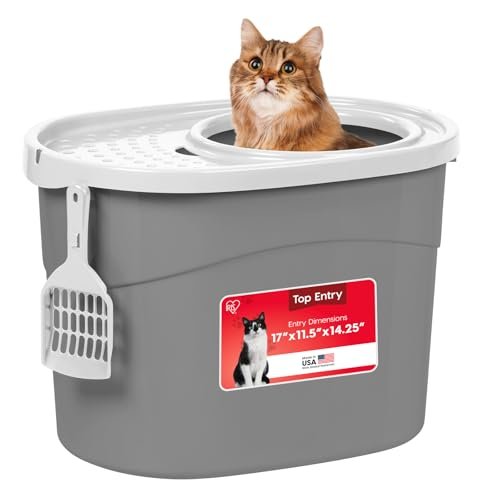
This is the finished version of the DIY idea above: a hooded, large IRIS USA box with the entry on top. Pick it if you want the top entry design without cutting anything.
IRIS lists a 9.25 inch round opening on its Large top entry model with scoop. Compare that with the 9 to 11 inch range you’d cut yourself, and confirm the listing you click matches.
Why It Works
- ✓ Hooded design keeps the litter area out of sight
- ✓ Large size, per the listing, leaves more turning room than a compact box
- ✓ Top opening makes it harder for dogs to reach the litter
Important Considerations
- • Check the inside length against 1.5 times your cat’s length
- • The jump is too much for kittens and seniors
- • Confirm how easily the hood lifts off for scooping
|
2
|
IRIS USA Top Entry Cat Litter Box, Hooded Privacy, Large, Beige |
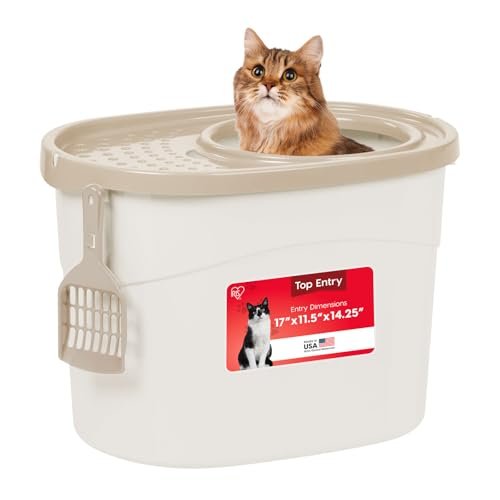
Same hooded, large IRIS USA design as pick 1, in beige. The listing titles match apart from the color, so the choice comes down to your room and the price on the day.
Amazon prices can differ between colorways of the same product, so open both listings side by side before you decide.
Why It Works
- ✓ Warm beige blends into wood floors and cream walls
- ✓ Hooded privacy and large size, per the listing title
Important Considerations
- • Light colors show stains and scuffs faster
- • Same jump-height limits as pick 1 for older or heavier cats
|
3
|
Amazon Basics Large Cat Litter Box with High Sides, Top Entry, Odor Co |
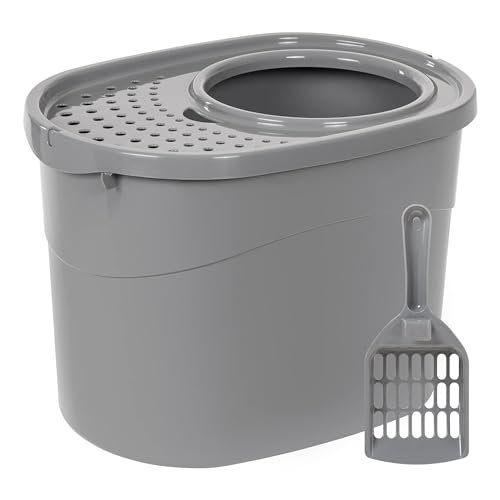
The title promises high sides and odor control, which makes this the pick for people whose main complaints are scatter and smell.
Read the listing to see what the odor control actually is, and whether it needs replacement parts. A filter you have to keep buying changes the real cost.
Why It Works
- ✓ High sides keep flung litter and stray spray inside
- ✓ Odor control is built into the product rather than bolted on
- ✓ Top entry blocks casual access by dogs
Important Considerations
- • Higher sides mean a longer jump, so skip it for seniors
- • Check availability of replacement odor parts before you buy
|
4
|
Arm & Hammer Premium Top Entry Litter Box with Filter to Clean Paws an |
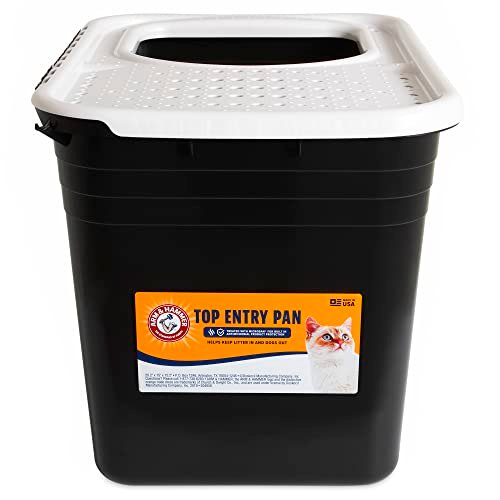
The filter in the title is aimed straight at litter tracking. It’s the closest ready-made match to the rug or grate you’d add to a DIY lid.
A filter is a wear part. Look up how often it needs replacing and what a refill costs before you commit.
Why It Works
- ✓ Built-in filter is designed to clean paws as your cat exits
- ✓ Top entry keeps the litter area enclosed
Important Considerations
- • Replacement filters add a recurring cost
- • Measure the opening against your cat’s shoulders before ordering
|
5
|
IRIS USA Large Top Entry Cat Litter Box, Hooded Privacy, Beige/White |
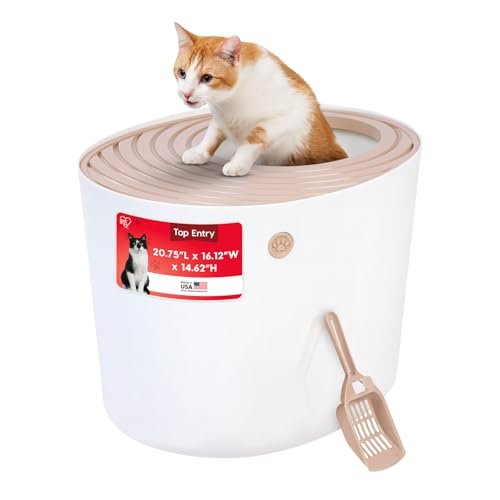
Another IRIS USA colorway, this one in a two-tone beige and white. It follows the same hooded, large formula as picks 1 and 2.
The title is worded a little differently from the other two, so compare its listed dimensions with theirs instead of assuming they match.
Why It Works
- ✓ Two-tone finish is easier on the eye than a single flat color
- ✓ Hooded privacy and large size, per the listing title
Important Considerations
- • Verify the listing’s dimensions and opening size
- • Same jump-height limits as the other IRIS options
Quick Summary
- ✓ Build a DIY top entry litter box if you have a healthy adult cat, a big cat that outgrows store-bought boxes, or a dog that raids the litter.
- ✓ Buy a ready-made one if you want a finished lid, a built-in filter, or a color that suits the room.
- ✓ Skip both for kittens, seniors, and cats with sore joints. Cut a 3 to 4 inch side entrance into an open tote instead.
- • Size the box at 1.5 times your cat’s length, start the hole at about 9 inches, sand every edge, and keep the old box available for a few days.
Frequently Asked Questions
How big should the hole be in a DIY top entry litter box?
Most adult cats do well with a round hole of 9 to 10 inches. IRIS USA lists 9.25 inches on its Large model, Modkat lists 10.25 inches on its XL, and one DIY build used an 11 by 10 inch rectangle for a heavier cat. Start small and enlarge by half an inch at a time.
What size storage tote works best for a top entry litter box?
Pick one with an inside floor length at least 1.5 times your cat’s length, measured nose to base of tail. Tutorials use 16 to 20 gallon totes for average cats. A 105 quart latching box suits large cats. A flat bottom and straight walls give the most usable floor space.
How much does it cost to make a DIY top entry litter box?
The tote is the main cost. Published tutorials put it under $10, with one build using a $4 16 gallon tote from Target, though those figures are a few years old. A knife and sandpaper are the only other necessities, and most households already own both.
What are the main benefits of a top-entry cat litter box?
Top-entry litter boxes limit litter scatter, since cats step across the lid on the way out, and a textured, carpeted, or grated lid catches more. They also give shy cats some privacy and make it harder for dogs or small children to reach the contents. The enclosed design can also help with odor, provided you scoop daily and the box has some airflow.
Is a top-entry litter box suitable for all cats?
No. Most cats adapt quickly, but these boxes suit healthy, agile cats who enjoy jumping. Senior cats, kittens, and cats with arthritis or mobility problems struggle with the climb. Check your cat’s physical limits before you switch, and consider a front-entry or low-sided box if you have any doubt.
How difficult is it to clean a top-entry litter box?
Daily scooping is straightforward once you’re used to lifting the lid or reaching through the opening. Most ready-made models have a cover that snaps or lifts off. A DIY tote’s lid pops off the same way. For deep cleaning, the smooth plastic walls rinse out easily, and soap and water is enough to sanitize them.
Will my cat feel trapped inside a top-entry litter box?
Some do. The opening is never blocked, so your cat can leave whenever they choose, but limited visibility makes a few cats nervous, especially in multi-cat homes. A roomy box helps. If your cat is anxious, try a translucent lid for more light, or cut a second opening so there’s no dead end.
How do I transition my cat to a top-entry litter box?
Place the new box near the old one and keep the old one available for a few days. Put treats on the lid, or leave the lid off at first so your cat gets used to the basin. Once they’re comfortable using the base, add the lid and encourage them to jump through the opening.
Will a top entry litter box keep my dog out?
It keeps out a lot of dogs, because a muzzle has to fit through a cat-sized hole. It isn’t dog-proof. A small dog can still squeeze in, and manufacturer lid ratings are load limits, not security claims. Cut the hole no bigger than your cat needs, or use a baby gate for extra protection.
How do I control odor in a DIY top entry litter box?
Scoop every day and use a clumping litter, which seals waste into a mass. Drill a few small vent holes near the top of the tote walls, above the litter line, and place the box in a room with airflow. Wash the tote and lid whenever you change the litter.
How many litter boxes do I need for multiple cats?
The usual rule is one box per cat plus one extra. Cats are territorial, and many won’t share a bathroom. If you build several DIY boxes, give each a second opening so a cat can’t get cornered.
Keep Reading
- • Top entry vs front entry litter box
- • Covered litter box with top entry
- • Stainless steel top entry litter box
Sources: Class Act Cats, DIY litter box ideas; PetHelpful, build a DIY top-entry cat litter box; the 2021 AAHA/AAFP Feline Life Stage Guidelines for box sizing.

Written by Mishu
A passionate cat lover and indoor living enthusiast, Mishu is the founder and voice behind Indoor Living Cat – a go-to resource for cat owners who want to create the happiest, healthiest life for their feline companions indoors.
View Full Profile