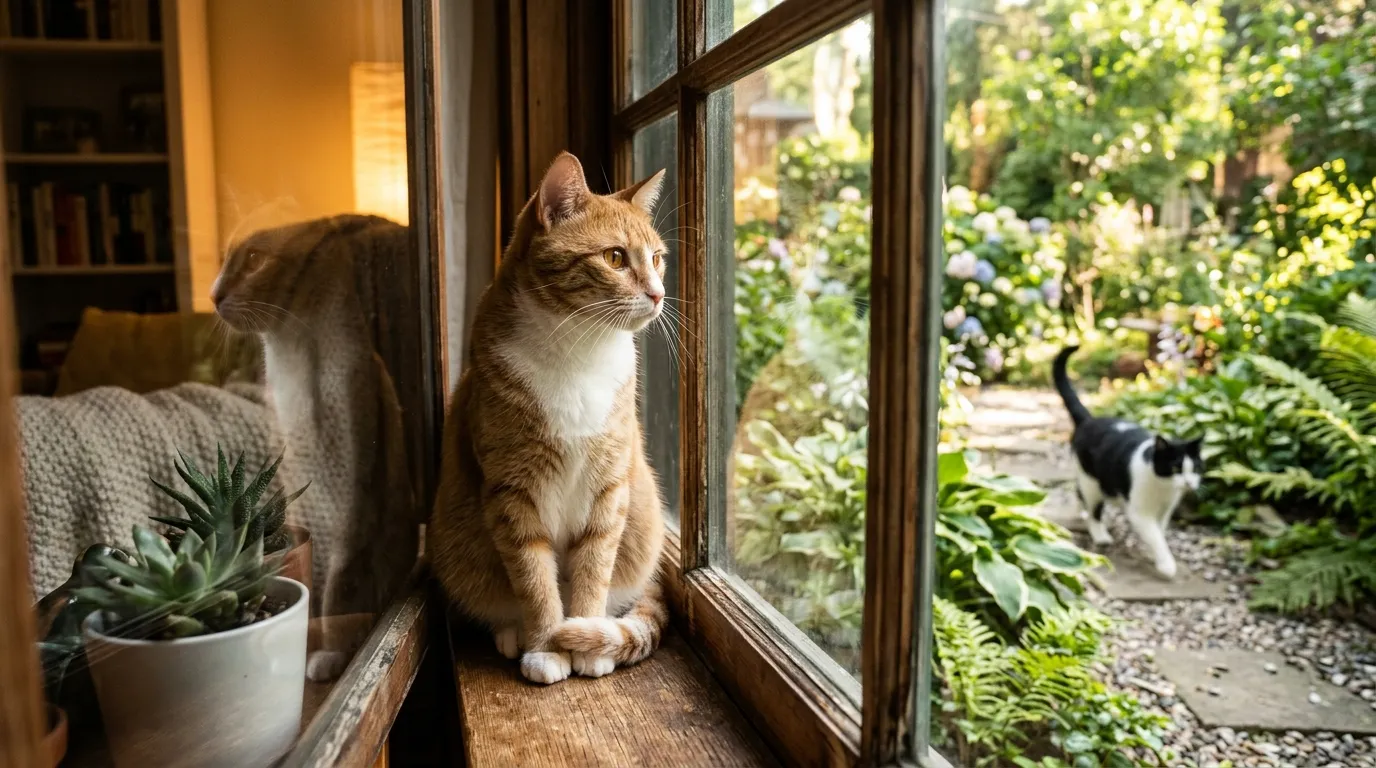
The behavioral difference between my indoor cat and the neighborhood cats outside her window became obvious to me slowly over years. The outdoor cats move differently. More coiled. More watchful. My cat rests in a full belly-up sprawl in the middle of the living room floor which no outdoor cat in active territorial conflict ever does. The indoor cat vs outdoor cat behavior differences are real and they run deeper than most owners realize touching on happiness health and whether switching between lifestyles is even a good idea. This article covers all of it honestly.
Indoor and outdoor cats develop genuinely different behavioral profiles. Indoor cats are more people-oriented, more routine-dependent and show stronger predatory play drive. Outdoor cats are more independent, more physically active and carry higher chronic stress from territorial vigilance. Neither is behaviorally superior. The indoor profile is fully normal for the lifestyle and produces equivalent long-term behavioral health when enrichment is present.
What Indoor Cat Behavior Actually Looks Like Day to Day?
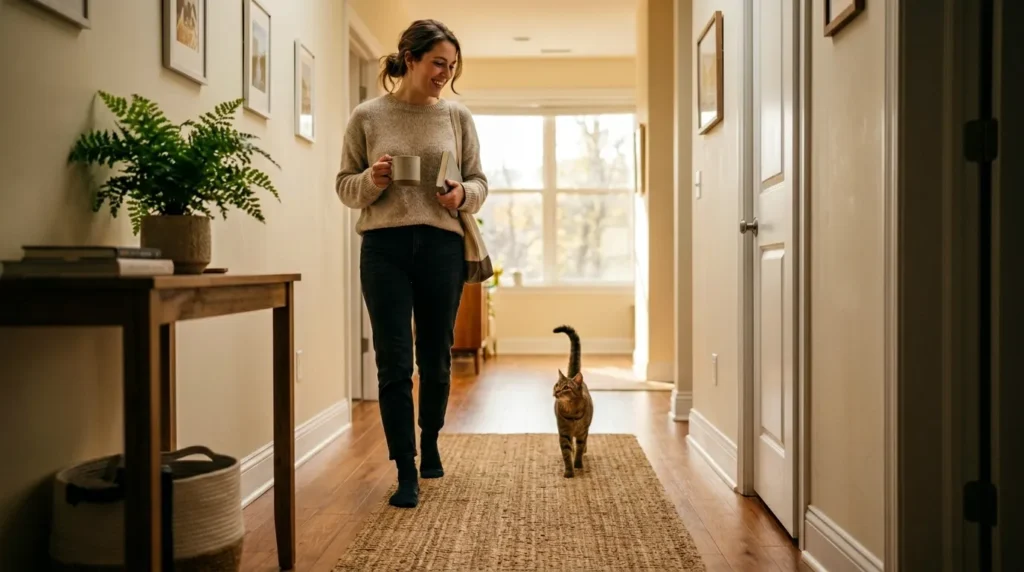
Indoor cat behavior is shaped by two primary forces: the predictability of a controlled environment and the consistent presence of a human who functions as the cat’s main social companion. These two forces produce a behavioral profile that looks very different from a cat navigating outdoor territory on its own terms.
People-oriented behavior is the most consistent characteristic of well-socialized indoor cats. They follow owners from room to room, time their activity around human schedules and develop specific rituals around feeding play and sleep. This reflects genuine social attachment rather than dependency. The owner is the primary animate element in the environment and the cat invests accordingly.
Indoor cats also show stronger predatory play drive than outdoor cats in behavioral studies which surprises most owners. Outdoor cats discharge hunting instinct through real prey. Indoor cats accumulate it between play sessions. A well-played indoor cat that has completed a full prey sequence is measurably calmer than one that has gone days without interactive play. The drive does not disappear. It builds until it finds an outlet.
What Outdoor Cat Behavior Actually Looks Like and What Shapes It?
Outdoor cat behavior is shaped by territorial management, continuous environmental input and the ongoing need to assess threat. An outdoor cat’s day is not a series of comfortable naps broken by exploration. It is a sustained monitoring exercise punctuated by activity bursts at dawn and dusk when prey is most active and territorial rivals most likely to move.
Territorial vigilance is the defining behavioral characteristic of outdoor cats. They patrol boundaries, scent mark regularly and maintain awareness of neighboring cats’ movements at all times. This looks like independence from the outside but it is better described as sustained alertness. An outdoor cat appearing calm is almost always scanning and processing information at a level an indoor cat with no territorial competitors simply does not need to.
 The activity pattern of outdoor cats follows a stronger crepuscular rhythm than indoor cats. Most outdoor cats cover significant territory at dawn and dusk and rest during midday. Indoor cats show a modified version of this pattern but it is often shaped by the human schedule they adapt to rather than purely by prey availability.
Indoor Cat vs Outdoor Cat Behavior Differences: The Honest Comparison
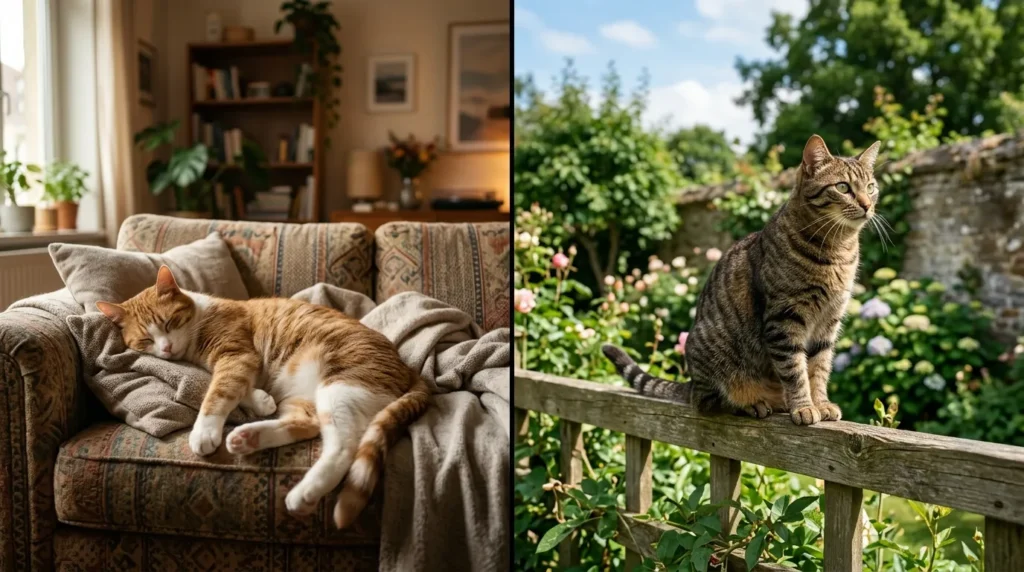
The core indoor cat vs outdoor cat behavior differences come down to three contrasts: stimulation source, social orientation and stress baseline. Indoor cats source stimulation from human interaction and environmental enrichment. Outdoor cats source theirs from real territory and prey. Neither approach is behaviorally incomplete. They are different systems producing different but equally functional outcomes.
Social orientation diverges significantly between the two lifestyles. Indoor cats direct more affiliative behavior toward humans because the human is the primary social variable in their environment. Outdoor cats distribute their social investment across a wider network of cats, humans in the territory and other animals. They tend to appear less demonstratively bonded to one person not because they care less but because their attachment is spread more broadly.
According to welfare guidelines from the International Cat Care organization, the sustained vigilance outdoor cats maintain has measurable behavioral costs even in cats that appear outwardly calm. An indoor cat in a well-enriched environment carries a significantly lower chronic stress load than an outdoor cat navigating active territorial competition daily. That difference shows up in resting posture, grooming frequency and interaction quality.
Which Lifestyle Produces a Happier More Content Cat?
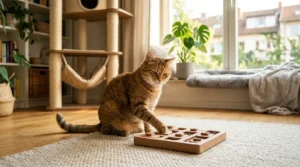 Cat happiness is a behavioral state with specific observable indicators not a self-reported experience. Feline contentment is expressed through slow blinking, kneading on comfortable surfaces, voluntary proximity to the owner, loose relaxed resting posture and consistent engagement with food play and social interaction. These indicators are measurable and they do not require outdoor access to produce them.

The outdoor cat’s happiness picture is more episodic than most owners recognize. Real hunting success produces genuine satisfaction. Territory patrol provides engagement. But territorial conflict unpredictable weather and proximity to traffic produce stress responses that counter those gains in ways that are easy to overlook when watching a cat confidently crossing a garden.
A well-enriched indoor cat produces stronger consistent contentment indicators than a stressed outdoor cat and equivalent indicators to a well-managed outdoor cat in a genuinely safe environment. The lifestyle is not the primary happiness variable. The enrichment level on both sides is what determines actual contentment. An indoor cat raised from kittenhood has no reference point for outdoor territory. It is not missing something. It is fully present in the world it knows.
The slow blink is the clearest happiness signal most owners never learn to read. A cat that slow blinks at you unprompted is communicating that it feels safe in your presence. If your indoor cat slow blinks at you regularly it is telling you directly that it is content. That is not a behavior a chronically unhappy cat produces regardless of whether it has outdoor access.
Indoor Cat vs Outdoor Cat Health Problems Each Lifestyle Creates
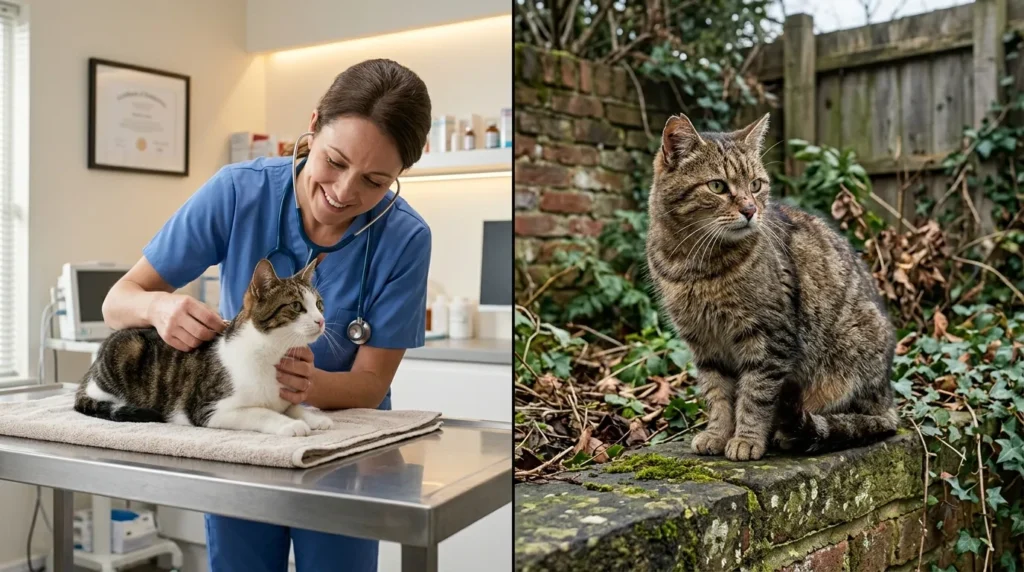
Indoor and outdoor cats face genuinely different health problem profiles and understanding both removes the assumption that one lifestyle is automatically healthier. Indoor cats face higher risks of obesity from reduced activity, dental disease from lower wear on teeth and stress-related conditions including feline idiopathic cystitis. All three are preventable with active management.
Outdoor cats face a significantly more serious disease burden. Feline immunodeficiency virus and feline leukemia virus are both transmitted through bite wounds during territorial fighting. Both are incurable and both progress slowly enough that an infected cat appears healthy for years. Toxoplasmosis exposure, intestinal parasite loads, external parasite infestations and trauma from traffic and predator encounters all add to the outdoor health risk profile in ways that accumulate over a much shorter lifespan.
The critical health difference is detection timing. Indoor cats live in controlled environments where behavioral changes are noticed quickly because the owner sees the cat daily in a predictable routine. Outdoor cats showing early signs of kidney disease, dental infection or diabetes often go undetected for months because their behavioral changes are attributed to their variable outdoor schedule rather than recognized as medical signals.
Can Indoor Cats Become Outdoor Cats and Should They Try?
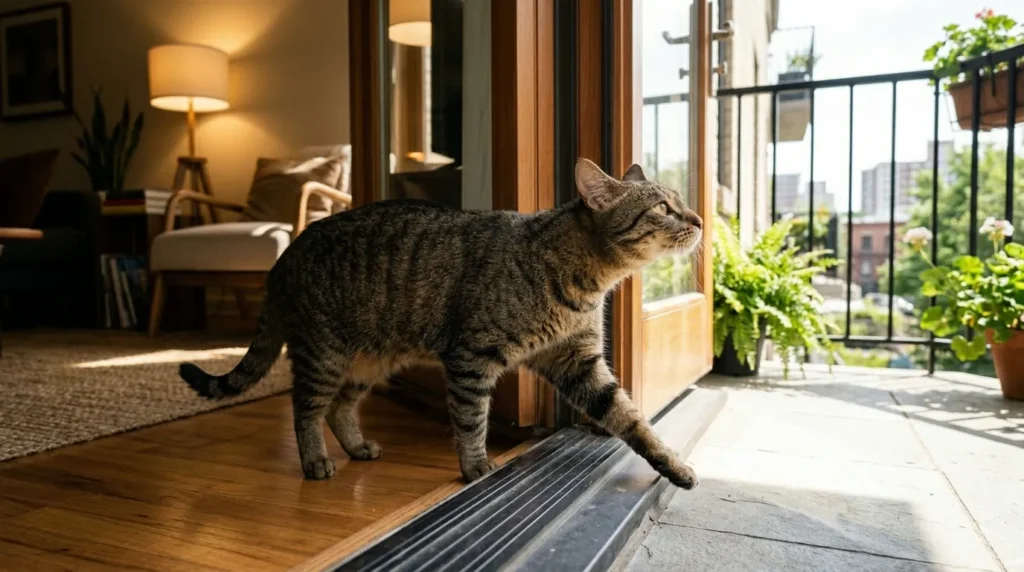
Some indoor cats transition to supervised outdoor access successfully and some do not and the difference comes down to individual temperament age and the specific outdoor environment available. An adult cat that has lived indoors for its entire life has established its territorial map entirely inside the home. Introducing outdoor access is not enriching a deprived cat. It is introducing a new and potentially overwhelming set of inputs to an animal that has no framework to process them.
The safest transition path for indoor cats that owners want to give outdoor experience is an enclosed catio or supervised harness walks rather than unsupervised roaming. These options provide the sensory benefits of outdoor access including fresh air natural sounds and outdoor scents without exposing the cat to the territorial disease and traffic risks that shorten outdoor cat lifespans significantly. A cat that shows signs of distress when taken outside including flattening crouching and seeking to return immediately is telling you directly that the outdoor environment does not feel like an enrichment opportunity to it.
Not every indoor cat wants outdoor access and that is completely fine. A cat that has been content indoors for five years is not secretly longing for territory it has never had. If you want to give your cat outdoor experience start with a screened window, then a catio, then harness walks before ever considering unsupervised roaming. That sequence respects the cat’s established sense of safety rather than overwhelming it.
The One Mistake People Make When Comparing Indoor and Outdoor Cats
The most consistent mistake is using activity level as a proxy for behavioral health. Outdoor cats are more physically active because their environment demands constant monitoring and territorial management. Indoor cats rest more because their environment is safe and their vigilance needs are low. Interpreting that rest as unhappiness or behavioral deficit is projecting human values onto feline biology.
A cat resting in a full sprawled belly-up position is not a bored unhappy cat. It is a cat so secure in its environment that it can make itself physically vulnerable without anxiety. That posture is one of the strongest positive welfare indicators available and it is far more common in indoor cats than outdoor cats precisely because indoor cats carry less threat load.
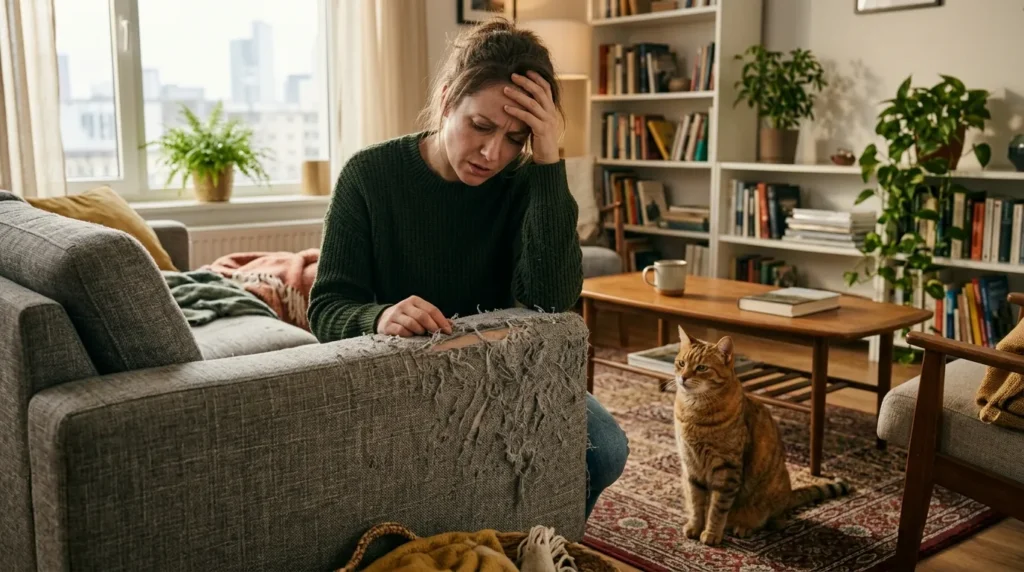
The second mistake is assuming that behavioral problems in indoor cats prove indoor living is inadequate. Destructive scratching excessive vocalization and litter avoidance are caused by insufficient enrichment not by the indoor lifestyle itself. An outdoor cat with the same enrichment deficit would show equivalent problems. The solution is always enrichment not unsupervised outdoor access.
Our Verdict: What the Evidence Says About Cat Behavioral Needs
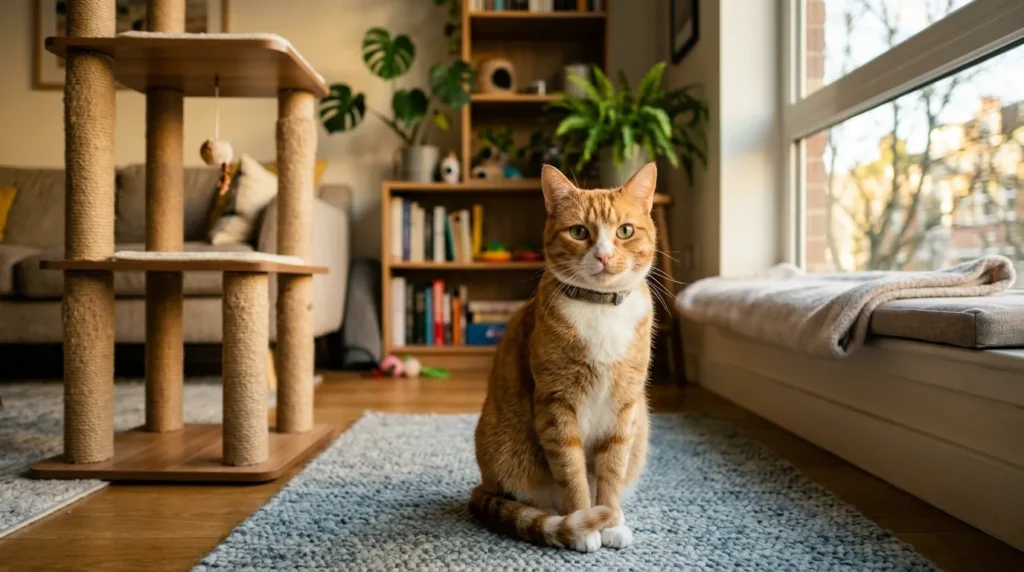
Indoor cats and outdoor cats develop different behavioral profiles shaped by their environments and neither is inherently superior. The indoor profile produces more consistent social bonding, lower chronic stress and better health monitoring conditions. The outdoor profile produces more varied environmental stimulation at the cost of sustained territorial stress and significantly higher disease and mortality risk.
For most owners in urban and suburban environments a well-enriched indoor cat produces a more behaviorally stable, healthier and more emotionally connected companion than a free-roaming outdoor cat. The responsibility that comes with that choice is real: the owner must actively provide what the outdoor environment provides passively. Daily interactive play, vertical space, window access and a consistent routine cover the majority of what that responsibility requires.
Frequently Asked Questions
Do indoor cats behave differently than outdoor cats?
Yes significantly. Indoor cats are more people-oriented and routine-dependent with stronger predatory play drive. Outdoor cats are more vigilant, more physically active at dawn and dusk and carry higher baseline stress from territorial management.
Are outdoor cats happier than indoor cats?
No evidence supports this when enrichment is controlled for. Outdoor cats carry higher chronic cortisol from territorial threats. Indoor cats in well-enriched environments show stronger contentment indicators including slow blinking and voluntary proximity.
Do indoor cats get more health problems than outdoor cats?
Indoor cats face obesity, dental disease and stress-related bladder conditions. Outdoor cats face feline immunodeficiency virus, feline leukemia, parasite loads, trauma and toxin exposure. Outdoor cat health problems are more numerous and more severe with a significantly shorter average lifespan as the result.
Can an indoor cat safely become an outdoor cat?
Some cats adapt to supervised outdoor access through catios or harness walks. Unsupervised roaming is not recommended for cats raised entirely indoors because they have no territorial framework for managing outdoor threats. A cat that flattens crouches or immediately seeks to return indoors when taken outside is communicating that outdoor access is not enrichment for that individual animal.
Why do indoor cats seem more attached to their owners?
Indoor cats invest their social bonding in the owner because the owner is the primary social variable in their environment. Outdoor cats distribute attachment across a broader territorial network. Neither indicates a stronger capacity for bonding. They reflect different social structures produced by different environments.
Conclusion
The indoor cat vs outdoor cat behavior differences are real, measurable and less concerning for indoor cat owners than most assume. Indoor cats are people-oriented, routine-loving and lower-stress. Outdoor cats are more independently active but carry health risks and chronic vigilance that most comparisons overlook. The most important takeaway is that indoor behavioral health depends on enrichment not on outdoor access. Start today with one five-minute wand play session before your cat’s next meal and build from there. For more on keeping the indoor setup strong check out how to make your home cat friendly from scratch.
Indoor and outdoor cats develop distinct behavioral profiles shaped by their environments. Indoor cats are more people-oriented, show stronger predatory play drive and carry lower chronic stress than outdoor cats navigating active territorial competition. Outdoor cats are more physically active at dawn and dusk but face higher baseline cortisol, greater disease exposure including feline immunodeficiency virus and feline leukemia and significantly shorter lifespans averaging 2 to 5 years compared to 12 to 18 years for enriched indoor cats. Indoor cat happiness is measured through slow blinking, voluntary proximity and relaxed resting posture not through outdoor access. Enrichment level determines behavioral health in both lifestyles.