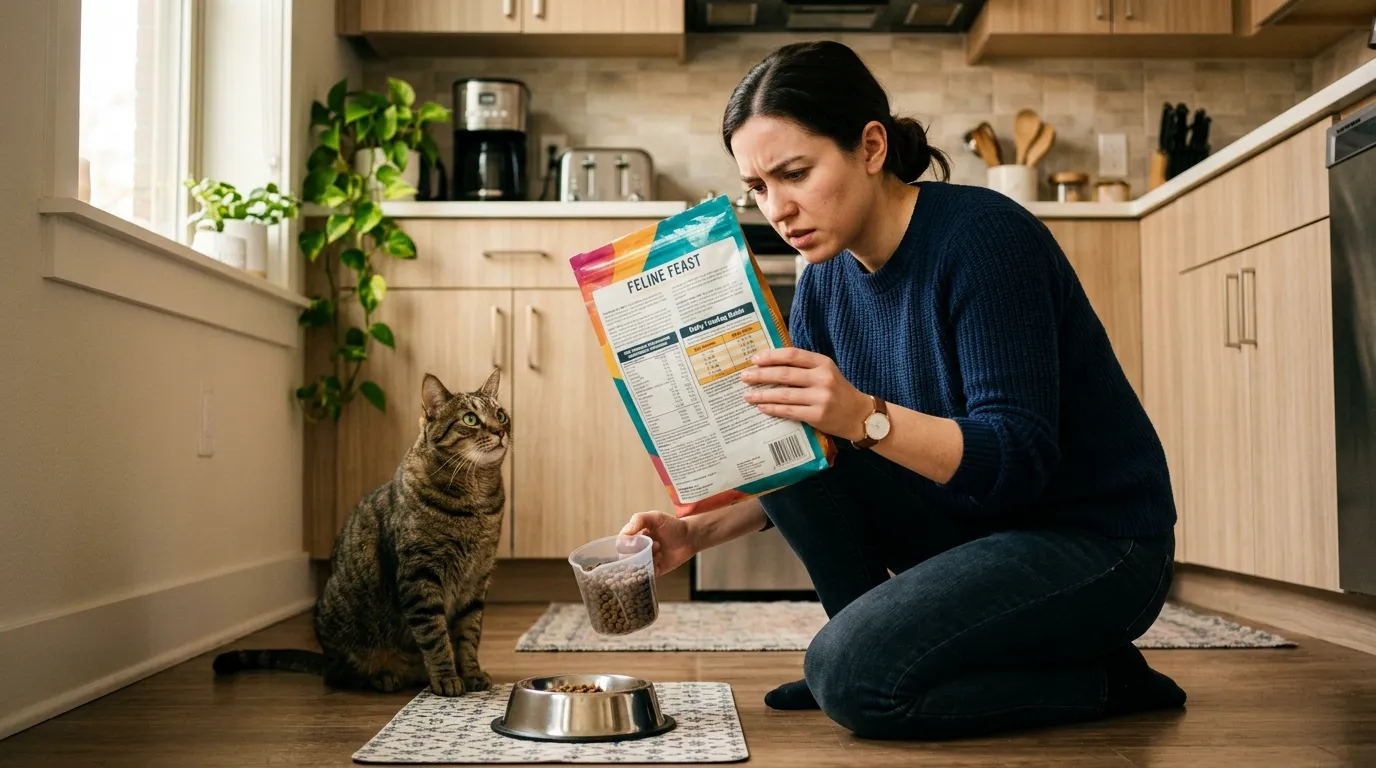
Every indoor cat owner has stood over that food bowl at some point and genuinely wondered if they are doing it right. The question of how much should indoor cat eat per day sounds simple but the answer depends on weight, age, whether the cat is spayed or neutered and what type of food you are using. I realized this when my cat started gaining weight despite me following the bag instructions exactly those guidelines are written for active outdoor cats and my apartment cat burned far fewer calories than that. This guide walks through exactly how to calculate the right daily amount for your specific cat, covering calories, portion sizes, wet versus dry food and how to adjust as your cat ages.
Most healthy adult indoor cats need 200 to 260 calories per day based on body weight. A 10-pound spayed or neutered indoor cat needs roughly 200 to 250 calories daily split across two or more meals. Calculate portions by dividing that calorie target by the calorie density on your food label not by the serving size printed on the bag.
How Much Should Indoor Cat Eat Per Day Based on Weight?
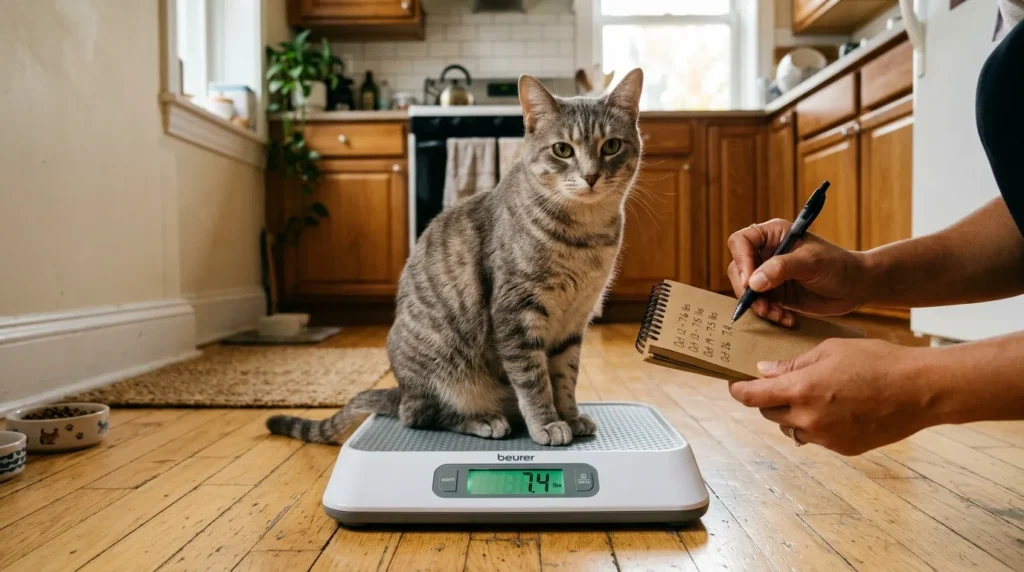
How much an indoor cat should eat per day starts with their weight because calorie needs scale directly with body size. Most veterinary guidelines use 20 to 30 calories per pound of ideal body weight as the starting range for indoor adult cats. An inactive or neutered indoor cat sits at the lower end of that range.
Use this chart as your starting point before calculating specific portions from your food label:
| Cat Weight (lbs) | Spayed or Neutered Indoor Cat (kcal/day) | Active Indoor Cat (kcal/day) | Weight Loss Target (kcal/day) |
| 5 lbs | 125 to 160 | 150 to 200 | 100 to 125 |
| 7 lbs | 175 to 220 | 210 to 270 | 140 to 175 |
| 10 lbs | 200 to 260 | 250 to 320 | 160 to 200 |
| 12 lbs | 240 to 300 | 290 to 370 | 190 to 240 |
| 15 lbs | 290 to 380 | 350 to 450 | 230 to 290 |
Always calculate based on your cat’s ideal body weight rather than their current weight if they are already overweight. A 14-pound cat with an ideal weight of 10 pounds should be fed for a 10-pound cat not a 14-pound one.
Insight Bag feeding guides are usually calibrated for an active cat at the high end of the weight range. Your indoor apartment cat is almost certainly more sedentary than that. Start at the lower end of the calorie range and monitor weight monthly. You can always adjust up if your cat loses too much.
Why Indoor Cats Need Fewer Calories Than Outdoor Cats?
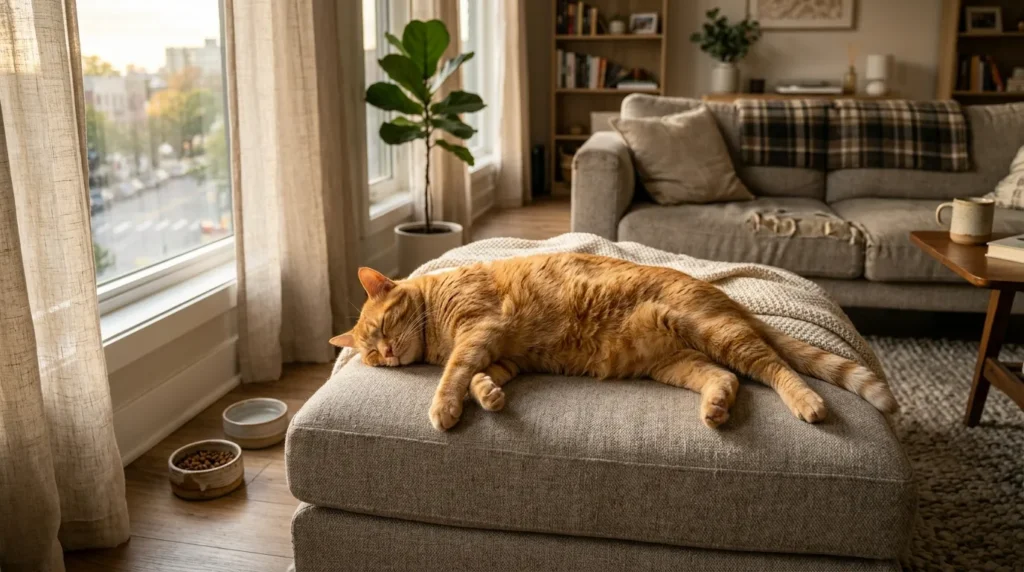
Indoor cats spend a large portion of their day sleeping. According to the American Association of Feline Practitioners, cats sleep an average of 12 to 16 hours daily and indoor cats at the lower end of their natural activity range burn significantly fewer calories than outdoor cats patrolling territory, hunting and moving freely across open space.
The practical effect of this is that indoor calorie requirements sit roughly 20 to 30 percent lower than equivalent-weight outdoor cats. Spaying and neutering lowers the metabolic rate further by reducing hormone-driven activity and restlessness. A neutered indoor cat may need as few as 20 calories per pound of body weight per day to maintain a healthy weight rather than the 30 or more calories that active outdoor cats require.
This lower calorie need is the core reason why following the bag instructions causes so many indoor cats to gain weight. Those guidelines are typically written for an average cat across all lifestyles and they almost always overshoot what a sedentary apartment cat actually needs. The whole picture of how daily routines and activity levels connect to feeding amounts is covered in this guide on how to feed an indoor cat properly it goes into the specific adjustments that apartment owners need to make that generic bag guidance skips entirely.
Wet Food vs Dry Food: How Portion Size Changes Completely?
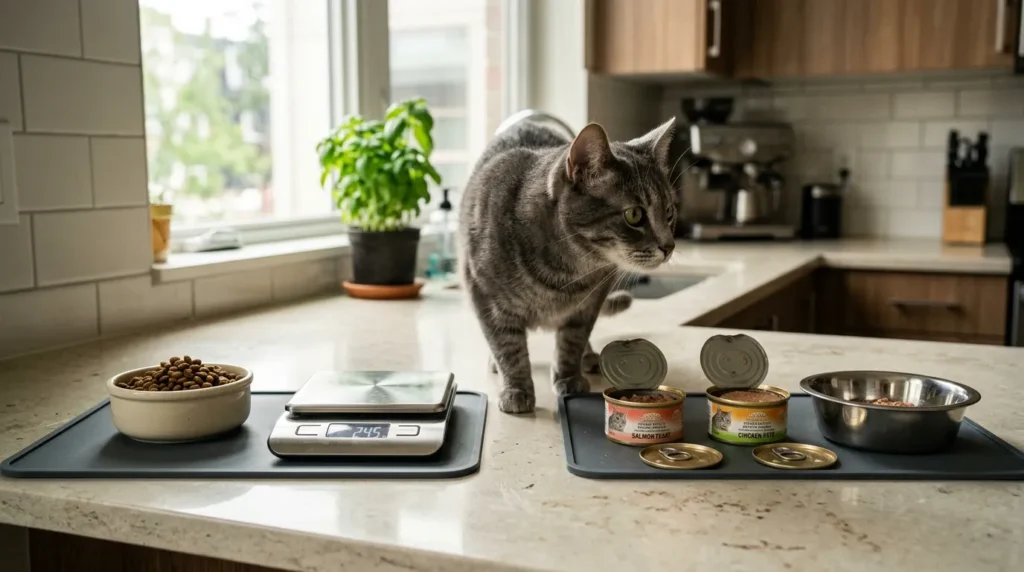
The type of food you use changes the physical portion size dramatically even when the calorie total stays the same. Dry food is calorie-dense a standard cup of dry kibble typically contains 300 to 500 calories depending on the brand. Wet food is much lower in calorie density because it contains 70 to 80 percent moisture a 3-ounce can often has only 70 to 100 calories.
Here is what that looks like in practice for a 10-pound indoor cat needing 220 calories per day:
| Food Type | Calorie Density (typical) | Daily Portion for 220 kcal |
| Dry kibble (standard) | 350 kcal per cup | About two-thirds of a cup |
| Dry kibble (calorie-dense) | 500 kcal per cup | Just under half a cup |
| Wet food (3 oz can) | 75 kcal per can | About 3 cans |
| Wet food (5.5 oz can) | 150 kcal per can | About 1.5 cans |
| Mixed feeding (50/50) | Varies | Half the dry portion plus 1 to 2 cans wet |
Never measure portions by cup or can count alone. Always check the calorie density on your specific food label and divide the daily calorie target by that number to get the correct portion. Two different dry foods can have a 200 calorie difference per cup despite similar packaging.
Insight Wet food is worth adding to every indoor cat’s diet for one practical reason beyond nutrition: it slows them down. A cat that eats wet food tends to feel fuller longer because the moisture adds volume without extra calories. For cats that inhale dry food and then beg all day, switching even one meal to wet changes the whole dynamic.
Feeding Frequency: How Many Meals Per Day Indoor Cats Actually Need?
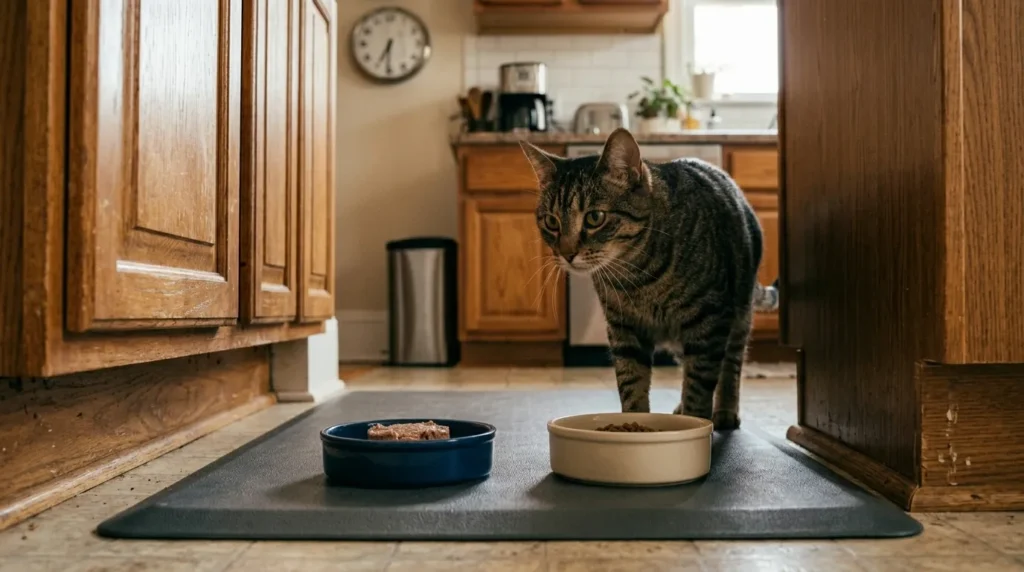
Indoor cats do best with two to three measured meals per day rather than free-feeding from a bowl that stays full. Free-feeding dry food is the single fastest path to an overweight indoor cat because dry food is calorie-dense and most cats will eat out of boredom as much as out of hunger when food is always available.
Split your cat’s daily calorie target across those meals evenly. For a cat needing 220 calories per day fed twice daily, that is 110 calories per meal. For three meals it is approximately 73 calories per meal. This matters because portion sizes look alarmingly small when you see them for the first time especially with dry food and knowing the math behind them makes it easier to stay consistent rather than second-guessing and overfeeding.
The hunt-eat-groom-sleep cycle that wild cats follow naturally is something indoor apartment cats benefit from simulating. Play actively before each meal for 10 to 15 minutes then feed immediately after. Cats that have physically engaged before eating are less likely to inhale their food and immediately demand more. This routine also significantly reduces nighttime hunger behavior. The broader picture of how feeding structure connects to apartment cat behavior and wellbeing is something this guide on indoor cat care covers well particularly the section on daily structure for cats in smaller spaces.
How Calorie Needs Change From Kitten to Senior Cat?
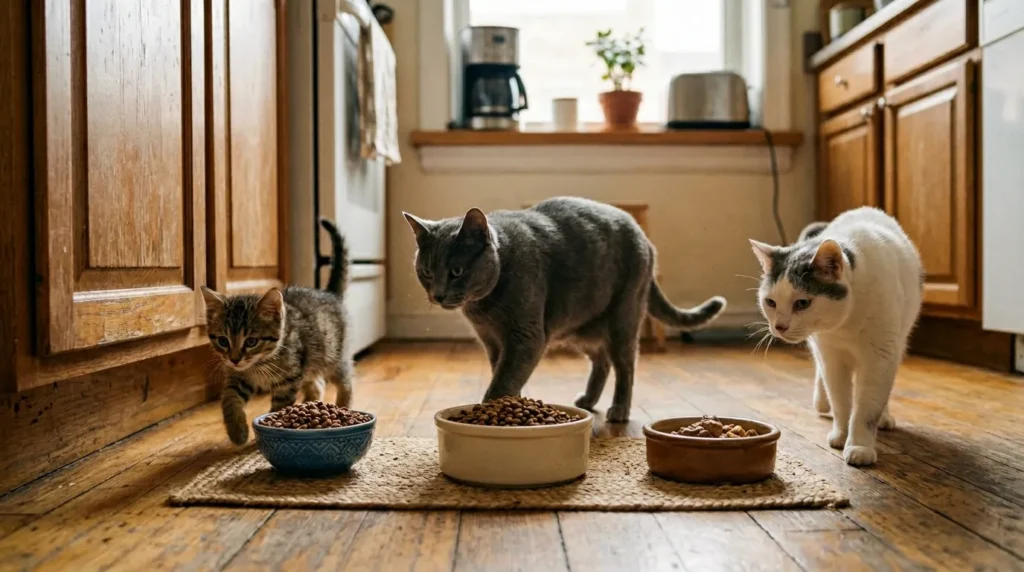
How much an indoor cat should eat per day changes significantly across life stages because metabolic needs shift dramatically from kittenhood through senior years.
Kittens need the most calories relative to their size. A growing kitten needs roughly 50 to 65 calories per pound of body weight per day more than double what an adult indoor cat requires and should eat three to four times daily to support growth without overwhelming a small stomach. Transition to adult feeding portions around 10 to 12 months of age.
Adult indoor cats settle into the 200 to 260 calorie daily range for most of their mature years. Senior cats aged 10 and older often need a slight recalculation because some lose muscle mass and may need more protein-dense food to maintain healthy body condition even if their overall calorie count stays similar or drops slightly. Watch for unexplained weight loss in senior cats it often signals something worth investigating rather than a normal aging change.
| Life Stage | Age Range | Approx. Calories Per Pound Per Day | Meals Per Day |
| Kitten | Under 12 months | 50 to 65 kcal/lb | 3 to 4 |
| Young Adult | 1 to 6 years | 25 to 30 kcal/lb | 2 to 3 |
| Adult Neutered Indoor | 1 to 10 years | 20 to 25 kcal/lb | 2 to 3 |
| Senior | 10 years and older | 18 to 25 kcal/lb (monitor closely) | 2 to 4 |
How to Read Your Cat’s Food Label and Calculate the Right Portion?
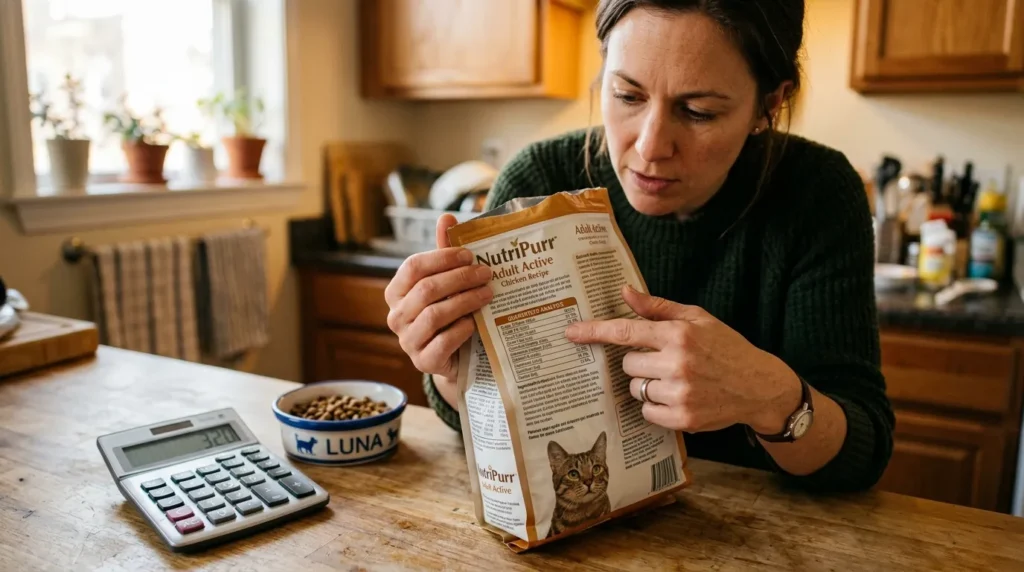
Reading a cat food label for the calorie information takes about thirty seconds once you know where to look. Find the section labeled “Caloric Content” or “Metabolizable Energy” it will list calories per cup (for dry food) or per can or per 100 grams (for wet food).
Once you have that number, the calculation is straightforward. Divide your cat’s daily calorie target by the food’s calorie density to get the daily portion. If your 10-pound indoor cat needs 220 calories per day and your dry food has 380 calories per cup, your daily portion is 220 divided by 380 which equals 0.58 cups just under two-thirds of a cup split across two or three meals.
Labels are starting points and individual cats vary by up to 20 percent in either direction based on metabolism, activity level and breed. Weigh your cat every three to four weeks for the first few months of a new feeding routine and adjust the daily portion up or down by 10 percent at a time based on what the scale shows.
Insight Most owners are surprised by how little food actually covers a cat’s daily needs. Half a cup of dry food looks like nothing. But a lean 10-pound indoor cat at maintenance genuinely needs very little and consistently feeding even 20 percent too much per day adds up to real weight gain over months. Trust the math more than your instinct to add a little more.
Common Feeding Mistakes That Lead to Overweight Indoor Cats
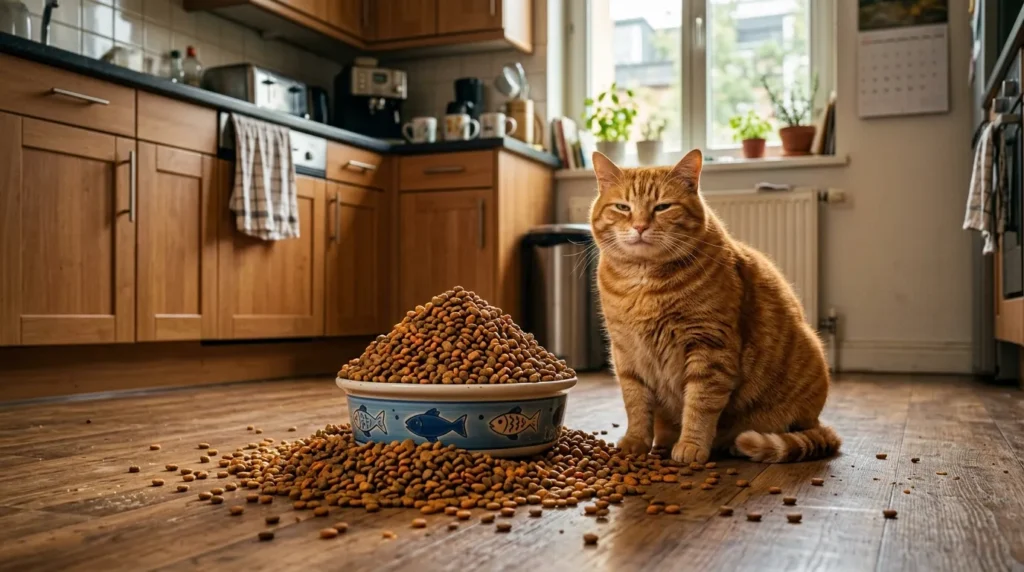
The most common feeding mistake for indoor cat owners is following the bag instructions without adjusting for lifestyle. Bag guidelines are written for an average active cat and they consistently recommend 20 to 40 percent more food than a sedentary indoor cat actually needs. The result is gradual weight gain that happens so slowly most owners do not notice until the cat is significantly overweight.
The second mistake is not measuring at all. Eyeballing a portion consistently leads to overfeeding because the visual calibration drifts over time. A proper kitchen scale or a standardized measuring cup used every single time is the only way to keep portions accurate.
The third mistake is giving treats without counting them toward the daily calorie total. Treats should account for no more than 10 percent of a cat’s daily calorie intake. For a cat on 220 calories per day that is 22 calories maximum from treats which is about three to five small commercial treats depending on the brand. Treats given freely throughout the day easily push a cat 30 to 50 percent over their calorie target without the owner realizing it.
When Your Cat’s Appetite Changes and When to See a Vet?
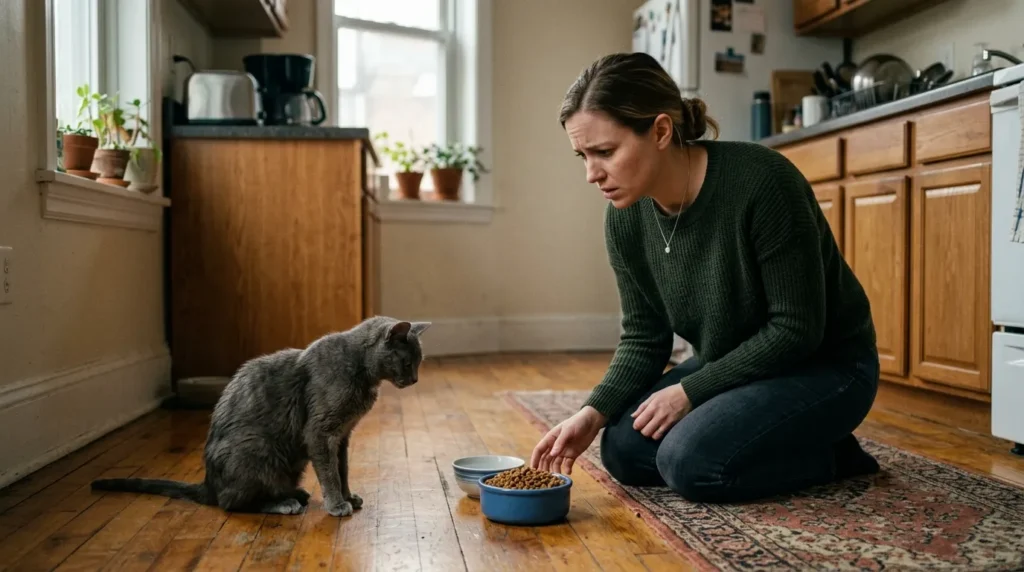
Normal variation in appetite is one thing. A cat that eats slightly less on a hot day or skips a meal after an exciting play session is not concerning. What warrants attention is a pattern a cat that consistently eats less than usual for more than 48 hours or loses noticeable weight over a few weeks is telling you something worth investigating.
Sudden unexplained weight loss in a cat that is eating normally is often the first sign of hyperthyroidism in older cats or diabetes in cats of any age. Both conditions change how efficiently calories are used and can cause dramatic body composition changes despite adequate food intake. Sudden weight gain with no change in feeding habits sometimes signals hypothyroidism or fluid retention.
Appetite loss lasting more than 48 hours in an adult cat or more than 24 hours in a kitten needs a vet visit. Cats that stop eating are at risk of hepatic lipidosis within 24 to 72 hours and that timeline is faster than most owners expect.
This article is for informational purposes only. Always consult your vet if you notice sudden changes in your cat’s appetite, weight or eating patterns.
Frequently Asked Questions About How Much Indoor Cats Should Eat
How many times a day should I feed my indoor cat?
Two to three measured meals per day works best for most adult indoor cats. Two meals prevents long gaps that lead to hunger-driven behavior. Three meals is better for cats prone to vomiting from an empty stomach or cats that beg persistently between two-meal schedules. Avoid free-feeding dry food it almost always leads to overeating in indoor cats with limited activity.
Is my indoor cat eating too much if they always beg for food?
Not necessarily. Indoor cats often beg out of boredom rather than genuine hunger. Play with your cat for 10 minutes before feeding and see whether the begging reduces if it does, the behavior is boredom-driven. If your cat is at a healthy body weight and begs constantly, the solution is usually enrichment and structured feeding rather than more food.
How much wet food should an indoor cat eat per day?
A 10-pound adult indoor cat on wet food alone needs roughly 3 to 4 small cans (3 ounces each) or 1.5 to 2 standard cans (5.5 ounces each) daily depending on the calorie density of your specific food. Always check the label. Wet food portions look much larger than dry food portions for the same calorie total because of the high moisture content.
Should I feed my cat less as they get older?
Not automatically. Senior cats aged 10 and older sometimes need slightly fewer calories early in old age but many older cats actually need more calories after age 12 or 13 to maintain muscle mass as digestion becomes less efficient. Watch the body condition rather than age a senior cat losing weight despite eating normal amounts needs a vet visit, not a portion cut.
Why does my cat act hungry right after eating a full meal?
This is normal for many cats and usually reflects either the pace of eating or the food’s satiety profile rather than actual calorie need. Cats that eat too fast feel hunger signals before digestion registers the meal. Slow feeders or puzzle feeders extend meal time and reduce this behavior significantly. If your cat genuinely seems hungry all the time and is losing weight, that warrants a vet check.
Your Cat’s Daily Food Amount Is Simpler Than It Looks
How much an indoor cat should eat per day comes down to knowing three things: the cat’s ideal body weight, the calorie density on the food label and how many meals you want to split across the day. Calculate from the calorie target rather than the bag instructions and weigh your cat every month to confirm the math is working. Start with 200 to 220 calories daily for a 10-pound neutered indoor cat and adjust from there based on what the scale actually shows.
Most healthy adult indoor cats need 200 to 260 calories per day based on ideal body weight. Spayed or neutered indoor cats require approximately 20 calories per pound of ideal body weight daily because of lower activity levels. Portions should be calculated by dividing the daily calorie target by the calorie density on the food label rather than following bag serving guidelines. Indoor cats do best with two to three measured meals daily rather than free-feeding. Kittens need 50 to 65 calories per pound per day. Treats should account for no more than 10 percent of total daily calories. Weight should be monitored monthly and portions adjusted by 10 percent increments.