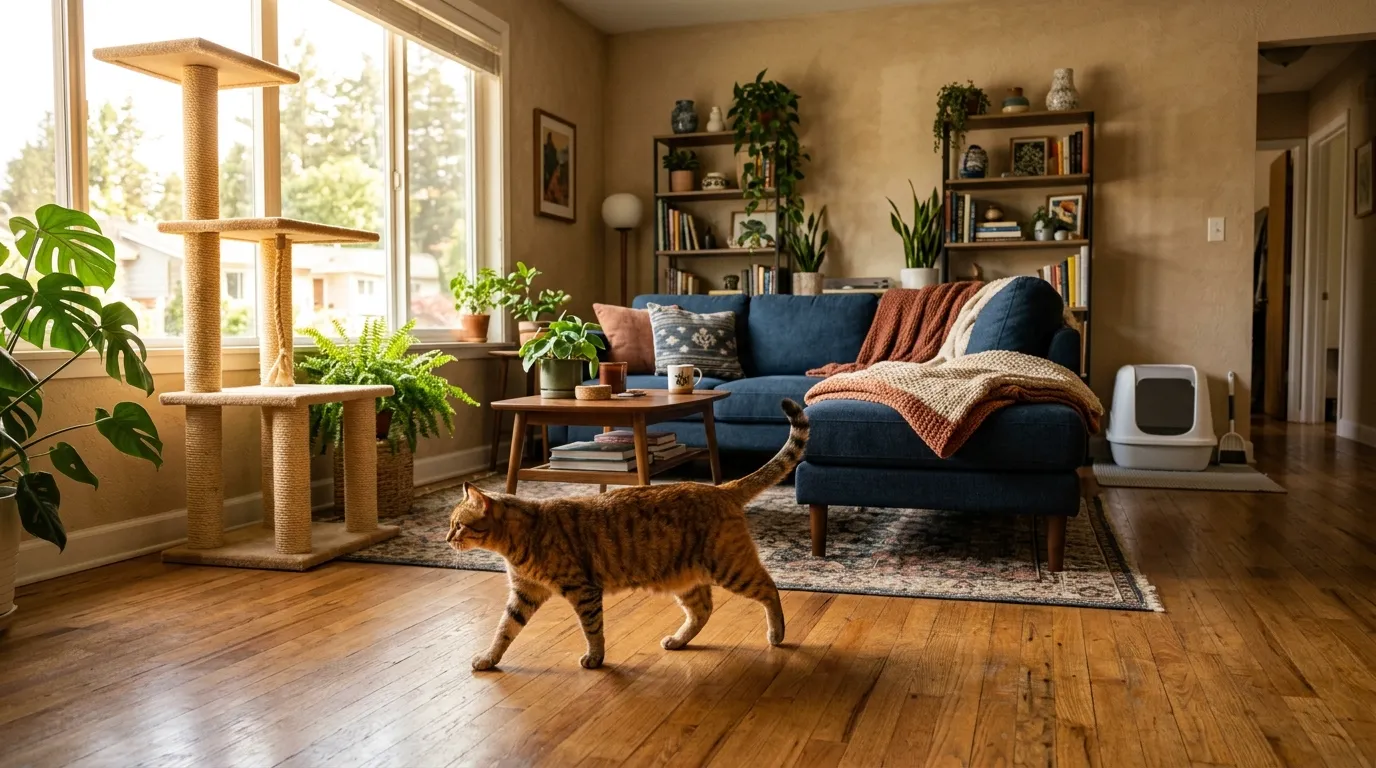
Most cat owners set up a home for themselves and then try to fit the cat in afterward. I did exactly that when I first brought my cat home. She spent the first two weeks hiding behind the couch and I could not figure out why until I realized the apartment gave her nowhere safe to go, nothing to climb and nothing to watch. Knowing how to make home cat friendly from the start changes the entire dynamic. This guide covers the seven changes that matter most for apartment cats, why each one works and how to implement them without turning your living room into a pet store.
To make your home cat friendly, focus on five core areas: vertical space for climbing and safety, a window perch with an outdoor view, a properly sized and placed litter box, a consistent feeding station and rotating toys for daily enrichment. These changes address your cat’s territorial, physical and mental needs. Most cost under $50 and take under an hour to set up.
How to Make Home Cat Friendly Starting With Vertical Space?
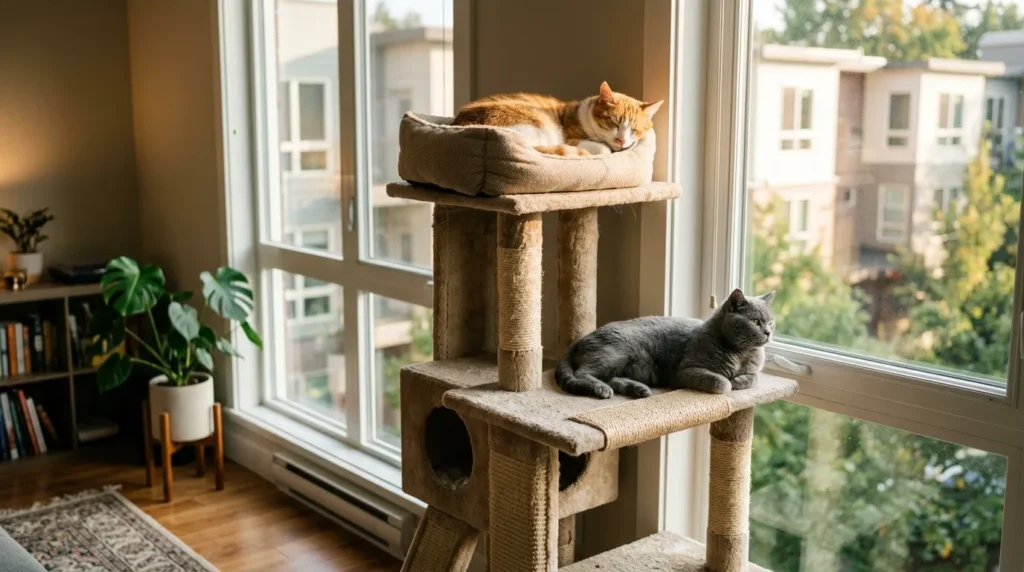
The single most impactful change you can make to a cat-unfriendly home is adding height. Cats are not floor animals by nature. Height gives them safety, territorial ownership and a place to decompress when they feel stressed or overstimulated. A cat with no vertical options is a cat with nowhere to truly relax.
A tall cat tree placed near a window is the starting point. It does not need to be expensive or elaborate. It needs to be stable, tall enough for your cat to sit above furniture height and positioned where your cat already spends time. A tree that wobbles even slightly will be abandoned inside a week.
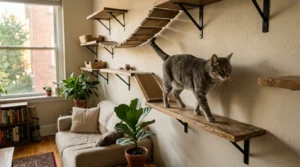 Wall-mounted cat shelves are the best solution for small apartments where floor space is limited. A staggered shelf route from low to high gives your cat a path to travel at height across the room. Each shelf needs a non-slip surface. Carpet tape or sisal over smooth wood prevents the sliding that makes cats refuse to use them after the first try.
In multi-cat households, vertical space is non-negotiable. Cats that cannot escape each other upward develop low-grade tension that never fully resolves. Give every cat a clear route to height and a high-value perch they can call their own and a lot of the ambient friction in a shared space quietly disappears.
The vertical space mistake I see constantly: one small cat tree shoved in a corner the cat never visits. Location is everything. Put the tree where your cat already hangs out, not where it fits best aesthetically. If your cat lives on the couch, the tree goes next to the couch. That is the only placement rule that matters.
Step 2: Set Up a Window Perch With Something Worth Watching
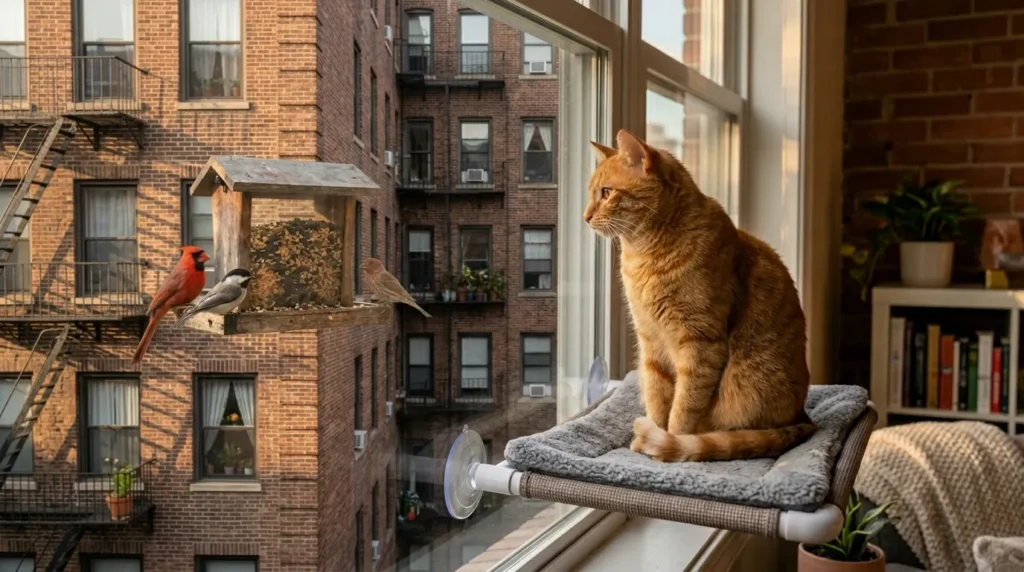
A window perch gives your cat access to live, moving, unpredictable stimulation without requiring you to be present. This matters enormously for cats left alone during work hours. Environmental enrichment through window access directly reduces the restless energy that builds into evening behavior problems when it has nowhere to go.
The perch itself is simple: a suction-cup shelf, a padded window seat or a cat tree positioned at sill height. The more important factor is what is outside the window. If there is nothing interesting to look at, the perch gets ignored. Add a bird feeder to a balcony railing or position a hanging feeder against the glass and your cat has hours of daily stimulation that costs nothing once it is set up.
Place the perch at a window your cat already gravitates toward. South-facing windows get the most sun and tend to be the most popular. If your windows only face a blank wall, even watching people or traffic gives a cat something to process. Movement is what matters, not scenery.
Step 3: Place the Litter Box Where Your Cat Will Actually Use It
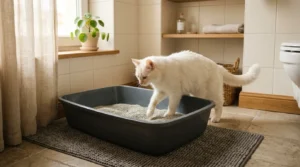
Litter box placement is one of the most overlooked parts of making a home cat friendly. The box needs to be in a quiet low-traffic spot where your cat will not be startled mid-use. Next to the washing machine, in a busy hallway or near the front door are all locations that create litter avoidance because cats associate sudden noise or movement with danger while they are in a vulnerable position.
One box per cat plus one extra is the baseline. One cat means two boxes minimum. Put them in different locations rather than side by side. Two boxes next to each other count as one box in a cat’s mind because any threat that approaches one also threatens the other.
Size is the issue most owners get wrong. The box should be at least one and a half times the length of your cat from nose to tail. Most commercial boxes sold in pet stores fall short of this. A large plastic storage tote with one side cut low makes a better litter box than most products marketed as one and costs a fraction of the price.
Step 4: Create a Dedicated Scratching Zone Before Your Cat Creates One
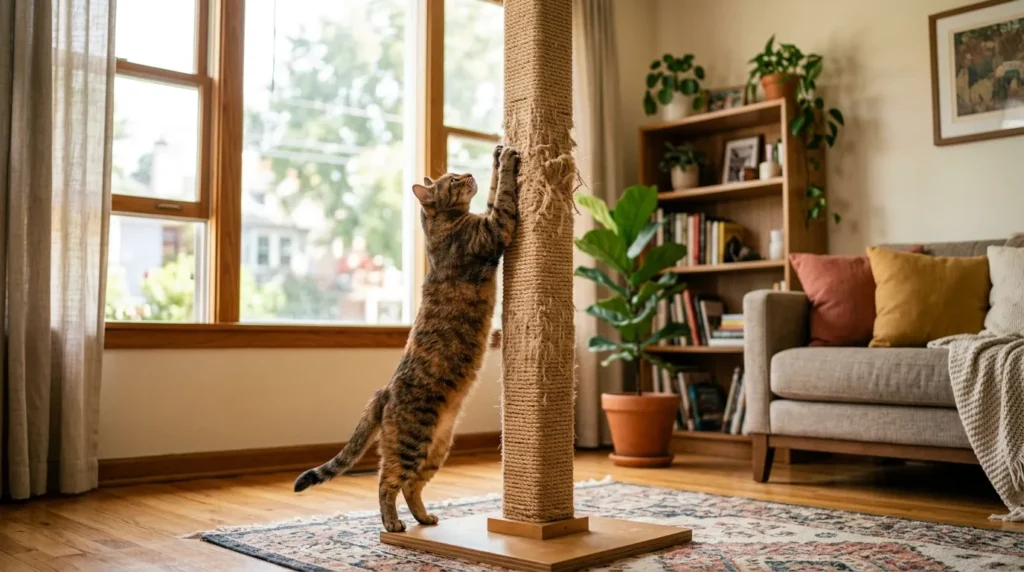
Scratching is not destructive behavior. It is a biological necessity. Cats scratch to shed claw sheaths, stretch muscles and deposit scent marking from glands in their paws. If you do not give your cat a designated place to scratch, they will choose one themselves. It will be your couch.
The post needs to be tall enough for your cat to fully stretch upright while scratching. Most short carpet-covered posts sold at pet stores are too small for adult cats and get ignored because they do not allow a full stretch. Sisal rope or sisal fabric works better than carpet for most cats because the texture provides satisfying resistance.
Location matters as much as material. Put the post next to the furniture your cat is already targeting. Cats scratch high-value areas in their territory, which means the couch and the armchair are prime targets. Placing the post nearby redirects the behavior without requiring the cat to change its habits dramatically. Once the post habit is established you can gradually move it if needed.
Add a horizontal scratcher too. Some cats prefer scratching flat surfaces over vertical ones and will use the carpet or a doormat instead of any post you provide. A flat cardboard scratcher costs under $10 and lasts months. Put one near the couch and one near wherever your cat sleeps. Two formats cover almost every cat’s preference.
Step 5: Build a Safe and Stimulating Play Zone for Daily Enrichment
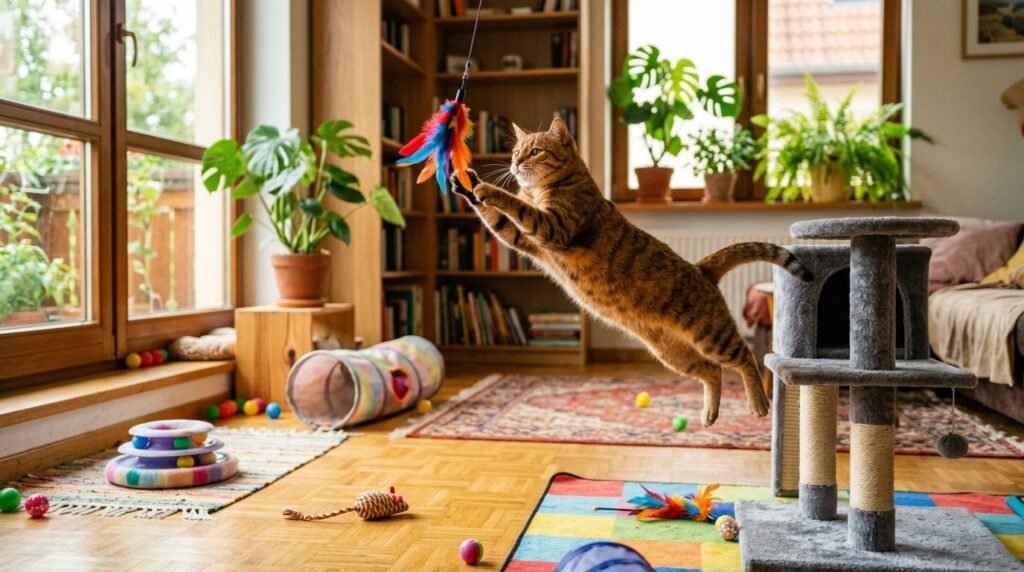
Interactive play is what separates a cat-friendly home from a cat-tolerated one. A collection of toys rotated regularly gives your cat variety that prevents the boredom of seeing the same object every day. Cats stop engaging with toys that never move or change because their brains are wired to track novelty. Put three or four toys out at a time and swap them weekly.
According to the ASPCA, cats need daily mental and physical stimulation to maintain healthy behavior patterns. Puzzle feeders satisfy the predatory instinct at mealtime by making cats work for food the way hunting would require. One puzzle feeder replacing the standard food bowl adds ten minutes of genuine mental engagement to every meal with zero extra effort from you.
 The play zone does not need to be a separate room. It is simply the area where toys live, where the cat tree sits and where play sessions happen consistently. Keeping it consistent helps your cat understand where active behavior is expected and welcomed, which also helps them learn where it is not.
Hiding spots matter as much as active play areas. Every cat needs at least one enclosed space where they can feel invisible when they need to reset. A cardboard box, an enclosed cat bed on a shelf or a covered cave on the cat tree all work. The option to hide is not antisocial behavior. It is how cats manage their stress levels and regulate their own arousal.
Step 6: Remove or Secure Every Hidden Hazard Before Your Cat Finds It
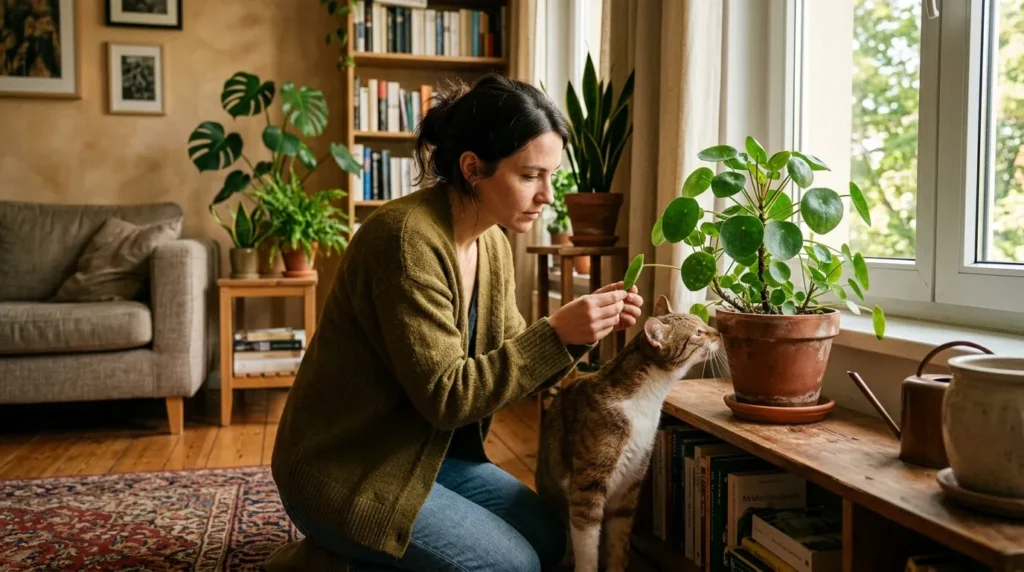
A cat-friendly home is a physically safe home and that requires a deliberate walk-through before your cat has access to every room. Toxic plants are the most common hidden hazard. Lilies are fatal to cats even in small amounts and they are found in most florist arrangements. Peace lilies, pothos and philodendrons are also toxic and extremely common in apartments. Check every plant you own before assuming it is safe.
Exposed electrical cords are the second most common hazard. Kittens especially will chew through them. Cable management channels, cord covers or simply running cables behind furniture removes the risk without requiring any renovation. Check under desks and behind entertainment units because those are where cats investigate first when they are new to a space.
Secure any cabinet that contains cleaning products, medications or small objects a cat could swallow. Cats learn to open lever-style cabinet handles faster than most owners expect. Childproof latches work and they cost almost nothing. Check the washing machine and dryer before every use because cats will sleep inside them given the opportunity.
Step 7: Set Up a Consistent Feeding Station in the Right Location
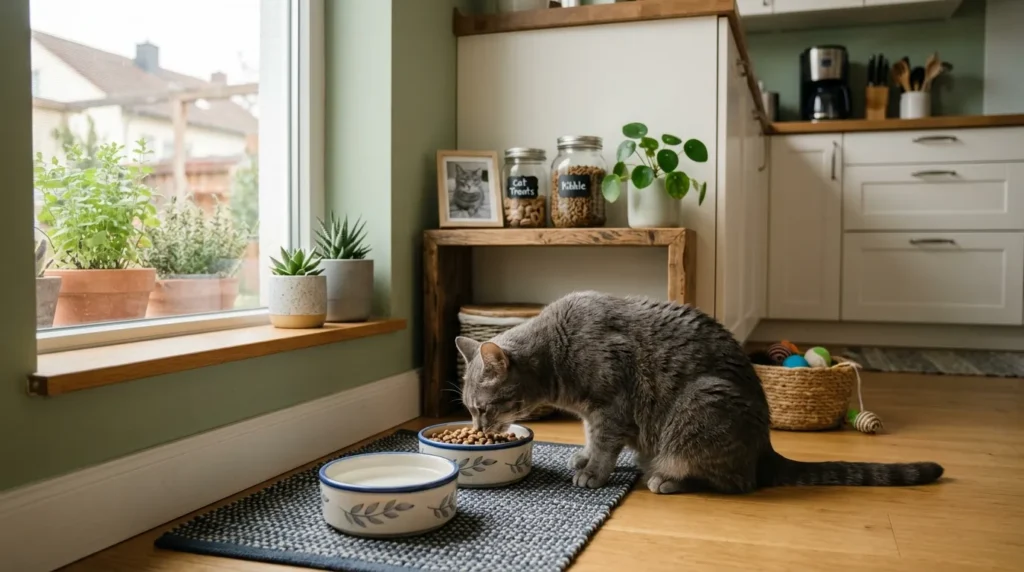
A feeding station is simply a fixed, consistent location where food and water are always served. Cats are creatures of habit and a stable feeding location reduces the ambient anxiety that comes from an unpredictable environment. Place the station away from the litter box. The distance most owners use, roughly the same room or just adjacent, is too close. Cats instinctively avoid eating near their waste.
Place the water bowl separately from the food bowl. This surprises most people but cats evolved avoiding water sources near prey because carcasses contaminate water. A bowl placed on the other side of the kitchen or in a different room entirely increases how much your cat drinks without any other changes.
Elevated feeding stations that raise the bowl off the floor work well for cats with joint issues or older cats who strain to bend down. They also keep the area cleaner because cats tend to eat more neatly when the bowl is at a comfortable height. It is a small change that makes a real quality-of-life difference for the right cat.
If your cat pushes food out of the bowl onto the floor before eating it, the bowl is too deep and the whiskers are touching the sides. Whisker fatigue is a real thing and it makes some cats reluctant to eat from standard pet bowls. Switch to a wide shallow dish or a flat plate and the floor-eating behavior usually stops immediately.
The Mistakes That Make a Home Less Cat Friendly Over Time
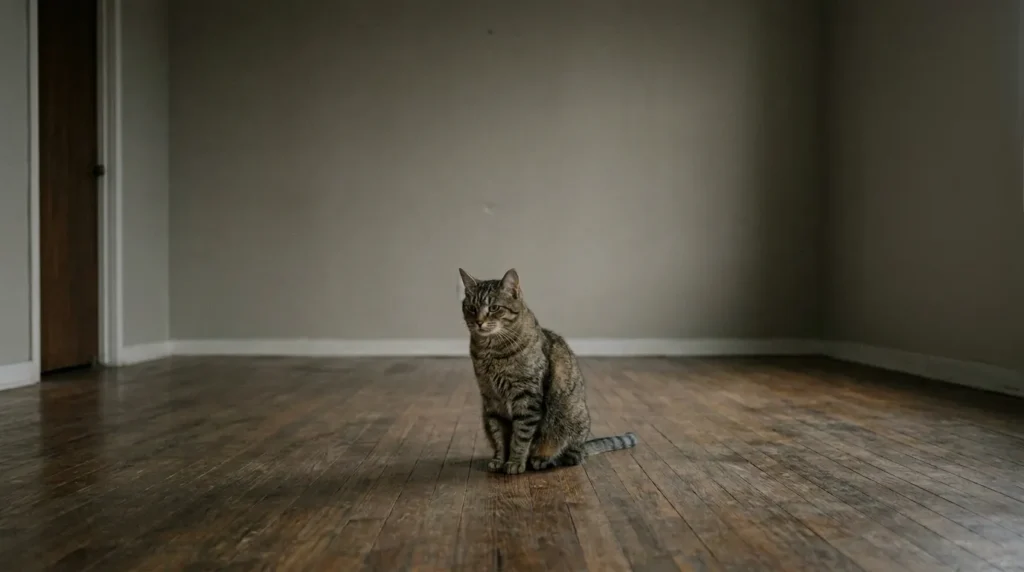
The most common mistake is setting up the home once and never updating it. Cats explore intensely when they are new to a space and then settle into fixed patterns. A toy that was exciting at three months gets completely ignored at eighteen months unless it is rotated out and brought back. Treat the setup as an ongoing system, not a one-time project.
The second mistake is prioritizing aesthetics over function. A small decorative cat tree that looks good in a corner but wobbles when the cat jumps on it is useless. A litter box hidden inside a piece of furniture that restricts entry or limits the cat’s ability to turn around will get avoided. When something is not working, the cat will tell you by not using it. Trust that signal over how something looks in your Instagram grid.
The third mistake is adding too much too fast. Cats need time to adjust to new objects in their environment. A new cat tree, a new scratcher and a rearranged room all at once is genuinely stressful for a cat that relies on familiar territorial markers. Add one change at a time and give your cat a few days to investigate before introducing the next.
When Your Cat’s Behavior Is Telling You the Setup Is Wrong?
A cat that is chronically destructive, hiding constantly or eliminating outside the litter box is not being difficult. The environment is not meeting its needs and the behavior is the feedback. Most behavior problems in indoor cats trace directly back to a setup problem, not a personality problem.
Sudden changes in behavior after a period of stability are different. A cat that was using the litter box reliably and suddenly stops, a cat that was eating normally and abruptly refuses food or a cat that becomes aggressive without a clear trigger: those are signals to see the vet before adjusting the environment further. Physical conditions including urinary infections, dental pain and thyroid issues all produce behavioral symptoms that look like attitude problems until they are diagnosed.
Check the environment first for gradual behavioral changes. Call the vet first for sudden ones. That distinction covers most situations correctly.
This article is for informational purposes only. Always consult your vet if you have concerns about your cat’s health.
Frequently Asked Questions About Making Your Home Cat Friendly
How do I make my home cat friendly on a budget?
Start with the three highest-impact changes: a tall stable scratching post near your couch, a window perch or cleared windowsill with a bird feeder outside and a larger litter box placed in a quiet location. A storage tote makes a better litter box than most pet store options and costs under $10. Wall-mounted shelves from a hardware store cost less than half of branded cat furniture and work just as well.
What do cats need in a home to be happy?
Cats need vertical climbing space, a window with movement to watch, a clean and properly sized litter box in a quiet spot, daily interactive play and at least one enclosed hiding spot. These five things cover the core territorial and behavioral needs of most indoor cats. Everything beyond this is enrichment that improves quality of life but is not essential for baseline happiness.
Is it okay to keep a cat in a small apartment?
Yes. Cats adapt well to small spaces when the vertical dimension is used effectively. A small apartment with wall shelves, a window perch and a consistent daily routine gives a cat a richer environment than a large apartment with nothing to climb and nothing to do. Square footage matters far less than how thoughtfully the space is set up.
How do I cat-proof my home before bringing a new cat home?
Walk through every room from floor level and look for exposed cords, toxic plants, small objects that can be swallowed and unsecured cabinets. Remove or secure all of these before the cat arrives. Check every plant against a verified toxic plant list from the ASPCA before assuming it is safe. Secure the washing machine, dryer and any tight spaces a cat could get stuck inside. If your cat ingests anything potentially toxic, contact your vet or the ASPCA Animal Poison Control Center immediately.
What is the best room setup for an indoor cat?
The best room for an indoor cat has a cat tree or shelves at multiple heights, a window perch with an interesting view, a flat or vertical scratcher nearby and a bed or enclosed hiding spot at height. Keep the feeding station and water bowl away from each other and away from the litter box. Rotate toys in this space weekly. That setup in a single room covers every core need an indoor cat has.
Conclusion
Making your home cat friendly comes down to three things done well: vertical space your cat can actually use, a clean and correctly placed litter box and a window with something worth watching. Start today with the change that costs the least and delivers the most. Move the litter box to a quiet spot if it is currently in a noisy or high-traffic area. That one adjustment resolves more behavioral problems faster than any other single change. For ideas on keeping your cat engaged daily once the setup is right check out indoor cat enrichment ideas for apartments.
Making a home cat friendly requires vertical climbing space such as a cat tree or wall shelves, a window perch with outdoor movement to watch, a properly sized litter box placed in a quiet low-traffic location and a dedicated scratching post near furniture the cat already uses. Cats need at least one enclosed hiding spot and a stable feeding station kept away from the litter box. Toxic plants including lilies and pothos must be removed before a cat has access. These changes address a cat’s territorial physical and mental needs in any size apartment.