
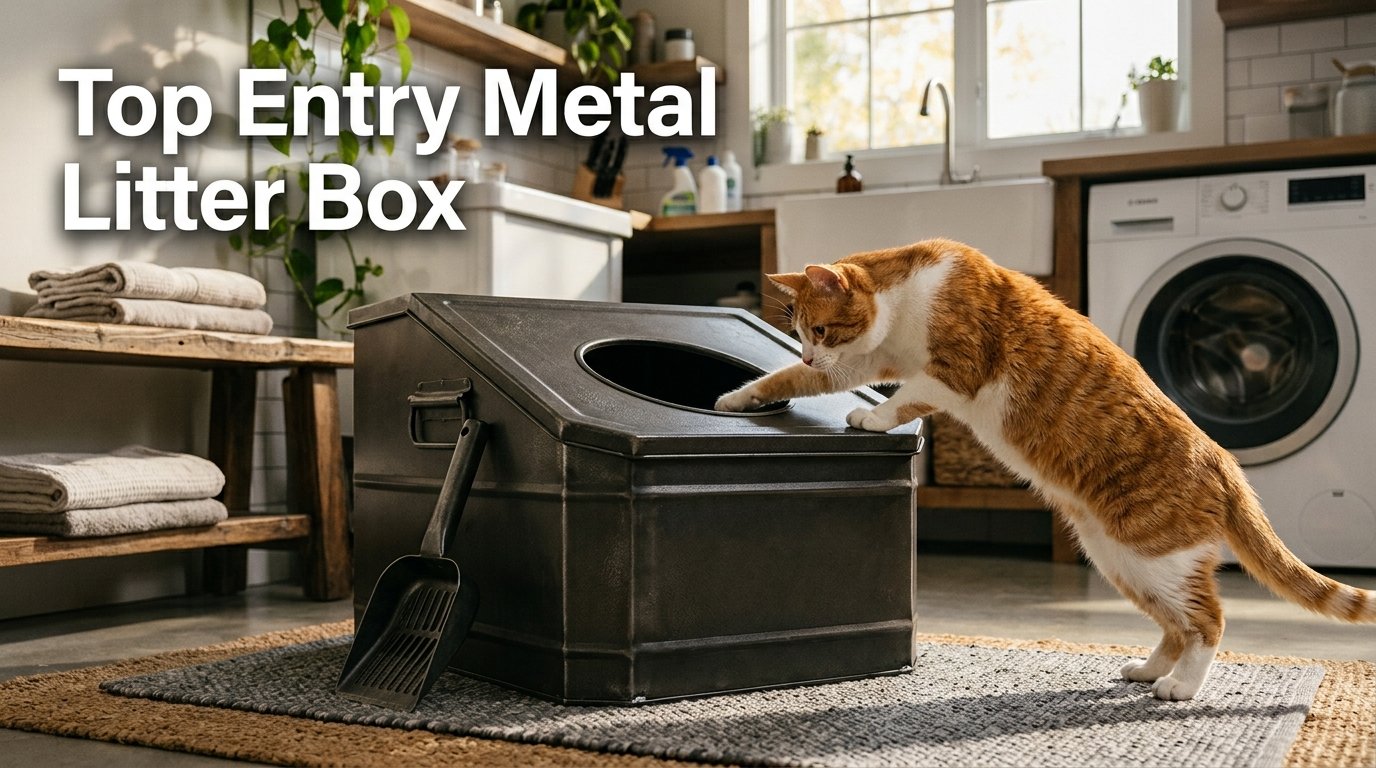
Plastic litter pans fail in a specific way. Claws cut fine grooves into the surface, urine salts settle into those grooves, and after six or eight months the box smells even on the day you change it. Stainless steel doesn’t scratch the same way, and it doesn’t absorb anything, so a scrub actually resets it.
A top entry metal litter box stacks a second fix on top of that. Your cat climbs out through the lid, and most of the granules stuck to its paws drop back into the pan instead of your hallway. The catch is fit. A 15-inch wall is a wall your cat has to clear twice a day, every day, for years.
I compared six stainless steel boxes on the numbers that decide whether this design works for you: interior length, wall height, litter capacity, entry style, and how each one handles a cat that pees standing up. Below you’ll find the shortlist, a sizing chart based on the AAHA/AAFP 1.5x rule, a top entry vs front entry breakdown, and the four cats that should never get a top entry box at all.
⚡ Quick Verdict
Top Entry Metal Litter Box Comparison
Sort by the column that matters to your situation. If you have a cat over 14 pounds, read the Interior Length column first and ignore everything else until you’ve ruled out the boxes that are too short.
| Image | Product | Interior Length | Wall Height | Capacity | Best For | Score | Link |
|---|---|---|---|---|---|---|---|
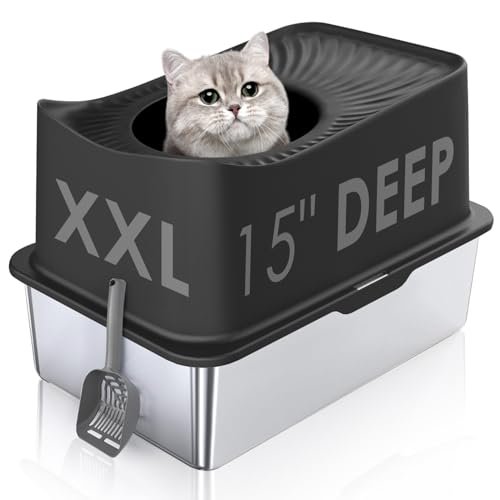 |
Kettnjoy XL Top Entry, Stainless Steel 🏆 Editor’s Pick |
24 in | 15 in | 65 L | Large breeds, multi-cat homes, high sprayers | 9.4/10 | View on Amazon Free Shipping & 30-Day Returns |
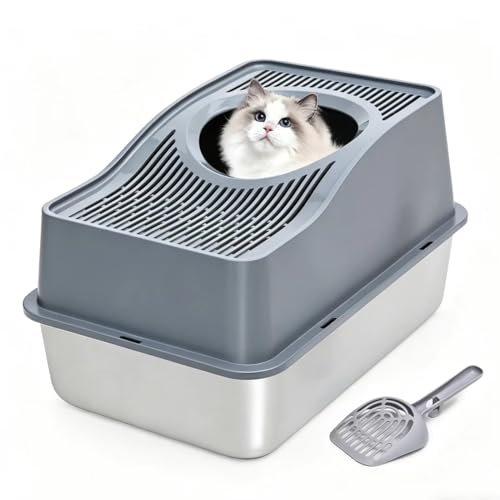 |
Kettnjoy Sloped Entry, Stainless Steel 🥈 Runner-Up |
24 in | 14 in | 25 L | Cats that hesitate at a straight vertical climb | 8.9/10 | View on Amazon Free Shipping & 30-Day Returns |
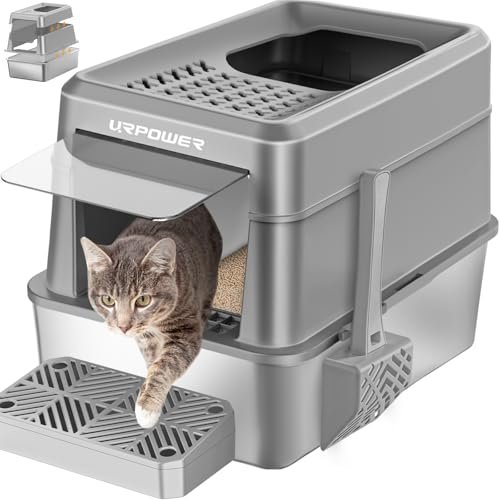 |
URPOWER Extra Large Stainless Steel Litter Box Best Anti-Tracking |
23.8 in | 15.2 in | 26 L | Carpeted rooms and heavy trackers | 8.5/10 | View on Amazon Free Shipping & 30-Day Returns |
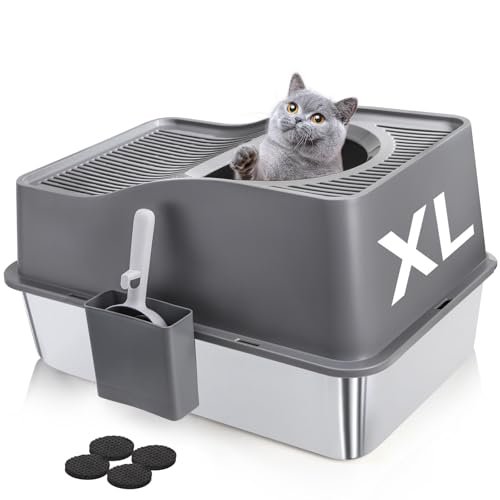 |
SOUJOY Stainless Steel Litter Box, Extra Large Tallest Walls |
23.6 in | 15.7 in | 37 L | Vertical peeers and aggressive diggers | 8.2/10 | View on Amazon Free Shipping & 30-Day Returns |
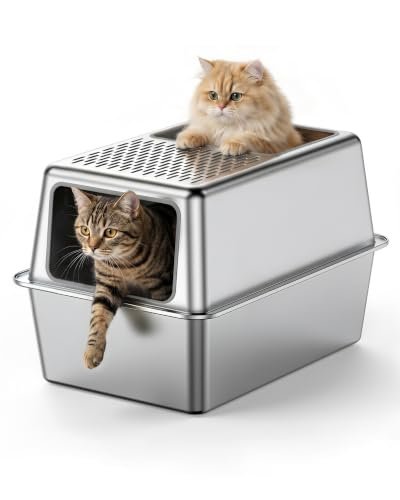 |
High-Sided All-Metal Enclosed Litter Box Dual Entry |
23.6 in | 15 in | Large | Homes with one athletic cat and one senior | 8.1/10 | View on Amazon Free Shipping & 30-Day Returns |
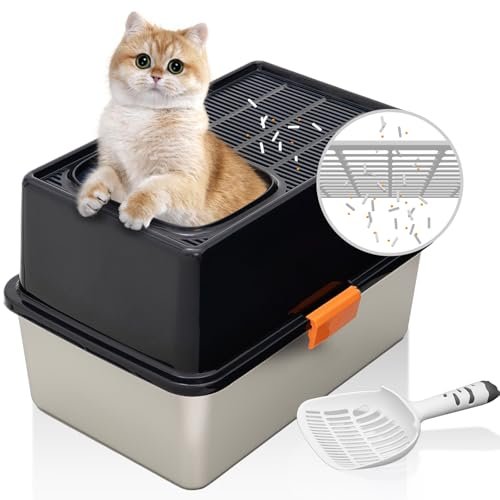 |
MEEXPAWS Stainless Steel Top Entry Small Spaces |
Compact | 8 in pan | Medium | Cats under 12 lb, apartments, second boxes | 7.8/10 | View on Amazon Free Shipping & 30-Day Returns |
📋 How We Evaluated These Boxes
Scores weight five things, in this order:
- Usable interior length (30%). Measured against the AAHA/AAFP guideline that a box should be at least 1.5 times the cat’s nose-to-tail-base length.
- Containment (25%). Wall height, lid overlap at the seam, and whether the lid channels urine back into the pan or lets it wick to the outside.
- Steel grade and finish (20%). 304 grade scored higher than unspecified “stainless”. Weld quality and rolled edges matter more than thickness claims on a listing.
- Cleaning time (15%). How many parts come apart, whether the corners are radiused or square, and whether litter jams in the lid slots.
- Accessibility (10%). Entry height, slope, step pedals, and whether an 8-year-old cat could use it without a running start.
Manufacturer capacity figures are listed as published. Where a spec was vague on the listing, it’s marked vague here rather than guessed.
Side-by-side photo of all six boxes on the same floor, with a tape measure laid across the front edge. Alt text: “Six top entry metal litter boxes compared by size.”
Will a Top Entry Box Work for Your Cat? A 60-Second Check
Before you spend anything, run this. The failure mode with top entry boxes isn’t a bad product. It’s a cat that quietly stops using the box and starts using the bath mat, and by the time you notice you’ve got a habit to undo.
✅ Green light if all five are true
- Your cat is between 1 and 8 years old.
- It still jumps onto counters or a cat tree without pausing to gather itself.
- It weighs under 15 lb, or you’re buying a 24-inch model.
- It has never had a diagnosis of arthritis, hip dysplasia, or a hind-leg injury.
- You have at least one other accessible box in the house during the switch.
❌ Red light, pick a low-entry box instead
- Kitten under six months. It physically can’t climb a 14-inch wall.
- Senior cat that hesitates on stairs or lands hind-legs-first with a thump.
- Any cat that steps in with front paws and leaves the back half hanging out.
- Cats that get ambushed by a housemate. An enclosed box with one exit is a trap, and anxious cats read it that way.
- Cats recovering from surgery or carrying extra weight they can’t shift.
Unsure? Tape a cardboard box to the height you’re considering, cut a hole in the top, and put a treat inside. If your cat goes in twice without hesitating, it’ll use a real one. If it circles and walks off, you have your answer for the price of a delivery box.
Detailed Reviews
Kettnjoy XL Top Entry Cat Litter Box, 304 Stainless Steel 🏆 Editor’s Pick
| Dimensions | 24 x 16 x 15 inches |
| Material | 304 Stainless Steel |
| Capacity | 65 Litres |
| Entry Type | Top Entry |
| Fits cats up to | 16 in nose to tail base |
| Included | Scoop and scoop holder |
What We Found
Twenty-four inches of interior length is the number that earns this box the top spot. Run the veterinary sizing rule on a 16-inch Maine Coon and you need 24 inches of floor inside the pan. Almost nothing on a pet store shelf gets there. This one does, and the 65-litre volume means you’re topping up litter rather than hauling the whole thing to the bin every week.
The 15-inch walls handle the cat that pees at wall height without turning around. That’s the single most common reason people give up on plastic hoods, and it’s solved here by geometry rather than by an absorbent pad you have to replace. The 304 steel gives you the other half of the fix. No pores, no claw grooves, nothing for ammonia to bond to.
Two honest warnings. Filled to a 3-inch litter depth, this pan is carrying roughly 30 pounds of clumping clay plus the weight of the steel, so decide where it lives before you fill it. And a 24 by 16 inch footprint eats a real chunk of a small bathroom. Measure the spot first.
💬 My Take
If your cat is big, this is the only box on the list I’d buy without hesitating. You’re paying for interior inches, and interior inches are what stop most litter box problems.
Who It’s For
Buy it if you have a Maine Coon, Ragdoll, Norwegian Forest Cat, Bengal, or any shorthair over about 14 pounds. It’s also the right call for two cats sharing a space, since the volume absorbs a second day of use without smelling. Skip it if your cat is under 8 pounds, because the climb-to-body-size ratio gets steep and you’re paying for room it won’t use.
Worth shortlisting against the covered top entry alternatives if you want the same containment in a smaller shell.
✅ Pros
- 24-inch interior clears the 1.5x rule for cats up to 16 inches long.
- 15-inch walls stop wall-height spray without add-on pads.
- 65-litre volume stretches the gap between full litter changes.
- Weight keeps it planted when a big cat launches out.
❌ Cons
- Around 30 lb of litter when filled, so it’s a two-hand lift.
- 24 x 16 inch footprint is too much for a narrow bathroom.
- Costs more than a plastic hooded box by a wide margin.
- 15-inch entry rules it out for seniors and kittens.
Kettnjoy Sloped Entry Cat Litter Box, Stainless Steel 🥈 Runner-Up
| Dimensions | 24 x 16 x 14 inches |
| Material | 304 Stainless Steel |
| Capacity | 25 Litres |
| Special Feature | Sloped access pedal |
| Included | Scoop, holder, non-slip pads |
What We Found
This is the version to buy when your cat can still climb but you’ve noticed it thinking about it first. The sloped lid and step pedal break a 14-inch wall into two shorter moves, which takes the compressive load off the landing. That landing is the part that hurts aging joints, not the climb up.
The lid overlaps the pan rim rather than sitting flush on it, so urine that hits the inside of the lid runs back down into the litter instead of wicking out along the seam. That seam is where cheaper enclosed boxes leak, and it’s the detail I’d check on any model you’re considering.
Capacity is the trade. Twenty-five litres against the XL’s 65 means more frequent full changes for a multi-cat home. Kettnjoy quotes up to 35 days between changes for a single cat, which assumes daily scooping and a good clumping litter. Treat that as a ceiling, not a schedule.
💬 My Take
The sloped entry buys you a couple of extra years before you have to move your cat to a low-entry pan. That’s worth more than 40 litres of capacity to most single-cat households.
Who It’s For
Best for cats in the 7 to 10 year range, cats carrying a bit of extra weight, and anyone who wants top entry containment without betting their floors on a full vertical jump. One cat, one box, hardwood or tile underfoot, this is the pick. If your cat has a confirmed arthritis diagnosis, don’t stretch for it. Go low-entry.
✅ Pros
- Sloped entry and pedal split the climb into two shorter steps.
- Overlapping lid keeps urine from wicking out at the seam.
- Non-slip pads stop it walking across tile during a dig.
- Same 24-inch interior length as the XL model.
❌ Cons
- 25 litres is thin for two cats sharing one box.
- One inch shorter than the XL, so slightly less spray protection.
- Brushed finish shows water spots if you don’t dry it.
- Still a 14-inch wall, which is too much for a true senior.
URPOWER Extra Large Stainless Steel Litter Box with Lid Best Anti-Tracking
| Dimensions | 23.8 x 16.5 x 15.2 inches |
| Material | 304 Stainless Steel |
| Capacity | 26 Litres |
| Entry Type | Top Entry |
| Configurations | Enclosed or semi-enclosed |
What We Found
The triple filter pedal is the reason to pick this one over the SOUJOY. Litter caught between the toes has three chances to drop before your cat reaches the floor, and on carpet that difference shows up within a week. Nothing eliminates tracking, but this design gets you closer than a plain lid does.
You can run it fully enclosed or drop it to semi-enclosed, which is useful during the switch. Start open so your cat associates the new box with normal business, then close it up once it’s using the box daily. That two-stage approach converts a lot of cats that would have refused a sealed box on day one.
At 15.2 inches the walls are among the tallest here, and the 304 steel wipes down without any scrubbing. Assembly is simple. The lid alignment takes a bit of fiddling the first time, and the filter pads are a consumable you’ll replace every few months.
💬 My Take
If litter in the carpet is what pushed you to shop for a new box, this is your model. Just budget for replacement filter pads.
Who It’s For
Right for carpeted bedrooms, homes where the box sits near a doorway you walk through barefoot, and cats that kick litter out with real enthusiasm. The switchable configuration also makes it the safest bet if your cat has never used an enclosed box before.
✅ Pros
- Triple filter pedal cuts tracking more than a flat lid does.
- Switches between enclosed and semi-enclosed during the transition.
- 15.2-inch walls, second tallest in this group.
- 304 steel wipes clean with soap and a cloth.
❌ Cons
- Filter pads are an ongoing cost.
- Lid takes some fiddling to seat the first time.
- 16.5-inch width is the widest here, so measure your gap.
- Pedal slots trap damp litter and need rinsing.
SOUJOY Stainless Steel Cat Litter Box with Lid, Extra Large Tallest Walls
| Dimensions | 23.6 x 15.7 x 15.7 inches |
| Material | 304 Stainless Steel |
| Capacity | 37 Litres |
| Entry Type | Top Entry |
| Configurations | Buckle-set enclosed or semi-enclosed |
What We Found
At 15.7 inches, these are the tallest walls in the group. If your problem is a cat that stands and sprays the back wall, height is the fix, and this box has more of it than anything else here. The 37-litre volume sits between the two Kettnjoy models.
Interior length is 23.6 inches, which still clears the sizing rule for a 15-inch cat. The buckle system lets you run it open or closed. Those buckles are the weak point, and a few owners report them loosening over months of daily handling. Not a dealbreaker, but check them when you deep clean.
There’s no filter pedal, so tracking control comes from wall height alone. Pair it with a ridged mat under the exit if you’re putting it on carpet. Otherwise this is a plain, well-built pan that does the job without extra parts to maintain.
💬 My Take
Buy this for the wall height, not the features. It’s the simplest box here and there’s less to go wrong.
Who It’s For
Best for vertical peeers, cats that dig like they’re burying evidence, and owners who’d rather not manage replaceable filters. It works on hard floors where a mat can catch what the walls don’t.
✅ Pros
- 15.7-inch walls, the tallest of the six.
- 37 litres suits one large cat or two smaller ones.
- Smooth 304 surface, nothing sticks to the corners.
- No consumable parts to replace.
❌ Cons
- No filter pedal, so you’ll want a mat underneath.
- Buckles can loosen with repeated use.
- Tallest walls also mean the hardest climb.
- Takes the same floor space as an XL model.
High-Sided All-Metal Enclosed Cat Litter Box, Dual Entry Dual Entry
| Dimensions | 23.6 x 15.7 x 15 inches |
| Material | Stainless Steel (grade not specified) |
| Capacity | Large (not published) |
| Entry Type | Front and top |
| Included | Anti-slip foot pads |
What We Found
Two openings, one box. The young cat takes the lid, the older one walks in the front, and neither has to compromise. In a two-cat home with an age gap, that solves a problem the other five boxes can’t.
It also gives you a way out if the top entry experiment fails. Your cat has a fallback the moment it decides the climb isn’t worth it, which beats discovering that fact via the laundry pile.
The cost is containment. A front opening is a hole at floor level, and litter leaves through it. You lose a good share of the tracking advantage that made you want a top entry box. The listing also doesn’t name a steel grade, which is why it scores below the 304 models on material.
💬 My Take
A compromise box, and it’s honest about it. Pick it when your cats have different bodies, not when you want maximum containment.
Who It’s For
Households with one athletic cat and one that’s slowing down. Also worth it if you’re not sure your cat will accept top entry and you don’t want to buy twice. Skip it if the front hole would sit on carpet.
✅ Pros
- Two entries suit cats with different mobility.
- Built-in fallback if your cat rejects the climb.
- Metal shell resists odour the same way the 304 models do.
- Anti-slip pads keep it steady on tile.
❌ Cons
- Front opening lets litter out at floor level.
- Steel grade isn’t stated on the listing.
- Capacity in litres isn’t published either.
- Needs a mat at the front door to stay tidy.
MEEXPAWS Stainless Steel Cat Litter Box, Top Entry Small Spaces
| Pan depth | 8 inches |
| Material | Stainless Steel |
| Capacity | Medium |
| Entry Type | Top Entry, slotted lid |
| Suits cats up to | 12 lb |
What We Found
The slotted lid does double duty as a litter mat. Your cat lands on it coming out, granules drop through the slots back into the pan, and you skip buying a separate mat. Clever, and it works. The slots are also the one part that’s annoying to clean, because damp litter cakes in them and you’ll need a brush.
MEEXPAWS caps this at 12 pounds, and that limit is real. An 8-inch pan with a medium footprint doesn’t give a big cat room to turn and posture, and a cramped box is the fastest route to a cat that goes beside it instead of in it. Under 12 pounds, it’s fine.
Build quality is better than the price band suggests. Rust-resistant panels, a metal scoop rather than a flimsy plastic one, and a buckle that actually holds the lid when a cat launches off it. For a studio apartment or a second box on another floor, that’s a sensible package.
💬 My Take
The right answer for a small cat in a small flat. Buy the XL instead if there’s any chance your kitten grows past 12 lb.
Who It’s For
Apartments, small bathrooms, and cats in the 7 to 12 pound range. It’s also a good second box under the n+1 rule if your main box is one of the XL models. See the full stainless steel top entry guide for how it compares to larger metal pans.
✅ Pros
- Slotted lid replaces a separate litter mat.
- Fits where a 24-inch box won’t.
- Metal scoop included, not plastic.
- Buckle holds the lid under a hard launch.
❌ Cons
- 12 lb ceiling rules out large breeds.
- Smaller volume means scooping twice a day.
- Lid slots cake with damp litter.
- Interior length falls short of the 1.5x rule for bigger cats.
What Size Metal Litter Box Does Your Cat Need?
Size is the spec most people skip and the one that causes most litter box problems. The 2021 AAHA/AAFP Feline Life Stage Guidelines set the standard: a box should be at least 1.5 times the length of your cat from nose to base of tail, not counting the tail itself. The same guidelines admit that most boxes sold in stores don’t meet it.
Measure your cat while it’s stretched out asleep. Then find the row below.
Litter Box Size Chart (1.5x Rule)
| Cat length (nose to tail base) | Minimum interior length | Typical cats | Box from this list |
|---|---|---|---|
| 10 inches | 15 inches | Kittens over 6 months, small adults | MEEXPAWS |
| 12 inches | 18 inches | Average domestic shorthair, 8 to 11 lb | Any model here |
| 14 inches | 21 inches | British Shorthair, large DSH, 12 to 15 lb | SOUJOY, URPOWER, Kettnjoy |
| 16 inches | 24 inches | Maine Coon, Ragdoll, Norwegian Forest Cat | Kettnjoy XL only |
Count matters as well as size. The same veterinary guidelines use the n+1 rule: one box per cat plus one spare. Two cats means three boxes, spread across different rooms rather than lined up together. A single XL metal box doesn’t replace that, however large it is. Research from the University of Prince Edward Island found cats used larger boxes far more often than standard ones, so if you’re between two sizes, go up.
💡 Quick tip
Listed dimensions are usually external. Subtract about an inch for wall thickness and lid overlap to get real interior length. On a 24-inch box that’s the difference between fitting a Maine Coon and not.
Stainless Steel vs Plastic Litter Box
The argument for metal comes down to surface chemistry. Polypropylene is slightly porous and it scratches. Urine contains urea, which bacteria break down into ammonia, and those breakdown products settle into scratches where soap can’t reach. Steel has no pores and takes claw marks far less readily, so a wash actually returns it to zero.
| Factor | Stainless steel | Plastic |
|---|---|---|
| Odour retention | None. Non-porous surface | Builds up in scratches over months |
| Typical lifespan | Years, often the life of the cat | Replace every 1 to 2 years |
| Cleaning | Wipe with dish soap, nothing sticks | Needs scrubbing, stains set in |
| Stability | Heavy, stays put | Light, slides on tile |
| Noise | Louder when scooping and digging | Quieter |
| Temperature | Cold to the paw in unheated rooms | Neutral |
| Upfront cost | Higher | Lower |
| Cost over 5 years | One purchase | Three to five purchases |
304 vs 201 Stainless Steel: Why the Grade Matters
Not all “stainless” is equal. Grade 304 contains roughly 18% chromium and 8% nickel, and that nickel content is what holds up against salts and acids. Grade 201 swaps much of the nickel for manganese to cut cost, and it pits sooner in a wet, salty environment. Cat urine is exactly that environment.
If a listing says “stainless steel” and never names a grade, assume 201 and price it accordingly. Four of the six boxes above state 304. Two don’t, and they’re scored lower for it.
Close-up comparison: scratched plastic litter pan surface next to a clean 304 steel pan. Alt text: “Scratched plastic litter box surface compared with stainless steel.”
Top Entry vs Front Entry vs Dual Entry
Entry style decides more about your daily experience than brand does. Here’s how the three compare on the things you’ll notice.
| Factor | Top entry | Front entry | Dual entry |
|---|---|---|---|
| Litter tracking | Lowest | Highest | Medium |
| Spray containment | Best | Depends on wall height | Good |
| Senior and arthritic cats | Poor fit | Best | Workable |
| Kittens under 6 months | Not usable | Best | Usable via front |
| Dogs raiding the box | Blocks most dogs | No barrier | No barrier |
| Anxious or bullied cats | One exit can feel like a trap | Easier escape | Two exits, best option |
| Scooping access | Lift the lid each time | Open | Open at front |
One point in favour of top entry that rarely gets mentioned: it keeps dogs out. If you have a dog that treats the litter box as a snack station, a 15-inch wall with a lid solves that without a gate or a closed door.
What to Look For Before Buying
Five specs decide whether a metal box works in your house. Check them in this order.
1. Interior length, not external dimensions
Your cat has to turn around, dig, squat, and cover without touching a wall. Use the size chart above, then subtract an inch from the listed dimensions for wall thickness. A box that’s too short shows up as pee over the edge long before it shows up as a refusal.
2. Steel grade, stated in writing
Look for 304 on the listing. If the seller won’t name a grade, it’s probably 201, which pits faster when urine sits on it. Also check that the top edges are rolled rather than raw cut. A raw edge on a lid is where a cat catches a paw pad.
3. Wall height matched to your cat’s habit
Five to six inches handles a cat that squats. Twelve to sixteen inches is what you need for a cat that pees standing up or kicks litter over the rim. Every extra inch of wall is also an extra inch of climb, so don’t buy 16-inch walls for a cat that squats politely.
4. Entry height against your cat’s shoulder
For healthy adults, a full vertical entry is fine. For older cats, veterinary guidance puts the usable entry at about five inches or less, and two to three inches once arthritis is diagnosed. Sloped lids and step pedals shrink the effective climb, which is why the Kettnjoy runner-up scores well on this.
5. How fast it comes apart
You’ll deep clean this box once a month for years. Rounded interior corners beat square ones because litter cakes in square corners. Buckles beat clips. Slotted lids catch tracking but need a brush, so decide which trade you’d rather make.
🛒 Pre-purchase checklist
- Cat measured nose to tail base, multiplied by 1.5
- Floor space measured, plus 6 inches of clearance for the lid
- Steel grade confirmed as 304
- Entry height checked against your cat’s age and joints
- A second accessible box available during the switch
- Litter mat ordered if the box has no filter pedal
How to Switch Your Cat to a Top Entry Metal Box
Most refusals come from the transition, not the box. Cats treat a new toilet as a risk, and a metal one sounds and feels different underfoot. Give it two weeks and you’ll convert almost any healthy adult cat.
- Days 1 to 3: set it up with no lid. Put the new pan next to the old box, fill it with the same litter to the same depth, and leave the lid off entirely. Nothing to learn yet except the smell of the new pan.
- Days 4 to 6: seed it. Move one scoop of used clumps from the old box into the new one. Your cat’s own scent is the strongest signal that this is a legitimate toilet.
- Days 7 to 9: add the lid, leave the entry open. Fit the lid but keep the box in semi-enclosed mode if it has one. If it doesn’t, prop the lid slightly so your cat can see out.
- Days 10 to 12: close it up. Full enclosure, full top entry. Watch for hesitation at the rim. A cat that pauses and then goes in is fine. A cat that circles and leaves needs another week at step 3.
- Day 13 onward: remove the old box. Only after you’ve seen the new box used at least three times in a row. Take the old one out of the room rather than leaving it empty, because an empty familiar box is still a target.
- If it stalls: keep both boxes. The n+1 rule says you should have a spare anyway, and a cat with two options is a cat that doesn’t use your rug.
⚠️ When it isn’t the box
Straining, frequent trips with little output, crying in the box, or blood in the litter are veterinary emergencies, especially in male cats. Urinary blockage can be fatal within hours. If elimination habits change suddenly, call a vet before you change anything about the litter setup.
Best Litter and Litter Depth for a Top Entry Metal Box
High walls change what litter works. Your cat lands from height, so the litter has to absorb that impact without spraying sideways, and it has to clump well enough that you can lift waste cleanly off a smooth steel floor.
- Medium-grain clumping clay is the safest default. It clumps hard, releases from steel, and heavier grains track less than fine ones.
- Skip ultra-fine crystal or dusty clay. Fine particles find the lid slots and every seam, and they puff up when a cat lands.
- Tofu and wood pellets track less but clump softer, and soft clumps smear on a bare metal base. Usable, just expect a bit more scraping.
- Depth: 3 inches, sometimes 4. Deeper than a standard open pan, because a cat dropping in from 14 inches needs cushioning. Below 2 inches you get urine pooling straight onto steel, which is where smells start.
- Liners don’t work here. The lid interferes with the rim, and cats shred them on landing. You don’t need one anyway, since steel releases waste on its own.
One practical note on weight. Filling a 24 by 16 inch pan to 3 inches takes roughly 30 pounds of clumping clay. Put the box where you want it before you pour.
Overhead shot of a metal pan with a ruler standing in 3 inches of clumping litter. Alt text: “Correct litter depth in a top entry metal litter box.”
How to Clean a Stainless Steel Litter Box (and Keep It From Pitting)
Steel is easy to clean and easy to ruin. The mistake people make is reaching for bleach or a scouring pad, both of which attack the passive layer that makes stainless stainless.
- Daily: scoop once or twice, and top the litter back up to 3 inches.
- Weekly: lift the lid, brush out the slots or pedal, and wipe the interior with warm water and a drop of dish soap.
- Monthly: empty it, wash with dish soap, rinse, then dry with a cloth. Drying is the step people skip, and it’s the one that prevents water spots and streaks.
- For mineral scale or stubborn film: a 1:1 white vinegar and water soak for ten minutes, then rinse thoroughly. Vinegar left sitting for hours is not better than vinegar rinsed off.
- Never: chlorine bleach, steel wool, or abrasive powders. Chlorides pit stainless, and steel wool leaves iron particles that rust on the surface and look like the box has failed.
| Use this | Avoid this |
|---|---|
| Mild dish soap and warm water | Chlorine bleach |
| Diluted white vinegar, rinsed off | Ammonia-based cleaners, which smell like urine to a cat |
| Soft sponge or nylon brush | Steel wool and scouring pads |
| Dry cloth afterwards | Air drying in a damp bathroom |
Who Should Skip a Top Entry Box Entirely
This design has a real audience and a real set of cats it fails. Being clear about the second group is worth more than another paragraph of praise.
- Cats over 8, or any cat with arthritis. Degenerative joint disease is common in older cats and usually goes unnoticed at home. The jump up is manageable. The landing is what hurts, and a cat that learns the box causes pain will find somewhere else.
- Kittens under six months. They can’t clear the wall, and a kitten that fails to reach the box learns bad habits fast.
- Very large breeds using a standard lid opening. A typical 8 to 10 inch circular hole is tight for a 15 to 20 pound cat even when its joints are fine. Match the opening to the cat, not just the pan.
- Anxious cats or cats being bullied by a housemate. One exit means one place to be cornered. Two boxes with open entries beat one enclosed box every time here.
- Cats being monitored for urinary issues. An enclosed box makes it harder to spot changes in urine volume or blood in the clumps.
If two or more of those apply, buy a low-entry metal pan instead. You still get the odour and durability benefits of steel without asking your cat to do something it can’t.
Frequently Asked Questions
Are stainless steel litter boxes better than plastic?
For odour and lifespan, yes. Steel has no pores and resists the claw scratches that hold bacteria in plastic, so washing it returns it to clean rather than almost clean. The trade-offs are cost, weight, and noise. If you replace a plastic box every 18 months, a steel one pays for itself inside three years.
Do top entry boxes actually reduce litter tracking?
They cut it substantially. Your cat climbs out rather than walking out, so gravity drops most of the loose litter back into the pan. Models with slotted lids or filter pedals catch more again. You’ll still find a few granules by the door, just not a trail down the hallway.
Can senior cats use a top entry litter box?
Some can, most shouldn’t. Veterinary guidance for older cats puts the ideal entry at around five inches so the cat walks in rather than jumps, and two to three inches once arthritis is diagnosed. A sloped model with a step pedal buys you time. A cat that already hesitates on stairs needs a low-entry box now.
How big should a metal litter box be for a Maine Coon?
Measure nose to tail base and multiply by 1.5. A 16-inch Maine Coon needs 24 inches of usable interior length. Only the Kettnjoy XL on this list clears that. Check the lid opening too, since a big cat needs room to get its shoulders through.
Do stainless steel litter boxes rust?
Grade 304 resists rust in normal use. Two things cause it anyway: chlorine bleach, which pits the surface, and steel wool, which leaves iron particles that rust and look like the box has failed. Use dish soap, rinse, dry. Unspecified “stainless” is often grade 201 and less forgiving.
How often should I clean a stainless steel box?
Scoop daily. Wipe the interior weekly. Empty and wash it monthly. Because nothing soaks in, a monthly wash on steel does what a weekly scrub does on scratched plastic.
What litter depth works best in a top entry box?
Three inches, and up to four for a cat that lands hard. Deeper than you’d use in an open pan, because the litter is absorbing a drop from height. Under two inches, urine reaches the steel and starts to smell between changes.
Is metal too cold or too loud for cats?
Three inches of litter insulates the pan, so temperature is rarely an issue once it’s filled. Noise is real. A metal scoop on a metal pan startles some cats, so scoop when your cat isn’t in the room for the first week and use a silicone-edged scoop if it stays jumpy.
Can I use litter box liners with a top entry metal box?
No, and you don’t need to. The lid sits on the rim where a liner would be anchored, and cats tear liners on landing. Waste lifts off bare steel cleanly, which is the reason to buy metal in the first place.
Will one XL box replace two regular boxes?
No. The n+1 guideline is about locations and access, not volume. Two cats need three boxes in separate spots so one cat can’t block another’s route. Size fixes comfort. Count fixes competition.
Will a top entry box keep my dog out of the litter?
For most dogs, yes. A 14 to 16 inch wall with a lid and a cat-sized opening blocks anything much bigger than a cat. A determined small terrier may still get in, so watch the first week.
My cat refuses the new box. What now?
Take the lid off and go back to step one of the transition plan. Keep the old box available the whole time. If the refusal came on suddenly with an established box, rule out a medical cause with a vet before treating it as a preference problem.
🎯 Final Verdict
The Kettnjoy XL is the pick for most people shopping for a top entry metal litter box, and the reason is 24 inches of interior length. That’s the only model here that satisfies the veterinary sizing rule for a large cat, and size prevents more litter box problems than any other feature on a listing. The 15-inch walls and 65-litre volume are what you’d want anyway.
If your cat is starting to think before it jumps, buy the sloped Kettnjoy instead. If litter in the carpet is the problem you’re actually solving, the URPOWER’s filter pedal earns its price. And if your cat is over 8, arthritic, or under six months old, don’t buy any of them. Get a low-entry steel pan and keep the odour benefit without the climb.
Measure your cat first. Everything else follows from that number.

Written by Mishu
A passionate cat lover and indoor living enthusiast, Mishu is the founder and voice behind Indoor Living Cat – a go-to resource for cat owners who want to create the happiest, healthiest life for their feline companions indoors.
View Full Profile