
Indoor cat behavior problems confuse and frustrate even experienced cat owners because most of the behaviors feel random until you understand what is actually driving them.
Indoor cat behavior problems are unwanted actions produced by cats whose instinctual needs for territory, stimulation, hunting and safety are not being fully met in an indoor environment. Almost every behavior issue in an apartment cat traces back to one of four root causes: insufficient enrichment, a medical condition that has not been identified, a territorial stressor in the environment or a resource shortage that creates chronic low-level stress.
My own cat went through a phase of knocking things off every elevated surface in the apartment at 2am. I spent two weeks assuming it was a personality quirk before I realized she had gone from two play sessions a day to zero after a schedule change. Two weeks of consistent evening play and the behavior stopped entirely.
This guide covers the most common indoor cat behavior problems and what actually causes them: scratching, aggression, litter box issues, nighttime activity, excessive meowing, overgrooming and strange attention-seeking behaviors. Every section connects to a deeper resource for the specific behavior you are dealing with right now.
Most indoor cat behavior problems trace back to insufficient daily enrichment, an unmet territorial or physical need or an undetected medical condition. The first step is always to rule out a health cause with a vet visit. If health is ruled out, the fix is almost always environmental: more daily interactive play, additional vertical space, a better litter box setup or a fairer split of resources in multi-cat homes.
Why Indoor Cat Behavior Problems Happen? The Root Causes
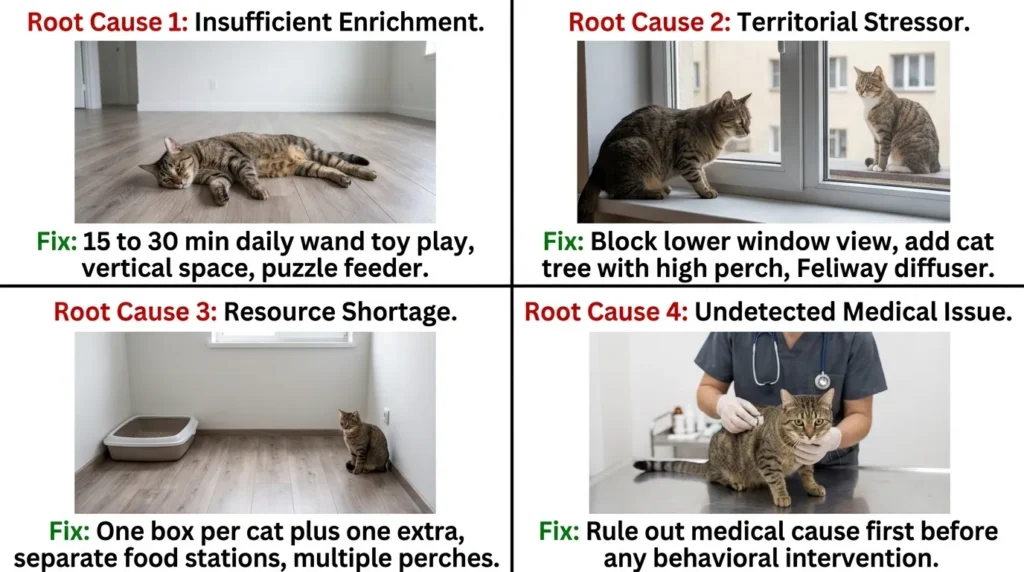
Indoor cat behavior problems almost never appear from nowhere. They are responses to a specific unmet need, and the need is always readable if you know what to look for. Cats cannot tell you the litter box situation is inadequate or that the new outdoor cat appearing at the window is stressing them out. They show you instead.
The four root causes of indoor cat behavior problems account for the vast majority of cases:
- Insufficient enrichment: a cat without adequate daily play, foraging and mental stimulation develops behavioral outlets for that accumulated energy. Scratching furniture, knocking things off surfaces and nighttime activity are the most common expressions.
- Territorial stress: an outdoor cat visible through a window, a new cat introduced to the household or a change in the apartment layout can trigger sustained stress that produces aggression, spraying or litter avoidance.
- Resource shortage: in multi-cat homes, competition for litter boxes, food stations, perches or your attention directly causes the inter-cat aggression and redirected behavior that owners often misread as personality incompatibility.
- Undetected medical condition: pain, urinary tract infection, hyperthyroidism and arthritis all produce behavioral changes before visible physical symptoms appear. Any sudden behavior change in a previously stable cat warrants a vet check before any behavioral intervention is attempted.
| Owner’s Tip
Every behavior problem I have ever traced to a solution started with one question: what changed in the last two to four weeks? Behavior problems in stable cats do not appear for no reason. Something in the environment, routine or physical state changed. Find the change and you find the cause. Did someone move in or out? Did a schedule shift? Did a new outdoor cat start appearing at the window, or did you switch food? The answer is almost always there. |
Quick Reference: Common Indoor Cat Behaviors at a Glance
If you just want the short version before reading further, this table maps the behaviors covered in this guide to their most likely cause and the fastest fix. Click through to the linked section for the full explanation.
| Behavior | Most Likely Cause | Fastest Fix |
|---|---|---|
| Scratching furniture | Territorial marking, claw maintenance | Tall sisal post placed beside the target furniture |
| Nighttime zoomies | Undischarged predatory energy | 15–20 minute wand play before the last meal |
| Excessive meowing | Learned attention-seeking | Consistent non-response plus a proactive schedule |
| Knocking objects off surfaces | Prey-testing instinct, learned attention response | More daily play, ignore the behavior itself |
| Biting during play or petting | Hand play history, overstimulation | Read pre-bite signals, use toys instead of hands |
| Litter box avoidance | Dirty box, wrong location, medical issue | Vet check first, then audit box number and placement |
| Inter-cat aggression | Resource shortage, redirected arousal | Separate resources, slow reintroduction |
| Overgrooming or bald patches | Stress, allergy, pain | Vet check first, then reduce identified stressor |
| Sudden hiding | Illness, new stressor in the home | Vet check, then quiet safe space |
| Kneading blankets or you | Comfort behavior from kittenhood | No fix needed; it is normal and affectionate |
Why Indoor Cats Scratch Furniture and How to Stop It?
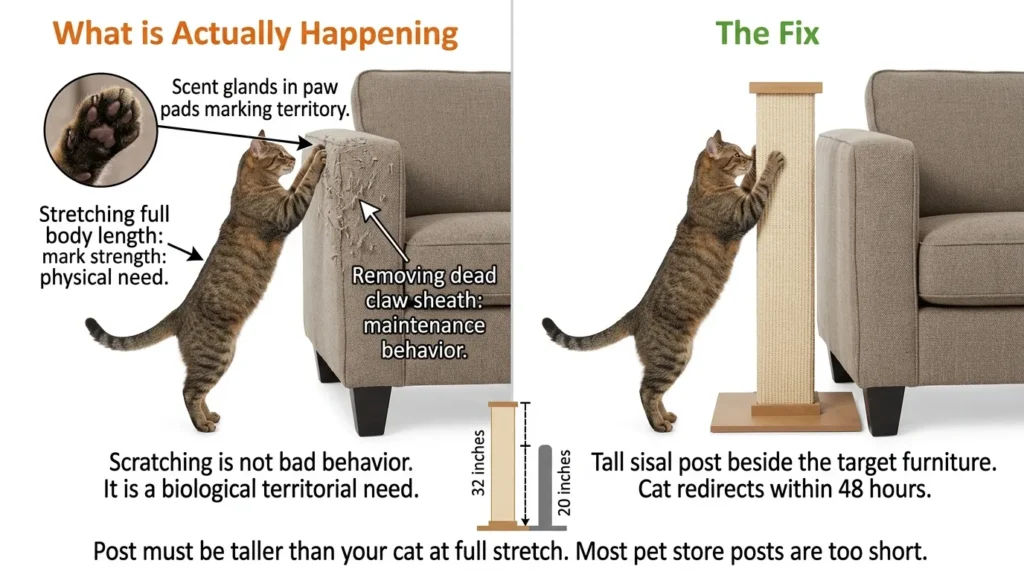
Understanding why does indoor cat scratch furniture changes everything about how you approach the problem. Scratching is not destructive behavior. It is territorial marking driven by scent glands in the paw pads, a physical need to stretch the full shoulder and back musculature, and a maintenance behavior that removes dead claw sheaths. An indoor cat that scratches furniture is not misbehaving. It is doing something it is biologically compelled to do, and it picked your couch because nothing better was on offer.
The fix is redirection, not punishment. Punishment does not touch the underlying need, and any link your cat draws between punishment and your presence near the couch creates anxiety that often produces more problem behaviors, not fewer.
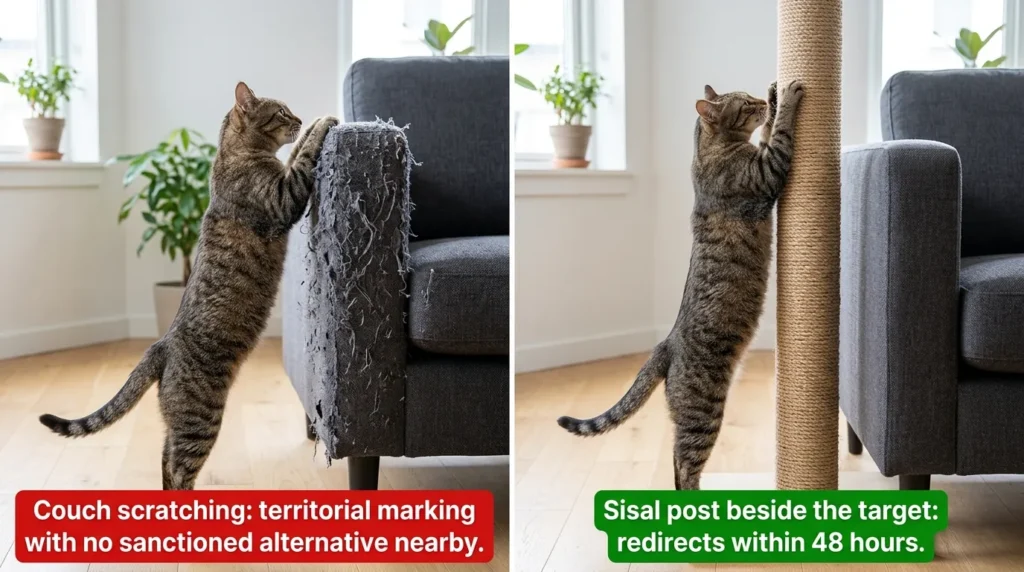
The correct redirect approach:
- Place a tall sisal scratching post directly beside the piece of furniture your cat is already scratching. Not in a corner. Not in a spare room. Directly beside the target.
- The post must be tall enough for your cat to scratch at full vertical stretch, typically 28 to 34 inches. Short posts do not fulfill the physical need behind the behavior.
- Sisal rope is the most effective material. Carpet-covered posts send the message that carpet anywhere in your home is fair game.
- Once your cat is consistently using the post, move it one to two inches per day toward a more convenient spot if you need to. Never move it suddenly.
Indoor Cat Aggression: Causes, Types and What to Do
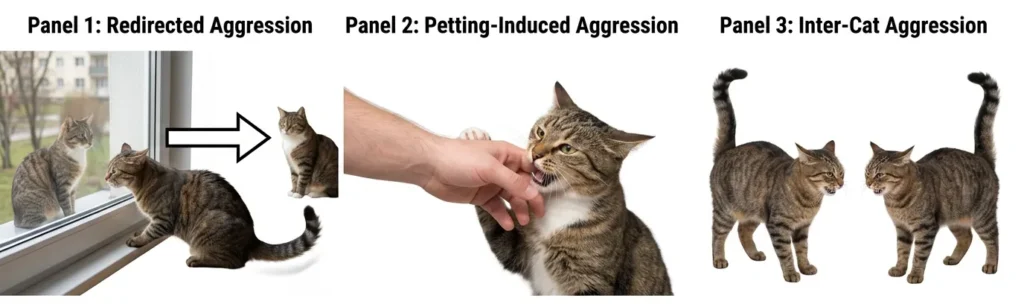
Separating aggression into types matters because each type has a different trigger and a different fix. Treat them all the same way and most interventions fail.
| Aggression Type | Common Trigger | Warning Signs | What Actually Helps |
|---|---|---|---|
| Redirected | Outdoor cat at the window, another animal, a loud noise | Dilated pupils, stiff body, sudden fixation on a nearby target | Frosted window film, 30+ minutes of no contact to de-escalate |
| Petting-induced | Physical contact past the cat’s tolerance | Tail flick, ears flatten, skin ripples along the back | Short sessions, stop at the first signal, let the cat re-initiate |
| Inter-cat | Resource competition, forced proximity | Blocking access to litter box or food, staring contests, hissing | Separate resources, slow scent-swap reintroduction |
| Play (mainly kittens) | Hands or feet used as toys during play | Stalking ankles, pouncing on moving hands | Wand toys only, never hands, redirect immediately |
Redirected aggression is the type that surprises owners most. A cat that sees an outdoor cat through the window becomes highly aroused. Unable to reach the trigger, it turns on the nearest available target: the other household cat, a passing person or whatever moved nearby during the arousal peak. The attack feels unprovoked because the trigger is not obvious.
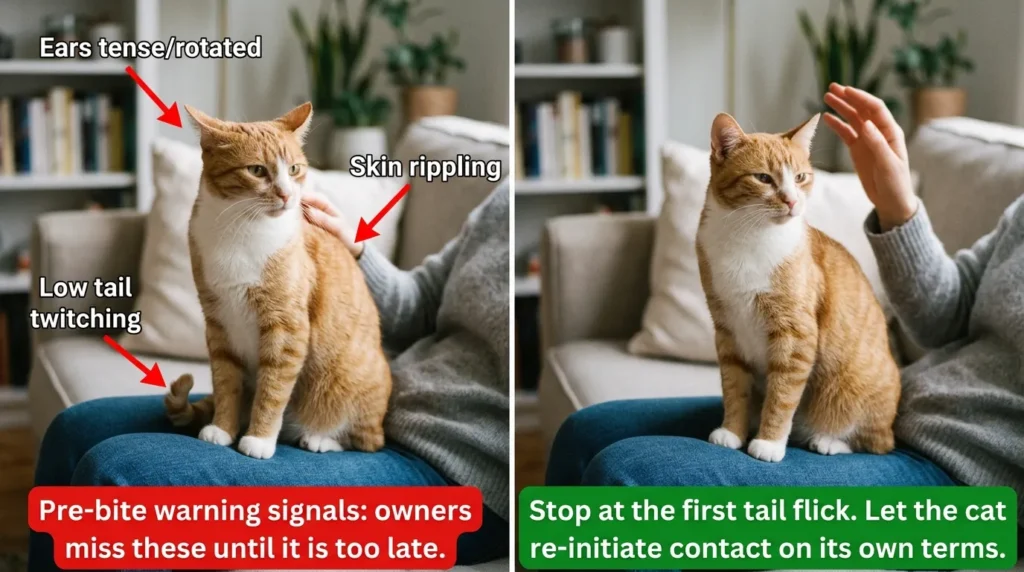
Petting-induced aggression is the most misunderstood. Cats have a low threshold for overstimulation during physical contact. They send clear warning signals: the tail begins to flick, the ears flatten slightly, the skin along the back ripples. Most owners miss these signals and keep petting past the cat’s limit. The bite that follows isn’t random. It was predicted by signals nobody read.
The practical management steps for each aggression type:
- Redirected aggression: apply frosted window film to the lower half of windows where outdoor cats appear. The indoor cat cannot see the trigger, so arousal never builds.
- Petting-induced aggression: learn your individual cat’s specific pre-bite signals and stop before they appear. Keep sessions short and let the cat re-initiate contact.
- Inter-cat aggression in apartments: separate all resources, make sure no cat has to pass another cat to reach food, water or a litter box, and reintroduce cats after an aggressive incident with a slow scent-swap protocol before visual contact resumes.
- Play aggression: stop using hands and feet as toys immediately, even in kittens. Redirect every pounce onto a wand toy instead.
| Owner’s Tip
Redirected aggression is the most dangerous type of indoor cat behavior problem because it looks unpredictable to anyone who doesn’t know what led up to it. A cat in redirected-aggression arousal cannot be reasoned with or calmed by handling. The only correct response is a quiet space to de-escalate with zero physical contact for at least 30 minutes. Trying to comfort or restrain an aroused cat is how people get bitten badly. |
Litter Box Problems: Spraying, Avoidance and How Many Boxes You Actually Need
Litter box problems are the single most common reason indoor cats end up surrendered, and they are almost always fixable once you separate the medical question from the behavioral one. The first move is always the same: rule out a urinary tract infection, bladder stones or kidney disease with a vet visit before assuming the box itself is the problem. A cat straining, crying in the box, or passing very little urine needs a same-day vet call, not a behavioral fix.
Once medical causes are ruled out, litter box avoidance comes down to a short list of fixable issues:
- Not enough boxes: the standard rule is one litter box per cat, plus one extra. A two-cat household needs three boxes, placed in different locations, not lined up next to each other.
- Box too dirty: scoop at least once a day. Cats have a strong aversion to soiled litter, and a single dirty box is enough to push a fastidious cat to the carpet instead.
- Wrong location: boxes in noisy, high-traffic or hard-to-reach spots get avoided. Quiet, accessible corners work best, away from food and water bowls.
- Sudden litter or box change: cats are sensitive to texture underfoot. If you need to switch litter brands, mix the new litter into the old gradually over one to two weeks.
- Covered boxes and liners: some cats dislike the enclosed feeling of a covered box or the smell that builds up inside one. If avoidance starts after switching to a covered box, try removing the lid.
Spraying is a different behavior from ordinary elimination, and telling them apart matters for the fix. A cat that sprays backs up to a vertical surface, tail held straight up and quivering, and deposits a small amount of urine at cat height, usually on a wall, door or piece of furniture. A cat with a litter box problem instead squats and urinates a larger volume, usually on a horizontal surface like a bed, rug or pile of laundry. Spraying is almost always territorial or stress-driven and responds to the same interventions as territorial stress elsewhere in this guide: reducing exposure to outdoor cats, adding resources in multi-cat homes and, in some cases, a vet-recommended pheromone diffuser. Unaltered cats spray far more often, so spay or neuter status is worth checking first if the behavior started recently in a young cat.
Why Indoor Cats Are Active at Night and How to Stop It?
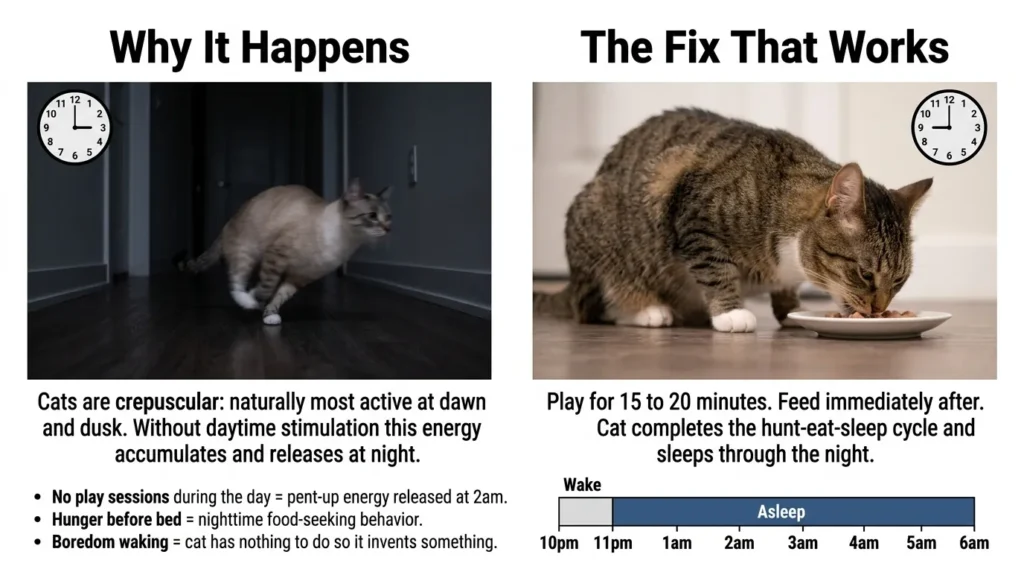
Knowing why does cat run around at night comes down to one biological fact: cats are crepuscular, meaning naturally most active at dawn and dusk. An indoor cat that gets no structured stimulation during the day accumulates predatory energy that has to discharge somewhere. The nighttime zoomies aren’t random. They’re the inevitable result of that accumulated energy finding its only available outlet.
The play-then-feed sequence is the most reliable fix for nighttime indoor cat behavior problems. Play actively with your cat using a wand toy for 15 to 20 minutes immediately before the final meal of the evening. The play burns off the predatory energy. The meal completes the hunt-eat-sleep sequence. Most cats that get this nightly routine sleep through the night within five to seven days.
Other nighttime behavior drivers and their specific fixes:
- Hunger waking: if your cat wakes you for food, an automatic feeder dispensing a small portion at 5am prevents the 3am alarm call.
- Medical waking: a cat that suddenly starts waking at night after years of sleeping through should see a vet. Hyperthyroidism and pain both produce nighttime restlessness.
- Boredom waking: leave a puzzle feeder accessible at night for cats that wake and roam. It gives them something to do without needing you.
- Zoomies right after the litter box: this is common and usually harmless, driven by a burst of relief and nerve stimulation from defecating. It only needs a vet visit if it’s paired with straining or crying.
Why Indoor Cats Meow So Much and Follow You Everywhere?
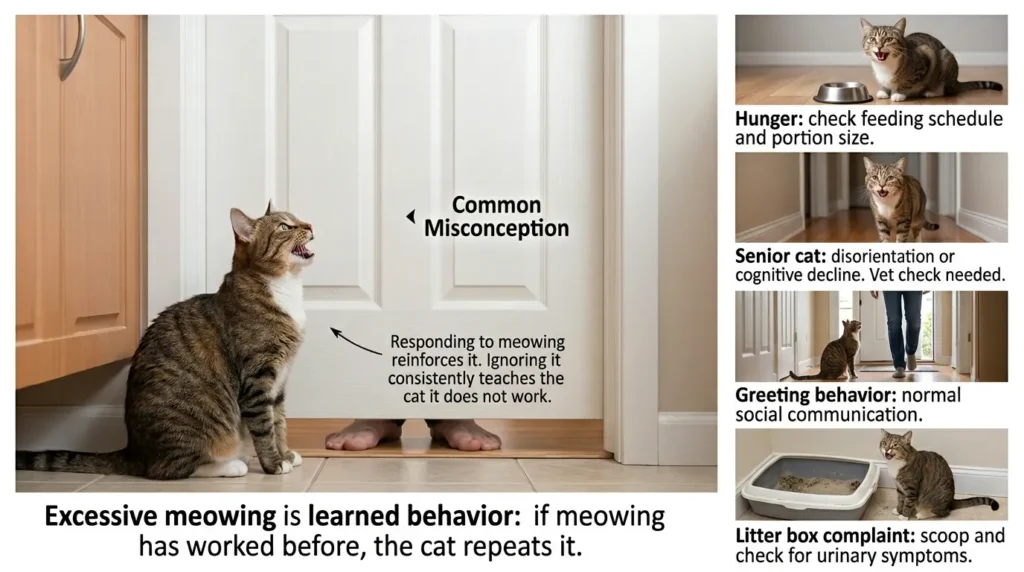
Understanding why does indoor cat meow so much starts with knowing that excessive meowing in adult cats is almost always learned. Cats do not use sustained vocalization to talk to each other in the wild. They developed it specifically to communicate with humans, and they keep doing it because it worked before.
The first time a cat meowed at 3am and its owner got up and fed it, that cat learned 3am meowing produces food. The behavior becomes self-reinforcing from there. Every response to meowing teaches the cat that meowing works. Stopping it takes consistent non-response plus a proactive schedule that meets the cat’s needs before it feels the urge to demand them.
Knowing why does cat follow me everywhere covers a related but usually harmless behavior. Most cats that trail their owners from room to room are social cats whose stimulation needs aren’t fully met by the environment. Following is the cat’s way of chasing the interaction it wants. Structured daily play and a more enriched environment typically reduce following without eliminating it in cats with a genuinely social temperament. In cats that also show distress when left alone, such as accidents outside the box, destructive behavior only when you leave or excessive vocalizing at the door, the following behavior may be closer to separation-related distress than simple sociability, and that’s worth mentioning to your vet.
When increased meowing requires a vet visit:
- Sudden increase in vocalization in a previously quiet cat.
- Nighttime meowing in a senior cat: disorientation, pain and hyperthyroidism all produce this.
- Meowing combined with litter box visits, straining or blood in the litter: same-day vet call.
Why Cats Knock Things Off Tables, Knead, Chatter and Headbutt You?
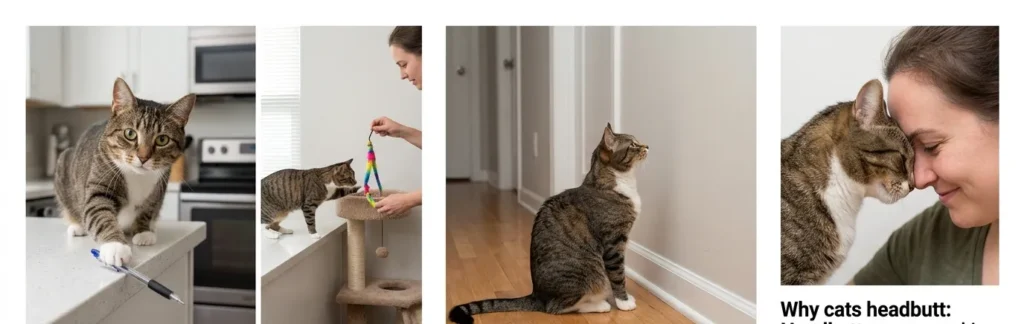
Some indoor cat behavior puzzles aren’t problems at all once you understand the biology behind them. Knowing why does cat knock things off tables is the classic example. Cats push objects off elevated surfaces because the movement triggers their prey-investigation instinct, because they’ve learned it gets a reaction from you, and because they’re testing the physical properties of objects the way a predator tests potential prey. It’s annoying, but it isn’t malicious and it isn’t random.
Knowing why does cat stare at wall usually has a straightforward explanation: cats hear insects, rodents or pipes inside walls at frequencies humans can’t detect. The stare is a cat investigating a sound source. Occasional wall staring is completely normal. A cat that stares at the same spot daily for extended stretches, especially alongside other behavior changes, is worth a vet mention.
Knowing why does cat headbutt me is the nicest question on this list. Headbutting is a scent-marking behavior. The cat deposits scent from glands on its forehead onto you to claim you as part of its social group. It isn’t annoying behavior. It’s one of the clearest signals of trust and affiliation a cat can offer.
Knowing why does cat sit on my laptop comes down to warmth, proximity to your attention and the scent of a frequently used object. Cats are drawn to warm surfaces and to things that carry your scent. The laptop is warm, it smells like you, and sitting on it produces the focused attention that sitting elsewhere doesn’t. A heated blanket or pad next to your workspace redirects this within a week.
Two more behaviors that come up constantly but rarely get their own section:
- Kneading: the rhythmic pushing motion with the front paws, sometimes on you and sometimes on a blanket, traces back to nursing behavior from kittenhood. It’s a comfort and contentment signal, not a problem to solve, even when the claws catch on skin or fabric. Trimming claws regularly makes it more comfortable for you without discouraging the behavior itself.
- Chattering at birds: that fast jaw-clicking sound a cat makes watching birds or squirrels through a window combines predatory excitement with frustration at not being able to reach the prey. It’s harmless and, if anything, a sign the cat’s hunting instinct is intact and looking for an outlet, which is exactly what daily wand play is for.
Why Your Indoor Cat Bites for No Reason and What to Do?
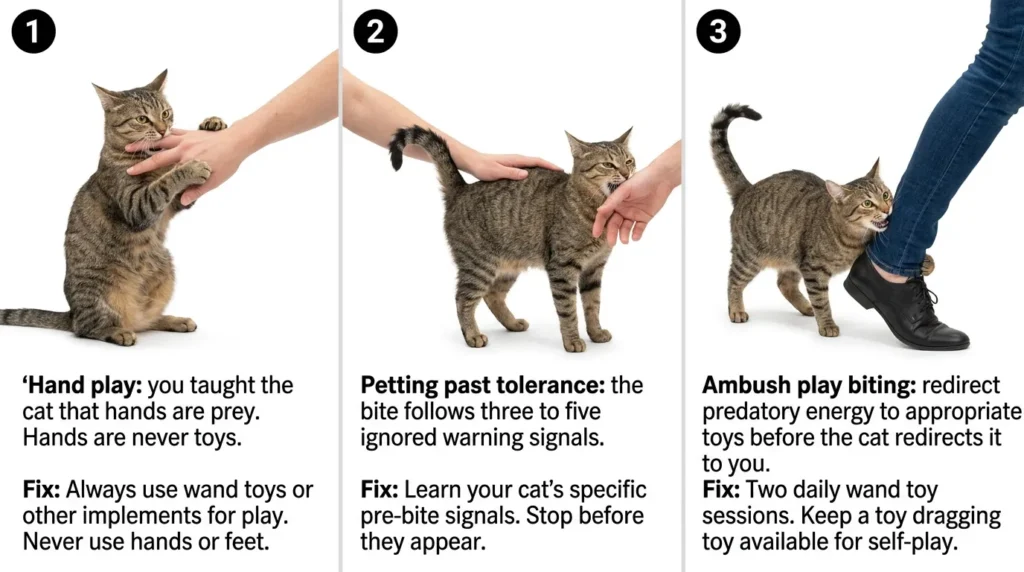
The phrase “bites for no reason” is the most common behavior complaint, and it’s always inaccurate. Knowing why does cat bite me for no reason almost always turns up a reason that was there all along. The three most common indoor cat biting causes are hand play that taught the cat hands are toys, petting sessions that ran past the cat’s overstimulation threshold, and redirected predatory energy with no appropriate outlet.
Hand play is the most preventable cause. Every time an owner wiggles fingers at a kitten or lets a cat bat and bite their hand during play, they teach the cat that human skin is an acceptable prey substitute. Kittens that learn this carry it into adulthood, when their jaws and claws are a lot more capable of causing injury. Never use hands or feet as play objects with a cat of any age.
The fix for biting from insufficient outlet is the same fix as nighttime activity: structured daily play with a wand toy before the evening meal. A cat that plays to genuine tiredness every evening has discharged its predatory drive appropriately and has no leftover impulse to redirect onto ankles passing in the hallway.
Why Do Indoor Cats Overgroom or Suddenly Hide?
Overgrooming and sudden hiding get grouped together because they’re both quiet, easy-to-miss stress signals, unlike aggression or scratching, which are impossible to ignore.
Overgrooming shows up as bald patches, thinning fur or skin that looks raw, usually on the belly, inner legs or flanks, spots a cat can easily reach with its tongue. Allergies, fleas and pain both cause it, so a vet visit always comes first. Once medical causes are ruled out, overgrooming is a stress-coping behavior, similar to nail-biting in people. The fix is identifying and reducing the stressor, whether that’s a new pet, a schedule change, construction noise or a territorial dispute with another cat, alongside more enrichment to give the cat something else to do with the excess energy.
Sudden hiding, especially in a cat that’s normally social, is one of the more reliable early signs of illness or pain in cats, since hiding is an instinctive response to feeling vulnerable. If a previously outgoing cat starts spending most of the day under the bed with no obvious environmental trigger, that warrants a vet visit before anything else. If a specific stressor is identifiable, like a new pet, houseguests or a loud renovation, giving the cat a quiet, defensible space with food, water and a litter box nearby, and letting it re-emerge on its own timeline, usually resolves it within a week or two.
Everything We Cover on Indoor Cat Behavior: Your Full Resource Library
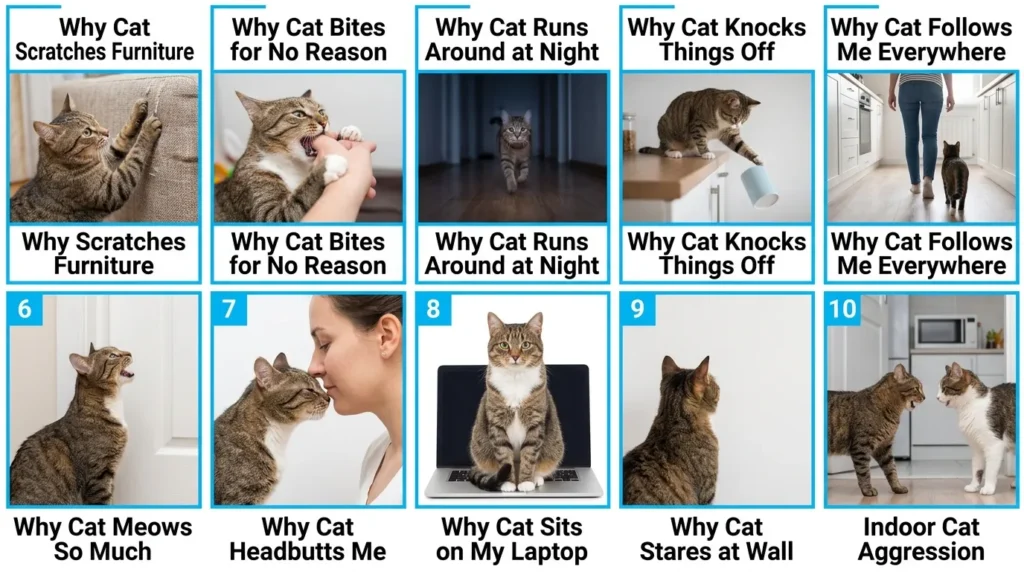
Find the one matching your most immediate problem and start there.
Why Does My Indoor Cat Scratch Furniture?
This article goes deep on the biology of scratching, why the location of the scratching post matters as much as the post itself, and the step-by-step redirect protocol that works on cats that have been scratching furniture for years. It includes specific material comparisons and the exact placement rule that produces results within 48 hours.
Get the full redirect guide in our article on why does indoor cat scratch furniture.
Why Does My Cat Bite Me for No Reason?
This article distinguishes the four most common bite types by cause and gives a specific intervention for each. It covers how to identify your cat’s individual pre-bite signals, the hand-play mistake that creates biting habits and the daily play protocol that resolves most biting problems within two weeks.
Understand and fix it in our article on why does cat bite me for no reason.
Why Does My Indoor Cat Run Around at Night?
This article explains the crepuscular biology behind nighttime cat activity and gives the specific play-then-feed evening sequence that stops nighttime zoomies in most cats within five to seven days. It also covers hunger waking, medical waking and how to tell the difference.
Get the evening routine solution in our guide on why does cat run around at night.
Why Does My Cat Knock Things Off Tables?
This behavior frustrates owners who read it as spite, but the reality is more interesting and more solvable. This article covers the three overlapping reasons cats knock objects off surfaces and gives the specific enrichment and environmental changes that end counter clearing as a go-to behavior in most cats within a week.
Read the full explanation in our article on why does cat knock things off tables.
Why Does My Cat Follow Me Everywhere?
Following behavior sits on a spectrum from charming to genuinely concerning, and this article covers the full range. It explains the social and environmental factors behind velcro cat behavior, tells normal social following apart from anxiety-driven following, and gives the enrichment changes that give a cat more to do when it isn’t shadowing you.
Get the full breakdown in our article on why does cat follow me everywhere.
Why Does My Indoor Cat Meow So Much?
Excessive meowing is learned behavior in most cases, and this article explains exactly how it gets learned and how to undo it without creating more anxiety. It also covers the specific medical causes of increased vocalization that require a vet visit and how to tell behavioral meowing apart from medical meowing based on context and pattern.
Find the cause and fix in our guide on why does indoor cat meow so much.
Why Does My Cat Headbutt Me?
Headbutting is one of the most positive behaviors a cat can direct at a human, and this article explains the full biology of feline scent-marking social behavior. It also covers the related behaviors of cheek rubbing and slow blinking that make up the feline social bonding vocabulary most owners never fully learn to read.
Learn what your cat is communicating in our article on why does cat headbutt me.
Why Does My Cat Sit on My Laptop?
This behavior has a completely predictable cause and an equally predictable fix. This article explains why the laptop is specifically attractive to cats beyond the obvious warmth factor and gives the three-step redirect approach that keeps most cats off keyboards within five to seven days of consistent effort.
Get the practical fix in our article on why does cat sit on my laptop.
Why Does My Cat Stare at the Wall?
Most wall staring is entirely normal, but knowing when it crosses into a health concern means understanding the difference between sensory investigation and neurological episodes. This article covers the specific behavioral markers that separate normal wall monitoring from the repetitive patterns that call for a vet check.
Read the full explanation in our guide on why does cat stare at wall.
Indoor Cat Aggression: Causes and Solutions
This is the most complete resource in the library for owners dealing with cat aggression in small spaces. It covers all five aggression types found in indoor cats with specific triggers, warning signals and step-by-step management protocols for each. It includes the redirected aggression scenario that produces the most dangerous and surprising bites.
Get the full aggression guide in our article on indoor cat aggression causes solutions.
| Owner’s Tip
Every article linked above connects back to this guide when you want to see the full behavior picture. IndoorLivingCat.com covers all these behaviors with the specific context of apartment and small-home cat ownership, where territorial stress and enrichment deficits are the most common root causes. The most important thing I know about indoor cat behavior problems after years of ownership: if the behavior is new and the cat has been stable for months, something in the environment changed. Find that change before trying any intervention. Behavioral interventions applied to the wrong cause fail every time. |
How to Prevent Indoor Cat Behavior Problems Through Enrichment?
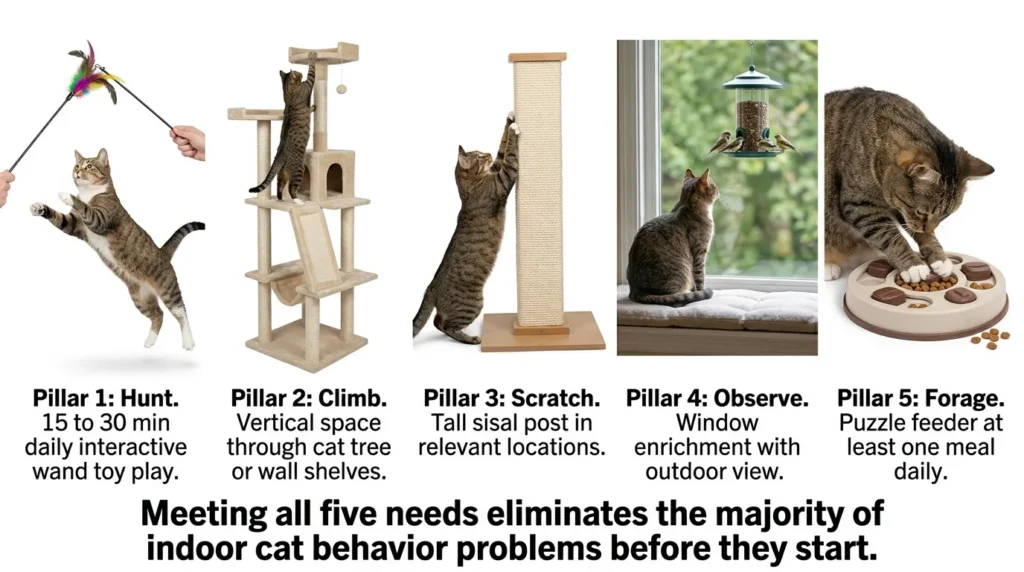
Prevention beats intervention for every indoor cat behavior problem in this guide. A cat whose environment meets all five core behavioral needs rarely develops the problems that bring owners to this page. The five pillars of feline environmental enrichment identified by feline veterinary medicine cover the specific needs that indoor environments most commonly fail to meet.
The five pillars and what they address in behavior terms:
- Hunt: 15 to 30 minutes of daily wand toy play discharges predatory energy that otherwise becomes nighttime activity, biting, counter-clearing and attention-seeking.
- Climb: vertical space through a cat tree or wall shelves gives territorial security that reduces the background anxiety driving aggression and stress-related behaviors.
- Scratch: sanctioned scratching surfaces placed in relevant locations redirect furniture scratching without punishment or deterrent.
- Observe: window enrichment with an outdoor view meets the instinct to monitor territory in a way indoor confinement otherwise blocks entirely.
- Forage: puzzle feeders at one meal per day meet the hunting and foraging instinct and cut down on the boredom-eating and attention-seeking that follows instant-access bowl feeding.
A cat whose environment consistently provides all five of these has a genuinely low probability of developing the behavior problems this guide covers. That doesn’t mean problems never appear, but the baseline that prevents most of them is in place.
Checklist: Rule Out Medical Causes Before Any Behavioral Fix
Run through this before starting any behavioral intervention. If any of these apply, book a vet visit first.
- Behavior started suddenly in a previously stable cat
- Any straining, crying or visible discomfort in the litter box
- Blood in urine or stool
- Noticeable weight loss or gain without a diet change
- Increased or decreased thirst and appetite
- Bald patches, raw skin or excessive licking in one area
- Behavior paired with lethargy or hiding for more than a day or two
The Most Common Mistakes When Dealing With Indoor Cat Behavior Problems
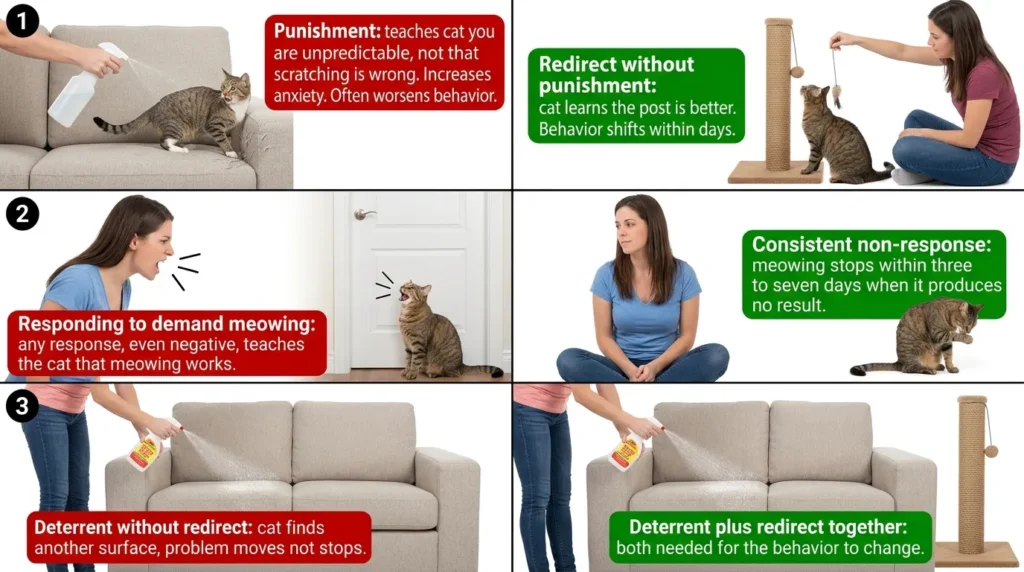
The most common indoor cat behavior problem mistake is punishment. Spraying water, making loud noises or physically moving a cat away from a problem behavior doesn’t address the underlying need driving it. It teaches the cat that certain behaviors are only unsafe when you’re present, and it produces ongoing anxiety that often generates additional problem behaviors.
The second most common mistake is applying a deterrent without a redirect. Bitter spray on the couch with no sanctioned alternative beside it tells the cat where not to scratch, not where to scratch instead. The deterrent just moves the problem to a different surface. The redirect solves it.
The third mistake is assuming that a behavior that’s been happening for months can’t be changed. Most indoor cat behavior problems respond well to environmental modification within two to four weeks of consistent effort, regardless of how long the behavior’s been established. The behavior formed in response to an environment. Change the environment and the behavior changes with it.
Frequently Asked Questions About Indoor Cat Behavior Problems
Why does my cat ignore the scratching post I bought?
The most common reasons are wrong location and wrong height. A scratching post in a corner away from the furniture your cat already scratches gets ignored, because cats scratch to mark territory in prominent, visible locations. Move the post directly beside the furniture they’re targeting. The second most common reason is that the post is too short. It needs to be tall enough for your cat to scratch at full vertical stretch, typically 28 to 34 inches. Most commercially sold posts fall short of that.
How do I stop my cat from waking me up at night?
The play-then-feed sequence is the most reliable fix. Play actively with a wand toy for 15 to 20 minutes immediately before the final meal of the evening. This burns off predatory energy, and the meal completes the hunt-eat-sleep cycle. Most cats adjust within five to seven days. If nighttime waking is a sudden new behavior in a cat that previously slept well, a vet check is warranted to rule out hyperthyroidism or pain.
Why has my cat suddenly become aggressive toward my other cat?
Sudden inter-cat aggression in a household where the cats previously got along is almost always triggered by a resource shortage or an external stressor causing redirected aggression. Check whether an outdoor cat has started appearing at windows recently. Also audit resources: are there enough litter boxes, feeding stations and elevated resting spots that neither cat has to pass the other to reach any of them? Temporary separation and a slow reintroduction protocol resolves most sudden inter-cat aggression. Always check with your vet to rule out pain as a trigger.
My cat bites during petting even though it seems relaxed. Why?
The cat hit its petting tolerance threshold, and you missed the warning signals that came before the bite. Common pre-bite signals: tail beginning to flick or curve, ears flattening slightly, skin along the back rippling, head turning to watch your hand. These signals show up several seconds before the bite. Keep petting sessions short and stop at the first tail flick. Let the cat re-initiate contact. Most cats extend their petting tolerance considerably once they learn that contact ends before it turns unpleasant.
Is my cat being destructive on purpose to get back at me?
No. Cats don’t experience spite or revenge as motivating emotions. Every behavior that looks retaliatory has a specific environmental or physiological cause behind it. Counter clearing, litter box avoidance and furniture destruction all happen because an environmental need is unmet, not because the cat is expressing displeasure. This reframe matters because it shifts the fix from managing a cat’s emotions to solving an environmental problem, which is always more effective.
How many litter boxes do I actually need?
The standard rule is one box per cat, plus one extra, so a single cat needs two boxes and a two-cat household needs three. Spread them across different locations rather than lining them up side by side, since two boxes next to each other function as one option to a cat that’s already stressed about access.
Why does my cat knead blankets or me before lying down?
Kneading traces back to nursing behavior from kittenhood, when kittens pushed against their mother to stimulate milk flow. Adult cats keep the motion as a comfort and contentment signal. It’s not a behavior problem and doesn’t need a fix, though trimming claws regularly makes it more comfortable if your cat kneads directly on you.
Why does my cat make a chattering sound at birds through the window?
That fast jaw-clicking noise combines predatory excitement with frustration at not being able to reach the prey. It’s a normal, harmless behavior and, if anything, a sign your cat’s hunting drive is intact and needs an outlet, which is exactly what daily wand toy play provides.
When should an indoor cat behavior problem prompt a vet visit?
Any sudden behavior change in a previously stable cat calls for a vet visit before any behavioral intervention. Specifically: litter box avoidance combined with increased frequency of attempts or visible straining needs a same-day call. Sudden aggression in a previously gentle cat. Increased water intake alongside behavior changes. Nighttime disorientation or vocalization in a senior cat. Repetitive stereotyped behaviors like spinning, compulsive grooming or wall-staring. These are all medical symptoms expressed through behavior. This is for informational purposes only. Always consult your vet for diagnosis.
Start Here: The One Change That Addresses Most Indoor Cat Behavior Problems
Most indoor cat behavior problems trace back to three fixable conditions: insufficient daily play that leaves predatory energy with nowhere to go, a territorial stressor that hasn’t been identified or removed, and a resource shortage in multi-cat homes that creates chronic low-level competition. Fix any one of these and behavior typically improves within two weeks.
If you’re starting right now, begin with the play session. Schedule 15 to 20 minutes of wand toy play immediately before the evening meal tonight. Our article on indoor cat aggression causes solutions gives you the most complete intervention guide for the indoor cat behavior problem that causes the most owner distress and the most cat surrenders.
Every specific behavior in this guide has its own in-depth article in the resource library above. Start with the behavior affecting your household most right now and build from there.
Indoor cat behavior problems including scratching furniture, litter box avoidance, nighttime activity, excessive meowing, biting, overgrooming and inter-cat aggression almost always trace back to insufficient enrichment, territorial stress, resource shortage or an undetected medical condition. Always rule out medical causes before behavioral intervention. The most effective prevention is 15 to 30 minutes of daily interactive wand toy play, adequate vertical space, one litter box per cat plus one extra, and separate resource stations in multi-cat homes. Punishment worsens most indoor cat behavior problems by increasing anxiety. Redirect and enrich instead.