
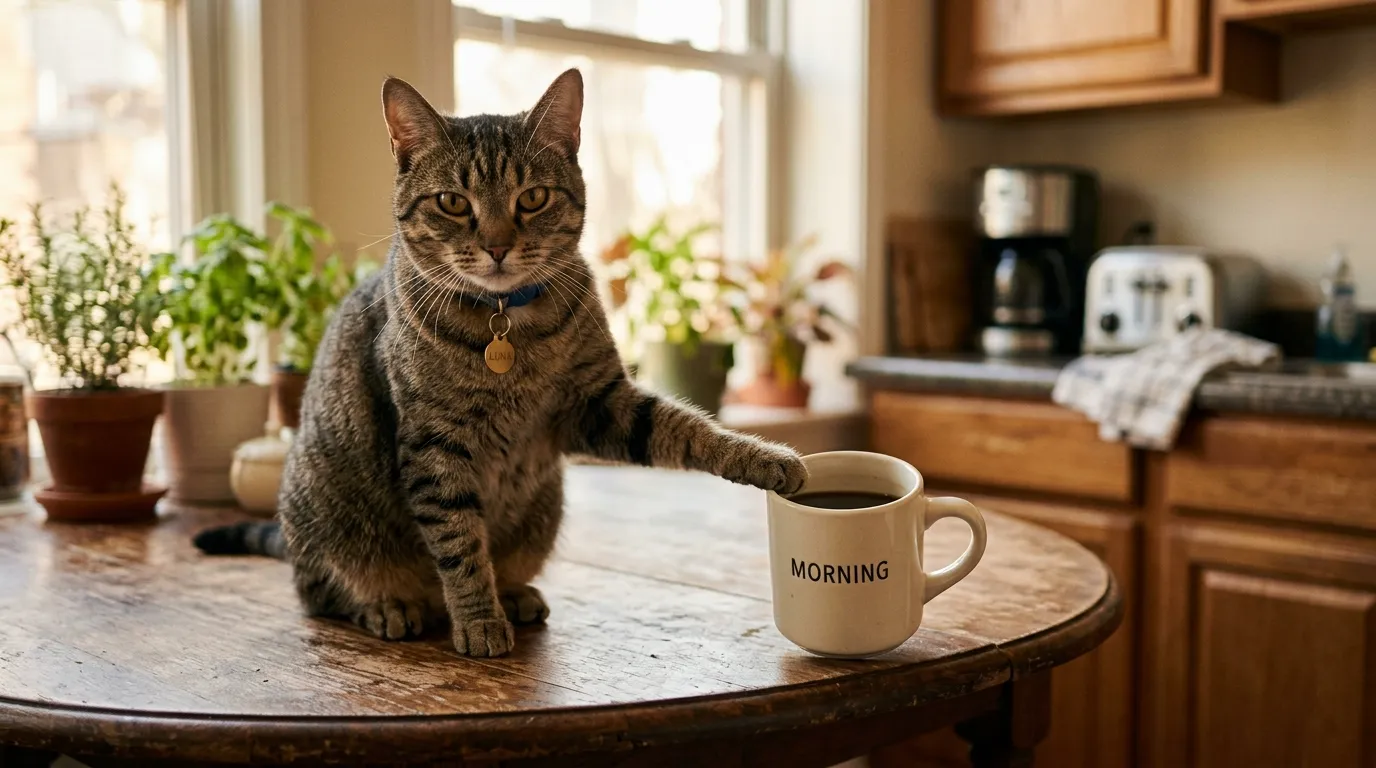
My cat once stared at me for four straight minutes before knocking my full glass of water off the counter with one slow, deliberate paw. It felt personal. It wasn’t.
Why does cat knock things off tables? Five real reasons: hunting instinct testing whether an object is alive, tactile exploration through sensitive paw nerve endings, cause-and-effect learning about gravity and sound, attention-seeking because it reliably gets a human reaction, and a blind spot under your cat’s chin that causes genuine accidents. The same causes apply whether it’s a table, a counter or a desk. This guide covers all five, including one cause most articles skip, plus the two fixes that actually work. This piece sits under our broader indoor cat behavior guide, itself part of our full indoor cat care resource, if you want the wider picture beyond this one habit.
- Hunting instinct: a paw test to see if the object reacts like prey.
- Tactile exploration: paw pads gather texture and weight data your cat’s eyes can’t.
- Cause and effect: she’s learning that a push equals a fall equals a sound.
- Attention seeking: she’s learned this behavior reliably gets you to appear.
- The blind spot: cats can’t see directly under their own chin, so some knockoffs are true accidents.
| Cause | What it looks like | What helps |
|---|---|---|
| Hunting instinct | Slow, focused paw taps, often with eye contact first | Daily wand play before mealtime |
| Tactile exploration | Repeated touching of new or textured objects | Rotate safe objects she can investigate |
| Cause and effect | Pushing the same item off more than once | Remove the object from the surface |
| Attention seeking | Happens only when you’re in the room | Complete non-engagement |
| Blind spot accidents | Cat looks confused or unbothered after | Give close-up items more table space |
The Real Reason Cats Knock Things Off Tables
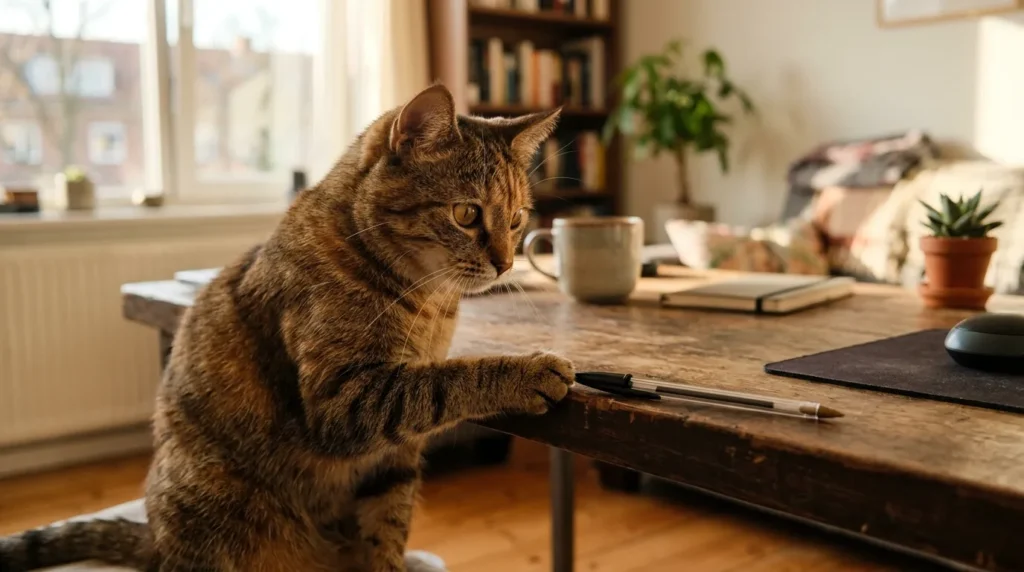
Before a wild cat commits to a kill, she tests whether the target is alive by batting at it. A live animal reacts. A dead or inanimate one doesn’t. Your cat runs the same test on your coffee mug, your pen and your phone charger.
When the object moves, her brain logs a prey signal. When it falls and makes a sound, the loop closes even tighter, since a thud maps to the noise a caught animal would make. Indoor cats get no real hunting experience, so this loop runs on repeat. Every table becomes a stand-in hunting ground.
This isn’t malice. It’s biology looking for an outlet that apartment life doesn’t provide. Learning how your indoor cat’s instincts drive her daily behavior makes this pattern, and most others that look random, a lot easier to read.
Why Cats Go Specifically for Food, Wrappers and Packaging
A separate, more specific version of this behavior shows up around food. A cat that ignores your pens and coasters but reliably attacks a bag of chips or a foil-wrapped sandwich isn’t running the predatory test. She’s after the smell and texture inside the packaging, and knocking it to the floor is often just a side effect of pawing at the wrapper to get it open. Crinkly plastic also mimics prey rustling closely enough to trigger genuine hunting interest on its own. The fix here is simpler than the general behavior: keep food sealed in a cabinet or drawer rather than on an open counter, since removing the trigger works faster than any training approach.
The Blind Spot Under Your Cat’s Chin (The Cause No One Mentions)
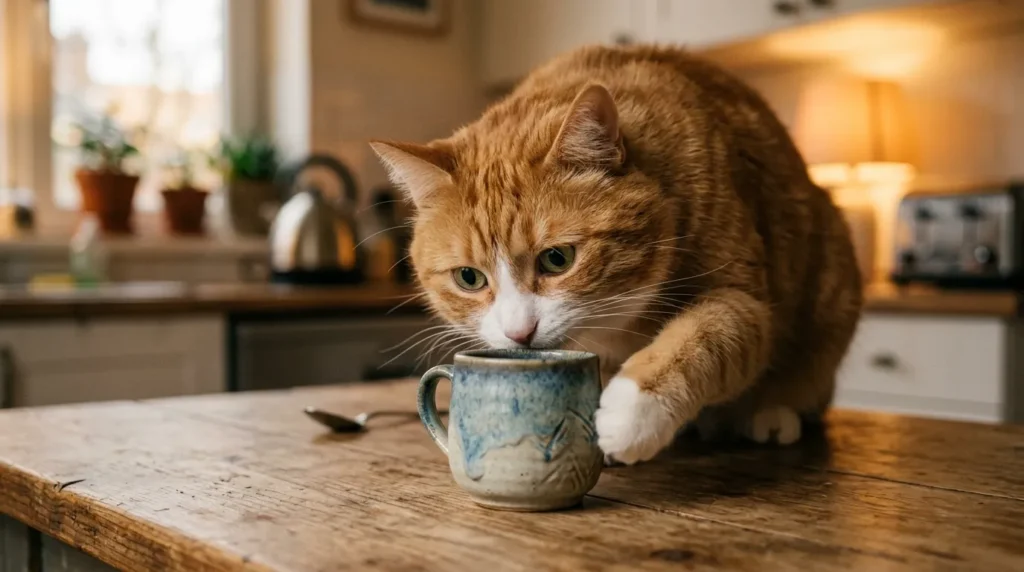
Cats see well at a distance, but they have a blind spot directly under their chin and nose. Once she gets close enough to inspect something at nose range, she can’t actually see it anymore. Her paw reaches for where the object used to be, guided by memory and proprioception instead of sight.
That means a real chunk of table knockoffs are accidents, not tests. She wasn’t pushing the object on purpose. She was reaching toward a spot she could no longer see clearly, and her paw happened to land on it. It falls. She looks completely unfazed, because from her side, she was just aiming at a target she’d briefly lost.
Most articles on this topic skip the blind spot entirely and label every knockoff as deliberate testing. That’s an easy read on the behavior, but it isn’t always the accurate one.
Why Paw Pads Make Tabletop Testing Feel Rewarding
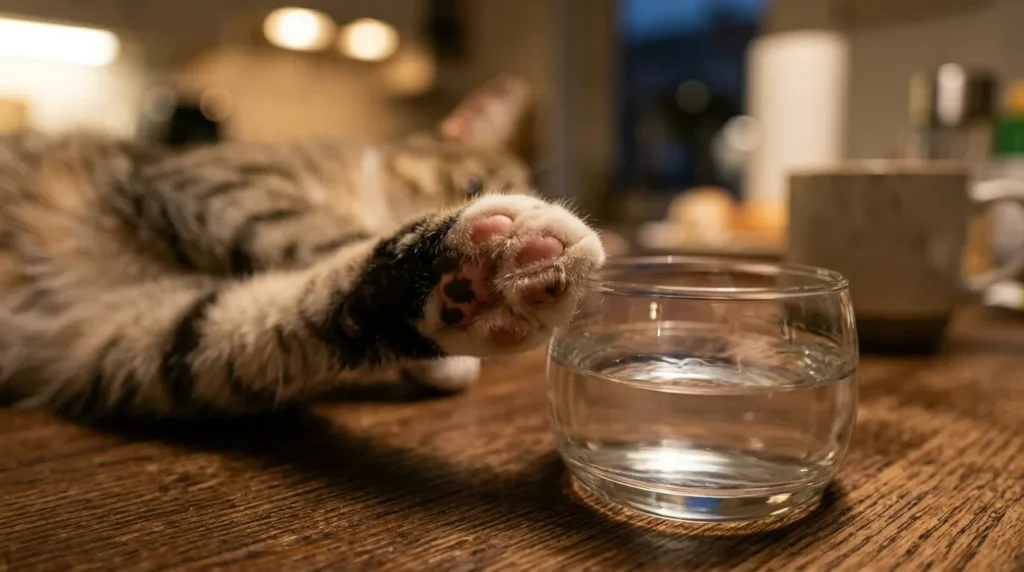
Cat paw pads carry a dense cluster of nerve endings called mechanoreceptors. They pick up vibration, texture, temperature and surface stability with real precision. When your cat touches your glass, she’s collecting data on its material, weight and surface in a way her eyes can’t fully deliver. This object manipulation is sensory intelligence, not mischief.
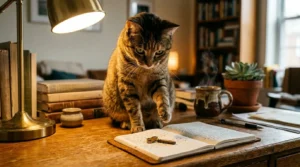
Indoor cats lean on this more than outdoor cats because their sensory world is a lot smaller. An outdoor cat brushes past hundreds of textures a day. An apartment cat meets the same ten surfaces on repeat. A new object on the table is genuinely interesting, not a threat to her territory.
A warm coffee mug feels nothing like a cool glass or a rough book cover under a paw. Each one gives different feedback, and working through that feedback is real mental stimulation, the kind indoor cats need but rarely get enough of.
Why Indoor Cats Knock Things Off Tables More Than Outdoor Cats
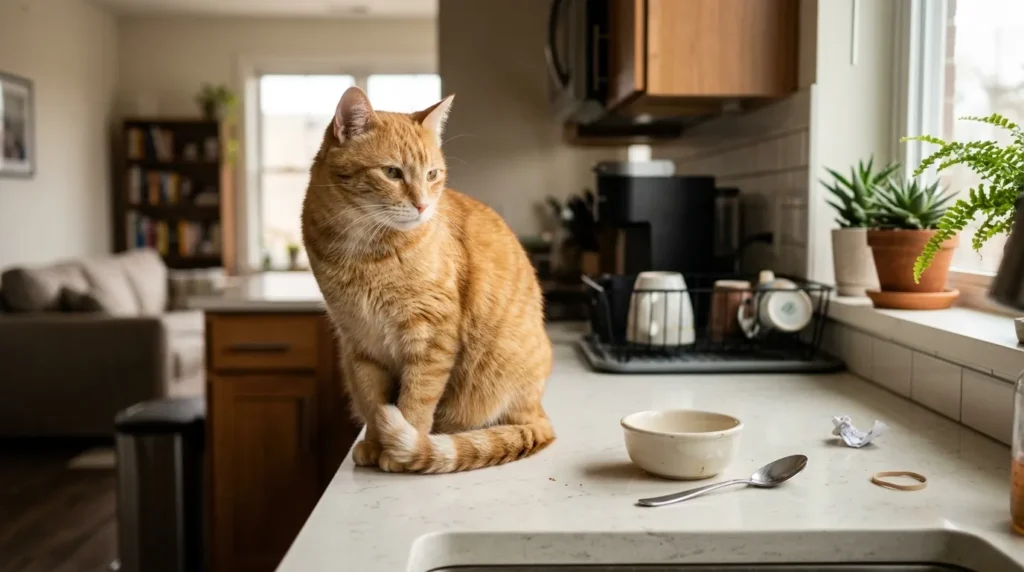
Three things separate indoor cats from outdoor ones here, and they compound each other.
- Fewer surfaces to explore, so any new object gets concentrated attention
- More daily contact with you, so more chances to learn that knocking things down gets a human reaction
- More pent-up energy with fewer natural outlets to burn it off
The attention piece is worth naming directly. The first time your cat pushed something off the counter and you appeared and spoke to her, that response landed as a reward, regardless of your tone. The behavior produced attention. Attention is what she wanted. She’ll do it again.
This isn’t a stretch. Research out of Oregon State University found that cats form real attachment bonds with their caregivers, similar in structure to the bonds seen in dogs and human infants. A cat that’s attached to you isn’t just tolerating your presence, she actively seeks interaction with you, and knocking something off a table is one of the more reliable ways she’s found to get it.
Adding vertical space and mental challenges for your indoor cat takes pressure off the behavior that table-clearing partly relieves. Daily enrichment built into a set routine addresses the boredom driving the more persistent cases. Setting up apartment life around your cat’s needs leaves fewer unmet instincts looking for an outlet.
How to Stop Your Cat From Knocking Things Off Tables
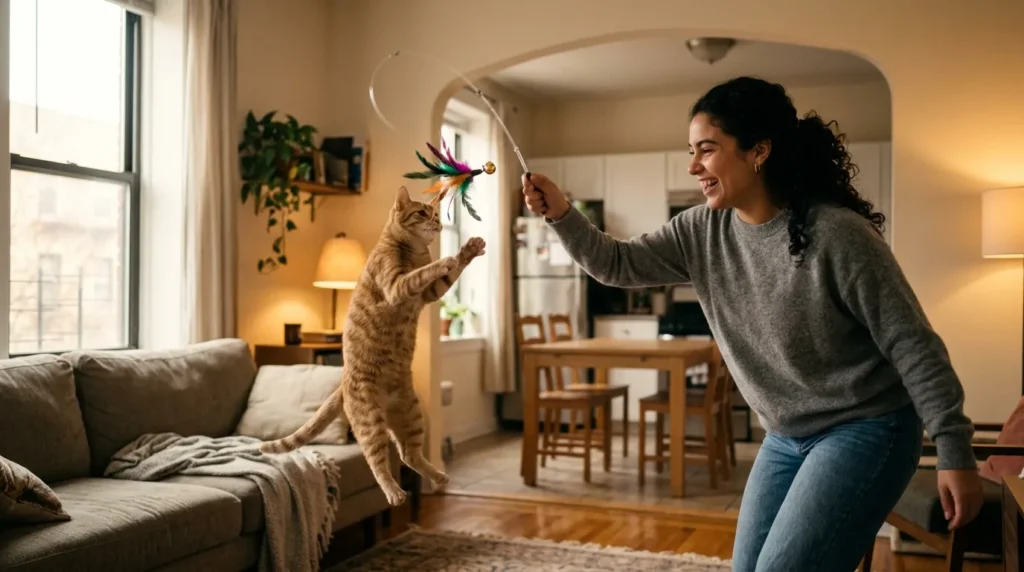
- Run the hunt-catch-eat cycle before her risky hours. Play with a wand toy for 10 to 15 minutes, then feed her right after. This closes the predatory loop that table-batting only half satisfies. Most owners see a real drop in table clearing within one to two weeks.
- Go completely quiet when it happens. No words, no reaction, just walk away. This pulls the attention reward out of the pattern. It’s hard, since the urge to react is strong, but any response, even a scolding, tells her the behavior works. Give it two to four weeks of consistent non-engagement.
- Clear the table of anything she’s already targeted. This is practical, not lazy. A cat who can’t reach her favorite object redirects that energy elsewhere. Double-sided tape or a sheet of crinkled aluminum foil on table edges she uses as launch points works as a deterrent too, since most cats dislike the texture underfoot.
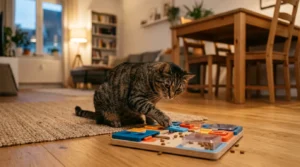
The honest part: if your cat makes deliberate eye contact before pushing something off, she has already learned that it gets your attention. She isn’t being cruel. She’s being effective. The fix is making it stop working, full stop.
Wand Play vs Non-Engagement: Which One First?
| Method | Best for | Time to see change | Effort level |
|---|---|---|---|
| Wand play + feeding | Hunting-driven testing, high energy cats | 1-2 weeks | 10-15 minutes, twice daily |
| Non-engagement | Attention-seeking, learned behavior | 2-4 weeks | Low effort, high patience |
Most cats respond best to both run together. Wand play drains the hunting drive. Non-engagement removes the payoff for the attention-seeking version. Building a consistent feeding routine makes the first method far easier to stick to, since the play session leads straight into a meal your cat already expects.
The Mistake That Makes Table Knocking Worse

Any consistent reaction turns occasional investigation into a daily show. Getting up, talking to her, picking the object up while she watches, even a frustrated sigh, all of it reads as successful attention capture. She ran the experiment. The hypothesis held: pushing things off surfaces gets you to interact with her.
Punishment adds a second problem on top. A scolded cat learns to knock things off when you aren’t watching, not to stop doing it. She hasn’t learned the behavior is wrong. She’s learned that doing it in front of you gets a bad outcome, so she waits until you leave the room.
Grooming and feeding routines can absorb some of the attention she’s chasing through table knocking. A regular at-home grooming schedule gives her structured one-on-one time that doesn’t depend on knocking anything down first. Household stress plays a role too, and keeping litter box habits steady and predictable takes one source of stress off the table, sometimes literally.
When Table Knocking Signals a Health Problem
A senior cat who suddenly starts knocking things off tables, after years of never doing it, may be dealing with vision loss. Cats with declining eyesight lean harder on their paw pads to find objects, which shows up as more tactile contact with table surfaces. It’s the blind spot issue, just amplified by real vision decline instead of normal visual limits.
A sharp increase in this behavior alongside more vocalizing or clinginess can point to anxiety, cognitive decline or hyperthyroidism. Those are medical issues, not training problems, and they need a vet visit rather than more enrichment. Keeping an eye on your indoor cat’s overall health is what catches these cases early, before they’re mistaken for a behavior quirk. The Cornell Feline Health Center’s behavior resources are a solid next step if the change is sudden or paired with other symptoms.
This article is for informational purposes only. Always consult your vet if you have concerns about your cat’s health.
Frequently Asked Questions About Cats Knocking Things Off Tables
Is my cat knocking things off the table on purpose?
Sometimes yes, sometimes no. Deliberate pushes are usually attention-seeking. Accidental knockoffs happen during close inspection, thanks to the blind spot under a cat’s chin where she can’t see objects right in front of her paws.
Why does my cat make eye contact before pushing something off?
She’s confirming you’re watching before doing the thing that gets your attention. She’s learned the sequence works. Stop reacting and the behavior fades fast.
Does my cat know it will break?
No. Cats have no concept of value or consequence for breakage. The sound of something shattering is actually rewarding to them, since it maps to a frequency close to the sound of caught prey. Keep fragile items out of reach.
Will more toys stop my cat from knocking things off tables?
Partly. Toys left sitting on the floor won’t do much on their own. Active wand play that completes the hunt-catch sequence cuts the predatory pressure driving the behavior. Ten minutes twice a day makes a real difference.
My cat only does this when I’m in the room. Why?
Because you’re the audience and the reward. Your past reactions trained the behavior. When you leave, the motivation goes with you. Non-engagement is the most direct fix.
Why does my cat only knock food, wrappers or bags off the counter?
This is usually about smell and texture rather than the general testing behavior. Crinkly packaging mimics the sound of small prey, and food scent is its own motivator. Store food in a cabinet or drawer rather than in the open, since removing access solves this version faster than any training method.
Is it unhygienic to let my cat walk on counters and tables?
Litter box contact on paws is the main concern vets raise, since it can carry bacteria onto food-prep surfaces. It isn’t usually a serious health risk in a healthy household with a clean litter box, but wiping counters before food prep and keeping litter box habits consistent lowers the risk further.
Do certain cat breeds knock things off tables more than others?
High-energy, high-intelligence breeds like Bengals, Siamese and Abyssinians tend to test objects more, simply because they have stronger hunting drives and need more stimulation. Breed isn’t the root cause though. Unmet enrichment needs are.
Does spaying or neutering change this behavior?
Not directly. Spaying and neutering reduce hormone-driven behaviors like spraying and roaming, but table knocking is rooted in prey drive and learning, not reproductive hormones. Don’t expect the surgery alone to fix it.
Cats knock things off tables for five real reasons: predatory testing, tactile exploration through paw pad mechanoreceptors, cause-and-effect learning, attention-seeking trained by owner reactions, and genuine accidents caused by the blind spot under a cat’s chin. Food and packaging get knocked off for a separate reason: scent and crinkle sound, not general testing. Indoor cats do it more because they get concentrated human interaction and fewer natural outlets. The fix that works is a 10 to 15 minute wand session followed by feeding, paired with complete non-engagement whenever table knocking happens.

Written by Mishu
A passionate cat lover and indoor living enthusiast, Mishu is the founder and voice behind Indoor Living Cat – a go-to resource for cat owners who want to create the happiest, healthiest life for their feline companions indoors.
View Full Profile