
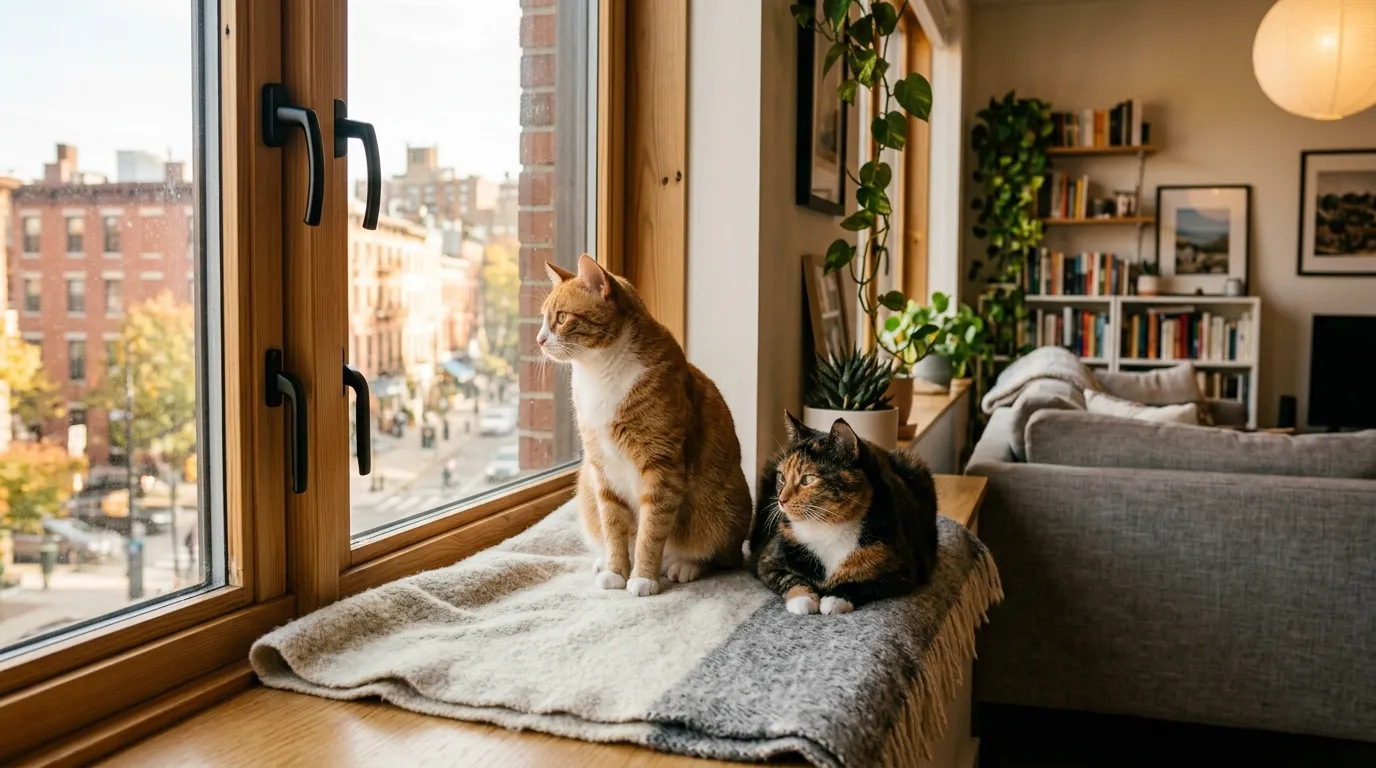
You’ve been going back and forth on one cat versus two for weeks now, and every article you find just repeats “cats are social animals” without touching the fact that you live in 700 square feet and your landlord charges per-pet rent on top of it. The practical side of this decision matters just as much as the emotional side, and most guides skip it entirely. I got a second cat after my first one started shredding the sofa at 2am out of pure boredom, and the change in both cats within a week was obvious. Whether you’re starting from zero or you already have one cat and you’re wondering if it needs a friend, this breaks down exactly when two cats in an apartment works and when one cat is genuinely the smarter call for your space, your schedule and your lease.
Get two cats if you’re adopting kittens, you work away from home eight or more hours a day, or you already have one cat that’s bored, restless and destructive with no fix in sight. Get one cat if you live in a studio, you’re adopting a senior cat, or your lease charges per-pet rent that genuinely strains your budget. The litter box math is the deciding factor most people overlook: two cats need three boxes minimum, and most cats do best with at least 18 to 20 square feet of dedicated personal space each.
Should I Get One Cat or Two for Apartment Life? The Real Decision Factors
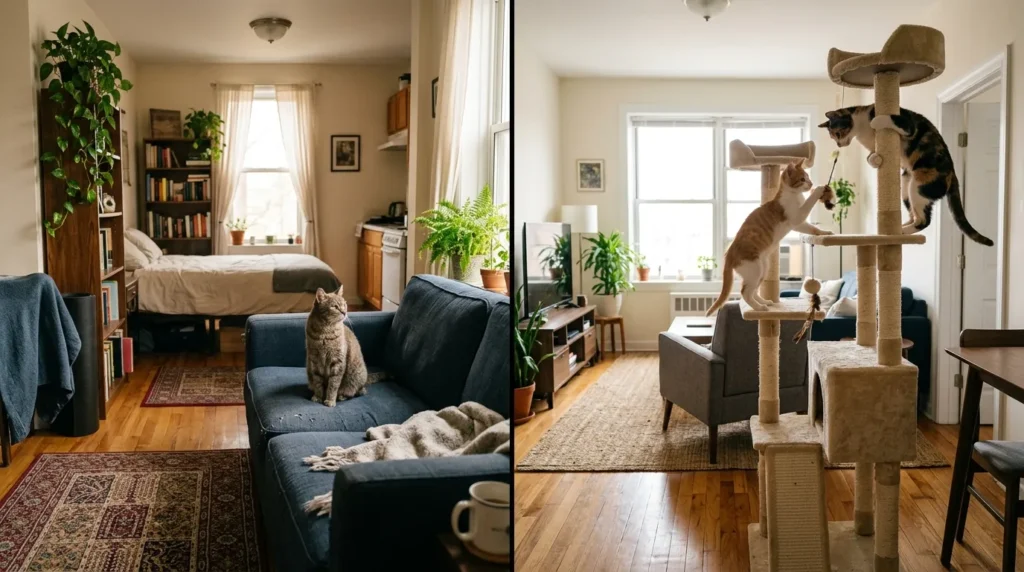
Whether to get one cat or two for an apartment comes down to five concrete factors: your daily schedule, your floor plan, your lease terms, the age of the cat you’re adopting and whether you already have a resident cat at home. Every other consideration flows from these five. “Cats need companionship” is a real argument, but it isn’t universal, and applying it without context is how a lot of owners end up in small apartments with mismatched expectations.
Your daily schedule matters most. A cat left alone in an apartment for eight or more hours every weekday will get bored, destructive or anxious without a companion. A cat whose owner works from home or keeps irregular hours usually gets enough stimulation from human interaction alone. Separation anxiety cases are real, but the problem doesn’t apply equally to every cat in every home.
The age of the cat changes the math entirely. Kittens under twelve months genuinely benefit from a companion for social development, and single kitten syndrome is a documented behavioral pattern where lone kittens develop biting and aggression problems because they had no littermate around to teach them bite inhibition. Adult and senior cats are a different story. Many prefer being the only animal in the household, full stop.
How Much Space Do Two Cats Actually Need?
There’s no single legal standard for how much room a cat needs, but the most commonly cited baseline, the one that traces back to shelter and breeding regulations, puts the bare minimum at 18 square feet of dedicated space per cat. That’s the floor, not the goal. For a cat to actually thrive rather than just survive, most veterinary sources point closer to 200 to 300 square feet of livable space for one cat, factoring in room to run, climb and get away from foot traffic.
Add a second cat and you don’t need to double your square footage. You need to add roughly 18 to 20 square feet of additional dedicated territory per cat, on top of doubling your vertical space and your resource stations (litter boxes, food, water, scratchers, perches). A 650-square-foot one-bedroom apartment clears the minimum for two cats on paper. Whether it clears the comfort threshold depends entirely on how you use the vertical space, which is the next section.
- Bare minimum per cat: about 18 square feet of dedicated space, not counting shared rooms.
- Comfortable minimum for one cat: 200 to 300 square feet of livable area.
- Each additional cat: add roughly 18 to 20 square feet, plus a full second set of resources.
- Vertical space counts. A cat tree or wall shelf adds usable territory without adding floor plan.
The Case for Two Cats in an Apartment: When It Actually Makes Sense
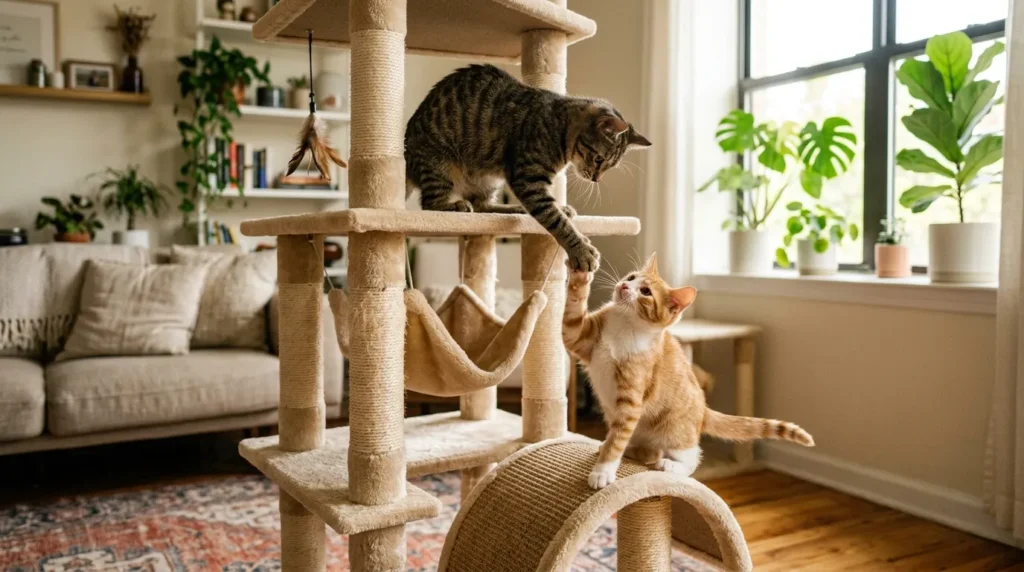
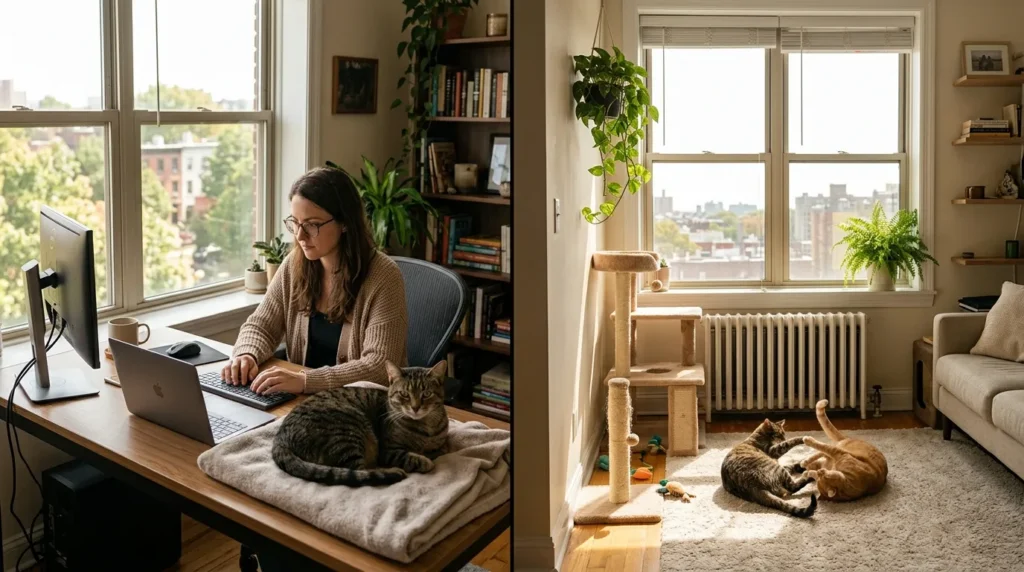
Two cats in an apartment make the most sense when you’re adopting kittens and when you work long hours away from home. Kittens wear each other out in a way no toy, no puzzle feeder and no amount of enrichment fully replicates. A kitten who’s burned off their energy playing with a companion is a kitten who isn’t destroying your belongings while you sleep.
Adopting a bonded pair from a shelter skips the multi-week introduction process that causes so much stress for owners who bring a second cat home later. Bonded pairs arrive already knowing each other, already having worked out their own hierarchy, already comfortable sharing close space. Two strangers rarely get there that fast in a small apartment. Introductions are genuinely harder when there’s limited territory to divide between two cats who’ve never met.
The social structure argument has a practical apartment payoff too, one most people miss: two cats who play together sleep more and rest more than a solo cat with no way to burn off predatory energy. A rested cat doesn’t knock things off shelves at 3am. A bored solo cat absolutely does.
According to the American Association of Feline Practitioners, kittens raised with a companion show measurably better social development and fewer behavior problems as adults than solo-raised kittens. It’s one of the clearest evidence-based arguments for getting two cats at the kitten stage.
The Case for One Cat in an Apartment: When Solo Is the Smarter Choice
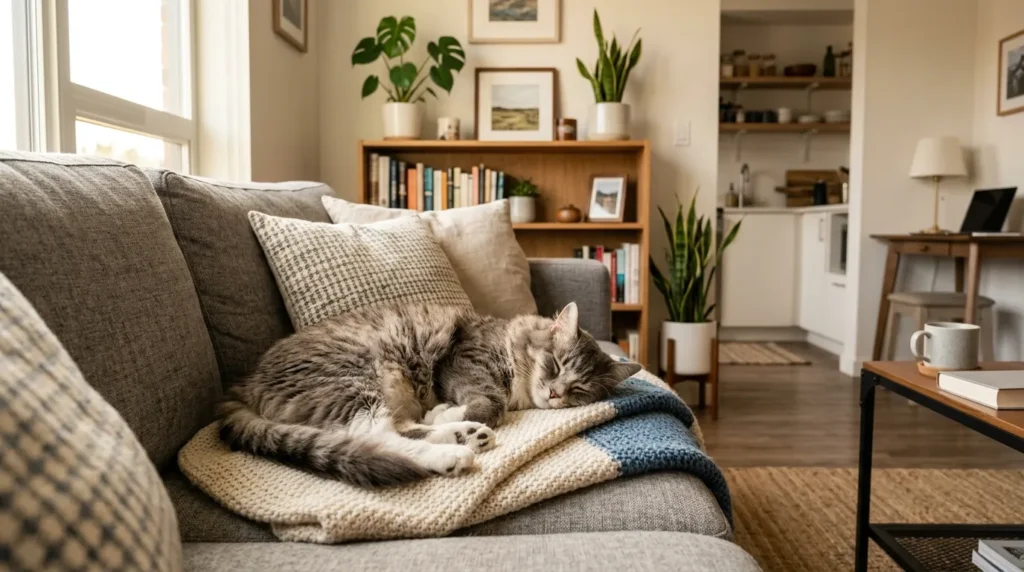
One cat is the right answer for a studio apartment, for anyone adopting a senior cat and for anyone whose lease charges per-pet rent that adds real cost to monthly housing. These aren’t compromises. They’re the correct decision for those situations.

The litter box math is what kills the two-cat plan in a lot of small apartments. The N-plus-one rule means two cats need three litter boxes minimum, and in a 600-square-foot apartment, finding three discreet spots for large open-top boxes is a real spatial problem. If you can’t put three boxes in three different locations, the box competition between two cats can cause litter box avoidance that’s much harder to fix than the boredom problem you were trying to solve in the first place.
Senior cats over seven years old are also, in a lot of cases, better suited to solo apartment living. Plenty of adult shelter cats get labeled “only pet preferred” by their foster home or previous owner for exactly this reason. These cats have spent their whole lives as the sole animal in a house, and adding a second cat creates ongoing stress that lowers their quality of life instead of improving it. A senior cat in a quiet apartment with one dedicated owner is, genuinely, a happy cat.
For the solo cat owner, the fix for boredom isn’t a second cat. It’s structured environmental enrichment that satisfies the predatory cycle: wand toy sessions before meals, window perches with a bird feeder outside, puzzle feeders and toys you rotate in and out. For a full framework on doing this well in a small space, indoor cat enrichment covers apartment-specific strategies that work for single cats.
Already Have One Cat? Here’s How to Know If It’s Ready for a Second
If you already have one cat and you’re reading this because it’s bored, loud, clingy or tearing up the sofa, a second cat can help, but only under specific conditions. It’s not a guaranteed fix, and it’s worth checking your cat against this list before you commit.
Good signs your current cat would welcome a companion:
- It’s under five years old and generally friendly with new people or animals.
- The destructive behavior tracks with boredom (bursts of activity, especially at night) rather than fear or pain.
- It’s never shown aggression toward other cats through windows, at the vet or on walks.
- You have the physical space for two full resource sets: two feeding areas, three litter boxes, separate resting spots.
Signs a second cat will likely make things worse, not better:
- Your cat is a senior, was previously labeled “only pet” by a shelter or foster, or reacts to other cats with hissing or hiding.
- The behavior problem is actually a medical issue. Sudden destructiveness, spraying or excessive vocalizing can signal pain, a UTI or anxiety that a second cat won’t touch. See a vet first.
- You’re in a studio or one-room apartment with no way to separate the cats during introductions.
If you decide to go ahead, the introduction has to be slow. Keep the new cat in a separate room with its own litter box, food and water for the first week. Swap bedding between the two so they get used to each other’s scent before they meet face to face. Do short, supervised visual introductions through a cracked door or baby gate starting in week two, and only let them share the full apartment once a full session passes with no hissing, swatting or prolonged staring. In a small apartment this whole process typically runs four to eight weeks. Rushing it is the single most common reason second-cat introductions fail.
[Image placeholder: step-by-step graphic showing a resident cat and new cat separated by a door during a slow introduction, apartment setting]
Two Cats in a One-Bedroom Apartment: What Actually Works
A one-bedroom apartment, roughly 600 to 800 square feet, is the size range where two cats most often works out and it’s also where people most often set it up wrong. The floor space usually clears the minimum. The layout doesn’t automatically.
The bedroom and the living room need to function as two separate zones, not one shared free-for-all. Put a cat tree or a set of wall shelves in each room so both cats have a high perch to retreat to without crossing the other’s path. Split the litter boxes between rooms too, one in the bathroom, one near the entry or a hallway closet, one tucked into a corner of the bedroom. Never cluster all three boxes in one spot. That defeats the entire point of having three.
Feeding is the other place one-bedroom apartments go wrong. Two bowls sitting six inches apart on the same counter is still a shared resource as far as a nervous cat is concerned. Put one feeding station in the kitchen and a second one in a completely different room, even if it’s just a placemat on top of a low bookshelf in the bedroom. That single change resolves most of the guarding and gulping behavior owners see in tight one-bedroom setups.
A closet, a home office nook or even a covered bed in a quiet corner gives each cat somewhere to be alone, which matters more in 700 square feet than it does in a house. Cats that can’t get away from each other when they want to are cats that start fighting over territory that was never divided up to begin with.
The Litter Box Math and Space Reality Nobody Talks About
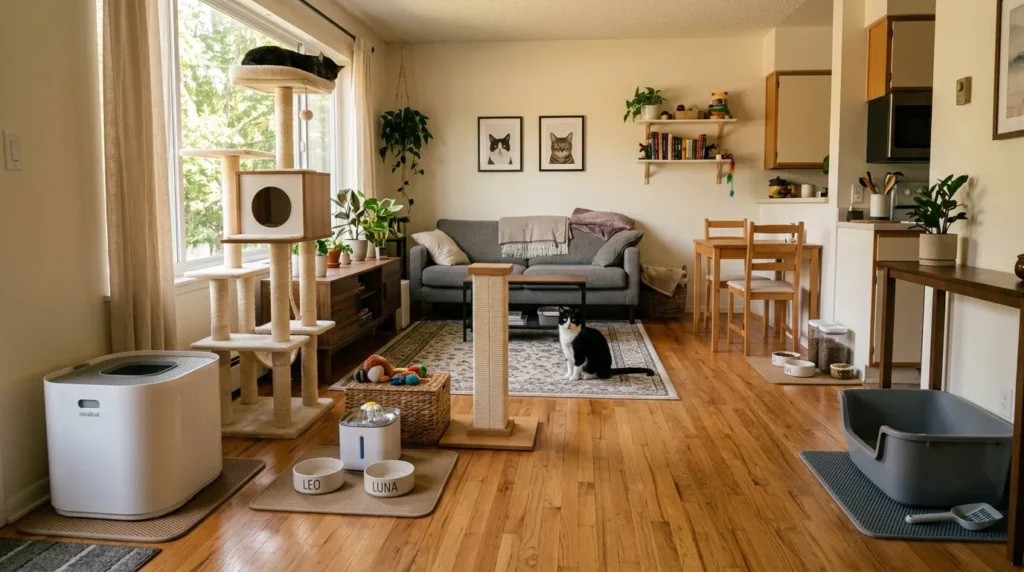
Two cats in an apartment don’t need double the floor space, but they do need double the vertical space and double the resource stations. This is where owners who get two cats in a small apartment run into friction. They set up one feeding station, one litter box, one sleeping spot, and then wonder why one cat guards everything while the other grows anxious.
Two separate feeding stations in different parts of the apartment prevent resource guarding and let both cats eat without social pressure. Cats sharing a single feeding spot will always sort into a dominant one and a subordinate one, and the subordinate cat ends up eating less, eating faster and developing anxiety around mealtime. The same logic applies to water stations.
Vertical territory is the most efficient use of square footage in a multi-cat home. A floor-to-ceiling cat tree, a set of wall-mounted shelves at varying heights and a window perch in a separate room give two cats enough distinct territory to avoid constant conflict, without eating up more floor space than a single cat needs. The cats end up using different levels of the apartment the way people use different floors of a house.
Straight Talk Check your lease before you fall in love with the idea of two cats. Many apartment leases charge $30 to $50 per month per additional pet, which adds $360 to $600 a year to your housing cost before food, litter or vet bills come into the picture. That’s a real number, and it matters. Know it before you decide, not after.
The Decision Matrix: One Cat or Two Based on Your Actual Situation
| Factor | Get One Cat | Get Two Cats |
| Daily schedule | Work from home or rarely away | Away 8 or more hours daily |
| Living space | Studio or loft under 500 sq ft | One bedroom or larger with vertical potential |
| Space per cat | 200+ sq ft available for one cat | Roughly 18–20 sq ft extra available per additional cat |
| Budget | Minimize monthly costs | Can absorb doubled food, litter and vet expenses |
| Cat age | Adopting a senior, 7 years or older | Adopting kittens under 12 months |
| Existing cat | Resident cat is a senior or previously labeled “only pet” | Resident cat is young, social and space allows two full resource sets |
| Litter box space | Room for one or two boxes | Room for three boxes in separate locations |
| Lease terms | Per-pet rent or two-pet cap already met | Lease allows two pets with manageable fees |
The Biggest Mistakes When Choosing Between One Cat or Two for an Apartment
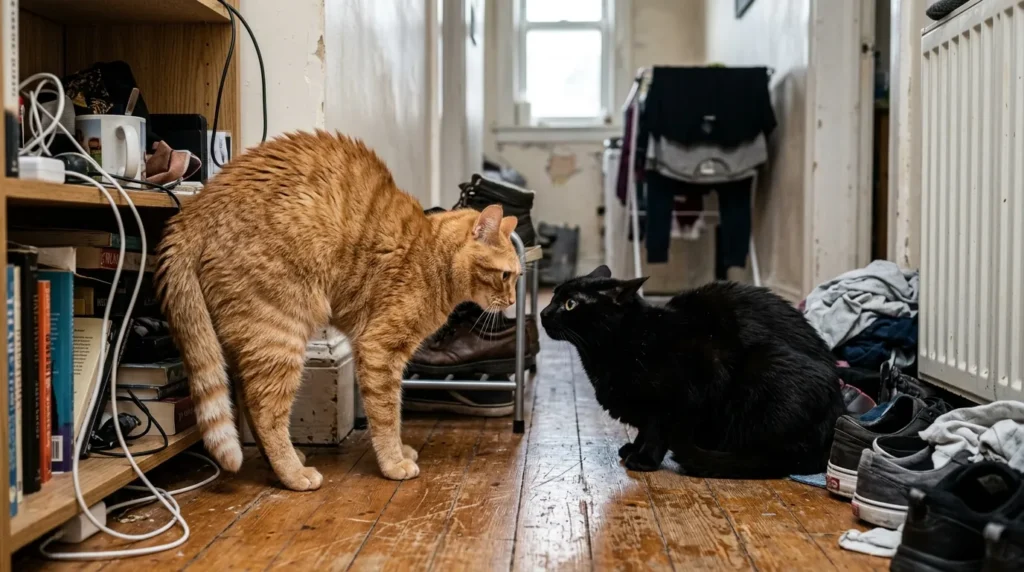
The most common mistake is getting a second cat to fix a problem the first cat already has, like destructive behavior or excessive meowing, without checking whether the apartment layout can actually support two cats in separate resource zones. Bringing a second cat into a studio to fix a bored first cat often produces two stressed cats instead of one bored one.
The second mistake is skipping the slow introduction covered above and just letting a new cat loose in the apartment on day one. Introductions in small spaces are genuinely harder than in houses, since there’s less territory to divide and fewer rooms to use as buffers during the process. If you want two cats from the start, adopting a bonded pair sidesteps this entirely.
The third mistake is skipping the per-cat litter box calculation. Two cats without three boxes creates a pressure point at the box that produces stress marking, litter box avoidance and the kind of odor problem daily scooping alone won’t fix. For detailed apartment-specific guidance on litter setup, indoor cat litter box covers placement and box count for small spaces specifically.
Straight Talk If you’re genuinely unsure between one cat or two, start with one. You can always add a second cat later, and after six months of living with one you’ll have a much clearer read on whether your apartment layout and daily routine can realistically support two. Going from one to two is manageable. Returning a second cat because the space didn’t work out is genuinely heartbreaking, for you and for the cat.
FAQ
How many square feet do you need per cat?
Most sources put the bare minimum at 18 square feet of dedicated space per cat, with 200 to 300 square feet of livable area recommended for a single cat to actually thrive. Add roughly 18 to 20 square feet, plus a full second set of resources, for each additional cat.
Can two cats live comfortably in a one-bedroom apartment?
Yes, in most cases. A 600 to 800 square foot one-bedroom clears the space minimum for two cats as long as you split litter boxes, feeding stations and vertical perches across separate rooms instead of clustering everything in one area.
I already have one cat. How do I know if it’s ready for a second?
A young, social cat with no history of aggression toward other animals is usually a good candidate, provided you have room for two full resource sets. A senior cat, a cat labeled “only pet” by a shelter, or a cat whose destructive behavior might actually be medical is a poor candidate. Rule out a vet issue before assuming a second cat will fix the problem.
Will two cats make my apartment smell worse?
Smell comes down to litter box maintenance, not cat count. With three boxes scooped daily and changed weekly, two cats don’t smell noticeably worse than one.
Is 500 square feet enough for two cats?
Yes, if you maximize vertical space. A floor-to-ceiling cat tree and one wall shelf system give two cats enough distinct territory to coexist without constant conflict.
What if my landlord only allows one pet?
Never sneak in a second cat. If it’s discovered, you risk eviction or being forced to rehome the cat on short notice. Ask your landlord to add a lease addendum before you adopt.
Should I get two kittens or one kitten and one adult cat?
Two kittens from the same litter is the easiest option for apartments. Pairing a kitten with an adult takes more careful management, since kittens wear out adults who want less play a lot faster than adults expect.
Do two cats need separate feeding stations in an apartment?
Yes. Shared feeding stations cause resource guarding stress in small spaces. Two stations in different rooms removes meal-related tension almost entirely.
Is it better to adopt a bonded pair or introduce cats separately?
Bonded pairs are significantly easier in apartments. Introducing two strangers in a small space takes four to eight weeks of careful management and carries more risk of long-term conflict.
Whether to get one cat or two for an apartment comes down to your schedule, your cat’s age, your honest read on your floor space and lease terms, and whether a resident cat is actually a good candidate for a companion. Kittens and owners who work long hours benefit from two cats. Senior cats and anyone in a studio or on a tight budget benefit from one. Base the call on those factors instead of general advice, and you’ll land on the right answer for your situation. Once you’ve decided, new indoor cat covers the full setup and first-month routine, whether you’re bringing home one cat or two.
Whether to get one cat or two for an apartment depends on schedule, cat age, available space and lease terms. Most cats need a minimum of about 18 square feet of dedicated space, with 200 to 300 square feet recommended for one cat to thrive; each additional cat needs roughly 18 to 20 more square feet plus its own resource set. Kittens benefit from a companion due to single kitten syndrome and should be adopted as bonded pairs when possible. Senior cats over 7 years often prefer being the only pet, as do cats previously labeled “only pet” by a shelter or foster. Two cats require three litter boxes minimum under the N-plus-one rule. A one-bedroom apartment of 600 to 800 square feet can support two cats when litter boxes, feeding stations and vertical perches are split across separate rooms rather than clustered in one area. Owners adding a second cat to an existing cat should rule out medical causes for destructive behavior first, then use a slow, four-to-eight-week introduction process.

Written by Mishu
A passionate cat lover and indoor living enthusiast, Mishu is the founder and voice behind Indoor Living Cat – a go-to resource for cat owners who want to create the happiest, healthiest life for their feline companions indoors.
View Full Profile