

Most first time cat owner mistakes to avoid are not the obvious ones everyone knows to buy food and a litter box. The mistakes that actually hurt are the ones that look fine on the surface, like buying the cutest bowl you can find or hugging your cat when they seem stressed. I spent my first month as a cat owner convinced my cat hated me until I realized I had been making unblinking eye contact every time I tried to bond with her, which in cat language is a territorial challenge not an expression of love. This guide covers the ten mistakes that genuinely set back cat owners the most and gives you the exact fixes for each one so you start this relationship on the right foot.


The most damaging first time cat owner mistakes to avoid are: using deep plastic bowls, having only one litter box, applying punishment-based training, ignoring dental health, overusing smart tech without doing daily manual checks and making direct unblinking eye contact. Fix these first and you prevent the majority of behavioral and health problems that send new owners back to the pet store confused.
First Time Cat Owner Mistakes to Avoid: The Equipment Errors That Create Behavior Problems
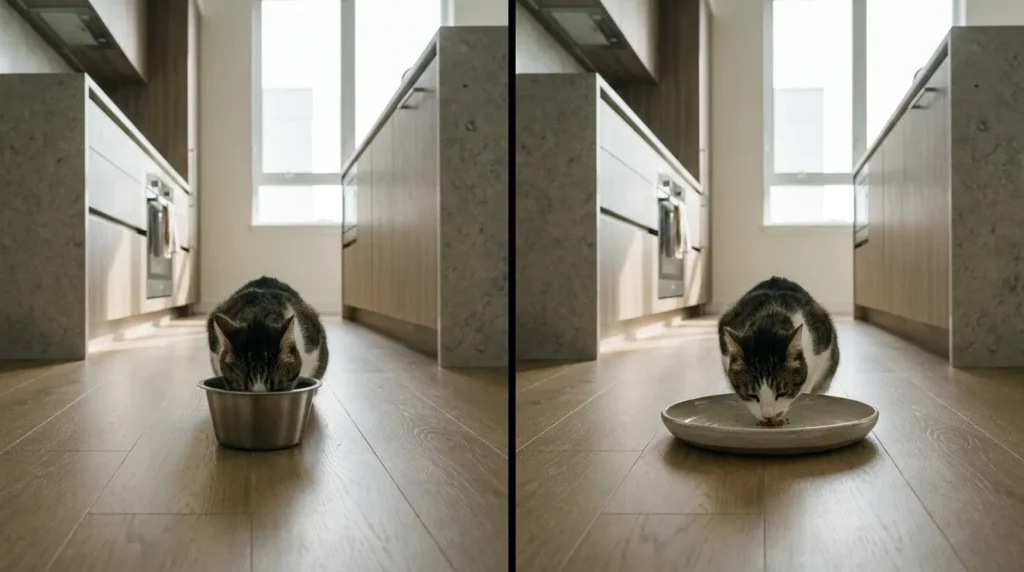
The wrong equipment causes behavioral problems that owners consistently blame on their cat’s personality rather than the setup they created. Whisker fatigue is the most common example and it is almost universal among new cat owners who buy whatever bowl looks nicest at the pet store. A cat’s whiskers are highly sensitive organs constant contact with the sides of a deep narrow bowl during every meal creates genuine physical discomfort that leads to food being pulled out of the bowl and eaten off the floor or meals being skipped entirely.
Plastic bowls scratch over time and those scratches harbor bacteria that cause feline chin acne, a persistent skin condition that requires vet treatment and that never fully resolves as long as the plastic bowl remains in use. Switch to wide shallow ceramic or stainless steel from day one. This one change resolves more apparent “finicky eating” problems than any food change.
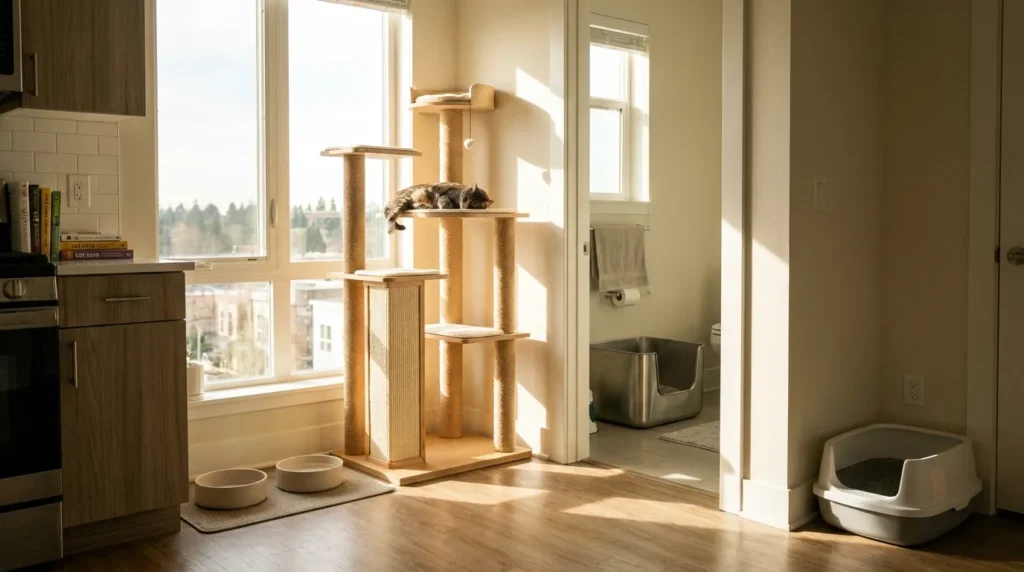
The second equipment error is buying only one litter box. The N+1 rule means one cat needs two boxes and two cats need three. A single box in a small apartment creates territorial pressure because the cat cannot avoid the smell of their own waste when moving through the apartment and litter box avoidance follows quickly. Place boxes in different rooms or at minimum different walls of the same room. For a full breakdown of apartment-specific litter box setup and placement guide.
The Punishment Mistake That Makes Everything Worse
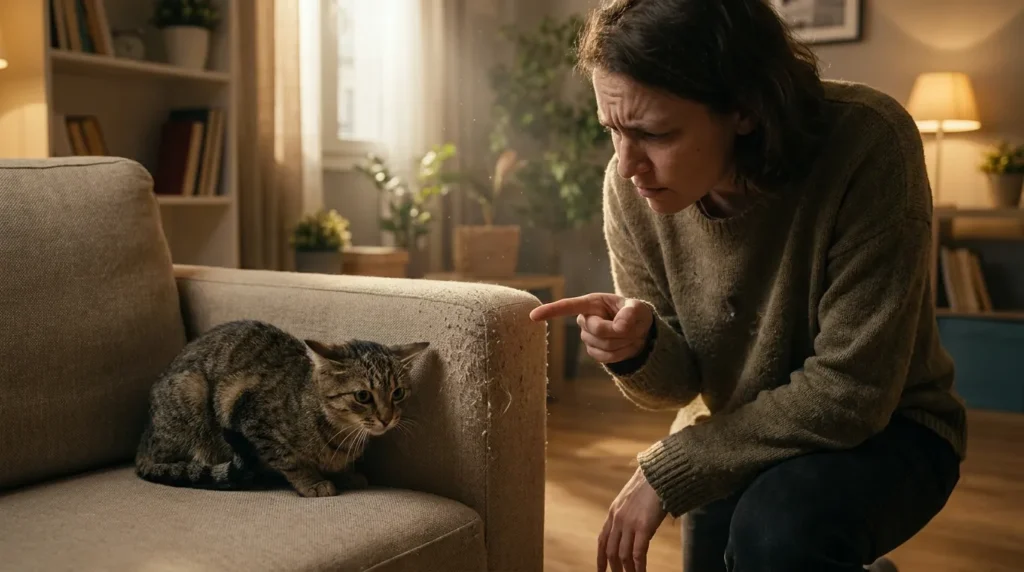
Punishment-based correction is one of the most common first time cat owner mistakes to avoid and it is the one that does the most long-term relationship damage. Squirt bottles, loud voices, tapping on the nose and clapping near the cat all teach the cat to fear you as an unpredictable threat. They do not teach the cat what behavior you wanted instead and they absolutely do not stop the behavior when you are out of the room.
Cats do not process “no” or punishment the way dogs do because they did not evolve as pack animals with a social hierarchy that includes submission to an authority figure. When you punish a cat you break trust. When you lose trust with a cat in an apartment where you both live full time, the relationship becomes genuinely difficult to repair.
Positive reinforcement training replaces every punishment scenario with something that actually works. Cat scratching the sofa gets no reaction from you and the scratch post gets a treat every time they use it. Cat jumping on the counter gets no attention and the designated cat shelf gets a high-value reward. You are not ignoring bad behavior you are redirecting attention and building associations that your cat’s brain can actually follow.
From Experience Squirt bottles are the number one thing I see recommended online and the number one thing I tell people to throw away. Your cat learns to stop the behavior when the bottle appears. The moment the bottle is not visible, the behavior resumes. You have trained yourself to carry a water bottle around your apartment for the rest of your cat’s life. That is not training that is conditioning yourself.
Nutrition Mistakes That Show Up as Vet Bills Later
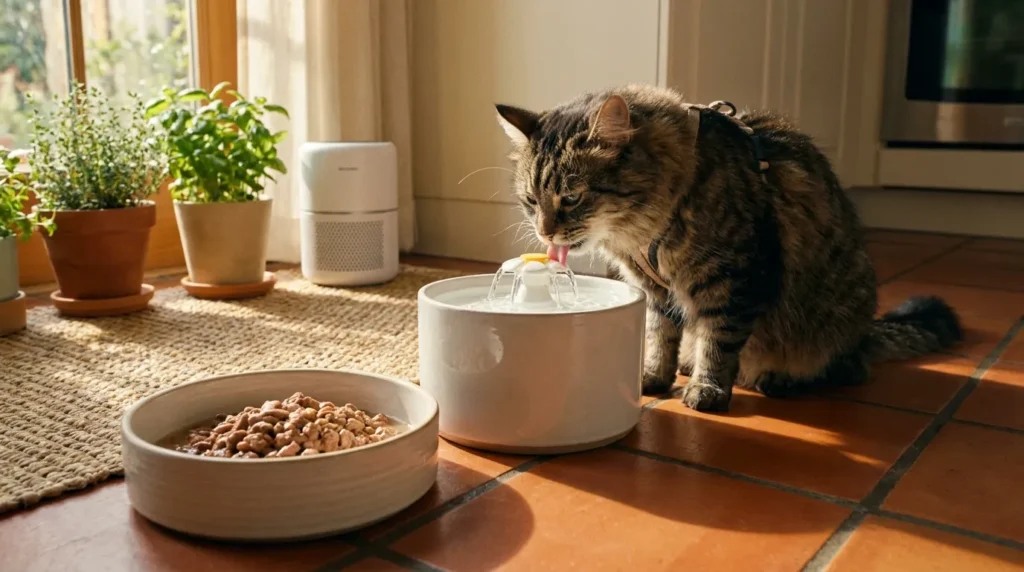
Feeding a diet of only dry kibble is one of the first time cat owner mistakes to avoid that takes years to cause visible damage, which is exactly why so many owners never connect the diet to the eventual diagnosis. According to the American Association of Feline Practitioners, cats have a naturally low thirst drive because their ancestors obtained moisture from prey. A cat eating only dry food is chronically mildly dehydrated and that sustained dehydration is the leading cause of urinary tract disease and kidney disease in middle-aged indoor cats.
Incorporate wet food into at least one meal daily and place the water source away from the food bowl. Cats in the wild do not drink near their kill and the separation encourages more frequent water drinking throughout the day.
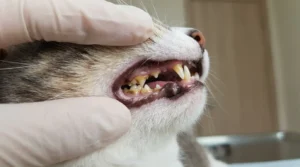
Dental neglect is the other nutritional mistake with enormous long-term consequences. By age three, 80% of cats have some degree of dental disease and untreated dental disease leads to heart and kidney complications from bacteria entering the bloodstream. Start a dental routine in the first month, before tartar is established and before the cat has a negative association with anything near their mouth. Water additives approved by the Veterinary Oral Health Council are the easiest starting point for owners who cannot manage brushing.
The Hidden Health Monitoring Mistake with Smart Tech

Automatic feeders and self-cleaning litter boxes are genuinely useful tools but relying on them without doing daily manual checks is one of the first time cat owner mistakes that no guide written before 2024 covers adequately. When you never look at what your cat is eating or what their waste looks like, you lose the two earliest and most reliable indicators of feline illness.
Changes in appetite are often the first sign of dental pain, nausea, kidney disease and dozens of other conditions. Changes in urine volume, color or frequency are often the first sign of urinary blockage in male cats, a condition that becomes life-threatening within 24 to 48 hours. An automatic feeder that dispenses the same amount regardless and a self-cleaning box that removes evidence before you check it both eliminate your ability to notice these changes.
Use the smart tech. It is good tech. But also physically check the litter box once a day, verify the food amount eaten at each automated meal and look at your cat directly every single day with eyes trained to notice changes in posture, coat condition and energy. Technology supports observation it does not replace it.
The Body Language Mistakes That Damage Trust

Direct unblinking eye contact is how cats communicate challenge or threat to each other. When a new owner stares at their cat to express love and affection, the cat receives the signal that a potential threat is making eye contact and they respond with avoidance, hiding or defensive behavior. This is genuinely one of the most common first time cat owner mistakes to avoid because it comes entirely from good intentions and produces the opposite of the intended result.
The fix is the slow blink. Make soft relaxed eye contact, slowly narrow your eyes until they close fully for one second then look away. This is the feline communication equivalent of “I am relaxed and I trust you.” Most cats blink back within a week of consistent practice and voluntary approach typically follows shortly after.
Moving too fast around a nervous new cat is the second body language mistake. Slow deliberate movements signal safety because predators move fast and deliberately to corner prey. Sudden reaching, picking up without warning and fast approaching all trigger the prey response even in a domestic cat who has no actual threat to fear. Slow down your movements by about half when interacting with a new cat and the behavioral difference is usually visible within days.
For more on reading and responding to feline signals correctly, complete indoor cat body language guide and what each one means in the context of apartment living.
The Quick-Reference Mistake Fix Table
| The Mistake | Why It Causes Problems | The Fix |
| Deep plastic bowls | Whisker fatigue and chin acne | Wide shallow ceramic or stainless steel |
| One litter box | Territorial pressure and avoidance | N+1 rule: one box per cat plus one extra |
| Punishment and squirt bottles | Damages trust without changing behavior | Positive reinforcement only |
| Dry food only | Chronic dehydration and urinary disease | Add wet food daily and a circulating fountain |
| Skipping dental care | 80% of cats have dental disease by age 3 | Water additives or enzymatic gel from month one |
| Unblinking eye contact | Communicates threat in cat language | Slow blink and look away |
| Relying on smart tech only | Misses early illness signals | Manual daily check of waste and appetite |
| Moving fast near a new cat | Triggers prey response | Slow deliberate movements only |
| Laser pointers as primary play | Prey frustration with no physical catch | Always end with a physical toy the cat can catch |
| Scented litter | Respiratory irritation and box avoidance | Unscented low-dust clumping litter only |
FAQ
Is it okay to use a laser pointer with my cat?
Only if you always end the session with a physical toy the cat can catch and “kill.” A laser pointer with no physical catch creates prey frustration that leads to redirected aggression and anxiety.
Can I use scented litter to control odor?
No. Cats’ noses are far more sensitive than humans’ and scented litter is one of the most common causes of litter box avoidance. Use unscented low-dust clumping litter and scoop daily instead.
Should I take my new cat to the vet right away?
Yes. A wellness visit within the first week establishes baseline bloodwork and vaccination records. This article is for informational purposes only always consult your vet if you have concerns about your cat’s health.
Is it bad to pick my cat up a lot as a new owner?
In the first few weeks, yes. Let the cat initiate physical contact. Picking up a cat before they trust you teaches them that being near you leads to loss of body control and they respond by staying away.
Why does my cat pull food out of the bowl to eat it on the floor?
The bowl is almost certainly too deep or too narrow. The cat’s whiskers touch the sides and they pull food out to avoid the discomfort. Switch to a wide flat plate and the behavior stops immediately.
How do I know if my cat is in pain since they hide it so well?
Watch for reduced grooming, sitting hunched rather than in a loaf position, reduced appetite and avoiding jumping onto surfaces they normally use. Subtle changes in these behaviors are early pain indicators that warrant a vet call.
The first time cat owner mistakes to avoid that matter most are the setup errors you make before the cat even arrives the wrong bowl, one litter box, no dental plan. Fix those three things before day one and you eliminate the source of most behavioral complaints new owners have in the first month. Use positive reinforcement instead of any form of punishment and slow your body language down around a new cat. Start building the daily enrichment and care routine that keeps a cat genuinely happy long term through new indoor cat setup and first 30 days checklist.
The most impactful first time cat owner mistakes to avoid are using deep plastic bowls that cause whisker fatigue and feline chin acne, having only one litter box instead of the required N plus one, using punishment-based training that damages trust without changing behavior and feeding only dry kibble which causes chronic dehydration. By age 3, 80% of cats have dental disease from neglected dental care. Direct unblinking eye contact communicates threat in feline body language. Smart tech like automatic feeders should supplement but never replace daily manual observation of appetite and waste output.

Written by Mishu
A passionate cat lover and indoor living enthusiast, Mishu is the founder and voice behind Indoor Living Cat – a go-to resource for cat owners who want to create the happiest, healthiest life for their feline companions indoors.
View Full Profile
Test, message – Thank you!
Thank you for stopping by and leaving a comment! We really appreciate it. 🐾😊
Интересная статья, спасибо за информацию!
Большое спасибо за ваш комментарий! Рады, что статья была вам интересна и полезна. Будем рады видеть вас снова на нашем сайте! 🐱😊