

Why does cat bite me for no reason? My cat used to bite my hand during quiet evening sessions on the couch, always right after what felt like a perfectly happy petting session, and for months I had no idea what I was doing wrong. Here’s the fact that changes everything: there’s no such thing as a random bite. Every bite is communication. It feels invisible because cats respond to stimulation thresholds that humans never learn to read, since we express discomfort with words instead of teeth. This guide is part of our indoor cat behavior series, and it covers the five real reasons behind so-called random biting, the body language that shows up before every bite, why some cats only bite one person in the house, how biting changes with age, and the specific indoor triggers that make apartment cats more prone to it than outdoor cats.
Why does cat bite me for no reason? Your cat always has a reason. The five most common are overstimulation from too much petting, play aggression from unmet hunting instincts, redirected aggression from something outside the window, pain in the area being touched, and attention-seeking when quieter signals get ignored. The bite that felt random was signaled well before it happened.
The 5 Real Reasons Your Cat Bites You Without Warning

Overstimulation is the most common reason by a wide margin. Cats carry nerve endings throughout their skin, and repetitive stroking in the same spot builds sensory load until what felt good turns irritating. Vet behavior resources call this petting-induced aggression or overstimulation, and most cats show warning signs before it happens, even if the signs are easy to miss. Once that threshold gets crossed, the cat stops tolerating contact and bites to end it. This isn’t aggression. It’s a request to stop, delivered in the only language left once the subtler signals ran out.
Play aggression is the second reason, and it shows up most in cats who never had proper play outlets as kittens. Your hand or ankle becomes prey the moment it moves in a way that triggers the predatory sequence. Indoor cats who skip regular wand toy sessions carry more pent-up hunting drive, and that energy has to land somewhere.
Redirected aggression happens when your cat gets aroused by something out of reach, then turns and bites you instead. The trigger could be another cat through the window, a loud hallway noise, or a strange scent on your clothes. Her nervous system is stuck in high alert, and you happened to be nearby when she needed to discharge it.
Pain is the fourth reason, and it tends to produce bites in one specific spot rather than random ones. An arthritic cat who bites when you touch her hips isn’t being unpredictable. She’s telling you that spot hurts. A dental problem can make a cat snap suddenly when you handle her face, and in rarer cases a condition called feline hyperesthesia syndrome makes the skin along the lower back and tail base painfully sensitive to touch. Cornell’s Feline Health Center describes cats with this condition rippling their skin, dilating their pupils, and turning to bite the moment that area gets touched.
Attention-seeking is the fifth reason, and it works as deliberate communication rather than overflow. A cat who learned that biting gets an instant reaction from you will use it once meowing, head bumps, and pawing stop working. Understanding your indoor cat’s full range of communication helps you catch the earlier signals, so the bite never becomes necessary.
Why Does My Cat Bite Me and Not Anyone Else in the House?
This is one of the most common follow-up questions once owners rule out the obvious triggers, and it usually comes down to who does the most hands-on interaction. The person who pets, carries, and grooms a cat the most also gives her the most chances to hit her overstimulation threshold. If you’re the one who scoops her up for cuddles while your partner mostly leaves her alone, you’re statistically more likely to be on the receiving end of a bite, not because she likes you less but because she gets more physical contact from you.
A few other patterns show up often:
- You read her signals less carefully than someone else in the house. Cats bite the person who keeps petting through the warning signs, not the person who stops early.
- You move differently. Fast, jerky hand movements trigger the predatory sequence more than slow, calm ones. Kids and new visitors often get bitten for this reason.
- You’re associated with something stressful. If you’re the one who does nail trims, gives medication, or carries her to the vet, she may connect your hands with those events.
- She’s more relaxed around you. A cat who feels fully comfortable with one person may let her guard down enough to reach her threshold, while she stays more reserved and cautious around everyone else.
Track which family member gets bitten and under what circumstances for a week. The pattern almost always points back to one of these four reasons rather than a personal grudge.
Types of Cat Bites at a Glance
Not every bite means the same thing. Here’s how to tell them apart in the moment.
| Bite Type | Warning Signs | Common Trigger | What To Do |
|---|---|---|---|
| Love bite | Gentle pressure, no broken skin, relaxed body | Mutual grooming or affection | No action needed, this is normal |
| Overstimulation bite | Tail flicking, ears rotating back, skin rippling | Petting past the cat’s threshold | Stop touching immediately, do not scold |
| Play bite | Crouching, dilated pupils, wiggling hindquarters | Moving hands or feet mistaken for prey | Freeze, then redirect to a toy |
| Redirected bite | Fast tail lashing, pinned ears, sudden turn toward you | Arousal from a window trigger or noise | Back away, give her 15 to 30 minutes to settle |
| Fear or defensive bite | Crouched low, ears flat sideways, hissing, dilated pupils | Feeling cornered, restrained, or startled | Stop restraint, give her an exit route, don’t loom over her |
| Pain bite | Sudden bite in one specific spot, growl or hiss | Touching an area that hurts | Stop touching that area and book a vet visit |
| Kitten teething bite | Persistent mouthing, chewing on fingers, no real force behind it | Teething discomfort or learning bite inhibition | Redirect to a chew-safe toy every time, never let it continue on skin |
Why Do Indoor Cats Bite More Often Than Outdoor Cats?
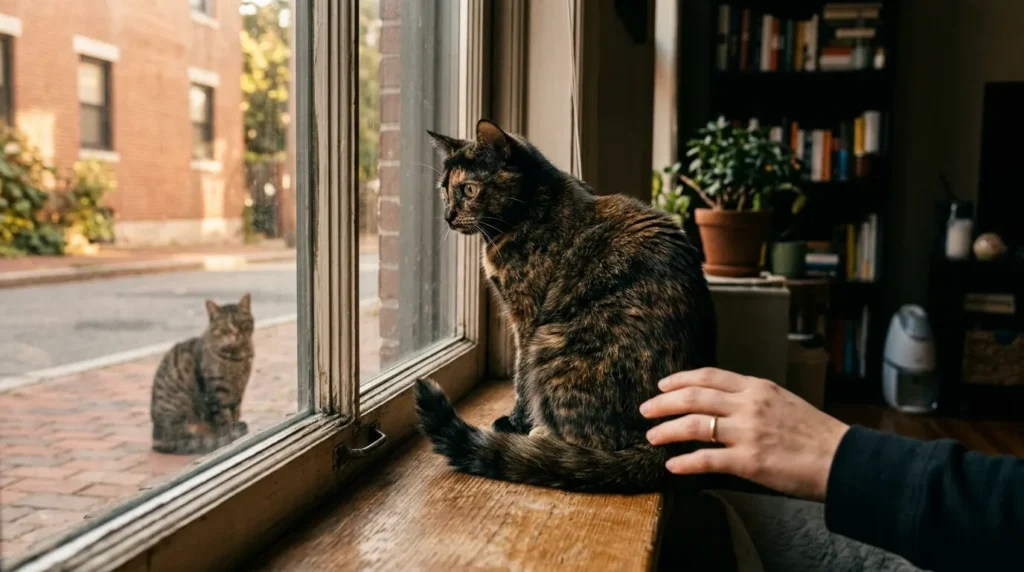
Indoor cats bite more than outdoor cats for four reasons tied to apartment life. First, they get more concentrated, prolonged human contact, which means more chances to hit the overstimulation threshold. A cat living in an apartment full time never burns off sensory load the way an outdoor cat does after three hours of patrolling her territory.

Second, window views of outdoor cats and wildlife build arousal with no physical outlet. That arousal stays elevated for hours after the trigger disappears. A cat who watched a neighborhood cat stroll by at 3pm may bite you when you reach out to pet her at 5pm. The bite isn’t about you at all.
Third, dry apartment air from HVAC systems creates static in cat fur and can leave skin more sensitive, which makes ordinary petting feel irritating. Cats with dandruff or existing skin issues from dry air reach their threshold faster than cats living in comfortable humidity. A full grooming and coat care routine addresses the skin conditions that push bite risk up.
Fourth, a stressful home environment adds up. A litter box that’s dirty, poorly placed, or shared with too many cats raises baseline tension in ways that show up as short tempers elsewhere. Getting your cat’s litter box setup right removes one stressor before it stacks on top of the others. Limited vertical space and hunting outlets pile on top of that, leaving indoor cats with more unspent predatory energy than outdoor cats ever build up. Enrichment activities and climbing space give that energy somewhere to go before it lands on your hand during a quiet moment.
Does Biting Change With Age? Kittens, Adult Cats, and Senior Cats
A five-month-old kitten mouthing your fingers and a twelve-year-old cat who suddenly starts biting are dealing with two completely different things, even though both look like the same behavior on the surface.
| Life Stage | What’s Usually Going On | What To Do |
|---|---|---|
| Kittens (under 1 year) | Teething discomfort and still-developing bite inhibition, often worsened by rough hand-play with owners | Redirect every mouthing attempt to a toy, never use hands as play objects, expect this to fade with consistent redirection by 8 to 12 months |
| Adult cats (1 to 10 years) | Usually overstimulation, play aggression, or redirected aggression tied to environment and habits | Track thresholds and triggers, adjust petting sessions and enrichment as covered above |
| Senior cats (10+ years) | A new or sudden increase in biting is far more likely to be pain, arthritis, dental disease, or a thyroid or neurological issue | Book a vet visit before starting behavior work; don’t assume it’s just a personality change |
Kittens bite during teething and while they’re still learning bite inhibition through play with littermates. Redirecting to toys early, instead of letting her mouth your hands, prevents the habit from carrying into adulthood. Senior cats past age ten who start biting more almost always have a medical driver behind it, which is why the vet visit comes first, not last, for that age group.
Reading the Body Language That Comes Before Every Bite
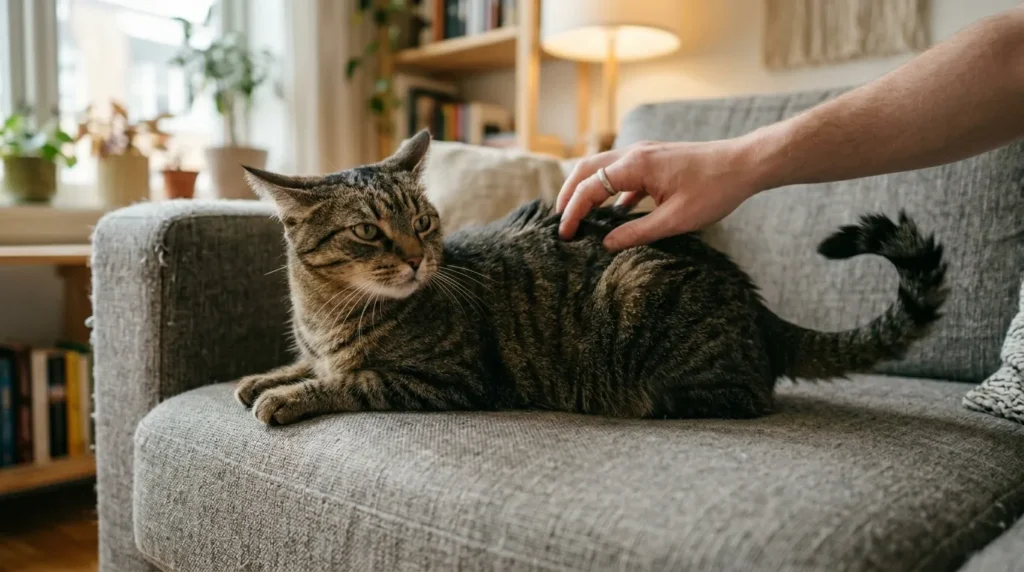
Every bite comes with a warning sequence first. Most owners miss it, which is why the bite feels sudden. Watch for:
- Tail flicking, lashing, or thumping against the floor or couch
- Ears rotating back or flattening sideways
- Skin rippling along the spine, especially near the base of the tail
- Pupils dilating suddenly, even in normal light
- A stiffening body or a sudden stillness right before she turns her head toward your hand
Any one of these means the cat has hit her limit and contact needs to stop now. Here’s the part most owners get wrong. Once these signals show up, the bite is already decided. You can’t pet through the warning and expect her to relax. Stopping the moment you see the first sign is what actually prevents the bite. Keep petting after the tail starts moving and you teach her that subtle signals don’t work, which over time produces a cat who skips the tail flick and goes straight to teeth.
According to ASPCA guidance on feline aggression, the most reliable prevention method is learning your specific cat’s pre-bite signals rather than waiting for a hiss or growl. Most cats communicate through body language long before they vocalize.
How Do You Stop a Cat From Biting You During Petting?

Stopping petting-induced biting means learning your specific cat’s threshold, not applying a general time limit. Some cats handle three minutes of petting with no problem. Others hit their limit in thirty seconds. Animal behavior groups recommend the same core approach: figure out how long your cat tolerates petting before she gets irritated, then stop a little earlier than that every single time.
- Find her real threshold. Time a few petting sessions and note exactly when the first warning sign appears.
- Stop two strokes before that point, every time. If your cat bites at the same point in every session, count your strokes. Overstimulation bites tend to land after a surprisingly consistent number of touches.
- Stick to areas she actually enjoys. Most cats tolerate head, cheek, and chin touches far longer than back or belly touches.
- Let her direct the session. Hold your hand out and let her initiate contact instead of reaching for her first.
- Stay consistent for a few weeks. Most cats actually extend their tolerance over time, because the sessions start to feel predictable instead of risky.
Never use your hands as toys. This single habit is what teaches a cat to see hands as fair prey. If she grabs your hand during play, stay still until she lets go and redirect to a toy right away. Don’t yank your hand back. Fast withdrawal mimics prey movement and makes the behavior worse, not better.
How to Stop Play Biting and Redirected Aggression

Play aggression and redirected aggression need different handling than overstimulation, because the cat isn’t asking you to stop touching her. She’s working through hunting drive or leftover arousal that has nowhere else to go.
For play biting:
- Freeze instead of pulling away the moment she grabs your hand
- Redirect to a wand toy the second she lets go
- Run two 10 to 15 minute wand toy sessions a day, ideally before the times she usually bites
- End every play session by letting her “catch” the toy so the hunting sequence feels complete
For redirected aggression from window triggers:
- Block her view of the specific trigger with a curtain, film, or furniture placement
- Don’t approach a cat mid window-watch or try to pick her up while she’s fixated
- Give her fifteen to thirty minutes after the trigger passes before you try any contact at all
- Offer a quiet room to decompress after a high-arousal event instead of following her
Appropriate cat furniture and vertical space gives her territory to claim, which cuts the general anxiety that comes from feeling contested on every surface. A cat who feels secure up high bites less than one who feels crowded at floor level.
Feeding matters too. Hunger sharpens irritability and shortens the fuse before a bite. Proper feeding and meal timing keeps blood sugar steady and takes one variable off the table.
The Mistake That Makes Random Biting Worse Every Time

The mistake that guarantees worse biting is reacting big to the bite itself. Yanking your hand away, yelping, or pushing the cat off all produce the same result: they feed the predatory sequence. Fast movement mimics prey escape. Loud noise mimics prey distress. Both tell the cat the interaction is working exactly as her instincts predicted.
The right response is stillness. Stop moving. Wait for her to release on her own. Then stand up and walk away calmly without eye contact. This tells her that biting ends the interaction, full stop, which is the clearest feedback a cat can get. Stay consistent for two to four weeks and most cats cut their biting frequency by a wide margin, since the behavior stops producing anything interesting.
Keeping an eye on your indoor cat’s overall health catches pain-related biting before it turns into a habit. Solid daily care built around her natural rhythms produces a cat who runs less reactive across the board.
When Cat Biting Needs a Vet Visit Instead of Behavior Work
A cat who suddenly bites hard in one specific spot that used to be touch-tolerant needs a vet check before any behavior training. Pain is a medical problem, and training doesn’t fix medical problems. Arthritis, dental disease, abscesses, and skin infections all cause sudden touch sensitivity that looks exactly like behavioral biting. In rarer cases, feline hyperesthesia syndrome causes intense skin sensitivity along the lower back and tail base; Cornell’s Feline Health Center notes that cats with this condition often ripple their skin, dilate their pupils, or bite suddenly the moment that area is touched, and that other causes of pain need to be ruled out first.
Watch for these signs that point to a medical cause rather than a behavior problem:
- Sudden biting in a cat who was reliably calm and touch-tolerant before
- Bites that happen in one exact spot every time, especially the hips, lower back, or mouth
- Skin rippling, tail chasing, or frantic grooming right before the bite
- A change in appetite, grooming habits, litter box use, or activity level alongside the biting
- Any cat over age ten with a new increase in biting frequency
A sudden jump in biting across every context, in a cat who previously behaved normally, calls for blood work to rule out thyroid disease, neurological issues, and other conditions that shift pain thresholds. Senior cats past age ten who start biting more almost always have a medical driver behind it.
When You Need Medical Care After a Bite: Cat bites carry a real infection risk for you too. Research published through the CDC puts the infection rate for cat bites between 28 and 80 percent, mostly from a bacterium called Pasteurella multocida that lives in a cat’s mouth. Redness, swelling, warmth, or pain that gets worse within 12 to 24 hours are signs to call a doctor. Bites on the hand or near a joint carry extra risk and deserve same-day medical attention, especially if you notice fever or red streaking near the wound.
This article is for informational purposes only. Always consult your vet if you have concerns about your cat’s health, and see a doctor for any bite that shows signs of infection.
Frequently Asked Questions About Cat Biting for No Reason
Is a love bite different from an aggressive bite?
Yes. A love bite is gentle pressure with no broken skin, and it happens during relaxed, mutual moments. An aggressive bite is sharp and fast, and it usually follows warning signs like tail lashing or flattened ears.
How do I know if my cat is about to bite me?
Watch the tail and the ears. A tail that starts flicking and ears that rotate backward mean she’s close to her limit. Stop contact the moment you see either one.
Should I punish my cat for biting?
No. Punishment raises stress and makes biting worse over time. Walk away calmly and end the interaction instead. That response cuts biting faster than any correction does.
Why does my cat bite me and then lick me right after?
This is a classic post-bite recovery pattern. The bite ended the overstimulation, and she returns to affectionate behavior once her sensory load resets. It isn’t guilt. It’s a normal cycle.
Does boredom cause random biting in indoor cats?
Yes. A cat with no outlet for hunting instinct redirects that energy at hands and ankles. Ten to fifteen minutes of daily wand toy play cuts down boredom biting in most cats.
My cat bit me out of nowhere while I was sleeping. Why?
Your feet moving under the blanket triggered her predatory sequence while you weren’t awake to respond. Keep your feet still, or use a thick blanket, and burn off hunting energy with a toy before bed each night.
Can a cat bite make you sick?
Yes. Cat bites get infected more often than dog bites because cat teeth are thin and puncture deep. Clean any bite right away with soap and water, and watch for redness or swelling over the next day.
Is it normal for kittens to bite more than adult cats?
Yes. Kittens bite during teething and while they’re still learning bite inhibition through play. Redirecting to toys early, instead of letting her mouth your hands, prevents the habit from carrying into adulthood.
Why does my cat bite me and not other people in the house?
Usually because you’re the one who handles her the most. More petting and carrying means more chances to hit her overstimulation threshold. It can also mean you’re associated with something stressful, like nail trims or vet visits, or that she’s simply more relaxed and off-guard around you than she is with anyone else.
Does spaying or neutering reduce cat biting?
It can help with certain types of aggression, especially hormone-driven aggression between intact males, but it won’t fix overstimulation, play aggression, redirected aggression, or pain-related biting on its own. Talk to your vet about whether it fits your cat’s specific situation.
What is feline hyperesthesia syndrome?
It’s a condition where the skin along a cat’s lower back and tail base becomes painfully sensitive, sometimes causing rippling skin, tail chasing, or sudden biting when that area is touched. It needs a vet diagnosis, since several other conditions can look similar.
Is it normal for my cat to bite when I pick her up?
Some cats find being lifted stressful or physically uncomfortable, especially if they have joint pain. If it’s a new behavior, rule out pain first. If it’s always been the case, she may simply prefer to stay on the ground and would rather you not pick her up at all.
Cats never bite for no reason. The five most common causes of apparently random cat biting are overstimulation past the individual threshold, play aggression from unmet hunting instincts, redirected aggression after a high arousal event, pain from a medical issue, and learned attention-seeking. Indoor cats bite more often than outdoor cats due to concentrated human contact, window triggers, home stressors like litter box setup, and limited physical outlets. Biting also shifts by life stage: kittens bite while learning bite inhibition, adult cats bite mostly from overstimulation or play drive, and a new biting habit in a senior cat usually points to pain or a medical issue. The correct response to a bite is complete stillness followed by calmly walking away. Most cats cut biting frequency within two to four weeks of a consistent, non-reactive response. Cat bites also carry a real infection risk for the owner, with CDC-linked research putting infection rates between 28 and 80 percent, so any bite with redness or swelling deserves medical attention.

Written by Mishu
A passionate cat lover and indoor living enthusiast, Mishu is the founder and voice behind Indoor Living Cat – a go-to resource for cat owners who want to create the happiest, healthiest life for their feline companions indoors.
View Full Profile