
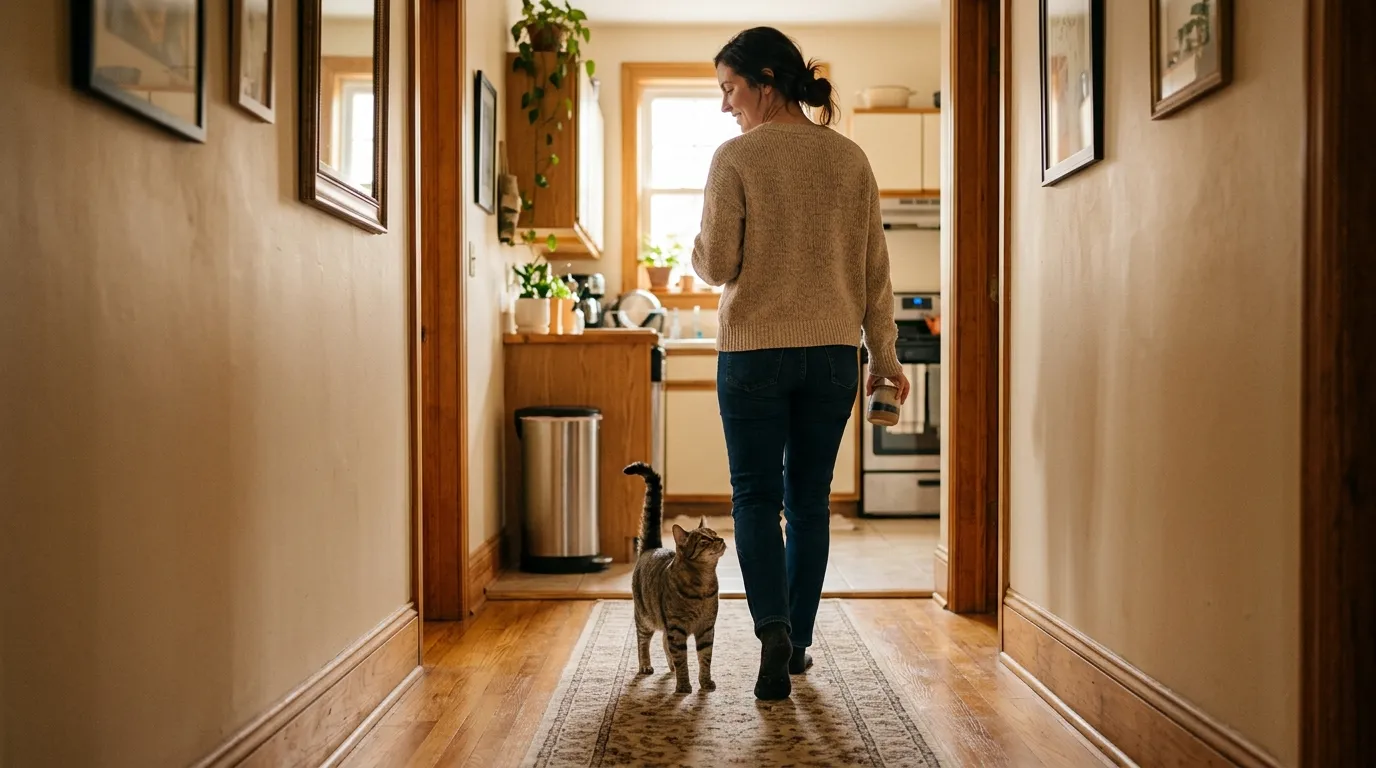
My cat is already in every room before I get there, like she scouted the apartment ahead of me. Why does cat follow me everywhere? It is not just hunger or curiosity, the two explanations most basic articles stop at. Oregon State University research, led by researcher Kristyn Vitale, found that cats form real attachment styles similar to human infants, and your movement through the apartment is something she tracks for specific psychological and biological reasons. This guide covers six science backed causes, whether breed changes the equation, how to build a more secure bond, and how to spot the line between healthy shadowing and separation anxiety.
Here is the short version. Cats follow their owners because you are:
- Their safe base for exploring the apartment
- Their main source of social referencing cues
- A trigger for oxytocin release and lower cortisol
- Part of their territorial patrol route
- Someone to protect during vulnerable moments, like bathroom trips
- A predictor of food and daily routine
Why does cat follow me everywhere in most cases? You are her safe base, her main source of information about the apartment, her scent patrol partner, and the trigger for a real oxytocin reward. This is almost always healthy attachment, especially in indoor cats with limited space to explore. It only becomes a concern when separation anxiety symptoms show up alongside it.
The Safe Base Theory: Why You’re Your Cat’s Emotional Anchor
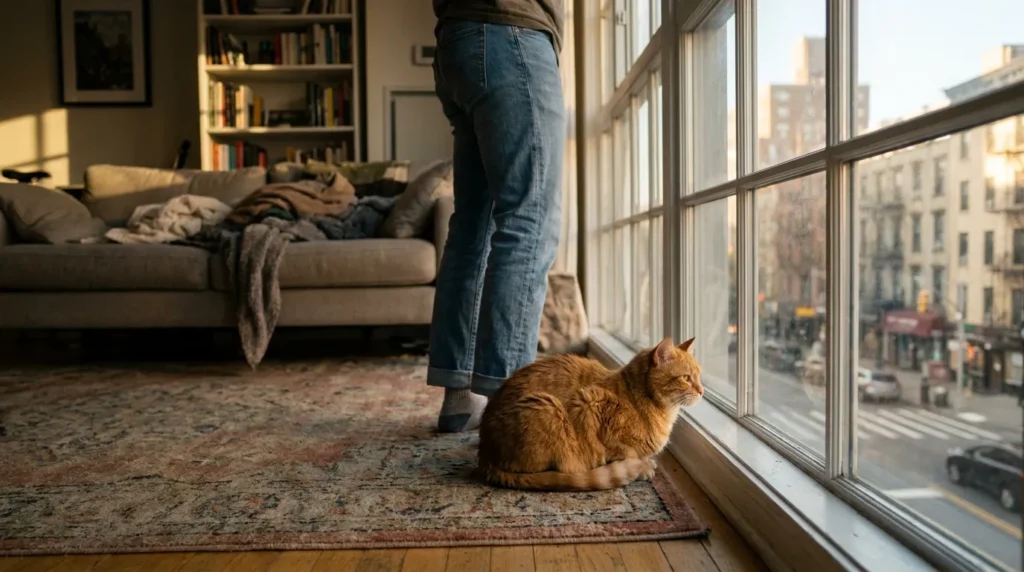
The safe base effect explains why does cat follow me everywhere better than any other theory, and most cat content skips it entirely. Research from Oregon State University found that cats, like human infants, develop secure or insecure attachment styles toward their main caregiver. A securely attached cat treats you as a stable point she can explore from and return to.
When you walk from the kitchen to the bedroom, she is not just curious where you are headed. She is keeping her anchor close so her sense of safety travels with her. A cat with no vertical space or environmental variety leans on you even harder, because you are the most reliably interesting thing in her world.
According to the Oregon State University Human-Animal Interaction Lab’s attachment research, about 64 percent of cats studied showed secure attachment to their owner, close to the 65 percent rate found in human infants. A closer look at indoor cat behavior patterns puts this research in context instead of treating it as a quirk.
The Three Cat Attachment Styles
Researchers borrow this framework from human infant attachment studies. Not every cat fits neatly into one box, but most lean one way.
| Attachment style | How following looks | What it means |
|---|---|---|
| Secure | Follows calmly, settles once you stop moving | Trusts you, still explores new objects on her own |
| Insecure, ambivalent | Follows constantly, vocalizes when you pause | Struggles to settle even with you present |
| Insecure, avoidant | Rarely follows, keeps distance under stress | Harder to read, may mask discomfort |
Social Referencing: Your Cat Uses Your Reactions as a Safety Guide
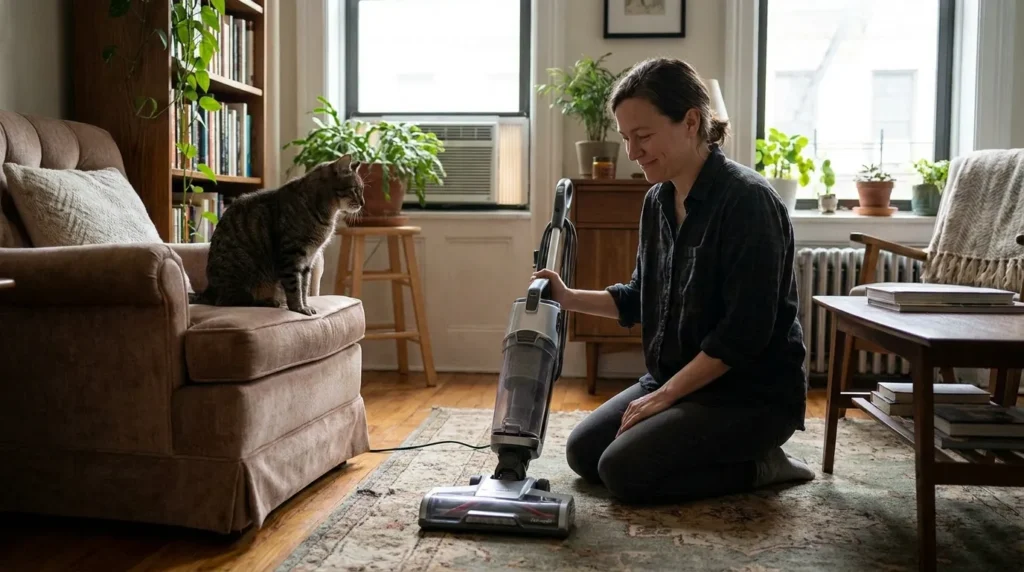
Feline social referencing is when a cat checks your face and body language to decide how to react to something new. When the delivery driver knocks, when a bag rustles, when a guest walks in, she looks at you before deciding whether to flee or investigate. Following you keeps that information source close all day.
Indoor apartment cats lean on social referencing more than cats with outdoor access, simply because they run into fewer new things and get less practice handling them alone. You have become her main decoder of the environment. A calm owner who does not startle signals that the apartment is safe. An anxious or unpredictable owner can raise a cat’s baseline stress just by sending mixed signals.
Cats check in with you most during:
- Unfamiliar sounds, like knocking or a dropped object
- New people entering the apartment
- New objects, boxes, or furniture
- Sudden changes in your tone of voice
This is also why she follows you and not the houseplants. You produce information: reactions, tone, position, activity. Following you is simply the most efficient way for an indoor cat to gather that data.
The Oxytocin Loop: The Chemistry Behind the Shadow Cat
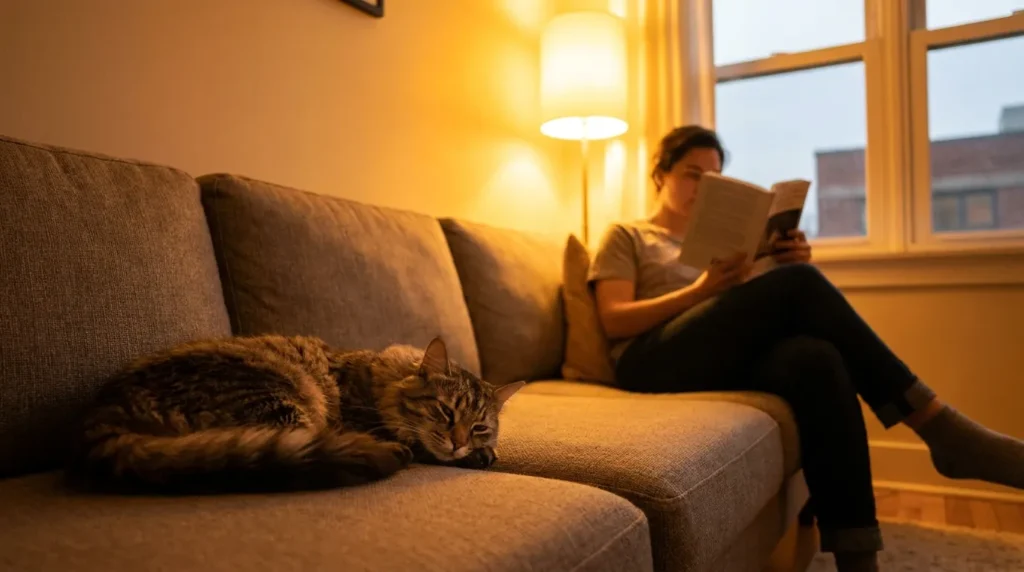
Proximity to a preferred person triggers oxytocin release in cats and lowers cortisol at the same time. Oxytocin is the hormone tied to bonding and calm; cortisol is the stress hormone. Being near you is not just comforting in a vague sense. It is a measurable chemical shift. Her stress hormones drop inside your range and climb when you step out of it. Following you is her body chasing that baseline.
That is why cats who follow everywhere are not always seeking touch. A cat sitting two feet away instead of on your lap is still inside the oxytocin zone. She keeps the proximity that pays off chemically without the overstimulation that direct contact sometimes brings. Following and not-quite-touching run on the same system.
A consistent indoor cat care routine supports this system, since predictable presence becomes a reliable reward instead of something she has to watch for. A steady feeding schedule builds the same anticipation around meal times, which feeds the following behavior in a loop.
Territorial Patrol: Following You Is Also a Security Sweep
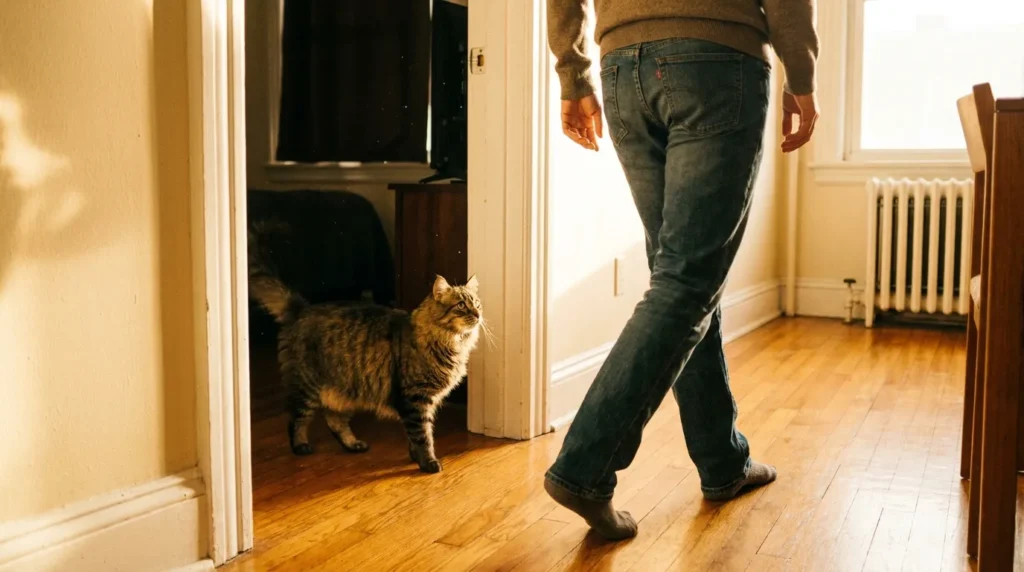
Cats are territorial, and territory needs active upkeep. When you move through the apartment, she treats it as a joint patrol. She is not only tracking your destination. She refreshes her scent by rubbing against furniture as you pass and checks that each room still feels familiar.
This is why following gets more intense when you move room to room than when you sit still. An owner parked on the couch for two hours draws less following than one who makes five trips in fifteen minutes. Movement is the trigger, not your location.
Vertical space and territory markers spread through the apartment take some of the pressure off, since she gets more territory to manage on her own. Enrichment that mimics territorial work spreads her investment across more of the apartment instead of onto your every move.
Two More Reasons Behind the Shadowing
The four reasons above cover most of it, but two more round out why does cat follow me everywhere so consistently.
Protective Instinct During Vulnerable Moments
Bathroom following is not curiosity about your routine. In the wild, elimination is a vulnerable moment, and her instinct treats your bathroom trip the same way. She follows to watch your back, not to invade your privacy. It is a protective behavior, not an intrusive one.
Anticipating Food and Routine
Cats track schedules closely. If you tend to feed her, open a treat bag, or head to a certain room around the same time each day, she learns the pattern and starts following ahead of it. This is less about you specifically and more about what your movement usually predicts. A steady routine actually reduces anxious following over time, because she can predict what happens next instead of monitoring you for clues.
Does Breed Affect How Much a Cat Follows You?
Yes, noticeably. Some breeds were shaped by generations of close human contact and shadow their owners as a baseline trait, not just an individual personality quirk.
| Breed | Following Tendency | Typical Pattern |
| Siamese | Very high | Vocal shadowing, follows room to room constantly |
| Burmese | Very high | Seeks physical closeness, not just proximity |
| Ragdoll | High | Calm following, often flops down near you rather than pacing |
| Bengal | Moderate to high | Follows during active hours, more independent at rest |
| Persian | Low to moderate | Prefers being near you in the same room over active following |
| British Shorthair | Low | More independent, follows selectively rather than constantly |
Mixed-breed cats vary more by individual temperament than by ancestry, so treat this table as a general tendency, not a guarantee. A famously independent breed can still form intense attachment to one specific person.
When Cat Following Becomes a Real Concern
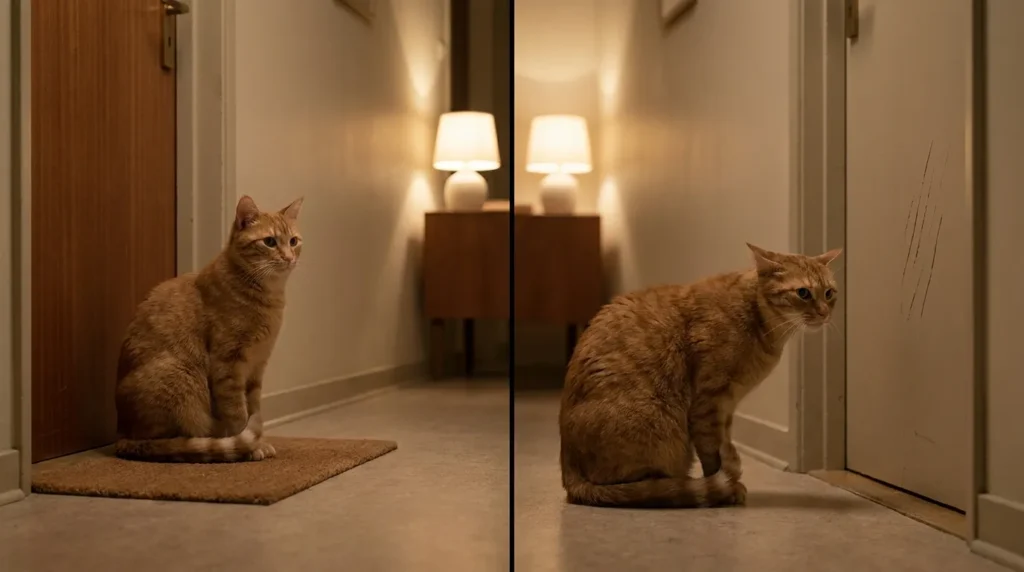
Following itself is healthy in most cats. The concern shows up when it comes with signs of separation anxiety instead of secure attachment: excessive vocalizing when you change rooms, destructive behavior only when you are out of sight, refusing food unless you are visible, or frantic behavior at the door when you leave.
A securely attached cat settles once you leave and returns to normal within minutes. An anxiously attached cat cannot handle your absence without distress signals that keep going the whole time you are gone. That difference matters, because the two need different responses.
| Sign | Secure attachment | Separation anxiety |
|---|---|---|
| Vocalizing | Quiet or occasional meow | Persistent crying when alone |
| Behavior alone | Naps or plays independently | Scratching, chewing, knocked-over items |
| Eating | Eats normally without you | Refuses food unless you’re visible |
| When you return | Calm greeting | Frantic pacing at the door |
| Settling time | Minutes | Does not settle for the whole absence |
Destructive behavior and constant attention-seeking while you’re home can also overlap with plain boredom rather than anxiety about your absence specifically. Our guide on signs your indoor cat is bored covers how to tell the two apart, since the fix for each is different.
Watching her health alongside behavior catches cases where more following points to hyperthyroidism, cognitive decline in senior cats, or pain that makes your presence feel necessary. Our guide on indoor cat lifespan covers the cognitive and sensory changes that come with each life stage, which is useful context if a senior cat’s following has changed recently. A clean, predictable litter box setup also cuts environmental stress that can amplify following in cats already prone to anxious attachment. If litter box habits shift too, unusual litter box odor after cleaning is worth ruling out alongside the behavior change. For apartment cats specifically, limited space makes predictable owner presence even more important for staying calm.

Regular, gentle grooming sessions build physical trust and a predictable handling routine, which helps anxious cats feel more secure around contact and separation. A cat with positive, predictable handling has more reason to expect your return instead of treating it as abandonment.
Building a More Secure Attachment: A Quick Checklist
If you want a calmer, more securely attached cat rather than a constantly shadowing one, these are the changes that actually move the needle:
- Keep feeding and play times at consistent hours so her routine predicts your movements instead of her having to monitor you directly
- Acknowledge her on your own schedule, not only when she demands it by following
- Add vertical space and window perches so she has territory to manage without you
- Use calm, predictable body language and tone, especially around new sounds or visitors
- Practice brief, low-stakes separations, like closing a door for a few minutes, so absence stops feeling unpredictable
- Reward settled, independent behavior with attention instead of only rewarding proximity
None of this requires ignoring her. It just shifts who controls the timing, which is what separates a securely attached cat from a demanding one.
The Mistake That Accidentally Increases Shadowing Behavior
The mistake that turns healthy proximity into demanding shadowing is responding to every following episode with instant attention, food, or play. Stop what you are doing every time she appears at your heels, and you build a loop: following gets a response, the response feels good, so she follows more.
A better response is acknowledging her on a schedule you control, not one she controls through persistence. Call her over at set times instead of reacting every time she shows up. Reward her for settling in her own space instead of rewarding proximity alone. This does not make you less loving. It builds a cat secure enough that she does not need to follow constantly, because she trusts attention will come on a schedule.
When Does a Sudden Increase Require a Vet Conversation?
A cat who starts following constantly after being more independent needs a health check. Sudden clinginess in a cat over age eight can point to pain, vision or hearing loss that makes you a needed navigator, or early cognitive decline.
Increased following paired with vocalization changes, weight loss or gain, appetite shifts, or altered litter box habits calls for a vet visit within one to two weeks, not a behavior fix. These combinations point to a medical issue, not an attachment adjustment.
This article is for informational purposes only. Always consult your vet if you have concerns about your cat’s health.
Frequently Asked Questions About Cats Following Their Owners
Is it normal for my cat to follow me everywhere in the apartment?
Yes. It is normal secure attachment behavior in indoor cats, especially those with limited environmental variety. Following you everywhere is a sign of trust rather than neediness.
Why does my cat follow me to the bathroom specifically?
Your cat follows you into the bathroom because elimination is a vulnerable moment in feline instinct and she is protecting you. She also knows you will be stationary for a few minutes, which is a reliable attention opportunity.
Does my cat follow me because she loves me?
Yes, in a biochemically measurable way. Proximity to you triggers oxytocin release and reduces her cortisol. She follows you because being near you literally feels good to her nervous system.
How do I stop my cat from following me everywhere?
You cannot eliminate it completely nor should you try. You can reduce demanding following by rewarding her for being settled in her own space and stopping the habit of responding every time she appears at your heels.
When does following everywhere become separation anxiety?
When it is accompanied by excessive vocalization, destructive behavior during your absence or refusal to eat without your presence. Calm following without distress symptoms is healthy. This article is for informational purposes only. Always consult your vet if you have concerns about your cat’s health.
My cat only follows me and ignores everyone else in the household. Why?
You are her primary safe base and oxytocin source. She has identified you as her attachment figure specifically. This is a compliment at the highest feline level, even if it sometimes feels inconvenient.
Why does my cat follow me and meow the whole time?
Constant meowing while following usually means she wants something specific, like food or access to a room, or she is anxious about losing sight of you. If it only happens around triggers like meal time, it is likely routine anticipation, not distress.
Do kittens follow their owners more than adult cats?
Yes, in most cases. Kittens are still learning what is safe, so they lean on you as a guide more heavily. Following often settles some as a cat matures and builds confidence in the space, though it rarely disappears completely.
Should I let my cat follow me into the bathroom?
There is no harm in letting her. It is a protective instinct, not a boundary problem. If you would rather have privacy, closing the door calmly, without scolding her, is enough. She will adjust.
My cat follows me everywhere but won’t let me pet her. What’s going on?
This is common and not a contradiction. Following satisfies her need for proximity and the oxytocin benefit that comes with it, while touch is a separate preference some cats are more selective about. She wants you nearby, just not always in physical contact. Let her initiate touch on her own terms rather than reaching for her every time she’s close.
Does having multiple cats reduce how much one follows me?
Sometimes, but not reliably. A cat with a strong bond to another cat in the household may follow you less, since some of her social needs are met elsewhere. A cat that doesn’t get along with the other cat, or that has a stronger attachment to you specifically, can follow just as much or more, using you as a buffer from tension in the home.
Cats follow their owners mainly from secure attachment, confirmed by Oregon State University research showing 64 percent of cats form infant-like attachment styles. The habit comes from the safe base effect, social referencing, oxytocin release that lowers cortisol, territorial patrol behavior, protective instinct during vulnerable moments, and anticipation of food and routine. Breed plays a role too: Siamese and Burmese cats show the strongest following tendency, while Persians and British Shorthairs are more independent. Indoor apartment cats follow more than cats with outdoor access, since they have less environmental variety. Separation anxiety shows up when following comes with excessive vocalizing, destructive behavior alone, or refusal to eat without the owner present. Building a secure attachment through consistent routine, vertical space, and rewarding independent settling reduces demanding shadowing over time.

Written by Mishu
A passionate cat lover and indoor living enthusiast, Mishu is the founder and voice behind Indoor Living Cat – a go-to resource for cat owners who want to create the happiest, healthiest life for their feline companions indoors.
View Full Profile