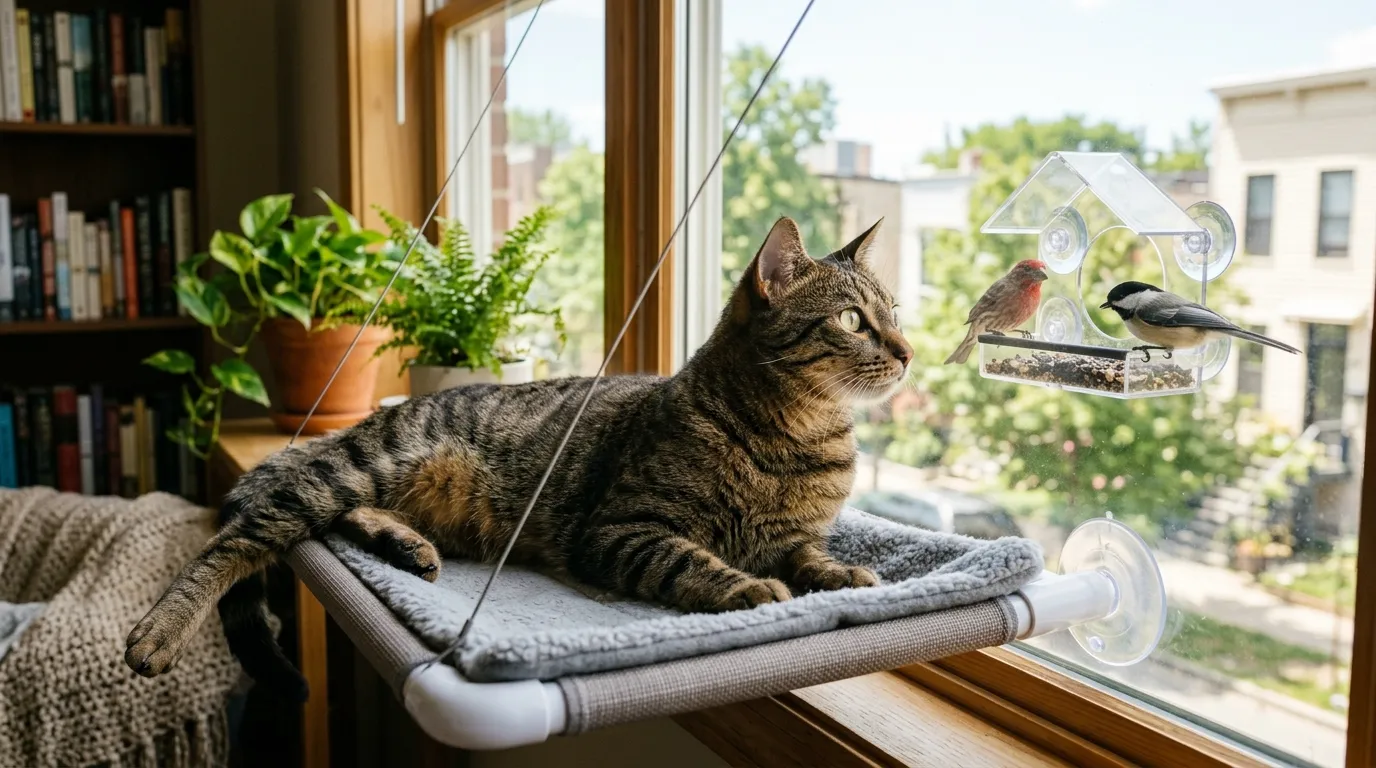
A window setup for indoor cat was the last thing on my mind when I adopted my first apartment cat. I put her bed in the corner, filled a basket with toys she ignored and spent six months wondering why she sat on the cold narrow windowsill instead of any of the comfortable surfaces I had prepared for her. She was telling me exactly what she needed and I kept buying things that were not it. A proper window setup for indoor cat is not a nice extra. It is a behavioral need that sits alongside food, play and litter access in terms of daily impact on a cat’s mental state. This article covers five steps to set it up correctly from perch positioning to the outside additions that turn an ordinary window into something your cat will actually use for hours.
A complete window setup for indoor cat needs four elements working together: a stable comfortable perch at the correct height, a bird feeder positioned five to ten feet outside the glass, a safe path up to the perch and a window that gives a clear sightline to outdoor movement. Set these up in that order and most cats begin using the station within twenty-four hours.
Why Your Cat Sits on the Windowsill and Ignores Everything Else You Bought?
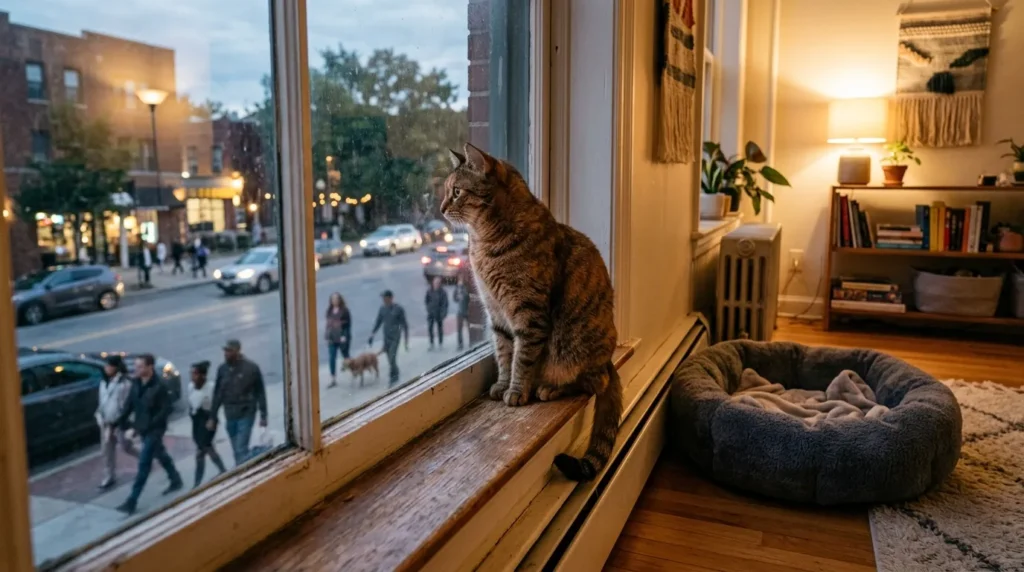
Cats sit on windowsills because the behavioral drive to survey territory from a vantage point with an unobstructed view is one of the strongest instincts a domestic cat carries. It is not about the sunlight. It is not about the temperature. It is about access to movement. A moving world outside the glass provides the unpredictable sensory input that an apartment interior structurally cannot. Birds land and leave. Squirrels cross. Leaves fall. People pass. None of it is predictable and all of it activates the observational alert state that is a core part of healthy feline neurology.
A windowsill is uncomfortable and narrow. Your cat sits on it anyway because it is the only spot in the apartment that delivers this kind of stimulation. A window setup for an indoor cat that works is simply making the most behaviorally valuable spot in the apartment also the most physically comfortable one. That single change redirects hours of restless pacing, furniture scratching and persistent vocalization into calm sustained window engagement.
The behavioral research on this is consistent. According to guidance from the Ohio State University Indoor Pet Initiative, access to natural sightlines from perches is listed as a core environmental need for indoor cats alongside food, water, litter and scratching surfaces. It is not enrichment as a bonus. It is baseline welfare.
Step 1: Choose the Right Window and Position the Perch Correctly
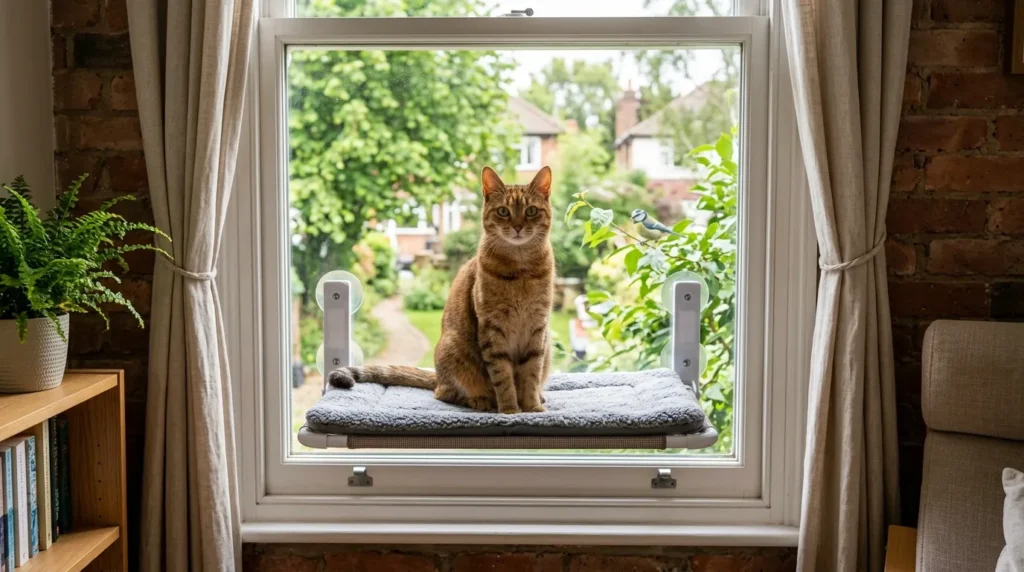
The right window is any window with outdoor activity visible and decent natural light. South or east-facing windows provide morning sunlight which most cats seek actively. A window facing a parking lot with no vegetation produces significantly less sustained engagement than one facing a tree, garden, lawn or street with foot traffic. You cannot always choose which apartment windows you have but you can choose which one to invest in as the primary cat station.
Position the perch so the cat’s eye level when sitting on it aligns with the middle third of the window glass rather than the very top or very bottom. A perch mounted too high requires the cat to crane its neck down to see ground-level activity. A perch mounted too low misses treetop activity and bird flight paths. Middle-third placement gives the widest combined view of both ground and sky movement.
The perch must be stable enough that the cat’s full relaxed weight produces zero movement. Any instability teaches the cat that the perch is not a reliable resting place and it reverts to the windowsill. Test a suction-cup perch by pressing on it with your full hand weight before letting the cat near it. Clean the glass with rubbing alcohol before attaching suction cups since any residue prevents proper sealing and causes drop events that permanently destroy a cat’s confidence in that perch.
Step 2: Add the Bird Feeder That Turns the Window Into Cat TV
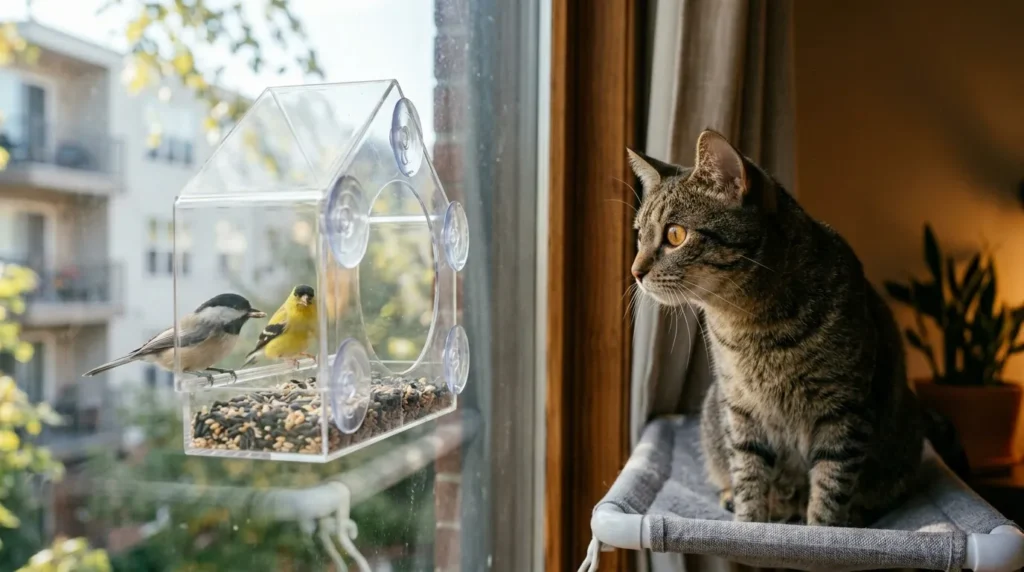
A bird feeder outside the window is the single addition that transforms a decent window setup into a genuinely compelling daily activity for an indoor cat. Without a feeder the view is passive: occasional birds or squirrels that may or may not appear. With a feeder positioned five to ten feet from the glass the view becomes an active event that repeats throughout the day at unpredictable intervals. Birds arrive, feed, startle and return. The cat’s brain tracks all of it without any owner involvement required after setup.
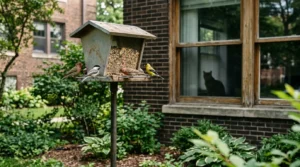
Suction-cup feeders that attach directly to the window glass bring birds within inches of the cat’s face and produce the most intense engagement but also the highest startle rate as birds see the cat and flee quickly. A pole-mounted feeder positioned five to eight feet from the glass produces calmer longer feeding visits because the birds feel less immediately threatened and stay to eat rather than landing and instantly departing. For most apartments a pole feeder in a balcony planter or a suction feeder on an adjacent surface works better than direct glass attachment for sustained daily engagement.
Refill the feeder every two to three days. An empty feeder stops producing birds within twenty-four hours and the cat’s attention drifts permanently within the first week. Consistency matters as much with the feeder as with any other daily enrichment. The window station becomes part of the cat’s understood daily environment and produces reliable engagement only when the feeder reliably produces birds.
Step 3: Build a Path Up That Your Cat Will Actually Use
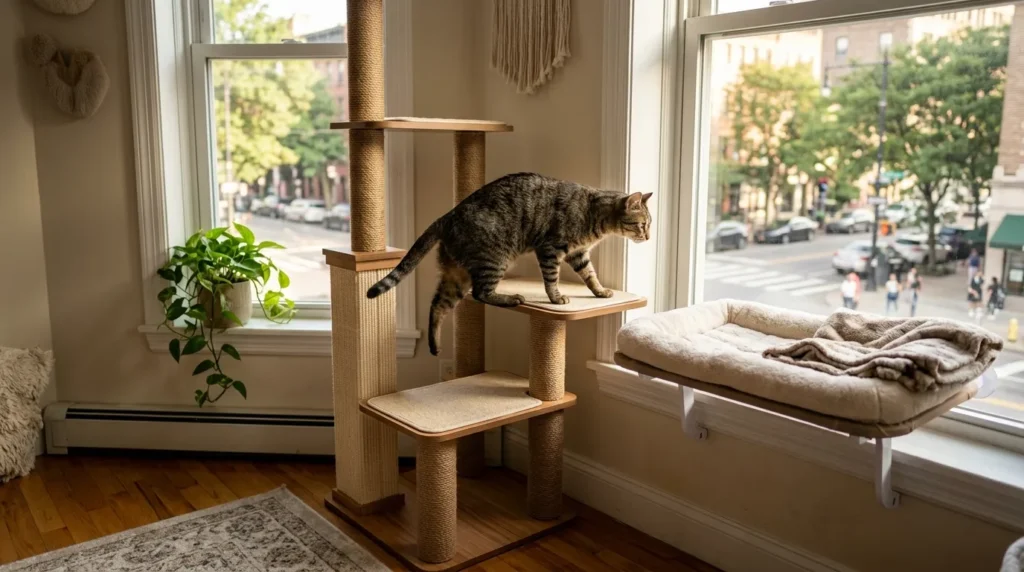
A window perch that the cat cannot reach comfortably is furniture. The path up to the perch matters as much as the perch itself especially for older cats and cats that are not naturally confident jumpers. A three-foot gap between the floor and the perch with nothing in between works for a young agile cat and completely blocks a senior cat with any joint stiffness from using the station at all.
Position a cat tree, a chair, a bookshelf or any stable intermediate surface within one comfortable jump of the perch. The intermediate surface should be lower than the perch by no more than eighteen to twenty inches so the final jump is small rather than requiring full extension. A clear logical stepwise path of floor, intermediate surface, perch gets used. A single intimidating jump from floor to high perch gets avoided.
The approach path also determines whether the cat feels secure on the perch once it arrives. A perch that can only be reached by a single jump with no alternative exit route feels like a trap to a cat that is ambush-aware. Two approach options, even if the second is just a chair placed on the other side, changes the behavioral calculation entirely. The cat will use the perch more and rest there longer when it perceives escape routes in multiple directions.
Choosing approach furniture that serves multiple purposes makes the investment sensible. A cat tree beside the window that functions as a climbing surface, a scratching post and an access route provides three separate enrichment categories simultaneously. How cat furniture is selected to serve overlapping behavioral functions determines how much of the apartment a cat actually uses versus how much of it becomes decorative storage for things the cat ignores. The right combination of cat furniture that serves multiple functions for an indoor cat transforms a functional corner into a zone the cat returns to across the full day.
Step 4: Make the Perch Worth Staying On for Hours
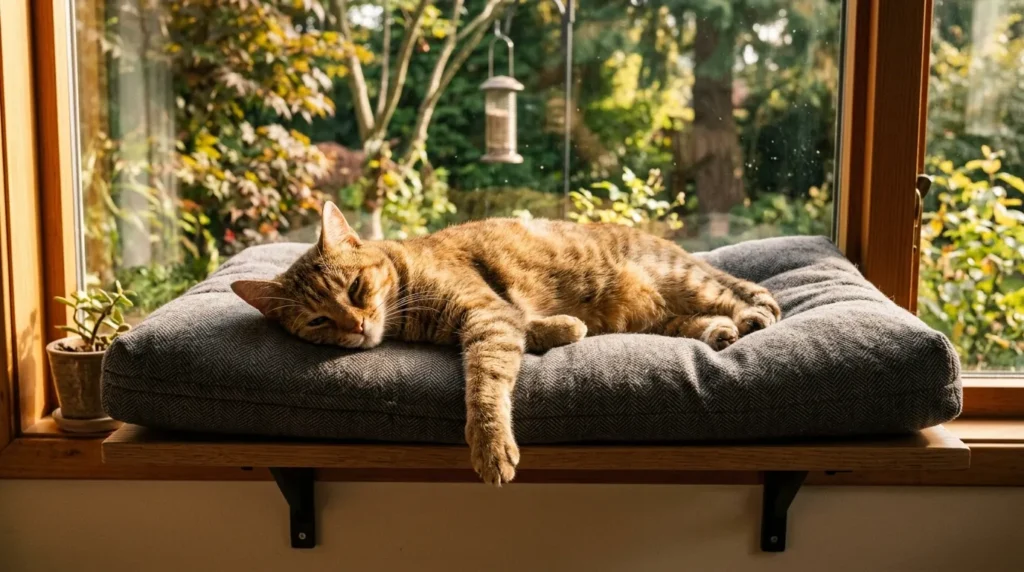
A cat that visits the window perch for three minutes and leaves has an engagement problem not a motivation problem. The outdoor activity is interesting enough. The perch is not comfortable enough to stay on. Most suction-cup perches are narrow enough that the cat must sit in an alert upright position rather than being able to sprawl fully. A cat in an upright alert position is in a physically uncomfortable resting state and eventually prioritizes physical comfort over visual stimulation.
The perch needs to be wide enough for the cat’s full body length and padded enough that lying flat is genuinely more comfortable than the windowsill. A perch that is twelve inches wide for a full-grown cat is too narrow. Sixteen to twenty inches allows a full sprawl. A thin foam insert covered with a fleece cover is acceptable but a two-inch memory foam cushion produces demonstrably longer session times because the cat can rest without postural effort.
Add a thin fleece blanket folded over the perch surface rather than a standalone cushion where possible. A blanket carries the cat’s own scent from sleeping elsewhere in the apartment and makes the new surface smell familiar within one to two uses. Cats approach novel surfaces cautiously and leave them quickly if nothing familiar anchors them there. A single familiar-smelling blanket on an unfamiliar perch shortens the adoption timeline from two weeks to two to three days for most cats.
Step 5: Cat-Proof the Window so It Can Be Left Open Safely
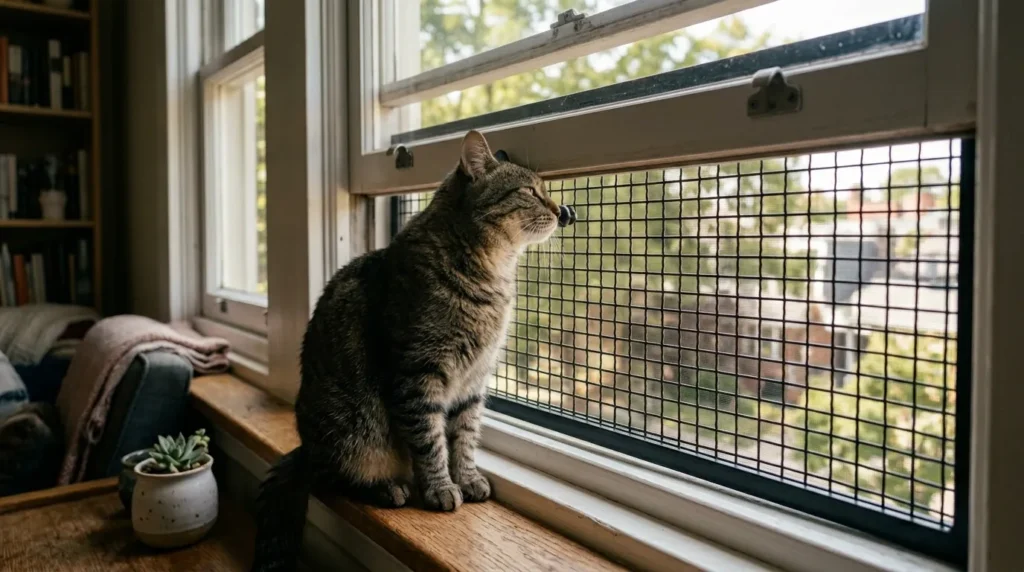
A window that can be opened safely adds an entirely new sensory dimension to the station. Fresh air carries bird sounds, ambient outdoor smell, temperature variation and wind movement that no amount of visual-only stimulation provides. A cat that can smell the outdoors through an open window receives the olfactory enrichment that is often the missing component in an otherwise well-designed indoor environment.
Standard apartment window screens fail under cat pressure. A cat that pushes against a standard screen with sustained interest will eventually pop the screen out which is a fall risk with serious consequences. Replace standard screens on any window you plan to leave open near the cat station with heavy-duty pet mesh fixed securely in the frame. Limit the window opening to no more than four inches regardless of screen quality. A cat cannot fit through a four-inch gap and four inches provides more than adequate airflow and scent access.
Insight The freshair component of the window setup is where most owners stop short and the cats notice. An open window with outdoor smells reduces indoor cat vocalization more reliably than almost any other environmental change I have seen reported consistently. The cat is not meowing because it wants to go outside. It is often meowing because it cannot smell anything but apartment air. Four inches of open window and heavy mesh costs almost nothing and solves a problem most owners spend months trying to address with play sessions alone.
The Window Setup Mistake That Makes All the Other Work Pointless
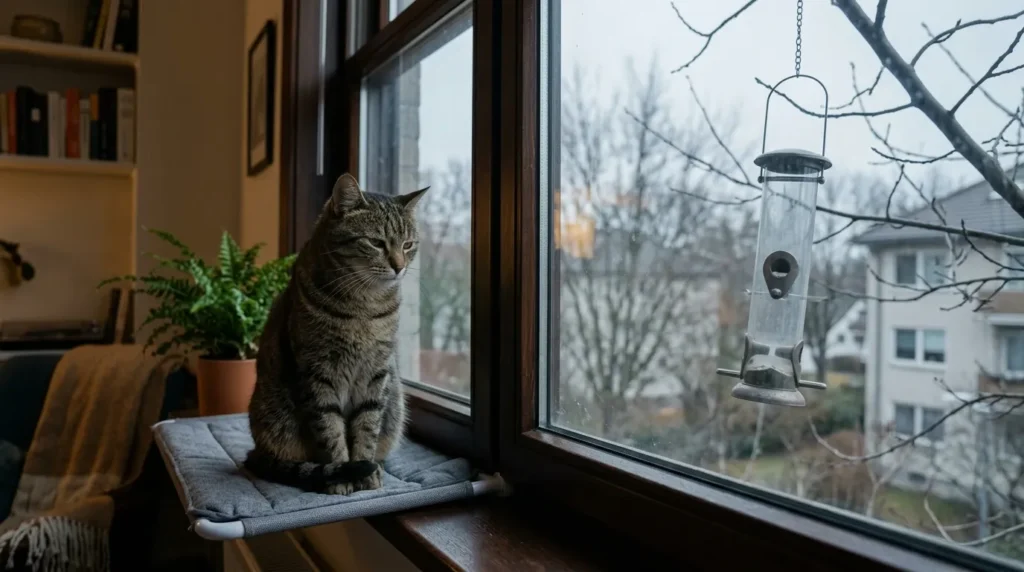
The mistake that collapses a well-designed window setup is treating it as a one-time installation rather than an ongoing system. The perch gets installed, the feeder gets filled once and three weeks later the feeder is empty, the suction cups have weakened slightly from temperature changes and the cat spends fifteen minutes at the window before leaving for the couch. All of the setup is physically intact but the behavioral value has dropped to near zero.
The maintenance schedule for a functional window station is simple. Refill the feeder every two to three days. Check suction cup stability by pressing firmly on the perch weekly and reinstall with fresh glass-cleaning if any flex is detected. Wash the perch cover monthly to remove built-up dander that desensitizes the scent anchoring effect. Rotate the blanket occasionally to refresh the familiar scent from a different sleeping spot.
The second mistake is setting up a window station and then blocking it. A chair moved in front of the access path, a shopping bag placed on the intermediate surface or a piece of furniture shifted in front of the perch approach breaks the behavioral routine. The cat tries the route once, finds it blocked and stops trying. Re-establishing a disrupted access habit takes longer than establishing it initially. Treat the approach path as permanent furniture rather than temporary arrangement.
Frequently Asked Questions
Does my indoor cat actually need a window perch or is the sill enough?
The sill is never enough because it is physically uncomfortable for sustained resting. A cat that sits on a sill watches for a few minutes then leaves because nothing supports its weight properly. A padded perch wide enough for a full sprawl converts brief visits into hour-long sessions. The behavioral difference between a sill and a proper perch is that significant.
What kind of bird feeder works best for indoor cat window entertainment?
A pole-mounted feeder five to eight feet from the glass produces the most sustained bird activity because birds feel safe enough to linger rather than flush immediately. Suction-cup feeders directly on the glass produce more intense close-up viewing but shorter visits. Both work. Start with a pole feeder if your building allows one or a suction-cup feeder on an adjacent wall or balcony railing.
How do I stop my cat from falling through the window screen?
Replace standard screens with heavy-duty pet mesh rated for cat pressure and limit opening to four inches maximum. Standard apartment screens are designed for insects not cats and they pop under sustained pushing force. Heavy-duty mesh does not. The four-inch limit is a physical barrier that no adult cat can pass through regardless of motivation.
My cat ignores the window perch I installed. What am I doing wrong?
Check the access path first. If the jump up is larger than eighteen inches or the only approach is a single direction the cat may be avoiding the vulnerability rather than the perch. Place a chair beside it to add a second approach and lower the jump height. Also check that the feeder outside is full and active. An empty feeder produces no birds and no engagement.
How long should an indoor cat spend at the window each day?
There is no upper limit. A cat that spends four hours at the window is a cat with its environmental needs met rather than a cat with a problem. The window station functions as passive enrichment that does not deplete like interactive play does. The goal is maximum voluntary window time rather than a set duration and a well-designed station with an active feeder produces this naturally.
Conclusion
A window setup for an indoor cat changes daily life more than most environmental upgrades combined because it produces passive ongoing enrichment throughout every day without requiring owner participation after the initial installation. Get the perch stable and comfortable, fill the feeder consistently and build a clear access path. Those three things done correctly produce a cat that chooses the window station over every piece of furniture you own. Start today by moving whatever is blocking the windowsill access and placing something stable at the right height beside it. The rest follows from there.
A window setup for an indoor cat requires a stable padded perch at mid-window height, a bird feeder positioned five to eight feet outside the glass for consistent bird activity, a clear low-jump access path from floor to perch and reinforced mesh screening for any windows left open. The perch should be sixteen to twenty inches wide to allow full body sprawling rather than upright sitting. Suction cups must be installed on alcohol-cleaned glass and checked weekly for stability. A functional window station provides five to eight hours of passive daily enrichment without owner participation after initial setup.