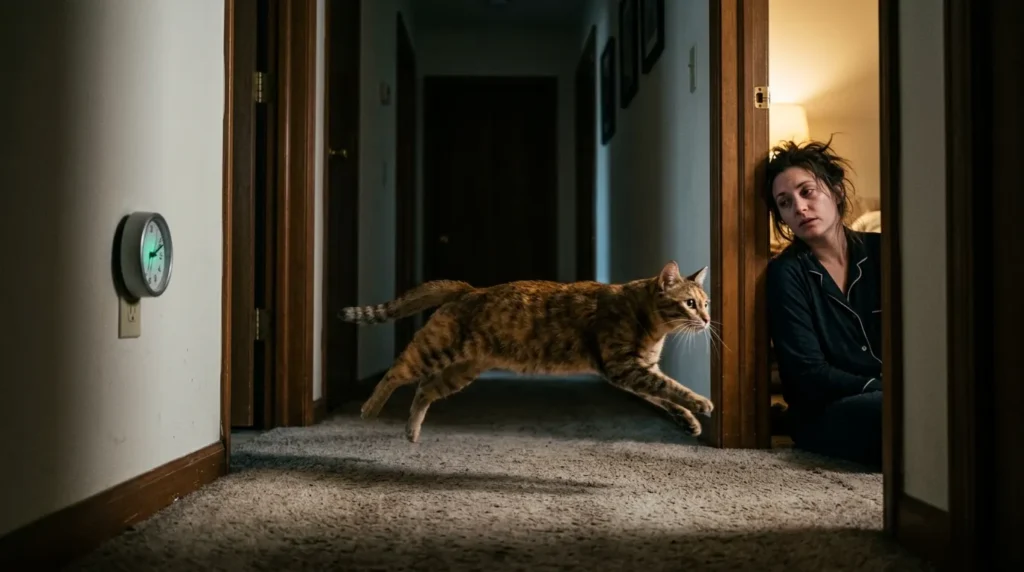
How to tire out hyper indoor cat is something I searched at 2am on a Tuesday after my cat launched herself off my face, knocked my water glass onto the floor and immediately began sprinting figure eights around the bedroom. She was two years old, perfectly healthy and absolutely feral with unspent energy every single evening. I had been giving her a play session in the morning thinking that covered it. It did not. Knowing how to tire out hyper indoor cat is less about finding the right toy and more about understanding when, how and in what sequence to discharge energy that builds across the full day. This article covers seven methods that actually work and why the order and timing matter as much as the activity itself.
The fastest way to tire out a hyper indoor cat is a fifteen-minute wand toy session timed to dusk when predatory drive naturally peaks, followed immediately by the evening meal. This completes the hunt-eat-groom-sleep sequence the cat’s biology expects. Two cats in the same apartment with this schedule running nightly stop producing midnight sprints within five to seven days in most cases.
Why Your Indoor Cat Has So Much Energy at Night?
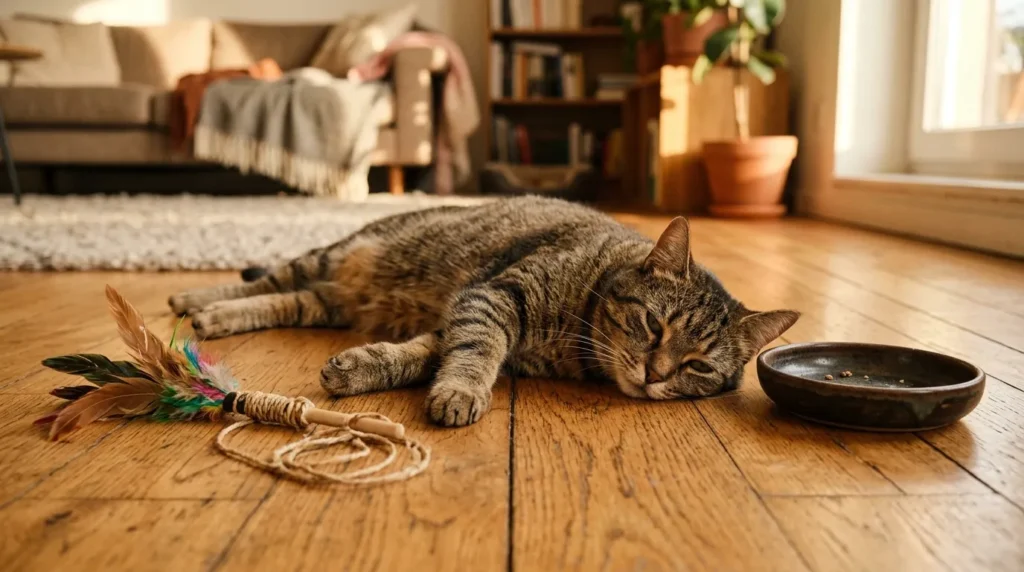
Indoor cats produce midnight zoomies and evening hyperactivity because they are crepuscular animals whose natural activity peaks fall at dawn and dusk. An indoor cat that sleeps all day in a quiet apartment arrives at dusk with a full biological drive for physical activity and hunting behavior. If that drive has no outlet it expresses itself as sprinting, climbing, attacking human feet and bouncing off furniture at midnight. This is not a temperament problem. It is an energy management problem.
The reason evening hyperactivity feels so overwhelming in indoor cats is precisely because the apartment removes every natural energy drain the cat would have outside. An outdoor cat walks territory, stalks real prey, responds to environmental unpredictability and experiences weather. An indoor cat sits. By 9pm it has roughly twelve hours of accumulated predatory drive with nowhere to direct it and the nearest moving things are your feet and your face.
Breed matters here but not as much as owners assume. High-drive breeds including Bengals and Abyssinians produce more intense evening energy than most domestic shorthairs but the underlying mechanism is identical across all cat types. Every indoor cat accumulates unspent predatory energy throughout its quiet indoor day and requires deliberate daily discharge to stay behaviorally settled. The only variable is how much daily discharge each individual cat needs.
Method 1: The Evening Play Session That Changes Everything
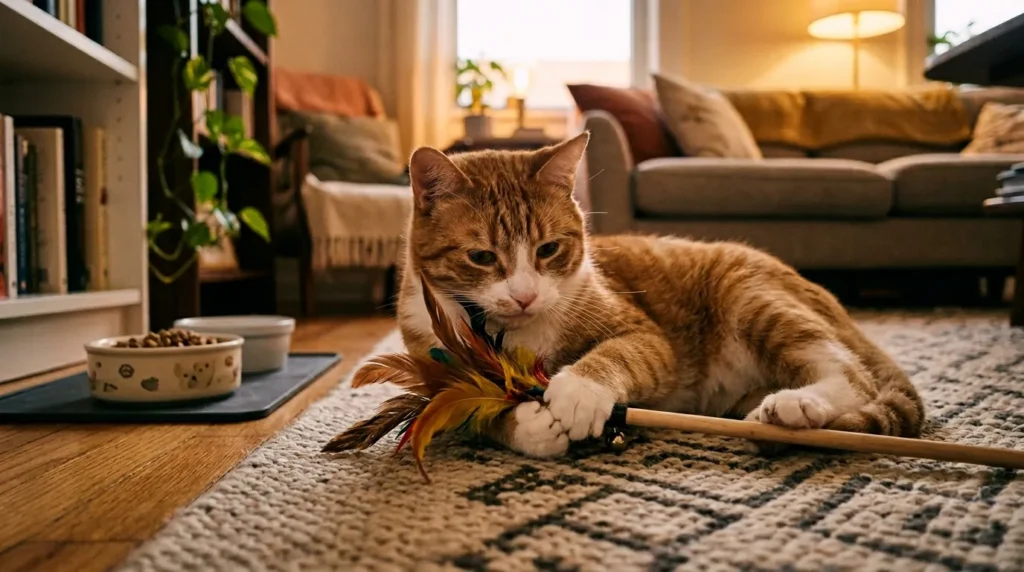
The single most effective method to tire out a hyper indoor cat is a fifteen-minute wand toy session scheduled at dusk and tied immediately to the evening meal. Dusk is when the cat’s predatory drive peaks biologically. An intense play session at that moment discharges the accumulated daily energy at the precise time the nervous system was already prepared to discharge it. This timing produces dramatically better results than the same session run at noon or in the morning.
The session structure matters as much as the timing. Run the wand in two-minute bursts of active movement followed by thirty seconds of stillness where the “prey” appears to hide. The cat sprints, crouches and readies itself during the stillness then launches again at the next burst. This mirrors a real hunt and produces genuine physical exhaustion in a healthy adult cat within twelve to fifteen minutes of properly paced intense play.

End every session by letting the cat catch and grip the toy for twenty to thirty seconds. Then deliver the meal immediately. This sequence completes what feline biology calls the hunt-eat-groom-sleep cycle: the cat hunted, caught, ate and will now groom and sleep. A session that ends abruptly without a catch leaves predatory arousal partially unresolved. A session that ends with a catch and a meal produces the grooming and genuine rest that follows a natural hunt. Most cats that receive this sequence nightly stop producing midnight activity within one to two weeks.
Method 2: Puzzle Feeders That Drain Energy at Every Meal
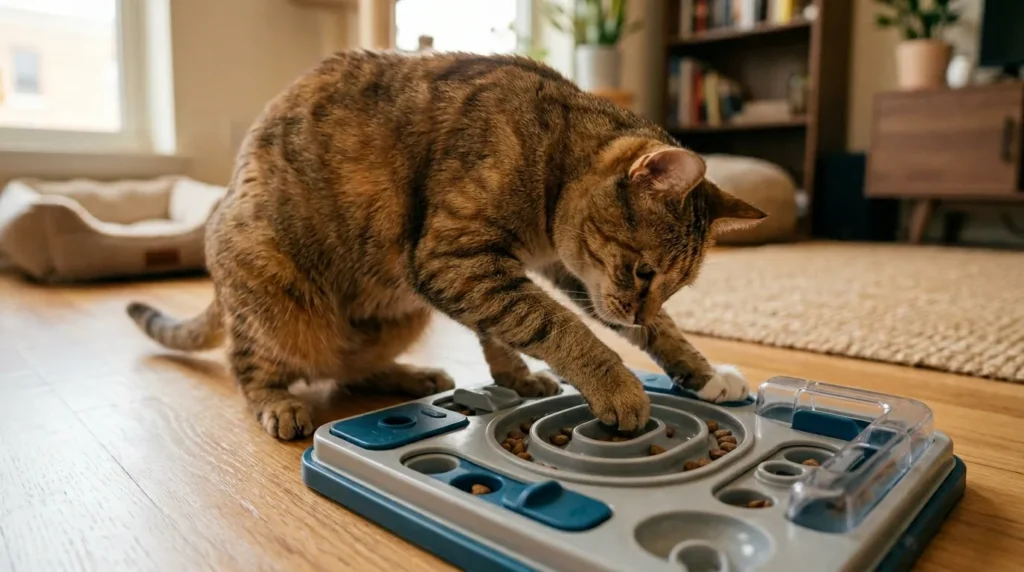
A puzzle feeder at every meal converts the two daily feeding events that a hyper cat typically dispatches in thirty seconds into ten to fifteen minutes of combined physical and cognitive work. A cat pawing, nudging and batting food out of puzzle channels is burning energy through the meal rather than conserving it. Over a full day two puzzle feeders replace forty seconds of bowl eating with twenty to thirty minutes of active foraging work.
The behavioral math is significant. A cat that spends twenty additional minutes in active foraging daily reaches its evening play session with measurably less accumulated pent-up energy. The evening play session still needs to happen but it produces a settled cat faster because the daily energy baseline is already lower from the midday foraging work. This is the compounding effect of stacking multiple energy-draining methods rather than relying on one single intense session.
Start with the easiest puzzle tier available. A hyper cat that fails repeatedly at an overly difficult puzzle abandons it rather than persisting and the energy drain goes to zero. Match the difficulty to the cat’s persistence threshold by observing whether it is still actively engaged at the two-minute mark or has already walked away. Walking away means the puzzle is too hard. Finishing it in under ninety seconds means it is too easy. The sweet spot is two to four minutes of sustained engagement per meal.
Method 3: Vertical Space That Drains Energy Passively All Day
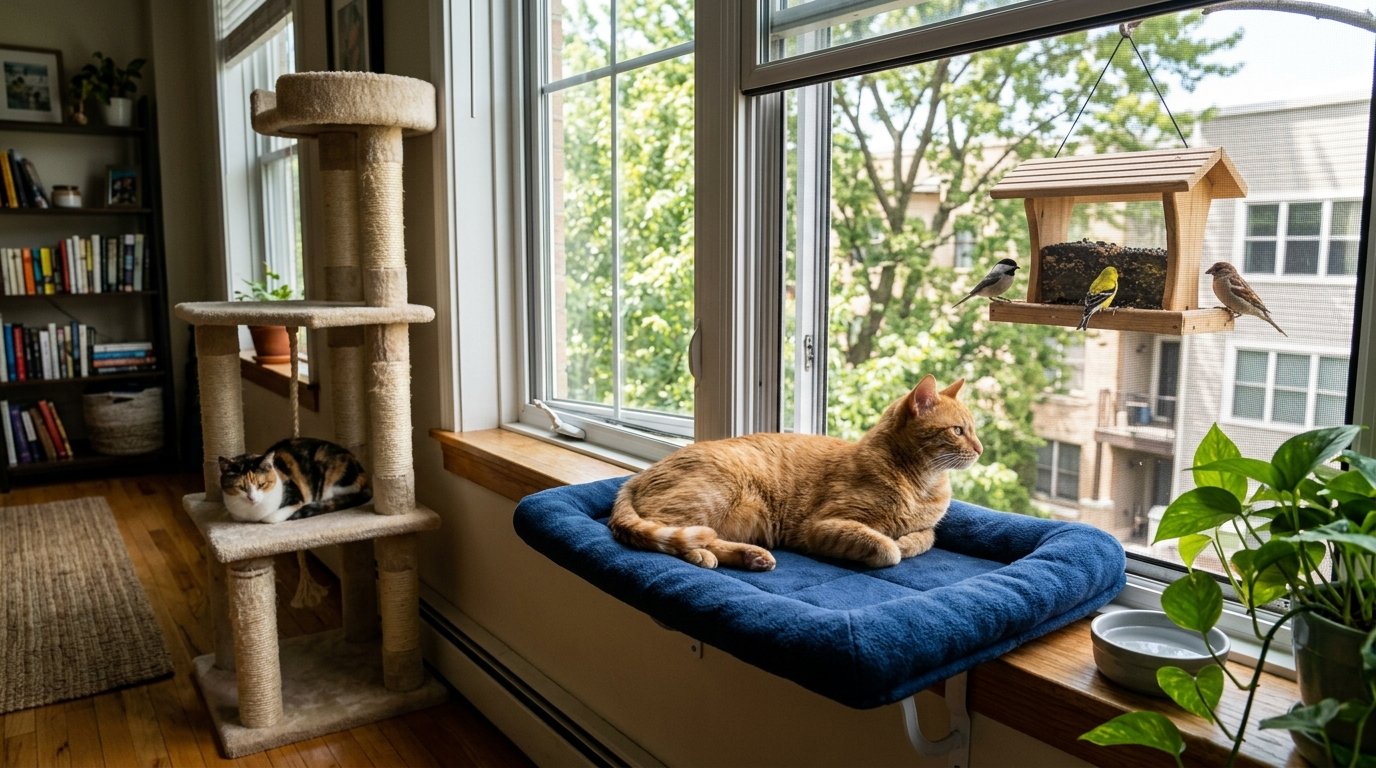
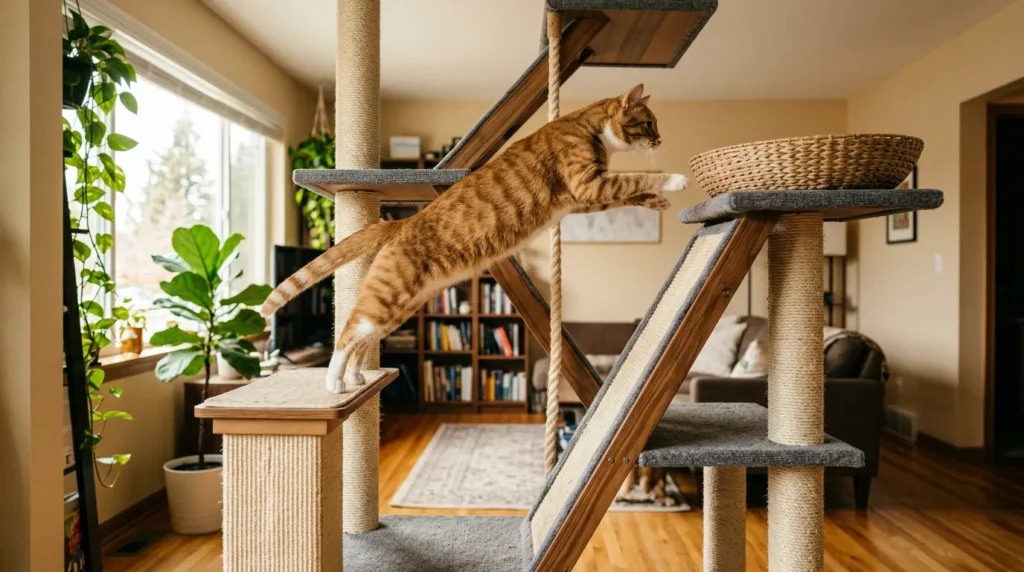
Vertical space drains energy passively throughout the day because a cat with multiple heights to navigate spends its resting hours moving between levels, jumping up and down in response to noises and activity and maintaining the physical engagement of an environment with genuine physical demands. A cat in an apartment with only floor-level options has no vertical movement to do during the day. All of its physical capacity arrives at dusk intact and floods out during the evening hours.
A tall cat tree with platforms at genuinely different heights placed near an active window works best because it combines the physical demand of climbing with the visual stimulation of the outdoor view. The cat climbs to the top to watch birds, comes down when something happens at floor level, climbs again when the birds return. That repeated cycle of climbs and descents across an eight-hour day represents real caloric expenditure that reduces evening energy accumulation.
The connection between a cat’s physical environment and its behavioral patterns across the whole day is stronger than most owners realize. The full picture of how an apartment cat’s surroundings shape its daily energy levels makes it clear why a well-designed living space matters as much as scheduled play sessions for managing high energy. An environment designed for physical movement produces a calmer cat at bedtime even without any additional owner-led exercise.
Method 4: The Midday Energy Outlet That Owners Always Skip
A five-minute midday energy outlet is the most underused method for managing hyper indoor cats because it feels too brief to matter. It matters considerably. A cat that gets one rolling crinkle ball chased across the floor at noon, one toilet paper roll treat dispenser to bat around in the afternoon and an evening wand session produces much calmer bedtime behavior than a cat that receives only the evening session regardless of how long that session runs.
The principle is energy distribution. Rather than allowing twelve hours of accumulation followed by one large discharge the midday outlet intercepts some of the accumulated daily energy before it reaches the evening peak. The evening session still discharges the bulk of the drive but it starts from a lower accumulated baseline. Smaller total discharge needed means faster transition to settled rest after the session ends.
These midday moments do not require the owner’s full fifteen-minute attention. Roll a crinkle ball down the hallway from the couch. Drop a toilet paper roll treat dispenser on the floor while making coffee. Toss a paper ball into the kitchen before leaving for work so the cat finds it during the day. Five minutes of scattered midday interaction reduces evening hyperactivity more reliably than extending the evening session from fifteen to thirty minutes.
Insight The cats I have seen with the worst evening hyperactivity all had one thing in common: zero midday contact from their owner. The owner was at work, the cat slept all day and arrived at 6pm with twelve hours of stored energy ready to detonate. Adding two brief five-minute interactions across the day: one before leaving and one at lunch via a toy or treat, changes the evening completely within a week. You do not need more evening time. You need the energy distributed differently across the day.
Method 5: Scatter Feeding to Make the Whole Apartment Work for You
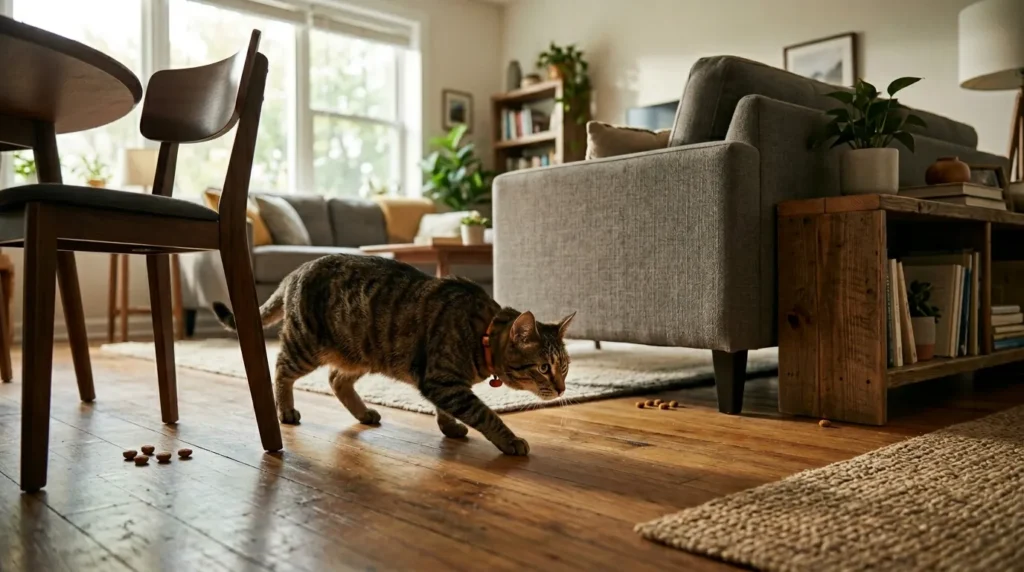
Scatter feeding turns the twice-daily feeding events into energy-burning foraging sessions that require the cat to cover the entire apartment rather than walk to a bowl. Hide the morning portion in five to eight locations across different rooms and let the cat find them. A cat that spends ten to twelve minutes hunting its breakfast has used its foraging drive productively, consumed energy through movement and satisfied the predatory sequence before you have even left for work.
The energy burned through scatter feeding is different from the energy burned through wand play and both types matter. Wand play discharges the sprint-and-catch predatory drive. Scatter feeding discharges the stalking-and-foraging drive which is a quieter but equally real behavioral pressure that indoor cats carry all day without any legitimate outlet when they eat from a bowl. Addressing both drives separately produces a calmer more satisfied animal than addressing only the sprint component through play.
What and how a hyper cat eats shapes its energy levels across the entire day because food timing affects alertness cycles in cats the same way it does in most mammals. The sequence of play then meal rather than meal then play is not optional for a hyper cat: it is the behavioral scheduling that produces rest after the session instead of a second wind.
The Mistake That Keeps Hyper Cats Hyper Indefinitely
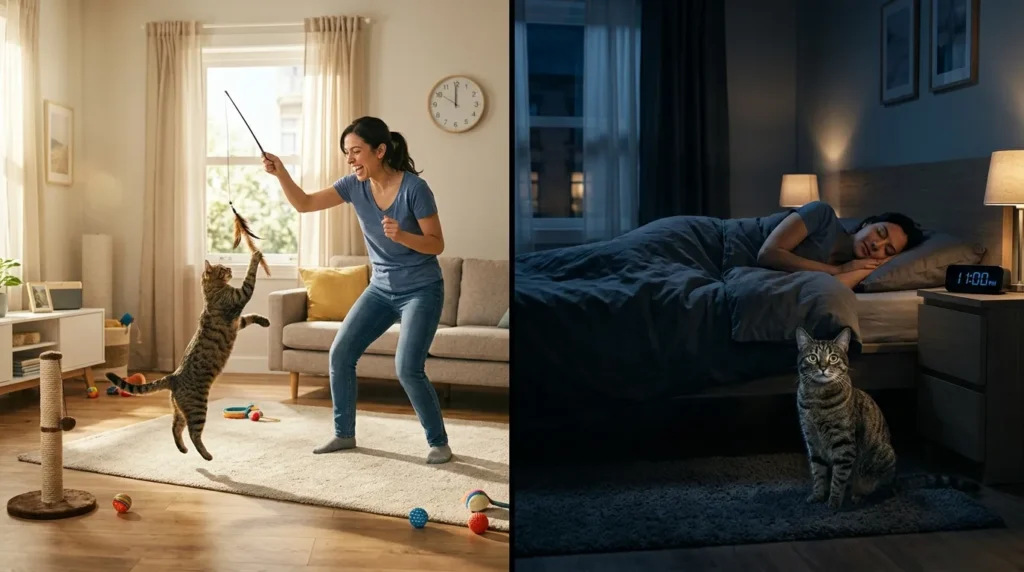
The most common mistake owners make when trying to tire out a hyper indoor cat is running the day’s only play session at the wrong time. Playing with the cat in the morning before work feels productive and responsible. It does not produce a calm cat at bedtime. By the time 10pm arrives the cat has been through eight to ten hours of daylight rest following the morning session and its crepuscular activity peak is fully charged again with nowhere to go.
Timing is the entire mechanism. A fifteen-minute session at 6pm before dinner produces calm bedtime behavior. The identical session at 8am produces a cat that is awake and energized again by evening. The session has to meet the cat’s biological energy peak not the owner’s scheduling convenience for it to discharge the drive that produces evening and nighttime hyperactivity.
The second mistake is relying entirely on physical play without any environmental energy drain running in parallel. A cat that gets a perfect evening play session but has an apartment with no vertical movement options, no puzzle feeders and bowl-fed meals all day enters that evening session with the maximum possible daily energy accumulation. Any single method used alone is always less effective than two or three methods running simultaneously throughout the day.
When Hyperactivity Signals Something Beyond Boredom?
A cat that suddenly becomes dramatically more hyperactive after a period of normal behavior may have an underlying medical cause worth ruling out. Hyperthyroidism in cats over eight years old produces a characteristic combination of increased vocalization, restlessness, weight loss despite normal or increased appetite and hyperactive behavior that looks exactly like under-stimulated cat energy but does not respond to play schedule improvements.
A cat that shows sudden onset hyperactivity with also changes in eating, weight or coat condition should have bloodwork run before any behavioral intervention is attempted. The same goes for a cat younger than two that shows hyperactivity significantly beyond what its age-group peers produce, since certain neurological conditions present in early adulthood with behavioral manifestations.
For cats with no medical finding behind the hyperactivity, the behavioral interventions in this article resolve the problem for the overwhelming majority within two to three weeks of consistent implementation.
This article is for informational purposes only. Always consult your vet if you have concerns about your cat’s health.
Frequently Asked Questions
Why is my indoor cat so hyper at night specifically?
Cats are crepuscular which means their biology produces peak activity at dawn and dusk rather than during the day. An indoor cat that sleeps through the quiet daytime arrives at dusk with twelve hours of accumulated predatory energy and no outlet for it. The nighttime hyperactivity is the discharge of that accumulated energy at the biologically correct time without any appropriate channel to absorb it.
How long does it take to tire out a hyper indoor cat?
A properly structured evening play session of fifteen minutes at dusk followed immediately by the evening meal typically settles a hyper cat within thirty to forty minutes of the session ending. Over a week of consistent daily sessions the cat’s baseline evening energy level reduces noticeably as it begins anticipating and expecting the structured discharge at the right time each day.
My cat goes crazy after I play with it. Am I doing something wrong?
A cat that becomes more agitated after play rather than settling usually did not complete the catch phase of the session. End every play session by letting the cat grip and hold the toy for twenty to thirty seconds then deliver the meal immediately. The catch-and-eat sequence closes the predatory loop neurologically. A session that ends mid-chase without a catch leaves arousal elevated rather than resolved.
Do I need to play with my cat twice a day or is once enough?
Twice is better for most hyper indoor cats: one shorter five to ten minute session in the morning and the main fifteen-minute session at dusk before dinner. The morning session does not need to be intense. It just breaks the overnight accumulation and sets a calmer baseline for the day. If hyperactivity continues despite two daily sessions for two weeks consult your vet to rule out thyroid or neurological causes.
Will getting a second cat help tire out my hyper indoor cat?
Sometimes. Two cats that play well together provide mutual exercise throughout the day that no owner can replicate through scheduled sessions alone. However introducing a second cat to resolve one cat’s hyperactivity is a significant commitment that may create new behavioral complications if the cats are incompatible. Fix the play schedule and environmental enrichment first. If those fail completely then a companion cat becomes a more reasonable consideration.
Conclusion
How to tire out hyper indoor cat is fundamentally a timing and sequencing problem rather than an intensity problem. The evening wand session at dusk followed by the meal is the foundation and everything else, the midday outlets, the puzzle feeders, the scatter feeding and the vertical space, compounds its effect by reducing the daily energy baseline the evening session has to clear. Start tonight with the fifteen-minute session before dinner timed to dusk. Add scatter feeding for tomorrow’s breakfast. Watch the difference across five nights and build from there.
To tire out a hyper indoor cat run a fifteen-minute wand toy session at dusk timed to the cat’s natural crepuscular activity peak, followed immediately by the evening meal to complete the hunt-eat-groom-sleep cycle. Add puzzle feeders at both daily meals to convert feeding into ten to fifteen minutes of active foraging work per meal. Install a tall multi-level cat tree near an active window for passive vertical energy expenditure throughout the day. Scatter feeding hides the morning portion in five to eight apartment locations to discharge foraging drive before the first human contact of the day. Most hyper indoor cats show significantly calmer nighttime behavior within five to seven days of consistent implementation.