
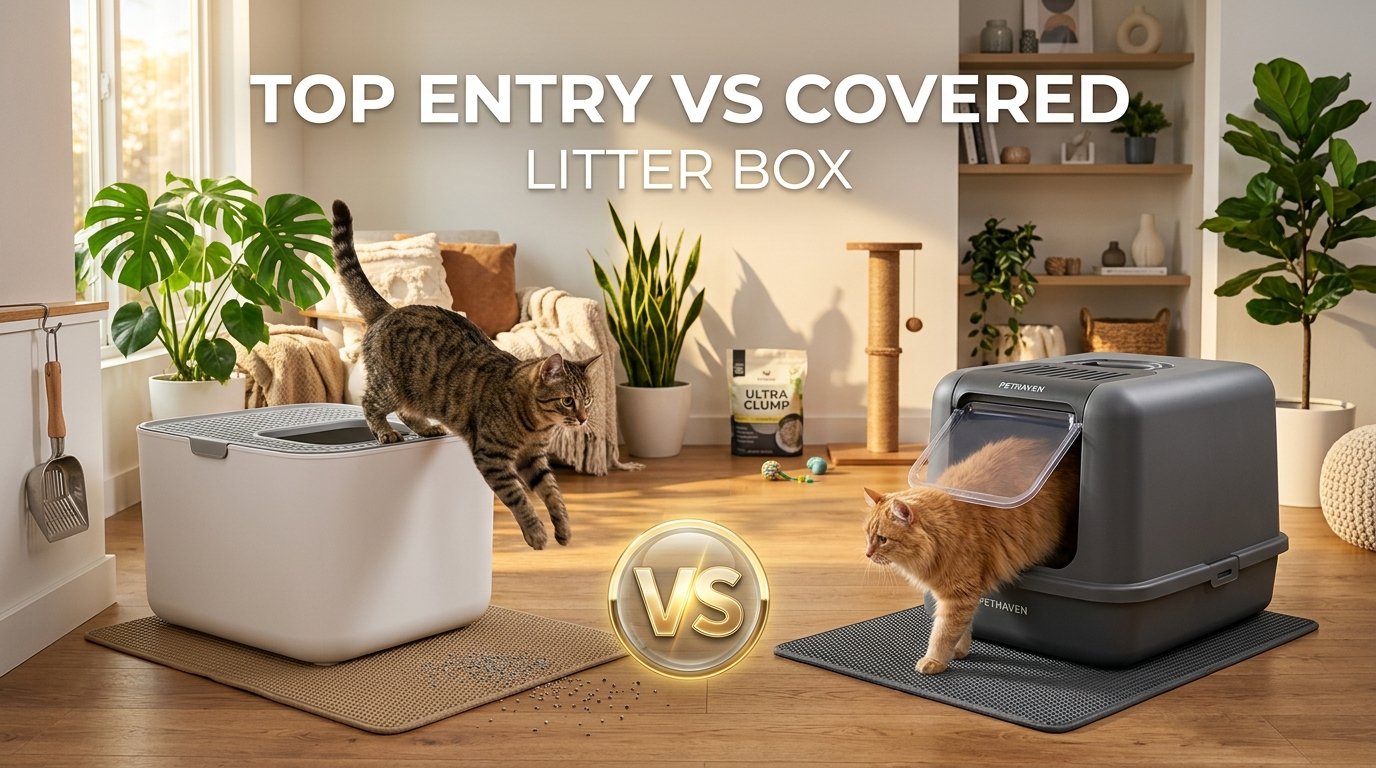
Picking a litter box sounds simple until you’re standing in the pet aisle staring at ten shapes and none of them look obviously right. This comparison lines up two of the most-searched styles: the Arm & Hammer Premium Top Entry Litter Box and the Amazon Basics No-Mess Hooded Enclosed Cat Litter Box. One asks your cat to jump down through a hole in the roof. The other lets them walk through a swinging door the way most cats already know how to. Both keep litter contained and give your cat some privacy, but the mechanics are almost opposites. Below, we get into which cats do better with each design, how much floor space you actually need, and what the packaging leaves out.
Top Entry vs Covered Litter Box: Quick Comparison
⚡ Quick Verdict
Pick the Arm & Hammer Top Entry box if tracked litter is the problem you’re actually trying to fix. The high walls and grated lid knock most of the loose granules off your cat’s paws before they hit the floor, and the design blocks dogs from getting to the box entirely. Pick the Amazon Basics Hooded box instead if your cat is older, has stiff joints, or just won’t jump. A cat that refuses to use the box you bought is a bigger problem than any amount of tracked litter.
Top Entry vs Hooded vs Front Entry: What the Terms Actually Mean
Listings throw around “covered,” “hooded,” “enclosed,” and “top entry” like they’re the same thing. They aren’t, and mixing them up is the easiest way to end up with a box your cat won’t touch. Here’s how the terms actually break down:
- Top entry: The only way in is a hole cut into the lid. Your cat jumps up and drops down into the litter. There’s no door at floor level at all.
- Front entry (also called side entry): A ground-level opening on one of the short sides. Your cat walks straight in, no jumping required.
- Hooded or covered: A general term for any box with a lid or dome over the litter. Most hooded boxes, including the Amazon Basics model in this review, are front entry with a swinging door or open archway cut into the hood.
- Self-cleaning: A separate feature, not an entry style. Both top entry and front entry boxes now come in automated versions, though neither model in this review is one.
So when someone searches “top entry vs covered litter box,” they’re usually asking top entry vs hooded front entry. Both boxes here are covered. The real difference is where the door sits, and that one detail changes almost everything about how your cat uses it.
Analysis: Arm & Hammer Top Entry
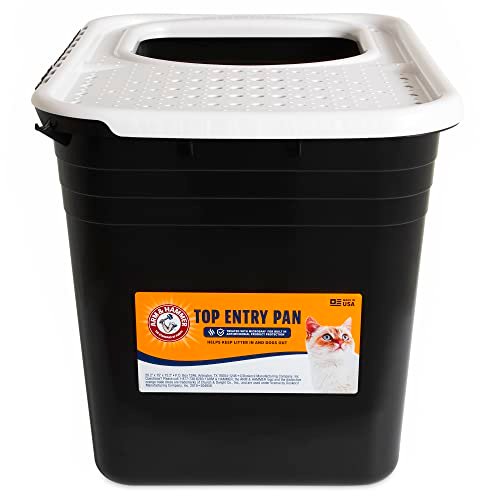
Good fit for owners fighting a losing battle with tracked litter, and for multi-pet homes where the dog keeps raiding the box. Not a good fit for kittens, seniors, or any cat that struggles to jump.
The Arm & Hammer Premium Top Entry Litter Box measures roughly 20″ L x 15″ W x 15″ H and weighs under 4 lb empty, so it’s light enough to carry out to the trash without wrestling with it. The tall walls contain scatter that a standard open pan just can’t hold in. Because the only way out is up and through the grated lid, jumping out naturally knocks loose granules off your cat’s paws before they touch your floor.
The plastic carries Microban antimicrobial treatment built into the material itself, which helps slow the bacteria that cause litter box smell between cleanings; it isn’t a substitute for scooping. The box is made from a high percentage of recycled plastic, has a molded hook for hanging your scoop, and includes a handle on the base so you can lift and dump it without spilling. The opening is wide enough that most adult cats, including larger breeds, don’t feel squeezed getting in or out.
Build Quality & Design
The recycled plastic feels solid, not flimsy, and the high-walled shell holds its shape even when a cat digs hard against the sides. The lid snaps on securely and hasn’t popped loose during normal use in owner reports. Rounded edges and a plain, boxy shape mean it tucks into a laundry room or bathroom corner without drawing attention.
Performance & Speed
Owners of top entry boxes commonly report a sharp drop in tracked litter compared to open pans or front entry hoods, since the grated lid does most of the work as the cat climbs out. It’s not zero, a determined digger will still fling some litter around inside the box before exiting, but almost none of it ends up on your floor. Cleanup is quick once you’re used to lifting the lid to scoop.
Features & Functionality
Key features are the Microban-treated plastic, the built-in scoop hook, and a lid design that works with clay, crystal, pine, or clumping litter without clogging. The top-entry structure doubles as a dog barrier: a dog’s snout can’t reach down through the small lid opening, so this is one of the few designs that actually solves the “dog eats cat litter” problem instead of just discouraging it.
User Experience
Most healthy adult cats adjust within a few days, especially if you start with the litter level a bit higher so the jump feels shorter. Scooping means lifting the whole lid off rather than reaching through a door, which is a small extra step but keeps litter from spilling over the sides while you work. It’s not a box you can service one-handed.
Value for Money
It costs more up front than a basic open pan, but you’ll spend less on litter mats, floor cleaner, and vacuuming once tracking drops off. Arm & Hammer recommends replacing any litter box, this one included, about every 12 months, since scratches in the plastic hold onto odor no amount of washing removes. Budget for that when you’re comparing sticker price against a cheaper box you’ll replace just as often anyway.
✅ Advantages
❌ Disadvantages
Analysis: Amazon Basics Hooded Box
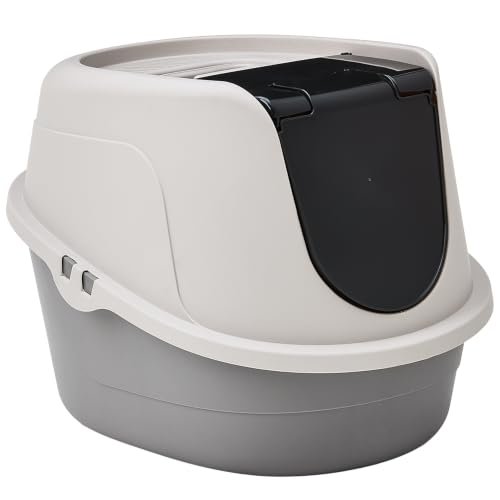
Good fit for kittens, seniors, cats with mobility issues, and anyone who wants a box their cat will use on day one with zero adjustment period. Not the box to reach for if a dog in the house keeps getting into the litter.
The Amazon Basics No-Mess Hooded Enclosed Cat Litter Box sticks to a design cats already know: a swinging door at floor level, no climbing involved. That familiarity matters more than it sounds. A shy or anxious cat is far less likely to avoid the box, or worse, start going outside it, when the entry doesn’t ask them to change how they use a litter box in the first place.
A pre-installed carbon filter handles odor management, working through absorption rather than an antimicrobial coating, so replacing the filter every few months keeps it effective. The plastic resists staining and holds up to soap-and-water cleaning. At 21″ x 16″ x 15″, it’s compact enough for a small bathroom or a tight closet corner without dominating the room.
Build Quality & Design
The plastic shell is solid enough for daily use and wipes clean easily. The swinging door is lightweight, so even a small kitten can push through without much effort, and the compact footprint makes it practical for apartments or homes with limited floor space around the litter area.
Performance & Speed
Odor control is solid for day-to-day use as long as you swap the carbon filter on schedule. The hood keeps digging debris from flying out during use, though some litter still tracks out through the swinging door on a fast exit, since nothing scrapes the cat’s paws clean on the way through. It won’t match a top entry box for tracking control, but it doesn’t ask anything extra of your cat either.
Features & Functionality
The carbon filter is the main functional feature here, cutting smell without chemicals or sprays. The hood lifts off for scooping, so you get quick access without disturbing the base pan. It’s a straightforward tool: nothing fancy, but it does the basic job of containment and privacy reliably.
User Experience
Cats need zero training here because the swinging door is exactly what most of them grew up using. That makes this the safer choice for a household bringing home a new kitten or introducing a rescue cat, where you don’t want the litter box itself to be one more unfamiliar thing. The removable hood pops off in seconds when you need to deep clean.
Value for Money
This is the lower-cost option of the two, and it delivers what it promises: basic odor control and a contained, private space, without asking you to pay for features you may not need. Factor in replacement carbon filters as an ongoing cost, since they aren’t a one-time purchase.
✅ Advantages
❌ Disadvantages
Which Cats Do Better With Each Design?
The entry method matters more to your cat than any filter or coating on the plastic. Age, joint health, and past habits decide whether a box gets used or gets ignored in favor of your carpet. Here’s how the two styles line up against real-world cat conditions.
| Cat Situation | Better Fit | Why |
|---|---|---|
| Kittens under 6 months | Amazon Basics Hooded | Growing joints and short legs make the jump into a top entry box harder than it needs to be. |
| Senior or arthritic cats | Amazon Basics Hooded | Stiff joints turn a simple jump into a real obstacle. A ground-level door removes that barrier entirely. |
| Overweight or large-breed cats | Depends on mobility | A heavier but agile cat handles the Arm & Hammer box fine. A heavier cat with joint strain does better with the swinging door. |
| Cats that “pee high” against a wall | Arm & Hammer Top Entry | The tall walls catch urine that would clear the sides of a standard pan or hood. |
| Anxious or newly adopted cats | Amazon Basics Hooded | A familiar door style means one less unknown while the cat settles into a new home. |
| Homes with a dog that raids the litter | Arm & Hammer Top Entry | A dog’s nose and mouth physically cannot fit through the top opening down to the litter. |
One more note on the “peeing high” issue: if your cat is spraying against the wall of any litter box, top entry included, it’s worth ruling out a urinary tract infection or marking behavior with your vet before assuming it’s just a design problem.
How to Get Your Cat Using a Top Entry Box
Switching an adult cat from an open pan or hooded box to a top entry design isn’t automatic. Most cats adjust within a week if you don’t rush it. Skip the steps below and you risk your cat avoiding the box, and possibly the floor next to it, instead.
- Keep the old box out for the first week. Set the new top entry box next to it rather than swapping cold turkey.
- Take the lid off at first. Let your cat use the base like an open pan for a few days so the shape and litter feel familiar before they have to deal with the jump.
- Add the lid once they’re comfortable. Put it on but leave the old box available for a few more days as a backup.
- Raise the litter level slightly. A shorter drop from the opening to the litter makes the jump feel less intimidating for smaller or older cats.
- Remove the old box only after you see consistent use. A few clean days in a row, not just once, is the signal it’s safe to take the backup away.
If a cat still won’t use it after two full weeks, that’s your answer. Some cats never take to top entry boxes no matter how gradual the switch, and forcing it usually just moves the accident somewhere else in the house.
Size, Placement, and Multi-Cat Households
Get the box itself right and you can still lose the battle on sizing or placement. A few rules of thumb that hold up regardless of which style you buy:
- Size rule: The box should measure at least 1.5 times your cat’s body length, nose to base of tail, not counting the lid. A cramped box is one of the top reasons cats stop using one entirely.
- One box per cat, plus one. The standard guidance from veterinary behaviorists is n+1 boxes for n cats. Two cats means three boxes, spread across the house rather than lined up in one room.
- Placement: Quiet, low-traffic spots work best. Avoid putting the box next to a loud appliance like a washing machine or furnace, since a startling noise mid-use can be enough to make a cat avoid the spot afterward.
- Escape routes matter for enclosed boxes. Both top entry and hooded boxes limit a cat’s sightlines. In multi-cat or multi-pet homes, place the box somewhere with more than one way out of the room, so a nervous cat isn’t cornered while using it.
Cleaning and Maintenance Checklist
Neither box replaces regular cleaning, and both perform worse than advertised if you skip maintenance. Use this as a baseline schedule for either style.
- Daily: Scoop solid waste and clumps. This alone handles most odor control regardless of which box you own.
- Weekly: Stir or check the litter depth, and top off as needed to keep it around 2 to 3 inches deep.
- Every 2 to 4 weeks: Full litter change and a wash of the base with mild soap and water. Skip bleach and harsh chemicals, since the smell can drive a cat away from the box entirely.
- Carbon filter (Amazon Basics box): Replace on the manufacturer’s recommended schedule, generally every 1 to 3 months depending on use.
- Every 12 months: Replace the box itself. Scratches in the plastic from scooping and digging hold onto bacteria and odor that no amount of washing fully removes, a maintenance point Arm & Hammer states directly for its own litter pans.
Major Factors to Consider
Beyond the entry style, a few practical factors decide whether either box works out long term.
Tracking and Odor Control
Look at how litter escapes containment: over the walls, through a door, or not at all. A cat that digs hard needs more physical containment than one who barely disturbs the litter. Match the box to your cat’s actual habits, not the one they had as a kitten.
Cleaning Access
A lid you lift entirely versus a hood you leave in place changes how fast your daily scoop routine is. If you’re managing multiple boxes for multiple cats, a quicker-access design saves real time over a year.
Total Cost, Not Just Sticker Price
Factor in replacement filters, floor cleaning products, and the fact that most boxes need replacing yearly regardless of brand. A cheaper box with ongoing filter costs can end up pricier than a sturdier one over 12 months.
Build Quality
Stain-resistant, scratch-resistant plastic lasts longer between replacements. Check for reinforced bottoms and rims if you have a cat that digs aggressively, since thin plastic cracks under repeated stress.
Fit for Your Cat’s Body and Habits
Top entry boxes suit agile jumpers. Hooded boxes suit cats with mobility limits or a strong preference for ground-level entry. Size the interior to your specific cat using the 1.5x body-length rule above, not the box’s marketed “size” label.
Durability
A durable box resists scratches, doesn’t absorb moisture, and cleans up with a smooth wipe rather than a scrub. Replace either box on a yearly schedule regardless of how sturdy it looks, since surface wear you can’t see still holds odor.
Feature Comparison
This table lines up the essential features of both boxes side by side.
| Feature | Arm & Hammer Top Entry | Amazon Basics Hooded Box |
|---|---|---|
| Top Entry Access | ✓ | ✗ |
| Swinging Door | ✗ | ✓ |
| Odor Filter | ✗ | ✓ |
| Microban Protection | ✓ | ✗ |
| High Walls | ✓ | ✓ |
| Removable Hood/Lid | ✓ | ✓ |
| Dog-Proof Design | ✓ | ✗ |
| No-Jump Entry (kitten/senior friendly) | ✗ | ✓ |
| Tracking Prevention | ✓ | ✗ |
| Recycled Material | ✓ | ✗ |
| Stain Resistant | ✓ | ✓ |
Specifications Comparison
Physical dimensions and key attributes for each box, side by side.
| Specification | Arm & Hammer Top Entry | Amazon Basics Hooded Box |
|---|---|---|
| Primary Material | Recycled plastic (roughly 95% pre-consumer) | Durable, stain-resistant plastic |
| Entry Type | Top entry only | Front swinging door |
| Odor Control Method | Microban antimicrobial plastic | Replaceable carbon filter |
| Approximate Dimensions | 20″ L x 15″ W x 15″ H | 21″ L x 16″ W x 15″ H |
| Approximate Weight | Under 4 lb | Not specified by manufacturer |
| Tracking Control | High | Moderate |
| Dog Access to Litter | Blocked | Accessible |
| Best Suited For | Agile adult cats, multi-pet homes with dogs | Kittens, seniors, cats with limited mobility |
| Cleaning Method | Full lid removal | Removable hood, front access |
🏆 Winner: Arm & Hammer Top Entry (For Most Homes)
Score Breakdown
9.0/10
9.5/10
6.0/10
9.0/10
9.0/10
8.0/10
The Arm & Hammer Premium Top Entry Litter Box wins on the two things most people complain about with litter boxes: tracked litter and dogs raiding the pan. It scores lower on accessibility, since it’s a bad match for kittens, seniors, and cats with joint problems. That single tradeoff is the whole decision. If none of those situations apply to your cat, this is the better long-term buy.
Choose Amazon Basics Hooded Box If…
Your Cat Is a Kitten, Senior, or Has Joint Issues
A low, swinging door removes the jump entirely. This matters most for cats under 6 months, cats over roughly 10 years, or any cat your vet has flagged for arthritis or mobility loss.
Budget Matters More Than Extra Features
This box costs less upfront and covers the basics: odor control, contained mess, privacy. If you don’t have a dog problem to solve, you’re not missing much by skipping the top entry model.
Your Cat Already Uses a Swinging-Door Box
Switching a cat used to a front door into a top entry box means a real adjustment period, and not every cat makes it. Sticking with a familiar entry style avoids that risk altogether.
You Don’t Have a Dog Getting Into the Litter
The dog-proofing that makes the top entry box worth its price to some owners simply isn’t relevant if there’s no dog in the house to keep out.
🎯 Final Recommendation
Buy the Arm & Hammer Top Entry box if you want to stop litter tracking and keep a dog out of the box, and your cat is a healthy adult with no mobility concerns. Buy the Amazon Basics Hooded box if your cat is young, old, arthritic, or simply prefers a front door, or if budget is the deciding factor. Both boxes contain mess better than an open pan and give your cat a private, enclosed space. The right one depends on your cat’s body, not the marketing copy on either box.
Summary
- The Arm & Hammer Top Entry box cuts litter tracking sharply because exiting through the grated lid knocks debris off your cat’s paws before it reaches the floor.
- The Amazon Basics hooded box uses a familiar swinging door, which suits kittens, seniors, and cats that struggle to jump.
- Microban-treated plastic gives the Arm & Hammer box passive odor control; the Amazon Basics box relies on a carbon filter you need to replace periodically.
- Top entry design is the only style here that actually blocks dogs from reaching the litter, not just discourages them.
- Size the box to at least 1.5 times your cat’s body length, and keep one box per cat plus one extra if you have more than one cat.
- Replace either box roughly every 12 months, since scratched plastic holds odor no amount of washing removes.
- Both boxes have removable lids for scooping, but the top entry model requires lifting the whole lid off rather than opening a side door.
Frequently Asked Questions
Which is better overall, top entry or covered?
For most healthy adult cats, the top entry box wins on tracking control and dog-proofing. But “better overall” depends entirely on your specific cat’s age and mobility. A senior cat is better off in a hooded, front-entry box no matter how good the top entry box looks on paper.
What’s the actual difference between top entry and hooded litter boxes?
Top entry means the only opening is in the lid, so your cat jumps down into the box. Hooded (also called covered) usually means a front-entry box with a dome on top and a door or archway at ground level. Both are enclosed and both contain odor, but only one requires jumping.
Can kittens or senior cats use a top entry litter box?
Kittens under about 6 months and cats with arthritis or joint pain generally struggle with the jump. It’s not impossible for every cat in these groups, but a ground-level front entry box is the safer default until you know your cat handles the climb comfortably.
Do top entry litter boxes really keep dogs out?
Yes, and this is the one claim that holds up consistently. The opening sits high on the lid and is small enough that most dogs physically can’t get their snout down to the litter, unlike a hooded box’s front door, which a determined dog can often push through.
How many litter boxes do I need for multiple cats?
The standard guidance is one box per cat plus one extra, spread across different rooms rather than grouped together. Two cats need three boxes. This applies to both top entry and hooded styles equally.
How often should I replace a litter box?
Roughly every 12 months for either style. Daily scooping and regular washing help, but scratches from digging and scooping hold onto bacteria that no amount of cleaning fully removes.
Is the price difference worth it?
If tracking or a nosy dog is your actual problem, yes, the Arm & Hammer box earns its higher price through less floor cleanup and effective dog-proofing. If neither issue applies to your household, the Amazon Basics box delivers what you need at a lower cost.
Which is easier to clean day to day?
The hooded box has a slight edge for quick daily scooping since the hood lifts off in one motion. The top entry box requires removing the full lid, a small extra step that some owners find annoying and others don’t notice after the first week.
My cat won’t use the new top entry box. What now?
Keep the old box available while you transition, remove the lid at first, and raise the litter level so the jump feels shorter. If two full weeks pass with no consistent use, that cat likely isn’t a fit for a top entry design, and it’s worth switching back rather than risking accidents elsewhere in the house.

Written by Mishu
A passionate cat lover and indoor living enthusiast, Mishu is the founder and voice behind Indoor Living Cat – a go-to resource for cat owners who want to create the happiest, healthiest life for their feline companions indoors.
View Full Profile