
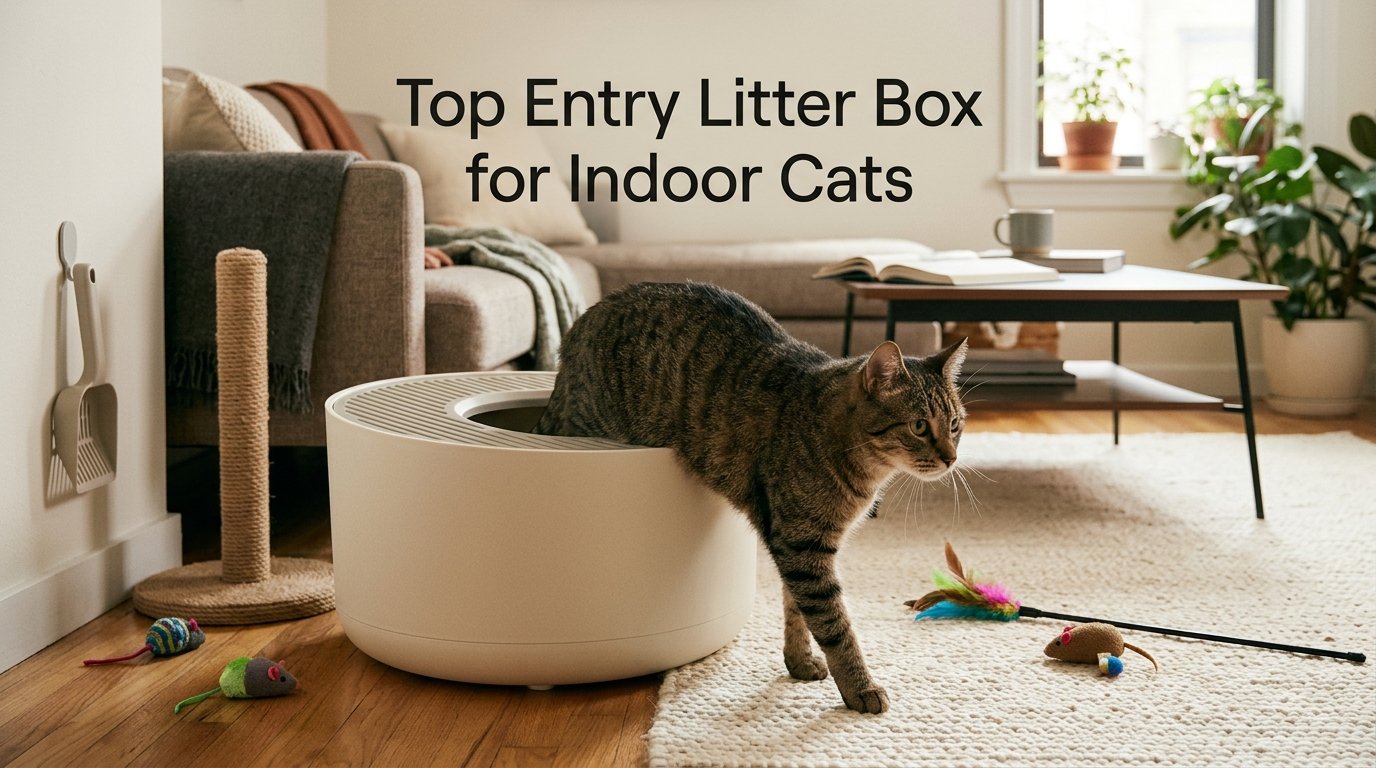
A top entry litter box for indoor cats won’t end litter tracking. It cuts it, because your cat has to climb out through a ridged or grated lid instead of stepping straight onto your floor, and most of the grit stuck to their paws drops back into the pan on the way. That single design change is why these boxes exist, and it’s the only promise worth measuring them against.
The tradeoff is access. Every box on this page sits roughly 14 to 15 inches tall, so your cat jumps up, balances on a lid, then drops through a hole that’s usually 9 to 10.5 inches across. Young, agile, average-sized cats handle that fine. Seniors with stiff hips, kittens under about five months, very heavy cats and broad breeds like Maine Coons often don’t. Below you’ll find six boxes ranked, the exact measurements that decide whether one fits your cat, and a 60-second check to run before you buy anything.
⚡ Quick Verdict
Skip both if your cat is over 10 years old, recovering from surgery, arthritic, or heavier than 20 pounds. IRIS rates its lid to hold 20 pounds or less, and a cat who hesitates at the jump will find somewhere else to go.
List of Top Entry Litter Box For Indoor Cats
| Image | Product | Score | Link |
|---|---|---|---|
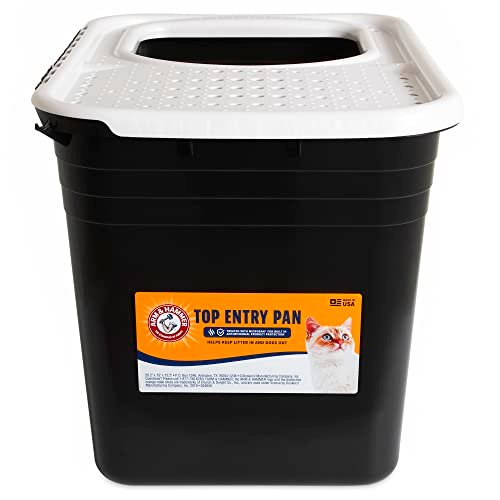 |
Arm & Hammer Premium Top Entry Litter Box with Filter 🏆 Editor’s Pick |
9.5/10 | View on Amazon Free Shipping & 30-Day Returns |
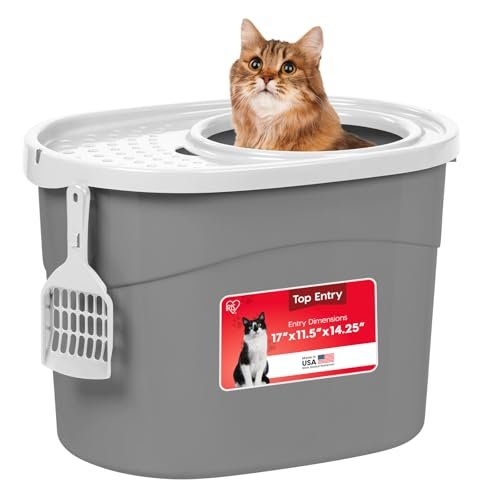 |
IRIS USA Top Entry Cat Litter Box, Hooded Privacy, Large, Grey 🥈 Runner-Up |
8.9/10 | View on Amazon Free Shipping & 30-Day Returns |
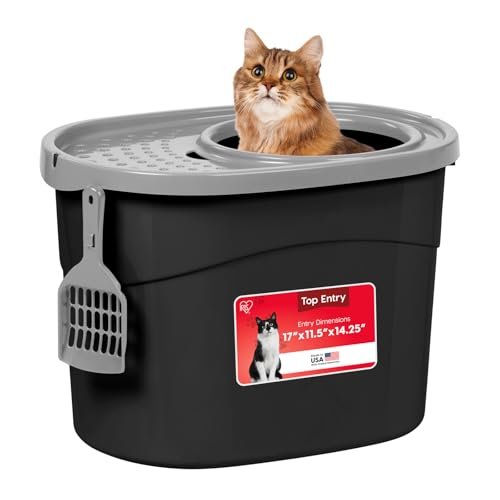 |
IRIS USA Top Entry Cat Litter Box, Hooded Privacy, Large, Black 🏠 Best for Small Apartments |
8.4/10 | View on Amazon Free Shipping & 30-Day Returns |
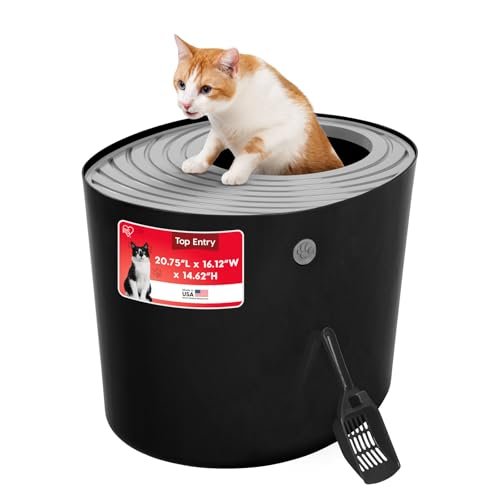 |
IRIS USA Top Entry Cat Litter Box, Hooded Privacy, Large, Dark Grey 🐈 Best for Bigger Cats |
8.2/10 | View on Amazon Free Shipping & 30-Day Returns |
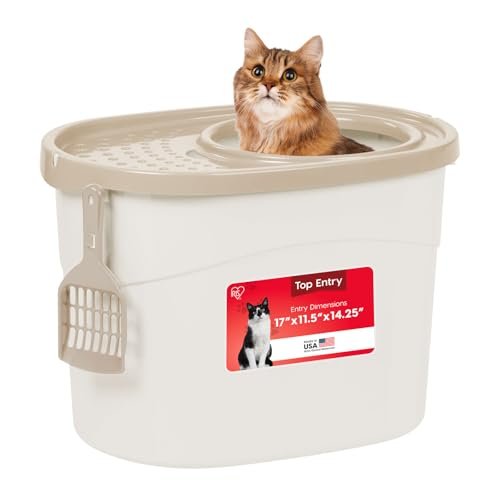 |
IRIS USA Top Entry Cat Litter Box, Hooded Privacy, Large, Beige | 8.1/10 | View on Amazon Free Shipping & 30-Day Returns |
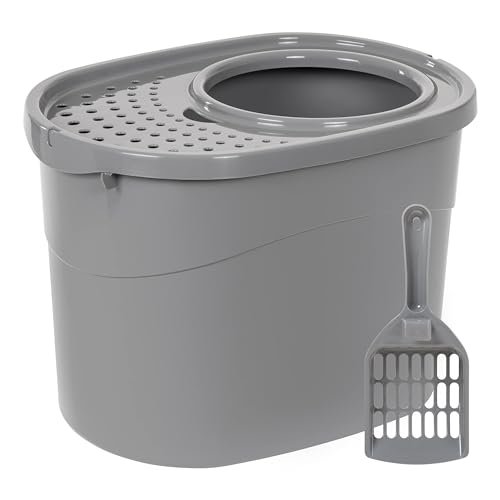 |
Amazon Basics Large Cat Litter Box with High Sides, Top Entry 💰 Budget Pick |
7.8/10 | View on Amazon Free Shipping & 30-Day Returns |
Will a Top Entry Box Actually Suit Your Cat? Run This 60-Second Check
Most one-star reviews on these products aren’t about build quality. They’re about a cat who wouldn’t use the box. Work through the five checks below before you spend anything, because a returned litter box is a nuisance and a cat peeing on the rug is worse.
✅ Pre-Purchase Checklist
- Can your cat jump 14 to 15 inches without hesitating? Watch them get onto a kitchen chair or a bed. A pause, a scrabble, or a two-stage climb means no.
- Is your cat under 20 pounds? IRIS rates its lid at 20 pounds or less. Above that the lid flexes and your cat learns not to trust it.
- Measure nose to tail base. The pan should be about 1.5 times that length. A 13-inch cat wants a pan around 20 inches long, which is roughly what all six boxes here give you.
- Measure shoulder width. Entry holes here run 9 to 10.5 inches. A cat wider than about 8 inches across the shoulders will squeeze, and squeezing turns into avoidance.
- Does your cat pee standing up? High walls help, but the lid seam on enclosed boxes is a known leak point. Budget for a wipe-down every couple of days.
One more thing worth knowing before you commit. A 2012 study out of Ross University School of Veterinary Medicine offered 28 cats a choice between covered and uncovered boxes and found no overall preference, as long as the boxes were scooped daily. Four cats preferred covered, four preferred uncovered, and the rest didn’t care. So enclosure isn’t the problem people assume it is. Cleanliness is. If you scoop once a day, a top entry box is a fair option for most healthy adult cats. If you scoop twice a week, no box design will save you.
Side-by-side photo: tape measure showing a cat’s nose-to-tail-base length next to the same measure against the litter box pan.
Suggested alt text: measuring a cat to size a top entry litter box for indoor cats
📋 How We Evaluated
Every box was judged on the same five things, weighted in this order:
- Tracking control (30%) how much grit the lid catches and how easily those grooves clear when they clog.
- Usable interior (25%) internal floor dimensions and entry hole size, not the outside box measurement marketers quote.
- Cleaning effort (20%) lid removal, corner radius, whether the pan fits a standard bathtub.
- Odor handling (15%) wall height, antimicrobial treatment, plastic quality and how fast the shell starts holding smell.
- Value and durability (10%) price against expected life, since manufacturers recommend replacing a plastic litter box every 12 months.
Dimensions come from manufacturer spec sheets, not estimates. Where owner reports contradict the marketing claim, we say so in the review.
Detailed Reviews
Arm & Hammer Premium Top Entry Litter Box with Filter🏆 Editor’s Pick
| Dimensions | 20.3 x 15 x 15 inches |
| Odor control | Built-in Microban antimicrobial |
| Lid | Non-slip textured, grated cutouts |
| Material | 95% pre-consumer recycled plastic |
| Litter compatibility | Clumping, pine, crystal, pellet |
| Extras | Scoop hook, moulded bottom handle |
What We Found
The grate is what separates this box from the IRIS models. IRIS uses shallow grooves that knock grit sideways. Arm & Hammer cuts actual openings through the lid, so litter your cat carries up falls straight back into the pan instead of sitting in a channel waiting for you to wipe it out. Those cutouts are sized to pass pellets and crystal litter too, which matters if you use pine or a large-granule crystal product that jams narrower grooves.
Microban is moulded into the plastic rather than sprayed on, so it doesn’t wash off. It slows the bacteria that turn urine into ammonia. It does not neutralise waste already sitting in the box, and anyone selling it that way is overselling. You still scoop daily.
At 20.3 inches long and 15 inches tall this is the roomiest pan here, and the moulded bottom handle is a small detail that pays off on litter-change day. Tipping 12 pounds of used clumping litter out of a smooth-sided tub is awkward. Having somewhere to grip makes it a one-person job.
The recurring complaint in owner reviews is the lid. It snaps on tight, which is good when a 12-pound cat lands on it and annoying every single time you scoop. Some people leave one clip unfastened to speed things up. Arm & Hammer also recommends replacing any plastic litter box after 12 months because odor works into the resin, and that advice applies here whatever the antimicrobial treatment does.
💬 My Take
Buy this one if you use pine or crystal litter. The cut-through grate handles big granules that clog the grooved IRIS lids.
Who It’s For
Households with one or two healthy adult cats, especially larger breeds that need the extra pan length. It’s also the pick for anyone running non-clumping litter, since the grate passes pellets that would otherwise pile up on the lid.
Skip it if your cat is arthritic, over 10 years old, or you’re setting up a box for a kitten. The 15-inch climb is the tallest on this list.
✅ Pros
- Grate cutouts drop litter back into the pan instead of trapping it.
- Longest pan here at 20.3 inches, room for bigger cats to turn.
- Microban is moulded in, so it survives washing.
- Bottom handle makes dumping old litter manageable alone.
❌ Cons
- Costs more than the IRIS and Amazon Basics boxes.
- Lid clips are stiff and slow down daily scooping.
- 15-inch height rules out seniors and short-legged breeds.
- Microban slows odor bacteria, it doesn’t replace scooping.
IRIS USA Top Entry Cat Litter Box, Hooded Privacy, Large, Grey🥈 Runner-Up
| Outside dimensions | 20.5 x 14.75 x 14.38 inches |
| Inside floor | 17 x 11.5 inches |
| Entry hole | 9.25 inch diameter |
| Lid weight limit | 20 lb or less |
| Tracking control | Grooved lid, acts as built-in mat |
| Extras | Scoop included, moulded scoop hook |
What We Found
The number that decides this purchase is 17 x 11.5 inches. That’s the inside floor, and it’s noticeably smaller than the 20.5-inch outside length the box advertises, because the walls taper inward toward the base. Fine for a cat up to about 11 pounds. Tight for anything larger.
The grooved lid works. Ridges run across the surface so paws drag through them on the way out and most loose granules stay up top. But they stay up top, which is the catch. Unlike the Arm & Hammer grate, IRIS grooves don’t drop debris back into the pan. You wipe them out once a week or they stop catching anything.
Two buttons on the sides release the lid, so daily scooping takes about ten seconds of setup. The rounded body has no square corners for clumps to weld themselves into, and the whole shell fits a standard bathtub for a monthly wash. IRIS also moulds a hook into the body for the included scoop, and the scoop itself is thin and undersized. Most owners swap it for a metal one within a month.
As a dog-proof litter box it does the job. A 14.38-inch wall with a 9.25-inch hole on top defeats most dogs that would otherwise raid a standard pan.
💬 My Take
The best value on this list for an average 8 to 11 pound cat. Measure your cat’s shoulders first, because 9.25 inches is not generous.
Who It’s For
Owners of average-sized cats who want tracking cut without paying a premium, and anyone sharing a home with a dog that treats the litter box as a snack bar. The neutral grey reads as a storage tub, which helps if the box has to live in a visible corner.
Skip it if your cat is over 20 pounds, over 12 inches across the shoulders, or you use pellet litter that won’t fit through the groove pattern.
✅ Pros
- Grooved lid cuts scatter without needing a separate mat.
- Two-button lid release, quick daily scooping.
- Rounded interior, no corners for clumps to stick in.
- 14.38-inch walls keep dogs out of the litter.
❌ Cons
- Inside floor is only 17 x 11.5 inches, tight for big cats.
- Grooves hold litter instead of returning it, so weekly wiping.
- Lid rated to 20 lb, and owners report the side catches can crack.
- Included scoop is flimsy and worth replacing.
IRIS USA Top Entry Cat Litter Box, Hooded Privacy, Large, Black🏠 Best for Small Apartments
| Outside dimensions | 20.5 x 14.75 x 14.38 inches |
| Entry hole | 9.25 inch diameter |
| Colour | Black / light grey |
| Tracking control | Grooved lid |
| Maintenance | Two-button lid release |
What We Found
Mechanically this is the same box as the runner-up in a darker shell. Same footprint, same 9.25-inch hole, same grooved lid. What you’re choosing is the finish, and dark grey hides the grey shadow that pale plastic gets around the entry hole after a few months of paw traffic.
It earns the small-apartment label on footprint. At 20.5 by 14.75 inches it takes up roughly the floor area of a large shoebox turned sideways, which fits under a pedestal sink or beside a washing machine where an open pan plus a mat would not. The enclosed shell also keeps the contents out of sight in a studio where the box shares a room with your sofa.
Black plastic shows dust and pale clumping litter more than beige does, so it looks dirty sooner even when it isn’t. That’s cosmetic, and it’s the trade for hiding the traffic marks. Ventilation is the real limitation on any fully enclosed box in a small room: heat and ammonia build up inside the shell, so keep it away from radiators and out of unventilated closets.
💬 My Take
Same box as our runner-up, darker shell. Pick by which colour you’d rather look at, not by spec.
Who It’s For
Studio and one-bed apartments where the litter box has nowhere to hide, and anyone with dark floors or dark cabinetry who wants the box to disappear into the room.
Skip it if the only spot you have is a closed closet. Enclosed boxes need airflow.
✅ Pros
- Small footprint fits under a sink or beside appliances.
- Dark finish hides wear marks around the entry.
- Contents stay out of sight in an open-plan room.
❌ Cons
- Black plastic shows dust and light-coloured litter.
- No upgrade over the grey model beyond the finish.
- Needs airflow, so a sealed closet is a bad placement.
IRIS USA Top Entry Cat Litter Box, Hooded Privacy, Large, Dark Grey🐈 Best for Bigger Cats
| Outside dimensions | 20.75 x 16.125 x 14.625 inches |
| Entry hole | 9 x 10.5 inches (oval) |
| Material | Polypropylene, made in USA |
| Lid weight limit | 20 lb or less |
| Extras | Scoop hook on lid, non-skid feet |
What We Found
This is the IRIS model to buy if your cat is on the larger side. The entry is an oval measuring 9 by 10.5 inches instead of the 9.25-inch circle on the other three, and the body is 1.4 inches wider. That extra inch and a bit of shoulder clearance is the difference between a cat who drops in and a cat who hovers at the hole deciding whether it’s worth it.
The 20-pound lid rating still applies, so this is not a Maine Coon box. It’s a box for a solid 12 to 16 pound domestic shorthair that found the standard IRIS opening tight. Cats.com tested the round IRIS model with an 11-year-old cat and reported the lid held his weight fine while the entry hole was too small for him to bother with, which is exactly the failure mode the oval opening addresses.
Rounded internal edges mean clumps don’t fuse into corners, and non-skid feet stop the box sliding when a heavier cat launches out of it. The scoop hook sits on the lid rather than the body here. Minor, but it means the scoop comes off with the lid every time you clean, which is either convenient or annoying depending on your routine.
The wider body is also the drawback. At 16.125 inches across it won’t tuck into the narrow gaps the 14.75-inch models manage. Measure your spot before ordering.
💬 My Take
The oval 9 x 10.5 inch entry is the whole reason to pick this over the cheaper IRIS boxes.
Who It’s For
Cats in the 12 to 16 pound range, broad-shouldered shorthairs, and anyone whose cat tried a round top entry box and refused it. It also suits owners who want a larger box without moving up to a powered unit.
Skip it if your placement is narrower than 17 inches, or your cat clears 20 pounds.
✅ Pros
- Oval 9 x 10.5 inch entry beats the 9.25-inch circle for wide cats.
- Widest body here at 16.125 inches, more room to turn.
- Non-skid feet stop the box shifting on tile.
- Rounded interior keeps clumps from welding into corners.
❌ Cons
- Too wide for narrow gaps that fit the other IRIS boxes.
- Lid still rated at 20 lb despite the bigger-cat positioning.
- Lid grooves need wiping, they don’t self-clear.
- Scoop lifts away with the lid every clean.
IRIS USA Top Entry Cat Litter Box, Hooded Privacy, Large, Beige
| Outside dimensions | 20.5 x 14.75 x 14.38 inches |
| Inside floor | 17 x 11.5 inches |
| Entry hole | 9.25 inch diameter |
| Colour | Beige / white |
| Extras | Scoop with hanging hook included |
What We Found
Identical hardware to the grey runner-up, finished in beige and white. The perforated lid catches paw litter the same way, the 9.25-inch entry is the same, and the inside floor is the same 17 by 11.5 inches. You’re buying a colour.
Beige is the practical choice next to oak floors, light tile or cream walls, and it hides the pale dust that clumping clay leaves on every surface within a foot of the box. What it doesn’t hide is urine staining. Light plastic yellows around the base over a year of use, especially if you’re stretching the box past the 12-month replacement window manufacturers recommend.
The 14.38-inch walls contain spray from cats who pee standing, which is the main structural argument for any high-sided box over an open pan. The moulded hook on the body keeps the scoop off the floor. Small thing, but it’s the difference between scooping daily and scooping when you can find the scoop.
💬 My Take
Good neutral finish for light rooms. Expect some yellowing by month twelve, which is when you should be replacing it anyway.
Who It’s For
Light-coloured rooms where a black box would stand out, and owners of average-sized cats who value a quiet-looking litter box over extra interior space.
Skip it if you plan to run the same box for two or three years. Pale plastic shows its age faster.
✅ Pros
- Neutral beige disappears against light floors and walls.
- 14.38-inch walls contain spray from standing pee-ers.
- Scoop hook keeps the tool off the floor.
- Hides clay litter dust better than dark plastic.
❌ Cons
- Light plastic yellows with age.
- Lid holes need a weekly wipe to keep working.
- 9.25-inch entry is fixed and tight for wide cats.
- No functional gain over the cheaper grey version.
Amazon Basics Large Cat Litter Box with High Sides, Top Entry💰 Budget Pick
| Dimensions | 20.5 x 14.75 x 14.38 inches |
| Material | BPA-free plastic |
| Lid | Removable, perforated |
| Antimicrobial | None |
| Included | Matching scoop with storage slot |
What We Found
This is the cheapest way to find out whether your cat will accept a top entry box at all. Same rough footprint as the IRIS models, BPA-free plastic, perforated lid, scoop included with a slot to store it in. Nothing here is clever, and nothing needs to be.
The gap against the pricier boxes shows in two places. There’s no antimicrobial treatment, so the shell starts holding smell sooner and you’ll be replacing it closer to the 12-month mark than stretching past it. And the plastic is thinner, which you notice when a heavier cat lands on the lid and it gives slightly. Neither is a dealbreaker for a cat under 12 pounds.
The high sides do their job on spray, and the lid lifts clear for cleaning without fighting clips. If you’re buying a second or third box to hit the standard recommendation of one box per cat plus one, this is the sensible way to fill out the set without tripling your spend.
💬 My Take
Buy this first if you’re not sure your cat will take to a top entry box. Upgrade once you know.
Who It’s For
First-time buyers testing the concept, multi-cat homes adding a second or third box, and renters who’d rather replace a cheap box annually than nurse an expensive one.
Skip it if odor is your main problem. Without an antimicrobial in the plastic, this shell holds smell sooner than the Arm & Hammer.
✅ Pros
- Lowest price here, low-risk way to test the format.
- Scoop and storage slot included.
- High sides contain spray from standing pee-ers.
- Lid lifts off cleanly, no stiff clips.
❌ Cons
- No antimicrobial, so the shell holds odor sooner.
- Thinner plastic flexes under heavier cats.
- Perforated lid needs frequent clearing.
- Plain styling, no colour options worth noting.
Side-by-Side Specs Comparison
Marketing copy quotes outside dimensions. Your cat cares about the inside floor and the hole they have to fit through. Here are both.
| Model | Outside (L x W x H) | Entry opening | Lid type | Best suited to |
|---|---|---|---|---|
| Arm & Hammer Premium | 20.3 x 15 x 15 in | Wide top opening | Grated, drops litter back | Pine, crystal, pellet users |
| IRIS Large, Grey | 20.5 x 14.75 x 14.38 in | 9.25 in circle | Grooved | Cats 8 to 11 lb |
| IRIS Large, Black | 20.5 x 14.75 x 14.38 in | 9.25 in circle | Grooved | Small apartments |
| IRIS Large, Dark Grey | 20.75 x 16.125 x 14.625 in | 9 x 10.5 in oval | Grooved | Cats 12 to 16 lb |
| IRIS Large, Beige | 20.5 x 14.75 x 14.38 in | 9.25 in circle | Perforated | Light-coloured rooms |
| Amazon Basics | 20.5 x 14.75 x 14.38 in | Standard top hole | Perforated, removable | Budget and spare boxes |
The IRIS boxes share an inside floor of about 17 x 11.5 inches at the narrowest point. All four IRIS lids are rated to hold 20 pounds or less.
Top Entry vs Front Entry vs Open Pan: Which Style Fits Your Situation
People search for a top entry box because of one problem: litter on the floor. Before you assume that’s the only fix, here’s how the three formats compare on the things that actually change day to day.
| Factor | Top entry | Front entry / hooded | Open pan |
|---|---|---|---|
| Litter tracking | Best. Lid filters paws. | Moderate. Needs a mat. | Worst without a mat. |
| Accessibility | 14 to 15 in jump. | Step-over lip. | Best. Can be 2 in. |
| Dog-proofing | Very good. | Poor for small dogs. | None. |
| Odor in the room | Contained while closed. | Contained. | Disperses, aired out. |
| Odor inside the box | Builds up fastest. | Builds up. | Lowest. |
| Spray containment | Very good. | Good. | Poor unless high-sided. |
| Escape routes | One. Risky in multi-cat homes. | One. | All sides. |
| Scooping speed | Slower, lid comes off. | Slower. | Fastest. |
One line in that table deserves more attention than it usually gets. A top entry box has a single exit. In a household where one cat ambushes another, a box with one way out becomes a trap, and the bullied cat stops using it. If you have three cats and any tension between them, put at least one open pan in a different room. The standard guidance is one box per cat plus one, and mixing formats across those boxes is better than buying four identical ones. For a deeper look at the tradeoffs, see our breakdown of top entry vs front entry litter boxes.
Three-panel comparison graphic: top entry, front entry hooded, and open high-sided pan, each labelled with entry height.
Suggested alt text: top entry vs front entry vs open litter box comparison for indoor cats
What to Look For Before Buying
Four specs decide whether a top entry litter box works in your home. Everything else is finish and packaging.
1. Interior Size, Not Advertised Size
Measure your cat from nose to the base of the tail, then multiply by 1.5. That’s your minimum pan length. A 13-inch cat wants roughly 20 inches, and every box here clears that on the outside. The catch is that moulded tubs taper, so the IRIS boxes drop to about 17 by 11.5 inches at the floor. Check the inside dimension before you check the price.
2. Entry Hole Width and Jump Height
Two separate numbers, both worth checking. The jump is 14 to 15 inches on everything reviewed here. The hole runs 9 to 10.5 inches. A cat who has to compress their shoulders to drop through will use the box for a week and then start going next to it. If your cat is wide rather than long, prioritise the oval opening over the circular one.
3. Lid Mechanism: Grate or Groove
Grates have openings that pass litter back into the pan. Grooves are shallow channels that hold it until you wipe them out. Grates handle pellets and crystals; grooves clog on anything chunky. If you run standard clumping clay, either works. If you run pine pellets, buy the grate.
4. Odor Handling and Replacement Cycle
Enclosed boxes trap ammonia inside the shell, which is pleasant for you and less so for the cat standing in it. Antimicrobial plastic like Microban slows the bacteria that generate that smell, but it doesn’t remove waste. Plan to replace any plastic litter box every 12 months, which is what Arm & Hammer recommends, because odor eventually works into the resin and no amount of scrubbing pulls it out.
5. Placement Before Purchase
Measure the gap you plan to put it in, and add four inches of clearance on the entry side so your cat has somewhere to land. Keep it away from the washing machine, the furnace and the food bowls. Quiet, reachable and ventilated beats hidden every time.
How to Switch Your Cat to a Top Entry Litter Box in 14 Days
Most refusals come from rushing. Cats treat a new toilet with suspicion, and the one thing you can’t do is remove the old box and hope. Work through these steps and give each one the time listed.
- Days 1 to 3: set it up with the lid off. Put the new box beside the old one, filled with the same litter to the same depth, and leave the lid in another room. Right now it’s just a tall open pan.
- Day 2: seed it. Move one used clump from the old box into the new one. The scent marks it as a toilet rather than a storage tub.
- Days 4 to 7: add the lid. Once your cat has used the open version at least twice, fit the lid. Don’t move the box while you do this. One change at a time.
- Days 8 to 10: make the old box less appealing. Keep scooping the new box daily and scoop the old one a little less often. Cats pick the cleaner option, and you want that to be the new one.
- Days 11 to 13: shrink the old box’s presence. Move the old pan a few feet away, then into the next room. Don’t remove it yet.
- Day 14: remove the old box. Only if the new one has been used consistently for three days straight. If there’s any hesitation, go back a step and give it another week.
💡 Tip
Put a sturdy step or a low stool next to the box during the transition. Cats that won’t commit to a 14-inch jump will often use a two-stage route, and many keep using the stool permanently.
If your cat urinates outside the box at any point during the switch, stop the transition and go back to the old setup. Then call your vet. Sudden house-soiling is a medical symptom more often than a preference complaint, and urinary blockage in male cats is an emergency.
Cutting Litter Tracking Even Further
The box is one lever. Three others matter almost as much, and together they do more than switching boxes alone.
- Litter granule size. Fine-grained clay sticks to paw fur and travels. Heavier, larger granules and pellets drop off sooner. If tracking is your main complaint, moving from a fine clumping clay to a coarser clumping or pellet litter changes more than most people expect.
- Litter depth. Two to three inches is the working range. Deeper than that and your cat digs to the point of flinging, and the surplus sits on top of the lid grooves. Shallower and they scrape the plastic and stop burying.
- A mat under the exit. Even with a filtering lid, a few grains make it out. A honeycomb or ridged mat placed where your cat lands catches them. Skip the thin rubber mats, they just slide.
- Clear the grooves weekly. A lid packed with old litter isn’t filtering anything. Tip the lid over a bin, brush the channels with a dry paintbrush, done in a minute.
Close-up of a grooved top entry lid before and after a weekly clean, showing packed channels versus clear ones.
Suggested alt text: cleaning the grooved lid of a top entry litter box to reduce litter tracking
Cleaning Schedule That Keeps an Enclosed Box Usable
An enclosed box hides mess from you, not from your cat. Since the covered-versus-uncovered research points at cleanliness rather than design as the deciding factor in whether a cat keeps using a box, the schedule below matters more than which of these six you buy.
| Frequency | Task | Why it matters |
|---|---|---|
| Daily | Scoop solids and clumps, top up litter to 2 to 3 inches | The single biggest factor in box acceptance |
| Every 2 to 3 days | Wipe the inside of the lid and the wall seam | Catches urine that sprayed upward before it dries on |
| Weekly | Clear the lid grooves or grate | Packed channels stop filtering paws |
| Monthly | Full dump, wash with unscented dish soap and warm water, dry fully | Removes the film that holds odor |
| Every 12 months | Replace the box | Scratches and absorbed odor stop coming out |
Never clean a litter box with an ammonia-based product. Ammonia smells like urine to a cat and can read as another animal’s territory marker. Bleach is also a poor choice around litter. Unscented dish soap and hot water do the job.
If you’re pregnant, hand litter duty to someone else where you can. The CDC advises avoiding contact with used cat litter because of toxoplasmosis risk. If that isn’t possible, wear disposable gloves and wash your hands afterwards.
Common Problems and How to Fix Them
| Problem | Likely cause | Fix |
|---|---|---|
| Urine on the underside of the lid | Cat pees standing, or is too close to the wall | Wipe the lid every couple of days, add an inch of litter, consider a wider box |
| Cat hesitates at the hole, then walks away | Entry too narrow or jump too high | Add a step beside the box; if it persists, move to an oval-entry or front-entry model |
| Litter still all over the floor | Clogged lid grooves, or fine-grain litter | Clear the grooves weekly, switch to a coarser litter, add a ridged mat |
| Strong ammonia smell when you lift the lid | Enclosed shell with no airflow, or overdue litter change | Full change plus wash, move the box out of a closed closet |
| One cat stops using the box in a multi-cat home | Single exit makes it an ambush point | Add an open pan in a separate room, follow one box per cat plus one |
| Lid catches crack or the lid flexes | Cat over the 20 lb lid rating | Switch to a front-entry high-sided box rated for heavier cats |
When You Should Not Buy a Top Entry Litter Box
Plenty of articles about these boxes never mention the cats they’re wrong for. Here’s the list.
⚠️ Choose a low-entry box instead if your cat is:
- Arthritic or over about 10 years old. Guidance for mobility-limited cats puts the ideal entry height at 6 inches or less, and under 4 inches for severe cases. A 14-inch climb is the opposite of that.
- A kitten under roughly five months. They can’t reliably make the jump, and a kitten who can’t reach the box learns to go on the carpet.
- Over 20 pounds. The lids here are rated at 20 pounds or less.
- A large breed like a Maine Coon or Ragdoll. A 9.25-inch entry and a 17 by 11.5 inch floor are not enough room to turn and posture.
- Recovering from surgery or injury. Jumping is off the table during recovery. Ask your vet when it’s safe again.
- Overweight or short-legged. A Munchkin or a heavy cat carrying extra weight will struggle with both the climb and the hole.
If your cat sits in any of those categories and tracking is still driving you up the wall, the better combination is a high-sided open pan with a low cut-out entry, paired with a large ridged mat. You keep the spray containment and lose the climb.
Photo of a senior cat approaching a low-entry high-sided pan, with the entry height measured alongside.
Suggested alt text: low entry litter box alternative for senior cats that cannot use a top entry box
Frequently Asked Questions
Do top entry litter boxes really stop litter tracking?
They cut it, they don’t end it. The lid catches most of what’s clinging to your cat’s paws, but fine clay dust still rides out on fur and a few grains come through the hole. Owners who pair a top entry box with a coarser litter and a ridged mat report the biggest drop. Owners who never clear the lid grooves report almost no improvement after the first month.
Are top entry boxes safe for older cats?
Usually not. Older cats with stiff joints struggle with a 14-inch climb, and accessibility guidance for arthritic cats calls for entry heights of 6 inches or less. A low-entry or front-entry box is the safer choice. Watch how your cat gets onto furniture. If they pause or take it in two stages, skip the top entry format.
Will a Maine Coon fit in a top entry litter box?
Not in these. A 9.25-inch entry and an inside floor of 17 by 11.5 inches is too tight for a cat that routinely runs 15 to 25 pounds and over 20 inches nose to tail base, and the lids are rated at 20 pounds. Large breeds need an extra-large open or front-entry pan, usually 24 inches or longer.
How often should I clean the lid grate?
Once a week for most households, more often if your cat is a heavy digger. Packed grooves stop filtering paws, which is the entire reason you bought the box. A dry paintbrush over a bin clears them in under a minute.
Can these boxes really keep dogs out?
For most dogs, yes. A 14.38-inch wall with a 9.25-inch hole on top defeats anything that can’t jump and reach in at the same time. Small terriers occasionally work it out, and a determined dog can tip a lightweight box over, so wedge it against a wall or into a corner.
What litter works best in a top entry box?
Low-dust clumping litter with a medium to coarse granule is the safest default, filled to 2 to 3 inches. Pine and crystal work if your lid has cut-through grates rather than shallow grooves. Avoid ultra-fine clay, which clings to paw fur and defeats the filtering lid.
How much litter do I put in a top entry box?
Two to three inches, topped up daily as you scoop. Going deeper doesn’t improve odor control, it just gives your cat more material to fling onto the lid. Going shallower means clumps stick to the base and your cat scrapes plastic.
Do enclosed litter boxes trap odor or cause it?
Both. They keep smell out of your room, which is why people buy them, and they concentrate it inside the shell, which your cat has to stand in. That’s manageable if you scoop daily and do a full wash monthly. It becomes a problem fast if you don’t, and it’s the main reason some cats abandon covered boxes.
Are top entry litter boxes suitable for kittens?
Not under about five months. Kittens can’t clear a 14-inch wall reliably, and a kitten who can’t reach the box goes somewhere else and learns that habit. Start with a low open tray and switch once they’re jumping onto furniture without effort.
How many litter boxes do I need for two cats?
Three, following the standard one-per-cat-plus-one recommendation, placed in different rooms. With top entry boxes specifically, make at least one of the three an open pan. A box with a single exit can become an ambush point, and a cat who feels cornered will find a different spot.
How do I transition my cat to a new box?
Run the 14-day plan above. Short version: set the new box beside the old one with the lid off, seed it with one used clump, add the lid only after your cat has used it twice, and don’t remove the old box until the new one has three consistent days of use.
How often should I replace a plastic litter box?
Every 12 months. Manufacturers including Arm & Hammer recommend it, and the reason is physical: scratches from claws give bacteria somewhere to sit, and odor works into the resin where washing can’t reach it. If the box smells right after a full clean, it’s done.
My cat stopped using the box after I switched. What now?
Put the old box back first, then book a vet appointment. Sudden house-soiling is more often medical than behavioural, and conditions like urinary tract disease, kidney disease and arthritis all show up this way. In male cats, straining with no urine produced is an emergency. Rule out illness before you blame the box.
🎯 Final Verdict
The Arm & Hammer Premium Top Entry Litter Box is the one to buy for most healthy adult cats. It has the longest pan at 20.3 inches, a grate that drops litter back into the box instead of holding it, and Microban moulded into the plastic rather than sprayed on. It also handles pine, crystal and pellet litter, which the grooved IRIS lids don’t do well.
If your cat is average-sized and you want to spend less, the IRIS USA Large in grey does the same core job. Check the 9.25-inch entry against your cat’s shoulders first. If they’re broader than that, step up to the dark grey IRIS with the 9 by 10.5 inch oval opening.
And if your cat is a senior, a kitten, over 20 pounds or a large breed, don’t buy any of them. A high-sided open pan with a low cut-out entry and a ridged mat gets you most of the tracking benefit with none of the access risk. The best litter box is the one your cat will use twice a day without thinking about it.
ⓘ About This Guide
Specifications in this article come from manufacturer listings and product pages, checked in September 2026. Behavioural guidance draws on published veterinary research, including a study from Ross University School of Veterinary Medicine that tested covered against uncovered litter box preference in 28 cats.
This is general information for healthy adult cats, not veterinary advice. If your cat suddenly changes their litter box habits, strains without producing urine, or shows signs of pain, contact your veterinarian. Urinary blockage in male cats is a medical emergency.
Affiliate disclosure: we earn a commission on qualifying purchases made through links on this page, at no extra cost to you. It doesn’t change which products we recommend or how we rank them.
Last updated: September 2026

Written by Mishu
A passionate cat lover and indoor living enthusiast, Mishu is the founder and voice behind Indoor Living Cat – a go-to resource for cat owners who want to create the happiest, healthiest life for their feline companions indoors.
View Full Profile