
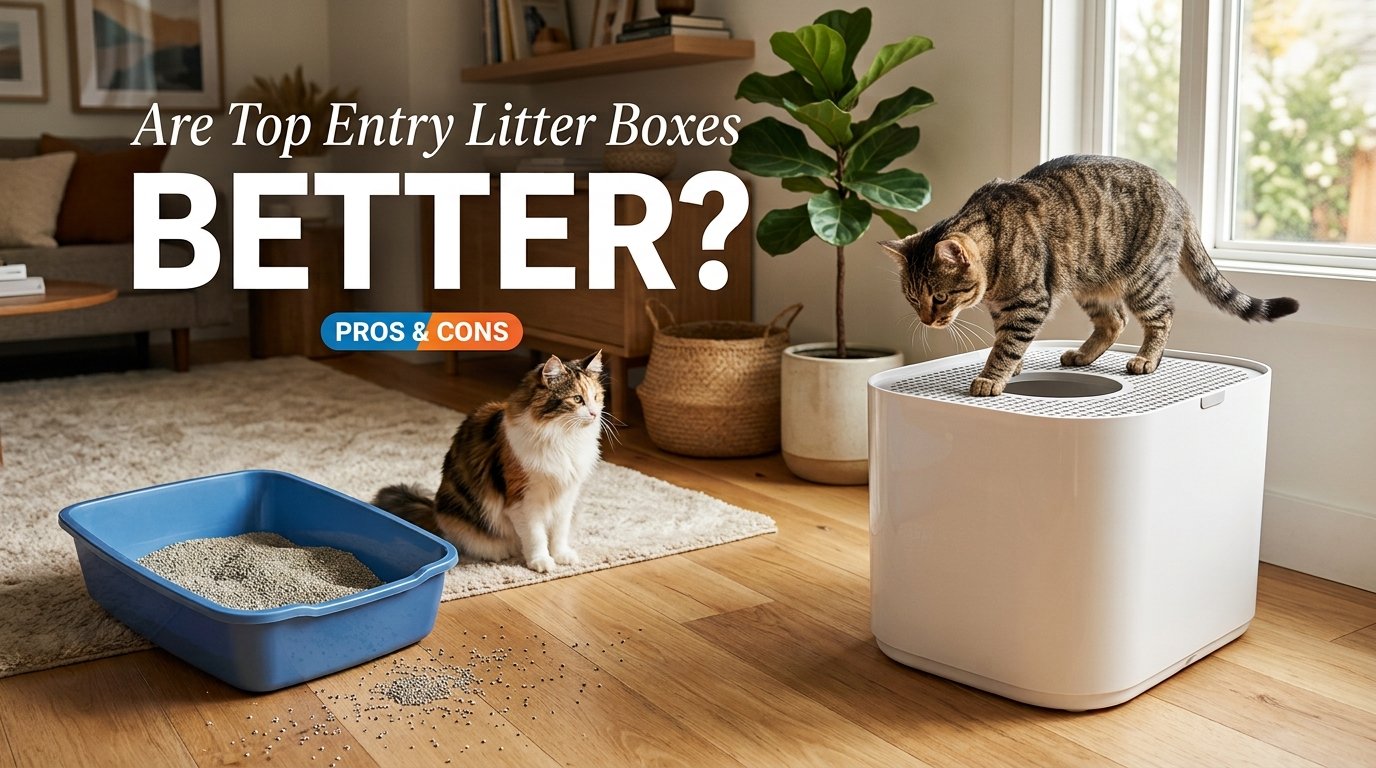
The short version of “are top entry litter boxes better?” is this. For healthy adult cats that scatter litter across the hallway, yes. For senior cats, kittens and large breeds, usually no.
A top entry box contains scatter and spray better than a standard pan, and most dogs can’t get into it. The price is a jump for your cat and a lid you have to lift at every scoop. This guide covers who benefits, who doesn’t, how top entry stacks up against front entry and open pans, and five models worth a look. You’ll also find a training plan, a cleaning schedule, a troubleshooting table and straight answers to the questions owners ask most.
Disclosure: some links below are Amazon affiliate links. If you buy through them, we may earn a commission at no extra cost to you. Last updated September 2026.
Are Top Entry Litter Boxes Better? Pros and Cons at a Glance
Each row below names a problem owners complain about and says whether a top entry design helps, hurts or depends on your setup.
| Situation | Verdict | Why |
|---|---|---|
| Litter tracked across the floor | Better | The grooved or perforated lid knocks granules off paws as your cat steps out, and high walls catch litter kicked during digging. It cuts tracking. It doesn’t end it. |
| Urine spray and standing pee | Better | Walls around 14 inches tall (IRIS lists 14.5 inches on its large model) catch spray that would hit the wall beside an open pan. |
| Dog raids the litter | Better | The opening is on top instead of at nose height. A small or athletic dog can still get in, so treat it as a barrier and don’t expect a lock. |
| Small apartment | Better | Everything stays in one compact, closed unit. That only pays off if your cat fits comfortably inside. |
| Litter box smell in the room | Depends | The enclosure holds odor in while the box is clean. Skip a scoop and the smell concentrates inside, where your cat has to use it. |
| Multi-cat home | Depends | One way in and out lets one cat block another, and enclosed boxes can turn into ambush spots. It works as one box among several. |
| Senior or arthritic cat | Worse | Every visit means a jump up and a drop down. Stiff joints turn that into a reason to avoid the box. |
| Kitten | Worse | Very young kittens can’t make the jump safely. Use a low-entry box until yours climbs furniture without trouble. |
| Large cat | Worse | Most enclosed boxes are too short for a big cat to turn around in. The sizing rule further down explains why. |
| Daily scooping | Worse | You lift the lid or reach through the hole every time. An open pan takes seconds. |
Verdict: top entry is a strong choice for agile adult cats, especially in homes with dogs or hard floors. It’s a poor first choice for any cat with mobility limits, and you should treat it as one box in your setup rather than the only one.
How a Top Entry Litter Box Cuts Down on Mess
The lid does most of the work. Your cat jumps onto the roof, drops through the opening, and climbs back out across a grooved or perforated surface that knocks loose granules off its paws. Those granules fall back into the box instead of onto your floor.
High walls handle the rest. Litter kicked during digging hits the wall and drops back down, and spray lands inside the box instead of on your baseboard. Because the only opening sits on top, most dogs can’t get to the litter either.
It cuts scatter but won’t stop it. A cat that flings litter up through the hole, or carries clumps stuck between its toes, will still leave a trail. Expect fewer stray granules. Don’t expect none.
Top Entry vs Front Entry vs Open Litter Box
This table covers the matchup most owners care about. For a deeper look at one pairing, read our guide to top entry vs front entry litter boxes.
| Feature | Top entry | Hooded front entry | Open high-sided pan |
|---|---|---|---|
| Litter tracking | Lowest of the three, thanks to the lid and tall walls | Moderate. No lid to wipe paws, but walls stop kicked litter | Highest. Paws walk straight out, though tall sides help |
| Spray containment | Excellent | Good | Depends on wall height |
| Odor | Held inside. Scoop daily or it builds | Held inside. Same rule applies | Spreads into the room, but airs out and is easy to spot |
| Keeps dogs out | Usually. Small or athletic dogs can still get in | Rarely | No |
| Access for seniors and kittens | Poor | Good, if the threshold is low | Best, especially with a low cut-out |
| Room for large cats | Limited | Limited to moderate | Best |
| Scooping effort | Lid off or reach in each time | Lid or door each time | Simplest |
| Best for | Agile adult cats, homes with dogs, litter scatter | Cats that want privacy but can’t jump | Big cats, picky cats, anyone who wants a simple box |
Do Cats Like Top Entry Litter Boxes?
Most cats don’t have a strong opinion about covers. In a study led by Dr. Emma Grigg and published in the Journal of Feline Medicine and Surgery, about 70 percent of the cats showed no preference between covered and uncovered boxes. Roughly 15 percent chose covered and roughly 15 percent chose uncovered.
Two caveats matter. The study used covered boxes with a front opening, so it says nothing about how cats feel about jumping into a top entry design. And the boxes were oversized storage tubs, about 32 by 20 inches, far roomier than any store-bought hood. A cat that shrugs at a giant covered tub can still hate a cramped one.
What cats tend to reject is a small space, trapped odor and the feeling of being cornered. Watch for these signs during the first two weeks.
| Signs it’s working | Warning signs |
|---|---|
| Your cat enters and exits without pausing | Your cat sits on the lid for a long time and won’t drop in |
| Digging and covering look normal | Your cat pees or poops right beside the box |
| No accidents near the box | Your cat bolts out after a few seconds |
| Your cat uses it at night as well as during the day | Your cat cries near the box or avoids that room |
If you see warning signs, take the lid off for a few days or put the old box back. And if a cat that used the box happily suddenly starts going elsewhere, call your vet. Urinary problems often show up as litter box avoidance.
Who Should Use a Top Entry Litter Box (and Who Shouldn’t)
Your cat’s body and your household decide this more than any brand does. Here’s how it breaks down.
Adult cats that jump well
A healthy adult that hops onto counters is the best candidate. If that cat also kicks litter across the room, digs hard or sprays, you’ll see the biggest gain.
Kittens
Skip top entry until your kitten climbs onto furniture without effort. Before that, use a shallow open box with a low cut-out. A scary or painful first jump can make a kitten avoid the box, and that’s a harder problem than tracked litter.
Senior cats
Radiographic studies find joint disease in most cats over 12, and cats hide pain well. If your older cat hesitates before a jump, the box will feel the same way to them. Switch to a low-entry design. A sturdy step beside a top entry box can work for mild stiffness, as long as it can’t slide or tip. Mention any hesitation to your vet, since litter box changes are often the first sign of joint pain.
Large cats
Measure from your cat’s nose to the base of its tail. The box should be at least 1.5 times that length so your cat can turn around and dig without stepping in waste. A cat that measures 18 inches wants 27 inches of usable interior. IRIS lists its large top entry model at 20.5 inches long on the outside, and the walls taper toward the floor. Most enclosed boxes fall short of the 1.5 rule, top entry ones included. If your cat is a Maine Coon or something close, keep an oversized open pan as the main box.
Multi-cat households
The standard advice from shelters and vets is one box per cat plus one extra, spread across the house. A top entry box can be one of those boxes. Don’t make it the only one, because a cat inside can get trapped by another cat waiting at the hole.
Homes with dogs
The top opening keeps most dogs away from the litter, which is the main reason many owners buy one. Small breeds and jumpers can still get in. If yours does, put the box in a room your dog can’t enter, or behind a baby gate with a cat-sized opening.
5 Best Top Entry Litter Boxes
These five models cover the main variations: grooved, perforated and filtered lids, hanging scoops, antimicrobial plastic and a few color options. Every one needs a cat that can jump, so if yours can’t, skip ahead to the alternatives section. Each listing below includes the trade-off we’d want to know before buying.
| Model | Lid design | Standout feature | Main trade-off |
|---|---|---|---|
| 1. IRIS USA Gray/White | Textured lid | Removable lid, compact footprint | Not for senior cats |
| 2. IRIS USA Beige | Grooved lid | Hanging scoop, US-made per the listing | Beige can show dirt |
| 3. Amazon Basics Large | Filtered lid | Onboard scoop, BPA-free plastic | Lid needs periodic deep cleaning |
| 4. Arm & Hammer Premium | Grated lid | Microban protection, works with pine, crystal and clumping litter | Bulky, and best replaced yearly |
| 5. IRIS USA Beige/White | Grooved lid | Hanging scoop, roomy interior | Needs jumping ability and more floor space |
|
1
|
IRIS USA Top Entry Cat Litter Box, Hooded Privacy, Large, Gray/White |
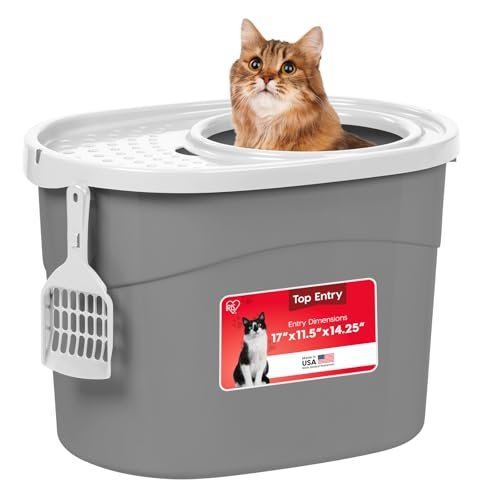
The IRIS Gray/White is the plainest way to add a top entry box. The textured lid knocks loose granules off your cat’s paws on the way out, and the enclosed body keeps kicked litter, spray and odor inside. It also keeps curious dogs away from the litter, which protects your cat’s space in a mixed household. The plastic is durable, and the compact shape fits into a bathroom or laundry room without much fuss.
The lid comes off for scooping, which is the deal you make with any top entry box. IRIS lists the large White/Gray model at about 20.5 by 14.75 by 14.5 inches, with a 9.25 inch entry hole. Sizes shift slightly between versions, so check the Amazon listing for the exact one. An average adult has room to move. A larger cat will feel it.
What It Does Well
- ✓ Textured lid catches litter from paws
- ✓ Enclosed body contains odor and spray
- ✓ Keeps most dogs out of the litter
Trade-offs to Know About
- • Lid has to come off for cleaning
- • Not suited to senior cats
- • Plastic needs regular washing
|
2
|
IRIS USA Top Entry Cat Litter Box, Hooded Privacy, Large, Beige |
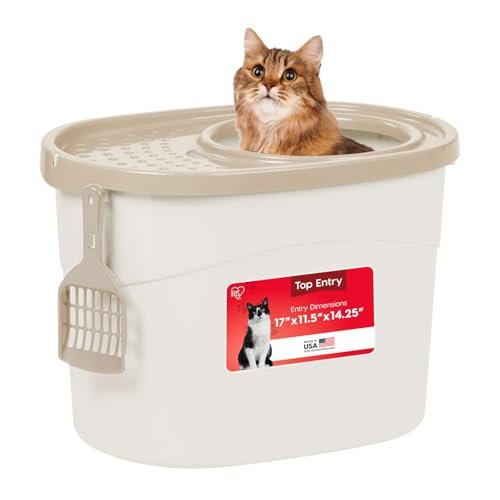
The beige IRIS box is the same idea in a quieter color. Per the listing, it’s made in the USA, and the grooved lid catches loose litter before it reaches your floor. The top opening gives your cat privacy and discourages dogs, and the high walls keep spray from reaching your walls and flooring.
The scoop has a hook, so it hangs on the side of the box and stays within reach. The interior gives most cats room to turn and dig, though the sizing rule still applies. The neutral color blends into most rooms, and it can show dirt and stains. Sturdy construction makes it a reasonable long-term buy, and it’s also heavier than a basic open pan.
What It Does Well
- ✓ Includes a hanging scoop
- ✓ High walls contain spray
- ✓ Neutral color blends into decor
Trade-offs to Know About
- • Beige can show dirt
- • Entry hole size is fixed
- • Heavier than standard open pans
|
3
|
Amazon Basics Large Cat Litter Box with High Sides, Top Entry, Odor Control |
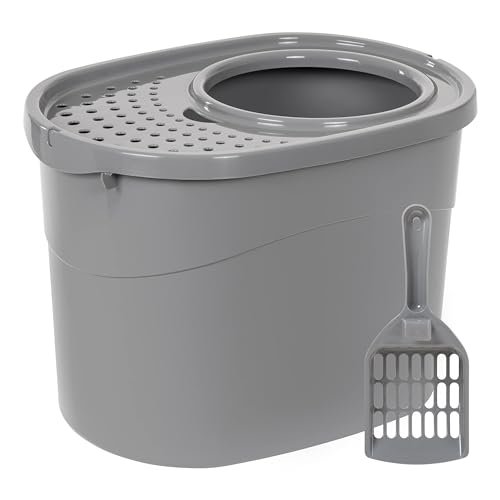
Amazon Basics keeps things simple. The filtered lid traps litter particles as your cat exits, the high sides hold in spray and smell, and the body is BPA-free plastic that holds up to daily use. It’s a large box sized for cats of different builds, and the gray finish is easy to place in a laundry room or guest bathroom.
The top is removable, so scooping and checking the litter is quick, and a matching scoop stores onboard. The listing also describes the plastic as recyclable. Two things to plan for: the lid needs a periodic deep clean to keep the filter surface working, and gray shows dust. The fixed shape also limits where you can put it, so measure the spot first.
What It Does Well
- ✓ Filtered lid traps debris
- ✓ Includes an onboard scoop
- ✓ Durable BPA-free plastic build
Trade-offs to Know About
- • Gray color may show dust
- • Lid needs periodic deep cleaning
- • Fixed shape limits placement options
|
4
|
Arm & Hammer Premium Top Entry Litter Box with Filter to Clean Paws |
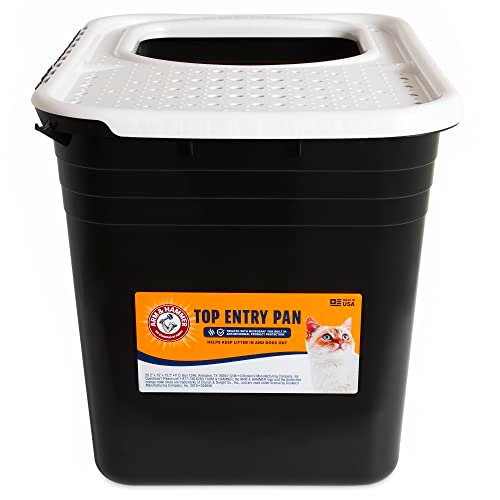
Arm & Hammer’s Premium top entry box is the one to look at if smell is your main complaint. The grated lid collects loose granules, and the plastic carries Microban protection, which inhibits bacterial growth on the box itself. That protects the plastic only, so daily scooping still does the heavy lifting. The wide entry and high walls also give larger cats more room than the tighter models on this list.
It works with pine, crystal and clumping litter, so you don’t have to change what your cat already likes. The listing mentions recycled materials, and you should plan to replace the box about once a year, which is a running cost the others don’t advertise. The footprint is large, so check your floor space. For homes with a dog, the top entry still keeps the litter out of reach.
What It Does Well
- ✓ Includes Microban odor protection
- ✓ Works with various litter types
- ✓ Made from sustainable materials
Trade-offs to Know About
- • Requires an annual replacement cycle
- • Large footprint may be bulky
- • Grated lid requires regular cleaning
|
5
|
IRIS USA Large Top Entry Cat Litter Box, Hooded Privacy, Beige/White |
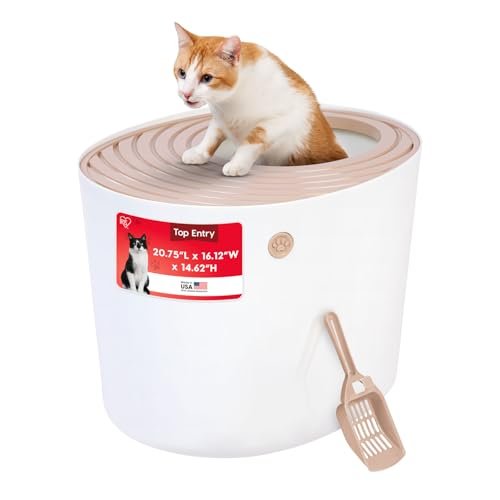
The two-tone Beige/White IRIS gives the same design a lighter look. Per the listing, it’s made in the USA, the lid grooves catch lingering litter, and the walls hold in spray and odor. The top entry keeps other pets away from your cat’s litter, and it fits most rooms without clashing.
The scoop hangs on the side of the box, so daily cleaning stays quick. The interior gives cats room to turn and dig, but measure your cat against the 1.5 rule before you assume it’s big enough. Your cat also has to jump to reach the opening, so it’s out for cats with stiff joints. The two-tone finish may show wear sooner than a solid color.
What It Does Well
- ✓ Modern beige and white look
- ✓ Includes a hanging scoop
- ✓ Spacious interior for most adult cats
Trade-offs to Know About
- • Two-tone color might show wear
- • Larger footprint requires more floor
- • Entry hole requires jumping ability
How to Choose the Right Top Entry Litter Box
Selecting a box means balancing your cat’s body against your home’s layout. Get the jump and the size right first. Everything else is secondary.
Size and Dimensions
Measure your floor space, then measure your cat. The box should be 1.5 times your cat’s nose-to-tail-base length, since cramped cats are the ones that leave accidents outside the box. If a cat can’t turn around, choose a bigger box or a different design.
Simple graphic showing how to measure a cat from nose to base of tail, with a note that the box should be 1.5 times that length.
Suggested alt text: How to measure a cat to choose the right litter box size
Entry Point Accessibility
Consider your cat’s age and health. The lid on most models sits about 14 inches off the floor. A quick test: if your cat won’t hop onto a 14-inch stool or ottoman without hesitating, this design will be hard for them. Older cats with joint pain are better off with a low-entry box.
Lid Texture and Cleaning
The lid works as a paw-cleaning station. Look for deep grooves, slots or small holes that strip litter from paws and let it fall back into the box. Shallow texture does little, and fine holes clog if you skip the weekly wipe.
Odor Control Technology
Some boxes add filters or antimicrobial plastic such as Microban. Those features protect the box itself. They don’t neutralize urine in the litter, so daily scooping matters more than any add-on. Give an enclosed box airflow, too, so don’t wedge it into a closed cabinet.
Ease of Maintenance
Look for a lid that lifts off in one motion. If cleaning is a chore, you’ll do it less often, and a dirty box is the fastest way to lose a cat’s trust.
Dog-Proofing Features
If you have dogs, entry height and hole size are your best defenses. The hole has to be big enough for your cat and small enough to discourage a dog from squeezing in. IRIS lists a 9.25 inch entry diameter on one large model, and other listings give the same number, so compare it against your dog’s head.
Materials and Durability
Plastic scratches over time, and scratches hold odor that washing can’t remove. That’s why we suggest replacing plastic boxes about once a year. If that bothers you, read our guide on whether stainless steel litter boxes are safe for cats, since steel is non-porous and doesn’t hold smell the same way.
Pre-Purchase Checklist
- ☐ I measured my cat from nose to base of tail and multiplied by 1.5
- ☐ My cat jumps onto a 14-inch surface without hesitating
- ☐ I measured the floor space for the box, plus room to lift the lid
- ☐ I have a second box, and it isn’t a top entry model
- ☐ I have a plan for keeping the dog out, if I have one
- ☐ The lid comes off easily enough that I’ll actually scoop daily
- ☐ If my cat has ever hesitated to jump, I’ve talked to my vet
How to Set Up a Top Entry Litter Box
Get these eight things right on day one and most problems never show up.
- Pick a quiet, low-traffic spot. Cats want privacy, and a hallway or a closet with no airflow works against you.
- Steady the box. Set it against a wall or on a non-slip surface so it doesn’t shift when your cat lands on the lid.
- Light the area. A cat that can see the entry point clearly builds confidence faster.
- Put a mat under and around the box. It’s a second barrier for stray granules that get past the lid.
- Use a low-dust clumping litter, two to three inches deep. More than that gets flung out when your cat digs.
- Clean the area first. Wipe old accident spots with an enzyme cleaner, and wash the new box with mild, unscented soap. Strong scents can drive cats away.
- Keep the old box nearby. Leave it in place for at least a week, and don’t retire it until you’re sure your cat uses the new one.
- Watch the first few visits. Confirm your cat steps onto the lid and drops in, and doesn’t try to crawl in sideways or perch on top.
How to Train Your Cat to Use a Top Entry Litter Box
Some cats take to the new box in a day. Others need a week or two. Go at your cat’s pace and never lift them in.
- Start with the lid off. If the lid comes off, leave it off for the first few days so your cat sees an open box.
- Add familiar litter. Mix a scoop of used litter from the old box into the new one so it smells like the right place.
- Place the boxes side by side. Keep the old box next to the new one and let your cat choose.
- Reward every visit. Use a treat or quiet praise the moment your cat uses the new box.
- Put the lid on. Once your cat uses the open box without hesitating, set the lid back in place.
- Coax a hesitant cat. A treat on top of the lid encourages the jump, and a sturdy step helps a cat that’s unsure. Don’t push or lift them in.
- Move the old box gradually. Shift it a foot or so every few days rather than taking it away in one go, and keep a second open box in the house regardless.
Top Entry Litter Box Cleaning Schedule
An enclosed box hides a dirty litter bed, so a routine matters more than it does with an open pan.
| When | What to do |
|---|---|
| Every day | Scoop clumps and waste. Glance at the lid holes for stuck litter. |
| Every week | Wipe or rinse the lid grooves so they keep catching litter. Top up litter to two or three inches. |
| Every two to four weeks (clumping litter) | Empty the box, wash it with mild unscented soap and warm water, dry it fully and refill. Shorter for multiple cats. |
| Once a year, or sooner | Replace the box. Inspect it regularly for scratches and cracks, since scratched plastic holds odor you can’t wash out. |
Top Entry Litter Box Problems and Fixes
| Problem | Likely cause | What to try |
|---|---|---|
| Litter still ends up on the floor | Litter too deep, clogged lid grooves, or a cat that kicks through the hole | Drop the depth to two or three inches, clean the lid weekly and add a mat |
| Cat sits on the lid but won’t go in | The drop feels unsafe, or the box shifts under their weight | Steady the box against a wall, remove the lid for a few days and use treats |
| Cat pees or poops beside the box | Box too small, too dirty or a medical issue | See your vet if it started suddenly, then add an open, oversized second box |
| Urine escapes under the lid or out of the hole | A cat that pees standing or backs up to the wall | Check the seams, and switch to a high-sided seamless pan if it keeps happening |
| The box smells | Skipped scooping, dirty plastic or scratches | Scoop daily, wash the box and replace it if the plastic is scratched |
| Cat rushes out or cries | Feels cornered or cramped | Remove the lid, or move to a larger open box |
| Dog still gets in | Small or athletic dog | Move the box to a room the dog can’t enter, or use a baby gate with a cat door |
Common Top Entry Litter Box Mistakes
Many owners buy for looks or convenience and forget what the cat needs. Avoid these and your cat will accept the change faster. Judge the setup by your cat’s behavior first and the floor second.
- Ignoring cat size: A cat that can’t turn around will hang its tail out of the box, which leads to accidents.
- Skipping daily scooping: Even with high walls, a dirty box is a dirty box. Cats are clean animals and will avoid one that smells.
- Using the wrong litter: Some cats dislike the texture of crystal or pellet litter. Match the litter to what your cat already uses.
- Ignoring senior health: Never force an aging cat to jump into a top entry box. Joint pain makes it painful for them, and they’ll avoid the box.
- Overfilling the box: Too much litter spills over the lid when your cat digs, which defeats the point of the design.
- Neglecting lid cleaning: If the grooves are packed with old litter, they can’t clean your cat’s paws. Clean the lid weekly.
- Rushing the transition: Don’t remove the old box right away. Keep both side by side for a week until you’re sure your cat is using the new one.
- Using it as the only box: A single top entry box leaves no backup if your cat refuses it or gets ambushed. Keep an open box in another spot.
- Wedging it into a closed space: Enclosed boxes trap smell. A closet or cabinet with no airflow makes that worse.
When a Top Entry Box Is the Wrong Choice (and What to Buy Instead)
If a top entry box doesn’t suit your cat, skip it. Here’s what fits each situation better.
| Your situation | Better option |
|---|---|
| Senior or arthritic cat | A low-entry open pan, or a hooded box with a low threshold or ramp |
| Kitten | A shallow open pan, moving to a larger box as your kitten grows |
| Large cat | An oversized open pan, or a big plastic storage tote with an entry cut into the side |
| Cat that pees over the edge but can’t jump | A high-sided open pan with a low front entry |
| You want to skip most of the scooping | An automatic box. See our guide to the best smart litter boxes for cats |
| You worry about plastic and odor | A steel box. Read whether stainless steel litter boxes are safe for cats |
Quick Summary
- The IRIS USA Gray/White model uses a textured lid to catch litter, keeps spray and odor inside, and keeps most dogs out. Best if you want the simplest top entry setup.
See it on Amazon - The IRIS USA Beige model adds a hanging scoop and a neutral color to the same design. Best if you like your tools within reach.
See it on Amazon - The Amazon Basics model combines a filtered lid, high walls and an onboard scoop. Best for a no-frills, durable option.
See it on Amazon - The Arm & Hammer Premium model uses Microban protection and a grated lid. Best for odor-sensitive homes and larger cats, but plan on replacing it yearly.
See it on Amazon - The IRIS USA Beige/White model pairs a roomy interior with a hanging scoop. Best if you want the lighter two-tone look.
See it on Amazon
Bottom line: if your cat jumps well and your problem is scatter, spray or a dog, buy a top entry box and keep an open second box for the first week. If your cat is a senior, a kitten or a big breed, buy a low-entry box and skip this category.
Frequently Asked Questions
Are top entry litter boxes better than front entry litter boxes?
They’re better at containing litter scatter, spray and dogs, and worse for cats that struggle to jump and for quick scooping. Neither type wins for every cat. In research on covered boxes, most cats showed no preference, so match the box to your cat’s body and your home.
Do cats like top entry litter boxes?
Many adult cats adjust within a few days, and some like the privacy. Others refuse, especially older cats, large cats and cats that dislike enclosed spaces. Put the new box beside the old one and let your cat decide.
Do top entry litter boxes stop litter tracking?
They cut tracking for most cats, but they don’t stop it. The lid knocks granules off paws and the tall walls catch kicked litter. Cats that fling litter out through the hole, or carry clumps in their toes, still leave some behind. A mat around the box catches the rest.
Do top entry litter boxes smell worse than open boxes?
The room smells better while the box is clean, because the enclosure holds odor in. Skip scooping and the smell builds inside, where your cat has to breathe it. Scoop daily, wash the box every two to four weeks and give it some airflow. Antimicrobial plastic protects the box itself but doesn’t neutralize urine in the litter.
Are top entry litter boxes good for kittens?
Not for very young ones. Kittens need a low entry until they can climb onto furniture without effort. If you want a top entry box later, introduce it with the lid off and a step nearby.
Are top entry litter boxes good for senior cats?
Usually not. The jump in and out is hard on stiff joints, and cats with arthritis often avoid the box. Use a low-entry pan and tell your vet if your cat has started to hesitate.
Are top entry litter boxes good for large cats?
Often no, because the interior is too small for a big cat to turn around in. The box should be at least 1.5 times your cat’s length from nose to base of tail. Measure before you buy, and keep an oversized open box as a backup.
How do I train my cat to use a top entry litter box, and how long does it take?
Set the new box beside the old one, take the lid off at first, add a scoop of used litter and reward each visit. Put the lid on once your cat is confident. Many cats adjust in a few days and others need a week or two. Never force your cat in.
Will a dog get into a top entry litter box?
Most dogs can’t, because the opening is on top and sized for a cat. Small or athletic dogs sometimes manage it. Move the box to a room the dog can’t enter if yours does.
How many litter boxes do I need if I use a top entry box?
One per cat, plus one extra, placed in different spots around the house. A top entry box counts as one of them. Keep at least one open box in the mix.
How often should I replace a top entry litter box?
About once a year, or sooner if the plastic is scratched or cracked. Scratches hold odor that washing can’t remove.
Is a top entry litter box worth it?
Yes, if your cat is a healthy jumper and your problem is scatter, spray or a dog. No, if your cat is a senior, a kitten or a big breed, or if easy scooping matters most to you.

Written by Mishu
A passionate cat lover and indoor living enthusiast, Mishu is the founder and voice behind Indoor Living Cat – a go-to resource for cat owners who want to create the happiest, healthiest life for their feline companions indoors.
View Full Profile