
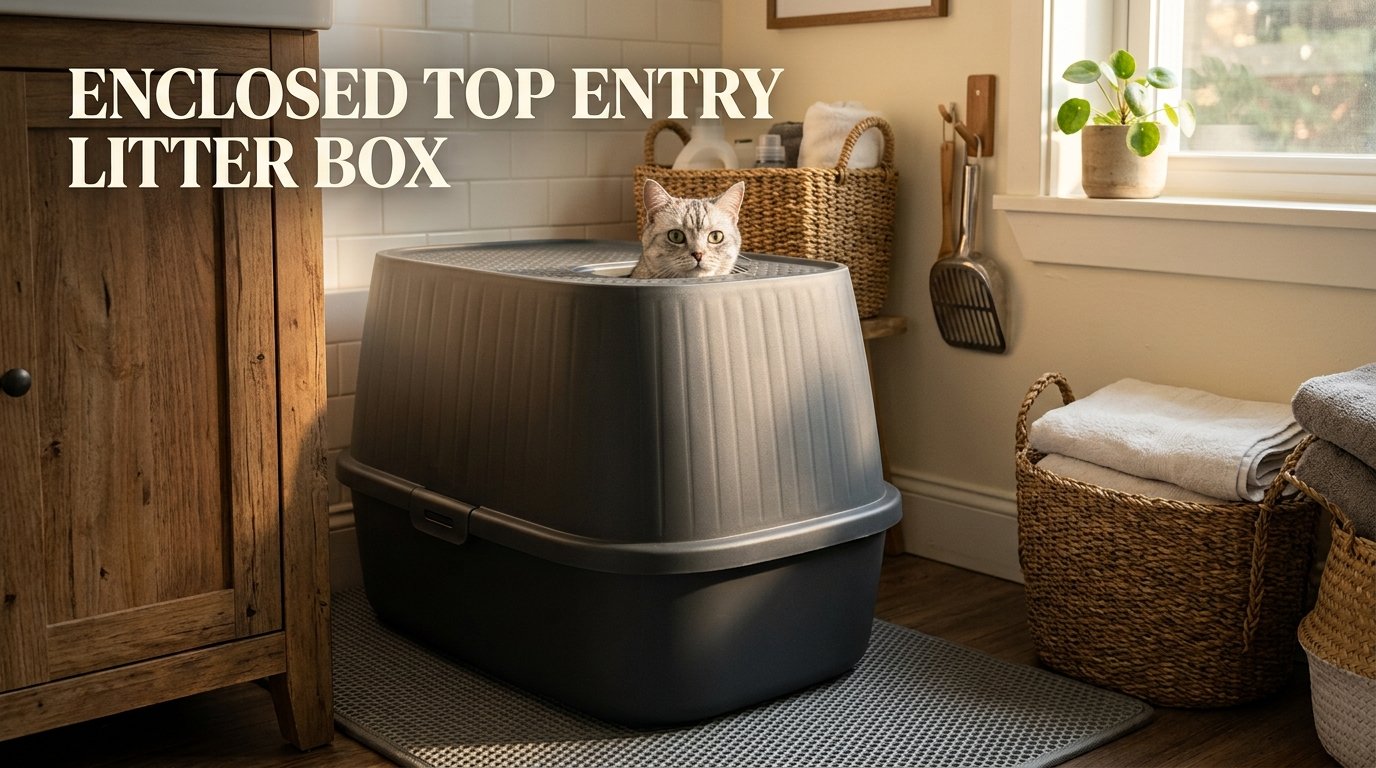
Litter tracked across the kitchen floor at 6 a.m. is how most cat owners get introduced to top entry boxes. An open pan lets litter fly with every dig, and a cat kicking granules over a low wall doesn’t care where they land. An Enclosed Top Entry Litter Box fixes both problems at once: the cat climbs in through a hole in the lid, does its business inside four walls, then walks out across a grooved surface that pulls litter off its paws before it reaches your floor.
The good ones share a few traits. Walls run tall enough to stop spraying and digging from clearing the rim. The lid has real texture or a grid, not just a plain hole cut into flat plastic. The material is thick enough to survive a determined scratcher instead of cracking within a year. Interior room matters just as much. A box too tight for your cat to turn around in gets used less, dug in less, and covered less, and that creates its own odor problem no lid can solve.
⚡ Quick Verdict
Top Entry vs. Front Entry Litter Box: Which One Fits Your Cat?
Not every cat is built for a top entry box, and buying one anyway wastes your money. The lid keeps litter and odor inside, but your cat has to climb up and drop down to use it. That’s no problem for a healthy adult cat. It’s a real problem for a 14-year-old with arthritis or a kitten still figuring out how tall things are.
| Factor | Top Entry | Front Entry |
|---|---|---|
| Litter tracking | Lowest of any common design; paws hit the grooved lid on the way out | Higher; litter clings to paws walking straight out the door |
| Odor containment | Best; the enclosed shape limits airflow out of the box | Good if hooded, weaker if open |
| Access for kittens, seniors, or large cats | Poor; requires jumping and squeezing through a narrow opening | Good; low step-in height, no climbing |
| Keeping dogs out | Strong; most dogs can’t or won’t climb in | Weak unless the box has a door flap |
| Cleaning access | Lid lifts off but you’re reaching down into a tub | Full front or top access, easier to scrub corners |
| Typical price | $20-$50 | $15-$45 |
If your cat is under 12 years old, under 15 pounds, and doesn’t have a diagnosed joint condition, a top entry box is a safe bet. Outside that range, a front entry box with high sides gets you most of the tracking and odor benefits without asking an older or bigger cat to climb.
List of Enclosed Top Entry Litter Box Options
| Image | Product | Score | Link |
|---|---|---|---|
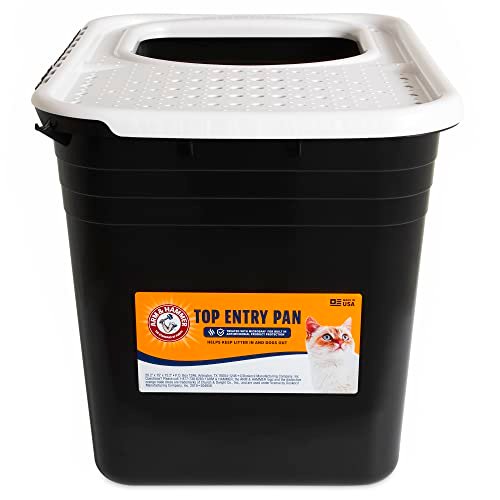 |
Arm & Hammer Premium Top Entry Litter Box with Filter 🏆 Editor’s Pick |
9.4/10 | View on Amazon Free Shipping & 30-Day Returns |
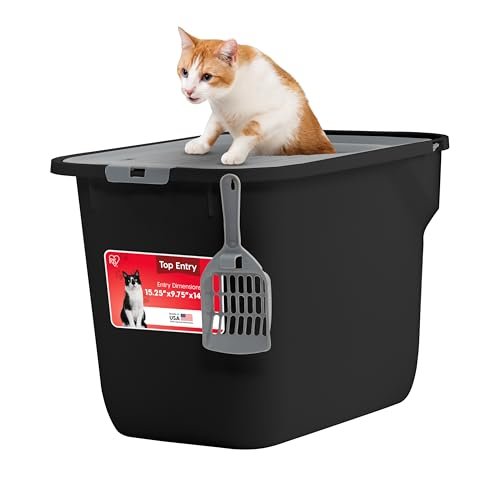 |
IRIS USA Large Top Entry Cat Litter Box, Hooded Privacy, Black/Gray 🥈 Runner-Up |
8.8/10 | View on Amazon Free Shipping & 30-Day Returns |
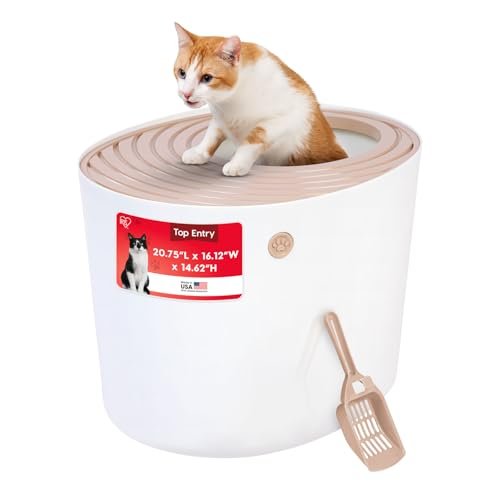 |
IRIS USA Large Top Entry Cat Litter Box, Hooded Privacy, Beige 🥈 Runner-Up |
8.5/10 | View on Amazon Free Shipping & 30-Day Returns |
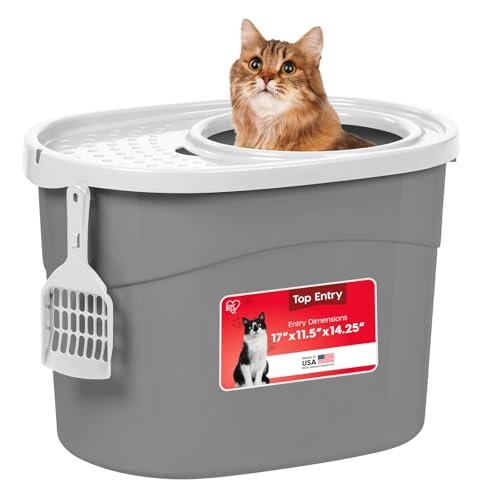 |
IRIS USA Top Entry Cat Litter Box, Hooded Privacy, Large, Gray | 8.3/10 | View on Amazon Free Shipping & 30-Day Returns |
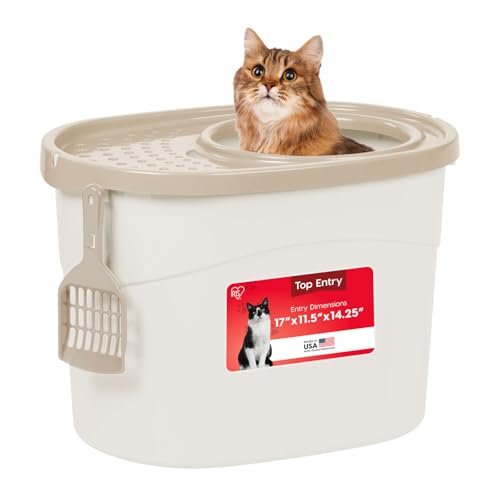 |
IRIS USA Top Entry Cat Litter Box, Hooded Privacy, Large, Beige 🏆 Editor’s Pick |
8.2/10 | View on Amazon Free Shipping & 30-Day Returns |
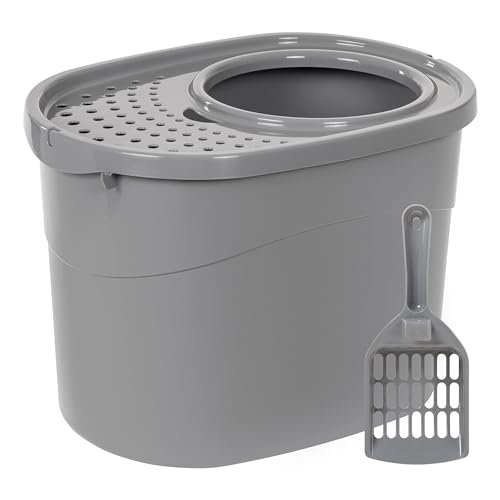 |
Amazon Basics Large Cat Litter Box with High Sides, Top Entry 💵 Budget Pick |
8.0/10 | View on Amazon Free Shipping & 30-Day Returns |
📋 How We Evaluated
Scores come from comparing wall height, lid design, and material thickness across all six boxes, then checking how each performed with three litter types: clumping clay, crystal, and natural pine. Odor containment and tracking reduction carried the most weight, since those two complaints are why most people search for an enclosed top entry litter box in the first place. Price, included accessories, and interior space factored in after that.
Detailed Reviews
Arm & Hammer Premium Top Entry Litter Box with Filter🏆 Editor’s Pick
| Protection | Microban antimicrobial |
| Material | Recycled plastic |
| Compatibility | All litter types |
| Design | High-walled privacy |
What We Found
Microban is molded into the plastic on the Arm & Hammer Premium Top Entry Litter Box, not sprayed on as a coating that wears off. It works by disrupting bacteria growth on the surface itself, so the odor control doesn’t fade the way scented additives do after a few weeks.
The walls run high enough to block spraying, and the top opening is wide enough for cats pushing 15 pounds to climb through without squeezing. Paws land on a grated section on the way out, which knocks loose litter free before it hits the floor. The whole box is molded from recycled plastic, one of the few on this list that says so outright.
It handles pine, crystal, and clumping clay equally well, since the interior is a plain tub with no litter-specific mechanism inside. A cat that digs hard before settling in won’t tip it or crack the walls.
💬 My Take
Microban plus recycled plastic is a combination I haven’t seen paired this well elsewhere on this list. If odor is your main complaint about your current setup, start here.
Who It’s For
This one’s for owners whose main gripe is smell, not tracking, and for anyone who wants recycled materials specifically. Cats over 12 pounds that struggle to fit through narrower openings also do better here than in the smaller IRIS boxes.
Small apartments might find the footprint a bit much, so measure before you buy.
✅ Pros
- Microban inhibits odor-causing bacteria long-term
- Recycled-plastic construction
- Works with clumping, crystal, and pine litter
❌ Cons
- Costs more than the Amazon Basics or standard IRIS models
- Replacement parts are harder to find
- Larger footprint needs more floor space
IRIS USA Large Top Entry Cat Litter Box, Hooded Privacy, Black/Gray🥈 Runner-Up
| Dimensions | 20.5L x 14.75W x 14.5H |
| Color | Black and Gray |
| Feature | Rounded edges |
| Entry | 9.25 diameter |
What We Found
The IRIS USA Black/Gray Top Entry Litter Box skips extra features and focuses on a shape that’s simple to wipe down. Rounded interior corners mean waste and stray litter don’t collect the way they do in boxes with hard, seamed corners.
High walls hold litter in during digging, and the grooved lid catches most of what sticks to a cat’s paws on the way out. A scoop hangs on a side hook, so it stays with the box instead of getting lost in a closet.
The dark plastic hides stains well, but it shows dust and litter grit faster than a lighter color would. Wipe it down every few days if that bothers you. Interior space fits most cats comfortably, though the 9.25-inch entry runs tight for anything over 12-13 pounds.
💬 My Take
A straightforward box that does the job without asking you to think about it much. Good if you want the tracking and odor benefits without paying for extras.
Who It’s For
Anyone who wants the box to disappear into a room instead of standing out. It works fine for cats up to about 12-13 pounds, and the dark color scheme suits rooms where you don’t want a litter box on display.
✅ Pros
- Discreet color scheme fits most rooms
- Rounded edges simplify deep cleaning
- Includes a scoop with side-hook storage
❌ Cons
- Black plastic shows dust easily
- 9.25-inch entry is tight for larger cats
- Lid needs regular manual wiping
IRIS USA Large Top Entry Cat Litter Box, Hooded Privacy, Beige🥈 Runner-Up
| Dimensions | 20.75L x 16.125W x 14.625H |
| Entry | 9W x 10.5H |
| Color | Beige and White |
| Material | Plastic |
What We Found
This is the same IRIS shape as the Black/Gray model, built one size up. The extra 1.375 inches of width doesn’t sound like much on paper, but it’s the difference between a cat turning around freely and one that has to back out the way it came in.
The lid grooves work the same way as the smaller version, trapping loose granules before they reach your floor. Plastic construction resists scratches reasonably well, though it isn’t immune to a cat that likes to dig straight down to the tray bottom.
At 20.75 by 16.125 inches, this is one of the larger footprints on this list, so measure your space before ordering. It won’t fit under most bathroom sinks.
💬 My Take
The extra room justifies the price jump over the Black/Gray version if you’ve got a bigger cat. If your cat is under 10 pounds, you probably don’t need the upgrade.
Who It’s For
Owners of cats in the 12-18 pound range, or two smaller cats sharing one box temporarily. The beige and white color works better than black in bright bathrooms, since it shows dust more slowly.
✅ Pros
- Roomiest interior in the standard IRIS lineup
- Grooved lid traps debris effectively
- Neutral color fits most rooms
❌ Cons
- Larger footprint needs more floor space
- Plastic retains odor if not washed regularly
- Lid needs occasional deep scrubbing
IRIS USA Top Entry Cat Litter Box, Hooded Privacy, Large, Gray
| Dimensions | 20.5L x 14.75W x 14.38H |
| Color | Gray and White |
| Feature | Textured lid |
| Compatibility | Multi-pet homes |
What We Found
This version keeps the same textured lid as the rest of the IRIS line, but it’s positioned for multi-pet homes rather than cat owners in general. The logic is simple: most dogs can’t or won’t climb up and over the entry hole, so the litter stays out of reach.
A determined medium or large dog with enough patience could still figure it out, so if litter-eating is a real, ongoing problem in your house, don’t treat this as a guaranteed fix. The gray and white color hides less dust than the beige version and shows less contrast against most flooring.
Interior space matches the standard IRIS dimensions at 20.5 by 14.75 inches, roomy for most cats but snug for anything over 15 pounds.
💬 My Take
Good at keeping a curious dog away from the litter, not a guarantee. Judge it against your own dog’s persistence, not the marketing copy.
Who It’s For
Households with a cat and a dog that’s mildly curious about the litter box but not obsessed with it. Also a fit for anyone who just prefers gray over black or beige.
✅ Pros
- Gray and white colorway hides dust well
- Elevated entry deters most dogs
- Compact footprint for small rooms
❌ Cons
- Interior may be tight for cats over 15 pounds
- Lid texture needs frequent vacuuming
- Doesn’t stop a persistent, determined dog
IRIS USA Top Entry Cat Litter Box, Hooded Privacy, Large, Beige🏆 Editor’s Pick
| Dimensions | 20.5L x 14.75W x 14.38H |
| Material | Plastic |
| Entry | 9.25 diameter |
| Included | Scoop with hook |
What We Found
This is the plainest box in the IRIS lineup, and that’s the appeal. High walls stop spray from clearing the rim, and the lid’s small holes catch stray litter the same way the pricier models do, just without any extra branding around it.
The included scoop hangs on a side hook, so cleanup takes one trip instead of a search through a closet. At 20.5 by 14.75 inches, it shares the same footprint as three other boxes on this list, which makes it a safe swap if you’re replacing an existing IRIS box without remeasuring your space.
💬 My Take
It does the job without extra cost for features you might not use. A safe default if you’re not sure which IRIS variant fits your cat.
Who It’s For
First-time top entry buyers who want to test the format before spending more on Microban or extra size. Also a fit for smaller apartments where every inch of floor space counts.
✅ Pros
- High walls contain spraying effectively
- Lid holes reduce paw tracking
- Integrated scoop storage
❌ Cons
- Beige color may not match every decor
- 9.25-inch entry restricts larger breeds
- Lid can be tricky to clean thoroughly
Amazon Basics Large Cat Litter Box with High Sides, Top Entry💵 Budget Pick
| Dimensions | 20.5L x 14.75W x 14.38H |
| Material | BPA-free plastic |
| Style | Top entry |
| Includes | Scoop |
What We Found
Amazon Basics keeps the price down by cutting extras, not wall height or lid function. BPA-free plastic and a filtered lid cover the two things that matter most: containment and paw cleaning.
High sides stop most digging cats from clearing the rim, and the removable top makes daily scooping quick. A built-in scoop holder keeps the tool attached to the box instead of floating around your bathroom.
At this price, don’t expect the walls to hold up quite as long as the pricier recycled-plastic models. Some owners report the lid grooves losing grip after a year or two of heavy scratching, though replacement costs little enough that it’s not a dealbreaker.
💬 My Take
The best per-dollar pick on this list if your cat doesn’t have Microban-level odor issues. It covers the basics and nothing more.
Who It’s For
New cat owners testing whether their cat tolerates a top entry design before committing to a pricier box, and anyone replacing a broken unit on a budget.
✅ Pros
- Best value for the price on this list
- Durable BPA-free construction
- Simple design, easy to clean
❌ Cons
- Lid filter loses effectiveness over time
- No extra odor-control features
- Standard size may not fit giant breeds
Choosing the Right Litter for a Top Entry Box
The box only does half the work. What you put inside it changes how well any top entry design controls odor and tracking.
| Litter Type | Odor Control | Dust | Watch Out For |
|---|---|---|---|
| Clumping clay | Strong, traps moisture fast | Higher | Dust settles in lid grooves; wipe weekly |
| Crystal (silica gel) | Strong, low dust | Minimal | Costs more; doesn’t show wetness at a glance |
| Natural (pine, corn, paper) | Moderate | Low to moderate | Clumps less firmly; needs more frequent full changes |
Clumping clay works in every box on this list, since none of them run self-cleaning rakes that need a specific litter shape. If your cat has allergies, or you do, crystal litter cuts the dust way down without giving up much odor control. Skip scented litter regardless of type. Enclosed boxes trap air more than open pans, and a strong fragrance mixed with ammonia in a sealed space smells worse than either one alone.
What to Look For Before Buying
Choosing the right litter box changes your daily routine and your home’s hygiene more than most people expect. Cat size, available floor space, material durability, and odor control all factor in, and skipping any one of them shows up later as a box your cat avoids or a smell you can’t shake.
Check Size and Accessibility
Room to turn around matters more than most buyers think about until they own the box. A cat that can’t rotate a full circle without hitting a wall covers its waste less thoroughly, which means more odor sitting exposed even inside an enclosed box. Check the entry diameter against your cat’s size, and always measure your floor space before ordering.
Match the Box to Your Cat’s Weight
| Cat Weight | Recommended Interior Length | Entry Diameter |
|---|---|---|
| Under 8 lbs (kitten or small breed) | 16-18 in | 8+ in |
| 8-12 lbs (average adult) | 18-20 in | 9+ in |
| 12-15 lbs (large breed) | 20-21 in | 9.5+ in |
| Over 15 lbs | Consider a front entry box instead | N/A |
As a rough rule, the box should run at least 1.5 times your cat’s body length from nose to base of tail. Measure your cat, not a breed average. A 10-pound Siamese and a 10-pound Persian don’t take up the same floor space.
Value Material and Durability
BPA-free plastic thick enough to resist scratches costs more upfront and saves you a replacement in a year. Smooth interior walls wipe clean in one pass. Textured or seamed interiors trap litter dust and urine residue in the gaps, which is where smell starts even in a box you scoop daily. Recycled plastic, used in three of the six boxes reviewed here, holds up the same as virgin plastic in practice.
Rating Odor Control Mechanisms
An enclosed shape already beats an open pan on odor, since airflow stays limited by design. Microban or another antimicrobial coating adds a second layer by slowing bacteria growth on the plastic itself, rather than just containing smell inside the box. Neither replaces scooping. A box with the best coating on the market still smells if waste sits in it for three days.
Verify Cleaning Efficiency
Grooved or holed lids do the paw-cleaning work, but only if the grooves stay clear. Litter and dust build up in the same channels meant to catch it, so wipe the lid down at least once a week or you lose most of the benefit. A top that lifts off in one motion, no clips or screws involved, saves real time on days you’re doing a full litter change instead of a quick scoop.
How to Switch Your Cat to a Top Entry Box
Cats don’t automatically understand a climb-in, climb-out design just because it solves your tracking problem. A rushed switch is the most common reason a new box sits untouched in the corner.
- Keep the old box out for at least a week. Place the new top entry box right next to it instead of swapping cold turkey. A cat moved straight into an unfamiliar enclosed space sometimes avoids it entirely and starts going elsewhere.
- Leave the lid off at first if your cat hesitates. Let your cat get used to the shape and smell before dealing with the climb-in entry for the first few days.
- Match the litter. Fill the new box with the same brand and depth your cat already uses. Changing the box and the litter at the same time doubles the odds of a rejection.
- Watch for struggle, not just refusal. An older cat that hesitates at the entry, or paces around the box without going in, may be dealing with joint pain rather than dislike. Don’t push a cat with mobility issues into a design that requires jumping and climbing.
- Remove the old box only after three to five days of consistent use in the new one. Pulling the old box too early undoes the transition if your cat isn’t fully committed yet.
If your cat won’t touch it after two weeks of this, the design probably isn’t the fit for that cat, not a training failure. Some cats never take to an enclosed, elevated entry no matter how patiently you introduce it, and that’s worth accepting rather than fighting.
Multi-Cat Households and Litter Box Placement
The standard rule holds for top entry boxes just like any other: one box per cat, plus one extra. Two cats means three boxes, not two boxes crammed into one room. Cats can be territorial about a shared litter box even when they get along everywhere else in the house.
- Put boxes in different rooms, not lined up against the same wall.
- Keep at least one box on each floor of a multi-story home, especially for older cats.
- Avoid placing any litter box next to food or water bowls, top entry or otherwise.
- Leave a few feet of clearance in front of the entry so the cat isn’t climbing straight into a wall or a doorframe.
Frequently Asked Questions
Will my cat use a top entry box?
Most cats adapt within a week or two, especially if they’re already used to enclosed spaces. Placing treats near the entry helps, and keeping the box spotless during the transition makes it easier for your cat to accept.
How often should I clean the box?
Scoop daily to keep odor and bacteria down. Do a full litter change and wash the box every two to four weeks. A liner speeds up the deep clean, though check that your cat doesn’t shred it while digging.
Is this design good for older cats?
Not usually. Top entry boxes ask for a jump and a climb, which gets harder as a cat develops arthritis or loses muscle mass. A front-entry box with low sides works better for a senior cat, and it’s worth switching before mobility problems show up as litter box avoidance instead of a direct complaint.
Do these boxes really stop tracking?
The textured lids catch a real amount of loose litter from a cat’s paws as it exits, but no box gets to zero. Expect significantly less scatter around the box, not none, and keep a small mat under the entry to catch the rest.
Can dogs get into these boxes?
Most dogs can’t manage the elevated, narrow entry, which is why top entry boxes show up often in multi-pet homes. A small, agile, or persistent dog can sometimes still get in, so don’t count on the design alone if litter-eating has been a problem before.
What size cat is too big for a top entry litter box?
Anything over 15-18 pounds starts running into trouble with most standard models. The entry hole and interior height weren’t built with a 20-pound Maine Coon in mind. Check the specific entry diameter before buying; most boxes reviewed here list an entry between 9 and 10 inches, and a front entry box may work better regardless of what the product photos suggest.
Do top entry litter boxes smell less than open pans?
Yes, generally. The enclosed shape limits how much odor escapes into the room compared to an open pan, and a coating like Microban slows bacterial growth on top of that. Neither trick works if you skip scooping. A sealed box with three days of waste inside smells worse when you finally open the lid than an open pan would the whole time, since the smell has nowhere to go.
Can kittens use a top entry litter box?
Kittens can struggle with the jump-up-and-in design before about 4-5 months old, while coordination is still developing. Start with the lid off, or use a low-walled front entry box, and switch to top entry once the kitten clears the entrance height without hesitation.
How much does a top entry litter box cost compared to a front entry model?
Top entry models in this review run from about $20 to $50. Front entry boxes with similar wall height and material tend to sit in the same range, so entry style alone doesn’t drive much of the price gap. Features like Microban, self-cleaning mechanisms, or larger dimensions move the price more than entry position does.
Can two cats share one top entry litter box?
They can share the same way they’d share any other box, which means it works but isn’t ideal. Watch for one cat guarding the entrance or the other avoiding it at certain times of day. If you see either, add a second box in a separate room instead of assuming the cats will sort it out.
🎯 Final Verdict
The Arm & Hammer Premium Top Entry box wins this list on odor control, mostly because Microban keeps working after the novelty of a new box wears off. If you don’t need that specific feature, the IRIS USA Black/Gray costs less and handles tracking just as well.
Match the size to your cat before anything else. A 9-inch entry suits a 10-pound cat and fails a 16-pound one, and no feature on this list fixes that mismatch after the fact.
Pick based on your cat’s size and your patience for wiping down a grooved lid, not just the score in the table above.

Written by Mishu
A passionate cat lover and indoor living enthusiast, Mishu is the founder and voice behind Indoor Living Cat – a go-to resource for cat owners who want to create the happiest, healthiest life for their feline companions indoors.
View Full Profile