
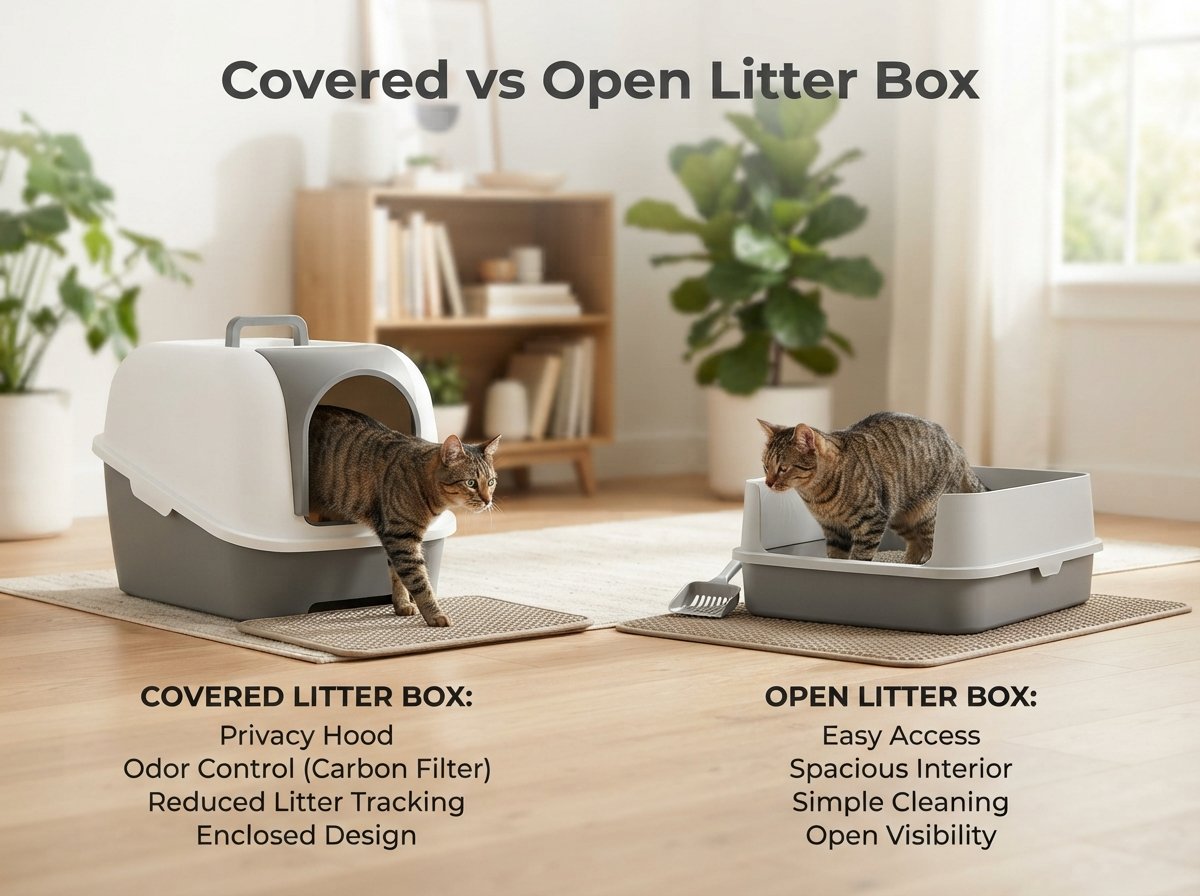
Most cats don’t care whether their litter box has a lid. In the best-known study on the question, 28 cats got a covered and an uncovered box side by side, and as a group they used both about equally. Owners are a different story. We have strong opinions about litter on the floor, smell in the room and how much waste we’d rather look at.
That’s why the covered vs open litter box question comes down to fit. I compared the Amazon Basics Covered Litter Box, a 21 x 16 x 15 inch hood with a swinging door and a carbon filter, against the Petmate Open Cat Litter Box, a 16 x 12 x 4 inch pan with nothing on top. Below you’ll find how each handles scatter, odor and scooping, what the research says about cat preference, a size check, a step-by-step switching plan and a cleaning checklist.
Last updated September 2026. This guide is general information, not veterinary advice. If your cat’s bathroom habits change suddenly, call your vet.
Jump to: Pros and cons at a glance | What the research says | Amazon Basics covered box | Petmate open box | Size check | Best box by situation | Switching guide | Cleaning checklist | FAQ
Covered vs Open Litter Box: The Two Boxes We Compared
⚡ Quick Verdict
Pick the Amazon Basics Covered Litter Box if litter on the floor and smell in the room bother you more than they bother your cat. The hood and swinging door keep kicked-out granules inside, and the pre-installed carbon filter takes the edge off odor. Pick the Petmate Open Cat Litter Box if you have a kitten, a senior cat or a cat that hates tight spaces. Its 4-inch sides are easy to step over and you can scoop it in seconds. One catch on size: this Petmate listing is the 16 x 12 inch Medium, which suits kittens and small cats. Bigger cats need the Large or Jumbo, and the standard Amazon Basics hood gets snug on any cat longer than about 14 inches.
Covered vs Open Litter Box: Pros and Cons at a Glance
Before the product breakdowns, here’s how the two designs compare in general. These rows apply to any hooded box versus any open pan, not only the two we review.
| Factor | Covered (hooded) box | Open pan |
|---|---|---|
| Litter scatter | The hood and door keep most kicked litter inside. Paws still carry granules out through the door. | Litter flies over the sides when a cat digs hard. A mat around the pan catches most of it. |
| Odor | A carbon filter reduces what escapes into the room, but smell concentrates inside the box. | More smell reaches the room, but air moves through, so the pan itself stays less stuffy. |
| Airflow and heat | Limited. Can feel stuffy in summer. | Full airflow. |
| Privacy | High. Good for shy cats and for hiding the box from guests. | Low. Your cat sits in the open with a clear view of the room. |
| Spotting health changes | You lift the hood to check clumps, color and volume. | Everything is visible at a glance. |
| Scooping | One extra step: lift the hood, then scoop. | Fastest. Nothing to move. |
| Kittens, seniors, stiff joints | Door flap and higher entry can be a barrier. Prop the flap open to help. | Low sides are the easiest to step over. The Petmate here is about 4 inches tall. |
| Large cats | Check interior length and door opening before buying. | Buy the Large or Jumbo pan. |
| Multi-cat homes | One exit lets a cat get cornered inside the hood. | Cats can see and leave in any direction. |
| Ongoing cost | Hood plus replacement carbon filters, which are sold separately. | The pan alone, plus a mat if you want one. |
[IMAGE PLACEHOLDER] Side-by-side photo of the Amazon Basics covered box and the Petmate open pan
Shoot both boxes in the same room, same angle, with a ruler or a standard object for scale. Add a pen or a can next to the door opening.
Suggested alt text: Amazon Basics covered litter box next to a Petmate open litter box for size comparison
Do Cats Prefer Covered or Open Litter Boxes?
Owners tend to assume cats hate lids. The best-known test says the picture is more mixed. In a 2013 study in the Journal of Feline Medicine and Surgery, researchers gave 28 cats a covered and an uncovered box side by side and weighed the waste in each. As a group, the cats used the two styles about equally. Eight individual cats did pick a side: four favored the covered box and four the open one. (Read the abstract on PubMed.)
Two caveats matter before you treat that as a green light for any hood. The test boxes were modified storage tubs roughly 32 inches long, far roomier than a 21 inch retail hood, and every box was scooped daily. Cat behaviorists, including Dr. Mikel Delgado, have pointed out that a small retail hood is a different proposition.
A 2019 field study points the same way. It counted feces in single-cat homes over two 4-week trials and found cats chose covered boxes more often when the covered box had 17% more floor space than the open one. With equal floor space, the lean toward covered boxes was weaker. (Study summary on ScienceDirect.)
So size and cleanliness carry more weight than the lid. The 2013 authors said as much: with boxes scooped at least once a day, most cats won’t show a preference.
What to Do With That
- Scoop at least once a day, whichever style you buy.
- Buy the largest box that fits your space, not the smallest one your cat can squeeze into.
- If your cat has a strong opinion, believe it. Individual cats in both studies did.
- If you’re not sure, put an open pan next to the hood for a week with the same litter and see which one your cat picks. The researchers call this offering a “cafeteria” of box styles.
[IMAGE PLACEHOLDER] Simple infographic of the 2013 study result
A bar or dot graphic: 28 cats, 8 with a preference (4 covered, 4 open), the rest with no preference. Credit the Journal of Feline Medicine and Surgery, 2013.
Suggested alt text: Chart showing 8 of 28 cats had a litter box preference, 4 for covered and 4 for open
Are Covered Litter Boxes Bad for Cats?
Not by default. A covered box becomes a problem when it’s too small, not scooped often enough or badly placed, and a few cats refuse one no matter what. These are the failure points worth knowing before you buy a hood:
- Trapped smell. A cat’s nose is far sharper than yours, and a hood concentrates odor inside the box. Scoop daily and swap the carbon filter on the maker’s schedule.
- Not enough room. If your cat can’t turn around and dig without bumping the walls, it may perch on the rim or go somewhere else.
- The door flap. Some cats dislike pushing through a flap. On the Amazon Basics, the listing gives the opening as about 7 by 7.5 inches.
- One way out. In a multi-cat home, a cat inside a hood can get cornered by another cat waiting at the only exit.
- Heat and humidity. A closed shell holds warmth, so a hot summer can make it stuffy.
Signs Your Cat Dislikes the Hood
- Perching on the rim without stepping in.
- Digging at the hood or at the floor outside the box.
- Going right next to the box.
- Skipping the box after you switched from an open pan.
Any of these can mean the door needs to come off or the hood needs to go. Try that first, using the steps in the switching guide below.
Analysis: Amazon Basics Covered Litter Box
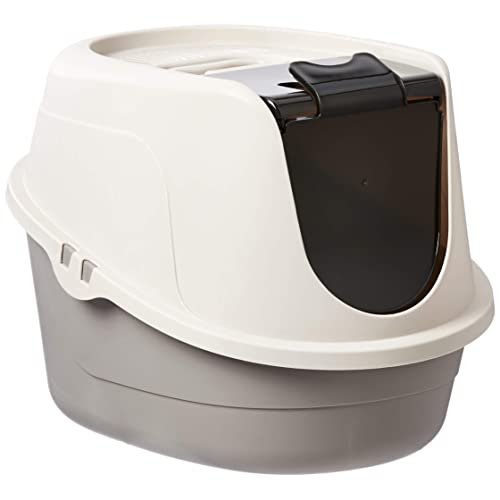
This enclosed box is for owners who want the litter area tidy and the waste out of sight. It works best for cats that like a little solitude while they go, and for homes where scattered litter and dust are a daily fight.
The Amazon Basics Hooded Litter Box puts a snap-on hood and a swinging plastic door between your cat and your floor. Kicked-out granules mostly land inside the hood instead of across the room. Some cats also feel safer with a roof over them, which counts if yours startles easily.
Odor gets attention too. A carbon filter comes pre-installed, and replacements are sold separately, so plan to buy them. Amazon describes the plastic as stain and odor resistant, and the pan wipes clean with a damp cloth.
Build Quality & Design
The hood snaps firmly onto the base, so it stays put even when a cat jumps in and out with energy, and a built-in handle lets you lift it off for scooping. The standard size measures 21 x 16 x 15 inches, small enough to tuck into a corner. Inside, that’s snug for a big cat. The size check below has the math.
Performance & Speed
The swinging door works like a wall. It stops most litter from flying across the room during a post-bathroom dig, so a high-traffic room stays cleaner between sweeps. Paws still carry some granules out, so a small mat by the door earns its space.
Features & Functionality
The carbon filter helps most in an apartment or shared space, where the box sits close to where you live. Carbon wears out, though. Replace it on the maker’s schedule. The stain-resistant finish also holds less odor between deep cleans, which cuts down on scrubbing.
User Experience
A hood makes the corner look tidier. The door is light, so most cats won’t have to push hard. But the opening is small: the listing gives it as 17.8 cm wide by 19 cm high, or about 7 by 7.5 inches. And scooping is a two-step job, because you unlatch the hood before you reach the pan.
Size & Fit
Amazon also sells a Large version at 24 x 18 x 17 inches under a separate listing. If your cat measures over about 14 inches from nose to base of tail, start with the Large Amazon Basics covered box instead. The size check below explains why.
Value for Money
You’re paying for a hood, a door and a filter, and the filter is the recurring cost. If containing scatter matters to you, that trade makes sense. If your cat refuses the hood, none of it earns its keep, so test with the hood off first (see the switching guide below).
✅ Advantages
❌ Disadvantages
Analysis: Petmate Open Cat Litter Box
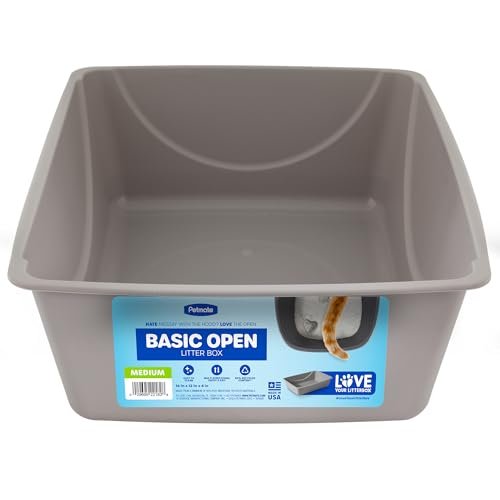
The Petmate Open Cat Litter Box is for owners who want a no-frills pan that works. It suits kittens, senior cats and any cat that gets anxious in tight spaces, and it is quick to keep clean.
The Petmate drops the lid and the door. It’s a low pan with rimmed sides, and that simplicity is the appeal. A kitten or an older cat can step in without pushing through anything, and air moves freely over the litter.
Petmate sells this pan in four sizes: Small at 14 x 10.5 x 3.5 inches, Medium at 16 x 12 x 4, Large at 18.5 x 15.5 x 5 and Jumbo at 22 x 16.5 x 6.5. The listing we link to is the Medium. And because nothing covers the litter, you can see at a glance when it needs scooping.
Build Quality & Design
Petmate makes the pan in the USA from plastic it calls durable. The rim around the top gives you a grip for lifting, moving and rinsing it out. Petmate’s own advice on its litter boxes is to replace them about every 12 months, since odor soaks into plastic and scratches build up, so plan to swap it every year or so.
Performance & Speed
Speed is the point. With no lid or door, you scoop in seconds. That suits owners who want to spot changes in clumps or stool quickly and keep upkeep short.
Features & Functionality
The sides are only about 4 inches tall, so an enthusiastic digger will throw litter over the edge. The wide base helps, and a litter mat catches the rest. The payoff is airflow: nothing traps odor inside the pan. Nothing filters it out either, so daily scooping does the job a carbon filter would.
User Experience
Your cat gets a full view of the room while she goes, and some cats need that before they’ll use a box at all. You see the litter’s condition instantly. The tradeoff is that everything is on display, including in a living room.
Size & Fit
At 16 x 12 inches, the Medium suits kittens and small cats, which matches how the listing describes it. By the 1.5x length rule, it covers a cat up to about 10.5 inches long. For an adult, pick the Large or Jumbo from the size options on the listing.
Value for Money
There’s no hood, door or filter to buy or replace, so beyond litter and maybe a mat, you’re paying only for the pan. Petmate suggests swapping it about once a year. Plan on it as a routine replacement.
✅ Advantages
❌ Disadvantages
Major Factors to Consider
Picking a litter box means matching your cat’s behavior to your own habits. These seven factors help you weigh the trade-offs so the box you choose makes daily life easier for both of you.
Performance
Performance is how well the box holds waste and stays sanitary while your cat keeps using it. A box that contains everything but gets avoided has failed. A covered box balances containment against a cat’s need for a comfortable, unstressed spot.
Speed & Efficiency
Efficiency is your daily routine. If you don’t want to spend time unlatching lids, an open box is faster. If a quick extra step buys you less sweeping, a covered box is the better trade.
Price & Value
Count the whole cost. A hood needs replacement carbon filters, and Petmate suggests replacing any plastic box about once a year. An open pan has no extra parts to buy, though many owners add a litter mat.
Build Quality
Look for non-porous plastic that doesn’t crack and doesn’t soak up smell. Deep scratches from digging trap odor, which is one reason plastic boxes have a shelf life. Thick, stable walls feel solid when your cat jumps in.
Design & Aesthetics
Design affects how your home looks and how your cat feels. A hood hides the mess, which helps the room, but some cats feel trapped inside one. Put your cat’s comfort ahead of how the box looks in your living room.
Durability
A box that gets used every day has to survive constant scratching and regular washing. A hood adds seams and a hinged door, which are the spots grime collects. A one-piece pan has fewer places to hide.
Size & Comfort
Size decides more than style does. Vets recommend a box at least 1.5 times your cat’s length, and most retail boxes fall short. Measure your cat before you shop. The size check below shows how.
Feature Comparison
This table compares the core differences between the two boxes. Use it to decide whether clean floors or open, low-stress access matters more to you.
| Feature | Amazon Basics Covered Litter Box | Petmate Open Cat Litter Box |
|---|---|---|
| Odor Control Filter | ✓ | ✗ |
| Mess Containment | ✓ | ✗ |
| Good Airflow | ✗ | ✓ |
| Easy Access | ✗ | ✓ |
| Privacy for Cat | ✓ | ✗ |
| Easy to Clean | ✗ | ✓ |
| Waste Visible at a Glance | ✗ | ✓ |
| Swinging Door | ✓ | ✗ |
| Stain Resistant | ✓ | ✓ |
| Lightweight Build | ✓ | ✓ |
| Suitable for Kittens | ✗ | ✓ |
Specifications Comparison
Check these physical attributes to see which box fits your space. Measure your corner or closet before you buy so the box has enough clearance, and leave room above the hood to lift it off. Dimensions come from the product listings and are outside measurements.
| Specification | Amazon Basics Covered Litter Box | Petmate Open Cat Litter Box |
|---|---|---|
| Price | Varies | Varies |
| Length | 21 inches | 16 inches |
| Width | 16 inches | 12 inches |
| Height | 15 inches | About 4 inches (low profile) |
| Weight | Lightweight | Lightweight |
| Material | Plastic (polypropylene) | Plastic |
| Filter Included | Yes | No |
| Door Type | Swinging | None |
| Door Opening | About 7 x 7.5 inches | Fully open |
| Other Sizes | Large: 24 x 18 x 17 inches (separate listing) | Four sizes, 14 to 22 inches long |
| Fits a Cat Up To (1.5x rule) | About 14 inches long | About 10.5 inches long |
The last row divides each box’s outside length by 1.5. Usable interior room is a bit smaller, so treat those figures as a ceiling.
Litter Box Size, Number and Placement
A good box in the wrong size or the wrong spot still gets avoided. This is the part of the decision most buyers skip.
How Big Should a Litter Box Be?
The AAFP and ISFM, two of the main feline vet groups, recommend a rectangular box 1.5 times your cat’s length, measured from nose to base of tail. Their house-soiling guidelines also cite a study in which adult cats preferred a 34 x 15 inch box over a smaller one. Most retail boxes are smaller than that, including both boxes here.
- Measure your cat from the tip of the nose to the base of the tail. Skip the tail itself. Many adult cats land between 16 and 20 inches.
- Multiply that number by 1.5. The result is the minimum interior length of the box.
- Compare it to the box’s interior length. Listed sizes are outside measurements, so the usable floor is a little smaller.
- Check entry height if your cat is a kitten, a senior or has stiff joints. A 4-inch rim is easy. A hood with a flap is harder.
| Cat length (nose to base of tail) | Minimum box length (1.5x) | Amazon Basics Standard (21 in) | Petmate Medium (16 in) |
|---|---|---|---|
| 12 inches | 18 inches | ✓ | ✗ |
| 14 inches | 21 inches | ✓ | ✗ |
| 16 inches | 24 inches | ✗ | ✗ |
| 18 inches | 27 inches | ✗ | ✗ |
| 20 inches | 30 inches | ✗ | ✗ |
The check marks use outside length, which flatters both boxes. If your cat is 16 inches or longer, size up: the Amazon Basics Large (24 inches) or the Petmate Large (18.5 inches) or Jumbo (22 inches). None of these reach 27 inches, so for a big cat, take the roomiest one that fits your space and watch whether your cat can turn around comfortably.
[IMAGE PLACEHOLDER] Diagram: how to measure your cat for a litter box
Simple line drawing of a cat with a measuring line from nose to base of tail (not the tail tip) and the 1.5x formula beside it.
Suggested alt text: Diagram showing how to measure a cat from nose to base of tail to size a litter box
How Many Litter Boxes Do You Need?
The AAFP and ISFM environmental guidelines call for one box per cat plus one extra. Two cats means three boxes. Spread them across different rooms where you can. Boxes lined up side by side work like one big box, which defeats the purpose if one cat is avoiding another. (AAFP/ISFM Environmental Needs Guidelines.)
Where Should You Put the Box?
- Pick a quiet, low-traffic spot where your cat can see who’s coming and has more than one way out.
- Keep it away from food and water bowls.
- Stay clear of loud appliances such as a washing machine or furnace, which can startle a cat mid-visit.
- Don’t shut a covered box in a closet with the door closed. A hood plus a sealed room traps smell and heat.
- For a hooded box, leave room above and beside it to lift the hood off. For an open pan, put a mat on the floor around it.
[IMAGE PLACEHOLDER] Photo or diagram of a good litter box spot
A room layout or a photo showing a box in a quiet corner with two clear exits, a mat, and food bowls in a different room.
Suggested alt text: Litter box placed in a quiet corner of a living room with a litter mat
Which Litter Box Is Best for Kittens, Senior Cats, Large Cats and Multi-Cat Homes?
Your cat’s age, size and household matter more than the box brand. Use this table to match the design to the situation.
| Situation | Better pick | Why |
|---|---|---|
| Kitten | Open pan, such as the Petmate Medium | Four-inch sides and no door to push through. |
| Senior or arthritic cat | Open, low-sided pan | Stepping over a low rim is easier than pushing through a flap and climbing into a hood. |
| Large adult cat | Large or Jumbo open pan, or the Amazon Basics Large hood | Standard sizes fall short of the 1.5x length rule. |
| Shy or easily startled cat | Covered, with the flap propped open | Privacy without the door. If your cat still balks, go open. |
| Multi-cat home | Open pans, one per cat plus one | More exits and clearer sight lines, so no cat gets cornered. |
| Apartment or shared space | Covered with a carbon filter | Keeps scatter and smell closer to the box. Leave room to lift the hood. |
| You want the fastest scooping and easy health checks | Open pan | Nothing to lift, and clumps, color and volume show at a glance. |
The Middle Ground
If you can’t decide, split the difference. Petmate also makes a Hi-Back open pan (19.25 x 15 x 9 inches) with high sides meant to cut scatter and spray, plus a lowered entry for older cats. And it makes a Basic Hooded pan (18.8 x 15.2 x 14 inches) with a removable privacy door. Neither is one of the two boxes reviewed here, but both sit between the extremes.
How to Switch Your Cat From an Open to a Covered Litter Box
Cats notice change. A sudden swap from an open pan to a hood can trigger accidents. Go in stages and let your cat set the pace.
- Set the covered box next to the current open one and leave both out. Don’t take the old box away yet.
- Start with the hood off, so the new box works as an open pan. Use the same litter at the same depth in both.
- When your cat uses the new pan on its own for several days, snap the hood on with the door flap propped open.
- Once your cat walks in and out of the open doorway without fuss, let the flap swing.
- Keep the old box available for another week. If accidents start, go back one step.
To go the other way, from covered to open, remove the flap first, then the hood, one step at a time.
[IMAGE PLACEHOLDER] Photo strip of the switching stages
Three small photos: hood off, hood on with the flap propped open, flap in place.
Suggested alt text: Three stages of switching a cat from an open to a covered litter box
Litter Box Cleaning and Odor Control Checklist
Cleanliness beats box style. The 2013 study’s authors tied the lack of preference to boxes being scooped at least once a day. This routine works for either design.
Every Day
Every Week
Every 2 to 4 Weeks
Once a Year
Cut Litter Scatter From an Open Pan
- Put a textured litter mat under and in front of the box.
- Don’t overfill. Litter piled near the rim ends up on the floor.
- Size up or choose a high-sided pan such as the Petmate Hi-Back.
🏆 Winner: Amazon Basics Covered Litter Box
🏆 BEST CHOICE
Score Breakdown
The Amazon Basics Hooded Litter Box takes the win for most homes because it balances scatter control and odor control. The open box is quicker to scoop, but keeping litter in the pan and smell out of the air makes the hood the more practical choice for indoor living. It is a conditional win. It assumes your cat accepts a hood, and that your cat is under about 14 inches long if you buy the standard size. If your cat is longer, take the Large.
Choose Petmate Open Cat Litter Box If…
Budget-Conscious Buyers
If you want the most basic, functional box, the Petmate is the better choice. It has no hood, door or filter to buy or replace, so beyond litter, your ongoing cost is close to zero. It does what it says, and it suits anyone who wants simple, low-cost utility.
Kittens, Seniors and Cats With Mobility Issues
Choose the Petmate if you have a kitten, a senior cat or a cat with stiff joints. The lack of a door and the roughly 4-inch sides make it easy to get in and out. That matters for cats that would find a swinging door hard or stressful.
Cats That Dislike Enclosed Spaces
If your cat is known to hate tight spots, the open design is the safer bet. Some cats refuse enclosed boxes and go elsewhere instead. The open style gives your cat a clear view of the room, which helps a nervous cat feel secure.
Busy Owners
For owners who prioritize quick upkeep, the open box is the better pick. You scoop it in seconds with no lid to remove and no door to work around. Pick the right size for your cat, since this listing is the 16 x 12 inch Medium.
🎯 Final Recommendation
Go with the Amazon Basics Covered Litter Box if you want floors that stay clean and odor that stays put, and your cat is happy to push through a door. Choose the Petmate Open Cat Litter Box, in the right size for your cat, if you’re raising a kitten, caring for a senior or living with a cat that dislikes enclosed spaces. If you’re still unsure, set an open pan next to the hood for a week and let your cat vote.
If automation is more your priority than airflow, our Covered vs Automatic Litter Box comparison breaks down that trade-off in more detail. We’ve also looked at how covered boxes stack up against self-cleaning models in our Covered vs Self Cleaning Litter Box guide, and if durability and rust resistance matter to you, our Covered vs Stainless Steel Litter Box comparison is worth reading too. For easier cleanup, our Covered vs Sifting Litter Box guide covers that angle. If you like the open-pan idea but not plastic that holds odor, see our open stainless steel litter box picks. And if the hood appeals but the look doesn’t, our hidden covered litter box guide shows options that blend into a room.
Summary
- Cats as a group show no clear preference between covered and open boxes when size and cleanliness match, though individual cats do pick sides.
- The Amazon Basics Hooded Box does best at keeping litter off the floor and smell out of the room.
- The Petmate Open Box gives the easiest access, which suits kittens, senior cats and cats that dislike tight spaces.
- Check size first. A box should be about 1.5 times your cat’s length, and neither standard size here fits a large adult cat.
- Scoop at least once a day, whichever you choose.
- A covered box hides the litter area from guests. An open pan is quicker to clean and shows health changes sooner.
- Use one box per cat plus one extra, in different spots.
- If you can’t tell which your cat prefers, test an open pan and a hood side by side for a week.
Frequently Asked Questions
Which product is better overall?
The Amazon Basics Covered Litter Box suits most households because it contains scatter and takes the edge off odor. The Petmate Open Box is the better choice if your cat is picky about enclosed spaces, or if you have a kitten or a senior cat.
Do cats prefer covered or open litter boxes?
In a 2013 study of 28 cats, the group showed no overall preference when both boxes were large and scooped daily. Eight individual cats did pick a side, four each way. If you’re unsure, offer both for a week and watch.
Are covered litter boxes bad for cats?
Not by default. They cause trouble when they’re too small, scooped too rarely or poorly ventilated, or when a cat dislikes the door. If your cat perches on the rim or goes next to the box, take the hood off and see if that fixes it.
Do covered litter boxes smell less?
The room smells less, because the hood and carbon filter hold odor in. The box itself smells stronger to your cat, since odor concentrates inside. Scoop daily and replace the filter on the maker’s schedule.
Are open litter boxes messier?
They scatter more litter over the sides, especially with a hard digger. A litter mat, a bigger or higher-sided pan and litter kept at 2 to 3 inches deep cut most of it.
Which is better for kittens and senior cats?
Open pans with low sides, like the roughly 4-inch Petmate, are the easiest to step into. If you go covered, prop the flap open or remove it, and pick a model with a low entry.
Is the price difference worth it?
Prices move with size and seller, so check both listings. The Amazon Basics gets you a hood, a swinging door and a carbon filter. That’s worth it if you want cleaner floors and less smell, and the replacement filters do cost extra over time.
Which has better build quality?
Both use solid plastic, and neither feels flimsy. The hood adds a hinged door and seams that need occasional scrubbing, while the Petmate is a one-piece pan. Petmate suggests replacing plastic litter boxes about once a year either way.
Which is better for beginners?
The Petmate Open Litter Box is the easiest to start with, since there’s no hood, door or filter to manage. It is as straightforward as a litter box gets.
Which offers better value for money?
If you want the most basic, functional box, the Petmate is hard to beat. If you want a box that actively helps manage smells and scatter, the Amazon Basics gives you more for your specific needs.
What are the main differences?
The hood, the door and the size. The Amazon model contains mess and hides waste, while the Petmate offers maximum access and airflow. Also check size: the Petmate here is the 16 x 12 inch Medium.
What size litter box do I need?
Measure your cat from nose to base of tail and multiply by 1.5. That’s the minimum interior length. A 16 inch cat needs a box at least 24 inches long inside.
How many litter boxes do I need?
One per cat plus one extra, placed in different spots. Two cats get three boxes.
Should a covered litter box have a door?
Not always. A flap keeps litter and sight lines contained, but some cats hate pushing through it. Start with the flap propped open or removed, then add it back once your cat uses the box without hesitation.
How do I switch my cat from an open to a covered litter box?
Go in stages. Put the covered box next to the old one, start with the hood off, add the hood with the flap propped open, then let the flap swing. The full steps are in the switching guide above.
How often should I scoop and change the litter?
Scoop at least once a day. With clumping litter, dump, wash and refill every 2 to 4 weeks, or more often in a multi-cat home.
Why is my cat peeing outside the box after I switched?
Put the old box back first and see if the accidents stop. If they don’t, see your vet, because peeing outside the box can signal a urinary tract problem or another medical issue.
Sources and Further Reading
- Litter box preference in domestic cats: covered versus uncovered, Journal of Feline Medicine and Surgery, 2013.
- Field assessment in single-housed cats of litter box type (covered/uncovered) preferences for defecation, Journal of Veterinary Behavior, 2019.
- AAFP and ISFM Guidelines for Diagnosing and Solving House-Soiling Behavior in Cats (litter box size, 1.5x rule).
- AAFP/ISFM Environmental Needs Guidelines (number and placement of boxes).
- Product dimensions and features come from the Amazon and Petmate product listings and may change.
If you’re still deciding which style is right for your cat, our Covered Litter Box guide rounds up our top picks, and the Indoor Cat Litter Box hub has everything else you need to make the call.

Written by Mishu
A passionate cat lover and indoor living enthusiast, Mishu is the founder and voice behind Indoor Living Cat – a go-to resource for cat owners who want to create the happiest, healthiest life for their feline companions indoors.
View Full Profile