
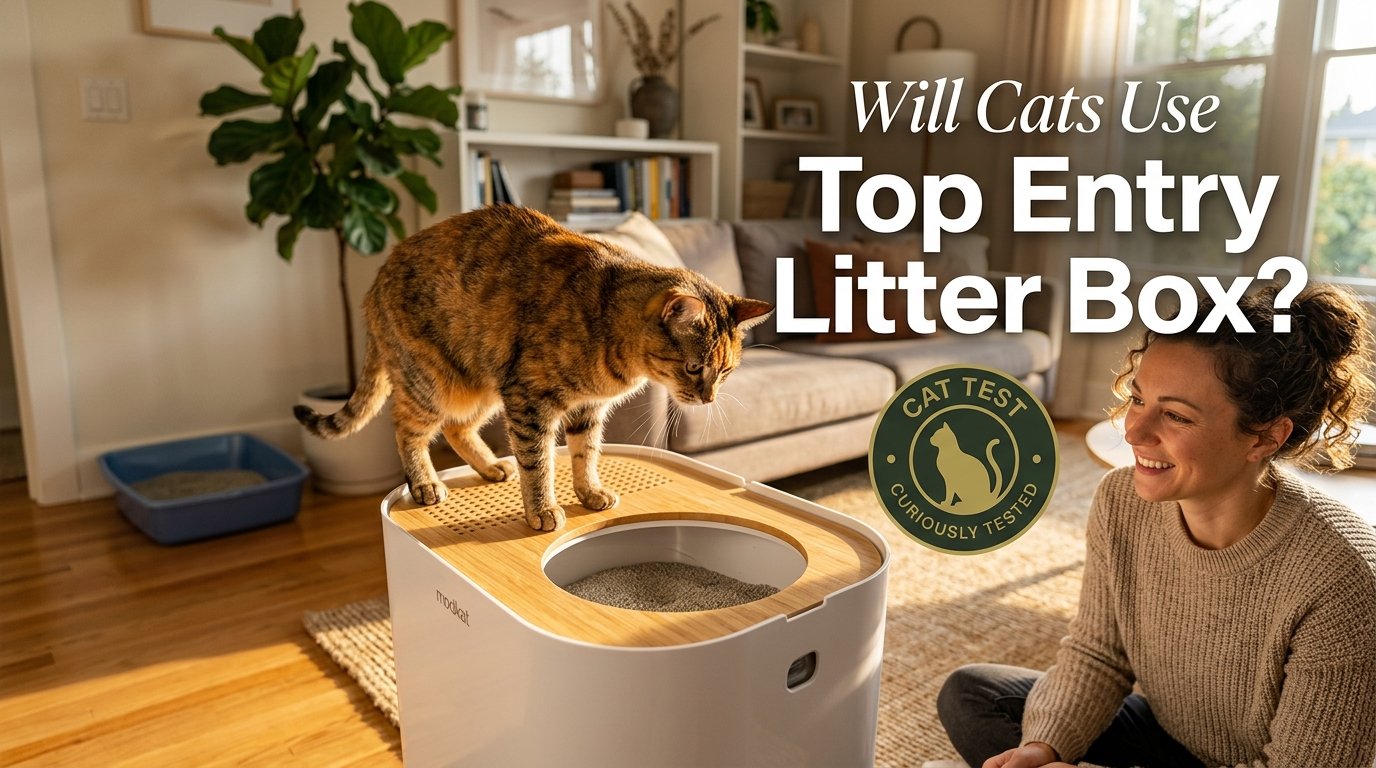
Will cats use a top entry litter box? Most healthy adult cats will, and usually within a few days. Kittens, senior cats with stiff joints, and very large or nervous cats are the ones that struggle. If your cat is in the first group, a top entry litter box fixes the two things that wear owners down: litter kicked across the floor and smells that leak out of an open pan. If your cat is in the second group, you’ll want to read the workarounds below before you spend a dime.
Disclosure: some links below are Amazon affiliate links. If you buy through them we may earn a small commission at no extra cost to you. It doesn’t change which boxes we list.
Quick Answer
- ✓ Healthy adult cats that jump well usually accept a top entry box within a few days.
- ✓ Kittens, seniors, overweight cats, and cats recovering from surgery should stay on a low entry box for now.
- ✓ Keep the old box beside the new one until your cat uses the new one every time.
- ✓ Your cat has to turn around fully inside. If it can’t, the box is too small.
Will Cats Use a Top Entry Litter Box? It Depends on the Cat
Age, health, size, and temperament decide this more than the box does. A four-year-old cat that already leaps onto the kitchen counter will treat a top entry lid like any other perch. A fourteen-year-old with sore hips won’t, and forcing the switch can lead to accidents on your floor.
Here’s a fast way to sort your cat.
| Cat profile | Likely to use it? | Why |
|---|---|---|
| Healthy adult, 1 to 9 years | Yes, in most cases | Jumps easily and likes the privacy of a covered space. |
| Enthusiastic digger or kicker | Yes | High walls and a grated lid keep the mess inside. |
| Young kitten | Not yet | Coordination and jump height are still developing. |
| Senior cat or arthritis | Often no | Jumping in and landing on loose litter can hurt. |
| Overweight cat | Often no | Vertical jumps strain joints and the opening can be a tight fit. |
| Large breed, such as a Maine Coon | Sometimes | Works only if the interior is roomy enough to turn around. |
| Anxious cat that likes to see its surroundings | Sometimes | A single exit above eye level can feel like a trap. |
That table is general guidance, not a diagnosis. Cats surprise people. If yours has bad hips but loves the box, fine. Watch how it moves, and trust what you see over what a chart says.
Try the Cardboard Test Before You Buy
You can find out whether your cat will use a top entry litter box for free. Take a large storage bin or sturdy cardboard box, cut a round hole in the lid about the size of the entry on the box you’re considering, and fill it with your regular litter. Then watch.
Cardboard Test Checklist
- ☐ Your cat jumps in without hesitating or scrambling.
- ☐ It turns around inside without brushing the walls.
- ☐ It jumps out smoothly, with no yowling and no limping afterward.
- ☐ It goes back a second and third time on its own.
- ☐ It never eliminates next to the test box.
Miss more than one box? Skip the purchase. A few days of cardboard beats a returned litter box and a cat that’s decided the hallway carpet is the new bathroom.
List of Top Entry Litter Boxes
Litter tracking and lingering odor are the two complaints we hear most. A top entry box handles both by catching debris on a grated or textured lid and closing in the smell. It also keeps dogs out of the litter, which anyone with a curious lab already knows is worth something. Pick the right size and design, and daily scooping gets a lot less annoying.
Best Top Entry Litter Boxes for Cats That Will Actually Use Them
We looked at five well-reviewed models and compared them on three things: how well the lid catches litter, how they handle odor, and how easy they are to clean. Each one suits a slightly different home. The table gives you the short version, and the write-ups after it give the detail.
| # | Model | Lid feature | Scoop | Standout | Watch for |
|---|---|---|---|---|---|
| 1 | IRIS USA Large, Gray/White | Textured lid | Not listed | Compact footprint, high walls | Big cats may want more room |
| 2 | IRIS USA Large, Beige | Integrated holes | Scoop with side hook | Blends into most decor | Beige shows dust |
| 3 | Amazon Basics Large, High Sides | Filtered lid | On-board storage | BPA-free plastic, removable top | Interior can feel tight for big cats |
| 4 | Arm & Hammer Premium | Grated lid | Not listed | Microban, recycled materials | Plan on replacing it yearly |
| 5 | IRIS USA Large, Beige/White | Grooved lid | Matching scoop with hook | Roomy interior, compact footprint | Takes more floor space than expected |
|
1
|
IRIS USA Top Entry Cat Litter Box, Hooded Privacy, Large, Gray/White |
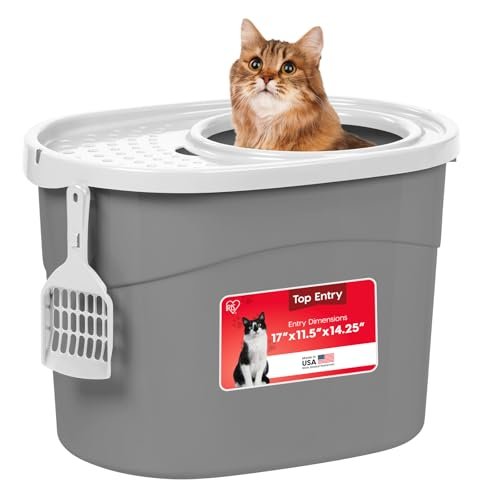
Litter tracking is the problem this box goes after first. The lid is textured, so as your cat climbs out, the grooves pull loose granules off its paws before they reach the floor. You’ll still find the odd piece near the box, but the sweeping drops off. The walls are tall too, which helps if your cat sprays or kicks hard. Everything stays in the tub. Because the waste is hidden, smells stay mostly contained, and cats that want privacy tend to like the enclosed feel.
The footprint is compact, so it slots into a laundry room or a small bathroom without eating the floor. The raised entry doubles as a dog barrier, which matters in a mixed household. Scooping means lifting the lid off, and that’s quick. The tradeoff is that your cat has to be comfortable jumping in. A confident adult will be. An older cat might not.
How This Can Solve Your Problem
- ✓ Textured lid effectively traps loose litter from cat paws
- ✓ Enclosed design keeps odors contained and provides feline privacy
- ✓ Elevated entry discourages dogs from accessing the litter box
Important Considerations
- • Requires cats to be comfortable jumping into the entry
- • Large cats may need more interior space than provided
- • Lid must be removed frequently for deep cleaning sessions
|
2
|
IRIS USA Top Entry Cat Litter Box, Hooded Privacy, Large, Beige |
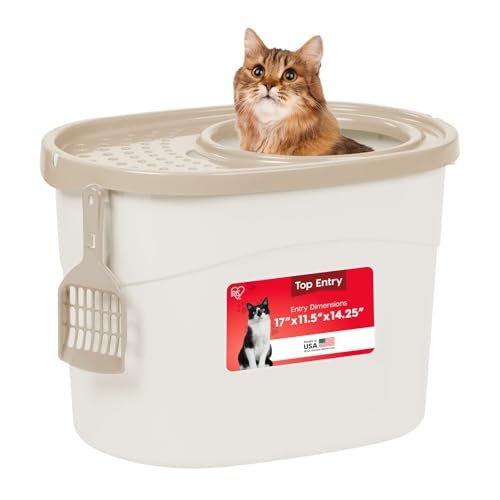
Same family as the gray model, in beige. The lid has built-in holes that let litter fall back into the box instead of following your cat across the room, and the tall walls hold in odor. Cats that like a closed-in bathroom feel safe in it, and a calmer cat is less likely to start avoiding the box. Beige also disappears against light walls and wood floors, so it won’t shout “litter box” from across the living room.
The scoop comes with a hook on the side of the box. Small thing, but you’ll appreciate it the first time you’d otherwise be hunting for the scoop at 7 a.m. The plastic is sturdy, and the entry is sized for most cats. Most cats take to the format fast. And like the rest of the line, the elevated opening keeps dogs from digging around in there.
How This Can Solve Your Problem
- ✓ Integrated holes in the lid catch debris before it tracks
- ✓ Included scoop with hook keeps cleaning tools organized and accessible
- ✓ Enclosed structure ensures privacy and keeps odors locked away
Important Considerations
- • Beige color may show dust more than darker options
- • Check dimensions to ensure it fits your specific floor plan
- • Requires consistent scooping to maintain optimal odor control
|
3
|
Amazon Basics Large Cat Litter Box with High Sides, Top Entry, Odor Co |
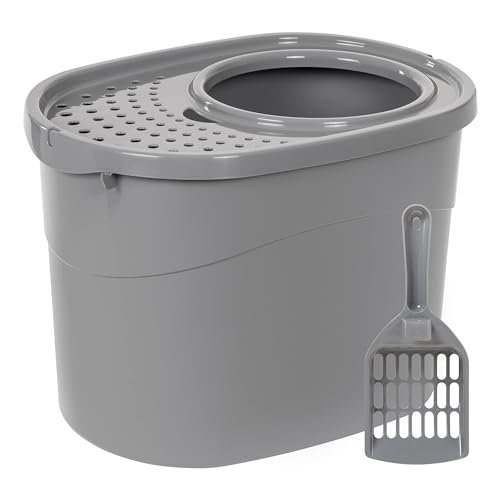
The Amazon Basics box pairs a filtered lid with high sides. The lid catches particles from paws, and the sides hold back spray while giving your cat room to move. It’s made from BPA-free plastic, and the top lifts off so you can check the litter level at a glance and scoop fast. Gray is a neutral color that fits most rooms. If you’ve been putting off cleaning because the process is fiddly, an easy-off lid makes it harder to make excuses.
There’s a spot on the box to store the scoop, so it’s always there when you walk past and notice the litter needs attention. The interior is generous for most cats, though a few owners of bigger cats find it snug, so measure your cat before ordering. The raised entry also keeps other household pets out of the litter.
How This Can Solve Your Problem
- ✓ Filtered lid design significantly reduces litter tracking on floors
- ✓ Durable BPA-free plastic ensures long-lasting and safe performance
- ✓ Convenient on-board scoop storage keeps cleaning supplies at the ready
Important Considerations
- • Gray color may highlight light-colored litter dust
- • Lid removal is necessary for routine scooping access
- • Larger cats might find the internal space slightly tight
|
4
|
Arm & Hammer Premium Top Entry Litter Box with Filter to Clean Paws an |
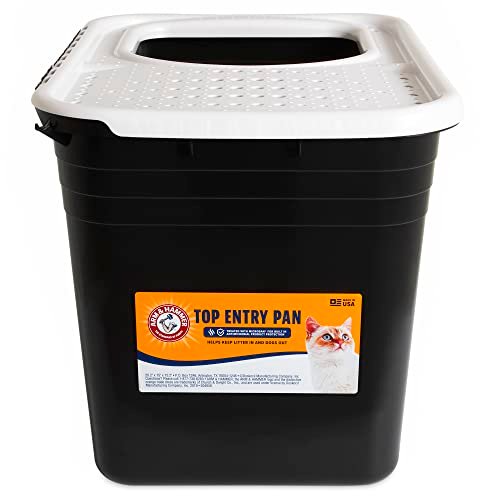
Pick this one if smell is your main headache. Microban protection is built into the plastic, and it works against the bacteria that cause odor. That won’t replace scooping, but it gives you a head start. The top entry is wide, so bigger cats fit more comfortably than in some rivals, and the grated lid brushes litter off paws on the way out. Walls are high, giving your cat privacy. It’s also made from recycled materials, which matters to some buyers.
It works with pine, crystal, and clumping litter, so you don’t have to change what your cat already likes. The proportions follow the standard rule that a litter box should be about 1.5 times your cat’s body length. One catch: the maker recommends replacing the box every twelve months to keep odor down, since plastic absorbs smells over time. Budget for that. Even so, for an affordable box with real odor protection, it’s a solid pick.
How This Can Solve Your Problem
- ✓ Microban protection actively inhibits growth of odor-causing bacteria
- ✓ Compatible with various litter types including pine and crystal
- ✓ Eco-friendly construction uses recycled materials for sustainability
Important Considerations
- • Requires a 12-month replacement cycle for maximum hygiene
- • Ensure your cat is comfortable jumping into top-entry boxes
- • Size is optimized for most cats but check specific dimensions
|
5
|
IRIS USA Large Top Entry Cat Litter Box, Hooded Privacy, Beige/White |
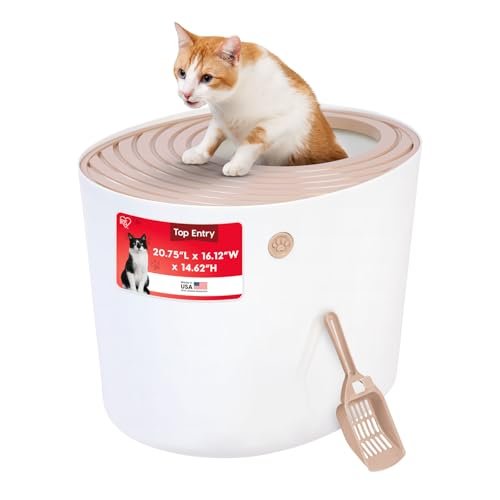
This is the two-tone version of the IRIS large box, and it looks a bit nicer than most litter boxes do. The top entry cuts down on spillage, and the tall walls keep sprayed urine inside. Grooves in the lid pull litter off your cat’s paws as it exits. Because the space is enclosed, odors stay lower, and cats get a secluded spot that tends to keep them calm.
A matching scoop and hook are included, so cleanup gear stays with the box. There’s enough interior room for a cat to move around, without the sprawl of a traditional large pan. That balance suits smaller apartments. The plastic is durable, and most cats adapt quickly to the top entry. Other pets can’t get to the litter, which keeps things tidier for everyone.
How This Can Solve Your Problem
- ✓ Grooved lid effectively captures particles to prevent floor tracking
- ✓ Enclosed design provides essential privacy and odor control
- ✓ Includes a convenient scoop hook for organized storage
Important Considerations
- • Larger dimensions may require more floor space than expected
- • Top-entry style requires a brief adjustment period for some cats
- • Regular scooping is needed to keep the enclosed space fresh
How to Get Your Cat to Use a Top Entry Litter Box (Step by Step)
Buying the box is the easy part. Getting your cat to trust it takes a plan. Where you put it and how slowly you switch matter more than the brand, so follow these steps in order.
- Pick a quiet spot. Choose a low-traffic corner where your cat won’t be startled. A busy hallway is a bad idea.
- Keep the old box. Set the new one next to it and leave both out. Don’t remove the old box until your cat is using the new one reliably.
- Use familiar litter. Fill it deep with the litter your cat already knows, ideally a quality clumping type. Changing litter and box at the same time doubles the risk of rejection.
- Lure, don’t lift. If your cat hesitates, put a few treats on the lid, or gently guide it up. Never push a cat in.
- Reward the first visits. A calm word or a treat after a successful trip helps the box feel like a good place.
- Scoop daily. Enclosed boxes trap smell, and a dirty one is the fastest way to lose a cat that was just getting comfortable.
- Remove the old box last. Once your cat has used only the new one for several days, take the old one away. Most cats settle in within a few days, though shy ones can take longer.
Setup and Care Tips That Help It Work
- Placement: Choose a quiet, low-traffic area where your cat feels safe and undisturbed.
- Transition: If your cat is used to an open box, keep both for a few days to encourage the switch.
- Litter Choice: Use high-quality clumping litter to make the top entry vs front entry decision easier, since clumps are simpler to scoop through a lid opening and trap waste better.
- Scooping Routine: Consistent daily cleaning prevents odors from building up inside the enclosed space.
- Lid Maintenance: Regularly wipe down the lid grooves so they keep catching litter particles.
- Cat Comfort: Make sure your cat can turn around completely inside without touching the walls.
- Dog Deterrence: Put the box where a cat can reach the lid easily but a larger dog can’t get at it.
- Deep Cleaning: Once a month, empty the entire box and wash it with mild soap.
Top Entry Litter Box for Kittens, Senior Cats, and Arthritic Cats
These are the groups that ask us most often, and the answer is usually “wait” or “use something else.” Here’s how to handle each.
Kittens
Very young kittens can’t jump high or land reliably. Start them on a shallow, low-sided pan and move to a top entry box once they’re jumping onto furniture with ease, typically after the first several months.
Senior Cats and Arthritis
Older cats are where top entry boxes fail most often. Jumping in strains sore joints, and landing on loose litter can hurt too. Arthritis often goes unnoticed, so a cat that “seems fine” may still be uncomfortable. Signs include hesitating at the entry, jumping out fast, or peeing beside the box. Three fixes, in order of effort:
- Place a sturdy step, low bench, or stable stool beside the box so your cat steps up instead of jumping.
- Switch to a low entry or hooded side-entry box that keeps odor control without the vertical climb.
- Ask your vet about joint pain. A cat that suddenly avoids its box may be hurting, and a vet can help with more than a litter box swap.
Multi-Cat Homes
You can mix styles. A three-year-old may love the privacy of a top entry box while a fourteen-year-old housemate needs a low entry pan. The usual rule of one box per cat, plus one extra, still applies. Put the boxes in different spots so one cat can’t guard them all.
Top Entry vs Front Entry Litter Box
Neither style wins across the board. Top entry contains mess better. Front entry is easier on the joints. Here’s how they compare, and our longer breakdown of top entry vs front entry litter boxes goes further.
| Feature | Top entry | Front entry |
|---|---|---|
| Litter tracking | Lower, thanks to the lid | Higher |
| Spray containment | Good | Depends on wall height |
| Dog access | Harder for dogs to reach | Easy for dogs |
| Senior and arthritic cats | Poor fit | Better fit |
| Kittens | Poor fit | Better fit |
| Big cats | Needs a roomy interior | Usually easier |
| Scooping | Lid comes off first | Often quicker |
| Footprint | Compact and vertical | Wider |
If you want less scooping and sweeping and you’d rather automate cleanup, a smart litter box is a different route worth looking at. It’s a bigger investment, and some cats find the noise off-putting.
Key Factors When Choosing a Top Entry Litter Box
Your home’s layout and your cat’s body both narrow the field. Odor control and ease of cleaning pull in opposite directions, so decide which one bothers you more before you shop.
Size and Dimensions
Measure your floor space first. A box that’s too small stresses your cat, and one that’s too large is hard to fit in. As a rule of thumb, aim for an interior about 1.5 times your cat’s body length, and check that your cat can stand and turn around without touching a wall.
Entryway Design
Check the size of the hole. Larger cats need a wider opening to get in and out without scraping. Look for a textured or grated lid, since that’s what strips litter off paws before your cat reaches carpet or hardwood. Entry height matters too: the higher the opening, the harder the jump for older cats.
Odor Management
Enclosed boxes hold smells better than open ones. Look for extras like carbon filters or odor-inhibiting materials such as Microban, and remember that none of them replace daily scooping.
Durability and Cleaning
Choose BPA-free plastic that survives frequent washing. A removable lid makes daily scooping faster. Also decide whether you want a scoop hook, since it keeps tools close and cuts down on the “where’s the scoop” search.
Top Entry Litter Box Prevention Tips
Good habits beat cleanup after the fact. A few small routines keep scatter and smell down and help your cat keep using the box.
- Use a deep layer of litter so waste doesn’t stick to the bottom of the box.
- Scoop at least once daily to keep the box clean and inviting.
- Put a small mat under the box to catch any stray litter.
- Check litter levels often and top off as needed.
- Replace the box every 12 months, since plastic absorbs odor over time.
- Vacuum or wipe the lid weekly so it keeps catching debris.
- Set the box on a level surface so waste doesn’t pool in one corner.
- If your cat hesitates, put treats on the lid to encourage the jump.
Common Mistakes With Top Entry Litter Boxes
Most refusals trace back to a handful of owner errors. Fix these and many cats come around.
Forcing the Transition
Don’t take away the old box right away. Keep it nearby until your cat is fully comfortable with the new one, or you may create a behavior problem that outlasts the box.
Ignoring the Size
A box that’s too small is the classic error. If your cat can’t turn around, it’ll probably skip the box and go somewhere else in the house.
Neglecting Scooping
An enclosed box traps odor when it’s dirty. Skip a day or two and your cat may look for a cleaner spot.
Poor Placement
A high-traffic spot puts cats on edge. They want privacy, so pick a quiet corner.
Using Incompatible Litter
Some litters don’t suit top entry boxes. If you’re still getting tracking, try a heavier, low-dust clumping litter.
Troubleshooting: What to Do If Your Cat Won’t Use It
| What you see | Likely cause | Try this |
|---|---|---|
| Cat circles the box but won’t jump in | Unfamiliar or too high | Add a step, use treats on the lid, keep the old box out. |
| Cat goes next to the box | Too small, dirty, or painful to enter | Check size, scoop more, get a vet exam. |
| Cat only uses the old box | Not ready to switch | Wait longer before removing it. |
| Litter still lands on the floor | Lid clogged or light litter | Wipe the lid, switch to heavier litter, add a mat. |
| Strong smell despite daily scooping | Old plastic or poor airflow | Deep clean monthly, replace the box if it’s over a year old. |
One warning. Avoiding the litter box can point to a medical issue, such as a urinary problem or joint pain, not just a dislike of the box. If your cat strains, cries, produces little urine, or has repeated accidents, call your vet. Don’t wait it out.
Quick Summary
- A textured lid catches debris and the enclosed design holds in odor, which suits small homes and healthy adult cats.
Get this Solution - Lid holes and a scoop hook keep floors tidy and tools close at hand.
Get this Solution - A filtered lid and BPA-free plastic cut scatter and make cleaning easy.
Get this Solution - Microban protection and recycled materials make this the pick for odor control.
Get this Solution - A large, good-looking box with a grooved lid gives your cat privacy and keeps odor in.
Get this Solution
Frequently Asked Questions
Will cats use a top entry litter box?
Most healthy adult cats will, often within a few days. Kittens, seniors with sore joints, overweight cats, and cats that feel trapped in enclosed spaces are the likely holdouts.
Do cats like top entry litter boxes?
Many do. The privacy and high walls appeal to confident, athletic cats, especially diggers. Cats that like to see their surroundings, or that are large or anxious, can find them cramped.
How long does it take a cat to get used to a top entry litter box?
Most cats adapt within a few days of consistent use. Shy or older cats can take longer. Keep the old box available throughout, and don’t rush the switch.
Are top entry litter boxes good for senior cats?
Usually not. Jumping in and landing on loose litter strains arthritic joints. A low entry box is safer. If you want to try top entry anyway, add a sturdy step and watch your cat closely.
Can kittens use a top entry litter box?
Not when they’re very young. They lack the jumping skill. Start with a low-sided pan and switch once your kitten climbs and jumps confidently.
Are top entry litter boxes good for big cats?
Only if the interior is big enough. Your cat should turn around fully without touching the walls. Measure your cat and compare it with the box’s interior dimensions before you buy.
Why won’t my cat use the top entry litter box?
Common causes are a box that’s too small, a dirty box, a busy location, an abrupt switch, or pain when jumping. If the problem started suddenly, rule out a medical issue with your vet.
Do top entry litter boxes keep dogs out?
They help a lot. The elevated opening makes it harder for most dogs to reach the litter, though a small or determined dog might still manage.
Do top entry litter boxes reduce litter tracking?
Yes. The grated or textured lid pulls litter off paws as your cat climbs out. Heavier, low-dust clumping litter and a mat underneath help even more.
Is a top entry litter box worth it?
For a healthy adult cat in a home with floor scatter or a dog, yes. It saves sweeping time and contains odor. For a senior or kitten, a low entry box is the better buy.

Written by Mishu
A passionate cat lover and indoor living enthusiast, Mishu is the founder and voice behind Indoor Living Cat – a go-to resource for cat owners who want to create the happiest, healthiest life for their feline companions indoors.
View Full Profile