
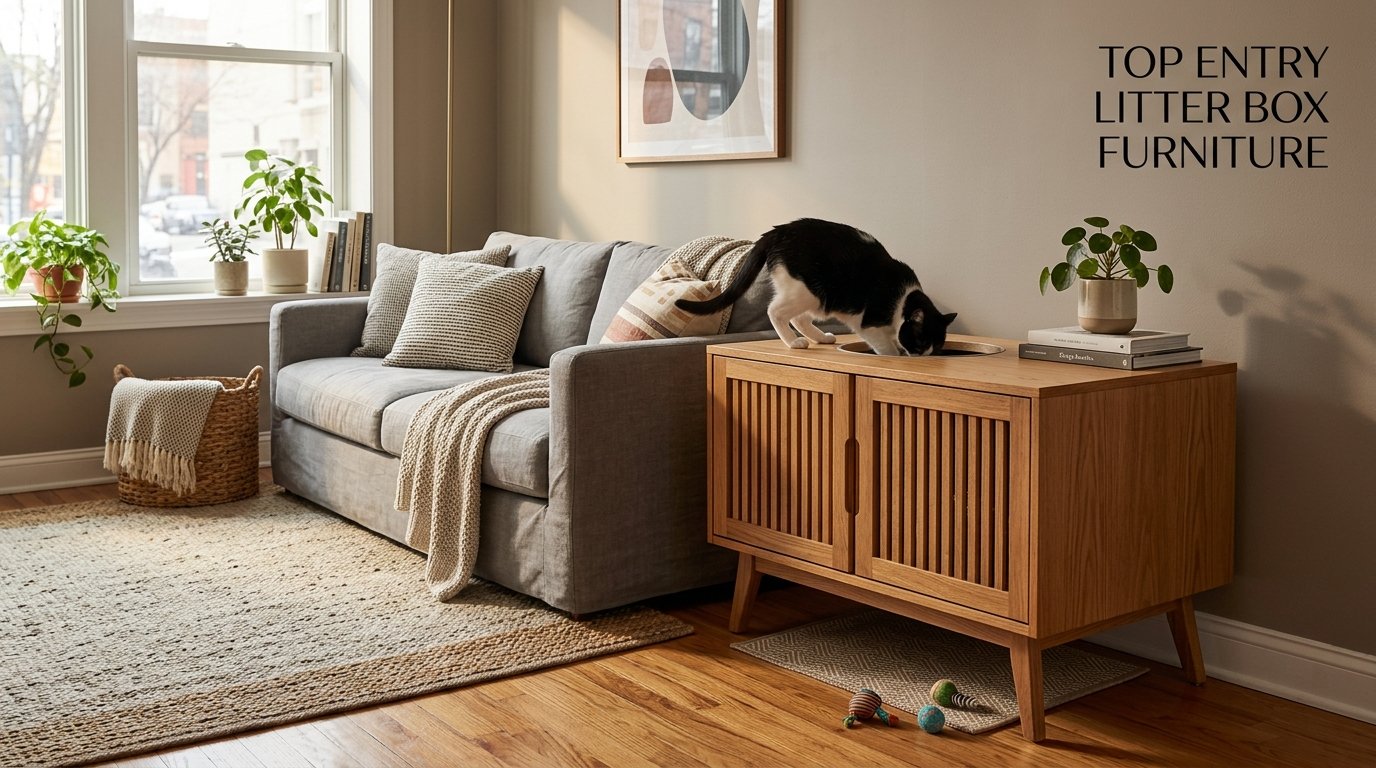
My living room floor used to crunch. Every morning, a trail of clay granules ran from the litter pan to the couch, and I swept the same three feet of hardwood twice a day. Top entry litter box furniture fixed most of that, because the cat has to climb out through a hole in the lid instead of walking straight out at floor level, and the litter drops off her paws before she lands.
I looked at six enclosures that hide a standard pan inside a cabinet, bench, or side table. Below you’ll find what each one measures inside, which litter boxes actually fit, how the lid or door opens for scooping, and where each one falls short. There’s also a sizing checklist, a training sequence for cats who refuse to jump up at first, and a short list of cats that shouldn’t use a top entry setup at all.
⏱️ Short Answer
Top entry litter box furniture is a wooden cabinet with the opening cut into the lid rather than the side. The cat jumps up, drops in, and steps back out through the same hole, so loose litter falls inside the box instead of onto your floor. It cuts tracking hard, hides the pan, and keeps dogs out. It’s a poor fit for arthritic cats, cats over about 15 pounds, and kittens under six months.
- Best overall: Amunrbrek Flip Top enclosure, for the wide lid and the sisal mat at the exit.
- Best for tall or jumbo pans: unipaws Tall enclosure, with a removable middle shelf.
- Best for two cats: MAHANCRIS two tier, 31.5 inches wide with a ramp.
- Measure first: your pan needs about 2 inches of clearance on every side, and the entry hole should be 8 inches across or wider.
⚡ Quick Verdict
List of Top Entry Litter Box Furniture
| Image | Product | Score | Link |
|---|---|---|---|
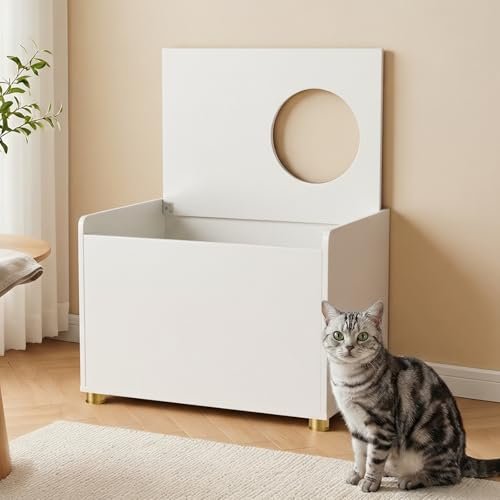 |
Amunrbrek Top Entry Litter Box Enclosure, Flip Top with Scra 🏆 Editor’s Pick |
9.4/10 | View on Amazon Free Shipping & 30-Day Returns |
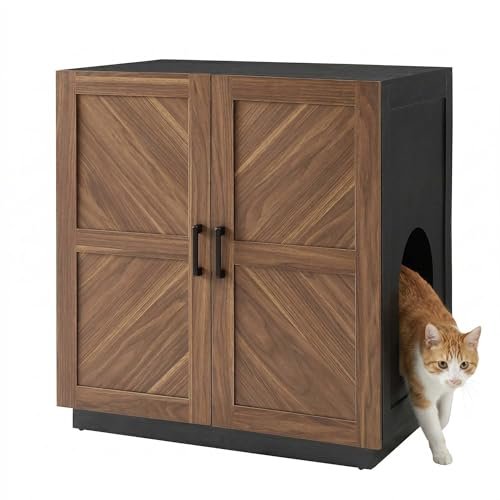 |
unipaws Tall Cat Litter Box Enclosure for Tall or Top Entry 🥈 Runner-Up |
9.2/10 | View on Amazon Free Shipping & 30-Day Returns |
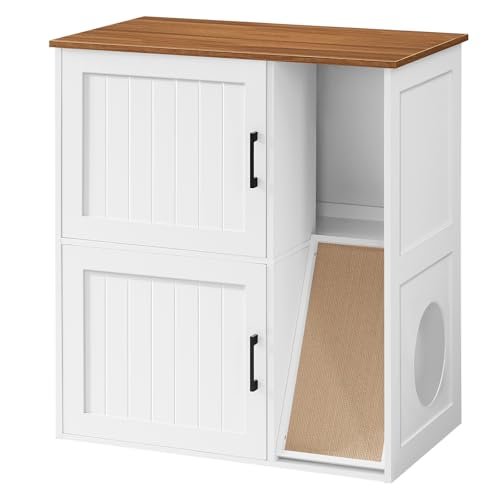 |
MAHANCRIS Litter Box Enclosure for 2 Cats, Hidden Litter Box 💰 Best Value |
9.1/10 | View on Amazon Free Shipping & 30-Day Returns |
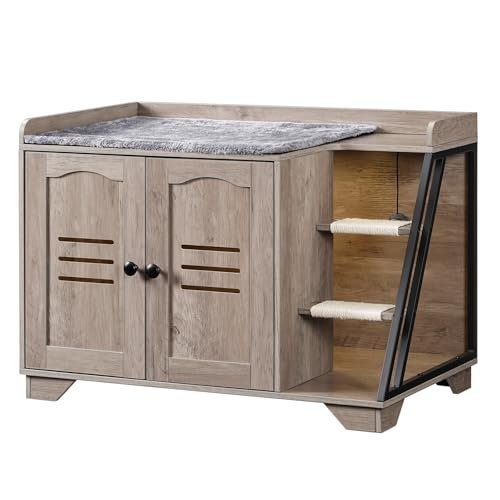 |
HOOBRO Cat Litter Box Enclosure with Ladder, Hidden Litter B | 8.5/10 | View on Amazon Free Shipping & 30-Day Returns |
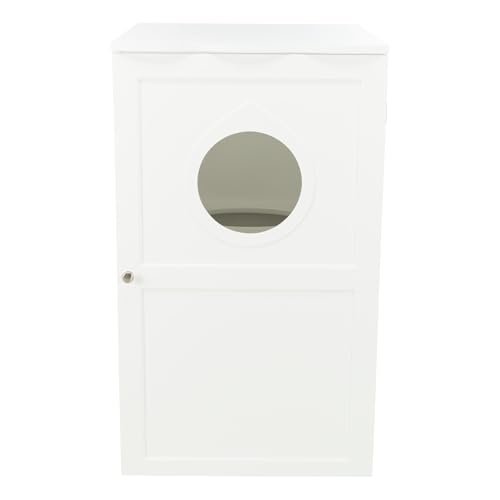 |
Trixie 2 Story Furniture Litter Box Enclosure (White), Hidde 🏠 Best for Small Spaces |
8.2/10 | View on Amazon Free Shipping & 30-Day Returns |
 |
Evermagin 31.5″ Cat Litter Box Enclosure Furniture 🐈 Best for Big Cats |
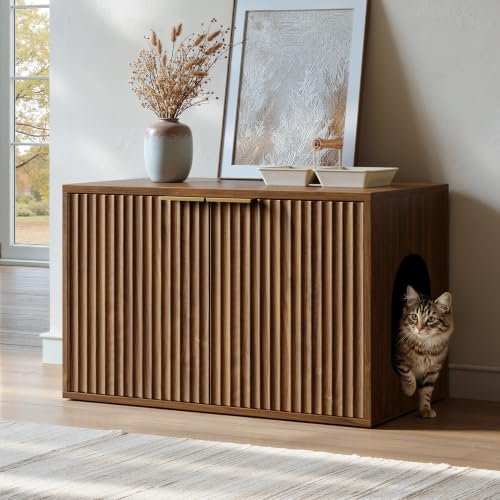
7.9/10 | View on Amazon Free Shipping & 30-Day Returns |
Specs at a Glance: Size, Access, and Who It Suits
| Model | Exterior (in) | Access for scooping | Entry style | Best for |
|---|---|---|---|---|
| Amunrbrek Flip Top | 26.8 x 19 x 19.2 | Full flip top lid | Top entry | One cat, heavy trackers, bad knees |
| unipaws Tall | Tall two tier | Front doors | Dual side entry | Tall or top entry pans, supply storage |
| MAHANCRIS 2 Cats | 31.5 x 19.7 x 35.4 | Front doors, two levels | Side entry plus ramp | Two cats, small footprint |
| HOOBRO with Ladder | 31.5 x 18.9 x 22.4 | Shutter door, LED lit | Side entry plus ladder | Dark corners, cats that like to climb |
| Trixie 2 Story | 23.5 x 20.75 x 35.25 | Magnetic front door | Upper deck hole | Apartments, narrow corners |
| Evermagin Fluted | 31.5 x 18.1 x 19.7 | Lift top panel | Reversible side entry | Large breeds, dog proofing |
Dimensions come from current manufacturer listings. Measure your own pan before ordering, since brands round differently and a half inch decides whether the lid closes.
📋 How We Evaluated These Enclosures
I run two cats at home, an 11 pound shorthair who digs like she’s burying evidence and a 9 pound senior. Everything here was judged on five things, in this order:
- Fit. Interior dimensions checked against the four most common pan sizes, including jumbo and top entry pans.
- Scooping access. Can you reach the whole pan without kneeling or pulling the box out?
- Airflow. Vent area, door gaps, and whether the interior traps ammonia between scoops.
- Build. Panel material, base construction, and the parts owners report failing first (hinges, base corners near the pan).
- Owner feedback patterns. Recent one star and three star reviews, which is where assembly and durability complaints live.
Rankings aren’t influenced by affiliate payouts. Where I haven’t personally used a model, I say so in the review.
Detailed Reviews
Amunrbrek Top Entry Litter Box Enclosure, Flip Top with Scra🏆 Editor’s Pick
| Exterior | 26.8L x 19W x 19.2H |
| Interior | 25.5L x 17.7W x 15.7H |
| Material | Wood Composite |
| Access | Flip Top |
| Fits pans up to | About 24L x 16W x 15H |
| Assembly | 30 to 45 minutes, tools included |
What We Found
This one does the single job that matters most. The cat exits through the lid, lands on the sisal mat, and whatever clings to her paws stays on the mat instead of the rug. My sweeping dropped from twice a day to a quick pass every other day.
Scooping is the other win. The whole lid flips up, so you stand, scoop the full pan, and drop the lid. No reaching sideways through a 10 inch door, no pulling the pan out onto the floor. There’s a small side port for tipping waste out too, which saves a trip when you’re just grabbing clumps.
The white finish reads as a modern side table from across the room, and the 19.2 inch height puts it in the right zone next to a sofa. Two cautions. It’s built from P2 rated particle board with a laminate skin, so standing water at the base will swell the corners over a year or two, and owner reviews cluster on hinge loosening somewhere around month eight to twelve. Both are fixable: a plastic tray liner under the pan handles the first, a screwdriver and a drop of threadlocker handles the second.
💬 My Take
If your main complaint is litter on the floor and your back hurts when you scoop, this is the one. Add a liner tray on day one and tighten the hinge screws at the six month mark.
Who It’s For
Owners of one healthy adult cat who kicks litter everywhere. Anyone with knee or back pain, because the top access removes the crouch entirely. It also suits people who already use a top-entry pan and want the furniture look around it.
Skip it if your cat is over 12 years old, carries more than about 15 pounds, or has been diagnosed with arthritis. The climb in and the landing on shifting litter are both harder than they look.
✅ Pros
- Top exit plus sisal mat catches litter before it reaches the floor.
- Full flip top lid means scooping standing up, not kneeling.
- Side litter port for quick waste removal between deep cleans.
- Converts an ordinary open pan into a top entry setup, so no new box needed.
❌ Cons
- Particle board base swells if urine or water sits on it.
- Hinge screws work loose after roughly a year of daily lifting.
- 15.7 inch interior height is tight for a Maine Coon or a 16 pound cat.
- White laminate shows dust and paw smudges.
unipaws Tall Cat Litter Box Enclosure for Tall or Top Entry 🥈 Runner-Up
| Design | Tall/2-Tier |
| Extras | Removable Shelf |
| Base | Solid Plinth |
| Entries | Dual-Side |
| Takes | Tall, jumbo, or top entry pans |
What We Found
Most cabinets are built around a short open pan, which is why a top entry box or a high sided jumbo won’t close the lid. This one is built tall on purpose. If you already own a Modkat, an IRIS top entry, or a 12 inch high sided pan, this is the enclosure that swallows it.
Take the middle shelf out and you get one tall chamber. Leave it in and the upper half stores a 20 pound litter jug, the scoop, and a roll of waste bags, which is the difference between a tidy corner and a cluttered one. The plinth base sits flush to the floor, so litter doesn’t scoot underneath where you can’t reach it with a broom.
Two side openings matter more than they sound in a multi cat home. A cat that can see a second exit is far less likely to get cornered by a housemate, which is one of the real causes of a cat quitting the box. The chevron wood grain and matte black frame look like furniture, not a pet product. The cost is price and assembly time, roughly an hour with the interior panels.
💬 My Take
Buy this one if you already own a tall pan you like. It’s the only pick here that doesn’t force you to downsize the box to fit the furniture.
Who It’s For
Owners of tall or top entry pans who keep striking out on fit. People who want litter, scoop, and bags stored in the same piece instead of in a closet down the hall. Homes with two cats that have any history of guarding the box.
It’s the wrong buy if you want the cheapest way to hide a standard pan. You’re paying for height and storage you may not need.
✅ Pros
- Takes tall, jumbo, and top entry pans that don’t fit standard cabinets.
- Removable shelf turns the upper half into litter storage.
- Two entries reduce ambush risk in two cat homes and improve airflow.
- Flush plinth base stops litter from sliding underneath.
❌ Cons
- Costs more than a single tier cabinet of the same width.
- Matte black frame shows fingerprints and cat hair.
- About an hour to assemble because of the interior panels.
- Taller silhouette blocks more sightline than a bench style unit.
MAHANCRIS Litter Box Enclosure for 2 Cats, Hidden Litter Box💰 Best Value
| Dimensions | 31.5L x 19.7W x 35.4H |
| Capacity | 2-Tier/2 Cats |
| Features | Sloping Ramp |
| Style | Farmhouse |
| Footprint | 4.3 sq ft of floor, vertical storage |
What We Found
Two cats need two boxes. The standard rule is one box per cat plus one spare, and most people in an apartment can’t give up that much floor. Stacking solves it. This unit holds two stations in the footprint of one, about 31.5 by 19.7 inches on the ground.
The ramp to the upper level is wrapped in scratch material, so it earns its keep twice. Side openings on both tiers keep air moving, which matters a lot once you’ve got two cats filling the same cabinet. Assembly parts are numbered and the instructions are clear, though the two tier build runs closer to an hour than half an hour.
One honest limit: this is a side entry cabinet with a ramp, not a true top entry design. Tracking control comes from the enclosure and the ramp surface rather than a lid hole. If cutting tracking is your only goal, pick number one. If you need two boxes hidden in one corner, pick this.
💬 My Take
The best way to get two boxes into a small apartment without giving up a wall. Expect to scoop both levels daily, because two cats in one cabinet load up fast.
Who It’s For
Two cat households short on floor space. Owners who want a private upstairs nook where one cat can retreat from the other. Anyone who likes the white and walnut farmhouse look that reads as a console rather than a cat box.
Not the right call for a senior cat who can’t handle the ramp, or for a single cat who only needs one station.
✅ Pros
- Two litter stations in the floor space of one.
- Scratch wrapped ramp doubles as a claw station.
- Top surface holds a lamp, plant, or basket.
- Openings on both levels keep air moving.
❌ Cons
- Side entry, so tracking control is weaker than a true top entry lid.
- Upper tier is out of reach for arthritic or overweight cats.
- Two tier assembly takes close to an hour.
- Two cats in one cabinet means daily scooping, not every other day.
HOOBRO Cat Litter Box Enclosure with Ladder, Hidden Litter B
| Dimensions | 31.5L x 18.9W x 22.4H |
| Features | LED Lighting |
| Style | Vintage/Rustic |
| Extras | Teaser Balls |
| Ventilation | Louvered shutter panels |
What We Found
The louvered shutter panels are the real feature here, not the lights. Slatted sides move air through the cabinet continuously, which is the difference between a box that smells at hour 20 and one that doesn’t. If you’ve ever opened a sealed enclosure and stepped back, you know the problem this solves.
The rechargeable LED strip comes in three color temperatures and helps if the cabinet lives in a dark hallway or you scoop at night. It’s a convenience, not a reason to buy. The sisal ladder and the plush top mat turn the cabinet into a perch, which my cat treated as her main daytime spot within about a week.
The greige finish with shutter accents leans cottage and farmhouse. In a stark modern room it’ll look out of place. The plush mat also collects hair and needs a vacuum pass every week or it starts looking grubby.
💬 My Take
Buy it for the ventilation. The LED is a nice extra if the cabinet sits somewhere dark, and the ladder gives the cat a reason to like the thing.
Who It’s For
People whose main complaint is odor rather than tracking. Homes with a cottage, rustic, or transitional look. Cats that like to climb and perch, since the ladder and top mat give them somewhere to be.
Skip it in a minimalist room, and skip it if you hate vacuuming fabric.
✅ Pros
- Shutter sides give the best airflow of the six, so odor builds slower.
- Rechargeable LED in three color temperatures for night scooping.
- Sisal ladder and top mat turn the cabinet into a perch.
- Numbered parts keep assembly straightforward.
❌ Cons
- Slatted sides let a little more litter escape than solid panels.
- Plush mat needs weekly vacuuming to stay presentable.
- Greige rustic finish clashes with minimalist rooms.
- More parts and steps than a plain bench enclosure.
Trixie 2 Story Furniture Litter Box Enclosure (White), Hidde🏠 Best for Small Spaces
| Dimensions | 23.5D x 20.75W x 35.25H |
| Interior | 22D x 19W |
| Access | Front Door |
| Levels | Two |
| Floor space used | About 3.4 sq ft |
What We Found
At 23.5 by 20.75 inches on the floor, this is the smallest footprint in the group, and it builds upward instead of outward. In a studio or a narrow hallway, that’s the whole argument. The top surface sits at 35 inches, which is standard console height, so it works beside a bed or inside an entryway.
The front door closes with a magnet and swings wide for scooping. The cat enters through a hole in the upper deck and drops into the lower chamber, which gives you top entry behavior with front door cleaning. Side vent holes handle airflow.
Two things to weigh. The interior is 22 by 19 inches, so a jumbo pan won’t fit and a large cat won’t have much turning room. And magnetic catches on budget cabinets tend to go soft after a couple of years of daily opening. A small cabinet latch is a five dollar fix if that happens.
💬 My Take
The right answer when floor space is the binding constraint and your cat weighs under about 12 pounds. Anything bigger and the interior gets cramped.
Who It’s For
Apartment and studio dwellers who need the piece to work as a nightstand or entry console. Owners who prefer a front door for scooping rather than lifting a lid. Traditional and transitional rooms where a white two story cabinet blends in.
Not for large breeds, and not for anyone who wants to keep a jumbo pan.
✅ Pros
- Smallest floor footprint here at roughly 3.4 square feet.
- Wide front door makes daily scooping quick.
- 35 inch top works as a nightstand or entry console.
- Upper deck hole gives the tracking benefit of a top entry.
❌ Cons
- 22 by 19 inch interior rules out jumbo pans.
- Magnetic catch can weaken with years of daily use.
- Needs 35 inches of vertical clearance, so not for under a shelf.
- Tight turning room for cats over about 12 pounds.
Evermagin 31.5″ Cat Litter Box Enclosure Furniture🐈 Best for Big Cats
| Exterior | 31.5L x 18.1W x 19.7H |
| Max Box Size | 28.3L x 16.9W x 18.6H |
| Finish | Walnut |
| Design | Fluted |
| Entrance | Reversible, left or right |
What We Found
A 28.3 by 16.9 inch pan clearance is the largest here by a wide margin. That’s a jumbo pan with room left over, which matters if you’ve got a Maine Coon, a Ragdoll, or a cat that hangs its rear over the edge of a standard box.
The reversible entrance panel lets you put the opening on either end, so you can push the long side against a wall and still have the cat walk in from the room. That one detail saved me from returning it when my first placement plan didn’t work.
The fluted walnut front looks more expensive than it is, and at 19.7 inches high it takes a tray, a lamp, or a coffee cup. Two real weaknesses: there’s no dedicated ventilation beyond the entry opening, which means odor lingers if you skip a day, and the interior is one open cavity with no divider for scoop or bags. Vents you can add yourself with a hole saw, though that voids your return window.
💬 My Take
The pick for big cats and dog proofing. Commit to daily scooping, because the airflow won’t cover for you.
Who It’s For
Owners of large breeds who need real interior room. Multi pet homes where a dog raids the litter box, since the solid sides and single opening keep most dogs out. Anyone who wants a bench or low console in walnut that hides the pan in plain sight.
Not for people who scoop every other day. This cabinet punishes that.
✅ Pros
- Takes pans up to 28.3 x 16.9 inches, the roomiest here.
- Reversible entrance works with either room layout.
- Solid sides keep most dogs out of the litter.
- Doubles as a bench or low console at 19.7 inches high.
❌ Cons
- No vents beyond the entry hole, so odor lingers if you skip a scoop.
- Fluted walnut surface scratches and needs a soft cloth, not a scrubber.
- One open cavity with no divider for supplies.
- Side entry, so it tracks more than a true top entry lid.
Top Entry vs Front Entry vs Side Entry Enclosures
Entry style is the decision that changes your daily life, more than finish or brand. Here’s how the three compare on the things you’ll actually notice.
| Factor | Top entry | Front or side entry | Two tier with ramp |
|---|---|---|---|
| Litter tracking | Best. Litter falls off on the way out | Moderate. Needs a mat outside the door | Moderate. The ramp catches some |
| Senior or arthritic cats | Poor. Jump up plus drop down | Best. Walk in at floor level | Fair on lower tier only |
| Scooping comfort | Best with a flip lid, stand and scoop | Usually means kneeling | Mixed, two doors to open |
| Dog proofing | Best. Most dogs can’t get through a lid hole | Weak against small dogs | Good if the box is upstairs |
| Odor control | Needs vents. A sealed lid traps ammonia | Open doorway helps air move | Good, two openings |
| Kittens under 6 months | No | Yes | Lower tier only |
If you want the longer breakdown of the pan itself rather than the cabinet, we covered a specific top-entry comparison separately.
Which Cats Should Not Use Top Entry Furniture
This is the part most buying guides leave out, and it’s the reason a lot of these cabinets get returned. Top entry solves a human problem. For some cats it creates a physical one, and a cat that hurts getting into the box will stop using the box.
| Cat profile | The problem | What to use instead |
|---|---|---|
| Seniors, 11 years and up | Joint degeneration is common in older cats and often undiagnosed. The landing on loose litter jars painful elbows and hips | Low entry pan, lip under 4 inches, inside a front door cabinet |
| Cats over about 15 pounds | Not enough room to turn and squat inside a standard cabinet, plus a harder climb | XL open pan in a wide, low enclosure |
| Kittens under 6 months | Coordination isn’t there yet, and a failed climb during training causes avoidance | Open low pan until about 8 months, then transition |
| Cats recovering from surgery | Temporary mobility limits, and incisions don’t like jumping | Low entry pan until your vet clears normal activity |
| Vertical sprayers | Urine finds the seams where the lid meets the cabinet and soaks the board | High sided seamless pan, liner tray under it |
Mixed age household? Run both. One top entry cabinet for the younger cat and one low entry pan for the senior. That’s more litter boxes, which you want anyway, and it removes the choice your senior cat would otherwise make by peeing on the rug. If your cat suddenly stops using a box it used to like, that’s a vet visit, not a furniture problem.
Measure Before You Buy: A 5 Point Checklist
Most one star reviews on litter box furniture are fit problems, not quality problems. Ten minutes with a tape measure prevents almost all of them.
- Measure your pan at its widest point, including the rim lip, not the base. Add 2 inches to length and width. That’s your minimum interior.
- Measure your pan’s height and compare it to the interior height. A 12 inch high sided pan won’t fit a cabinet with 15.7 inches of interior clearance if the lid hardware hangs down.
- Measure your cat nose to tail base. The pan should be at least 1.5 times that length. If your current pan already fails that test, buy the bigger pan first and the cabinet second.
- Check the entry hole diameter. Under 8 inches is tight for an average adult cat. Under 7 inches and larger cats will refuse.
- Check clearance around the unit. Front doors need 18 to 20 inches of swing, and a top entry lid needs headroom above it, which rules out a spot under a floating shelf.
Common Pan Sizes and What They Need
| Pan type | Typical size (in) | Minimum interior needed |
|---|---|---|
| Standard open pan | 18 x 14 x 5 | 20 x 16 x 10 |
| Large open pan | 22 x 17 x 6 | 24 x 19 x 11 |
| High sided pan | 24 x 18 x 11 | 26 x 20 x 15 |
| Jumbo pan | 27 x 19 x 7 | 29 x 21 x 12 |
| Top entry pan | 21 x 15 x 15 | 23 x 17 x 19, tall cabinet only |
How to Train a Cat to Use a Top Entry Enclosure
Some cats hop in on day one. Most take a week. A few need two. The mistake that causes refusal is swapping the old box out overnight, because a cat that can’t find its bathroom picks a new one, usually a rug.
- Days 1 to 3. Assemble, don’t relocate. Put the new enclosure next to the existing box with the lid off or the door open, and the old box still fully usable. Let the cat walk through, sniff, nap on it.
- Days 4 to 6. Move the pan in, lid still off. Transfer the old pan into the cabinet with its existing litter, including a scoop of used litter. The familiar scent does most of the work.
- Days 7 to 9. Put the lid on. Some units let you set the top panel at a lower height first. If yours doesn’t, prop a sturdy step or a low stool at the entry so the climb is two short hops instead of one tall one.
- Days 10 to 12. Remove the backup. Once you’ve seen three or four confirmed uses of the new setup, take the old box away. Don’t do this earlier.
- Day 13 onward. Move it, slowly. If the final spot is elsewhere, shift the cabinet about 3 feet a day rather than carrying it across the house in one go.
Tip: keep the litter depth at 2 to 3 inches inside a top entry setup. Deeper litter means more drag on the climb out and more scatter inside the cabinet, and it makes clumps harder to find when you scoop through the lid.
If the cat still refuses after two weeks, the problem is usually the hole size, the litter depth, or the location. Cabinets in noisy laundry rooms next to a washer get rejected a lot.
Keeping a Hidden Litter Box From Smelling
An enclosure hides the box from your eyes and from the air at the same time. That’s the tradeoff. Ammonia concentrates inside a wooden cabinet far faster than it does around an open pan, and the cat notices before you do.
A Cleaning Schedule That Works
| How often | What to do |
|---|---|
| Daily | Scoop once, twice with two cats. Shake the lid mat out. |
| Weekly | Top up litter to 2 to 3 inches. Wipe interior walls with a damp cloth. Vacuum any fabric mat. |
| Monthly | Dump the pan, wash with unscented dish soap, dry fully before refilling. Check hinges and screws. |
| Every 6 months | Pull the pan out, inspect the cabinet base for swelling or stains, tighten all hardware. |
Odor Fixes Ranked by How Much They Help
- Scoop daily. Nothing else on this list comes close.
- Add ventilation. If your cabinet has solid sides, a couple of 2 inch holes drilled high on the back panel move a surprising amount of air.
- Use a hard clumping, unscented litter. Clumps you can lift whole leave less behind. Scented litters mask odor for you and put cats off.
- Line the base. A cheap plastic boot tray under the pan catches misses and protects the particle board, which is what actually holds the smell long term.
- Skip air fresheners inside the cabinet. Cats avoid strongly scented boxes. Baking soda mixed into the litter is the safe version.
- Don’t put it in a closet. No airflow, no chance.
Troubleshooting: Common Problems and Fixes
| Problem | Likely cause | Fix |
|---|---|---|
| Cat won’t go in | Hole too small, climb too tall, or moved too fast | Add a step at the entry, go back to the lid off stage for a week |
| Still tracking litter | Litter too deep, or lightweight litter that clings to fur | Drop to 2 inches, switch to a heavier clumping clay, put a mat at the landing spot |
| Smells within a day | No airflow, or urine soaked into the cabinet floor | Add vent holes, add a liner tray, seal the interior base with a pet safe sealant |
| Lid or door sags | Hinge screws backing out of particle board | Tighten, or move up one screw size and add a drop of wood glue in the hole |
| Cat pees over the edge | Pan sides too low for a vertical sprayer | Swap in a high sided pan, or tape a plastic shield to the interior wall |
| Base swelling at corners | Moisture in particle board | Liner tray from day one. Once swollen, it doesn’t go back |
What to Look For Before Buying
Once fit is sorted, four things separate a cabinet you keep from one you list on Marketplace in six months.
Interior Space and Entry Height
A cat needs to turn a full circle inside the pan without touching the walls. Cramped boxes are one of the main reasons cats go outside the box. Check the internal dimensions against the table above, and check how high the entry sits off the floor. Anything over 18 inches is a real jump for a cat that isn’t young and fit.
Ventilation
Look for shutter panels, side vents, or two openings. Air has to enter one place and leave another, so a single hole in a sealed box does almost nothing. If you fall for a solid sided cabinet anyway, plan on drilling a few holes high on the back where nobody sees them.
Ease of Cleaning
You’ll open this thing 400 times a year. Flip top lids and wide front doors win. Units that need the pan dragged out onto the floor before you can scoop lose, because you’ll skip days, and skipped days are how a cat starts using the laundry pile.
Materials and Moisture
Nearly everything in this price range is MDF or particle board with a laminate or veneer skin. That’s fine on the sides and lid. The floor is where it fails, because urine and spilled water swell the board from the inside and the smell stays. Solid wood and sealed plywood hold up better and cost two to three times more. Either way, a plastic liner tray under the pan is the cheapest insurance you can buy. Check the hinges too, since soft close hardware lasts longer than a bare friction hinge.
Where to Put It
Quiet, low traffic, and easy for the cat to reach without passing a dog or a noisy appliance. Not next to the food bowls. Not in a closet with the door shut. On the same floor the cat spends its day on, because a senior cat won’t take the stairs at 3am.
Frequently Asked Questions
Do cats actually like top entry litter boxes?
Healthy adult cats between about one and ten years old usually take to them, because the enclosed space feels private and they already jump on counters for fun. Cats that dislike them tend to be older, heavier, or nervous about entering a space with one exit. Introduce it gradually and you’ll know within two weeks.
Will my cat use an enclosed litter box?
Most do. Set the enclosure next to the old box first, then move the old pan inside it with a scoop of used litter for scent, and only remove the backup box after you’ve seen the cat use the new one several times. Make sure the opening is wide enough, at least 8 inches across for an average adult.
How much does top entry litter box furniture cost?
Laminate over particle board runs roughly 90 to 170 dollars. Tall two tier units with storage sit around 150 to 250. Solid wood or veneered plywood from smaller makers starts near 300 and climbs past 600. Prices move, so treat these as bands rather than quotes.
Does top entry really stop litter tracking?
It cuts it hard, it doesn’t end it. Litter still comes out on fur and between toes. Pair the enclosure with 2 inches of heavier clumping litter and a mat where the cat lands, and most people find they sweep once every few days instead of daily.
How do I control odors in an enclosure?
Scoop daily, use unscented clumping litter, and make sure air can move through two openings rather than one. Baking soda mixed into the litter helps. Skip scented sprays and deodorizer pucks inside the cabinet, since strong smells push cats away from the box.
Can these enclosures fit any size litter box?
No. Compare the interior dimensions of the cabinet to the exterior of your pan and leave about 2 inches of slack on each side. Jumbo and top entry pans need a tall enclosure built for them, like the unipaws model above. High sided pans are the ones people get wrong most often, because the height, not the footprint, is what fails.
How many litter boxes do I need for two cats?
Three, under the widely used rule of one per cat plus one spare. If floor space won’t allow that, a two tier enclosure like the MAHANCRIS gets you two stations in one footprint, and you can put the third in a bathroom or utility corner.
Does litter box furniture keep dogs out?
A top entry lid stops most dogs, since they can’t climb through a hole in a raised panel. Side entry cabinets stop medium and large dogs but not terriers and small breeds, who fit through the same opening the cat uses. If you have a small dog, top entry is the one that works.
Are top entry boxes bad for senior cats?
For most cats over 11, yes. Joint disease is common in older cats and often goes undiagnosed until behavior changes. The climb is one problem and the landing on unstable litter is the bigger one. Use a low entry pan under 4 inches at the lip, and put it inside a front door cabinet if you still want it hidden.
Are these enclosures difficult to assemble?
Plan on 30 to 60 minutes for a single tier bench and closer to an hour for two tier units with interior panels. Parts are numbered and most kits include the hex key. A second pair of hands makes the panel alignment faster and stops you from cross threading the cam locks.
Do I need a special litter box for these units?
Usually not. A flip top cabinet converts an ordinary open pan into a top entry setup, which is the cheapest route. You only need a dedicated top entry pan if you choose a specific top-entry model built around one. High sided pans are worth it if your cat kicks litter or sprays vertically.
Can I build litter box furniture myself?
Yes, and plenty of people convert a cheap cabinet by cutting an 8 inch hole in the top or side with a hole saw. Two things to get right: seal the interior base so urine can’t soak into raw board, and sand the cut edge smooth so nobody snags a paw. A DIY build saves money but rarely looks as clean as the laminate finishes on the units above.
Where should I put a litter box cabinet in an apartment?
A quiet corner of the living room or bedroom beats a bathroom with the door usually closed. Avoid spots beside a washing machine, a furnace, or the food bowls. Keep at least a foot of clearance behind the unit for airflow, and make sure the cat’s route to it doesn’t pass a dog bed.
🎯 Final Verdict
The Amunrbrek Top Entry Litter Box Enclosure wins because it does the two things you bought this furniture for: it keeps litter off the floor and it lets you scoop without kneeling. The particle board base needs a liner tray and the hinges need a tighten once a year, and with those two habits it holds up.
If you already own a tall or top entry pan, buy the unipaws instead and keep the box you like. Two cats in a small apartment, take the MAHANCRIS. A cat over 15 pounds, the Evermagin, and scoop it daily. A cat over 11 years old, none of these. Get a low entry pan and hide it behind a front door cabinet.
Measure your pan and your cat before you order. That single step prevents most of the returns in this category.
About This Guide
Written by the Indoor Living Cat editorial team, who have kept indoor cats for over a decade and have set up, cleaned, and returned more litter enclosures than we’d like to admit. Picks combine hands on use, manufacturer specifications, and patterns in recent owner reviews. Where a model hasn’t been used personally, the review says so.
Nothing here replaces veterinary advice. If a cat suddenly stops using a litter box it previously used, see a vet, because urinary problems and joint pain both show up that way.
Disclosure: some links on this page are affiliate links. If you buy through them we may earn a commission at no extra cost to you, and it doesn’t change which products we recommend. Last updated September 2026.

Written by Mishu
A passionate cat lover and indoor living enthusiast, Mishu is the founder and voice behind Indoor Living Cat – a go-to resource for cat owners who want to create the happiest, healthiest life for their feline companions indoors.
View Full Profile