
Feed too much and your cat gets fat. Feed too little, guess at portions, or leave a bowl of kibble out all day, and you’re setting up problems that show up years later as diabetes, arthritis, or a $2,000 vet bill. Knowing how to feed an indoor cat properly is one of the most impactful decisions you will make for your cat’s long-term health, and it’s also one of the most misunderstood parts of cat ownership.
Indoor cat feeding means giving a cat that lives exclusively inside a measured, scheduled diet that matches its actual energy needs, not the needs of a cat that hunts and patrols a yard all day. Indoor cats move less by nature, and feeding has to account for that lower burn or weight creeps on. According to the Cornell Feline Health Center, obesity is the most common preventable health problem in indoor cats, and it almost always comes down to overfeeding rather than some hidden medical issue.
My own cat gained half a kilogram in her first year with me because I was guessing portions instead of measuring them. I switched to a kitchen scale and a fixed schedule, and her weight leveled off within 60 days. That one change, weighing the food, did more than anything else I tried.
This guide covers what to actually feed an indoor cat, how much, how often, wet versus dry, obesity prevention, puzzle feeders, hydration, multi-cat households, and the mistakes that trip up most owners. Every section links to a deeper resource for the specific question you came here to answer.
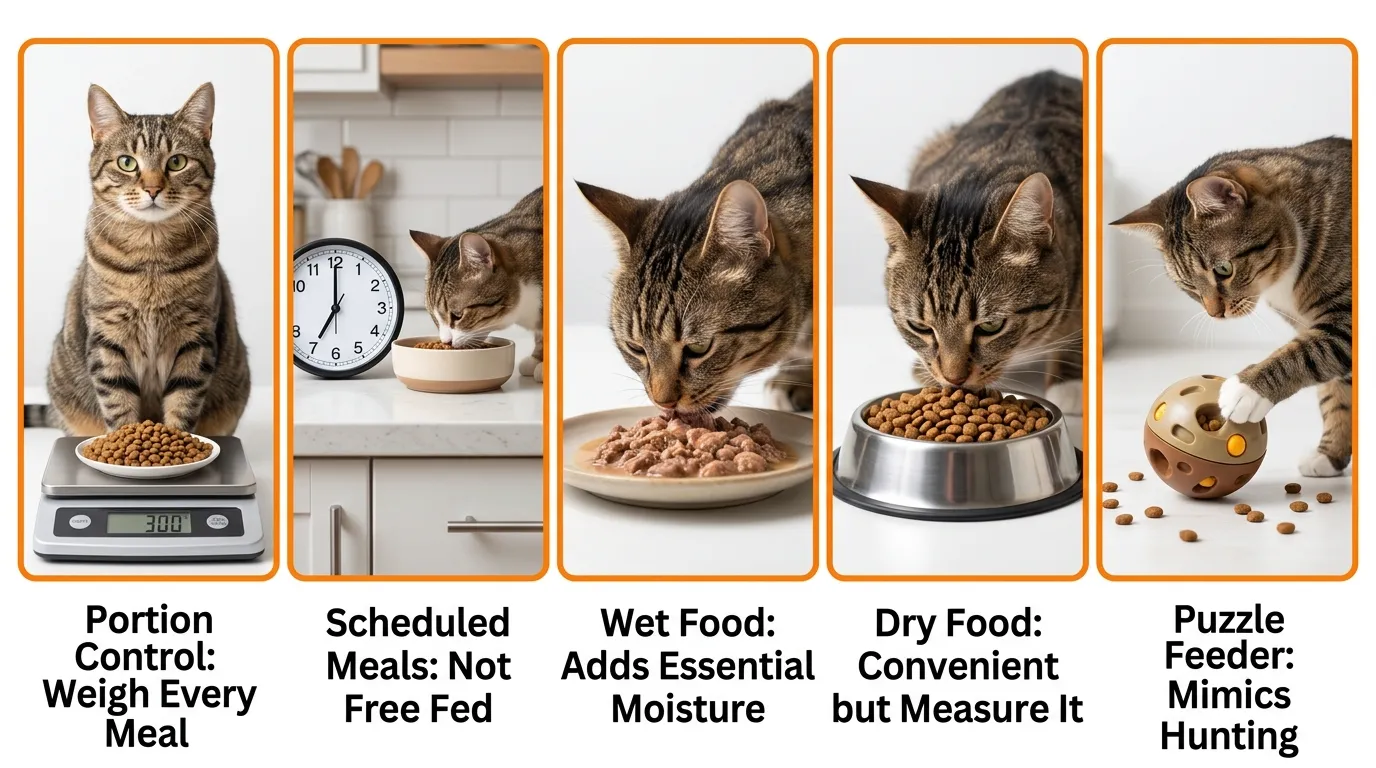
Quick answer: Feed an adult indoor cat two to three measured meals a day, based on 20 to 30 calories per pound of ideal body weight. A 10-pound cat needs roughly 200 to 250 calories daily. Weigh every portion on a kitchen scale. Work in wet food at least once a day for hydration. Never free feed dry kibble to an adult indoor cat. Use a puzzle feeder for at least one meal so your cat gets to “hunt” for it.
Why Indoor Cat Feeding Is Different From Feeding Other Cats
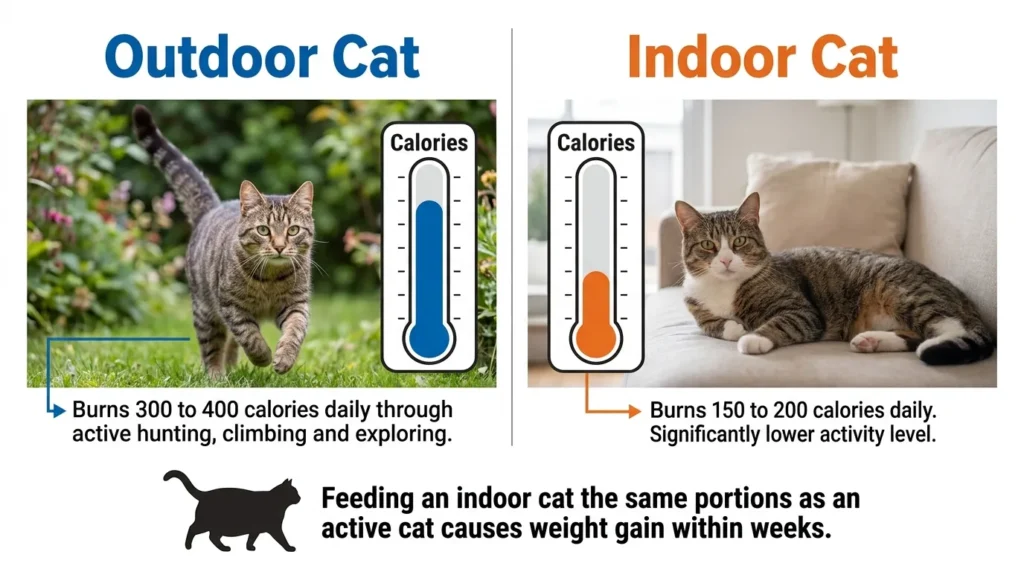
Indoor cats burn far fewer calories than cats that go outside. A cat that hunts, climbs, and patrols territory burns 300 to 400 calories a day. A cat asleep on your couch burns 150 to 200. Feed both cats the same portion, and the indoor cat gains weight, steadily, over months, without anyone noticing until the vet points it out.
Most indoor cats are also spayed or neutered, which drops metabolic rate by roughly 20 to 30 percent on top of the activity difference. That’s not a reason to starve your cat. It’s a reason to measure precisely instead of eyeballing it.
Three things make indoor feeding genuinely harder to get right:
- Lower activity means calorie needs drop well below what a working or outdoor cat requires.
- Spaying and neutering slow metabolism, so every extra calorie counts for more.
- Boredom eating is real. A cat with nothing else to do will eat from habit, not hunger.
| Owner’s Tip
The biggest feeding change I ever made was switching from eyeballing to weighing. I thought I was giving a medium portion. The scale showed I was giving 40 percent more than the recommended amount, every single meal. One $10 digital kitchen scale and three minutes a day fixed months of overfeeding, immediately. |
What Should You Actually Feed an Indoor Cat?
Cats are obligate carnivores. That’s not a marketing phrase, it’s biology: cats can’t make certain amino acids and fatty acids on their own and need to get them directly from animal tissue. So the question of what to feed an indoor cat starts with one filter: does this food get most of its protein from meat, poultry, or fish, or is it padded out with plant protein and fillers?
Look for these things on any bag or can before you buy it:
- A named animal protein as the first ingredient (chicken, turkey, salmon), not a generic “meat meal” or “animal by-product.”
- An AAFCO statement saying the food is “complete and balanced” for the correct life stage (kitten, adult, or senior). This is the single most reliable indicator that a food meets minimum nutrient standards.
- Taurine listed on the label. Cats cannot survive on a taurine-deficient diet long term; deficiency causes heart disease and blindness.
- Real protein sources you can name, not a long list of unidentified byproducts and fillers.
What a Healthy Diet for an Indoor Cat Actually Looks Like
A healthy diet for an indoor cat runs high in protein, moderate in fat, and low in carbohydrate, roughly the opposite ratio of most human diets. Here’s what that breaks down to in practice:
| Nutrient | Target range (dry matter basis) | Why it matters |
| Protein | At least 30 to 40% for a healthy adult | Builds and maintains muscle; cats use protein for energy more than carbs |
| Fat | 15 to 20% | Concentrated energy source and supports skin and coat health |
| Carbohydrate | As low as the food allows, typically under 10% in wet food | Cats have no biological requirement for carbs; excess carbs are a common driver of weight gain |
| Taurine | Present and labeled | Essential amino acid cats cannot synthesize; deficiency is linked to heart and eye disease |
| Moisture | 70 to 80% in wet food, roughly 10% in dry | Directly affects hydration and urinary tract health |
If your cat has a diagnosed condition like kidney disease, diabetes, or a history of urinary crystals, these general ranges don’t apply. Prescription diets exist for a reason, and a vet should set the targets for those cats specifically.
Human Foods and Ingredients Indoor Cats Should Never Eat
Owners feed table scraps more often than they’d admit, and most of the time it’s harmless. Some foods are not harmless at all:
- Onions and garlic (raw, cooked, or powdered) damage red blood cells and can cause anemia.
- Grapes and raisins are linked to kidney failure in cats, even in small amounts.
- Chocolate and caffeine contain compounds cats metabolize far more slowly than humans, leading to toxicity at low doses.
- Raw dough containing yeast expands in the stomach and can produce alcohol as it ferments.
- Xylitol, a sweetener in some peanut butters and sugar-free products, causes a rapid, dangerous drop in blood sugar.
- Cow’s milk isn’t toxic, but most adult cats are lactose intolerant and it causes diarrhea.
If your cat eats any of these and shows vomiting, lethargy, or diarrhea, call your vet or an animal poison control line right away rather than waiting to see if it passes.
[Image placeholder: infographic listing foods toxic to indoor cats, with icons for each item and a “call your vet” call-out]
Wet Food vs Dry Food for Indoor Cats: What the Difference Actually Means
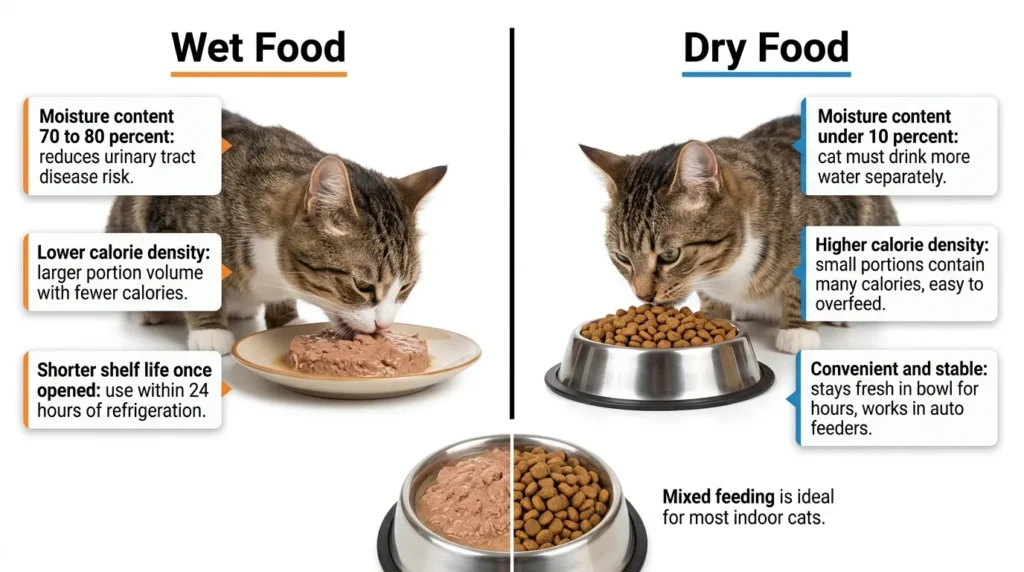
The wet-versus-dry debate isn’t really a debate once you understand what each one does. Both have a place in an indoor cat’s diet. The real question is how to use each correctly, not which one wins.
Wet food carries the hydration load. Cats descend from desert animals with a naturally low thirst drive, and they often won’t drink enough water on their own to make up for a fully dry diet. A cat eating only kibble is frequently walking around mildly dehydrated, which over time feeds into urinary tract disease.
Dry food is convenient and calorie-dense. The convenience genuinely helps busy owners and works with auto feeders. The density is the risk: dry kibble packs three to four times the calories per gram that wet food does, so a small miscalculation in portion turns into consistent overfeeding.
| Wet Food | Dry Food | |
| Moisture | 70–80% | ~10% |
| Calorie density | Lower per gram | 3–4x higher per gram |
| Best for | Hydration, urinary health, satiety | Convenience, auto-feeders, puzzle feeders |
| Shelf life once opened | Hours in the bowl before it spoils | Weeks, stays fresh for grazing or puzzle use |
| Risk if mismanaged | Waste if not finished quickly | Overfeeding from free access |
Practical approach for most indoor cats:
- Wet food as the main meal, or one dedicated wet meal a day, for hydration and satiety.
- Dry food as a secondary option if you use it, always measured by weight, never by cup.
- Dry food works well in puzzle feeders because it holds up without spoiling during a longer play session.
- Never free feed dry kibble. High calorie density plus unlimited access is the top cause of obesity in adult indoor cats.
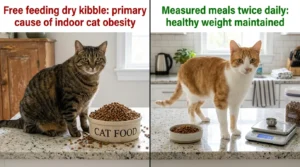 If you free feed dry food right now and your cat is overweight, this is almost certainly why. Switching to two measured meals with a kitchen scale is the single most effective, and cheapest, weight management move available.
How Much to Feed an Indoor Cat: Portion Sizes and Calorie Guide
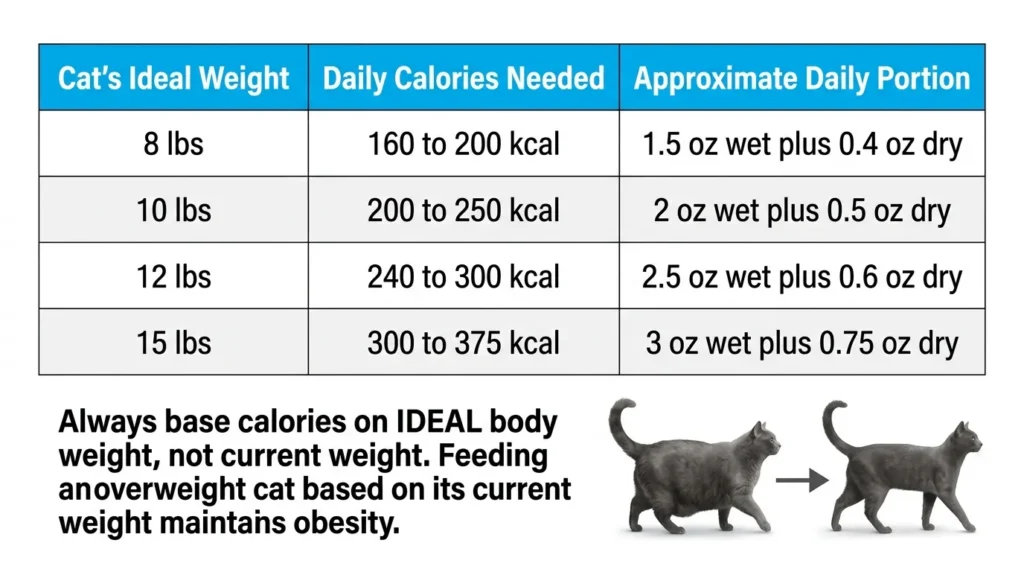
Knowing how much an indoor cat should eat per day comes down to two numbers: ideal body weight and the calorie content of your food. Everything else follows from those. The most common mistake is feeding for current weight instead of ideal weight, which locks an overweight cat into the exact diet that made it overweight.
Most veterinary sources put the target at 20 to 30 calories per pound of ideal body weight per day for adult indoor cats. Spayed and neutered cats usually land at the low end. A 10-pound ideal-weight cat needs about 200 to 250 calories a day, so 100 to 125 calories per meal if you’re feeding twice.
Daily Calorie Guide by Ideal Body Weight
| Ideal Weight | Daily Calories (approx.) | Per Meal (2x/day) |
| 6 lbs | 120–150 kcal | 60–75 kcal |
| 8 lbs | 160–200 kcal | 80–100 kcal |
| 10 lbs | 200–250 kcal | 100–125 kcal |
| 12 lbs | 240–300 kcal | 120–150 kcal |
| 15 lbs | 300–375 kcal | 150–188 kcal |
These are starting points, not prescriptions. Activity level, age, and health conditions shift the number up or down. Ask your vet to confirm a target if your cat has any diagnosed condition.
How to calculate the right portion for your cat:
- Step 1: Find your cat’s ideal body weight. Ask your vet if you’re not sure. A healthy cat has a visible waist from above and ribs you can feel but not see.
- Step 2: Multiply ideal weight in pounds by 20 to 25 for a typical spayed or neutered adult.
- Step 3: Check the calorie count on your food’s packaging, usually listed as kcal per kilogram or per can.
- Step 4: Divide your daily calorie target by the food’s calorie density to get the gram or ounce portion.
- Step 5: Weigh the portion on a kitchen scale every meal. Don’t scoop, don’t estimate.
| Owner’s Tip
Calorie counts on cat food packaging are often buried in tiny print or listed in units that need converting. Search the food’s name plus “kcal per 100g” and you’ll usually find it fast. Do the division once per food, write the gram weight on the bag, and you’re set until you switch brands. |
Best Feeding Schedule for Indoor Cats: Timing and Frequency
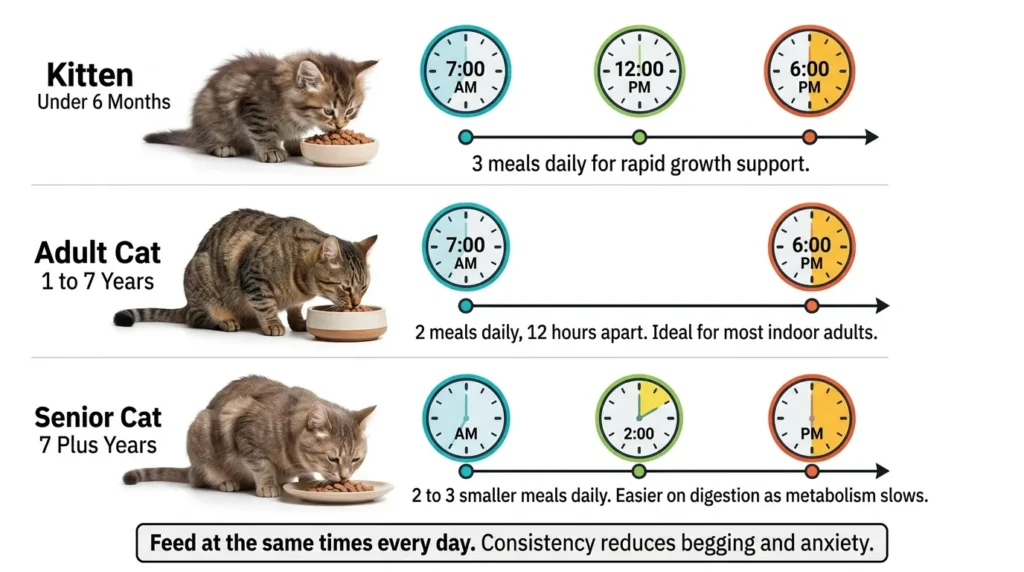
The best schedule for most adult indoor cats is two measured meals a day: one between 7 and 8am, one between 5 and 7pm. That lines up with a cat’s natural crepuscular activity and spaces meals about 12 hours apart, which roughly matches how long it takes a cat’s stomach to empty.
A consistent schedule does more than manage weight. It settles your cat’s internal rhythm, cuts anxiety, and is the most reliable fix for begging. A cat that knows exactly when food is coming stops demanding it at random hours.
Feeding frequency by life stage:
- Kittens under 6 months: 3 to 4 meals a day to support fast growth.
- Junior cats, 6 to 12 months: transition down to 2 to 3 meals a day.
- Adult indoor cats, 1 to 7 years: 2 meals a day, roughly 12 hours apart.
- Senior cats, over 7 years: 2 to 3 smaller meals a day to ease digestion and keep energy steady.
The play-then-feed sequence is the single most effective behavioral tool here. Play with your cat for 15 to 20 minutes, then feed right after. It mimics the natural hunt-catch-eat cycle, triggers satiety more effectively than food alone, and is the most reliable way to stop nighttime zoomies and 3am hunger calling.
Preventing Obesity in Indoor Cats: What Actually Works
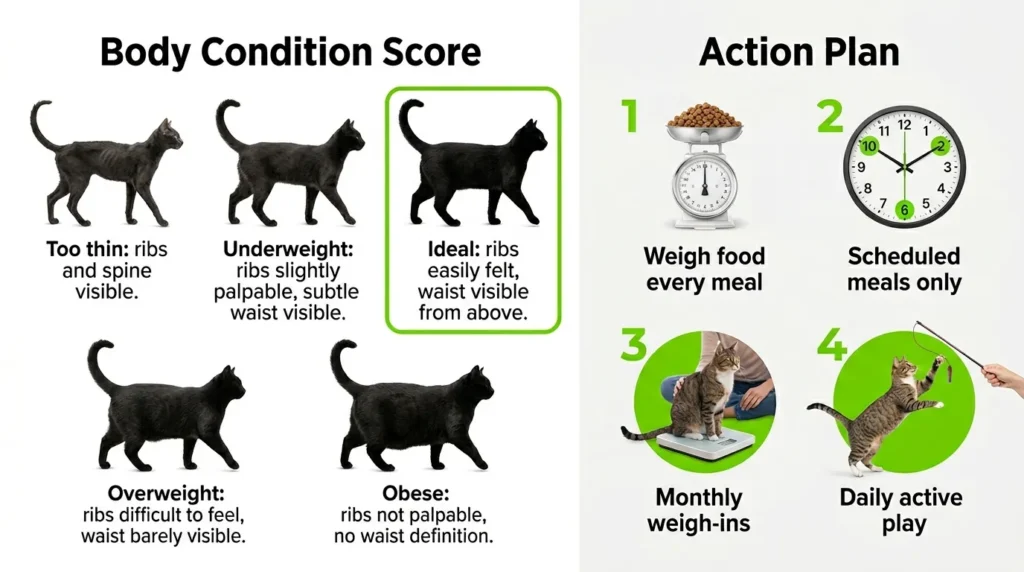
Obesity in indoor cats is the most preventable problem in feline medicine and, at the same time, the most undertreated one. An estimated 60 percent of cats in the US are overweight or obese, according to the Association for Pet Obesity Prevention. An overweight cat carries a much higher risk of diabetes, arthritis, heart disease, urinary problems, and a shorter life.
Four actions that actually move the needle:
- Weigh every meal on a kitchen scale. Estimating is the most common reason overfeeding never stops.
- Switch to scheduled meals and drop free feeding entirely if you’re currently doing it.
- Weigh your cat monthly on a bathroom scale. A 0.5-pound gain over two months means it’s time to cut portions.
- Add 15 to 20 minutes of active play daily to burn more calories without cutting food further.
If your cat is already overweight, feed for ideal body weight, not current weight. Most owners get this backward. Feeding a 14-pound cat for 14 pounds maintains 14 pounds. Feeding that same cat for its 10-pound ideal weight creates a gradual deficit that produces real weight loss over 6 to 12 months.
Don’t restrict food hard to speed up weight loss. Cats that lose weight too fast can develop hepatic lipidosis, a serious liver disease. A loss of 0.5 to 1 percent of body weight per week is the safe ceiling.
How to Get Your Indoor Cat to Drink More Water
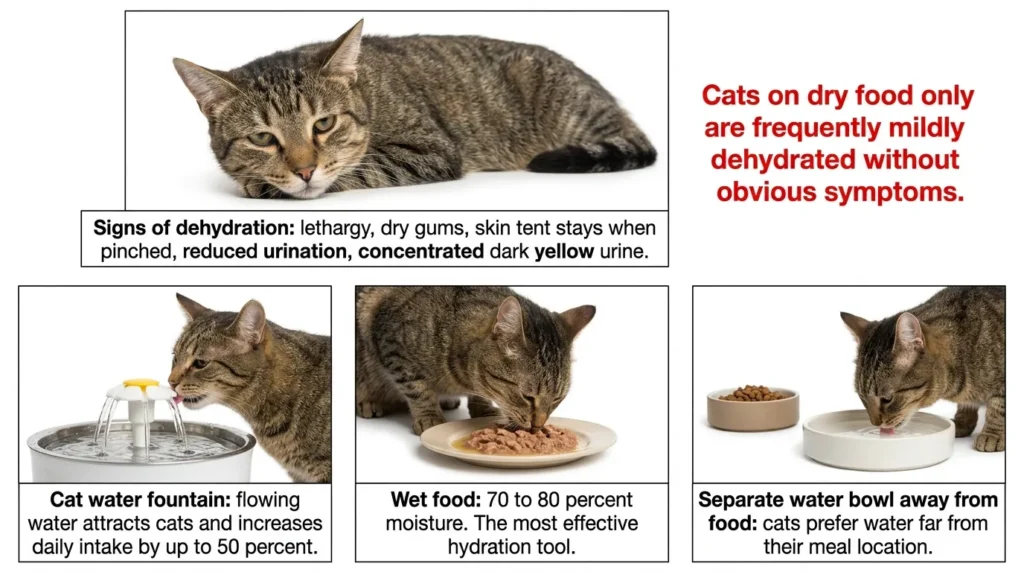
Getting an indoor cat to drink more water solves one of the most overlooked health risks in cats. Cats evolved as desert animals with a low thirst drive, relying on moisture in prey to stay hydrated. A cat eating only dry food typically gets less than 20 percent of the moisture it would get in the wild.
Chronic low-grade dehydration feeds directly into urinary tract disease, kidney disease, and bladder crystals, all far more common in cats on dry food without enough water intake.
The most effective ways to raise water intake:
- Add wet food to at least one meal a day. This alone raises daily moisture intake with zero behavior change required from the cat.
- Set up a cat water fountain. Cats are drawn to moving water, and a fountain increases voluntary drinking for most cats compared to a still bowl.
- Put water bowls away from food bowls. Cats instinctively avoid drinking near where they eat, since in the wild water near a kill site is often contaminated. Separate locations mean more drinking.
- Use wide, flat bowls instead of deep, narrow ones. Cats dislike their whiskers brushing the sides while drinking.
- Refresh water at least daily. Cats notice staleness and drink less from a bowl that’s sat for 24 hours.
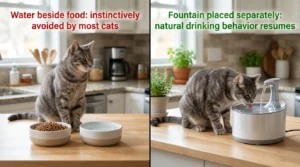 The fastest single change for hydration is adding one serving of wet food a day. If your cat currently eats only dry kibble, adding wet food at the morning meal puts in 70 to 80 grams of water per 100-gram serving, with no extra effort from the cat.
Puzzle Feeders and Food Enrichment for Indoor Cats
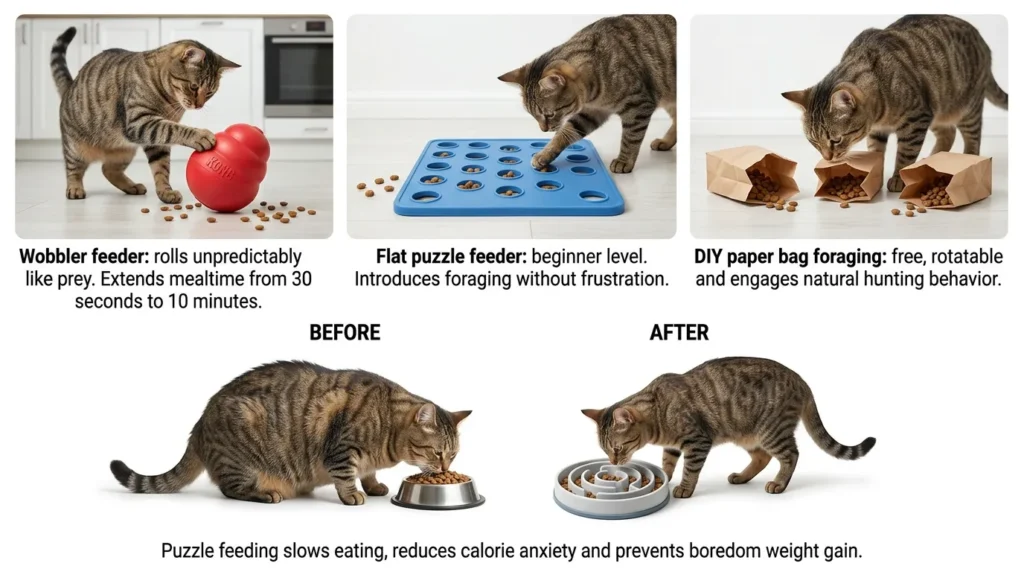
Puzzle feeders sit at the highest-value intersection of feeding and enrichment for an indoor cat. They stretch mealtime from 30 seconds to 10 minutes or more, turn on natural hunting and foraging instincts, and cut down the boredom eating that drives weight gain when food is always available.
Wild cats spend four to six hours a day hunting and foraging. A house cat that gets its entire daily calorie allotment dumped in a bowl in under a minute never gets to spend that energy. A puzzle feeder redirects it, and stretches the same portion of food to feel like more.
How to introduce puzzle feeders without frustrating your cat:
- Start with the easiest option: a flat lick mat or a wide, shallow puzzle with large openings.
- Make the first session an easy win. Pieces that are too hard to reach mean the feeder gets ignored for good.
- Raise the difficulty gradually over one to two weeks as your cat builds skill.
- Use dry kibble in puzzle feeders since it holds up over a longer foraging session without spoiling.
- Rotate between two or three feeders weekly. Novelty is what keeps a cat engaged with the same food.
How to Feed Multiple Cats Separately in a Small Home
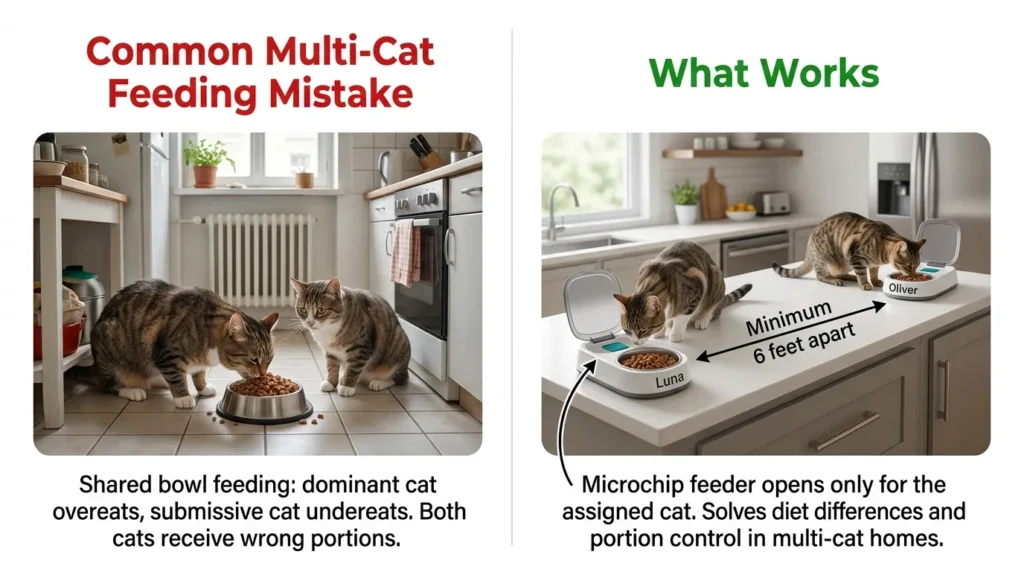
Feeding multiple cats separately is the challenge most multi-cat households never fully solve, mostly because they don’t realize what’s actually happening at the bowl. In a shared setup, the more dominant cat eats past its portion while the shyer cat eats under its portion. Both end up wrong at the same time.
The simplest fix is physical separation of at least six feet between feeding stations. Cats don’t like eating close to each other. One station at each end of a kitchen counter, or in separate rooms, solves the competition problem for most households.
For cats with specific needs, a diabetic cat or one on a weight management diet, separation alone often isn’t enough. Microchip-activated feeders are the reliable fix. They open only for the cat whose chip matches, so no other cat gets in regardless of how persistent it is.
Rules that hold up even in small apartments:
- Feed every cat at the same time to cut competition and rushed overeating.
- Separate stations by at least six feet, ideally in different rooms or on different surfaces.
- Pick up all bowls after 20 to 30 minutes, whether or not the food is finished. This removes the chance for one cat to clean up another’s plate.
- Track each cat’s weight separately, monthly, to confirm the portions are right for each individual.
Everything We Cover on Feeding Indoor Cats: Your Full Resource Library
Find the one that matches your most immediate question and start there.
How Much Should an Indoor Cat Eat Per Day?
Portion size is the single biggest feeding variable for indoor cats, and the one owners get wrong most consistently. This article walks through a full calorie calculation, a weight-based portion guide by food type, and specific adjustments for cats that are over or under their ideal weight.
Get the full calculation in our article on how much should indoor cat eat per day.
Wet Food vs Dry Food for Indoor Cats: The Honest Comparison
This comparison goes deeper than most, breaking down the hydration, calorie, and behavioral differences between food types and how each shapes long-term health. It includes specific guidance for cats with urinary issues, weight problems, or picky eating habits.
Get the full comparison in our article on wet food vs dry food for indoor cats.
How Often Should You Feed an Indoor Cat?
Meal frequency affects weight, behavior, and digestion in ways most feeding guides skip over. This article covers the science behind meal timing and gives you a way to decide between two and four meals a day based on your cat’s age and health.
Find the right frequency in our guide on how often should I feed my indoor cat.
Best Feeding Schedule for Indoor Cats
A structured schedule is the most effective behavioral tool an indoor cat owner has. This article gives you a full hour-by-hour template for working adults, breaks down the play-then-feed sequence, and covers how to adjust timing when more than one person in the house is feeding the cat.
Build your schedule using our full guide to best feeding schedule for indoor cats.
Should You Free Feed an Indoor Cat?
Free feeding works in a few specific situations and causes real harm in a lot more. This article walks through the research on free feeding outcomes, identifies the cat types it’s genuinely fine for, and explains how to transition off it without stressing your cat out.
Get the honest answer in our guide on should I free feed my indoor cat.
Why Is My Indoor Cat Always Hungry?
A cat that acts perpetually hungry is telling you something specific, and it isn’t always about quantity. This article breaks down the seven most common causes of constant hunger, from genuinely small portions to medical conditions to boredom-driven food seeking, with a way to figure out which one applies to your cat.
Find the cause and fix in our article on why is my indoor cat always hungry.
How to Get an Indoor Cat to Drink More Water
Low water intake is one of the most overlooked health risks for indoor cats, and the fixes are simpler than most owners expect. This article covers five evidence-backed strategies, including fountain comparisons, bowl placement rules, and the wet food math showing exactly how much moisture each method adds.
Solve the hydration problem with our guide on how to get indoor cat to drink more water.
Do Indoor Cats Need Wet Food Every Day?
This question has a clear, evidence-backed answer, and this article gives it to you directly. It covers the specific health conditions that make wet food non-negotiable, which cats do fine on a mixed diet, and a practical daily approach for owners who feed mostly dry kibble but want better hydration.
Get the full answer in our article on do indoor cats need wet food every day.
How to Stop a Cat From Begging for Food
Begging is almost always a feeding system problem, not a behavior problem. This article identifies the patterns that create and reinforce begging, explains why the common fixes (ignore the cat, add more food) both fail, and lays out the specific schedule and enrichment changes that stop begging within two weeks for most cats.
Fix begging behavior using our guide on how to stop cat begging for food.
How to Feed Multiple Cats Separately
Multi-cat feeding is one of the hardest practical problems in indoor cat ownership, and most households never fully sort it out. This article covers separation strategies, microchip feeder options, scheduled feeding protocols, and setups that work in apartments where separate rooms aren’t an option.
Set up your multi-cat feeding system using our guide on how to feed multiple cats separately.
| Owner’s Tip
Every article in the library above links back to this guide when you need the full picture again. IndoorLivingCat.com covers all of these topics in depth, specifically for apartment and small-home cat owners who need answers that account for tight spaces and shared rooms. Here’s the pattern I keep seeing: these topics are all connected. Fix portion control and begging usually stops on its own. Fix hydration and urinary issues often clear up. Fix the schedule and nighttime hunger calling disappears. Start with whatever problem is loudest right now, and the rest tend to fall into place. |
Common Mistakes Owners Make Feeding an Indoor Adult Cat
The most common mistake is free feeding dry kibble and treating it as equivalent to scheduled meals. It isn’t. Free feeding causes predictable weight gain in most adult indoor cats within six to twelve months, because cats eat from boredom and habit, not just hunger, when food never runs out.
The second mistake is measuring by cup or scoop instead of by weight. A half-cup of dry kibble can run anywhere from 50 to 90 calories depending on kibble size and density. Weighing on a kitchen scale gives you the same number every time; a scoop doesn’t.
The third mistake is placing the water bowl right next to the food bowl. It seems logical from a human perspective, and it backfires. Cats avoid drinking near where they eat because, in the wild, water near a kill site is often contaminated. Put water on the opposite side of the room.
The fourth mistake is feeding for current weight instead of ideal weight once a cat is already overweight. This keeps an overweight cat exactly as overweight as it started, since the portion matches the extra pounds rather than the target.
The fifth mistake is switching foods abruptly. A sudden diet change causes vomiting or diarrhea in a lot of cats. Transition over 7 to 10 days, mixing in more of the new food each day, and most cats handle it without issue.
Frequently Asked Questions About Feeding Indoor Cats
How many calories does an indoor cat need per day?
An average adult indoor cat needs 20 to 30 calories per pound of ideal body weight daily. A 10-pound ideal-weight indoor spayed or neutered cat needs roughly 200 to 250 calories a day. Always calculate from ideal weight, not current weight. A cat that’s overweight at 14 pounds but has an ideal weight of 10 pounds should be fed for 10 pounds, so it loses weight gradually and safely over several months.
What should I actually feed my indoor cat?
Feed a complete and balanced diet with a named animal protein as the first ingredient, an AAFCO life-stage statement on the label, and taurine listed among the nutrients. A mix of wet food (for hydration and calorie control) and measured dry food (for convenience and puzzle feeders) works for most healthy adult cats. Cats with a diagnosed medical condition need a diet set by their vet, not a general recommendation.
What does a healthy diet for an indoor cat look like?
High protein (30 to 40% on a dry matter basis), moderate fat (15 to 20%), and low carbohydrate. Cats have no biological need for carbohydrate, so a diet heavy in fillers and grain works against them, not for them. Moisture matters too: wet food at 70 to 80% water content does more for hydration than dry food ever will on its own.
How do I know if I’m overfeeding my cat?
The body condition test is the most reliable method. Run your hands along your cat’s ribcage. You should feel each rib clearly with light pressure, but not see them. From above, look for a visible waist narrowing behind the ribs. If you can’t feel the ribs without pressing hard, your cat is overweight. Monthly weigh-ins on a bathroom scale are the most precise way to track this over time.
Why does my indoor cat seem to never drink enough water?
Cats have a naturally low thirst drive and don’t instinctively drink enough when eating dry food alone. The most effective fixes are adding wet food to at least one meal a day, using a cat water fountain instead of a still bowl, and moving the water station away from the food. Cats also prefer wide, flat bowls over deep, narrow ones because their whiskers don’t touch the sides.
How do I stop my cat from begging for food between meals?
Begging between meals usually comes down to one of three things: the portion genuinely isn’t enough for the cat’s calorie needs, the cat has learned begging works, or boredom is triggering food-seeking that has nothing to do with hunger. Check the portion math first. If it’s correct, start a play session the moment begging starts, and never feed early to quiet it down. Most begging stops within two weeks of a consistent response.
Do indoor cats really need puzzle feeders, or is that optional?
Puzzle feeders aren’t optional for cats that eat too fast, beg excessively between meals, or show clear signs of boredom. For those cats, one puzzle-fed meal a day addresses all three at once. For cats without those problems, puzzle feeders still help with enrichment, just less urgently. Every indoor cat benefits from at least occasional foraging-style feeding.
Is it safe to feed a cat the same food every day for years?
Feeding the same complete and balanced food long-term is safe as long as the packaging carries an AAFCO statement for the right life stage. Variety isn’t required for nutritional completeness, and plenty of cats do better on a consistent diet than on frequent switching. Sudden diet changes upset digestion in most cats, so when you do change foods, transition over 7 to 10 days by gradually mixing the new food in with the old. This article is for general information only. Always check with your vet for guidance specific to your cat.
Conclusion
Feeding an indoor cat well comes down to three habits: weigh every portion on a kitchen scale, feed two scheduled meals instead of leaving food out all day, and work in wet food at least once daily for hydration. Get those three right, and you head off most of the expensive, preventable problems before they start.
If you change one thing today, make it the kitchen scale. Moving from guessed portions to weighed ones is the single biggest feeding change any indoor cat owner can make. Our full guide on how much should indoor cat eat per day walks you through the exact calorie math and weight chart to get portions right starting today.
Adult indoor cats need 20 to 30 calories per pound of ideal body weight daily; a 10-pound ideal-weight indoor cat needs roughly 200 to 250 calories a day split across two scheduled meals. A healthy indoor cat diet runs 30 to 40% protein, 15 to 20% fat, and low carbohydrate on a dry matter basis, with taurine as an essential nutrient cats cannot produce themselves. Free feeding dry kibble is the primary cause of indoor cat obesity, which affects roughly 60 percent of US indoor cats. Wet food is 70 to 80% moisture and is the most effective way to raise daily water intake. Foods toxic to cats include onions, garlic, grapes, raisins, chocolate, caffeine, xylitol, and raw yeast dough. Puzzle feeders extend mealtime and engage natural hunting instincts. Portions should be weighed on a kitchen scale, not measured by cup or scoop.