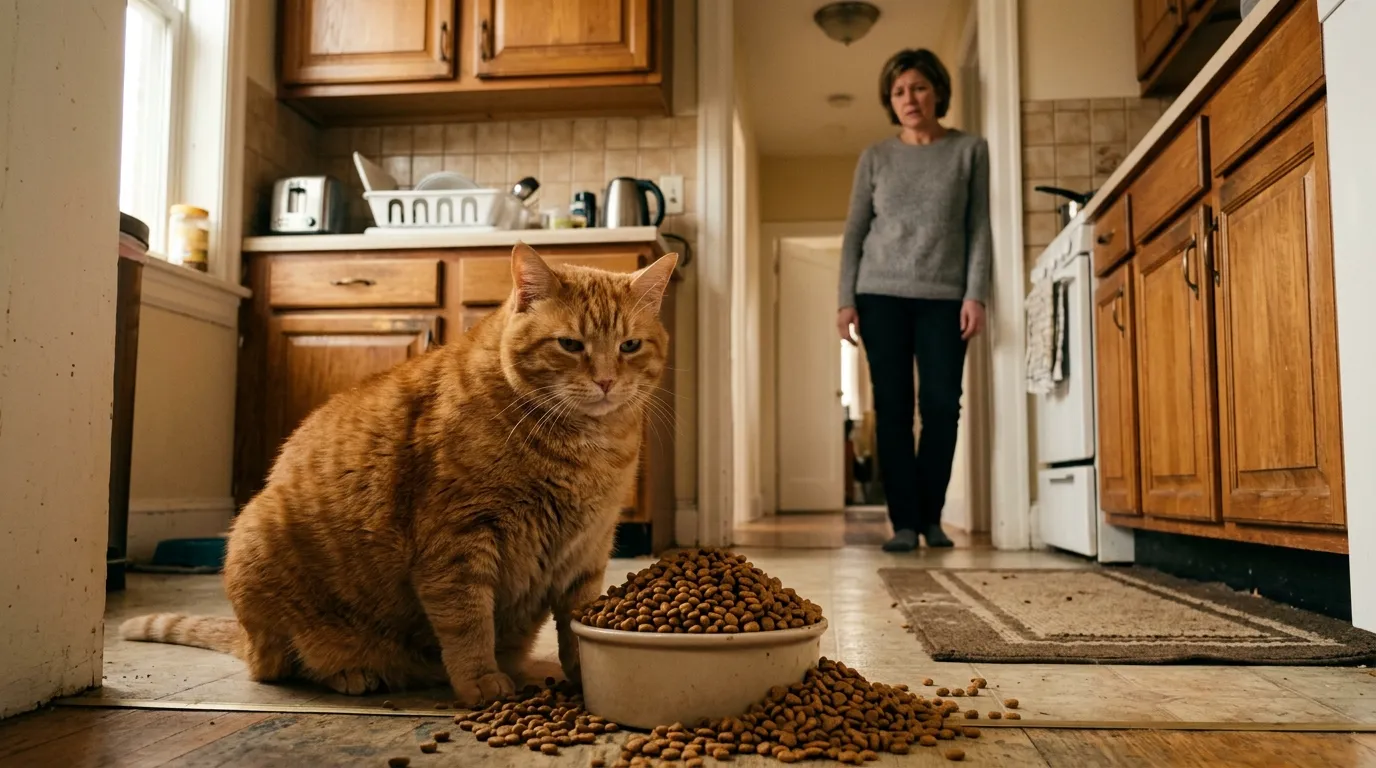
You fill the bowl, top it off when it gets low, and your cat looks fine. So should I free feed my indoor cat, or is a full bowl quietly doing damage? For most apartment cats the answer is no, though the real answer depends on your specific cat and not a blanket rule. I thought free feeding was the relaxed, low-stress choice until my vet pointed at the scale and told me my cat had gained almost two pounds in a year. Nothing else in her diet had changed. The bowl just stayed full all the time. This guide covers what free feeding does to an indoor cat over months and years, the narrow set of situations where it can still work, and how to switch to scheduled meals without a fight.
Should I free feed my indoor cat? For most indoor cats, free feeding is not recommended. Sedentary apartment cats overeat without the activity to burn it off, and weight gain shows up within months. Two to three measured meals a day give you control over calories, let you catch health changes early, and tend to produce a calmer cat between meals.
This guide is part of our feeding cluster. For the full daily calorie math and meal-splitting guidance, see how to feed an indoor cat properly, the pillar guide this article builds on.
Short Answer: Who Should and Shouldn’t Free Feed?
Find your cat in this table before reading the rest. Each row is covered in more detail below.
| Your Cat | Free Feed? | What to Do Instead |
|---|---|---|
| Neutered adult, normal weight or overweight | No | Two to three measured meals a day |
| Adult at a body condition score of 3, stable for 12 months | Possibly | Weigh monthly and stop if weight creeps up |
| Kitten under six months | Not unlimited | Three to four scheduled meals |
| Senior cat eating less per sitting | No | Four or five small measured meals, plus a vet visit if she’s losing weight |
| Multi-cat home with one underweight cat | Not from a shared bowl | Microchip-activated feeder or separate stations |
| Underweight cat | Only under vet direction | Vet check for the cause first |
What Free Feeding Actually Means and Why It Feels So Natural?
Free feeding means food is available around the clock, so your cat eats whenever she wants. Most free-fed cats eat dry kibble, since wet food spoils within a few hours at room temperature and can’t sit out safely. The appeal makes sense. Fill the bowl once or twice a day and you never have to think about it again.
It feels natural because it loosely echoes how cats eat in the wild, many small meals spread across the day instead of set portions. That instinct is real. But wild cats burn real energy hunting before every meal, and an indoor apartment cat doesn’t. The calorie math that works for a cat hunting eight to twelve times a day falls apart when food sits twelve inches away, all day, every day.
Free feeding means continuous food access with no portion control and no meal timing. Scheduled or meal feeding is the opposite: a measured portion offered at set times and picked up after thirty to forty-five minutes. If you want the full breakdown of how much to feed and when, our guide on how to feed an indoor cat properly walks through the exact daily calorie math. Many veterinarians recommend scheduled feeding for indoor cats specifically, because low activity can’t offset unlimited calories.
Free Feeding vs Scheduled Feeding: A Quick Comparison
Here’s how the two approaches stack up on the things that actually matter for an indoor cat.
| Factor | Free Feeding | Scheduled Feeding |
|---|---|---|
| Weight control | Poor for most indoor cats | Strong, calories are measured |
| Spotting illness early | Hard, bowl always looks the same | Easy, you know the normal amount eaten |
| Multi-cat households | Favors the dominant cat | Fair, each cat gets its own portion |
| Owner effort | Low, refill occasionally | Moderate, requires a routine |
| Best suited for | Proven self-regulators, some kittens | Most neutered indoor adult cats |
Can You Free Feed Wet Food, or Only Dry?
Free feeding is almost always a dry food habit, and that’s part of the problem. Wet food can’t sit out the way kibble can, so a cat on a “free fed” diet is usually getting the most calorie-dense option in the cupboard with the least moisture.
| Food Type | Safe to Leave Out? | Free Feeding Concern |
|---|---|---|
| Dry kibble | Yes for the day, though stale food loses appeal | Highest calorie density, easy to overeat without noticing |
| Wet food (canned or pouch) | No, follow the label, usually a few hours at most | Dries out and grows bacteria, so it can’t be free fed |
| Mixed wet and dry | Only the dry part | Leaving the dry half out still gives unlimited calories |
If your cat eats wet food, schedule it. Put it down at meal time, pick it up after thirty to forty-five minutes, and refrigerate any opened can with a cover.
A Middle Ground: Portion-Controlled Grazing
Some cats really do prefer many small meals, and you can honor that without leaving a full bowl out. Measure her whole daily total once, then spread it out:
- Weigh the day’s dry food on a gram scale.
- Load it into a timed feeder set to release four to six small portions across the day.
- Or divide it between a few puzzle feeders and hide them around the apartment so she hunts for it.
- Add any wet food as a separate scheduled meal and subtract those calories from the dry total.
That setup keeps the grazing rhythm and still ends the day at the right number of calories.
Gravity Feeders and Automatic Feeders: Are They Really Free Feeding?
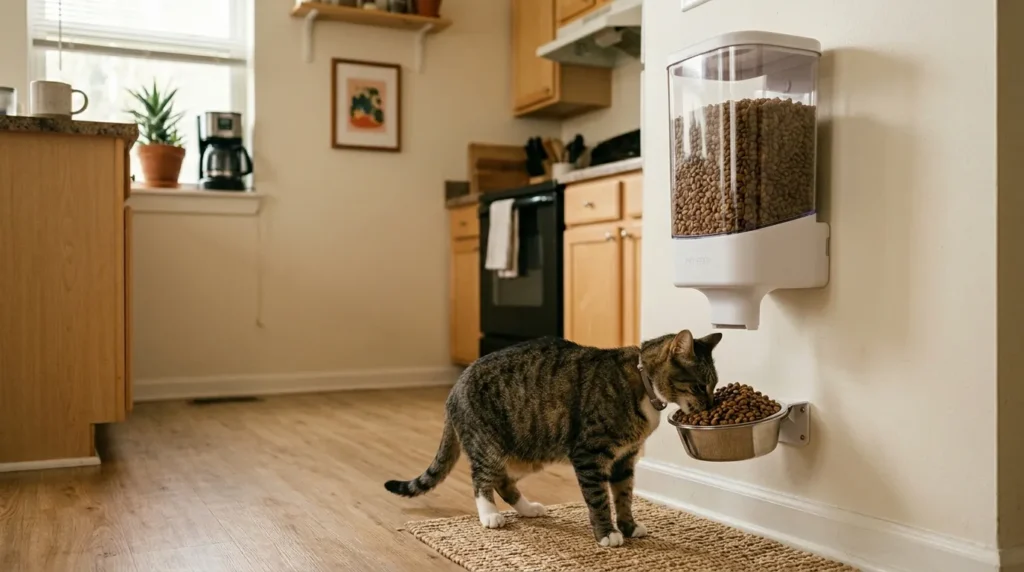
Not all “hands-off” feeding tools work the same way, and the difference matters for your cat’s weight. A gravity feeder is functionally identical to free feeding. It just refills the bowl automatically as your cat eats, with no cap on total daily intake. A timed automatic feeder is a different tool entirely, since it releases a set portion at scheduled times and then stops.
| Feeder Type | Portion Control | Effectively Free Feeding? |
| Gravity feeder | None, refills continuously | Yes |
| Timed automatic feeder | Set amount at set times | No, functions as scheduled feeding |
| Microchip-activated feeder | Set amount, restricted to one cat’s chip | No, and solves multi-cat sharing too |
| Puzzle or slow feeder | Depends on how much you load it with | Only if refilled without a daily limit |
If your goal is to stop free feeding but you still want less hands-on involvement than measuring bowls by hand twice a day, a timed automatic feeder solves that. A gravity feeder does not, no matter how modern it looks on the counter.
Should I Free Feed My Indoor Cat If They Seem to Self-Regulate?
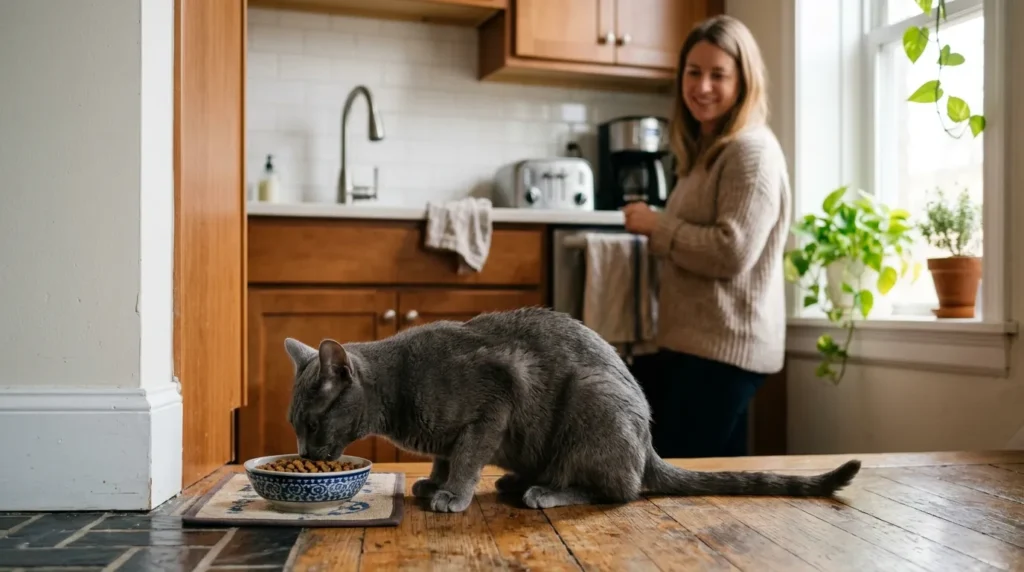
Some cats genuinely self-regulate. They graze in small amounts and hold a healthy weight on free-fed dry food for years. These cats tend to be naturally lean, sometimes with a baseline anxiety that suppresses appetite rather than boredom eating that drives it up. They show up far more often in outdoor cats, who burn real calories daily, and far less often in neutered indoor cats.
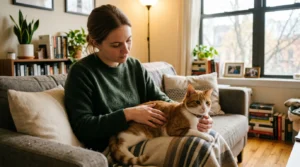
The honest test is a body condition score check, not how your cat looks from across the room. Run your fingers along her ribs from the spine outward. You should feel individual ribs without pressing hard, but they shouldn’t stick out. If you can’t feel them without real pressure, she’s carrying excess fat.
| Score | What You Feel and See | What It Means |
|---|---|---|
| 1 to 2 | Ribs, spine, hip bones visible with little fat cover | Underweight, talk to your vet |
| 3 | Ribs felt easily under a thin fat layer, visible waist | Healthy weight |
| 4 | Ribs felt with slight pressure, waist barely visible | Overweight, cut back on calories |
| 5 | Ribs hard to feel, no waist, fat pad on belly | Obese, vet-guided plan needed |
Three more checks take under a minute and don’t need a scale:
- View from above: a healthy cat has a visible waist behind the ribs. A straight line or a bulge means extra weight.
- View from the side: her belly should tuck up toward the hind legs, not hang level or swing as she walks.
- Grooming reach: a cat who suddenly can’t clean her lower back or hindquarters may be carrying too much weight to twist that far.
If your cat scores a 3 and has held that weight for a full year on free-fed food, she may genuinely self-regulate. If she’s gained weight at all in the past year, she isn’t self-regulating, and the trend will keep going. Cat weight doesn’t level off on its own at a mildly overweight point. It keeps climbing as long as food access stays unlimited.
The 5 Real Risks of Free Feeding Indoor Cats in Small Apartments
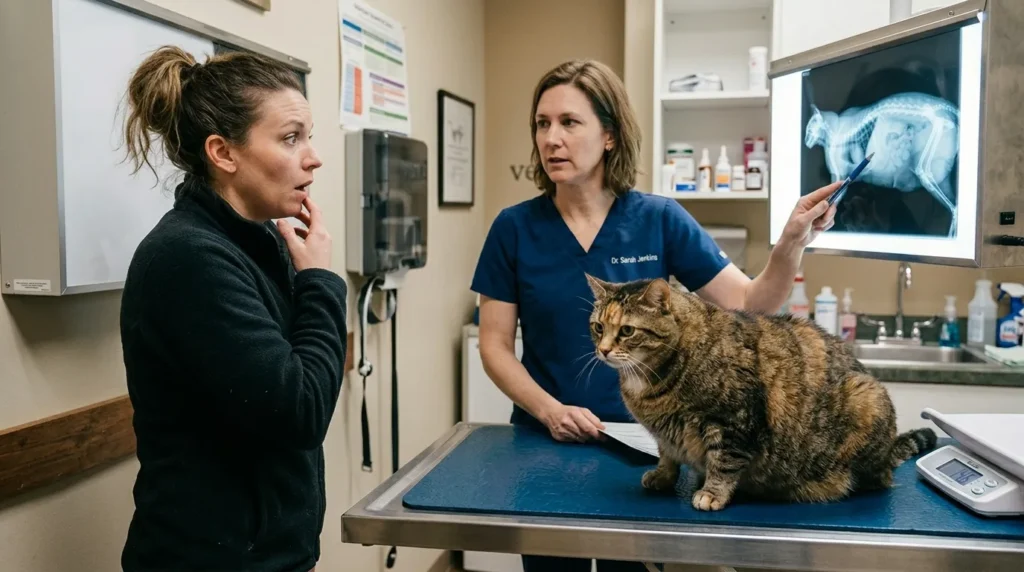
Free feeding an indoor apartment cat carries five specific risks that owners rarely connect back to the feeding method until a vet points it out.
- Cat obesity. According to the American Association of Feline Practitioners, obesity affects roughly 60 percent of cats in the United States and remains the most preventable nutritional disease in companion animals. A neutered indoor cat on free-fed dry food can gain half a pound to a pound a year with no obvious daily change. Over five years, that adds up to a genuinely overweight cat.
- Diabetes risk. Excess weight lowers insulin sensitivity, and the pancreas struggles to keep up, similar to type 2 diabetes in people. Cornell’s Feline Health Center notes that obese cats are up to four times more likely to develop diabetes than cats at a healthy weight.
- Urinary tract disease. Dry kibble is low in moisture, and cats rarely drink enough at the bowl to make up the difference, so cats eating only dry food take in less water overall than cats eating wet food. Low water intake is a common factor in lower urinary tract disease (FLUTD), and indoor cats already face higher FLUTD risk from low activity and sedentary stress.
- Appetite monitoring becomes impossible. With free feeding, there’s no baseline to compare against. Kidney disease, dental pain, and nausea often cut a cat’s intake well before any other symptom shows. If the bowl always looks about the same, you can’t tell whether she ate normally or ate half as much.
- Behavioral food obsession. Some free-fed cats fixate on the bowl rather than relax around it, especially in small apartments with limited stimulation. That fixation drives eating beyond hunger and reinforces a food-centered anxiety loop. Structured meal feeding tends to break this within two to three weeks.
Pros and Cons of Free Feeding an Indoor Cat
Weighing both sides helps before you commit either way.
| Pros | Cons |
|---|---|
| Low daily effort, refill and go | Weight gain in most sedentary indoor cats |
| Works well for a small group of natural self-regulators | Hides early signs of illness |
| Can suit very young kittens with frequent small meals | Unfair in multi-cat homes with one dominant eater |
| No begging at set meal times | Higher long-term diabetes and FLUTD risk |
When Free Feeding Can Work and Who It Is Actually Right For?
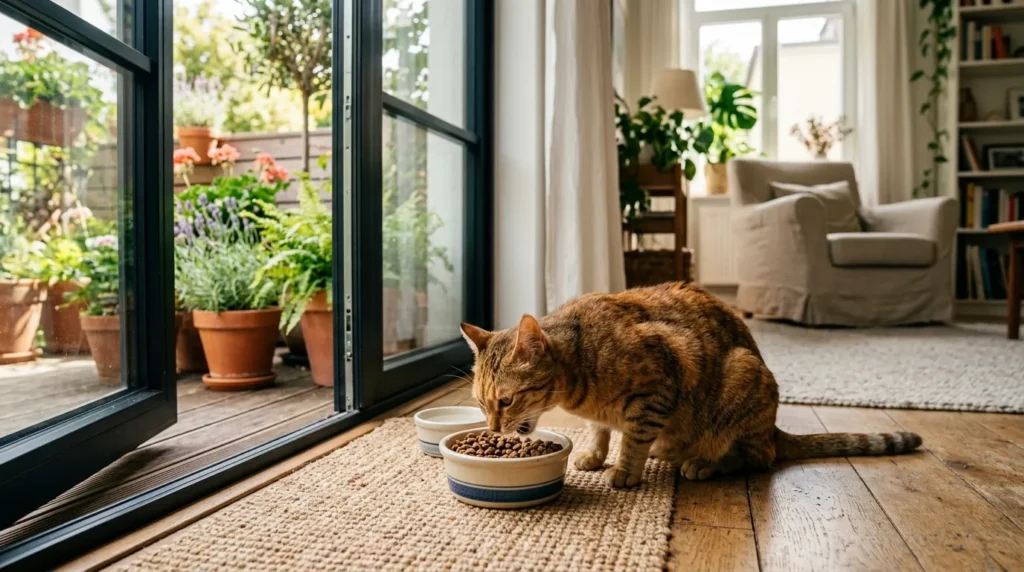
Free feeding fits two specific situations well. First, a cat that has passed the body condition score check and held a healthy weight for a documented twelve months on free-fed food. Second, a multi-cat home where one cat is underweight and needs constant access while the others are at a healthy weight and need limits. That second case almost always calls for a microchip-activated feeder rather than one shared open bowl.
Kittens under six months are a partial exception. Their stomachs are small and their calorie needs are high relative to size, so they often do better with food available more often than a standard two-meal schedule allows. Even so, three to four scheduled meals beat unlimited access, since free access from kittenhood can set a lifelong habit of eating past hunger. Around six months, start moving toward two to three meals a day.
Insight: If you’re set on trying free feeding, a monthly weight check at home is the only honest way to know if it’s working. Weigh yourself holding your cat, then weigh yourself alone. The difference is her weight. A baby scale or small pet scale gives a more precise number. Three straight months of stable weight is the minimum proof that free feeding suits your specific cat.
Does Free Feeding Make Sense for a Senior Cat?
Usually not, even though the reasoning behind it sounds different for an older cat. Senior cats sometimes eat less at any single sitting because of dental pain, reduced smell, or a health condition, and owners respond by leaving food out constantly so she can nibble whenever she’s willing. The instinct makes sense. The fix is still wrong.
Frequent small measured meals solve the same problem without bringing back the portion-control risks that come with unlimited access. Four or five small measured meals a day work better than one giant bowl left out around the clock, since you still know exactly how much she’s eating.
A senior cat that’s genuinely losing weight, rather than just eating less per sitting, needs a vet visit before a feeding change. Weight loss in an older cat can point to kidney disease, hyperthyroidism, or dental disease, and more food access won’t fix any of those causes. For the medical side of increased or changed appetite in an older cat, see our guide on indoor cat health.
How to Transition from Free Feeding to Scheduled Meals Without Causing Harm?
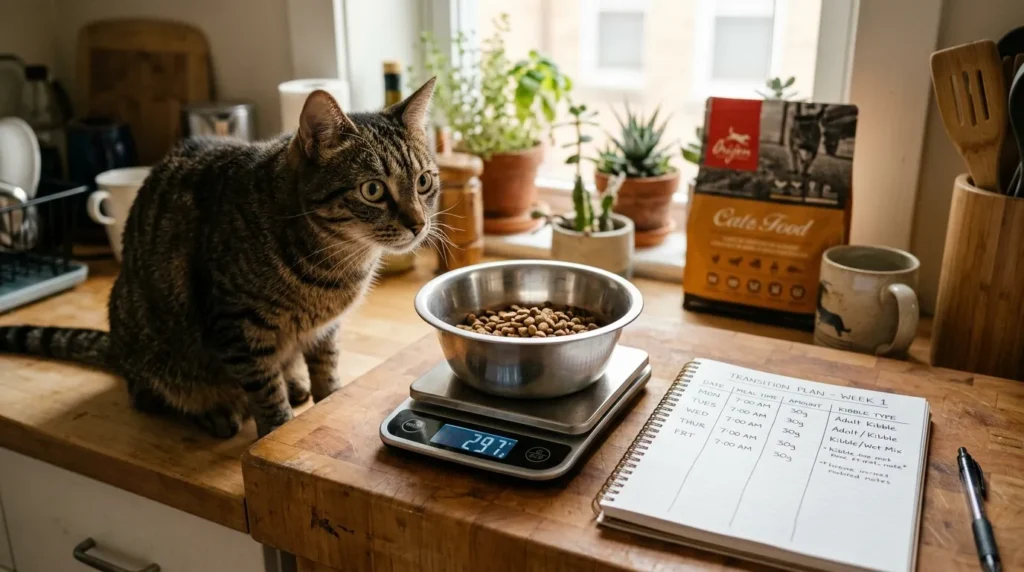
Go slow here. A sudden cut in food can trigger hepatic lipidosis, a serious liver condition that shows up when a cat stops eating or eats far less, far too fast. A cat that’s been free-fed for months or years won’t accept an abrupt switch to set portions without some resistance, and that resistance is exactly what raises the risk.
- Weigh the food you put down and measure what’s left after 24 hours. That’s her real daily intake, not a guess.
- Cut the daily amount by ten percent a week instead of jumping straight to the target portion.
- Set specific meal times. Put the food down, then pick up the bowl after thirty to forty-five minutes.
- Hold the routine for two to three weeks. Most cats accept the new schedule without much fuss by then.
Here’s what that looks like if her starting intake is 100 percent. Stop stepping down once you reach the daily target your vet gives you. If she already eats close to that target, skip the cuts and just add the meal times.
| Week | Daily Amount | What Else Changes |
|---|---|---|
| Week 1 | About 90% of her measured 24-hour intake | Start set meal times, pick up the bowl after 30 to 45 minutes |
| Week 2 | About 80% | Add a slow feeder or puzzle feeder if she gulps |
| Week 3 and on | Continue in 10% steps until you hit the vet-approved target | Weigh her weekly and keep the routine steady |
For the full math on daily calorie targets and how to split them between wet and dry food, our guide to feeding an indoor cat properly covers it step by step. That’s what separates a clean transition from one where your cat loses weight too fast or gains it back because the portions were eyeballed.
Insight: The hardest stretch is the first three days, when your cat learns that meowing at an empty bowl doesn’t produce food on demand anymore. It feels harsh at the time and does no harm. Most cats adjust within a week, and the calmer behavior that follows makes the short discomfort worth it.
What to Do When Your Cat Begs or Wakes You Up for Food
Begging is the number one reason owners quit scheduled feeding, so plan for it. A cat who learned that crying produces food will cry louder for a week or two before she gives up. These changes shorten that stretch:
- Feed the biggest meal last. A larger late-evening portion keeps her fuller through the night.
- Play before the last meal. A wand toy session followed by food mimics the hunt, catch, and eat sequence and tends to settle her afterward.
- Use a timed feeder for early morning. Set a small release shortly before you normally wake, so the food comes from the machine and not from your attention.
- Don’t feed on cue. Giving in once teaches her that more crying works. Stay quiet and feed at the scheduled time.
- Check her weight. If she’s losing too fast or looks hungry all day, the portion may be too small, and your vet can adjust it.
If begging keeps going for more than a few weeks, or comes with weight loss, heavy drinking, or constant hunger, that points to a medical cause, not a habit. Book a vet visit.
What If My Cat Eats Too Fast on a Schedule? Preventing Scarfing and Vomiting
This is the objection that stops a lot of owners from switching at all, and it’s a fair one. A cat used to grazing all day can inhale a measured portion in under a minute once it finally appears, and fast eating brings a real risk of vomiting shortly after.
- Switch to a slow feeder bowl. The raised ridges force her to eat around obstacles instead of gulping straight down.
- Use a puzzle feeder for part of the portion. Making her work for some of the food naturally slows the pace and adds mental stimulation at the same time.
- Split the same daily total into more, smaller meals. Four small portions are less tempting to scarf than two large ones.
- Spread kibble across a flat tray instead of a deep bowl. A shallow, wide surface makes fast, deep gulping harder.
None of these mean going back to unlimited access. They slow down how she eats her measured portion, which fixes the scarfing without reopening the door to overeating.
Multi-Cat Households and Free Feeding
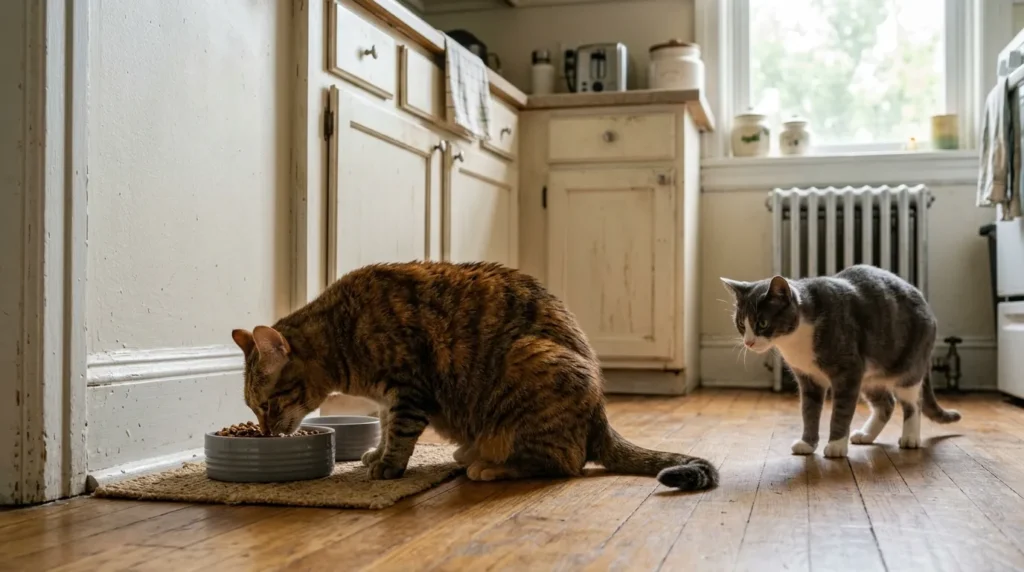
Multi-cat apartments make free feeding harder to manage. Food-dominant cats eat more than they need, and food-submissive cats eat less. The dominant cat gains weight from an always-available bowl while the timid cat may go chronically underfed, and you might never notice, since the bowl always looks about the same.
Separate feeding stations in different rooms, on set meal times, fix this cleanly. Both cats get their measured portion at the same time, in places where neither can monitor the other’s meal. For more on how social dynamics between cats shift eating behavior in small spaces, see our guide on indoor cat behavior, including how resource guarding plays out differently in confined apartments than in larger homes.
If you can’t separate them by room, a microchip-activated feeder opens only for the cat whose chip it’s set to. It costs more than a bowl, but it’s the one tool that lets an underweight cat eat freely while her housemate stays on a measured portion.
Common Mistakes When Deciding Whether to Free Feed an Indoor Cat
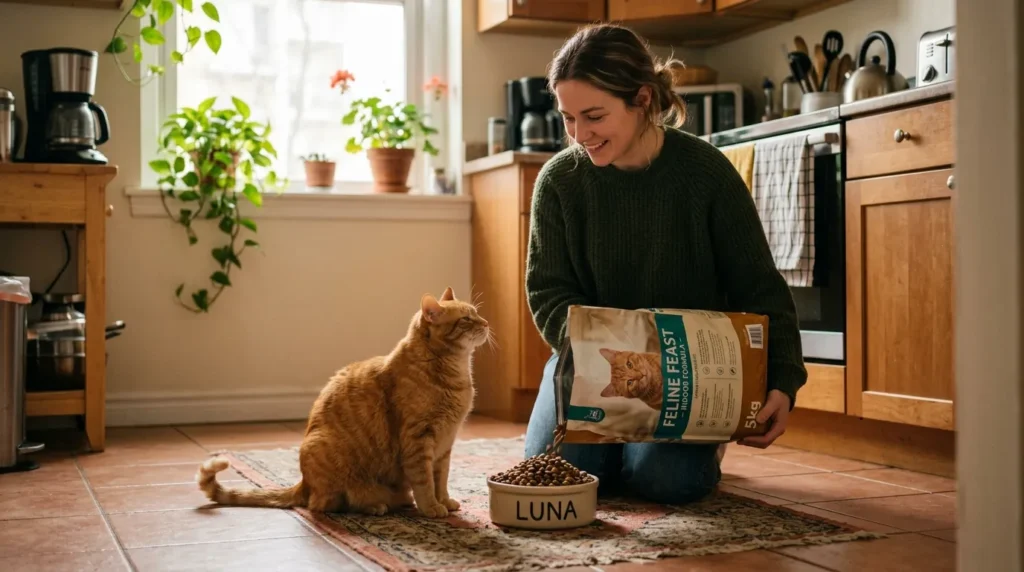
- Treating contentment as proof it’s working. A cat gaining weight slowly on free-fed food still looks happy, right up until reduced mobility, grooming trouble, or lethargy shows up. By then the habit is years deep, and reversing it takes longer.
- Assuming premium food fixes the problem. Better ingredients still deliver excess calories when access is unlimited. The feeding method drives weight outcomes, not just food quality. A measured portion of mid-range food beats unlimited premium kibble.
- Giving up and going back to free feeding. The adjustment period is real and uncomfortable for both of you. It takes two to three weeks to fully settle. Restarting free feeding resets that discomfort from zero, every time, and you never reach the calm routine that ends the begging for good.
- Buying a gravity feeder and calling it solved. A gravity feeder still refills without a limit. It removes the chore of refilling, not the overeating risk that comes with constant access.
- Skipping the slow-down step and reverting at the first vomit. Fast eating after a switch is a solvable mechanics problem, not proof scheduled feeding doesn’t work for your cat.
- Measuring with a scoop. Scoops vary by 20 percent or more depending on how you fill them. A gram scale costs a few dollars and removes the guesswork.
When Eating Pattern Changes Signal a Health Problem?
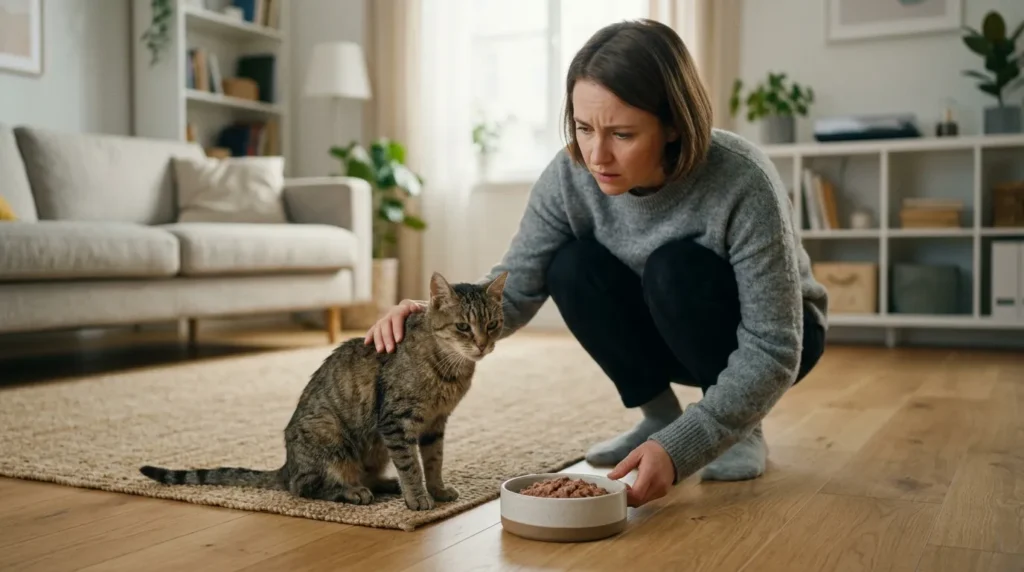
Scheduled feeding surfaces health problems weeks earlier than free feeding does. If your cat usually finishes breakfast in twenty minutes and one morning she ignores it, you’ll notice right away. On free feeding, the same drop in appetite can go unnoticed for days, since the bowl always looks roughly full.
A cat that stops eating for more than 48 hours is at risk of hepatic lipidosis, whatever the underlying cause. That window is shorter than most owners expect, and shorter than the equivalent risk period in dogs. Overweight cats face this risk even sooner, since fat around the liver mobilizes fast once food intake drops.
If your cat misses two meals in a row, or eats noticeably less for more than 48 hours, call your vet before it compounds. Appetite loss is almost always a symptom, not a preference.
Eating Red Flags Checklist
- Skipping two meals in a row
- Eating noticeably less for more than 48 hours
- Drinking or urinating much more than usual
- Dropping food from her mouth, chewing on one side, or pawing at her face
- Vomiting more than once or twice after meals
- Visible weight loss with no change in feeding
This article is for informational purposes only. Always consult your vet if your cat shows sudden changes in appetite or unexplained weight loss.
Quick Checklist: Should You Free Feed Your Cat?
- Check body condition score first. A score of 4 or 5 rules out free feeding right away.
- Confirm at least twelve months of stable weight if you’re already free feeding.
- Schedule wet food. It can’t be free fed safely.
- Swap a gravity feeder for a timed automatic feeder if you want less hands-on effort without unlimited access.
- Use separate stations or a microchip feeder for any multi-cat household.
- Transition off free feeding gradually, cutting the daily amount by ten percent a week.
- Measure with a gram scale, not a scoop.
- Use a slow feeder or puzzle feeder if scarfing and vomiting show up after the switch.
- Expect begging for one to two weeks and don’t feed on demand.
- For seniors eating less per sitting, choose frequent small measured meals, not unlimited access.
- Call your vet if your cat misses two meals in a row or eats noticeably less for more than 48 hours.
Frequently Asked Questions About Free Feeding Indoor Cats
Is free feeding bad for indoor cats?
For most indoor apartment cats, yes. Low activity means they can’t burn off constant food access, so weight gain builds into obesity, diabetes risk, and urinary problems over time. Free feeding does work for the minority of cats that truly self-regulate, but that group is smaller among neutered indoor cats than most owners assume.
Can I free feed dry food but not wet food?
You can leave dry food out, but that doesn’t make it safe for a weight-prone indoor cat. Dry food has the highest calorie density of any common cat food, and grazing on it all day adds up fast without any single obvious overeating episode. A timed feeder that doles out a measured daily total across three or four portions is a better middle ground than a bowl that’s always full.
Can I free feed wet food to my cat?
Not for long. Wet food dries out and spoils at room temperature, so check the can label for how long it can sit out, which is often a few hours at most, and pick up leftovers. If you want your cat to graze, use measured dry food in a timed feeder or puzzle feeder instead.
How do I stop free feeding without stressing my cat?
Cut the daily amount by ten percent a week instead of jumping to the target portion right away. Add set meal times during that same stretch so she adjusts to both changes together. Most cats accept the new routine fully within two to three weeks.
Why does my cat beg so much since I stopped free feeding?
Expect a week or two of begging while she tests whether crying still produces food. Stay consistent, feed on the clock instead of on demand, and use a timed feeder or a play session before bed. If the begging lasts more than a few weeks or comes with weight loss or increased thirst, see your vet.
My cat lost weight after I stopped free feeding, is that normal?
Losing half a pound to a pound in the first month is often appropriate if she was mildly overweight to start. Losing more than one to two percent of body weight per week is too fast and can trigger hepatic lipidosis. Weigh her weekly during the transition, and slow the reduction if she’s dropping faster than that.
This article is for informational purposes only. Always consult your vet before starting a weight loss plan for your cat.
Does free feeding cause behavioral problems in indoor cats?
For some cats, yes. Indoor cats with limited stimulation can develop food-centered anxiety when food is always present, since the bowl becomes the main event of their day. Set meal times add structure that lowers overall anxiety in many indoor cats within a few weeks.
How many times a day should an indoor cat eat?
Two to three measured meals a day works for most healthy adult indoor cats. Kittens under six months usually need three to four smaller meals to match their higher calorie needs and small stomach size.
How much should I feed my indoor cat?
It depends on her weight, age, activity level, and the calories in the specific food. Read the calories per cup or can on the label, measure with a gram scale instead of a scoop, and ask your vet for a daily calorie target. Our indoor cat feeding guide walks through the math.
Is free feeding okay for kittens?
Kittens under six months can eat more often than adults, so three to four scheduled meals fit them best. Unlimited access can set a lifelong habit of eating past hunger, so by around six months most kittens should move toward two to three meals a day.
Do automatic feeders count as free feeding?
No, not if they dispense measured portions at set times. An automatic feeder loaded with a fixed daily total, split across scheduled releases, gives you the same portion control as hand feeding. It’s only free feeding if the bowl refills without a portion limit.
Is a gravity feeder the same as free feeding?
Yes, functionally. A gravity feeder just refills the bowl automatically as your cat eats, with no limit on total intake. It solves the chore of refilling by hand, not the overeating problem that comes with unlimited access.
What should I do if my cat eats too fast during scheduled meals?
Switch to a slow feeder bowl or puzzle feeder that makes her work for each bite, and split the same daily total across smaller, more frequent meals. Both slow the pace without going back to unlimited access.
Should senior cats be free fed?
Usually not, even if a senior cat eats less per sitting due to dental pain or reduced appetite. Frequent small measured meals solve that problem without reintroducing the portion-control risks of unlimited access. A senior cat losing weight needs a vet visit, not just more food access.
Is it okay to free feed an underweight cat?
Only under your vet’s direction. An underweight cat needs a check for the cause first, such as dental pain, parasites, or kidney or thyroid disease. Extra food access can be a short-term tool, but it doesn’t treat the reason she’s thin.
The Answer for Most Indoor Cats Is Clear
For most neutered indoor apartment cats, free feeding leads to gradual weight gain that turns into real health problems within a few years. Two to three measured meals at consistent times removes that risk and tends to produce calmer, more settled behavior as a side effect. The transition takes two to three weeks of mild discomfort. Start today by measuring what your cat eats in 24 hours, since that number is your starting point for a gradual, safe reduction.
Free feeding means leaving food out at all times with no portion control or meal timing. For most indoor cats, this isn’t recommended, since low activity can’t offset unlimited calories, and weight gain follows within months. Roughly 60 percent of cats in the United States are overweight or obese, according to veterinary practice guidelines, and obese cats are up to four times more likely to develop diabetes. Wet food can’t be free fed safely, and gravity feeders function as free feeding regardless of how automated they look, while timed automatic and microchip-activated feeders provide real portion control. Two to three measured meals a day give owners control over calorie intake and make appetite changes visible early, and slow feeder bowls solve the scarfing concern that stops many owners from switching. Moving from free feeding to scheduled meals should happen gradually, cutting about ten percent a week over two to three weeks, to avoid hepatic lipidosis. Multi-cat apartments sharing one bowl are especially risky, since dominant cats eat more than their share while submissive cats can go chronically underfed, and senior cats eating less per sitting need frequent small measured meals rather than unlimited access.

Written by Mishu
A passionate cat lover and indoor living enthusiast, Mishu is the founder and voice behind Indoor Living Cat – a go-to resource for cat owners who want to create the happiest, healthiest life for their feline companions indoors.
View Full Profile