
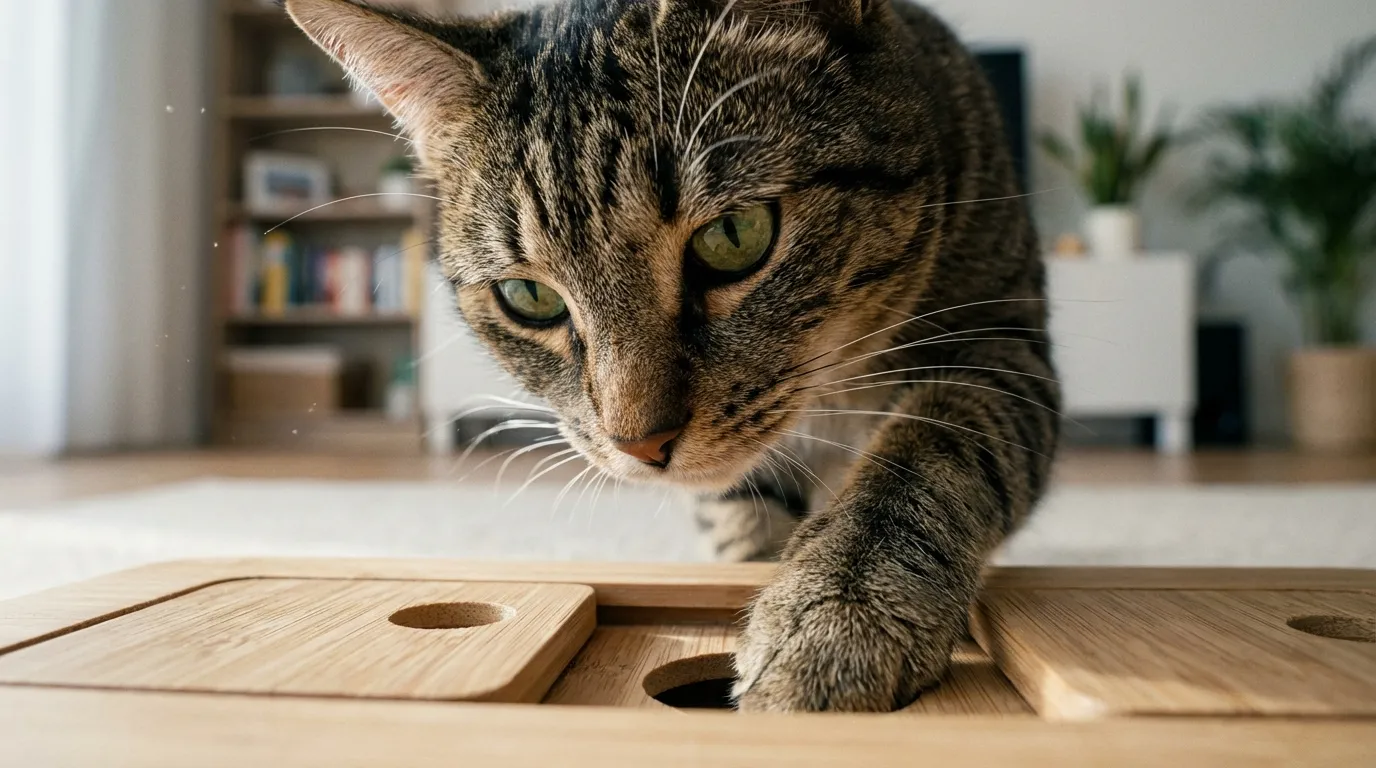
Most indoor cat owners think their cat is fine because it is eating, sleeping and not visibly sick. The cat often disagrees.
Indoor cat enrichment is the practice of providing physical activity, mental stimulation and sensory engagement to meet a cat’s natural instincts in a confined environment. Cats are hunters by biology, and a life without outlets for those instincts leads directly to boredom, stress and destructive behavior. According to the American Association of Feline Practitioners, environmental enrichment is one of the top preventable factors in indoor cat behavioral and health problems. Whether you call it indoor cat enrichment or house cat enrichment, the goal is the same: give a cat stuck inside four walls something to hunt, climb, scratch and watch.
My own cat spent the first year of her life knocking things off shelves and attacking my ankles at random. Adding two structured play sessions a day and a puzzle feeder at breakfast stopped both behaviors within ten days. It was not a personality problem. It was an enrichment problem.
This guide covers the most effective indoor cat enrichment ideas across every category: play, foraging, climbing, scratching, window stimulation, scent enrichment and DIY options that cost almost nothing. It also covers who needs something different, like kittens, senior cats and multi-cat homes, plus a full FAQ built from the questions readers actually ask. Every section links to a deeper resource so you can go as far as you need on any topic.
The best indoor cat enrichment ideas are daily interactive play with a wand toy for 15 to 30 minutes, a puzzle feeder at least once a day, a tall cat tree with a window view, a sisal scratching post and a window perch near a bird feeder. Rotating toys weekly keeps novelty high. These five elements combined meet a cat’s core instincts for hunting, climbing, scratching and observing.
Quick-Start Checklist: Indoor Cat Activities to Try This Week
If you only read one section, read this one. Here is every core indoor cat activity from this guide compressed into a checklist you can act on today.
- Play: One wand toy session in the morning, one in the evening before the last meal. 15 to 30 minutes total.
- Forage: A puzzle feeder or scattered kibble at least once a day instead of a bowl.
- Climb: A cat tree or shelf system that lets your cat get near ceiling height.
- Scratch: A sisal post at least 28 to 32 inches tall, placed near where your cat already scratches.
- Watch: A window perch, ideally with a bird feeder mounted outside the glass.
- Sniff: Catnip, cat grass or silvervine on rotation, a few times a week.
- Rotate: Swap out toys every 3 to 4 days and store the rest out of sight.
Cover those seven and you have addressed almost every enrichment deficit a vet or behaviorist would flag in a home visit. The rest of this guide breaks down each one, plus what to do if your cat’s situation is not the default: a kitten, a senior cat, or a multi-cat household.
Why Indoor Cat Enrichment Matters More Than Most Owners Realize?
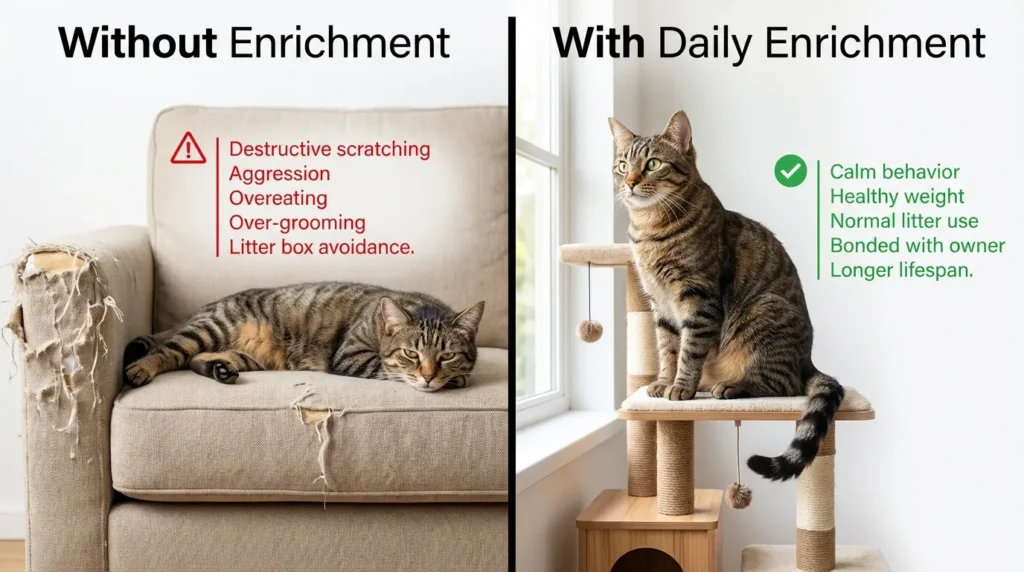
A cat without enough mental stimulation does not just get bored. It develops behavioral problems that most owners mistake for personality quirks. Excessive meowing, furniture destruction, aggression during handling and compulsive over-grooming are almost always enrichment deficits presenting as behavior problems.
The connection between enrichment and physical health is just as direct. Indoor cats without daily activity gain weight faster than outdoor cats, and obesity in cats raises the risk of diabetes, arthritis and joint problems that can take years off a cat’s life. Daily physical exercise through play and foraging keeps cats at a healthy weight without calorie restriction.
The good news: enrichment does not require expensive equipment or constant attention. Most of the highest-impact options cost very little and take under 15 minutes a day to set up. The results are visible within days, not months.
| INSIGHT
Every behavioral problem I have ever seen in an indoor cat had either a litter box cause or an enrichment cause. Before you assume your cat is aggressive or difficult, ask yourself honestly when you last had a genuine 15-minute play session with it. Not a laser pointer from the couch. Not a crinkle ball you tossed across the room. A real wand toy session where you made the toy behave like prey. Most “behavior problems” disappear within a week of consistent interactive play. |
Interactive Play: The Most Effective Indoor Cat Enrichment Idea
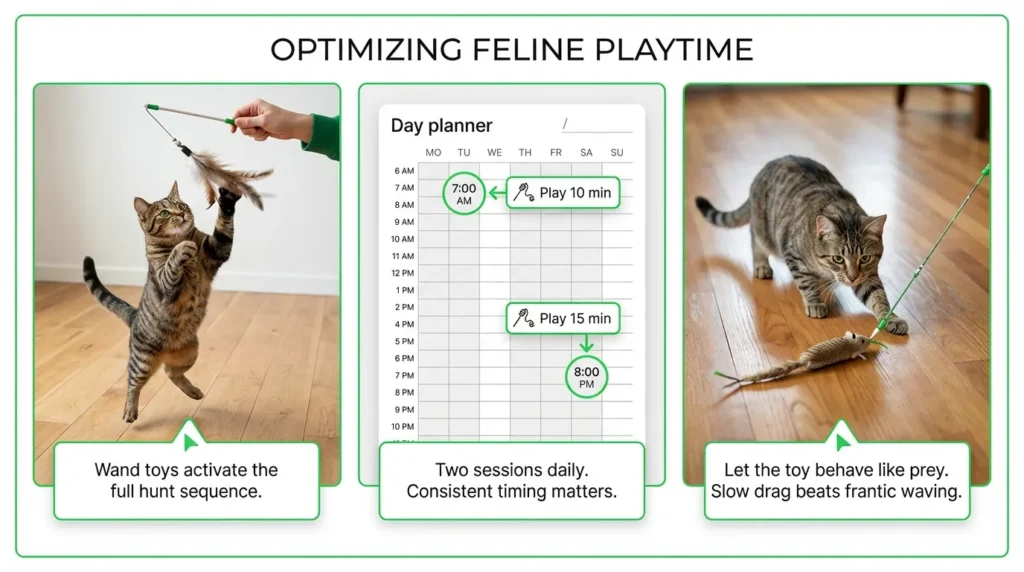
Interactive play is the single most important enrichment activity for an indoor cat, and it is the one most owners get wrong or skip entirely. A wand toy or feather on a string activates the full predatory sequence: stalk, chase, pounce, catch. That complete sequence is what discharges the hunting drive. Toys a cat bats at alone do not come close to it.
Fifteen to thirty minutes of active wand toy play a day is the target for adult cats. Split this into two sessions, one in the morning and one in the evening before the last meal. The evening session followed immediately by food mimics the natural hunt-catch-eat cycle, and it is the most reliable fix for nighttime activity and 3am waking.
The way you move the toy matters as much as the toy itself. Drag it slowly across the floor like a mouse moving through grass. Let it disappear under a blanket. Make it dart and freeze. Cats lose interest fast in toys that move in unrealistic patterns. Moving the toy like actual prey is the difference between a cat that plays for five minutes then walks away, and one that plays until it is genuinely tired.
Rotate toys every three to four days. Novelty matters more than variety. A toy your cat played with yesterday is much less interesting today. Keep four to six toys in rotation and store them out of sight between sessions. When you bring a stored toy back out, it registers as new prey to your cat’s brain.
| INSIGHT
The most common play mistake I see is waving the toy frantically in front of the cat’s face. That does not trigger hunting behavior. It triggers overstimulation. Drag the toy away from your cat, not toward it. Prey runs from predators. Your cat wants to chase and catch something that is trying to escape. Once you change the direction of movement, everything about how your cat plays changes. |
How Much Indoor Cat Activity Is Actually Enough?
This is the question behind most of the search traffic to this guide, and the honest answer is that it depends on age, health and whether your cat has a feline playmate. Use this table as a starting point, then adjust based on how your own cat responds.
| Life stage | Daily active play | Foraging | Notes |
| Kitten (under 1 year) | 30 to 45 minutes, in short 5 to 10 minute bursts | Easy puzzle feeders, low difficulty | Short attention span, needs supervision around small parts |
| Adult (1 to 10 years) | 15 to 30 minutes, two sessions | One puzzle feeder or foraging session daily | The baseline most of this guide is built around |
| Senior (10+ years) | 10 to 15 minutes, gentler pace | Simple, low-effort puzzles | Watch for arthritis; ramps instead of jumps |
| Multi-cat household | Individual sessions per cat, not just shared play | Separate stations to avoid resource guarding | Cats playing together does not replace hunting play with you |
If your cat is at the low end of its range and still showing signs of boredom, the fix usually is not more time. It’s better technique: real stalk-and-pounce movement instead of a toy waved overhead, or a harder puzzle feeder instead of a longer session with an easy one.
Puzzle Feeders and Food Enrichment for Indoor Cats
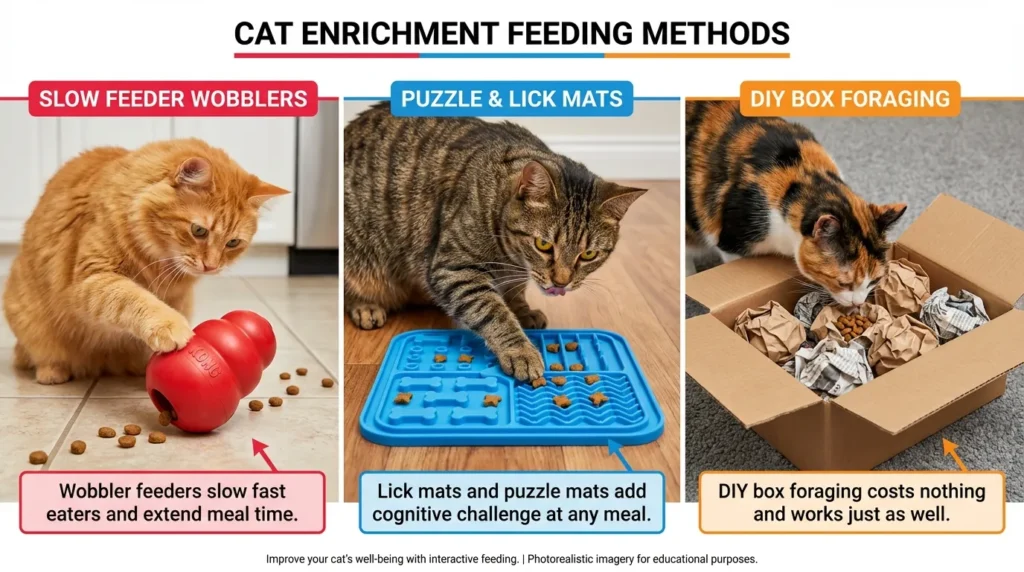
Puzzle feeders are one of the most underused indoor cat enrichment tools available. Cats in the wild spend four to six hours a day actively seeking food. A house cat that gets its meal delivered to a bowl in 30 seconds has all that hunting energy with nowhere to go. Puzzle feeders redirect it somewhere useful.
Food enrichment does more than occupy time. Cats that work for food eat more slowly, which cuts down on vomiting in fast eaters and supports better digestion. Puzzle feeding also helps with weight management, since the extra effort makes a smaller portion feel more satisfying.
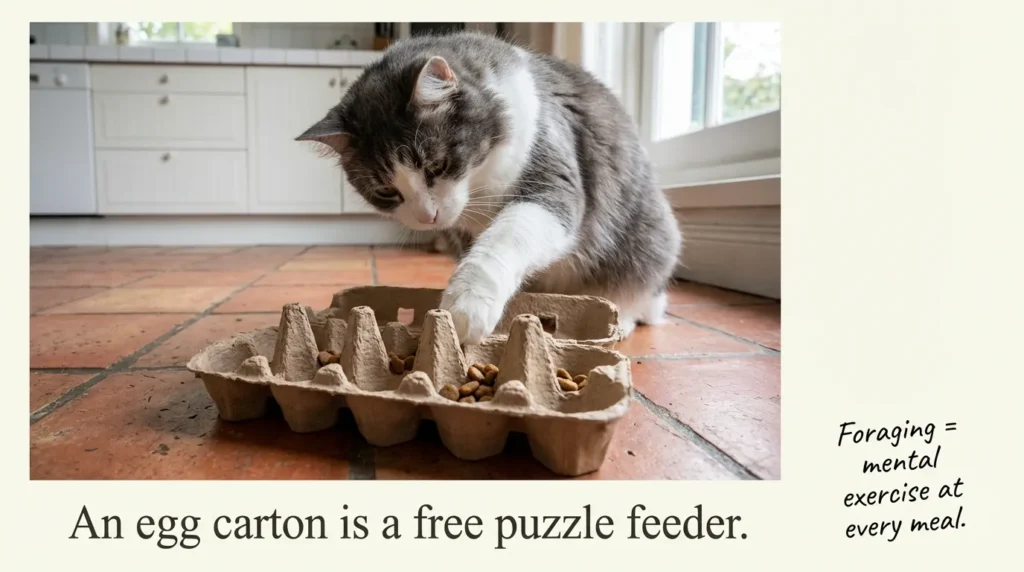 You do not need to buy anything to start foraging enrichment. Scatter a portion of dry food across a bath mat so your cat has to search for each piece. Hide small piles of kibble in different rooms and let your cat find them. Place dry food inside a crumpled paper ball or an egg carton. These free options give the same cognitive stimulation as commercial puzzle feeders.
When you introduce puzzles for the first time, make them easy. If the food is too hard to reach, the cat gives up and learns to ignore the feeder. Start with pieces your cat can get out with minimal effort, then increase difficulty over one to two weeks as your cat builds the skill and the confidence to keep trying.
Puzzle Feeder Types Compared
| Type | Cost | Difficulty | Best for |
| Scatter feeding on a mat | Free | Very easy | First-time puzzle feeders, kittens |
| Egg carton or muffin tin | Free | Easy to moderate | Dry food, budget setups |
| Roller or ball feeder | $8 to $20 | Moderate | Cats that like batting and chasing |
| Tiered or maze puzzle | $15 to $35 | Moderate to hard | Confident foragers who need a challenge |
| Wet food lick mat or puzzle | $10 to $25 | Easy | Slow feeding, anxious eaters |
Vertical Space and Climbing: Why Height Changes Everything for Indoor Cats
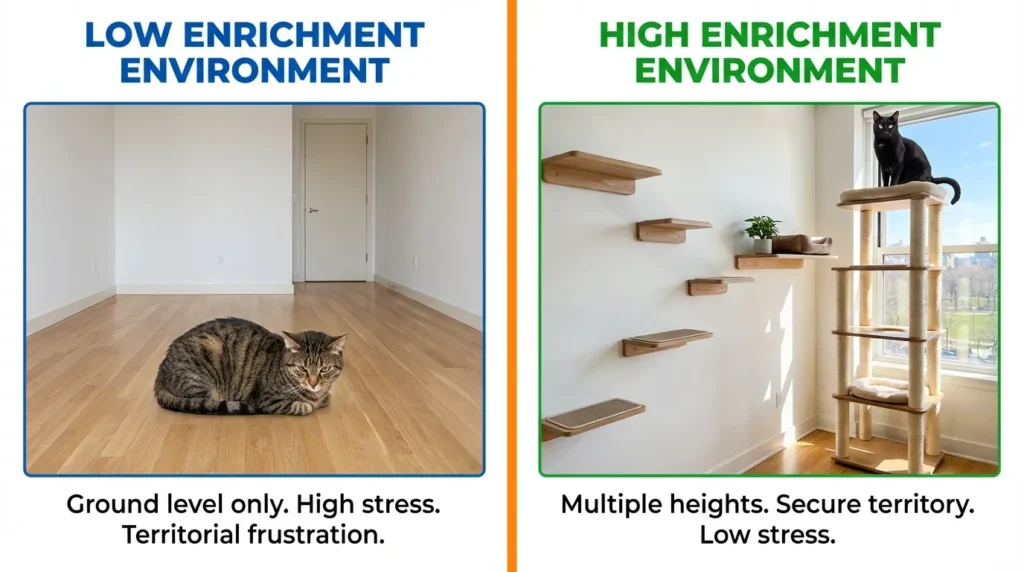
Cats are vertical animals. In the wild they climb to watch their territory, escape threats and rest safely. A cat with no elevated surfaces at home is denied one of its most basic behavioral needs. This is one of the most common, and most overlooked, apartment cat problems.
A cat tree tall enough to reach near the ceiling is the single most impactful enrichment purchase for a small apartment cat. Height gives your cat control over its space. A cat that can survey a room from above is a calmer cat. The territorial outlet alone reduces inter-cat tension in multi-cat households and cuts down on the compulsive patrolling behavior a lot of apartment cats show.
Wall-mounted cat shelves are a space-efficient alternative to floor-standing cat trees. A series of shelves staggered at different heights creates what is sometimes called a cat highway, giving your cat a full climbing circuit without giving up floor space. Shelves work in a bedroom, hallway or living room, and most cats use them daily once they find the route.
If budget is tight, a cleared bookshelf top or the top of a stable wardrobe works as a starting point. Your cat does not care whether the surface was designed for cats. It cares whether it is stable, accessible and high enough to give a real vantage point.
Window Enrichment and Sensory Stimulation for Apartment Cats
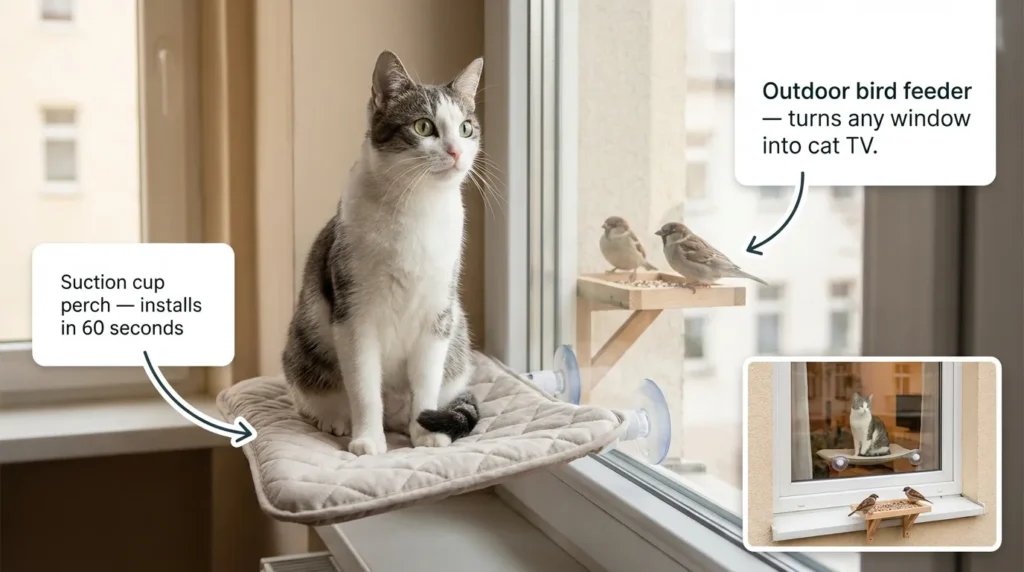
A window perch with an outdoor view is the highest-value low-cost enrichment option for any apartment cat. Birds, squirrels, passing pedestrians and wind-moved plants give continuous visual stimulation that commercial toys cannot replicate. Cats can watch a window for hours without any input from you.
A suction-cup window perch costs $15 to $30 and installs in under two minutes. Mount a basic platform bird feeder with seed on the outside of the same window and you have turned your apartment window into what cat behaviorists call sensory stimulation television. Birds land within inches of your cat’s face, separated only by glass. The combination of sight, sound and movement keeps most cats engaged for long stretches every day.
Catnip, cat grass and silvervine offer a different kind of sensory enrichment through scent. Most cats respond to catnip with 5 to 15 minutes of active rolling, rubbing and vocalizing, followed by a calm period. Silvervine produces a stronger, longer response in cats that don’t react to catnip. Neither is harmful, and both give a reliable burst of sensory enrichment that takes no effort from you once it’s set up.
| INSIGHT
A $20 platform bird feeder mounted outside a window is the single highest-ROI enrichment purchase I have ever recommended. Your cat gets hours of stimulation a day from it. You never have to participate. Birds show up on their own schedule. Buy one for every window that gets morning or afternoon light, and your cat will have enrichment running in the background of every day without you doing anything after the initial setup. |
Scratching Posts and Marking Surfaces: Enrichment You Cannot Skip
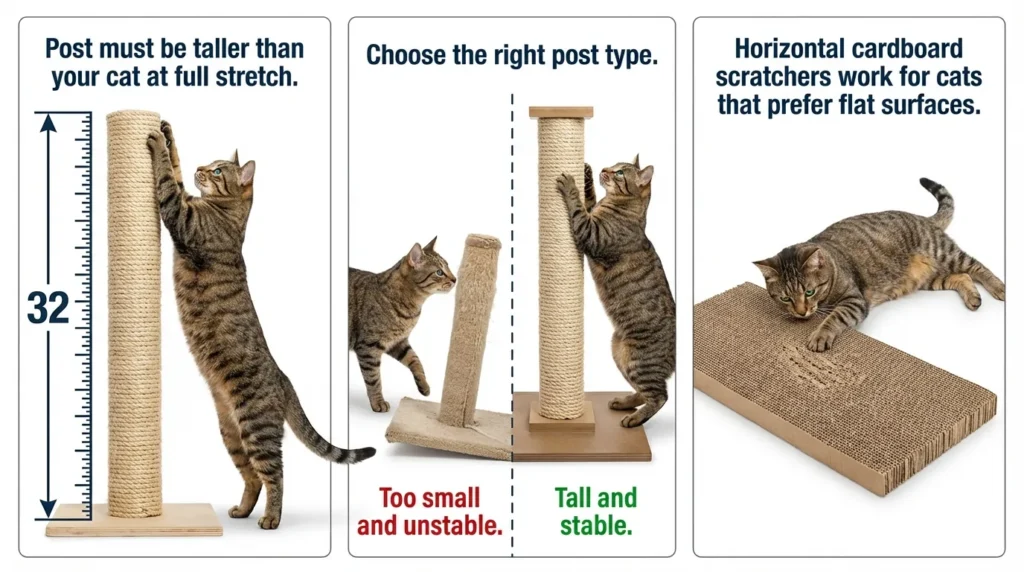
Scratching is not a problem to manage. It is a biological need cats have to maintain their claws, remove dead claw sheaths and mark territory through the scent glands in their paw pads. A cat without a sanctioned scratching surface will create one on your furniture, not out of spite but out of necessity.
The most important spec for a scratching post is height. The post has to be tall enough for your cat to scratch at full vertical stretch, typically 28 to 32 inches for an adult cat. Most posts sold in pet stores are too short. A cat that cannot reach full stretch on a post will find a door frame or sofa arm that lets it do so.
Scratching Surface Materials, Side by Side
| Material | Why cats like it | Downside |
| Sisal rope | Texture is closest to real tree bark; most effective for most cats | Costs more than carpet-covered posts |
| Carpet | Cheap and widely available | Feels like household rugs, which can encourage scratching the actual carpet |
| Corrugated cardboard | Cheap, satisfying shred texture, easy to replace | Wears out fast, best as a supplement not the only post |
| Bare wood or logs | Natural, appeals to some cats over rope | Splinters over time, needs sanding or replacement |
If you only buy one scratching item, make it a tall, stable sisal post.
Placement matters as much as the post itself. Cats scratch to mark territory, so they scratch in visible, prominent spots near resting areas and room entrances. Put the post next to the furniture they are already scratching and they will switch to it within days. Move it to a corner and they will likely ignore it.
Free DIY Indoor Cat Enrichment Ideas That Actually Work
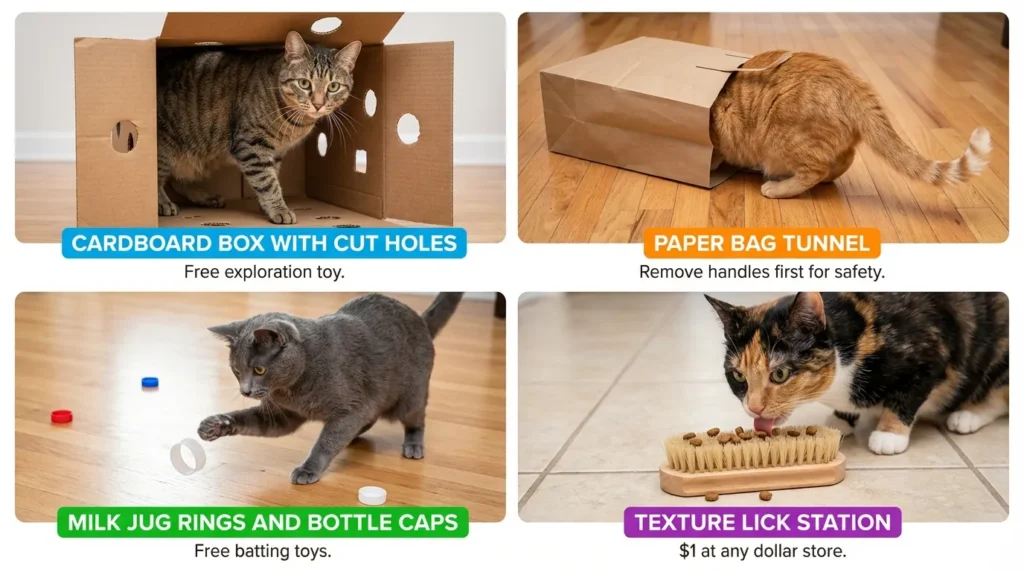
Some of the most effective cat enrichment activities cost nothing. A cardboard box with holes cut in the sides is a hiding spot, an exploration tunnel and a scratching surface all in one. Cats that have never shown interest in commercial toys will often spend an hour investigating a new cardboard box, because it smells different and has an unfamiliar shape.
Paper bags with the handles removed make good temporary tunnels. Crinkle paper stuffed loosely into a box gives cats something to dig and hunt through. A toilet paper roll crimped on both ends and filled with a few pieces of dry food is a free puzzle feeder that takes thirty seconds to make. These free options are sometimes more engaging than expensive commercial products, simply because they’re novel and disposable.
Rotating the free options matters as much as rotating commercial toys. Make a new cardboard box setup every week or two. Introduce a new paper bag. Rearrange the furniture slightly so your cat has new surfaces and angles to explore. Novelty drives cognitive enrichment more reliably than any single toy, no matter how expensive.
| INSIGHT
I spent years buying cat toys only to watch my cat ignore every single one while obsessing over the shipping box they came in. The cardboard box lesson applies universally: cats want to investigate new things in their environment, not objects that have been sitting in the same corner for three weeks. Free and rotating beats expensive and permanent. Build a rotation habit and most cats stay consistently engaged. |
Enrichment for Multi-Cat Households
[Suggested new image: two indoor cats using separate window perches and separate puzzle feeders in the same room]
Two cats do not need double the enrichment. They need enrichment set up so neither cat has to compete for it. Resource guarding around toys, perches and food puzzles is one of the most common causes of tension between cats that otherwise get along.
- Set up duplicate stations. Two window perches, two scratching posts, two feeding areas, placed far enough apart that a confident cat cannot block both at once.
- Play with each cat separately at least some of the time. Chasing another cat around the house is exercise, but it is not the same as the stalk-pounce-catch sequence of wand toy play. Most multi-cat households still see behavior problems in one cat that simply is not getting one-on-one hunting play.
- Give the more anxious cat a head start on vertical space. If one cat dominates the cat tree, add a second climbing option in a different room so the less confident cat has somewhere to retreat that is not the floor.
- Watch for feeder guarding. If one cat consistently blocks another from a puzzle feeder, separate the stations by room, not just by a few feet.
A feline companion helps with loneliness and some play, but it supplements human-provided enrichment. It does not replace it. For a deeper look at whether a second cat is the right call in the first place, see our guide on does indoor cat need a companion.
Cat Wheels, Catios and Other Advanced Enrichment Options
[Suggested new image: cat exercise wheel next to a small catio enclosure attached to a window]
Once the basics are covered, some owners want to go further, especially with high-energy breeds or cats recovering from serious under-stimulation. These are the next-level options, in rough order of cost and commitment.
- Cat exercise wheels. Run around $150 to $300 and take real training time, usually a few weeks of treat-based conditioning before a cat will use one on its own. Best suited to young, high-energy cats, not a fix for a cat that just needs more play time.
- Catios. An enclosed outdoor structure attached to a window or door that gives real outdoor air, smells and sounds with zero escape risk. Cost ranges from a simple $100 window box to a multi-hundred-dollar walk-in enclosure. This is the closest thing to outdoor access without the risks of letting a cat roam free.
- Harness and leash walks. Not every cat will tolerate a harness, but for the ones that do, short supervised walks add sensory variety a window cannot. Start indoors with the harness on for a few minutes a day before attempting an actual walk.
- Clicker training. A five-minute session teaching a cat to target a stick, sit, or high-five is genuine mental enrichment and it strengthens the bond between cat and owner. It also makes vet visits and nail trims easier down the line.
None of these are required. They are worth considering only after the core five (play, forage, climb, scratch, watch) are already solid and your cat is still asking for more.
Everything We Cover on Indoor Cat Enrichment: Your Full Resource Library
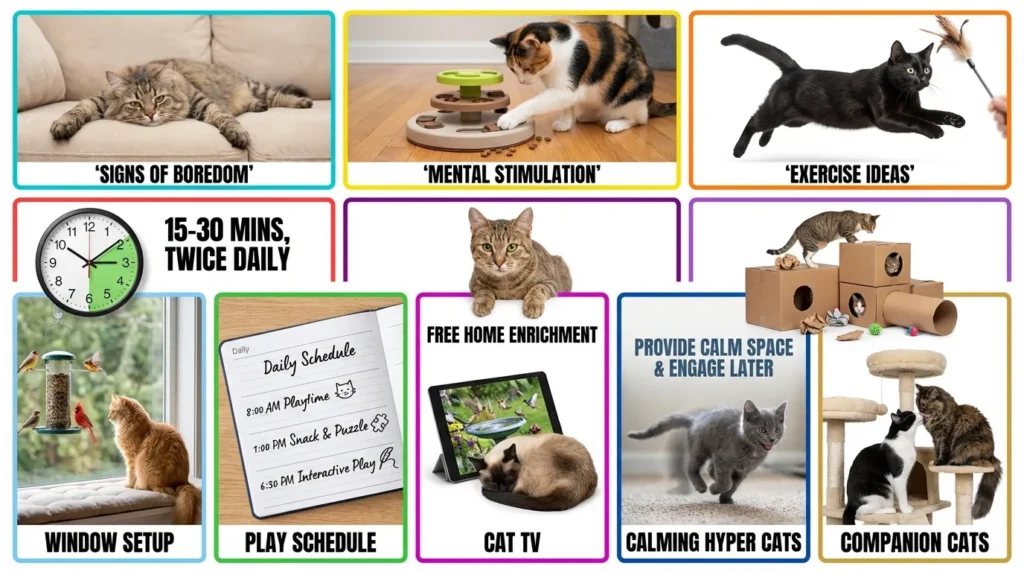
Start with the one that matches the problem you are dealing with right now.
Signs Your Indoor Cat Is Not Getting Enough Enrichment
Most cats do not announce that they are understimulated. The signs show up as behavioral changes that are easy to misread as personality. This article covers the specific physical and behavioral signs that tell you clearly when your cat needs more stimulation, and what each sign is actually communicating.
If you have noticed changes in your cat’s behavior but cannot pinpoint the cause, this is the right starting point. Find the full list of warning signs in our article on signs indoor cat is bored.
How to Mentally Stimulate an Indoor Cat Every Day?
Physical play addresses energy. Mental stimulation addresses the thinking and problem-solving side of a cat’s natural behavior, and it takes a different set of activities. This article walks through the specific cognitive enrichment techniques that engage your cat’s brain separately from its body.
For the complete practical guide with step-by-step implementation, see our article on how to mentally stimulate indoor cat.
How to Exercise an Indoor Cat in a Small Apartment?
Exercise for indoor cats looks different from exercise for dogs, and the techniques that work in a small apartment are not obvious. This article covers the specific activity types that give a cat genuine physical exertion in a limited space and explains why most owners underestimate how little floor space you actually need.
Get the full apartment-friendly exercise plan in our guide on how to exercise indoor cat.
How Many Hours a Day Should You Play With an Indoor Cat?
The answer depends on your cat’s age, energy level and whether it has a feline companion at home. Getting the number right matters, because too little causes behavioral problems and too much can overstimulate sensitive cats. This article gives you the specific numbers by age group and tells you exactly how to read your own cat’s signals.
Find the right number for your cat in our guide to how many hours to play with indoor cat.
Free Cat Enrichment Ideas You Can Set Up at Home Today
Not every enrichment solution requires a budget. This article focuses entirely on setups that cost nothing or under $5, using items most owners already have at home. Every idea in it has been used by real cat owners in real apartments with consistently positive results.
See every free setup with step-by-step instructions in our article on free cat enrichment ideas at home.
How to Set Up a Window for Your Indoor Cat?
The window setup is one of the most impactful enrichment decisions you can make for a cat in a small space, and most owners set it up wrong by skipping the outdoor element. This article covers the exact hardware involved, how to mount a bird feeder safely on rental windows and which window orientations get the best results.
Build the ideal window setup using our full guide to window setup for indoor cat.
Indoor Cat Play Schedule: How to Structure Your Cat’s Day?
A play schedule is the most reliable behavior management tool available to any indoor cat owner. This article gives a complete hour-by-hour template built around a working adult’s typical day, with specific guidance on timing, duration and how to sequence play against feeding for maximum benefit.
Download the full schedule template and implementation guide in our article on indoor cat play schedule.
Cat TV: Do Cats Actually Benefit From Watching Videos?
Cat TV videos of birds and squirrels have millions of views and strong opinions on both sides. The answer on whether they genuinely benefit cats is more nuanced than most articles suggest. This article looks at what the evidence shows about visual stimulation from screens versus windows, and when cat TV helps versus when it just causes frustration.
Get the full honest answer in our article on cat tv do cats watch it.
How to Calm Down a Hyper Indoor Cat
A hyper indoor cat is almost always an under-enriched indoor cat expressing pent-up predatory energy in the only ways available to it. This article identifies the specific root causes of hyper behavior in apartment cats and lays out a structured seven-day reset plan that works on cats of any age.
Start the seven-day reset with our full guide on how to tire out hyper indoor cat.
Does an Indoor Cat Need a Companion?
A second cat is not the right solution for every enrichment problem, and it is not the right solution for every cat. This article looks at the specific circumstances where a feline companion genuinely improves an indoor cat’s quality of life, versus situations where a second cat adds more stress than it resolves.
Get the full honest assessment in our guide to does indoor cat need a companion.
| INSIGHT
The articles above are the specific deep dives for every enrichment topic this guide covers at a high level. If your cat is doing zoomies at midnight, the hyper cat article is your starting point. If your cat stares at the wall for hours, the mental stimulation article will tell you exactly what is missing. You will find everything you need across IndoorLivingCat.com, a site built entirely around the specific challenges of keeping cats happy in small spaces. Every article linked above will also link back to this guide, so you can always return to the full picture after reading about a specific topic. |
The Biggest Indoor Cat Enrichment Mistakes Owners Make
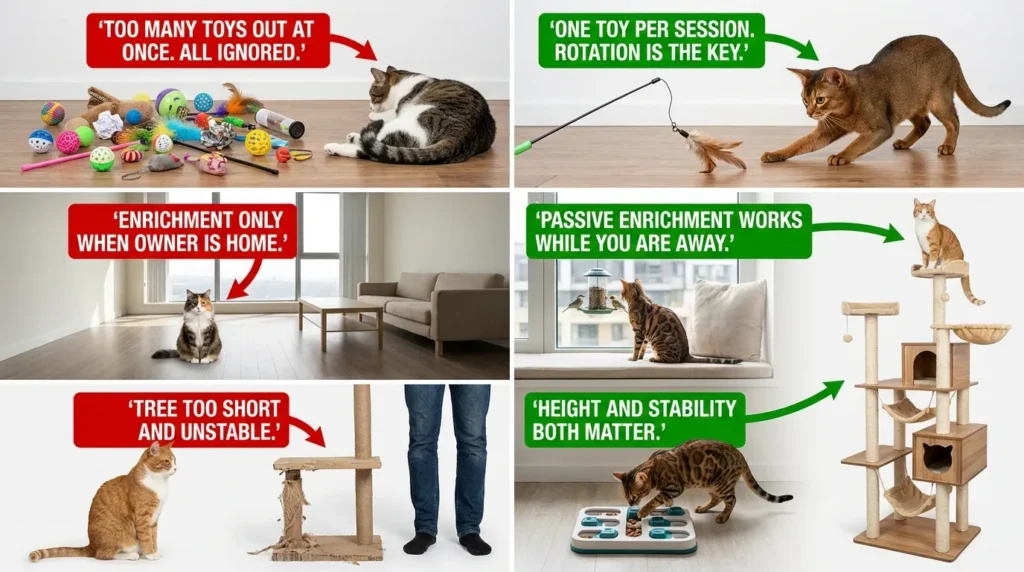
The most common indoor cat enrichment mistake is leaving too many toys out at once. When every toy is always available, they stop registering as interesting. Your cat is not ignoring toys because it dislikes playing. It is ignoring them because familiarity has made them invisible. Rotate every three to four days and store toys completely out of sight between sessions.
The second most common mistake is assuming enrichment only counts when the owner is present. Passive enrichment through window setups, puzzle feeders and foraging stations works constantly, whether you are home or not. A cat left alone for eight to ten hours with zero passive enrichment is a cat that stress-accumulates all day. One window perch and one foraging setup changes that completely.
The third mistake is buying the wrong cat tree. A tree that is too short does not meet the vertical territory need it is supposed to address. A wobbly tree gets used once, then permanently avoided, because cats do not trust unstable surfaces. Buy tall and sturdy the first time. A well-built 60-inch cat tree will outlast a decade of cheap replacements.
Frequently Asked Questions About Indoor Cat Enrichment
How much playtime does my indoor cat need each day?
Adult indoor cats need a minimum of 15 to 30 minutes of active interactive play every day, split into two sessions. Kittens and young adults under two years need closer to 30 to 45 minutes across two or three sessions. The evening session should happen right before the last meal of the day. Cats that get consistent daily play sleep through the night more reliably than cats with inconsistent play.
How do I know if my indoor cat is not getting enough enrichment?
The key signs are: destructive scratching on furniture instead of provided posts, unprovoked aggression or biting during normal handling, excessive vocalizing especially at night, compulsive over-grooming with visible hair loss, litter box avoidance without a medical cause, and extreme lethargy beyond the normal 12 to 16 hours of daily sleep. Any three of these appearing together strongly suggest an enrichment deficit. This article is for informational purposes only. Consult your vet to rule out medical causes before assuming a behavioral root.
What is the single best enrichment investment for an apartment cat?
A tall, stable cat tree positioned near a window with an outdoor bird feeder mounted outside gives your cat vertical territory, a constant source of visual stimulation and a resting spot that meets multiple needs at once. If you can only buy one item, this combination delivers the highest enrichment value per dollar. Add a single wand toy for interactive play and you have covered the three most important categories.
What is the best free enrichment for a house cat?
Scatter feeding is the single best free option: spread a portion of the daily kibble across a bath mat or muffin tin instead of using a bowl. It costs nothing, takes thirty seconds to set up, and gives the same foraging benefit as a $25 puzzle feeder. Pair it with a rotating cardboard box for exploration and you have covered foraging and enrichment for free.
Can window watching replace interactive play for indoor cats?
No. Window watching gives passive visual stimulation that addresses the observing instinct. It does not replace the physical exertion and predatory sequence that interactive play provides. A cat that watches birds all day but never plays is still under-exercised. Both are needed and they serve different biological functions. Treat window watching as background enrichment and interactive play as the active session.
Why is my indoor cat hyper and active late at night?
Cats are naturally crepuscular, meaning most active at dawn and dusk. An indoor cat that gets no active stimulation during the day accumulates energy that has to go somewhere, and it usually goes into nighttime zoomies, vocalizing and destructive activity. The fix is consistent daytime and evening play sessions combined with a meal right after the final evening session. Most cats calm down at night within five to seven days of a structured play-then-feed evening routine.
Do indoor cats need enrichment if they have another cat to play with?
Yes, but the type and amount shifts. Two cats that actively play together meet part of each other’s physical and social needs. They still need hunting simulation through wand toys, though, since chasing another cat does not fully replicate prey behavior. They still benefit from puzzle feeders, vertical space and window stimulation. A feline companion supplements enrichment. It does not replace structured, human-provided enrichment entirely.
Do senior cats need enrichment too?
Yes, though it looks different. Senior cats often deal with arthritis or reduced mobility, so swap high jumps for ramps and low-step cat trees, keep play sessions shorter and gentler, and stick to easy puzzle feeders rather than difficult ones. Mental stimulation matters even more for senior cats, since cognitive decline is a real risk. A daily five-minute scent enrichment session with catnip or a low-effort foraging mat is often enough.
Is a cat exercise wheel worth buying?
For a young, high-energy cat that is not satisfied by standard play, yes. For most cats, no. A wheel costs $150 to $300 and needs weeks of training before a cat uses it independently. Most enrichment problems are solved by consistent wand toy play and a puzzle feeder at a fraction of the cost. Consider a wheel only after the core basics are already in place and your cat is still clearly under-stimulated.
The One Enrichment Change That Makes the Biggest Difference
Good indoor cat enrichment comes down to three consistent actions: daily interactive play with a wand toy for 15 to 30 minutes, a foraging option at least once a day whether that’s a puzzle feeder or scattered kibble, and a window setup that gives your cat passive stimulation while you are away. These three habits address the hunt, eat, climb and observe instincts that define feline biology.
If you are not sure where to start, begin with play. It is the fastest and most measurable change you can make, and results show up in behavior within days. Our article on the indoor cat play schedule gives you a complete daily template you can start using today without buying anything.
Everything else in this guide is covered in detail in the resource library above. You now have the full picture of indoor cat enrichment, and exactly where to go for each specific topic.
Indoor cats need 15 to 30 minutes of daily interactive play with a wand toy, split into two sessions. Puzzle feeders at one meal a day fulfill the natural foraging instinct and reduce obesity risk. A cat tree of at least 60 inches provides the vertical territory that reduces stress. Window perches combined with outdoor bird feeders give passive sensory stimulation. Rotating toys every three to four days keeps novelty and engagement high. Multi-cat homes need duplicate stations and individual play time, not just shared toys. Senior cats need the same core habits at a gentler pace. Insufficient enrichment causes destructive behavior, aggression and compulsive over-grooming in indoor cats, whatever you want to call the fix: indoor cat enrichment, house cat enrichment, or just giving your cat something to do.