
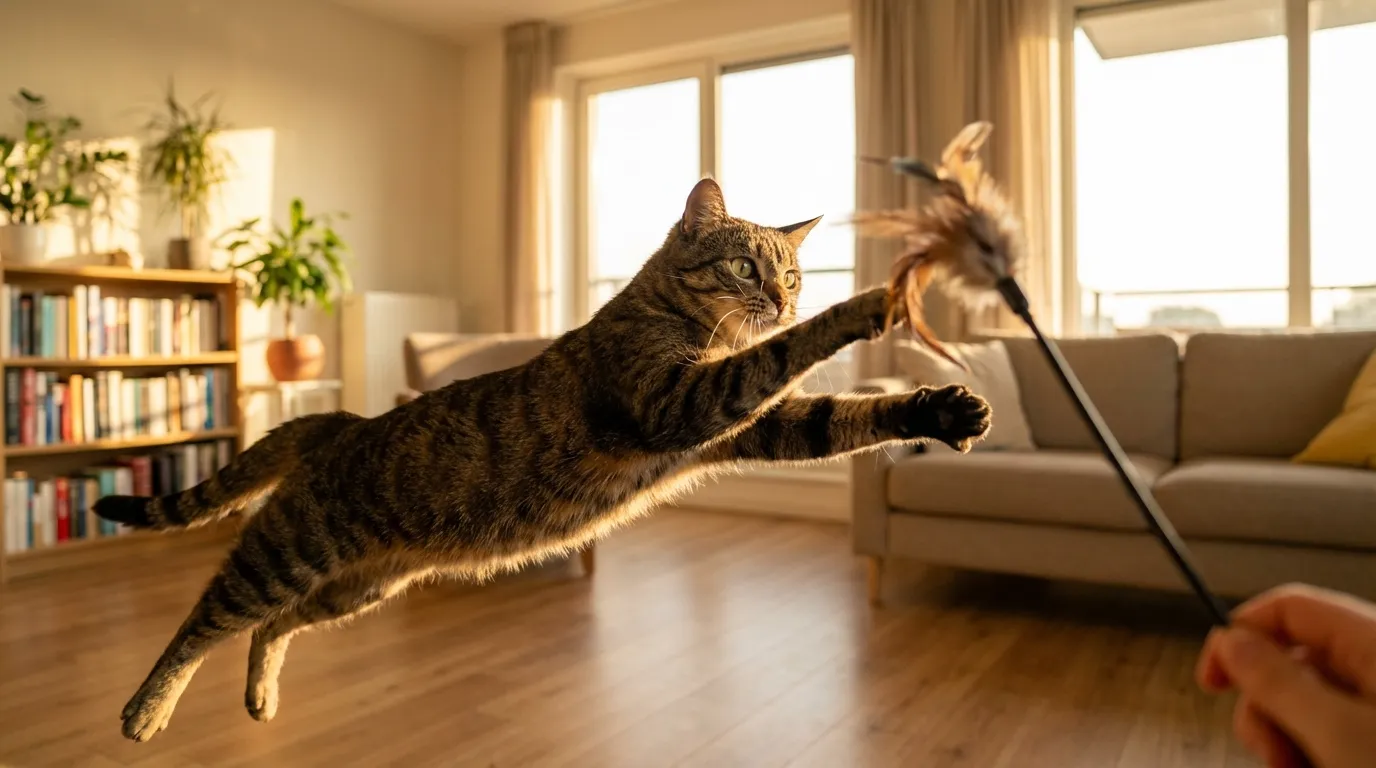
My cat spent two weeks knocking everything off every surface in the apartment, and I spent those two weeks assuming she was being dramatic. She wasn’t. She’d gone weeks without a real outlet for her hunting drive, and the shelf-clearing was her way of making her own prey. Most owners search how to mentally stimulate an indoor cat only after the scratched furniture, the 3am racing or the bald patch has already shown up.
The fix doesn’t need expensive gear or an hour a day. It needs a few small habits built around what a cat’s brain is set up to do: stalk, chase, catch, eat, groom, sleep, and watch the territory from somewhere high. This guide covers eight methods, a free seven-day starter plan, and how to adjust for kittens, seniors, multi-cat homes and owners who are out all day.
The Short Answer: Five Changes That Work Fastest
The most effective ways to mentally stimulate an indoor cat are interactive wand play for fifteen minutes twice a day, a puzzle feeder or scatter feeding in place of at least one bowl meal, a window perch with an active outdoor view, a weekly toy rotation, and at least one tall climbing surface. Most owners see calmer behavior within a week of doing all five. Cats with long-standing habits like night zoomies can take two to three weeks.
This guide is part of our broader indoor cat enrichment series, which sits under our full indoor cat care guide if you want the picture beyond mental stimulation alone.
Eight Methods at a Glance
| Method | Time cost | Effort level | Best for |
|---|---|---|---|
| Interactive wand play | 15 min, twice daily | Active | Every cat, especially energetic ones |
| Puzzle feeders | Replaces one meal | Low | Food-motivated cats, owners who work |
| Vertical space | One-time setup | Low | Small apartments, shy cats |
| Window perch and feeder | 5 min setup, passive after | Passive | Cats home alone all day |
| Clicker training | 5 min, 3x weekly | Active | Smart, treat-driven cats |
| Toy rotation and scent enrichment | 2 min weekly | Low | Cats that ignore their toys |
| Daily structure | About 30 min a day total | Combined | Anyone who wants lasting results |
| Leash walks and cat wheel | 10 to 20 min, as desired | Active, optional | High-energy or overweight cats |
Why Your Indoor Cat Needs Mental Stimulation More Than You Realize
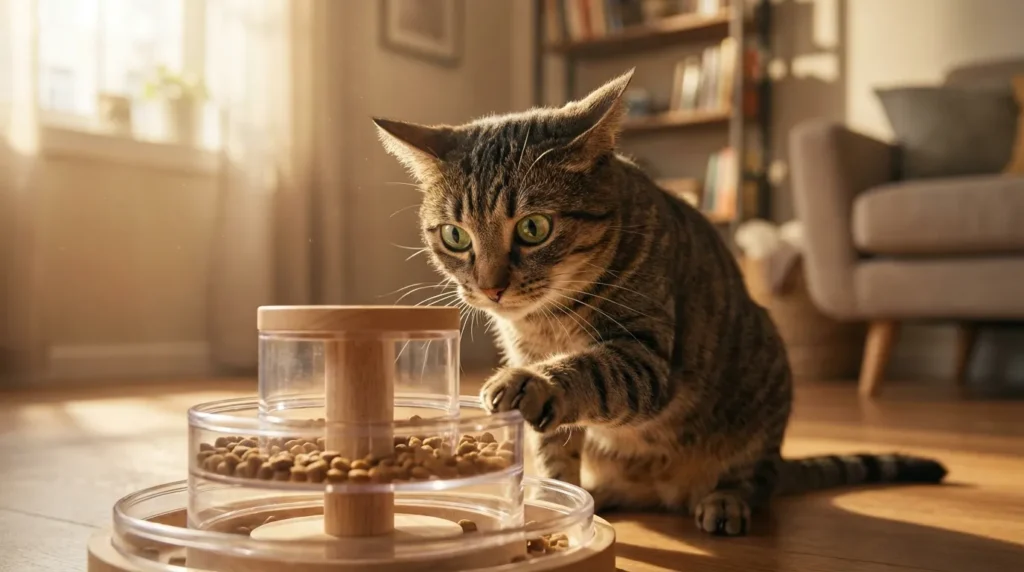
A house cat has the same predatory wiring as her wild relatives. She needs to hunt, stalk, solve problems and investigate new territory most days, and an apartment hands her none of that on its own. The AAFP and ISFM feline environmental needs guidelines treat opportunities for play and predatory behavior as one of five pillars of a healthy environment for exactly this reason. When the pillar is missing, the problem behaviors that follow are usually a symptom of that gap, not a character flaw.
Watch for these signs your cat needs more stimulation:
- Scratching furniture beyond the scratching post
- Racing through the apartment at 3am
- Knocking objects off shelves and counters
- Overgrooming, including bald patches
- Vocalizing more than usual for no clear reason
- Overeating or begging right after a full meal
- Following you from room to room and pawing for attention
- Ambushing ankles or other pets
One of these now and then is normal. Several together, or a pattern that’s getting worse, points to an unmet need. Skip to the vet section first if the change was sudden.
Cognitive enrichment is what separates a stimulated indoor cat from a bored one. Running laps exercises the body. A full hunting sequence through wand play works the brain, the reward system and the body together. Over weeks, that gap shows up as a settled cat or one that screams at 3am.
Good indoor cat health covers more than food and vet visits. Chronic stress and a barren environment are both linked to feline idiopathic cystitis, overgrooming and stress-related digestive upset, so enrichment works as prevention as well as behavior management. For the wider view across every enrichment category, see the broader picture of indoor cat enrichment.
How Much Mental Stimulation Does an Indoor Cat Need?
Plan on about 30 minutes of active, owner-led play a day, split into two sessions, plus passive enrichment running in the background. Passive options like window watching add to that total but don’t replace it. Needs shift with age and personality, so treat the numbers below as a starting point and adjust to your cat.
| Life stage | Play sessions | What to adjust |
|---|---|---|
| Kitten (under 1 year) | Three to four short sessions of 5 to 10 min | Brief attention span, so go short and often. Use soft toys they can’t swallow in pieces. |
| Adult (1 to 10 years) | Two sessions of about 15 min | Raise puzzle difficulty as she masters each level. |
| Senior (10+ years) | Two to three gentler sessions of 5 to 10 min | Low-impact movement, ramps or steps to perches, more scent and food puzzles. |
For the exact session structure by age, see our guide on how many hours to play with an indoor cat.
Method 1: Interactive Play That Completes the Hunting Sequence
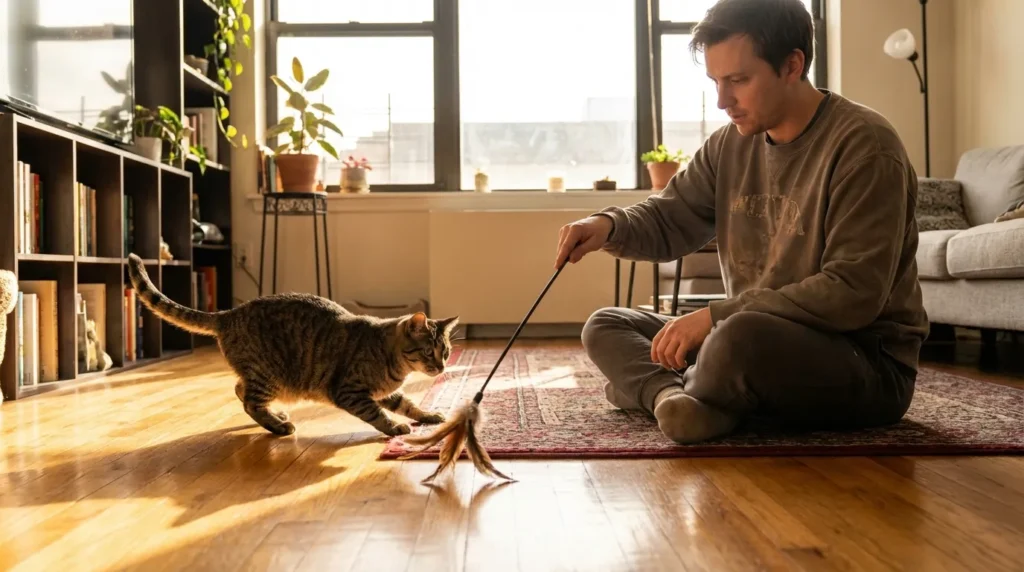
Interactive play is the most useful method here, and the one people most often do wrong. Dangling a toy and twitching it while you watch TV gives a cat almost nothing. Real prey moves in short bursts low to the ground, freezes, and vanishes behind something before it reappears. Copy that.
Sequence beats duration. A complete hunt covers stalking, chasing, pouncing and catching, and the catch is the part most owners skip. Let her grab the toy and hold it for thirty seconds, then give a small food reward so the hunt, eat, groom, sleep pattern her body expects gets finished.
Here’s a session that works:
- Start with the toy hidden or barely moving so she has to find it.
- Drag it away from her in short bursts, low to the floor, with pauses.
- Let her chase for a minute or two, then slow down as she tires.
- Let her catch it and hold it. Don’t yank it back.
- Finish with a few treats or a small meal, then put the wand away out of reach.

Schedule sessions around dawn and dusk when you can. Cats are crepuscular, so their energy peaks twice a day regardless of the apartment they live in. Play timed to those peaks tends to cut midnight zoomies and ankle-biting within a week or so of steady practice. Play at the wrong time and you’re working against her body clock.
Put wand toys away after every session. String, ribbon and feathers can be swallowed, and a linear foreign body is an emergency.
What About Laser Pointers?
A laser gives movement with no catch, and a hunt that never resolves can build frustration instead of releasing it. If you use one, end every session with a wand toy or a treat toss so she gets a real catch. Some cats also start chasing shadows and reflections afterward, so watch for that.
Method 2: Puzzle Feeders That Turn Every Meal Into Brain Work
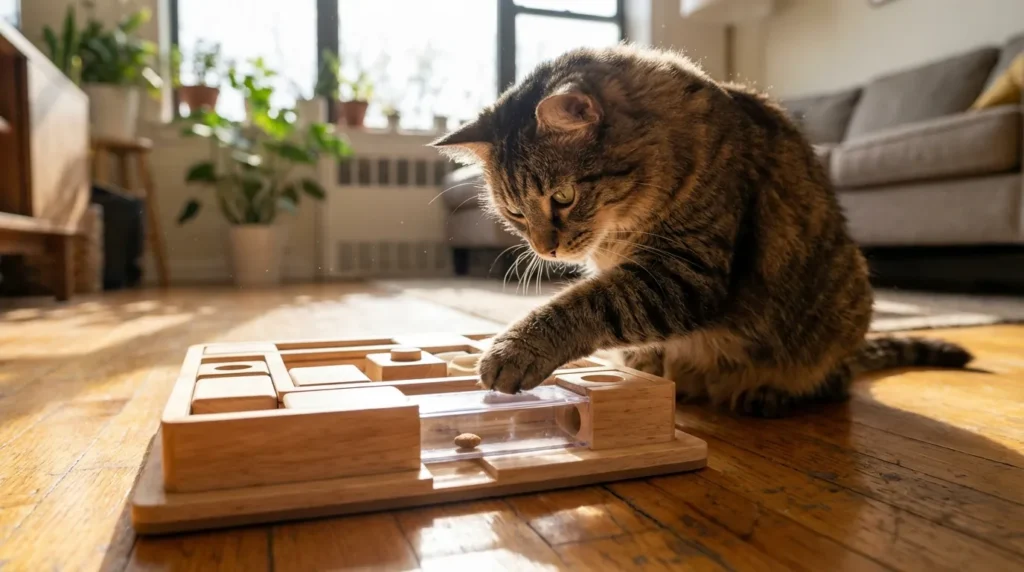
A cat eating from a bowl can finish in under a minute with no thinking involved. Working kibble out of a puzzle feeder for ten minutes asks her to search, problem-solve and use her paws, the way hunting does. Many owners report calmer behavior and less begging after switching, and food puzzles are widely recommended by feline behavior groups for that reason.
Start easy. Move up a level only once she solves the current one within about two minutes without frustration. If she walks away, the puzzle is too hard. Drop the difficulty instead of assuming she isn’t interested. Count puzzle food toward her daily portion, and feed multi-cat homes in separate spots so nobody guards the feeder.
Free DIY Puzzle Feeders
You don’t need to buy anything to start. These work almost as well as store-bought on day one:
- Cardboard tube challenge: stand empty toilet paper rolls upright in a shallow box, drop kibble into some of them, and let her fish it out with a paw.
- Egg carton puzzle: put kibble or treats in a few compartments of an empty carton, cover it loosely with scrunched paper, and let her paw her way in.
- Scatter feeding: hide small amounts of dry food in five spots around the apartment before each meal.
How you feed shapes her daily rhythm. Everything about how to feed an indoor cat properly feeds directly into enrichment, since foraging and feeding routine run on the same behavioral system.
Method 3: Vertical Space That Expands Territory Without Floor Space
Height adds territory without adding square footage. A cat with several levels to use gets a richer environment than one stuck at floor level in the same room, and a high perch gives her the lookout spot cats use to monitor their surroundings. Without one, she lives permanently exposed, and that low-grade stress doesn’t go away because the apartment is clean.
A tall, stable cat tree near a window covers height, scratching, resting platforms and a view in one purchase. Every item in the best cat furniture for indoor cats list should earn its floor space by doing more than one job.
Can’t fit a tree? Try these:
- Wall-mounted shelves or a cat shelf path along one wall
- A sturdy bookshelf top cleared for her, with a bed on it
- A window ledge with a secure padded perch
- A cardboard box or covered bed on a high surface for a hiding spot
In a multi-cat home, add a second route to the top platform or a second tree. Cats forced to share one narrow path often skip the perch rather than risk a standoff, which cancels the benefit you paid for.
Method 4: Window Enrichment and Outdoor-Adjacent Options
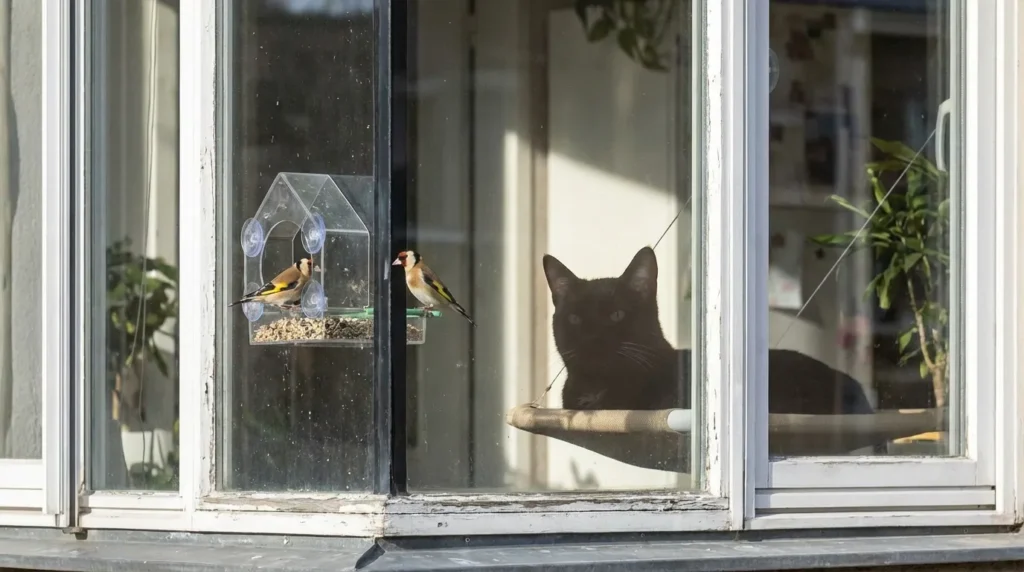
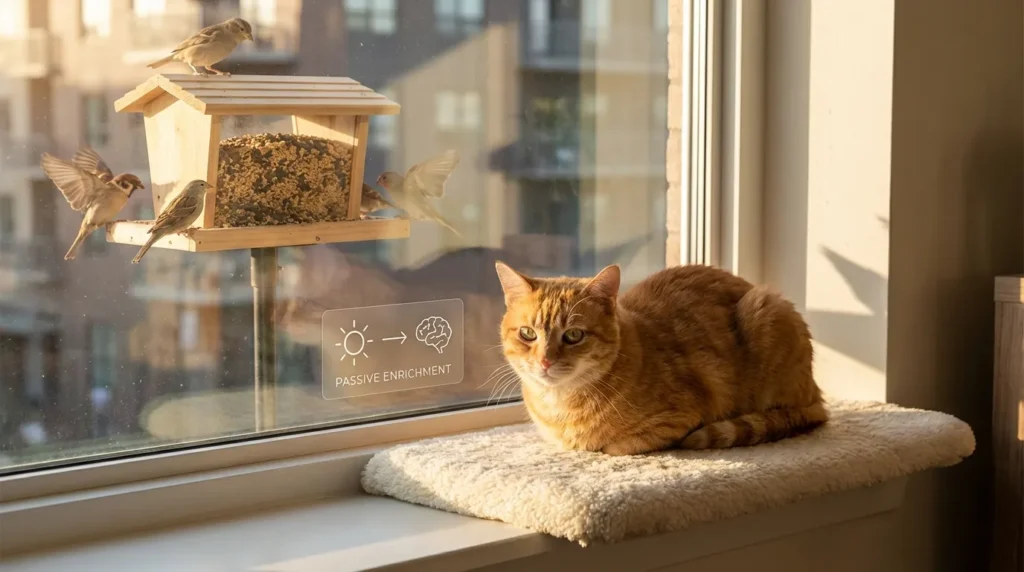
A window perch with a bird feeder outside gives hours of passive visual stimulation a day with no effort from you after setup. Birds move unpredictably, make sounds through the glass and trigger the stalking response in most cats within seconds. For an apartment cat, it’s the lowest-effort, highest-return change on this list.
Suction-cup window feeders stick to apartment glass with no outdoor access needed, though check your lease if the window opens onto a shared space. Birds usually find them within one to three days, and they cost under twenty dollars. Life with a cat in apartment means working within real space limits, and this solves outdoor enrichment inside them better than almost any other single purchase.
Window, Catio, Cat TV: Which One Fits?
| Option | Cost | Needs outdoor access? | Role |
|---|---|---|---|
| Window perch and feeder | Under about $20 for the feeder, plus a perch | No | Core, passive all day |
| Catio or window box catio | $50 to a few hundred for a window box, more for walk-in | Yes, a balcony, patio or ground floor | Best real-outdoors option |
| Cat TV videos | Free | No | Supplement only |
| Harness and leash | Low | Yes, a safe walking spot | Optional extra |
Is a Catio Worth It?
A catio is an enclosed outdoor patio or window box a cat can reach safely. It gives real fresh air, texture and scent that no window can match, without traffic, predator or disease risk. The tradeoff is cost and space. A basic window box runs fifty to a few hundred dollars, and a walk-in version costs more and needs actual outdoor access, which rules it out for most upper-floor apartments. With a ground-floor unit or a balcony, it’s worth the money. Without one, the window perch and feeder gets you most of the stimulation for far less.
Does Cat TV Actually Help?
Cat videos of birds, fish or rodents work as a supplement, not a core method. Some cats track the screen like a real bird and others ignore it, and you can’t predict which until you try. Cap sessions at 30 to 60 minutes. A screen offers a chase with no catch, the same problem as the laser pointer. Use it on days you can’t manage a full window setup, not in place of interactive play.
Method 5: Clicker Training for Maximum Daily Cognitive Engagement
Of everything here, clicker training asks the most of a cat’s brain per minute. She has to link the click to a reward, then work out which behavior earned it. Five focused minutes can tire a cat out more than half an hour of toys left on the floor, which is why trainers like it for bright, bored cats.
Teach a sit first:
- Hold a treat above her head and slightly back until she sits to look up at it.
- Click the moment her hindquarters touch the floor.
- Give the treat right away.
- Repeat about ten times, then stop while she’s still keen.
Most cats start offering the sit on their own within two to three sessions. That voluntary offer is memory and problem-solving at work. Knowing the indoor cat behavior patterns behind why cats respond to training makes sessions go smoother.
Once sit is solid, move to target training. Hold a chopstick or target stick a few inches from her nose, and click and treat the moment she touches it. That single skill leads to high five, spin, come, and eventually leash walking, since you can guide her with the target instead of pulling on a leash she doesn’t understand yet.
Method 6: Toy Rotation and Scent Enrichment
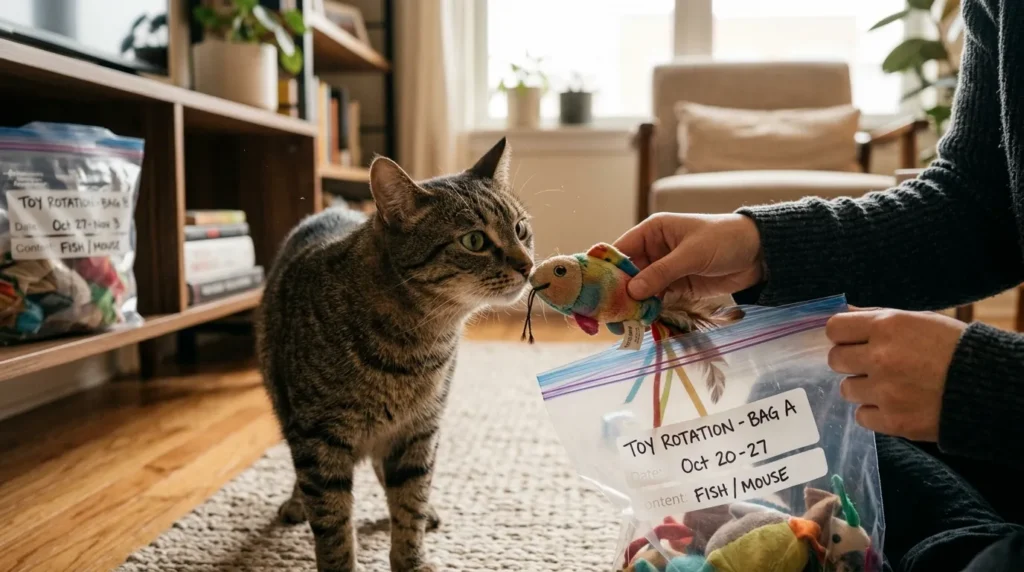
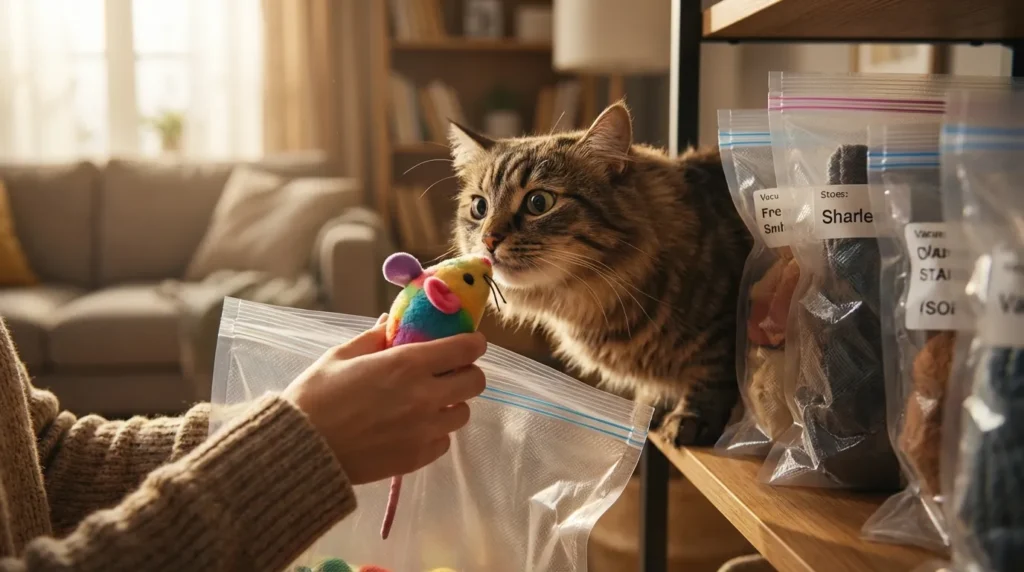
Rotation brings novelty back without new purchases. A toy she ignored on Monday can look interesting again after five days in a sealed bag, because the scent fades and the object reads as new. For a single cat, keep four to six toys total with only two out at a time, and swap weekly. Add two toys to the pile for each extra cat so nobody waits for a turn.
Hide-and-Seek and Treasure Hunt Games
Scatter feeding hides food. Hide-and-seek hides toys, and it works search and discovery rather than pure foraging. Tuck two or three small toys under a towel, inside an open paper bag or behind a chair leg while she’s out of the room, then let her back in. Change the spots so she’s searching and not just checking the one that worked last time.
Free and Low-Cost Toy Ideas
- A paper bag with the handles cut off, left open on its side
- A cardboard box with a few holes cut in the sides
- A crumpled paper ball to bat across a hard floor
- A sock stuffed with a little catnip and knotted shut (supervise it)
Avoid anything with string, rubber bands, loose ribbon or small parts she can chew off and swallow.
Scent Enrichment and an Indoor Cat Garden
Scent enrichment is the most overlooked method here. Catnip, silver vine and valerian root each trigger different responses, so test them one at a time. Many cats that ignore catnip react strongly to silver vine. Roughly a third of cats don’t respond to catnip at all, so a miss tells you about her genetics, not your effort.
A small indoor cat garden covers texture and smell at once. A pot of cat-safe grass such as wheatgrass or oat grass gives most cats something to chew, and the chewing works as a mild stress outlet. Spider plants are another cat-safe option, tolerate low light and get investigated constantly. Skip true lilies entirely. Every part of the plant is toxic to cats, pollen included, and a nibble can cause kidney failure. Check any new plant against the ASPCA toxic plant list before it comes home.
Regular grooming doubles as enrichment through structured touch that builds trust. Done well, how to groom an indoor cat at home turns a chore into daily bonding that most cats come looking for.
Method 7: A Consistent Daily Structure That Prevents Boredom From Building
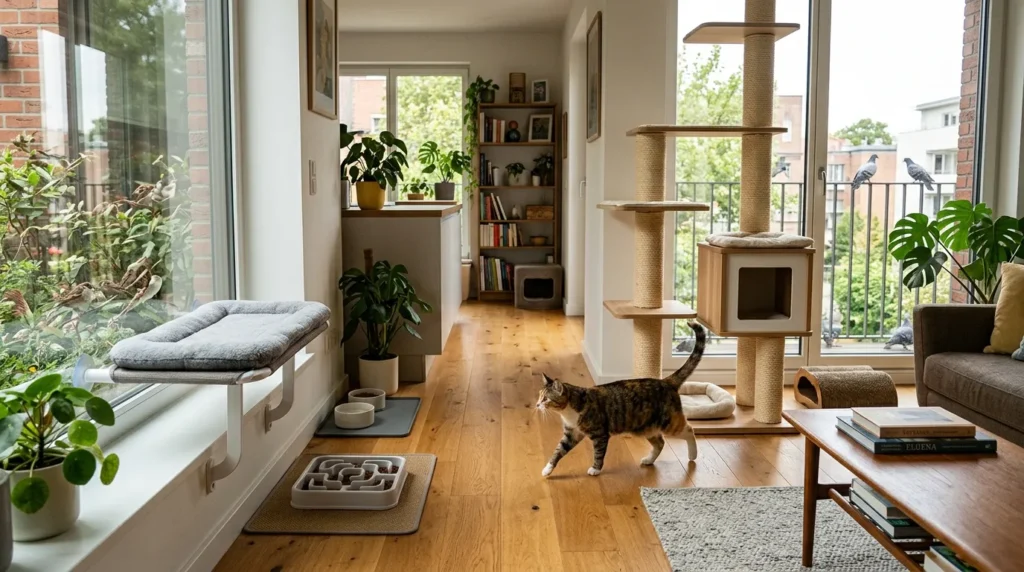
Stimulation works as a routine, not an occasional effort. Three great days followed by four empty ones doesn’t average out to a well-stimulated cat. She gets swings between peaks and deficits, and that produces anxiety. Five solid days out of seven beats a perfect week followed by two weeks of nothing.
Here’s a daily loop that fits a working schedule:
| When | What | Your effort |
|---|---|---|
| Morning, before work | Scatter feeding or a puzzle feeder, plus a 10 to 15 min wand session if you can | 5 to 15 min |
| All day | Window perch and bird feeder, tall tree, two rotated toys out | None |
| Evening, before dinner | 15 min wand play, ending with a catch | 15 min |
| Dinner | Meal in a puzzle feeder | 1 min |
| 3x a week | 5 min clicker session | 5 min |
| Once a week | Rotate the toys, change the hiding spots | 2 min |
That comes to roughly thirty minutes of active effort a day and covers every major category.
Mental health and physical health run together in cats. A well-stimulated cat tends to hold a healthier weight, since she moves more and eats slower from puzzle feeders. Even her habits around the indoor cat litter box can improve with lower stress, since inappropriate elimination is often a stress behavior. If odor keeps coming back after regular cleaning, persistent litter box smell after cleaning is worth ruling out alongside stress. For the full picture, see indoor cat care.
Seven-Day Starter Plan
If building the whole routine at once feels like too much, add one piece a day:
- Day 1: Evening wand session, ending with a catch and a small meal.
- Day 2: Add a morning wand or scatter feeding session.
- Day 3: Build a cardboard tube puzzle and use it for dinner.
- Day 4: Set up a window perch and, if you can, a suction-cup feeder.
- Day 5: Bag three of her toys and put two others out. Play hide-and-seek once.
- Day 6: Try a first five-minute clicker session on sit.
- Day 7: Review. Note which behaviors changed and which didn’t.
Daily Checklist
- ☐ Two interactive play sessions finished with a catch
- ☐ At least one meal in a puzzle feeder or scattered
- ☐ Window perch clear and the feeder stocked
- ☐ Two toys out, the rest stored
- ☐ Wand toys put away
- ☐ Ten minutes of calm attention from you
Method 8: Leash Walks, Cat Wheels and Social Enrichment
These three options aren’t required. They’re for owners who want to go further, or whose cat has energy the first seven methods don’t burn off.
Leash Training and Cat Strollers
A harness and leash let a cat meet real sunlight, grass and smells under full supervision, with none of the traffic, predator or disease risk of free roaming. Start indoors. Let her wear the harness around the apartment for five minutes at a time until she stops walking sideways or freezing. Go outside only once she ignores it completely, and choose a quiet spot first. Not every cat takes to it, and forcing a panicking cat does more harm than the enrichment is worth. A cat stroller is a fair middle option for cats who like the sights and smells but never relax enough to walk.
Are Cat Wheels Worth It?
A cat exercise wheel is a large rotating running surface, typically around 40 inches across, that a cat powers herself. Unlike wand play, the wheel puts her in charge of pace and duration, so cats that take to one often use it without prompting. Some investigate it once and never return. Expect a few days of placing treats on and around it before she’ll step on willingly, and start running sessions at five to ten minutes, building to fifteen or twenty. For overweight cats, seniors who stay active, or high-energy breeds like Bengals and Abyssinians, a wheel gives a longer outlet than wand play alone. For a calm cat already well served by puzzle feeders and evening play, it’s an optional upgrade.
Social Enrichment: Other Cats and People
Some cats get real enrichment from a second cat to chase, groom and nap with. Others are territorial and find a housemate stressful, so this isn’t a blanket recommendation. If you’re thinking about a second cat for enrichment, a slow, supervised introduction over one to two weeks matters more than the decision itself. Human attention counts too. Ten minutes of focused time, talking to her, letting her sit near you while you work, or slow-blinking at her, gives social stimulation no toy replicates.
Adjusting for Your Situation
If You Work All Day
Front-load the morning with scatter feeding and leave a clear window perch with a feeder running. Put two rotated toys out, including a kicker or a ball she can bat around alone. Keep the long wand session for the evening, before her main meal.
If Your Cat Is a Kitten
Go for short, frequent bursts and supervise every toy. Kittens learn the rules of hunting and biting through play, so use toys and never your hands. A kitten that gets steady wand play usually needs fewer corrections later.
If Your Cat Is a Senior
Swap jumping for low-impact movement. Add ramps or pet stairs to the window perch, use gentle wand play, and lean on scent games and food puzzles. If a senior stops caring about things she used to love, book a vet check before assuming it’s age.
If You Live in a Small Apartment
Go up, not out. Wall shelves, a bookshelf top and a window ledge add more usable territory than another floor item. A window perch with a feeder and a rotated toy bag cost almost no floor space.
If You Have More Than One Cat
Run separate play sessions so the shy cat gets a turn, feed puzzles in separate spots, and add a second path to every high perch. Watch for blocking, staring and guarding of perches. Those are early signs the setup needs more resources.
The Mistake That Cancels All Other Enrichment Efforts
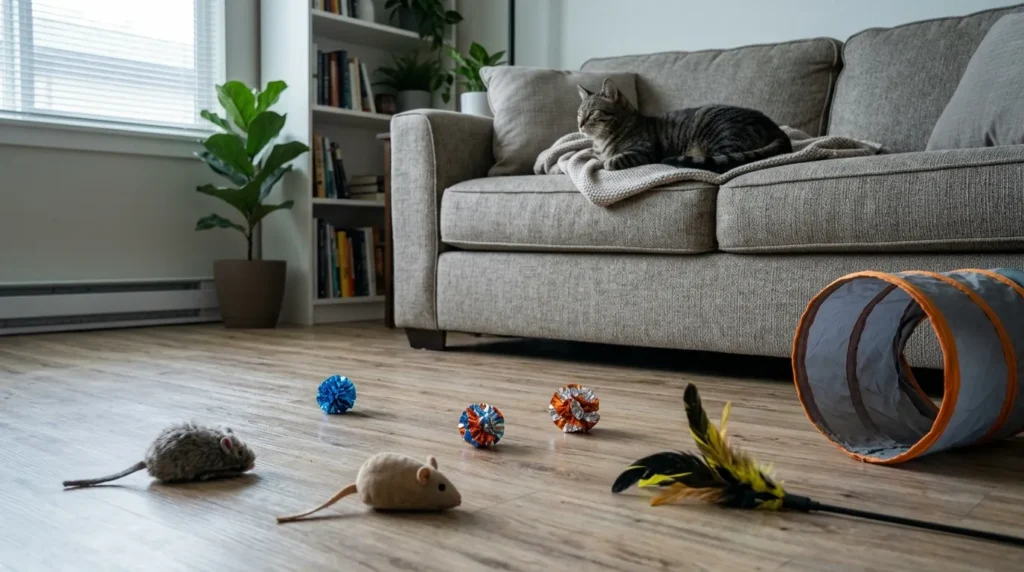
The most common mistake is filling the apartment with passive toys and calling it enrichment. A cat’s predatory drive responds to movement. A toy mouse sitting still gets filed as harmless and ignored, often within a day of the first sniff.
Every toy eventually goes stale. She tags it “explored, not interesting” and moves on, however new it looked on day one. Rotation delays that. Owner-controlled play avoids it better, because unpredictable movement from another being doesn’t wear out the way a static object does.
The second mistake is inconsistency. A cat’s behavior builds on accumulated daily experience, so one great week and two empty ones will lose to five decent days a week held across months. And a third: ending play without a catch. Whether it’s a laser, a screen or a wand pulled away at the last second, the unfinished hunt leaves her wound up.
Insight: If you can only add one thing today, make it a wand session before her last meal. Done daily for a week, it fixes more problems than any toy purchase. The meal afterward closes the hunting cycle her brain expects, and many owners see a calmer evening the same night.
When Stimulation Is Not Enough: Signs You Need a Vet
Some behaviors that look like boredom are medical. Sudden overgrooming after a stretch of steady enrichment can point to a skin condition, parasites or a food allergy. A cat who stops using enrichment she used to love may be in pain. Cognitive dysfunction syndrome, seen in cats over twelve, shows up as slow disengagement from familiar activities and looks different from ordinary boredom.
Call the vet promptly if you see any of these:
- Sudden loss of interest in play, food or climbing
- Straining in the litter box, or frequent trips with little output
- Bald patches, red skin or sores from overgrooming
- Heavy night-time yowling in a senior cat
- Aggression that appears out of nowhere
The rule for everything else: apply consistent enrichment for two weeks and watch for improvement. If signs persist or worsen, book a vet visit within the week to rule out a physical cause.
This article is for informational purposes only. Always consult your vet if you have concerns about your cat’s health.
Frequently Asked Questions
How do I mentally stimulate my indoor cat if I work all day?
Scatter feeding before you leave gives your cat fifteen to twenty minutes of foraging in the morning. A window perch with a bird feeder provides passive stimulation while you’re out. A fifteen-minute wand session in the evening and a puzzle feeder for dinner cover the active side. Your active time stays near thirty minutes.
How much mental stimulation does an indoor cat need every day?
Aim for about thirty minutes of active, interactive play a day, split across two sessions. Passive enrichment like window watching adds to this but doesn’t replace it. Cats that get only passive stimulation often drift into boredom behaviors over weeks, no matter how many things fill the apartment.
What are the best activities for an indoor cat?
Wand play ending in a catch, puzzle feeders and scatter feeding, a window perch with a bird feeder, a tall cat tree, clicker training, and toy rotation. Scent games with silver vine or catnip add variety. Together they cover hunting, foraging, observing, climbing and learning.
Do cats get bored staying indoors all the time?
They can, if nothing in the home replaces hunting, exploring and watching. Indoor cats live longer and safer than outdoor cats, but they need the environment to do some of the work. Signs of boredom include night zoomies, destructive scratching, overgrooming and constant attention-seeking.
Do puzzle feeders really make a difference for indoor cats?
Yes. A puzzle feeder engages problem-solving and foraging at once, which a bowl skips. Many owners notice a calmer, more settled cat within a few days of switching at least one meal. Begin with the easiest level and move from bowl to puzzle gradually.
How can I make a puzzle feeder without buying one?
Two options cost nothing. Stand empty toilet paper rolls upright in a box and drop kibble into some of them. Or drop treats into a few compartments of an empty egg carton and cover it loosely with scrunched paper. Scatter feeding works too.
My cat ignores all its toys. What am I doing wrong?
Still toys give no movement cue, so they get ignored. The fix is interactive play where you control the toy’s movement. Also check rotation. Toys left out all the time can go stale within a day or three. Store them in a sealed bag and swap weekly.
What are good DIY toys for indoor cats?
A paper bag with the handles removed, a cardboard box with holes, a crumpled paper ball, and a tube-and-box puzzle all work. Skip anything with string, rubber bands or small parts that can be swallowed.
Is a catio worth the cost for an indoor cat?
If you have a balcony or ground-floor access, yes. A catio gives real air, scent and texture that no window setup matches, and it’s safer than free roaming. In an upper-floor apartment with no outdoor space, a window perch with a bird feeder gets you most of the benefit for much less.
Is cat TV a legitimate form of mental stimulation?
It works as a supplement. Some cats track on-screen birds like the real thing and others don’t care. Cap sessions at 30 to 60 minutes, since a chase with no catch builds frustration. Use it on days you can’t manage full interactive play.
Does clicker training actually work for cats?
Yes. Cats respond well to positive reinforcement, and most learn a basic sit within two to three sessions of about ten repetitions. The problem-solving needed to earn the click engages her brain more than passive toys do.
Are cat exercise wheels worth buying?
For an active, food-motivated or overweight cat, often yes. A wheel lets her run at full stride indoors at her own pace. Expect a few days of treat-based introduction, and know that not every cat takes to it. A calm cat well served by wand play and puzzles can skip it.
Can leash training help mentally stimulate my cat?
Yes, for cats that tolerate a harness. Supervised outdoor time gives sensory input no indoor setup matches: real grass, wind and unfamiliar smells. Introduce the harness indoors and head outside only when she moves normally in it.
Can too much stimulation stress a cat?
Yes. Flattened ears, a lashing tail, dilated pupils or hiding mean she’s had enough. End the session calmly with a treat and shorten the next one. A shy or newly adopted cat does best with a slow start.
How do I know if my cat is under-stimulated?
Look for scratching outside the post, nighttime zoomies, knocking objects off surfaces, overgrooming or extra vocalizing. One of these occasionally is normal. Several together, or a worsening pattern, points to an unmet need.
Is mental stimulation different for kittens than adult cats?
Kittens need shorter, more frequent sessions. Adults handle longer wand sessions and harder puzzles. Seniors often need lower-impact versions of the same activities, especially anything involving jumping.
How soon will I see a behavior change after starting enrichment?
Many owners see some change within three to five days. Entrenched habits like night zoomies usually take two to three weeks of steady daily structure. If your cat shows sudden behavioral changes unrelated to enrichment, consult your vet to rule out medical causes.
Conclusion
How to mentally stimulate an indoor cat comes down to five daily habits: interactive wand play twice a day timed to dawn and dusk, at least one puzzle feeder or scatter-fed meal, a window perch with an active view, a weekly toy rotation, and a tall place to climb. Add five minutes of clicker training three times a week, and a catio, cat TV, leash walks or a cat wheel if your space and your cat suit them. Over three weeks, the change in her behavior is easy to see. This piece is one part of the full indoor cat enrichment picture under our broader indoor cat care guide. Start with the evening play session tonight and see what the morning looks like.
To mentally stimulate an indoor cat, run two fifteen-minute wand play sessions daily at dawn and dusk and finish each with a real catch. Replace at least one meal with a puzzle feeder, a DIY cardboard tube or egg carton puzzle, or scatter feeding. Add a window perch with a bird feeder for passive all-day viewing, a tall cat tree or wall shelves for vertical space, and a weekly toy rotation with four to six toys, only two out at once. Use scent enrichment such as catnip, silver vine and cat-safe grass, and never lilies. Clicker training for five minutes three times a week adds high cognitive engagement. Catios, cat TV, leash walks, cat wheels and a compatible second cat are optional extras. Check with a vet if behavior changes suddenly or doesn’t improve in two weeks.

Written by Mishu
A passionate cat lover and indoor living enthusiast, Mishu is the founder and voice behind Indoor Living Cat – a go-to resource for cat owners who want to create the happiest, healthiest life for their feline companions indoors.
View Full Profile