
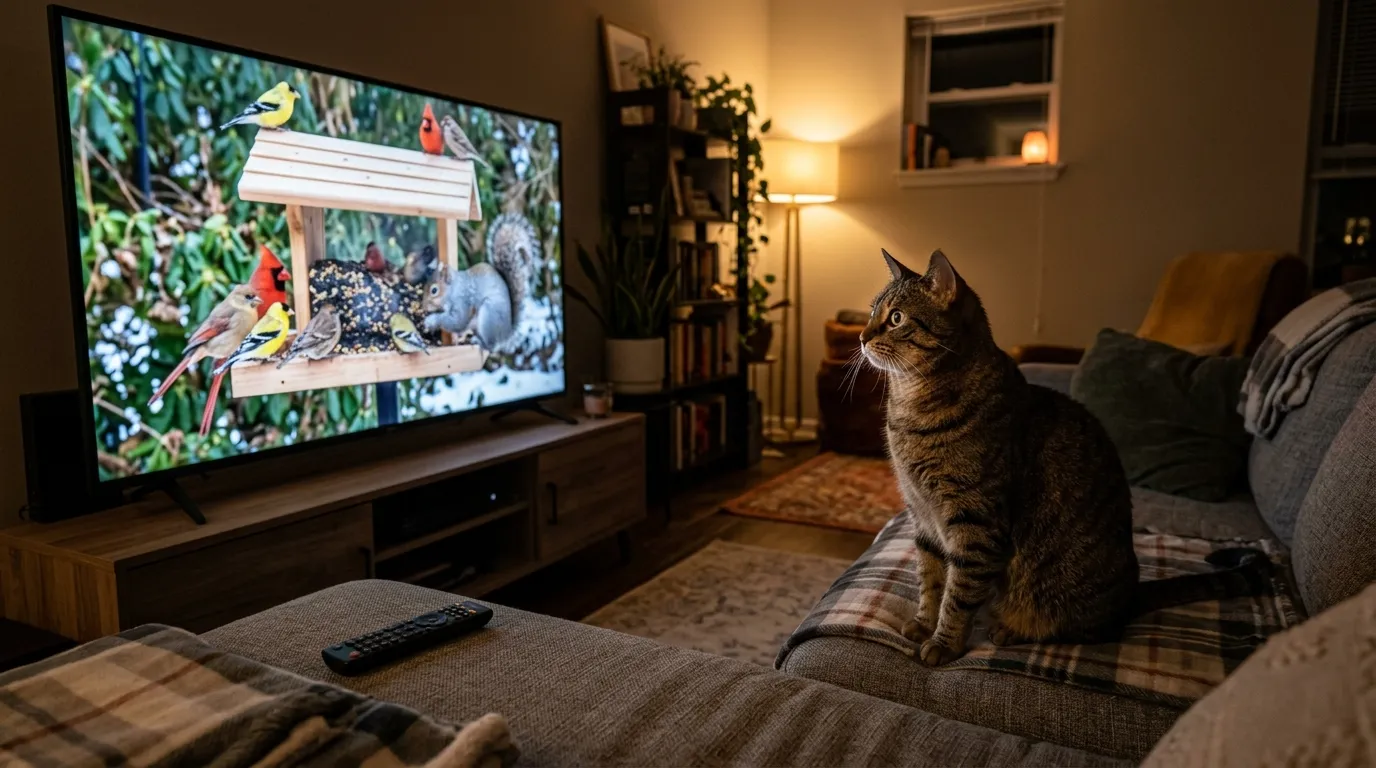
My cat spent twenty minutes stalking the corner of my TV during a nature documentary. She wasn’t lounging near the screen. She was crouched low, tail sweeping the floor, watching a squirrel with the same focused intensity she gives the bird feeder outside the window. That’s what got me asking do cats watch TV in the first place, and it turns out the question is really two questions stacked together: can they see what’s on the screen, and does any of it trigger something real in their brain. The answer to both is yes, with limits that change how useful TV actually is as enrichment.
Cats do watch TV in a functional sense. They detect and respond to motion, color and prey sounds on screen, but they don’t understand narrative or images the way humans do. Fast movement and prey sounds trigger engagement, not storyline. Most cats respond to bird or squirrel footage within seconds and show real predatory attention for ten to thirty minutes before frustration at not catching anything cuts engagement short.
Do Cats Watch TV the Same Way Humans Do? The Real Science
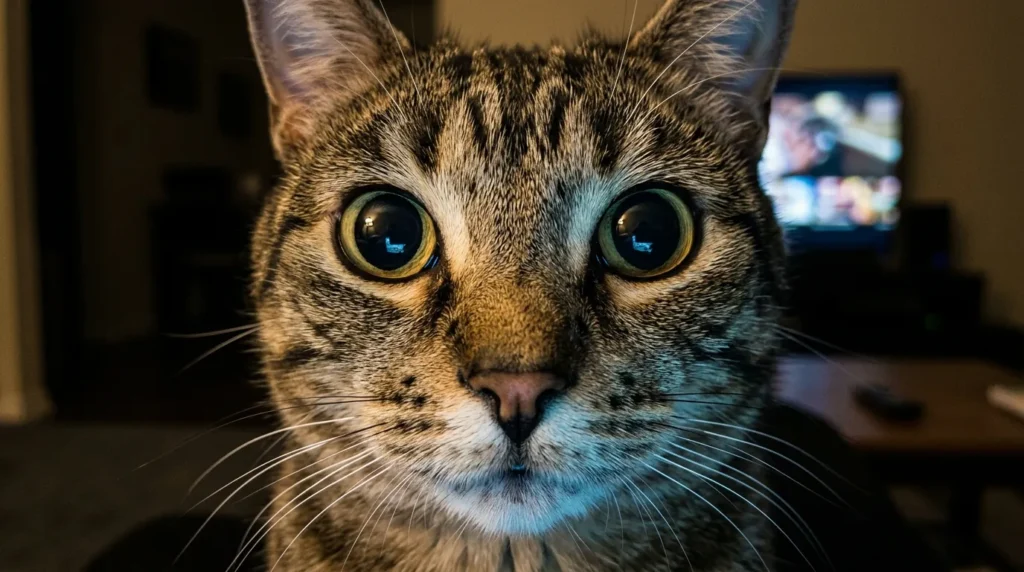
Cats don’t watch TV the way humans do, but they’re not ignoring it either. A cat watching a bird video is going through genuine visual stimulation through motion detection rather than image comprehension. Feline vision is built to catch movement with real sensitivity. Their retinas hold more rod cells than human retinas, which makes them highly responsive to changes in light and motion but gives them weaker color perception than humans have.
Refresh rate on modern flat screens matters more than most owners realize. Old CRT televisions flickered at rates cats could pick apart into individual frames, so the picture looked like a stuttering slideshow instead of fluid movement. Modern LED and OLED screens running at sixty frames per second or higher produce motion that reads as smooth to a cat’s visual system. That’s why cats who ignored old television sets often respond strongly to a modern 4K screen playing bird footage.
A shelter study found cats spent roughly six percent of their observation time actively watching footage when prey animals appeared on screen. That number sounds small, but it represents real attentional engagement in an environment full of competing stimuli. At home, with fewer distractions, many cats show sustained attention for ten to twenty minutes on wildlife footage before interest fades.
What Kind of TV Content Actually Engages Cats?
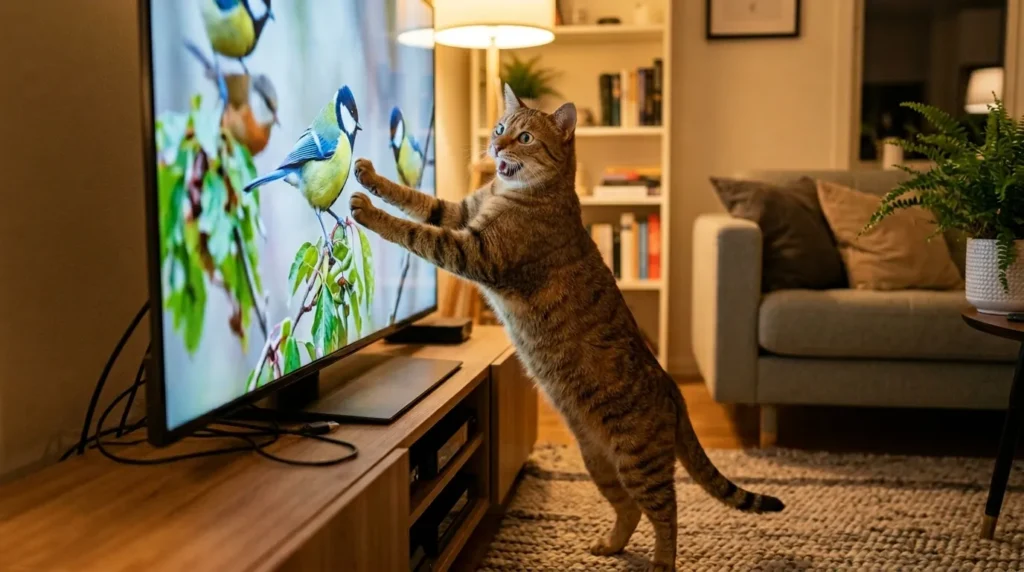
Content type decides whether a cat engages or ignores the screen completely. The categories that reliably trigger predatory attention are birds at feeders with natural sound, squirrels and chipmunks moving at feeding stations, close-up fish footage and animated mice or bugs with realistic movement. All of it shares one trait: small, fast-moving, prey-sized objects making sounds that match what a cat’s auditory hunting system is tuned for.

Content that almost never holds attention includes human faces, slow landscape footage, static objects and fictional shows with no prey-sized moving elements. A cat sitting in the room while a human drama plays is resting near a screen, not watching it. That distinction matters, because plenty of owners assume their cat is engaged with whatever’s playing when the cat is just in the vicinity.
| Content Type | Engagement Level |
| Bird feeder footage with natural sound | High |
| Squirrel/chipmunk feeding station footage | High |
| Close-up fish aquarium video | Moderate to high |
| Animated mice or bugs with realistic movement | Moderate |
| Human faces / dialogue-driven shows | Low, near zero |
| Slow landscape or nature scenery | Low |
Eight-hour wildlife loop videos made specifically for cats and posted on YouTube are the most practical option for passive TV enrichment. Search for compilations labeled as bird or squirrel feeders in 4K, and your cat will typically start showing engagement within two to three minutes of the footage starting.
TV vs. Tablet vs. Phone: Does Screen Size Matter?
Screen size changes the experience more than most owners expect. A cat watching a bird on a 55-inch TV from six feet away sees a bird roughly the size of a real one at that distance, which reads as a plausible target. The same footage on a phone held a foot away shrinks the bird to something closer to an insect, and a lot of cats lose interest fast or paw at it more like a bug than a bird.
| Screen | Typical Response | Best For |
| TV (large, wall-mounted or on a stand) | Sustained watching from a distance, less direct pawing | Passive background enrichment during the day |
| Tablet on a stand at cat height | Closer engagement, more pawing and touching | Interactive touchscreen games with response |
| Phone held close | Short bursts, often frantic rather than sustained | Quick attention grab, not extended sessions |
Tablets add one thing a TV can’t: touch response. Cat-specific apps that make a bug scurry away when pawed give a resolution a passive video never does, which matters for the frustration issue covered further down. If you’re choosing between the two for interactive play rather than background enrichment, a tablet with a responsive app does more for actual hunting satisfaction than a TV loop ever will.
Does Age or Personality Change How Much a Cat Engages With TV?
Kittens tend to respond faster and more intensely than adult cats. Their prey drive is fully active but untrained, so a moving shape on screen gets an immediate pounce response with less hesitation than an adult cat typically shows. That intensity is also why sessions should stay shorter for kittens, closer to ten minutes, since the frustration buildup discussed below hits a young, high-drive cat faster.
Senior cats often show less interest, and that’s usually vision-related rather than a personality change. Age-related vision decline reduces how well an older cat tracks fast motion, so footage that grabbed her attention at two years old might get a passing glance at twelve. A slower-paced video, birds perched and preening rather than darting quickly, sometimes holds an older cat’s attention better than fast action does.
Individual personality plays a role too. Cats with a strong outdoor prey history, ones who grew up hunting or watching birds through a window regularly, tend to engage with screen footage faster than cats raised entirely without exposure to live prey. A cat who’s never shown interest in the window probably won’t show much interest in the TV either, and that’s worth knowing before assuming screen enrichment will work for every cat equally.
How to Use Cat TV as Real Enrichment Without the Frustration Problem
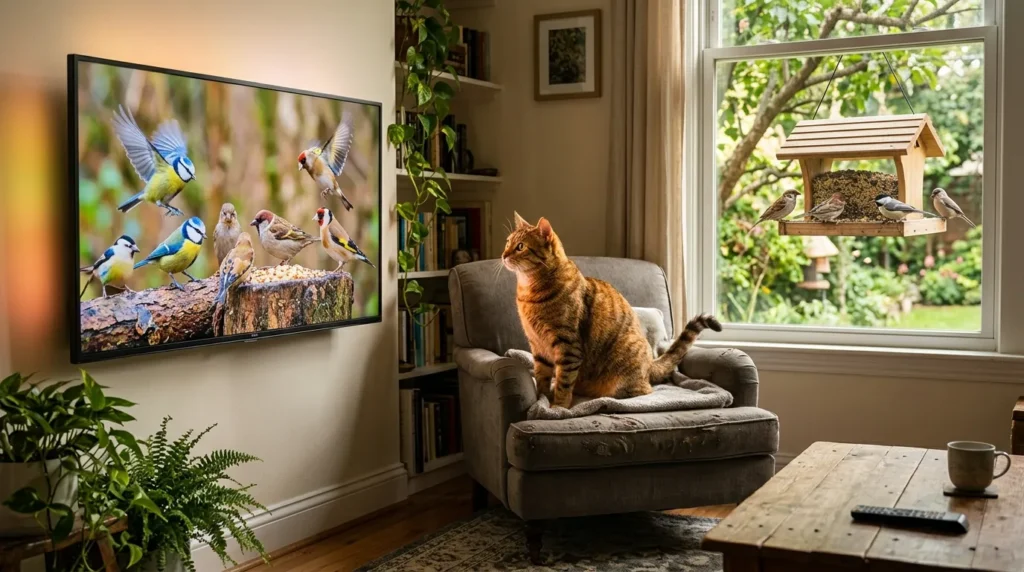
Cat TV works as passive enrichment for indoor cats with one specific limitation: a cat that watches prey on screen and can’t catch it builds up frustration if the session runs too long without resolution. That frustration shows up as tail lashing, more vocalizing, aggressive pawing at the screen and eventual abrupt disengagement. Limiting sessions to twenty to thirty minutes at a time keeps that from building.
The most effective way to use screen enrichment is as a midday passive activity during hours when you’re not around for interactive play. A bird feeder video running while you work, cook or step out gives your cat something to monitor instead of an empty, silent apartment. It doesn’t replace daily interactive wand play, which actually discharges predatory drive through the physical completion of the hunt.
What fills an indoor cat’s day shapes how much she needs from evening play. Screen enrichment during quiet hours is one part of that. The physical setup of the space, window access and vertical territory all add up to how settled a cat feels by the end of the day. Anything that fills the quiet hours with real sensory engagement cuts down the behavioral pressure that builds into evening hyperactivity.
For the full picture of how screen time, window setups and sensory variety fit together in a cat’s daily environment, our guide on indoor cat enrichment covers what actually moves the needle on indoor cat behavioral health, of which cat TV is one small piece.
The Mistake That Turns Cat TV Into a Stress Source
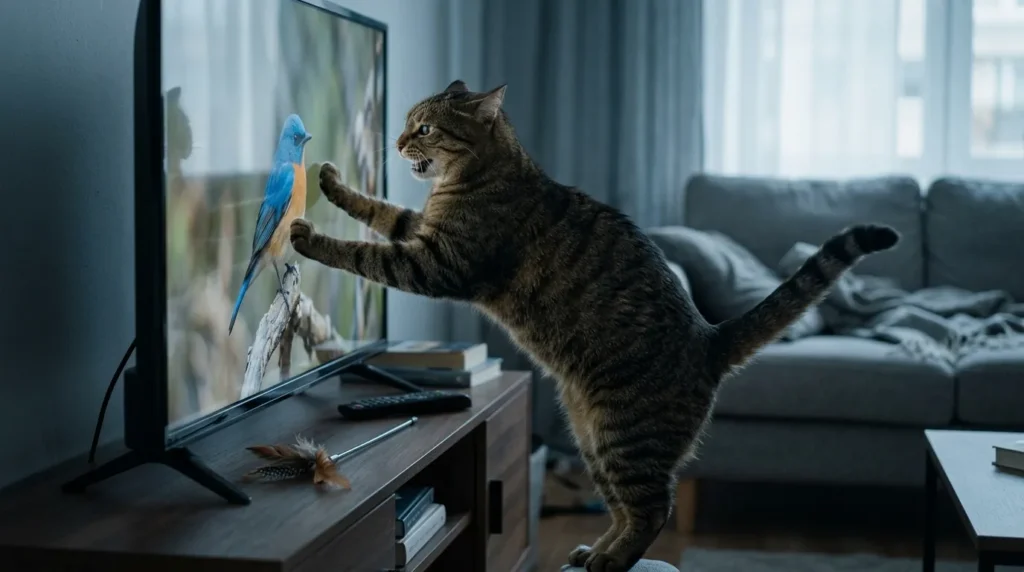
The mistake most owners make is running cat TV continuously in the background, assuming more is better. A cat exposed to prey footage for four or five hours straight develops escalating frustration, because the prey never gets caught and the hunting arousal never resolves. By mid-afternoon the cat is more agitated than she’d have been with no screen at all, and the owner can’t figure out why.
Use screen enrichment in defined twenty-to-thirty-minute segments with gaps in between, not all-day background loops. End each session by switching off the screen and offering a small food reward or a brief wand toy session where your cat actually catches something. That physical completion resets the arousal baseline instead of leaving it elevated.
Insight: The screen is a starter, not a finisher. It activates the hunting drive but gives no resolution. Pair every cat TV session with something your cat can physically interact with afterward: a crinkle ball tossed across the floor, a puzzle feeder or a thirty-second wand session that ends in a catch. That pairing is what makes screen enrichment genuinely useful instead of a slow frustration builder.
A Quick-Start Checklist for Introducing Cat TV
- Pick footage with sound. Bird chirps or rustling matter as much as the visual; muted nature footage engages far less.
- Start with a short session, five to ten minutes, and watch her reaction before assuming she’ll love it.
- Position the screen at a height and distance she can approach freely, not blocked by furniture or a coffee table.
- Set a timer for twenty to thirty minutes so the session doesn’t run into frustration territory unsupervised.
- End with something physical. A tossed toy or a short wand session gives the hunt somewhere to go.
- Skip it entirely if she shows no interest after two or three tries. Not every cat engages with screens, and that’s normal, not a failure on your part.
Can Cats Damage a TV Screen by Pawing at It?
Yes, with repeated contact over time. A cat pawing at a screen occasionally won’t do much, but a cat who paws hard and often can leave scratches on some screen coatings, especially matte or anti-glare finishes that scratch more easily than plain glass. If your cat paws aggressively rather than just watching, a tablet in a protective case set at a distance she can’t quite reach handles the interaction better than a TV she can walk right up to.
Frequently Asked Questions
Do cats actually see what’s on TV or just the light?
Cats see the movement and some colors on TV, but not in the same resolution or detail as humans. Modern high-refresh-rate screens produce motion that reads as genuinely fluid to a cat. Bird and wildlife footage triggers real predatory attention because the motion and sounds match what their visual and auditory systems track in the wild.
What’s the best type of TV content for cats?
Bird feeder footage, squirrel and chipmunk compilations and fish aquarium videos produce the most consistent engagement. These feature small, fast-moving, prey-sized objects with natural sounds. Eight-hour wildlife loop videos on YouTube made specifically for cats are the most practical option for passive daily enrichment.
Can watching TV stress my cat out?
Yes, when sessions run too long or the content stays intense without breaks. A cat watching prey footage for extended periods without resolution builds up frustration that shows as aggressive pawing at the screen, tail lashing and agitated vocalizing. Keep sessions to twenty to thirty minutes and follow with a brief physical activity that lets her catch something.
Is cat TV a good substitute for a window?
No. A real window with a bird feeder outside gives outdoor smells through the glass, natural sound variation, weather changes and genuine unpredictability that a screen can’t replicate. Screen enrichment works as a useful supplement for hours when window activity is low or your cat is alone, but a well-positioned window with outdoor activity consistently beats any screen content.
Can kittens watch TV, or is it too much stimulation?
Kittens can watch TV, and most respond faster than adult cats do. Keep sessions shorter, around ten minutes, since a young cat’s high prey drive builds toward frustration faster than an adult’s. Watch for overstimulation signs like frantic pawing or growling at the screen, and end the session before that point rather than after.
Do cats prefer TV or a tablet?
It depends on what you want from the session. A TV works better for passive background watching from a distance. A tablet, especially with a touch-responsive app, gives closer interaction and an actual resolution when the cat’s paw makes something on screen react. For hands-off enrichment, TV wins. For active engagement, a tablet app does more.
Will my cat get bored of the same TV footage?
Yes, over time. Cats habituate to repeated stimuli the same way they do with toys left out too long. Rotating between two or three different videos, birds one day, fish or squirrels another, keeps the novelty that drives engagement in the first place.
Conclusion
Do cats watch TV? They genuinely do, when the content matches what their visual system is built to track: small, fast-moving prey with natural sound. Use it as a midday passive enrichment tool in twenty-to-thirty-minute sessions followed by something physical. Pair it with a real window setup rather than treating it as a replacement. That combination builds a genuinely enriched indoor cat without the frustration that comes from screens run without limits.
Cats watch TV by detecting motion and prey-like sounds rather than comprehending narrative. Modern flat screens at 60 or more frames per second produce fluid motion that cats respond to with genuine predatory attention. Bird feeder footage, squirrel compilations and fish aquarium videos produce the most consistent engagement, and screen size affects how plausible the prey looks, with large TVs at a distance reading as more realistic than a phone held close. Kittens engage faster and need shorter sessions than adult cats, while senior cats often show less interest due to age-related vision decline. Sessions should stay limited to 20 to 30 minutes to prevent frustration from extended prey exposure without physical resolution. Cat TV works as passive midday enrichment for indoor cats and should be paired with real window views and daily interactive play rather than used as a standalone all-day substitute.

Written by Mishu
A passionate cat lover and indoor living enthusiast, Mishu is the founder and voice behind Indoor Living Cat – a go-to resource for cat owners who want to create the happiest, healthiest life for their feline companions indoors.
View Full Profile