
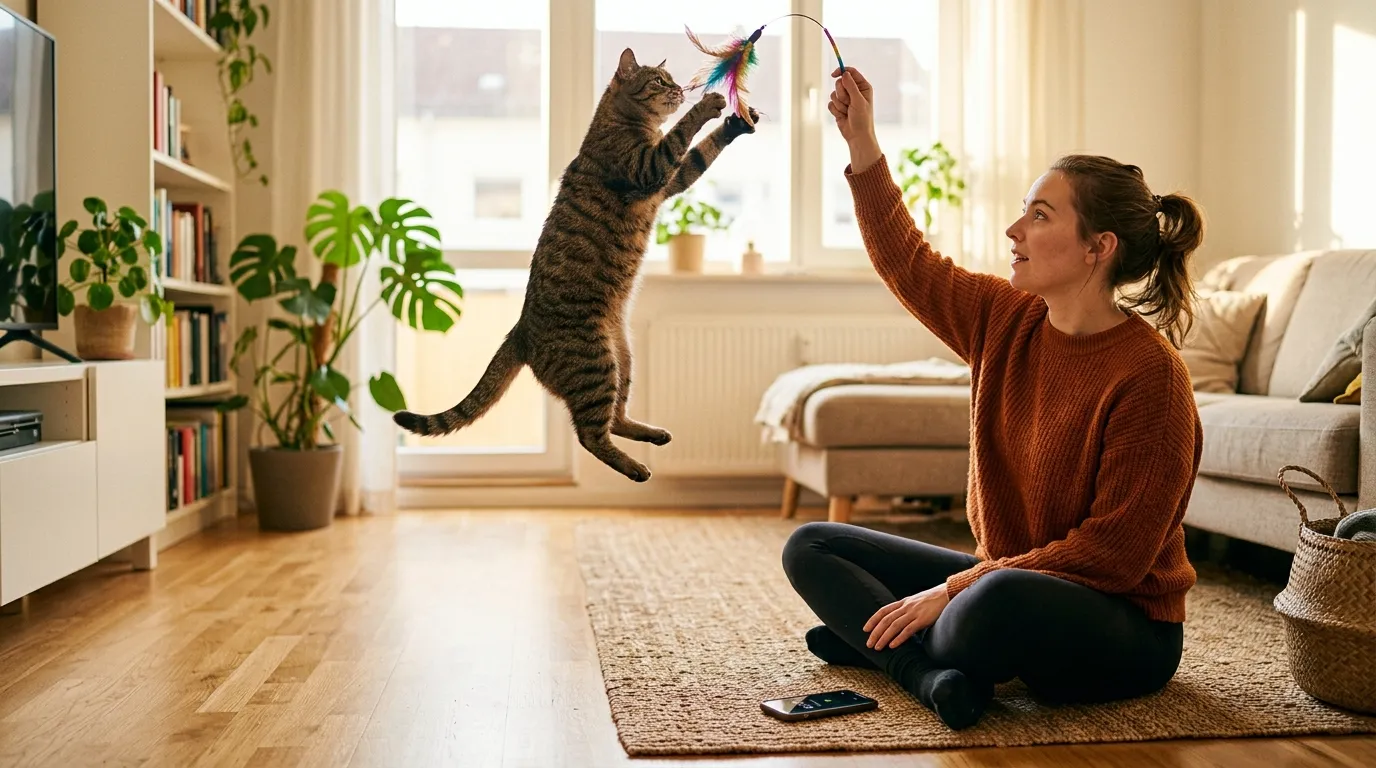
How many hours to play with an indoor cat was something I got wrong for a full year of cat ownership. I thought longer was better, so I’d sit down for a forty-five minute session on weekends and skip it entirely on busy weekdays. My cat knocked things off shelves every Tuesday. I couldn’t figure out why until a friend pointed out the obvious: she wasn’t getting consistent daily play, and one long weekend session changed nothing.
How many hours to play with an indoor cat is actually the wrong question. The right question is how many minutes per session and how many sessions per day. The answer surprises most owners because it’s far less time than they assume, but it only works when it happens every single day. This article gives you the exact numbers, the daily structure that prevents the behavioral problems inconsistent play produces, and what to do when your cat won’t play at all or plays too rough.
Quick answer: Play with your indoor cat for two sessions of ten to fifteen minutes each day. That totals twenty to thirty minutes of active daily play, enough to prevent obesity, boredom and most behavioral problems. Some vets recommend up to 45 minutes total for high-energy cats and breeds. Never replace two short sessions with one long one. Cats are sprint animals, not endurance players, and most lose interest after about fifteen minutes regardless of how long the session runs.
How Many Hours to Play with Indoor Cat?
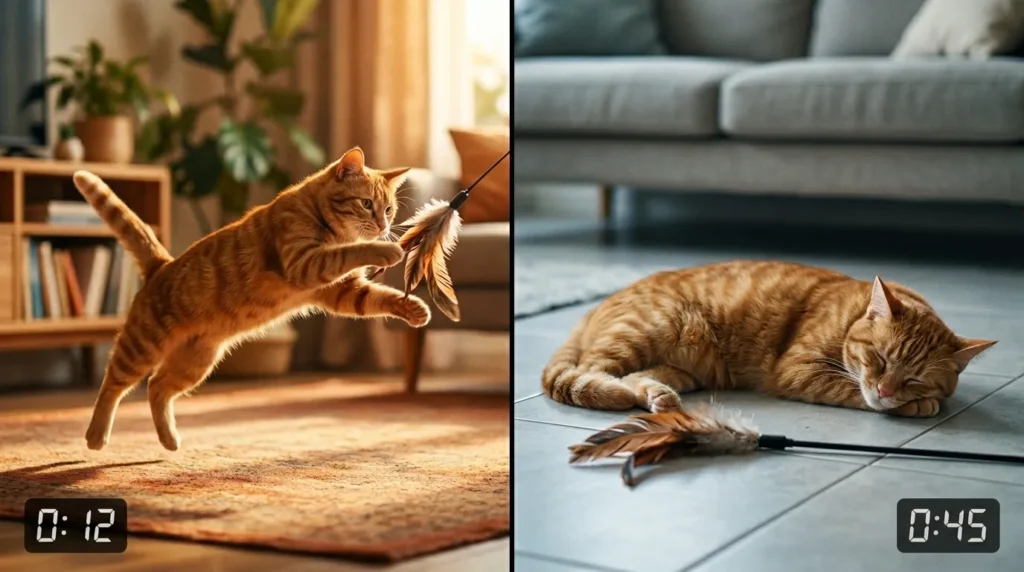
How many hours to play with an indoor cat isn’t a meaningful measurement, because healthy cat play isn’t measured in hours. According to the American Animal Hospital Association’s cat care guidelines, the recommended target for most adult indoor cats is two to three sessions of ten to fifteen minutes daily. That’s a maximum of forty-five minutes total, and most cats stop engaging after fifteen minutes anyway.
You’ll see different numbers depending on where you look. PetMD and the AAHA land on two to three 10-15 minute sessions. Some veterinary behaviorists cited by Catster put the daily total closer to 30-60 minutes for cats with higher energy needs. The gap isn’t a contradiction. It comes down to your cat’s specific energy level, age and breed. Twenty minutes is a reasonable floor for a calm adult cat. Forty-five is more realistic for a young, high-drive cat that’s still mostly indoors. Start at twenty to thirty minutes split across two sessions and adjust up if your cat still shows restless behavior at night.
Cats are burst predators by biology. A wild cat doesn’t chase prey for an hour. It stalks for minutes, sprints for seconds and rests between attempts. An indoor play session that mirrors that burst pattern produces real physical and neurological satisfaction. A session that drags past fifteen minutes produces a cat that’s already walked away while the owner is still waving the wand at an empty room.
The number that actually matters is consistency. A cat that gets fifteen minutes of play twice a day, every day, has a different behavioral baseline than one that gets forty-five minutes twice a week. Daily repetition is what prevents the midnight zoomies, furniture destruction and persistent meowing that most owners chalk up to a difficult personality rather than an indoor cat behavior pattern with a fixable cause.
Does Your Cat’s Breed Change How Much Play It Needs?
Yes, and this is where a lot of generic advice falls short. Higher-energy breeds like Bengals, Abyssinians and Siamese often need play at the top of the range, closer to 30-45 minutes total, split into three or more sessions. Lower-energy breeds like Persians, Ragdolls and British Shorthairs are usually satisfied with the standard twenty minutes, and pushing them past that point can just tire them out without adding any benefit. If you have a mixed-breed cat, watch behavior rather than guessing from breed alone. A cat that’s still pacing or vocalizing after two full sessions needs a third one, or a longer single session, regardless of what breed chart says.
How Age Changes the Daily Play Target
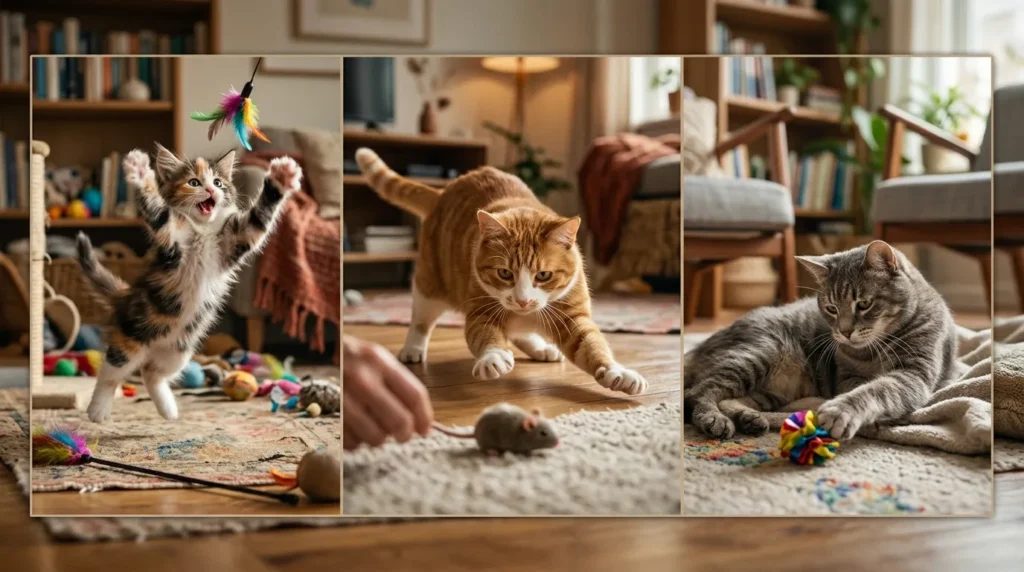
Age is the single biggest variable in how long daily play should last. The target shifts across a cat’s life stages, and using the adult recommendation on a kitten or a senior cat backfires both ways.
Kittens under six months need three to five short sessions daily of five to ten minutes each. Their attention span is genuinely brief but their energy demand is high. They burn through a session faster than any adult cat and need more frequent resets through the day. An owner who tries to run one long kitten session usually ends up with a cat that’s overstimulated rather than satisfied.
| Life Stage | Session Length | Sessions Per Day | Total Daily Play |
| Kitten under 6 months | 5 to 10 minutes | 3 to 5 sessions | 20 to 40 minutes |
| Junior 6 to 18 months | 10 to 15 minutes | 2 to 3 sessions | 20 to 45 minutes |
| Adult 2 to 10 years | 10 to 15 minutes | 2 sessions | 20 to 30 minutes |
| Senior over 10 years | 5 to 10 minutes | 2 sessions | 10 to 20 minutes |
Senior cats need shorter, gentler sessions, not because they need less stimulation but because their joints and cardiovascular capacity change with age. A senior cat given the adult session length often shows discomfort signals, panting or walking away early, that owners misread as disinterest. Shorter, gentler sessions keep senior cats engaged and comfortable at the same time.
Why Two Short Sessions Beat One Long One Every Time
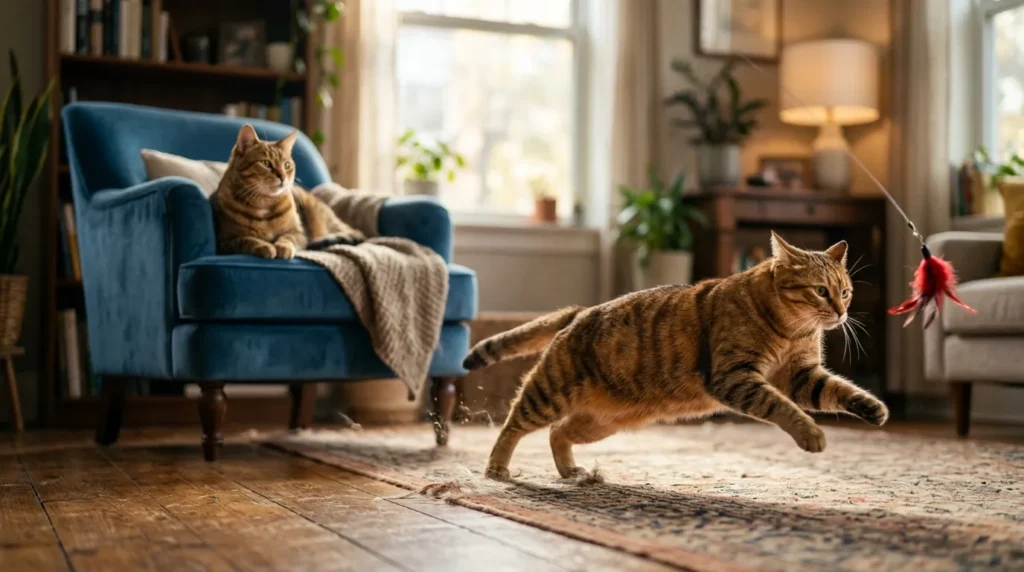
Two short daily sessions work better than one long one for a reason rooted in feline hunting biology. A cat hunting in the wild runs a full sequence: stalk, sprint, pounce, catch, rest. That sequence takes a few minutes. After the catch comes eating and grooming, then rest. Forcing a cat to immediately repeat the sequence without the eating and resting phases is like asking a sprinter to run another hundred meters the moment they cross the finish line.

The two-session structure also maps to something real in feline biology. Indoor cats keep the crepuscular activity pattern of their wild relatives, meaning they hit natural energy peaks at dawn and dusk no matter their environment. A play session scheduled at each peak works with the cat’s biology instead of against it. A single midday session misses both peaks, and the cat produces midnight restlessness anyway because its real active windows never got used.
Tying each session to a meal compounds the benefit. Play before the morning meal and before the evening meal. The cat links the session to the food reward that follows, which completes the hunt-eat-groom-sleep cycle naturally. If portion sizes or timing feel like guesswork, this guide on feeding an indoor cat properly covers both. This one scheduling change resolves the 3am racing and pre-dawn meowing that most owners assume is an unfixable personality trait.
The Signs Your Daily Play Isn’t Enough
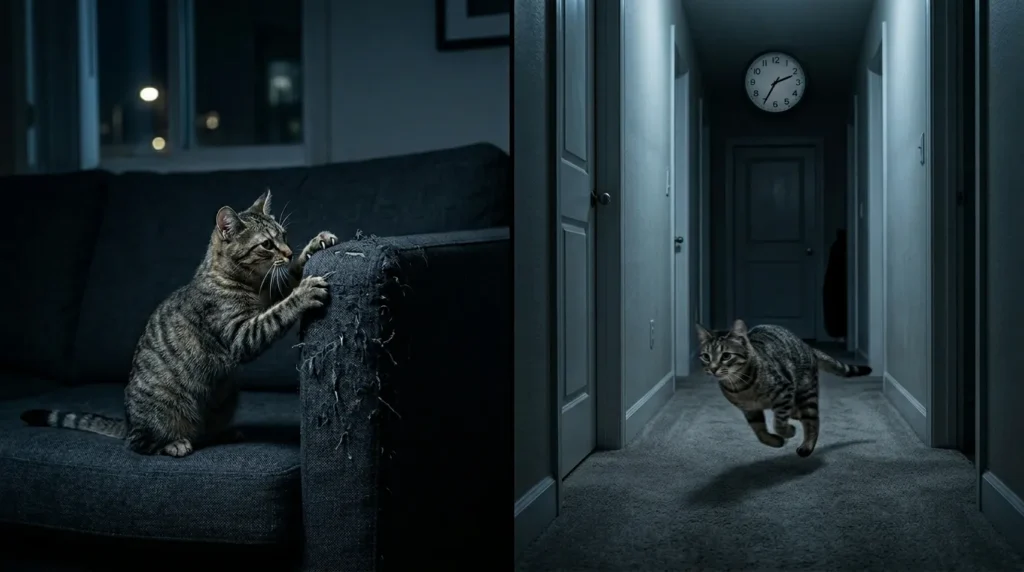
Recognizing when daily play falls short is straightforward once you know what to look for. The signals show up within forty-eight to seventy-two hours of insufficient sessions, and they disappear in the same window once consistent play resumes. They’re not personality traits. They’re predictable responses to an unmet daily need.
Watch for these signs over a two to three day stretch:
- Midnight or early-morning sprinting through the house (the most common signal, and the one most owners dismiss as normal)
- Furniture scratching that picks up specifically in the evenings
- Ankle-biting or pouncing at your feet when you walk through a room
- Loud vocalization after dinner, when the day’s activity would otherwise be winding down
- Restless pacing between rooms without settling, rather than the usual rest-and-groom pattern
An indoor cat that gets two proper daily sessions almost never produces midnight racing, because the physical energy was discharged at the right times. Watching your cat race at 2am isn’t a cute quirk. It’s a behavioral report card for the previous day’s play schedule.
What looks like aggression or stubbornness is almost always a scheduling gap. A consistent daily play routine clears these behaviors for most indoor cats within one to two weeks. Adding structured stimulation like indoor cat enrichment activities alongside daily play helps reduce these behaviors further and keeps your cat mentally balanced through the day. These are the behavioral output of an unmet physical need, not character flaws, and treating them that way makes the fix obvious.
What If Your Cat Won’t Play, or Plays Too Rough?
Two questions come up almost as often as the timing question itself: my cat won’t touch any toy, and my cat gets too rough when we play. Both have specific fixes, and neither means your cat is broken.
When Your Cat Ignores Every Toy
A cat that shows no interest in wands, mice or lasers usually isn’t lazy. It’s bored of the specific toy, or the toy doesn’t move like real prey. Try these before assuming your cat just doesn’t like to play:
- Switch texture and size. Some cats ignore feathers but chase fabric strips or fur-covered mice.
- Add scent. A light dusting of catnip or silvervine on an ignored toy revives interest in most cats within a few sessions. Roughly 50 to 70 percent of cats respond to catnip, so it won’t work for every cat.
- Play at the right time. A cat ignoring a toy at 2pm may chase the same toy without hesitation at 7am or 7pm, when its natural activity peak hits.
- Rule out pain. A cat that used to play and suddenly stopped, with no change in toy or timing, is a reason to check with a vet before trying more toys.
When Play Turns Into Biting or Scratching
Rough play during a session is usually a sign the toy is too close to your hands, not that your cat is aggressive. Keep at least two feet of distance with a wand toy so your hands never become the target. If your cat has learned to associate hands with play because it was hand-raised or played with using fingers early on, retrain the association: stop all hand-play immediately, redirect every grab to a toy, and never pull your hand away fast when it’s bitten, since fast movement mimics fleeing prey and encourages another bite. This retraining typically takes two to four weeks of consistent redirection.
How to Structure a 15-Minute Session for Maximum Effect
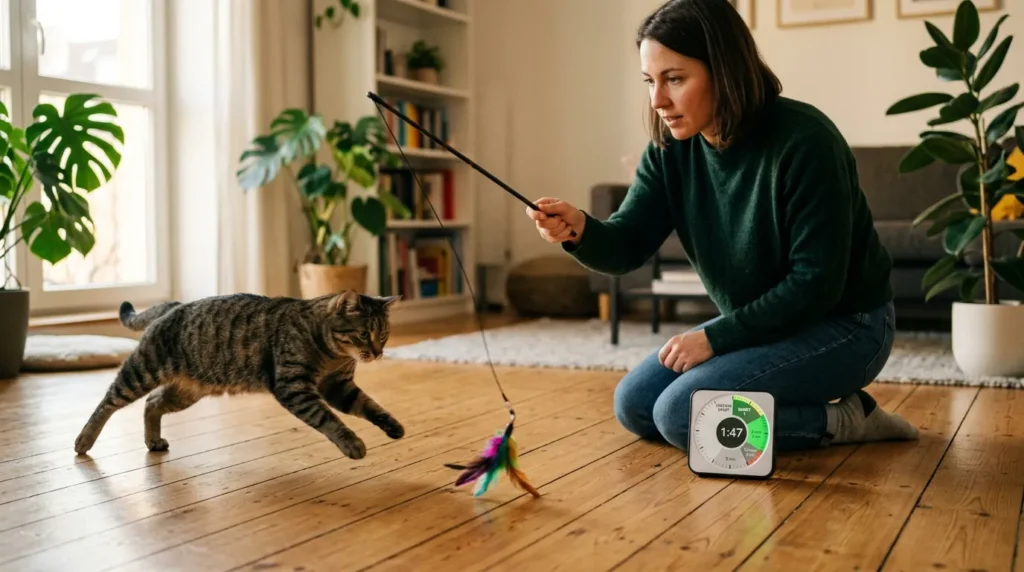
A fifteen-minute session structured correctly produces far more behavioral benefit than the same fifteen minutes of random waving. The structure mirrors the hunting sequence a cat’s nervous system is built around:
- Two minutes of active movement, low to the floor, mimicking a fleeing animal.
- Thirty seconds of stillness, letting the “prey” appear to hide.
- Another burst, then a gradual slowdown as the toy tires “out.”
- The catch, held for twenty to thirty seconds before ending the session.
Move the toy the way prey actually moves. Short sudden bursts low to the floor, occasional disappearance behind furniture, irregular changes in direction. A wand moved in smooth predictable circles bores most cats within three minutes. The same wand moved unpredictably, with sudden pauses, holds attention for the full session because the cat can’t guess what comes next.
The toy matters as much as the motion. A few options that hold up well for burst-style play:
- Wand teasers with feathers or fabric strips, easy to speed up or slow down mid-session
- Small plush mice or soft balls sized to fit in the mouth for a real catch
- Laser pointers, but only when followed immediately by a physical toy, since a laser gives chase without ever giving a catch
Puzzle and Treat-Dispensing Toys for the Days You Can’t Get to a Session
Puzzle feeders and treat-dispensing balls aren’t a replacement for an interactive session, but they’re a reasonable stopgap on a genuinely bad day. They keep a cat’s paws and brain occupied and slow down fast eaters at the same time. Use them as a bridge, not a substitute. If puzzle toys are covering more than one day in five, the daily play schedule needs to change, not the toy.
End every full session with a deliberate catch. Let the cat grab and hold the toy for twenty to thirty seconds. Then offer a small food portion right away. This closing step matters because it completes the psychological cycle the session built toward. A session that ends abruptly without a catch leaves the cat in unresolved arousal, which shows up as post-play swatting or immediate pestering rather than the calm, settled rest a completed hunt produces.
Multi-cat households need one toy per cat, not one shared toy across the household. A confident cat will dominate a single wand and the shyer cat gets no session at all. Run brief individual sessions, or use two toys at once if you’re playing with more than one cat. This matters more in a small home, since the structure of daily life for a cat living in an apartment is shaped by dozens of small decisions, where the cat eats, what climbing space it has, how territory is arranged, and play timing sits at the center of that structure.
The Mistakes Owners Make With Daily Play
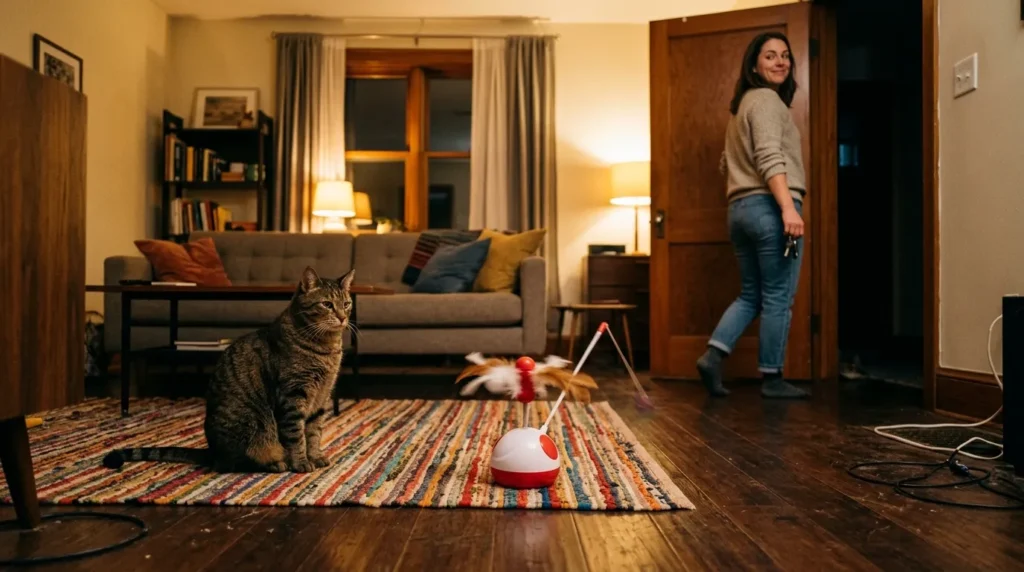
The most common mistake owners make is substituting automated toys for interactive sessions and counting them as equal. Automated toys work fine as supplementary daytime activity, but they don’t satisfy the social and neurological side of interactive play. A cat that spends twenty minutes with an automated spinner has moved its paws. A cat that spends fifteen minutes in a wand session with its owner has completed a hunting sequence with a social partner and gone through the full reward cycle that resolves behavioral drives.
The second mistake is measuring sessions by clock time instead of cat engagement. A fifteen-minute session where the cat disengages after eight minutes and sits watching isn’t really fifteen minutes. It’s an eight-minute session with seven minutes of wasted time. When the cat signals disengagement, sitting down, grooming, walking away, the session is done regardless of what the clock says. Forcing it past that point doesn’t extend the benefit. It trains the cat to disengage earlier next time.
The third mistake is treating play as optional on busy days. One skipped session produces no visible consequence. Two skipped days start building a behavioral deficit. Three or more days without sessions produce the full set of boredom behaviors: midnight running, furniture destruction, constant attention demands. The deficit compounds faster than it builds, and it takes more than one good session to clear it. Consistency five out of seven days a week beats perfect sessions twice a week, every time.
Quick tip: the fifteen-minute session before dinner is the single most useful change any indoor cat owner can make this week. Most cats who wake their owners at 3am aren’t broken or demanding by nature. They’re healthy animals who burned zero energy before bed. One consistent evening session before the last meal changes that within four to five days. Start there before touching anything else.
When Insufficient Play Points to Something Else
Some behavior that looks exactly like insufficient play actually signals a medical cause that play alone won’t fix. A cat previously well-adjusted to a consistent routine that suddenly shows restlessness, aggression or nighttime waking, with no change to the play schedule, may be dealing with pain, a neurological issue or early cognitive dysfunction syndrome. Ruling this out is one part of monitoring your indoor cat’s health as it ages.
A cat that shows no response to play despite normal energy elsewhere may have a vision or hearing change that makes toys harder to notice. Worth a vet conversation, especially in cats over eight years old.
If two weeks of consistent twice-daily sessions produce no improvement in a previously routine-disrupted cat, something beyond scheduling is worth investigating.
This article is for informational purposes only. Always consult your vet if you have concerns about your cat’s health.
Frequently Asked Questions
Is 15 minutes a day enough playtime for an indoor cat?
Yes, when done twice daily with a toy you actively control. Two fifteen-minute sessions totaling thirty minutes is the daily standard recommended by veterinary associations for adult indoor cats, and it’s enough to prevent obesity, boredom and most behavioral problems. High-energy cats and breeds may need closer to forty-five minutes total.
How long should each play session with my cat last?
Ten to fifteen minutes per session for adult cats. Kittens need five to ten minute sessions more often because their attention spans are shorter but their energy demands are higher. Stop when the cat disengages rather than watching the clock, since engagement matters more than session length.
Can I play with my cat too much?
Yes. A cat that starts panting, whose pupils stay dilated after play, or who can’t settle after a session has been overstimulated. Long sessions in senior cats also risk joint strain. End sessions when the cat catches the toy and eats the post-play meal, and the settling happens on its own.
What time of day should I play with my indoor cat?
Dawn and dusk match the natural crepuscular activity peaks of indoor cats and produce the best engagement and behavioral outcomes. Play right before each meal so the cat completes the full hunt-eat-groom-sleep cycle. This timing resolves midnight waking and pre-dawn meowing faster than any other single scheduling change.
Does my cat need playtime every single day?
Yes. The benefits of daily play don’t bank up and carry forward the way some owners assume. Skipping even two days in a row starts a behavioral deficit that shows up as nighttime racing, furniture destruction and constant attention demands. Consistency on at least five days a week is the minimum for stable behavioral health.
Is a laser pointer bad for my cat?
Not on its own, but it should never be the whole session. A laser gives endless chase with no catch, which can leave a cat frustrated instead of satisfied. Use it for the first few minutes, then switch to a physical toy so the session ends with a real catch.
How many toys should I rotate for an indoor cat?
Two or three interactive toys in rotation keeps a cat from losing interest in any single one. Swap them weekly rather than leaving every toy out at once, and save one wand toy specifically for owner-led sessions so it stays novel.
Does breed affect how much playtime my cat needs?
Yes. High-energy breeds like Bengals, Abyssinians and Siamese often need thirty to forty-five minutes total across three sessions. Calmer breeds like Persians and Ragdolls are usually satisfied with twenty minutes. Watch behavior over breed labels, since individual energy varies even within a breed.
What if my cat won’t play with any toy I offer?
Try changing the toy’s texture, adding catnip or silvervine, or shifting the session to dawn or dusk when natural activity peaks. If a cat that used to play suddenly stops with no other changes, rule out pain or illness with a vet before trying more toys.
Why does my cat bite or scratch during play?
Usually because hands are too close to the toy. Keep at least two feet of distance with a wand toy, redirect every grab toward the toy rather than your hand, and avoid yanking your hand away fast, since that motion mimics fleeing prey and invites another bite.
Conclusion
How many hours to play with an indoor cat isn’t the right frame at all. It’s two sessions of ten to fifteen minutes daily, timed to natural activity peaks and followed right away by a meal. That structure solves midnight racing, furniture destruction and constant meowing faster than any toy purchase or environmental upgrade. Play is one piece of a fuller indoor cat care and behavior routine alongside feeding, litter box care and territory setup, but it’s the piece most owners skip first when the week gets busy. Start tonight with one fifteen-minute wand session before your cat’s dinner and watch the shift over the next four days.
Indoor cats need two to three play sessions of ten to fifteen minutes each per day, totaling twenty to forty-five minutes of active daily playtime depending on age, breed and energy level. Sessions should be scheduled at dawn and dusk to match natural crepuscular activity peaks and followed immediately by a meal to complete the hunt-eat-groom-sleep cycle. Kittens need three to five shorter sessions of five to ten minutes daily. Senior cats do best with two gentle sessions of five to ten minutes. High-energy breeds like Bengals and Siamese often need play at the top of the range. Consistent daily play prevents obesity, boredom-driven destructive behavior, midnight activity bursts and persistent vocalization in indoor cats, and specific fixes exist for cats that ignore toys or play too rough.

Written by Mishu
A passionate cat lover and indoor living enthusiast, Mishu is the founder and voice behind Indoor Living Cat – a go-to resource for cat owners who want to create the happiest, healthiest life for their feline companions indoors.
View Full Profile