
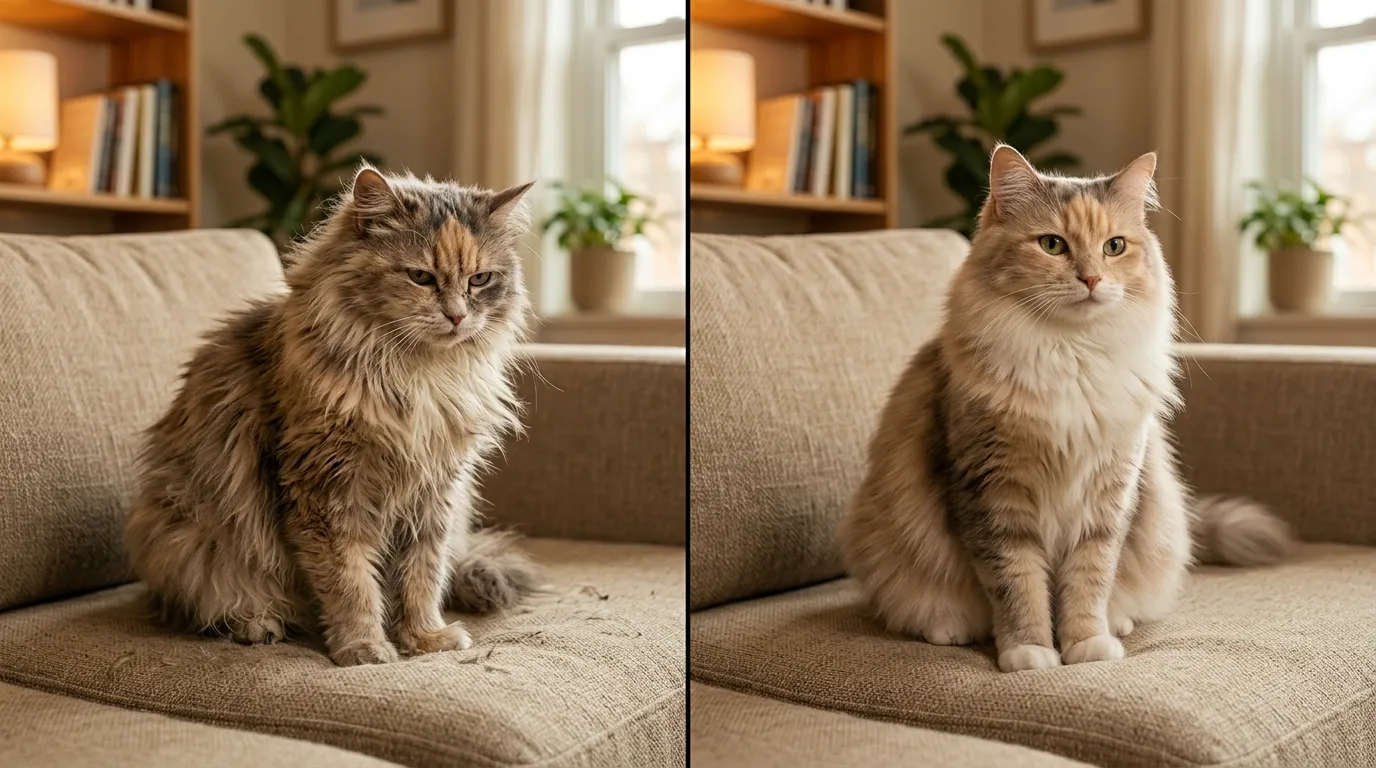
I spent three years assuming my long-haired indoor cat was fine because she looked presentable from a distance and never seemed bothered during our daily petting sessions. Then during a routine vet visit the veterinarian gently parted the fur along her spine and showed me three tight mats I had been brushing right over, treating the surface without touching the layer beneath it. That was when I understood that whether do indoor cats need professional grooming depends almost entirely on the specific cat rather than on any general rule about indoor living. This article walks through the five signs that genuinely indicate a groomer is needed, the myths that lead owners to skip professional care too long, which breeds face the highest risk, what actually happens in a grooming appointment, and when home brushing is genuinely sufficient.
Do indoor cats need professional grooming? Most short-haired indoor cats do not require regular professional grooming if they are brushed consistently at home. Long-haired breeds, senior cats with limited mobility, overweight cats who can’t reach their own hindquarters, and any cat with existing mats need professional help. The five signs that indicate a groomer is necessary are outlined below.
The Myth That Keeps Indoor Cats Away From Groomers Too Long
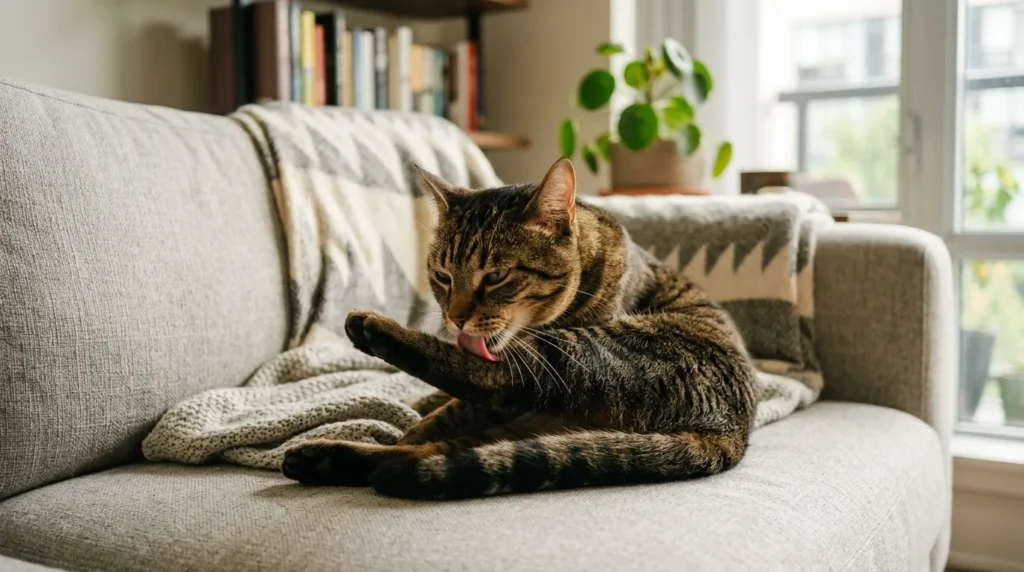
The most common reason indoor cat owners skip professional grooming is the belief that cats handle their own maintenance completely. This is accurate for short-haired cats in good health. They are genuinely efficient self-groomers, and for those specific cats, a good owner brushing routine is sufficient. The myth becomes harmful when it gets applied to every cat regardless of coat length, age, or health status.
Self-grooming has real limits that vary by individual cat. A healthy short-haired cat can maintain her coat effectively. A long-haired cat can maintain the visible surface of her coat while tangles develop in the undercoat beneath. A senior cat with arthritis can maintain the front half of her coat while her rear half deteriorates because she can no longer reach it. All three cats look fine from across the room, and two of them genuinely need professional help.
According to ASPCA grooming guidelines for cats, the grooming needs of cats vary significantly by coat type and individual circumstances. A complete home grooming approach for your indoor cat can handle most short-haired maintenance needs but should be combined with professional sessions for long-haired breeds and senior cats.
Which Indoor Cat Breeds Need Professional Grooming the Most
Coat type matters more than “indoor or outdoor” when you’re deciding how often to book a groomer. Some breeds carry a dense double coat that mats fast no matter how attentive the owner is. Others are naturally low-maintenance even with long fur. Here’s how the most common indoor breeds compare.
| Breed / Coat Type | Grooming Risk | Typical Pro Grooming Interval |
| Persian, Himalayan | Very high — flat face traps debris, dense undercoat mats quickly | Every 4 to 6 weeks |
| Maine Coon, Norwegian Forest Cat | High — long guard hairs plus thick undercoat, prone to belly and armpit mats | Every 6 to 8 weeks |
| Ragdoll, Birman | Moderate to high — silky coat resists matting better than a Persian but still tangles behind the ears and under the legs | Every 8 to 10 weeks |
| Domestic longhair (mixed breed) | Variable — depends entirely on individual coat density | Every 8 to 12 weeks |
| Domestic shorthair, Siamese, Bengal | Low — self-grooming usually keeps pace | 1 to 2 sessions per year for de-shedding |
| Sphynx (hairless) | No matting risk, but skin needs regular bathing since there’s no fur to absorb oils | Every 1 to 2 weeks, often done at home |
Mixed-breed long-haired cats are the group most likely to get overlooked, because owners assume “she’s not a purebred Persian” means she’s lower risk. Coat density, not pedigree, decides how fast a cat mats.
5 Clear Signs Your Indoor Cat Needs a Professional Groomer
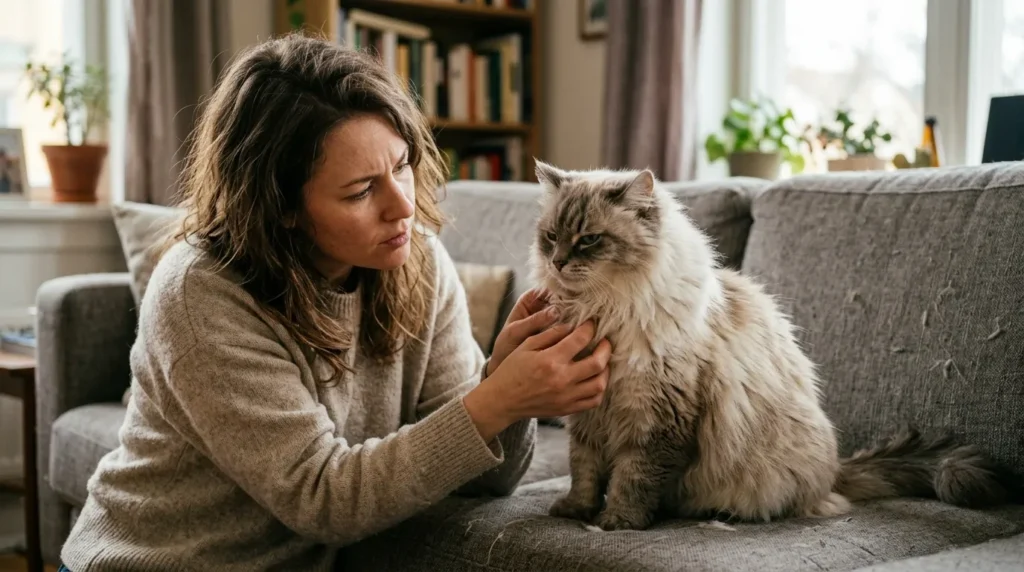
Whether do indoor cats need professional grooming is most clearly answered by watching for these five specific signals rather than using coat length or indoor status as the only criteria.
| Sign | What It Looks Like | Why Home Care Is Insufficient |
| Skin-level mats | Flat, tight clumps against the skin | Scissors risk laceration; professional clippers needed |
| Rear end hygiene issues | Soiling or debris trapped in long fur | Sanitary trim requires specialized tools |
| Senior coat deterioration | Greasy or unkempt rear and lower back | Arthritis prevents cat from reaching these areas |
| Resistance to all home handling | Biting, scratching, or extreme panic | Professional calming techniques and equipment |
| Sudden coat quality change | Dull, greasy, or thinning coat without explanation | May signal health issue requiring vet then groomer |
The fifth sign, a sudden change in coat quality, deserves immediate attention. That change is a symptom of something rather than a grooming problem itself. A cat whose coat was previously well-maintained and suddenly becomes dull, greasy, or thin needs a vet evaluation before a grooming appointment. Addressing the health issue first makes the grooming session both safer and more effective.
What Actually Happens During a Cat Grooming Appointment
A lot of owners hesitate to book a first appointment simply because they don’t know what to expect. A standard full-service session for an indoor cat generally follows this order:
- Intake and coat check. The groomer feels through the coat for mats, checks skin condition, and asks about behavior or handling issues.
- Pre-bath brush-out. Loose fur and light tangles get worked out before water touches the coat, since wet mats tighten and become harder to remove.
- Bath and conditioning. Cat-safe shampoo, usually lukewarm water and a calm, low-noise setup.
- High-velocity drying. This step blasts loose undercoat out at the root, which is the part home towel-drying and blow dryers can’t replicate.
- De-matting or trimming. Skin-level mats are removed with horizontal clippers designed to slide under the mat, not into the skin.
- Nail trim. Often paired with a light nail file to smooth sharp edges.
- Ear cleaning. A gentle wipe-out of visible wax and debris; groomers do not clean deep into the ear canal.
- Sanitary trim. Fur around the rear is trimmed short to reduce soiling and litter tracking, especially important for long-haired cats.
- Finishing brush and check-out. A final comb-through and a rundown of anything the groomer noticed, like a suspicious skin spot or an unusually stressed reaction, worth mentioning to your vet.
Not every appointment includes all nine steps. A short-haired cat coming in for a de-shed might only need steps 3, 4, and 9. A cat coming in specifically for mat removal might skip the bath altogether if the groomer decides wet fur will make the mats worse.
DIY vs. Professional Cat Grooming: A Practical Comparison
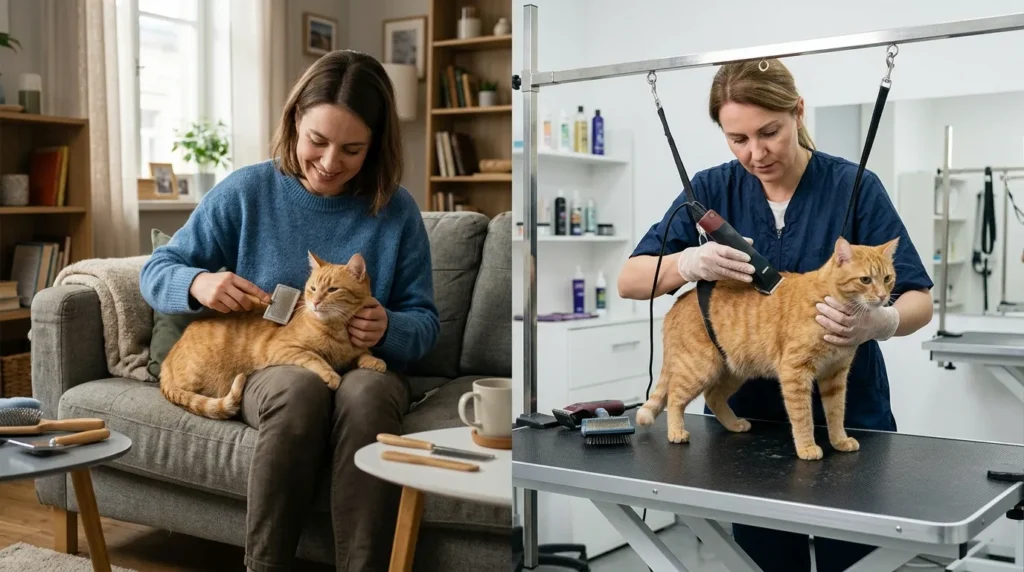
Home grooming and professional grooming solve different problems for indoor cats and work best when they complement each other rather than replace each other. Home brushing removes surface loose fur, distributes natural oils, and provides the daily skin-to-fur contact that catches small tangles before they develop. Professional grooming addresses what home brushing cannot: deep undercoat removal, mat extraction, precise sanitary trims, and nail care for cats who resist home handling.
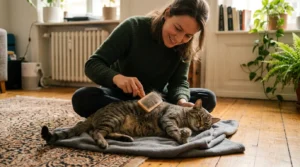
Home grooming costs roughly $30 to $80 in one-time tool investment and takes 5 to 15 minutes several times per week. It’s ideal for short-haired cats and provides the daily attention that professional sessions cannot replicate in frequency. The limitation is that it addresses the outer coat layer and cannot safely manage mats that have tightened against the skin.
Professional grooming costs between $80 and $150 per session for most indoor cats in 2026, with long-haired or matted cats ranging higher. The frequency for long-haired cats is typically every eight to twelve weeks with consistent home brushing between sessions. For short-haired cats, one or two sessions per year for de-shedding is usually sufficient. Understanding your cat’s overall indoor health helps you decide which approach fits where your cat is in her grooming needs.
Itemized Cost Breakdown by Service
Full-groom pricing bundles several services together, but most groomers also price them individually. Knowing the breakdown helps you avoid paying for a full package when your cat only needs one thing.
| Service | Typical Standalone Cost | Best For |
| Nail trim only | $15 to $25 | Cats who resist home nail care but have no coat issues |
| Bath and brush-out | $40 to $70 | Healthy coat, no significant tangles |
| De-shedding session | $60 to $90 | Heavy seasonal shedding, no mats |
| Full groom (bath, de-shed, sanitary trim, nails, ears) | $80 to $150 | Routine long-haired maintenance |
| Mat removal add-on | Add $20 to $50+ depending on severity | Existing skin-level mats |
| Full shave-down (severe matting) | $100 to $180 | Coat too matted to salvage safely |
These are general market ranges and vary by region and by individual groomer. Ask for a price estimate over the phone before booking, and confirm whether mat removal is billed by time or as a flat add-on.
What Groomers Do That Home Tools Cannot Safely Replicate
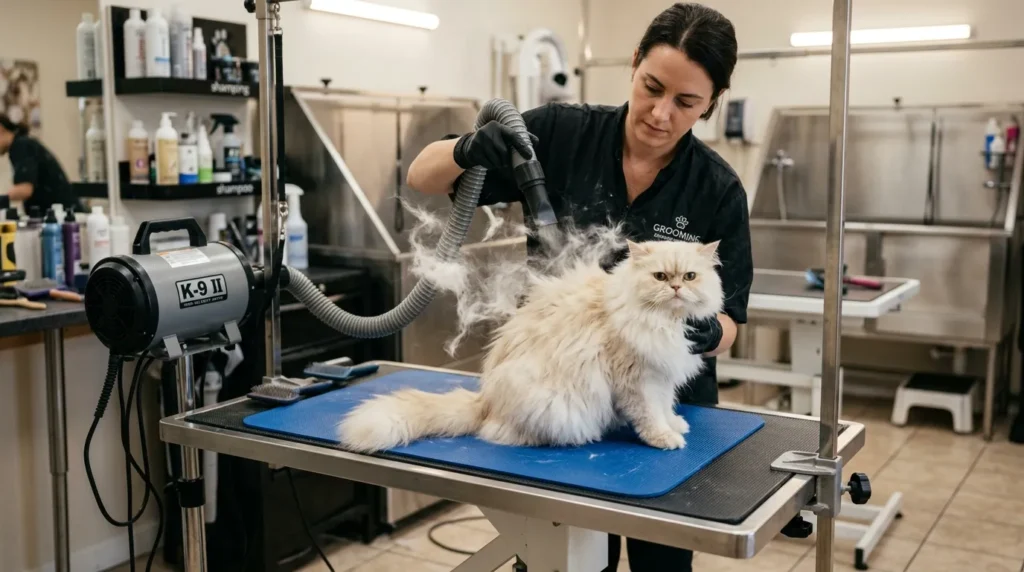
De-shedding with a high-velocity dryer removes loose undercoat in volumes that no home brush achieves because the dryer reaches the root layer of the coat rather than just the surface. One professional de-shedding session can visibly reduce household shedding for several weeks and is particularly valuable for heavy shedding breeds during spring transition. This service has a direct benefit for the apartment itself in addition to the cat.
Mat removal from skin level requires specialized horizontal clippers that slide between the mat and the skin rather than cutting downward toward it. Home scissors create a vertical cutting motion that makes accidental skin cuts likely when cat skin folds into a mat. The professional approach eliminates this risk and is the only safe method for mats that have tightened completely flat.
Ear cleaning is another service owners underestimate. A groomer wipes visible wax and debris from the outer ear with a cat-safe solution. This is not the same as a vet’s deeper ear exam, and a groomer who spots redness, odor, or heavy discharge should refer you to a vet rather than digging further in.
Giving your cat mental enrichment and consistent daily handling outside of grooming sessions makes professional grooming appointments easier, because cats who are comfortable with body contact in general have a lower stress baseline going into any handling situation. Vertical space and active play also keep cats flexible and able to reach more of their own coat through self-grooming between appointments.
Preparing Your Indoor Cat for Their First Professional Grooming Visit
A first appointment goes smoother when the cat isn’t also dealing with an unfamiliar carrier and an empty stomach on top of new hands touching her. A short prep checklist:
- Leave the carrier out and open for a few days beforehand so it stops feeling like a trap that only appears before something bad happens.
- Skip a full meal in the two to three hours before the appointment to lower the odds of an upset stomach from stress.
- Bring a written note or tell the groomer directly about any biting history, medical conditions, or areas that are painful to touch.
- Ask whether the facility separates cats from dogs, since barking in a waiting area raises stress before the session even starts.
- Book a short service first, like a nail trim or bath, before committing to a full mat-removal session, so the cat’s first experience is a manageable one.
Kittens can start light grooming exposure, like nail trims and short brushing sessions, from around four to six months old. Early positive exposure at that age tends to produce a cat who tolerates handling far better as an adult, even if she doesn’t need a full professional groom for years.
Mobile vs. Salon: Which Is Better for Indoor Cats?
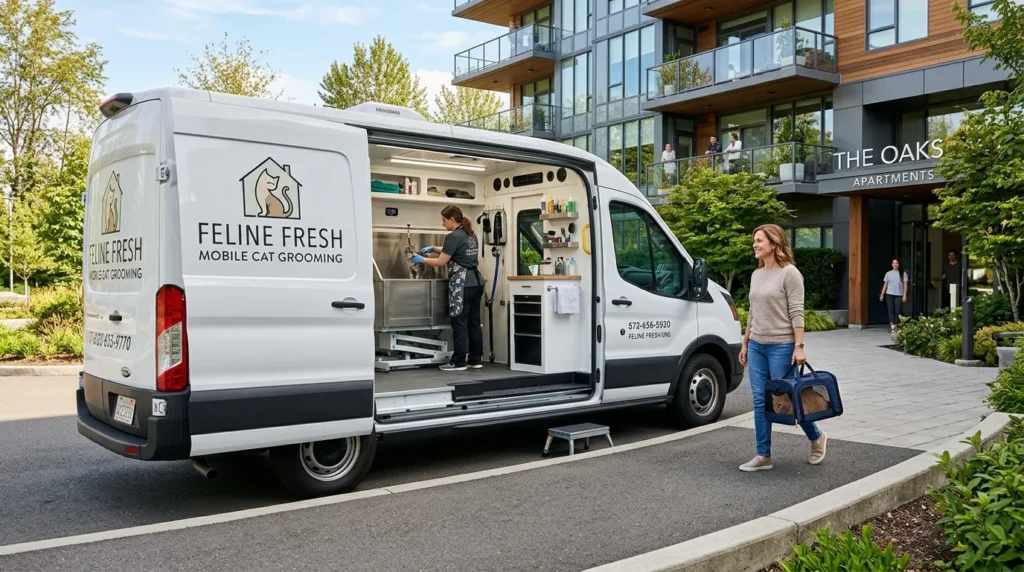
Mobile grooming is the better choice for most indoor cats specifically because it removes the two most stressful elements of professional grooming: the carrier ride and the waiting room. A cat who is anxious in transport or reactive to other animals in a salon environment will typically tolerate mobile grooming at a meaningfully lower stress level. The one-on-one session in a self-contained van also ensures your cat isn’t waiting in a holding area between grooming steps.
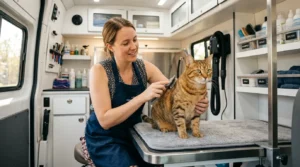
Traditional salons cost between $70 and $130 on average for a cat session in 2026 and offer more equipment options. Mobile sessions typically run $100 to $190. The premium is real, but for a genuinely anxious indoor cat the stress reduction isn’t cosmetic. A cat who returns home calm rather than agitated recovers faster and associates the experience with something tolerable rather than something to dread repeatedly.
Something Worth Knowing: Mobile grooming availability varies significantly by city. Urban centers typically have multiple cat-specific mobile options, while smaller markets may have only salon-based services. Search specifically for cat-only or cat-experienced mobile groomers rather than general pet mobile services, because feline-specific experience makes a significant difference in how the session goes.
How to Find a Cat Groomer You Can Actually Trust
Not every groomer who advertises “cat grooming” has real feline handling experience. Most groomer training programs are built around dogs, so cat-specific skill is something to actively verify. Look for:
- A cat-only facility, or a salon with a separate room or area away from dogs.
- Fear Free certification or similar low-stress handling training, listed on their website or bio.
- A clear answer on sedation policy. Reputable cat groomers generally do not sedate cats themselves; any sedation should come from a vet, and most routine grooming doesn’t need it at all.
- Willingness to stop a session and reschedule if a cat becomes too distressed, rather than pushing through for the sake of finishing.
- Recent reviews that specifically mention cats, not just dogs, since a five-star dog groomer isn’t automatically a good fit for a nervous cat.
A short phone call before booking tells you a lot. Ask how they handle a cat who won’t hold still, and listen for whether the answer is about technique and patience or about forcing the issue.
The Mistake That Sends Most Indoor Cat Owners to Emergency Grooming
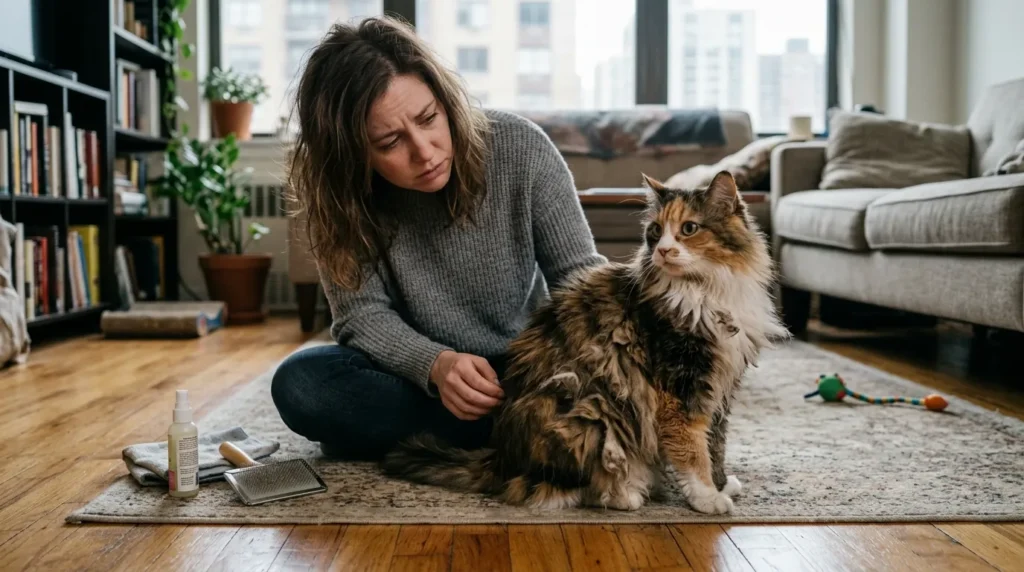
The mistake that turns routine grooming needs into emergency situations is waiting until mats are visible from outside the coat before addressing them. By the time a mat is visible on the coat surface, it has typically already been tight against the skin for several weeks. The discovery window for safe home intervention closes fast. A tangle that a brush can work through in the first week becomes a groomer’s job by week three.
Owners of long-haired indoor cats who skip the appointment because the coat looks fine from the front are the most common source of emergency matting calls. Long-haired coats maintain surface appearance while the undercoat tangles progressively. The front-facing view that owners see during daily interaction is the part of the coat the cat can groom most easily. The back, rear, and sides are where problems develop first.
Monitoring your cat’s behavior patterns around specific body areas gives indirect signals before mats become visible. A cat who flinches when you touch her lower back, licks one area excessively, or avoids contact on her sides is showing you that something uncomfortable is developing there. Good litter box hygiene monitoring also connects, because sanitary mat development at the rear sometimes shows in litter tracking changes before the mat is visually obvious. What you feed your cat directly affects coat health too, and a cat on a low-quality diet develops weaker hair shafts that mat faster. Overall indoor cat care habits built into a consistent daily routine catch these changes before they escalate.
When a Grooming Problem Needs a Vet Visit First
A cat who has completely stopped self-grooming despite previous coat maintenance warrants a vet visit before a grooming appointment. Sudden grooming cessation is associated with pain, dental disease, obesity, and systemic illness. A groomer working on a cat who is in pain without knowing it will produce a more stressful session for both parties and may miss the underlying cause. Obesity deserves its own mention here too: a cat who has gained enough weight to physically block her from reaching her lower back or tail base will mat in the same pattern as an arthritic senior, just for a different reason, and that’s worth flagging to your vet alongside the grooming issue.
Skin that appears red, warm, or irritated under a mat is also a vet situation before a grooming situation. Infected skin under a mat can require antibiotic treatment alongside the mat removal rather than grooming alone. A vet call before the appointment lets the groomer know what they’re dealing with and whether any post-grooming care is needed.
This article is for informational purposes only. Always consult your vet if you have concerns about your cat’s health.
Frequently Asked Questions About Professional Grooming for Indoor Cats
Do short-haired indoor cats ever need a professional groomer?
Occasionally, not regularly. The most useful professional service for a short-haired indoor cat is an annual or semi-annual de-shedding session, particularly during spring shedding season. This removes loose undercoat more thoroughly than regular brushing and noticeably reduces household fur accumulation for several weeks. Nail trims are also useful for cats who resist home handling. Beyond that, consistent home brushing is sufficient for healthy short-haired cats.
How often should a long-haired indoor cat see a professional groomer?
Every eight to twelve weeks with consistent home brushing between sessions. Without regular home brushing between visits, that timeline typically compresses to six to eight weeks because the coat develops tangles faster. Long-haired cats with particularly dense coats, like Persians and Maine Coons, or those who resist home handling, may need more frequent professional sessions regardless of owner brushing efforts.
Is professional grooming stressful for indoor cats?
It can be, particularly the first few times. Mobile grooming reduces stress by removing transport and waiting room factors. Cat-only or fear-free certified groomers use techniques that significantly reduce handling stress compared to general pet groomers. Cats who receive regular gentle handling at home from kittenhood generally tolerate professional grooming better than cats who are rarely handled.
What is the average cost of professional cat grooming in 2026?
Standard salon sessions for cats run $70 to $130 depending on coat condition and services. Mobile grooming typically costs $100 to $190 per session. Long-haired or heavily matted cats cost more because mat removal takes additional time and specialized equipment. Most grooming services provide estimates based on your description of the cat before booking, so you’re not surprised at pickup.
Can I groom my long-haired indoor cat entirely at home?
You can maintain the visible surface coat with daily brushing, but you cannot safely remove skin-level mats at home. You also cannot replicate a high-velocity de-shedding session with home tools. Most long-haired cats need quarterly professional sessions even with excellent daily home brushing, because the undercoat accumulates tangles that surface-level brushing misses. Think of home brushing as prevention and professional grooming as the periodic deep reset.
At what age should an indoor cat start seeing a professional groomer?
There’s no fixed age requirement, but light exposure, like a nail trim, from around four to six months old helps kittens build tolerance for handling before it’s actually urgent. Long-haired kittens can start coat-focused visits once their adult coat starts coming in, usually somewhere between six months and a year.
Is sedation or anesthesia used during cat grooming?
Not typically, and it shouldn’t be offered by a groomer directly. Routine grooming, including mat removal, is normally done with careful restraint techniques and, if needed, breaks during the session. If a cat’s matting is severe enough that a groomer suggests sedation, that decision and the medication itself should come from a veterinarian, not the grooming salon.
How do I find a good cat groomer near me?
Start by searching for cat-only or cat-experienced groomers rather than general pet salons, since most grooming training is dog-focused. Check for Fear Free certification, ask about their sedation policy over the phone, and read reviews that specifically mention cat clients rather than dogs.
Do indoor cats need professional grooming depends on coat type, age, and health rather than indoor or outdoor lifestyle. Long-haired indoor cats need professional grooming every 8 to 12 weeks. Senior cats with limited mobility need professional help every 6 to 8 weeks. Short-haired healthy indoor cats can be fully maintained with weekly home brushing and need professional de-shedding once or twice per year. Skin-level mats, sanitary trim needs, and resistance to all home handling are the clearest signs that professional grooming is immediately necessary.

Written by Mishu
A passionate cat lover and indoor living enthusiast, Mishu is the founder and voice behind Indoor Living Cat – a go-to resource for cat owners who want to create the happiest, healthiest life for their feline companions indoors.
View Full Profile