
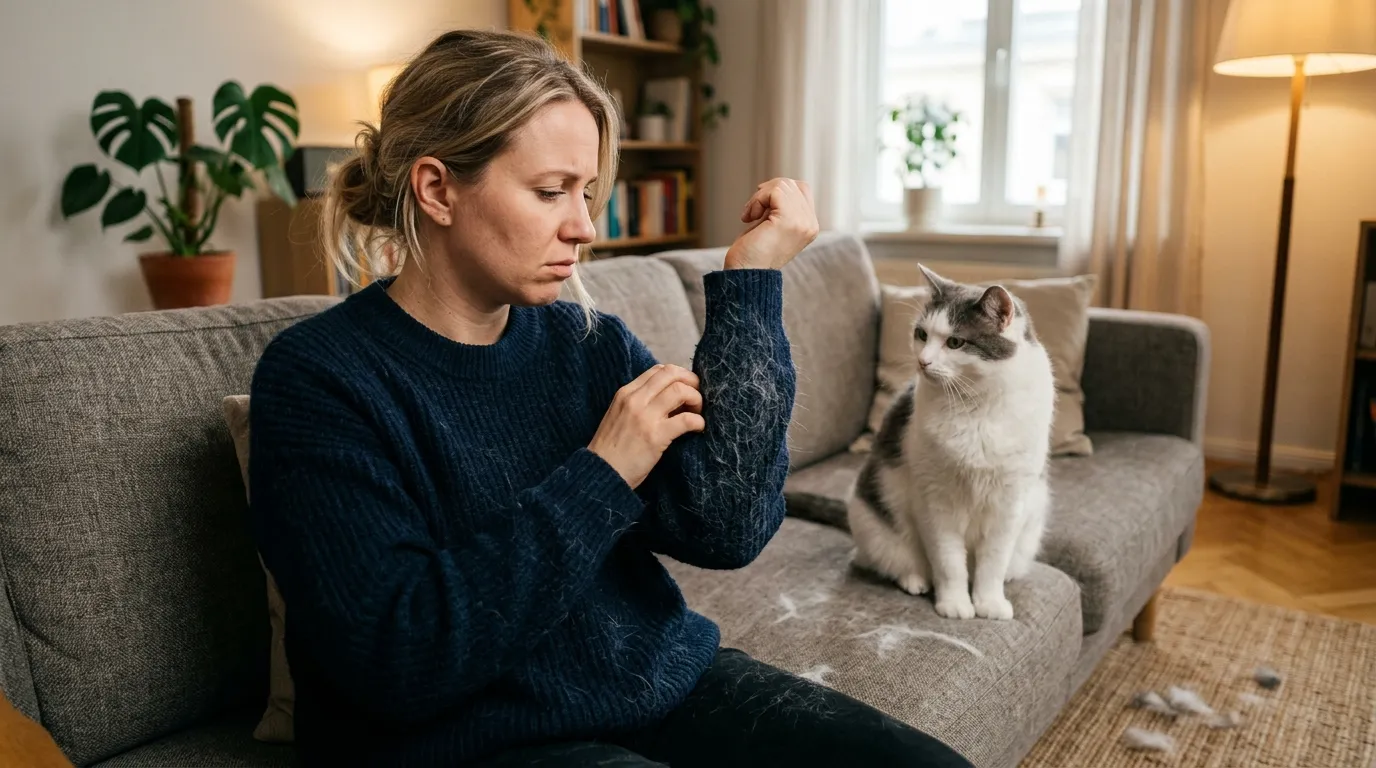
Every surface in my apartment has a permanent layer of fine white fur on it no matter how recently I vacuumed, and for the first two years I genuinely thought something was wrong with my cat. Learning why an indoor cat sheds so much turned out to be one of those explanations that made sense the moment someone laid out the actual biology. Your apartment environment is actively tricking your cat’s body into shedding year-round instead of seasonally. That’s the core of it. This article covers the seven real causes, what separates normal shedding from excessive shedding, and the specific changes that cut down how much fur ends up on your clothing every day.
Why is my indoor cat shedding so much? Indoor cats shed continuously year-round because artificial light and stable indoor temperatures disrupt the natural photoperiod signals that trigger seasonal coat changes. Diet quality, stress, age, coat type, and underlying health conditions all add to it. Most indoor shedding is normal. Sudden increases or patchy loss are the exceptions worth a vet visit.
Why Indoor Cats Shed Differently Than Outdoor Cats
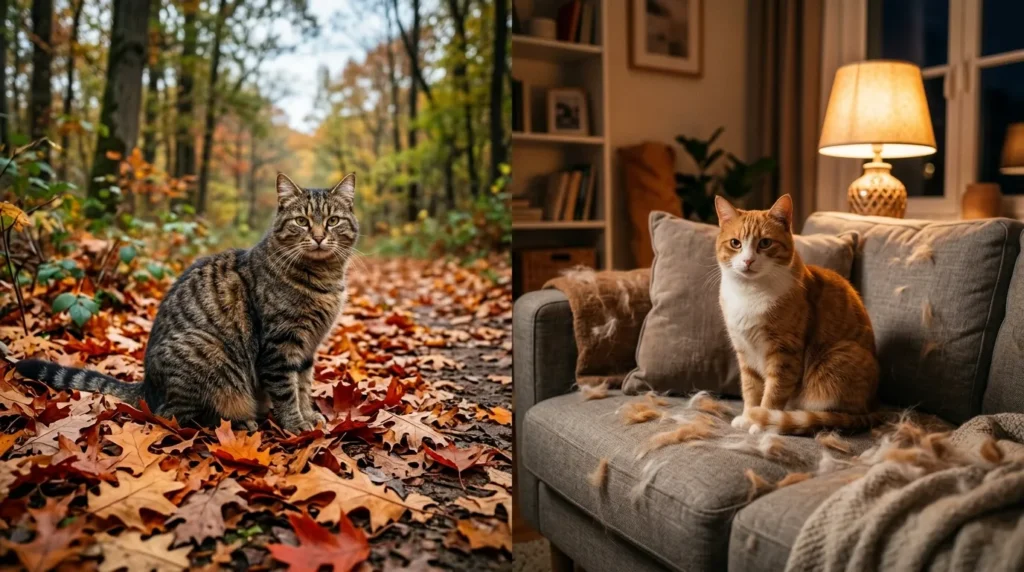
Year-round shedding in indoor cats comes down to a biological mechanism called the photoperiod. In the natural world, daylight length signals the pineal gland to shift hormone levels that control the hair growth cycle. Longer days tell the body to shed the thick winter coat. Shorter days signal it to grow one back. Outdoor cats follow this rhythm reliably, producing dramatic seasonal blowouts in spring and fall.
Indoor cats live under artificial lighting that stays on well into the evening regardless of season. Their HVAC system holds a stable temperature that never mimics the real shift in outdoor climate. The pineal gland gets no clear seasonal signal, so the hair cycle keeps turning over slowly and continuously instead of concentrating into two annual events.
According to the Cornell Feline Health Center, disruption to a cat’s natural environmental cues can affect multiple body systems beyond the coat cycle alone. Understanding your cat’s complete indoor cat health picture puts shedding in context alongside other health markers, instead of treating it as an isolated cosmetic problem.
One nuance worth naming: a cat who spends hours parked in a sunny window still catches a partial photoperiod signal, weaker than what a fully outdoor cat gets, but real enough that some indoor cats show a mild seasonal uptick in spring even without ever going outside. It doesn’t produce the dramatic blowout of a barn cat, but it explains why some indoor owners notice a spring bump that others don’t.
The 7 Real Reasons Your Indoor Cat Sheds So Much
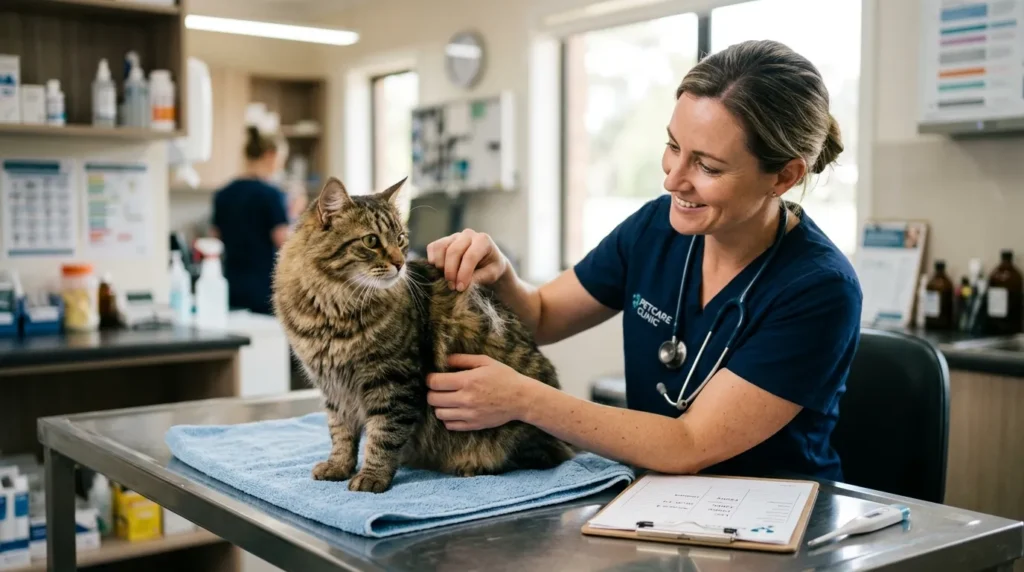
Indoor cats shed heavily for a combination of reasons that usually stack on top of each other rather than having one single cause. Photoperiod disruption is the baseline. Everything else adds to it.
| Cause | Why It Increases Shedding | Indoor Cat Risk Level |
| Artificial light disruption | Confuses hair cycle timing | High for all indoor cats |
| Poor diet or low protein | Weakens hair shafts | Moderate |
| Chronic stress or boredom | Elevates cortisol, accelerates shedding | Moderate to high |
| Coat type and breed | Double coats shed more visibly | Breed-dependent |
| Age and reduced grooming | Seniors groom less effectively | High for cats over 8 |
| Allergies or parasites | Cause over-grooming and coat damage | Low to moderate |
| Medical conditions | Thyroid and kidney disease disrupt coat | Requires vet assessment |
Diet is the second biggest controllable factor. Hair is primarily protein, specifically the structural protein keratin. A cat eating low-quality food with too little protein and limited omega fatty acids produces weaker hair shafts that break and fall out faster than a well-nourished coat would. The change in shedding volume when nutrition improves is often noticeable within four to six weeks.
Chronic stress from boredom, household changes, or multi-cat tension raises cortisol levels in indoor cats. Higher cortisol pushes more hair follicles into the resting phase early, producing a jump in loose fur within days to weeks of a stressful event. That’s why apartment cats going through a move, a new pet, or a major schedule change often shed noticeably more in the weeks that follow.
Coat Type and Breed: Why Some Cats Shed More Than Others
[Image placeholder: side-by-side comparison of a double-coated long-haired cat and a single-coated short-haired cat]
The table above lists coat type as a factor, and it deserves its own explanation because “long hair sheds more” only tells half the story. What matters most is whether a breed carries a double coat, a soft, dense undercoat layered under a coarser topcoat, versus a single coat.
Double-coated breeds like Maine Coons, Norwegian Forest Cats, Siberians, and even many domestic shorthairs and longhairs carry that dense undercoat, and it’s the undercoat, not the visible topcoat, that produces most of the tumbleweeds you find under the couch. These breeds go through undercoat “blowouts” even indoors, periods of a week or two where shedding spikes noticeably beyond the usual baseline, tied to that weaker seasonal signal mentioned above.
Single-coated breeds, like Siamese and other short, fine-coated cats, shed continuously but in smaller amounts with no real blowout period. Curly-coated breeds like the Devon Rex and Cornish Rex shed the least of any coated breed because their hair shafts are finer and more fragile, breaking down before they build the volume other coats do. The Sphynx, being hairless, doesn’t shed fur at all but does produce oily skin buildup that needs its own regular wiping routine, a different maintenance problem, not a lesser one.
Normal Shedding vs. Excessive Shedding: How to Tell the Difference
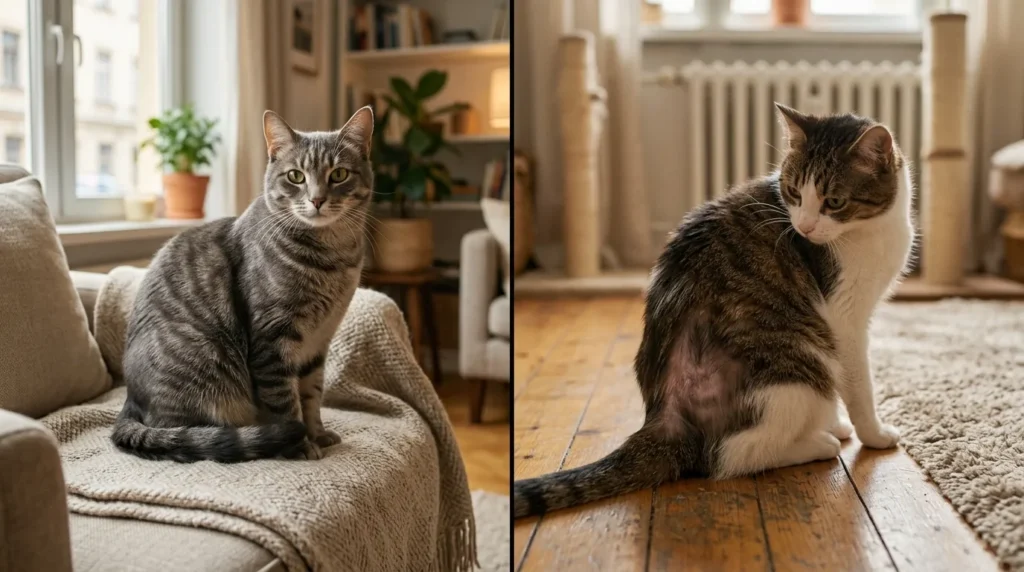
Normal shedding means even fur loss spread across the whole body, with healthy skin visible beneath. Your cat’s coat should still look full and consistent even when you find plenty of fur on your furniture. The skin under the coat should be clean and pale pink, no redness, flaking, or unusual moisture.
Excessive shedding looks different, and the timing of a change matters as much as the appearance. A sudden increase in a cat whose coat was previously stable means more than shedding that has always been part of her normal.
| Sign | Normal Shedding | Excessive / Concerning |
|---|---|---|
| Distribution | Even across the whole body | Patchy, thinning in specific spots |
| Skin underneath | Clean, pale pink | Red, flaking, or scaly |
| How fur releases | Comes out gradually with brushing | Pulls out in clumps with light touch |
| Pattern | Consistent, has always been this way | Sudden change from a previously stable coat |
| Behavior | No repetitive licking of one spot | Overgrooming one area until fur disappears |
How Nutrition Directly Controls How Much Your Cat Sheds
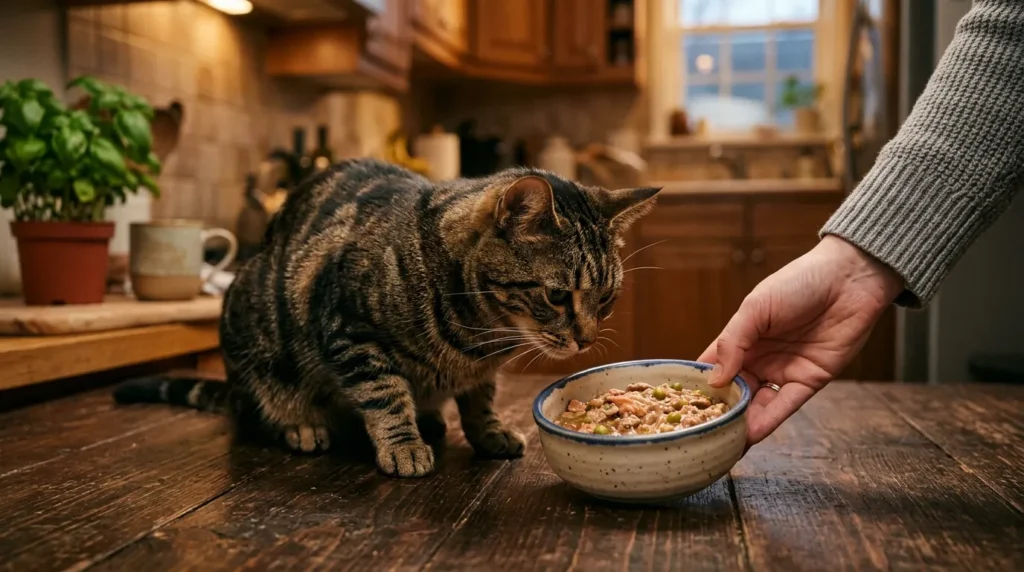
Omega fatty acids are the single nutritional factor most consistently linked to reduced shedding in cats. Omega-3 and omega-6 fatty acids support the skin barrier, cut inflammation, and strengthen individual hair follicles, so fur is less likely to release too early. Fish-based wet foods naturally carry higher omega levels than most dry kibble.
Protein quality matters just as much. The minimum protein percentage on a food label doesn’t tell you how bioavailable that protein is for your cat’s body to actually use. Plant-based proteins count toward the label number, but cats can’t efficiently convert them into the keratin that builds hair. Named animal proteins listed first on the ingredient list are a more reliable sign of coat-supportive nutrition than the percentage alone.
What and how you feed your indoor cat shapes coat health across months, not weeks. Switching to higher-quality food won’t stop shedding immediately, but the improvement in coat density and reduced loose fur is typically visible within four to eight weeks of a consistent change.
How Regular Grooming Controls What Actually Lands on Your Furniture
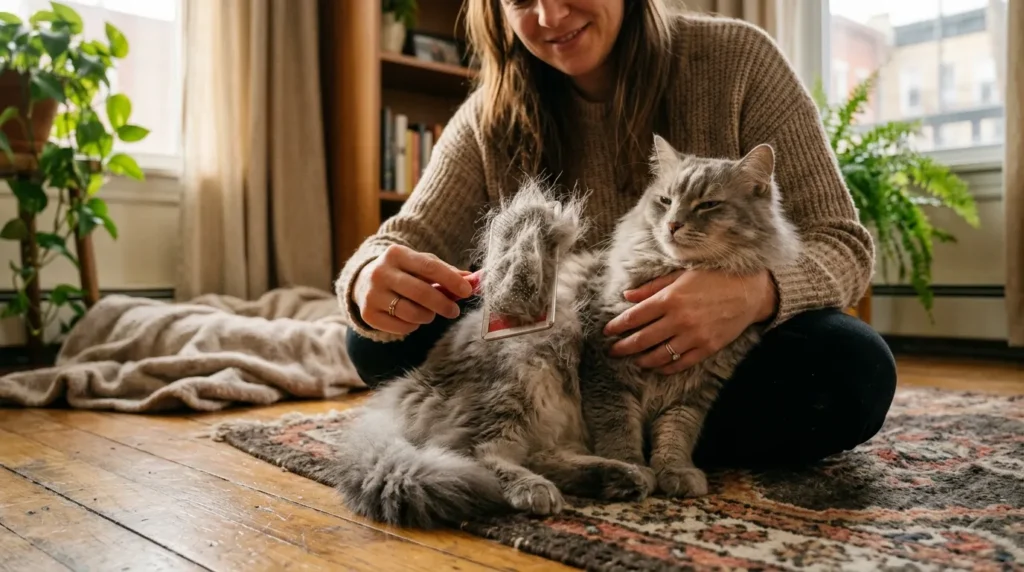
Regular brushing removes loose fur before it detaches and lands on your couch, clothing, and floors. It doesn’t stop shedding, but it relocates where the fur ends up. A thorough five to ten minute brushing session captures the equivalent of days of passive shedding in one controlled moment you can dispose of directly.
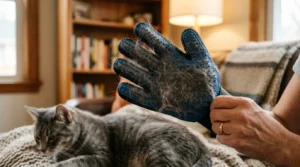
Brushing frequency should match coat type and current shedding level. A short-haired indoor cat needs one to two sessions per week. A medium-haired cat needs one every two to three days. A long-haired or double-coated cat needs daily attention to stay ahead of the undercoat turnover that produces most of the visible shedding.
A full indoor cat grooming routine that combines regular brushing with occasional waterless shampoo use and nail maintenance builds a complete coat management system, rather than addressing just one piece of the shedding problem.
Deshedding Tools Compared
| Tool | Best For | Limitation |
|---|---|---|
| Slicker brush | Reaching deep undercoat, double-coated breeds | Can irritate skin if pressed too hard |
| Rubber grooming glove | Cats who dislike brushes, quick daily sessions | Doesn’t reach deep undercoat |
| Metal deshedding comb | Heavy seasonal blowouts | Needs a gentle hand near the belly and legs |
| Grooming wipes | Between-brush touch-ups, hairless breeds | Doesn’t remove loose undercoat |
How Stress and Boredom Quietly Make Shedding Worse
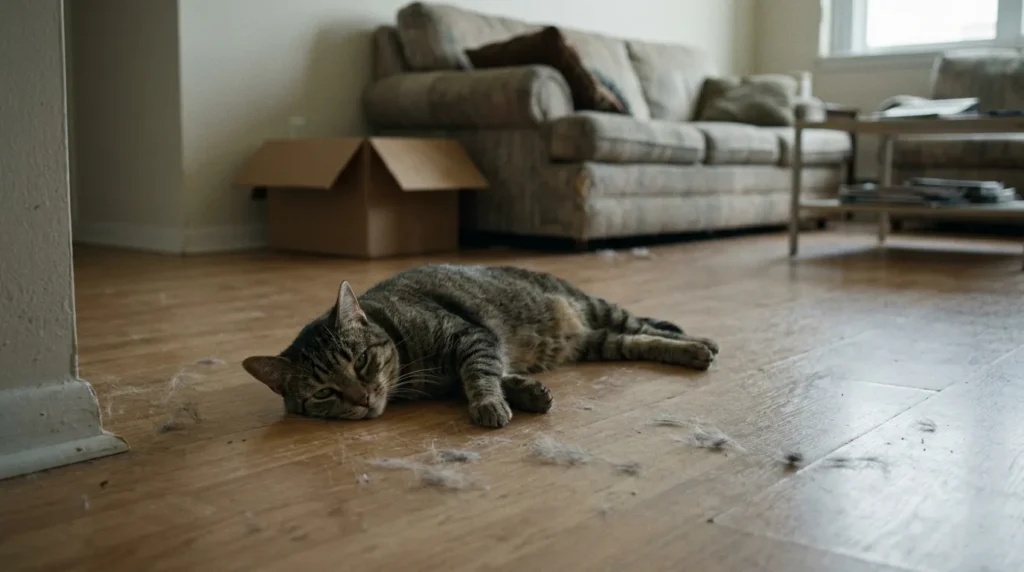
An indoor cat with nothing to do develops a form of chronic low-grade stress that owners often mistake for contentment, because the cat isn’t visibly distressed. She just sits and sleeps and seems calm. Underneath, elevated baseline cortisol is quietly speeding up her hair cycle, and you notice it as more fur on the furniture rather than any behavioral symptom.
Enrichment and daily stimulation directly cut the baseline stress load that contributes to shedding in understimulated apartment cats. A cat who hunts her toys, watches birds from a window perch, and has vertical climbing space available runs lower stress hormones across the whole day. That drop over weeks and months shows up in the coat.
Understanding your cat’s behavioral signals helps you tell whether shedding spikes line up with behavior changes like more hiding, less play, or shifts in appetite. When shedding and behavior change together, the cause is usually stress rather than a coat-specific issue.
Shedding and Hairballs: When Fur You Don’t See Becomes a Problem
More loose fur on the furniture means more fur available to swallow during grooming, and that connects directly to hairball frequency. Most cats bring up a hairball once or twice a month, and that’s considered normal, especially during a heavier shedding stretch. If your cat is producing hairballs more than two or three times a month, or retching repeatedly without producing one, that’s worth a vet visit rather than something to just manage at home, since it can point to excessive grooming, a digestive issue, or in rare cases a blockage.
Brushing does double duty here. Every strand your brush catches is a strand your cat can’t swallow, so the same routine that keeps fur off your couch also lowers her hairball load.
The Management Mistake That Keeps Shedding Out of Control
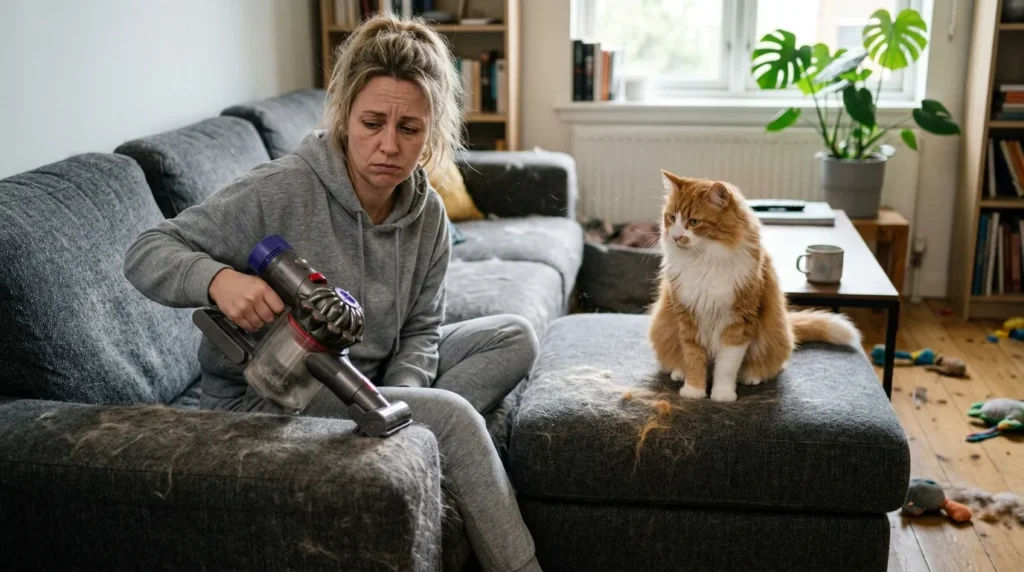
The most common management mistake is treating the surfaces rather than the source. Vacuuming furniture and sweeping floors every day handles the symptom without touching what creates it. The fur on your couch was attached to your cat yesterday. The only way to cut what lands on your furniture is to remove it from your cat through regular brushing before it ever detaches.
The second mistake is assuming that because shedding is normal, nothing can be done about the volume. Diet quality, brushing frequency, stress reduction, and indoor enrichment all meaningfully change how much loose fur your cat produces. None of them eliminates shedding, but together they cut visible fur accumulation by a real margin, without any single dramatic fix.
Keeping the litter box clean and accessible is also part of the overall stress management picture. A cat in a clean, low-stress environment produces less stress-related excess shedding than one in a home where basic comfort needs go inconsistently met. Good general indoor cat care builds the low-stress baseline that keeps shedding within the normal range for indoor cats. Vertical space and climbing furniture gives cats physical outlets that lower cortisol and support overall coat health.
Groomer’s Honest Take: the rubber grooming glove is genuinely underrated for shedding control. Most cats accept it right away because it feels like being petted. A five-minute session on the couch during TV time picks up a striking amount of fur that would otherwise be on your clothing tomorrow. The one limitation is that it doesn’t reach deep undercoat the way a slicker brush does, so use both instead of treating them as substitutes.
Reducing Cat Hair Around Your Apartment
Coat-side changes take weeks to show results, so a few environmental habits help in the meantime, especially in a small space where fur has fewer places to hide.
- Run a HEPA air purifier in the main living area. It won’t touch fur already on furniture, but it does pull loose fur and dander out of the air before it settles again.
- Use washable throws on furniture your cat favors, and toss them in the wash weekly instead of trying to brush fur out of upholstery fibers.
- Vacuum with a pet-specific attachment that has rubber bristles, which lift embedded fur out of carpet and fabric far better than a standard brush head.
- Keep a lint roller by the door for a fast pass before you leave, rather than trying to fully de-fur an outfit at the last minute.
None of this replaces brushing the cat herself. It just buys you time while the diet and stress changes above start doing the real work.
When Shedding Signals Something That Needs a Vet Visit
Sudden, real shedding in a cat whose coat was stable is a red flag regardless of what else is happening. So is patchy loss, visible bald spots, skin that looks red or scaly, or fur that clumps when you touch it lightly. These aren’t photoperiod issues. They point toward allergies, parasites, a fungal infection, hyperthyroidism, or another medical condition that needs a proper exam.
Senior cats over age eight who start shedding more and also show weight loss despite normal eating fit a common profile for hyperthyroidism, which is highly treatable when caught early. A cat who suddenly licks one spot obsessively until fur disappears is showing stress-induced overgrooming, which has a behavioral root worth addressing through enrichment and sometimes veterinary guidance.
Book a vet visit if you notice:
- A sudden shedding increase with no obvious cause
- Bald patches or visibly thinning areas
- Red, scaly, or flaking skin under the coat
- Hairballs more than two or three times a month
- Weight loss alongside increased shedding in a senior cat
This article is for informational purposes only. Always consult your vet if you have concerns about your cat’s health.
Frequently Asked Questions About Indoor Cat Shedding
Is it normal for my indoor cat to shed all year long?
Yes. Indoor cats shed year-round because artificial lighting and stable indoor temperatures disrupt the seasonal photoperiod signals their bodies rely on to trigger coat changes. Outdoor cats get concentrated spring and fall shedding events. Indoor cats get a slower, steadier version of the same process spread across all twelve months. This is biologically normal.
Can a poor diet really cause my indoor cat to shed more?
Yes, quite a bit. Hair is built mainly from protein, and omega fatty acids are directly tied to follicle strength. A cat eating low-quality food with too little animal protein and minimal omega content produces weaker hair shafts that release earlier in the growth cycle. Switching to a higher quality, high-protein wet food often produces a visible drop in shed volume within four to eight weeks.
How can I reduce how much my indoor cat sheds?
Brush consistently based on coat length: one to two times weekly for short hair, every two to three days for medium hair, and daily for long or double-coated hair. Feed a high-protein diet with omega-3 and omega-6 fatty acids. Cut baseline stress through daily interactive play and environmental enrichment. These three changes together reduce visible fur accumulation more than any single fix alone.
Does stress really make cats shed more?
Yes. Elevated cortisol from chronic stress or a specific stressful event pushes more hair follicles into the resting and shedding phase early. Indoor cats are especially vulnerable, since boredom creates a low-grade stress state many owners don’t recognize as stress at all. A cat who is understimulated may show more shedding with no obvious behavioral symptoms.
When should I worry about how much my indoor cat is shedding?
Worry when the pattern changes, not when it’s simply consistent. Sudden increases, bald patches or thinning areas, skin redness or flaking, fur that clumps or pulls out easily, and overgrooming of one spot are all signs worth a vet visit. Consistent year-round shedding with a full, even coat and normal skin is the indoor cat baseline, not a warning sign.
Do certain cat breeds shed more than others indoors?
Yes. Double-coated breeds like Maine Coons, Norwegian Forest Cats, and Siberians shed the most because of their dense undercoat, and they can still show mild seasonal blowouts even living entirely indoors. Single-coated breeds like Siamese shed less dramatically but more continuously. Curly-coated breeds like the Devon Rex shed the least of any coated cat.
Can spaying or neutering affect how much a cat sheds?
There’s no strong, direct evidence that spaying or neutering changes shedding volume on its own. Some owners notice a coat texture shift after the procedure, but that’s more likely tied to the metabolic and weight changes that can follow surgery than to shedding specifically. If shedding changes noticeably around the time of a spay or neuter, treat it as a coincidence worth mentioning to your vet rather than an expected side effect.
How often should a cat get hairballs, and when does it mean too much shedding?
Once or twice a month is typical, and slightly more during a heavy shedding stretch. More than two or three times a month, or repeated retching without producing one, is worth a vet visit rather than home management alone.
Indoor cats shed year-round because artificial lighting and stable HVAC temperatures disrupt the photoperiod signals that normally trigger seasonal coat changes in outdoor cats. The main controllable factors are diet quality, brushing frequency, coat type, and chronic stress from boredom or household changes. High-protein wet food with omega fatty acids reduces shedding within four to eight weeks. Brushing removes loose fur before it reaches furniture and also lowers hairball frequency, since swallowed fur is what forms them. Double-coated breeds shed the most and can show mild blowouts even indoors. Sudden increases in shedding, patchy loss, or skin changes call for veterinary evaluation rather than grooming management alone.
Shedding is one thread in the larger picture covered by our indoor cat care guide, and it connects closely with indoor cat health and indoor cat behavior for the fuller picture of what’s normal and what isn’t. For the specific pieces that support the fixes above, see our guides on feeding, grooming at home, enrichment, and cat furniture.

Written by Mishu
A passionate cat lover and indoor living enthusiast, Mishu is the founder and voice behind Indoor Living Cat – a go-to resource for cat owners who want to create the happiest, healthiest life for their feline companions indoors.
View Full Profile