
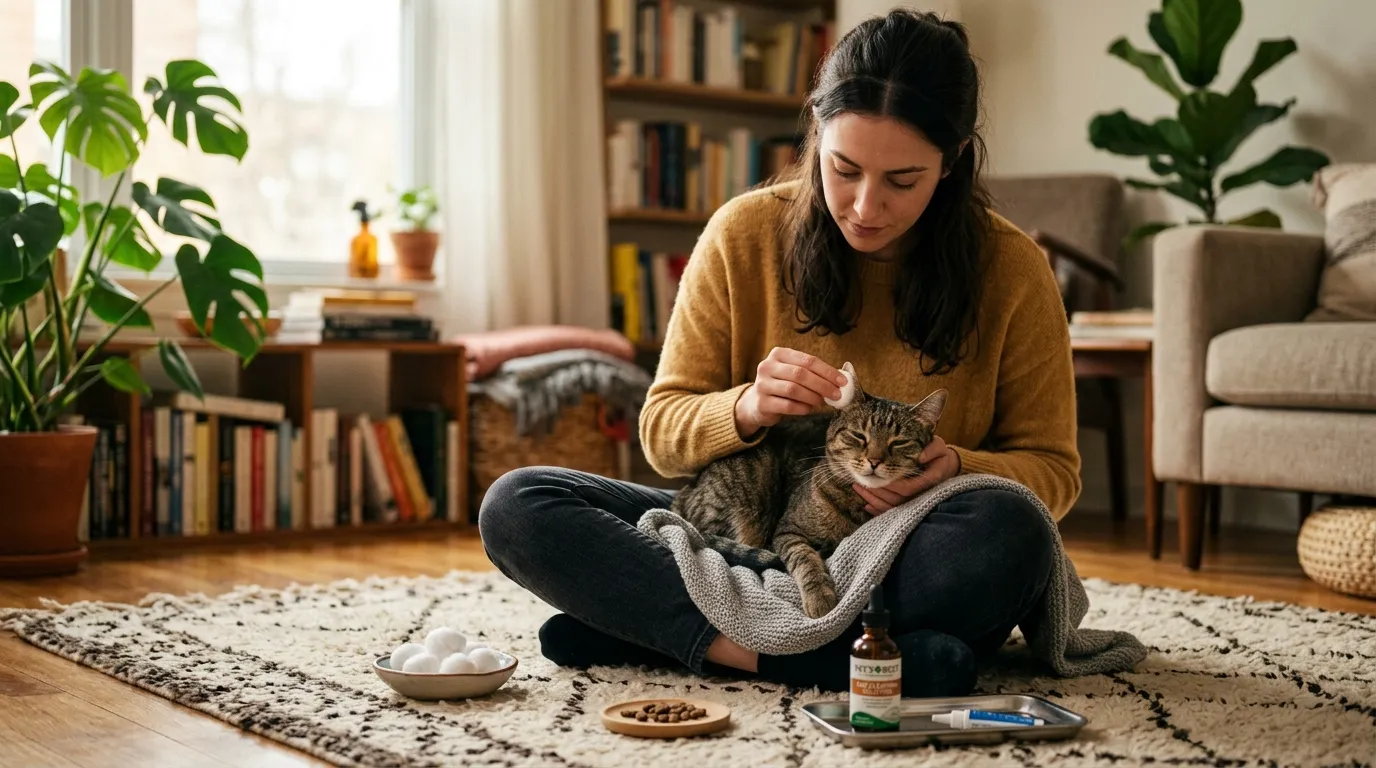
I noticed my cat had been tilting her head slightly to the left for a few days before I looked inside her ear and found a small accumulation of dark debris near the outer canal from her favorite dusty hiding spot behind the radiator. Learning how to clean cat ears at home properly turned a genuinely worrying discovery into a ten-minute routine that I now do monthly as a precaution. Most cats never need deep ear cleaning but knowing when and how to do it safely is the difference between a minor maintenance moment and an accidental injury. This article covers the six-step technique, how to tell healthy wax from a problem worth calling your vet about, what to do with a kitten or a cat who won’t hold still, and the one tool you must never put inside a cat’s ear.
How to clean cat ears at home: apply a vet-formulated ear cleaner to a cotton ball or directly into the canal, massage the base of the ear for 20 to 30 seconds, let your cat shake and then wipe the outer ear with a clean cotton ball. Never use cotton swabs. Reward immediately. Clean only when visible debris is present, not on a fixed schedule.
Do Indoor Cats Actually Need Their Ears Cleaned?
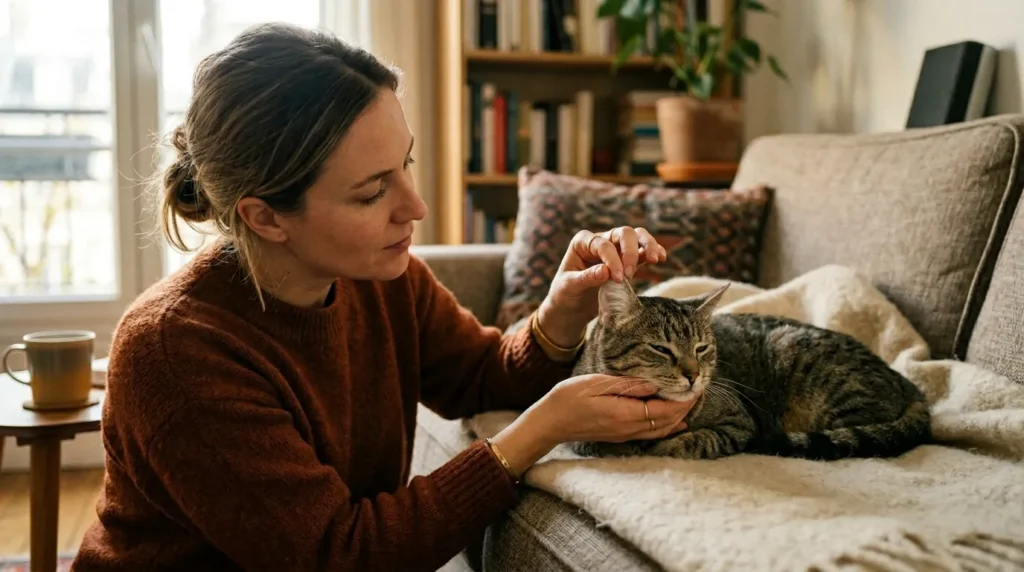
Most healthy indoor cats clean their own ears effectively as part of their self-grooming routine. Their outer ear canal naturally moves debris upward and out, so for most cats a weekly visual inspection is genuinely all the maintenance required. If the ears look pink, smell like nothing at all and your cat shows no signs of discomfort, the correct response is to leave them alone.
According to VCA Animal Hospitals, over-cleaning cat ears strips protective oils and can cause the same irritation and microbial imbalance owners are trying to prevent. Clean only when visible wax or debris is present. Don’t clean on a fixed weekly schedule regardless of what you see, and don’t assume ear cleaning is even necessary in the first place. VCA notes that ear cleaning isn’t usually necessary for most cats, but it becomes an important part of hygiene for cats prone to wax buildup or infection.
Your cat’s ear canal has a shape that works against her here. It runs vertically before bending sharply into a horizontal section, so debris that gets past the bend can’t always work its way back out on its own. That’s the structural reason some cats need periodic help even though most don’t.
Your cat’s full indoor grooming routine is the right context for ear checks. Do a quick visual while you brush rather than treating ears as a separate scheduled task. That habit catches debris before it accumulates without overcleaning clean ears.
What a Healthy Ear Looks Like: A Quick Checklist
Before you decide whether to clean anything, check for these three things. If your cat’s ears hit all three, skip the cleaning and just keep watching.
- Color: pale pink skin, no redness or dark blotches
- Smell: nothing. A healthy ear has no odor at all
- Wax: none, or a small amount of light-to-medium brown wax near the outer canal only
Fail any one of these and you’re in judgment-call territory. Fail two or more, or add head shaking or scratching to the mix, and you should call your vet before you clean anything.
Supplies You Need Before You Begin
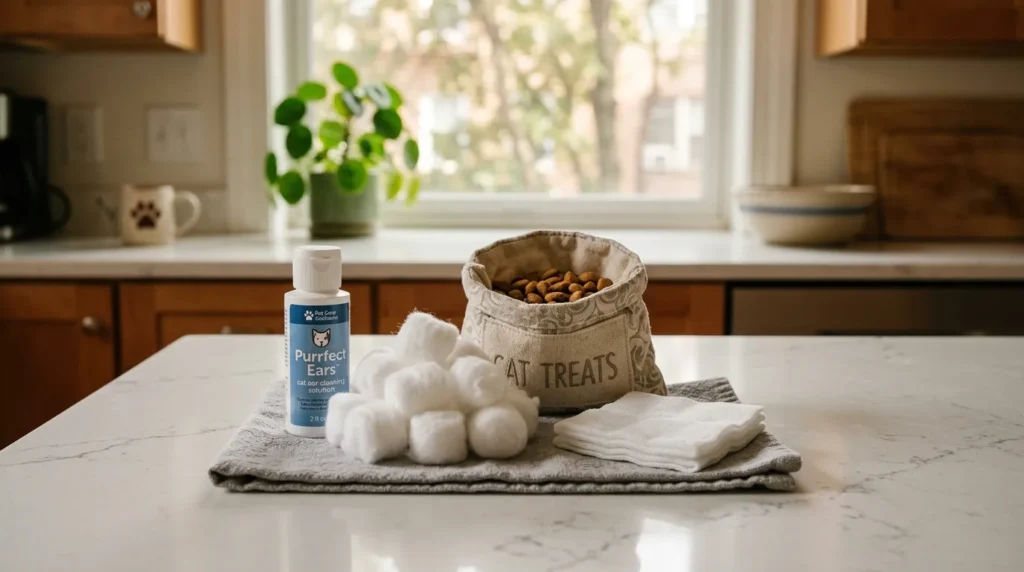
The most important supply is a vet-formulated ear cleaner, and nothing else substitutes for it. pH-balanced enzymatic solutions or gentle drying formulas designed specifically for cats are the right choice. Human ear drops, hydrogen peroxide, vinegar and isopropyl alcohol all cause chemical irritation inside the ear canal, ranging from mildly painful to severely damaging depending on concentration and your cat’s individual sensitivity. Coconut oil and baby oil aren’t a fix either. They’re covered in the FAQ below.
| Cleaner Type | Best For | Indoor Cat Suitability |
| Enzymatic flush (e.g., enzyme-based) | Routine wax maintenance | Excellent |
| Drying formula (salicylic acid base) | Waxy or moisture-prone ears | Very good |
| Acetic acid formula | Yeast-prone or odor issues | Good |
| Pre-moistened wipes | Skittish or resistant cats | Very good |
Beyond the cleaner, you need soft cotton balls or gauze pads and a supply of high-value treats. A bath towel helps too, more on that below. Do not buy cotton swabs for this purpose. Not for the outer ear, not for a quick gentle touch. Cats move unpredictably, and the risk of a swab going deep into the canal by accident is real enough that every vet source agrees it simply shouldn’t be in the kit.
Cat Won’t Hold Still? Try the Towel Wrap First
If your cat turns into an eel the moment she sees a cotton ball, you’re not doing anything wrong. Some cats just need more restraint than a lap and a calm voice can offer.
Lay a bath towel flat and set your cat in the middle, facing away from you. Wrap the sides over her body like a burrito, leaving only her head free. This keeps her paws tucked in so she can’t swat the bottle or scratch your hand mid-clean. A second person holding her gently in place while you work is genuinely useful if you have one, and it turns a wrestling match into a two-minute job.
If your cat is still frantic even wrapped, stop. Forcing it through can teach her to associate ear handling with panic, which makes every future attempt harder. Build tolerance first using the desensitizing routine in the FAQ section below, then come back to this once she’s used to having her ears touched at all.
How to Clean Cat Ears at Home? The 6-Step Method
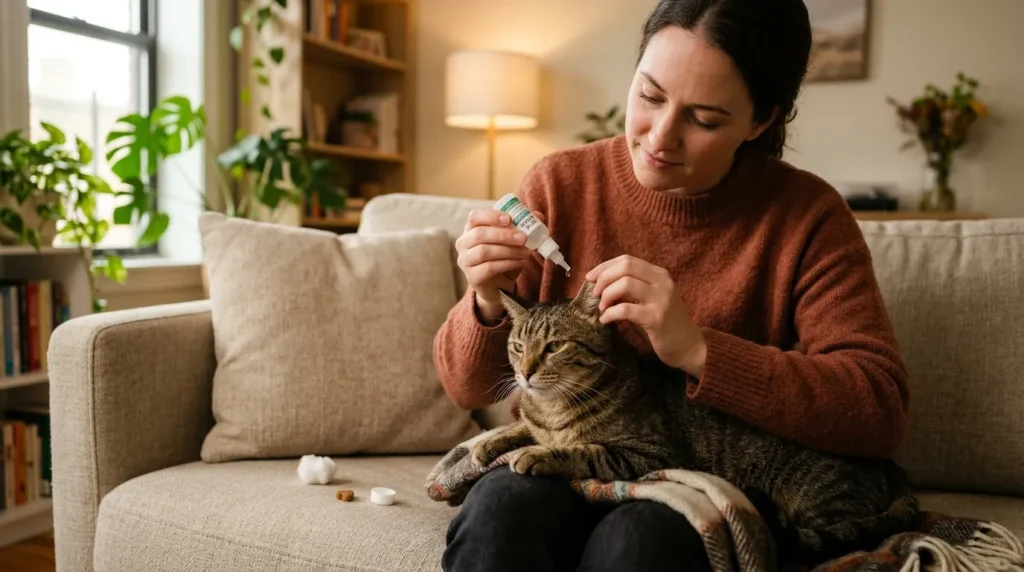
Step 1: Choose the timing carefully. A cat who just finished a play session and a meal is at her most relaxed. That’s your window. Don’t attempt ear cleaning when she’s alert, in hunting mode or already tense from a recent stressor. If she’s a wriggler, use the towel wrap above before you start.
Step 2: Fold back the ear flap gently and inspect the canal with good light before applying anything. What you see before cleaning matters. Pink skin, a small amount of light brown wax and no odor means normal maintenance. Dark debris, redness, swelling or any smell at all means stop here and call your vet before proceeding.
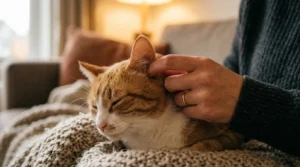
Step 3: Apply a vet-formulated ear cleaner. Squeeze a few drops directly into the canal or soak a cotton ball and tuck it just inside the opening. The cotton ball method is gentler for cats who startle at the squirt sound.
Step 4: Massage the base of the ear for 20 to 30 seconds. The right spot is at the bottom of the ear where it meets the skull, not near the opening. You’ll hear a soft squelching as the solution loosens debris deeper in the canal. This step is where the real cleaning happens.
Step 5: Release your cat and let her shake her head. This is beneficial, not something to prevent. The head shake brings loosened debris up and out of the canal toward the outer ear where you can reach it.
Step 6: Use a clean cotton ball to wipe the outer ear and the visible parts of the canal. Clean only what you can see without inserting your finger. Offer a treat immediately. Repeat on the other ear if needed.
Understanding What Normal Looks Like Inside a Cat’s Ear?
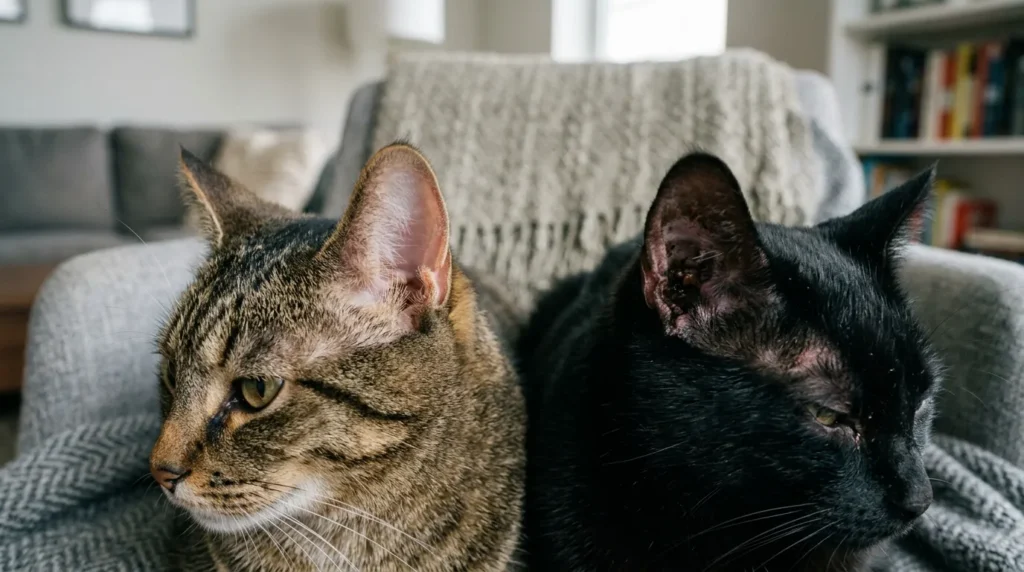
A healthy ear is pale pink, odorless and has at most a light coating of pale to medium brown wax near the outer canal. That wax is normal and protective. Removing it completely with aggressive cleaning does more harm than leaving it in place.
Debris color tells you a lot before you even get to a vet. Here’s how to read it:
| What You See | Likely Cause | What To Do |
| Light to medium brown, waxy | Normal wax | Clean if visible, otherwise leave alone |
| Dark brown or black, coffee-ground texture | Ear mites | Vet visit for antiparasitic medication |
| Yellow or greenish discharge | Bacterial infection | Vet visit, likely needs medication |
| Brown, waxy, with a yeasty odor | Yeast infection | Vet visit, an acetic-acid cleaner may be recommended after diagnosis |
Ear wax buildup that appears dark brown or black with a coffee-ground texture is associated with ear mites rather than routine debris. Ear mites require medication, not a home cleaning session. A foul, sweet or yeasty odor from the ear canal is also a sign of infection rather than simple wax accumulation. Both conditions look like they need more aggressive cleaning when what they actually need is a vet visit.
Monitoring your cat’s behavioral signals around ear discomfort helps you catch problems early. A cat who shakes her head frequently, scratches at one ear repeatedly or holds her head tilted is telling you something is wrong before the visual symptoms become obvious.
How Often Do Indoor Cats Need Ear Cleaning?

Most indoor cats need a full ear cleaning only when visible debris appears. For healthy cats that averages every two to four weeks for cats who produce more wax, and less often or never for cats who don’t. The key is a weekly visual inspection, not cleaning on a fixed schedule whether the ears need it or not.
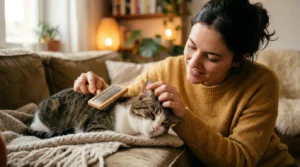
Long-haired breeds and cats who spend time near dusty corners or radiators tend to accumulate more debris than sleek short-haired cats who patrol cleaner environments. Outdoor and indoor-outdoor cats need more frequent checks than strictly indoor cats, since they pick up dirt and parasites their housebound counterparts never encounter. If your cat has a favorite hiding spot that tracks dust and debris through her coat, checking her ears when you check her coat makes practical sense as a combined routine.
A complete approach to indoor cat care treats ear checks as part of a whole-body health awareness habit rather than a separate task. The owners who catch ear infections early are almost always the ones who have built a habit of regular physical checks, not the ones who wait for visible symptoms.
Owner’s Note: After the first time I actually did this properly, I realized how easy it had sounded versus how much my cat disliked the squelching sound during the massage step. Offering a treat during rather than only after made a real difference. The treat as a distraction mid-massage, not just a reward afterward, is the specific adjustment that changed her tolerance from escape attempts to mild resignation.
How to Clean a Kitten’s Ears (What’s Different)
Kitten ear canals are smaller and more delicate than an adult cat’s, so the same routine needs a lighter touch. Use less solution than you would for an adult cat, work faster so she isn’t restrained any longer than necessary, and skip the deep massage step if she seems uncomfortable with any pressure at all.
Check with your vet before cleaning a kitten’s ears for the first time, especially if she’s under twelve weeks old. Kittens are also more prone to ear mites picked up from a mother or littermates, so dark, crumbly debris in a young kitten’s ear is worth a vet call rather than a home cleaning attempt.
The Mistake That Causes More Harm Than Dirty Ears

Using a cotton swab is the most common mistake owners make when cleaning cat ears at home, and it’s also the most dangerous. A cat who moves unexpectedly during a swab insertion can sustain damage to the ear canal or the eardrum that requires veterinary treatment to fix. The ear canal isn’t a straight tube, and the safe cleaning zone for any home tool ends where you can no longer clearly see the surface you’re touching.
The second mistake is cleaning when a problem already exists. An infected ear is painful, and applying cleaning solution into an already-inflamed canal causes additional pain while potentially pushing debris further inward. If you see redness, swelling or unusual discharge before you start, the correct first step is a vet call, not a cleaning session. Keeping track of your cat’s overall indoor health patterns including ear condition as part of a regular assessment gives you the baseline that makes sudden changes obvious rather than easy to overlook.
Litter box habits and feeding patterns changing alongside ear discomfort sometimes signal a systemic health shift rather than an isolated ear issue. Enrichment and daily engagement help too, because a cat who’s mentally active is one whose behavior changes are easier to notice quickly.
When Cat Ear Symptoms Need a Vet Visit, Not Home Cleaning
A cat who shakes her head more than a few times daily, scratches at one ear repeatedly with her back leg or holds her head consistently tilted is showing symptoms that home cleaning won’t resolve. These behaviors indicate something beyond surface wax and need diagnosis before any treatment. Trying to clean at this stage can make an infection worse.
Dark coffee-ground debris in the ear canal points to ear mites rather than accumulated wax. Ear mites need antiparasitic medication applied to the canal and sometimes given systemically, usually for two to four weeks depending on the product your vet prescribes. Cleaning removes the debris temporarily but doesn’t kill the mites or their eggs. The itching and debris come back within days without proper treatment.
Redness, swelling or a foul odor from either ear warrants a same-week vet appointment rather than a wait-and-see approach. Cat ear infections escalate faster than human ear infections because cats mask pain effectively and keep up normal behavior until the infection is advanced.
This article is for informational purposes only. Always consult your vet if you have concerns about your cat’s health.
Home Cleaning vs. a Vet or Groomer Visit: Which Do You Need?
| Situation | Home Cleaning | Vet or Groomer |
| Light brown wax, no odor, no discomfort | Yes, safe to handle yourself | Optional |
| Dark, crumbly debris or strong odor | No | Yes, needs diagnosis |
| Redness, swelling or visible pain | No | Yes, same week |
| Cat won’t tolerate any handling | Try desensitizing first | A groomer or vet tech can help |
If a professional cleaning turns out to be the right call, cost varies a lot by clinic and region. It’s sometimes bundled into a routine wellness exam and sometimes billed as a small standalone service, so ask your vet’s office for their specific pricing rather than assuming a number from the internet.
Frequently Asked Questions About Cleaning Cat Ears at Home
How often should I clean my indoor cat’s ears?
Clean only when you see visible wax or debris during your weekly visual inspection. For most healthy indoor cats this happens every two to four weeks at most, and for many cats it happens rarely or never. Over-cleaning every week regardless of what you see strips protective oils from the canal and can cause the irritation you’re trying to prevent.
Why can’t I use a cotton swab to clean my cat’s ears?
Cat ear canals aren’t straight, and cats move unpredictably during grooming. A sudden movement while a swab is inserted can drive the tip into the canal or against the eardrum, causing injuries that need veterinary repair. The outer ear and the visible part of the canal are all that should ever be touched with any tool during home cleaning.
What does normal cat ear wax look like versus something I should worry about?
Normal wax is light to medium brown and waxy in texture. Small amounts in the outer canal are healthy and protective. Dark brown or black debris with a coffee-ground appearance suggests ear mites. A yellow or green discharge suggests bacterial infection. Any foul smell from the canal is always worth a vet call rather than an attempt at home cleaning.
My cat hates having her ears touched. How do I desensitize her?
Touch her ear briefly, for about one second, and offer a treat immediately after. Do this daily for a week without using any cleaner or doing any actual cleaning. The goal is pairing ear contact with a reward before you introduce any maintenance. Over ten to fourteen days, gradually increase how long you handle the ear before each treat. Most cats tolerate ear cleaning once this foundation is built.
Can I use baby oil or coconut oil to soften ear wax in my cat?
No. Oils that aren’t formulated for a cat’s ear canal can trap debris rather than dissolve it, create conditions that favor microbial growth, and they’re hard to rinse out without extra product. Use only a vet-formulated ear cleaner with a pH-balanced formula built for feline ear biology. The gap between a proper cleaner and an improvised alternative isn’t small.
Is it normal for my cat to shake her head after I clean her ears?
Yes, a few head shakes right after cleaning is expected and helpful. It’s how leftover solution and loosened debris work their way out of the canal. What isn’t normal is head shaking that continues for hours, or that starts up again a day or two later. That pattern points to leftover irritation, residual debris, or an infection, and it’s worth a vet check rather than another cleaning.
How do I know if it’s ear mites or just wax?
Texture and color are the fastest tell. Ordinary wax is smooth and light to medium brown. Ear mite debris looks like dry coffee grounds and is usually darker, almost black. Mites also tend to come with more intense itching than wax alone causes, so a cat pawing frantically at one ear alongside dark, crumbly debris is a strong case for a vet visit rather than a cleaning session.
Is it different to clean a kitten’s ears than an adult cat’s?
Yes. Kitten ear canals are smaller and more sensitive, so use less solution, work quickly, and skip firm massage if she seems bothered by pressure. Check with your vet before the first at-home cleaning, particularly for kittens under twelve weeks, since dark debris at that age is more often mites than routine wax.
How to clean cat ears at home involves applying a vet-formulated ear cleaner, massaging the base of the ear for 20 to 30 seconds, letting the cat shake and then wiping the outer canal with a cotton ball. Most healthy indoor cats need cleaning only when visible wax or debris appears, roughly every two to four weeks for wax-prone cats and less often for others. Never use cotton swabs. A towel wrap helps with cats who won’t hold still, and kittens need a lighter touch with less solution. Signs requiring a vet visit include dark coffee-ground debris, head shaking that continues after cleaning, ear scratching, redness or odor from the canal.

Written by Mishu
A passionate cat lover and indoor living enthusiast, Mishu is the founder and voice behind Indoor Living Cat – a go-to resource for cat owners who want to create the happiest, healthiest life for their feline companions indoors.
View Full Profile