
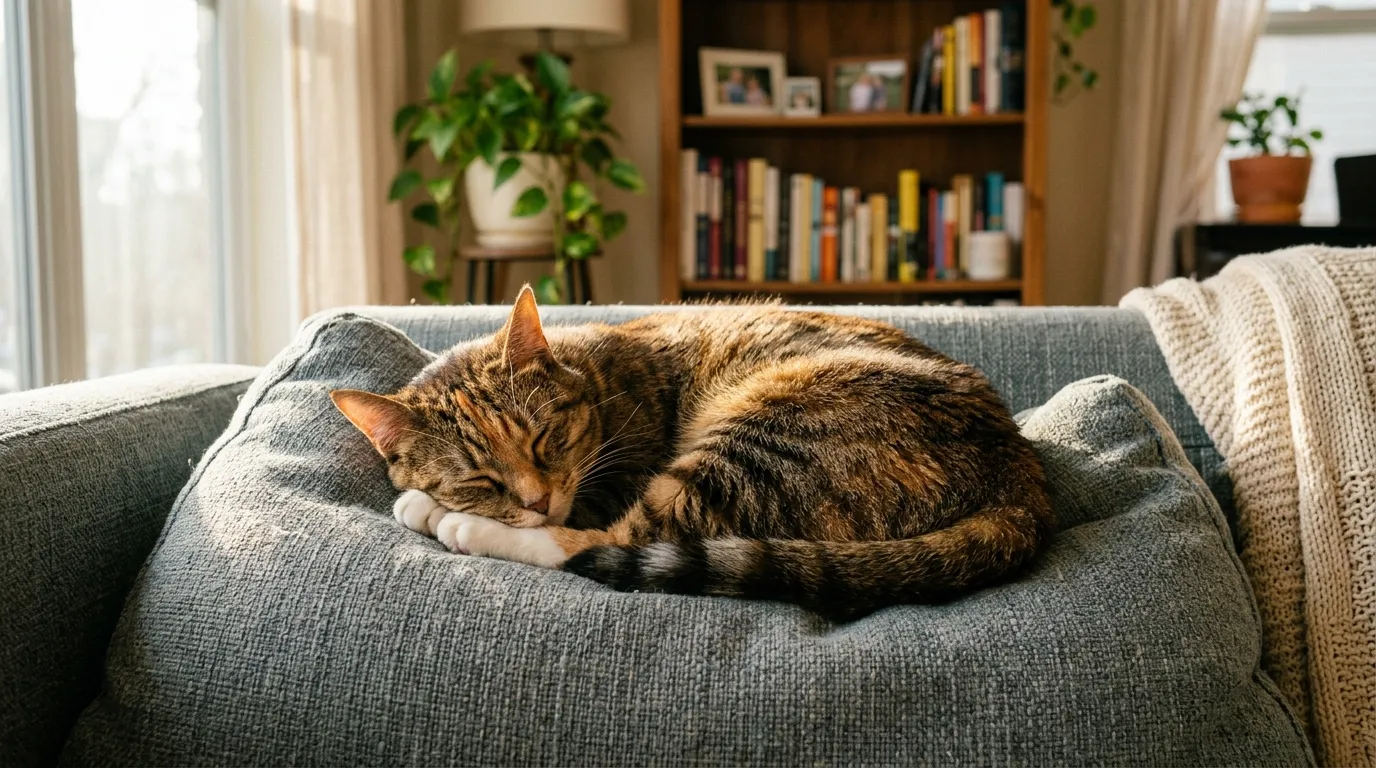
The first time I watched my cat sleep through an entire Saturday afternoon and well into Sunday morning, I started worrying that something was wrong with her. Nothing was. If you’ve ever typed “why does my indoor cat sleep so much” into a search bar, you’ve probably had the same moment. A cat who naps most of the day is usually a healthy one, because her body is built to rest this way. This article covers the seven reasons behind all those naps and how indoor life changes them. It also shows you how to tell boredom from illness, with a checklist for when to call the vet.
Quick answer: adult indoor cats sleep 12 to 16 hours a day, and kittens and seniors can reach 18 to 20. Cats are crepuscular predators built for short bursts of energy. Indoor life removes the hunt that would normally spend that energy, so rest fills the gap. The number of hours matters less than change. A cat whose sleep jumps suddenly, or who wakes groggy and skips meals, needs a vet.
The 7 Reasons Indoor Cats Sleep So Much
Here is the short version. Each reason gets its own section below.
- Energy conservation. Predators bank fuel for short, intense bursts. Read the biology.
- Crepuscular rhythm. Cats peak at dawn and dusk and rest in between. Read the biology.
- A quiet home. Fewer things wake an indoor cat than an outdoor one. See indoor vs. outdoor.
- Boredom. With nothing to chase or investigate, sleep becomes the default. See boredom.
- Age. Kittens and senior cats sleep the most. See age.
- Cold, dark days. Short days and bad weather add naps, even indoors. See season.
- Stress. A move, a new pet or a lost companion can send a cat into hiding and sleep. See stress.
Reasons 1 and 2 are biology you can’t change. Reasons 3, 4 and 7 respond to what you do at home. And if none of the seven fits, skip ahead to the warning signs, because a health problem can look exactly like a lazy cat.
How Much Sleep Is Actually Normal for Indoor Cats?
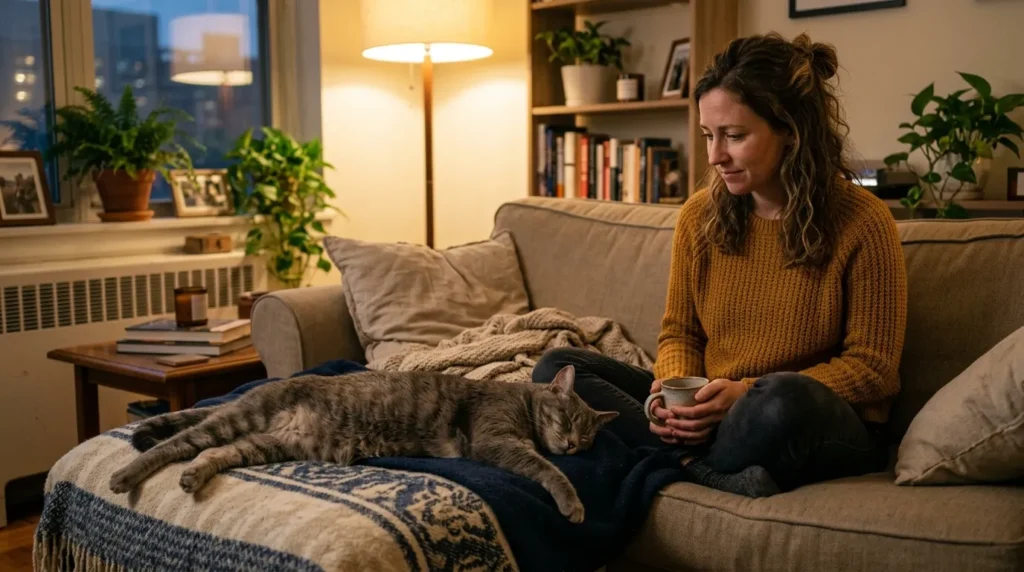
Indoor cats sleep between 12 and 16 hours a day on average, and some reach 18 to 20 when they’re young, elderly or very sedentary. That number sounds excessive until you see what drives it. Long sleep is a cat’s normal setting, so the total alone rarely tells you much.
| Life Stage | Typical Sleep Hours Per Day | What It Looks Like |
| Newborn kittens (first weeks) | Up to 22 hours | Wake mainly to feed |
| Kittens (under 6 months) | 16 to 20 hours | Short bursts of play between naps |
| Adult cats (1 to 7 years) | 12 to 16 hours | Activity peaks at dawn and dusk |
| Senior cats (7 years and older) | 16 to 20 hours | More daytime sleep, sometimes more night activity |
Treat these as averages, not targets. A cat at 11 hours and a cat at 17 can both be healthy. The useful comparison is your cat against her own normal.
Sleep in cats is polyphasic, meaning it comes in many short cycles instead of one long block. Her 14 hours are dozens of small pieces: light dozing, naps that often run 15 to 30 minutes and shorter stretches of deep REM sleep, repeated day and night. From the couch it looks like nonstop sleep.
Light Sleep, Deep Sleep and Dreaming: What Your Cat Is Doing
Not every “asleep” cat is fully out. Plenty of cats doze within sight of their person, which lets them rest while still tracking the room. Here’s how to read what you’re seeing.
| Stage | What You’ll See | How Fast She Wakes |
| Light doze (a cat nap) | Half-closed eyes, ears swiveling toward sounds, paws tucked under | Instantly |
| Deep sleep | Eyes fully closed, slow even breathing, curled tight or stretched out | A few seconds |
| REM sleep | Twitching whiskers, paws or tail, eyes moving under the lids, soft chirps | Slowly, and she may startle |
The twitching in REM matches what researchers see in other sleeping mammals, so dreaming is a fair bet. Nobody can confirm what a cat dreams about. Hunting is the popular guess and nothing more.
What Your Cat’s Sleeping Position Means?
Position tells you how deeply she’s resting and how safe she feels. None of these is a diagnosis, but they help you read a cat who spends most of her day horizontal.
| Position | What It Usually Means |
| Loaf (paws tucked, chest down) | Light rest. She can be on her feet in a second. |
| Curled in a tight ball | Keeping warm and protecting her belly. Common in cold rooms. |
| Stretched out on her side | Comfortable and warm enough to relax fully. |
| Belly up | Deep trust. She feels safe enough to expose her most vulnerable spot. It’s not an invitation to rub her belly. |
| Hunched, tense, eyes half open | Resting but wary. If she holds this posture for hours, think pain or stress. |
Cats who sleep on you are chasing warmth, and they also like your scent and the steady rhythm of your breathing. It’s a good sign about the bond. It doesn’t mean she’s lonely or needs more attention than usual.
The Real Biology Behind Why Indoor Cats Sleep So Much
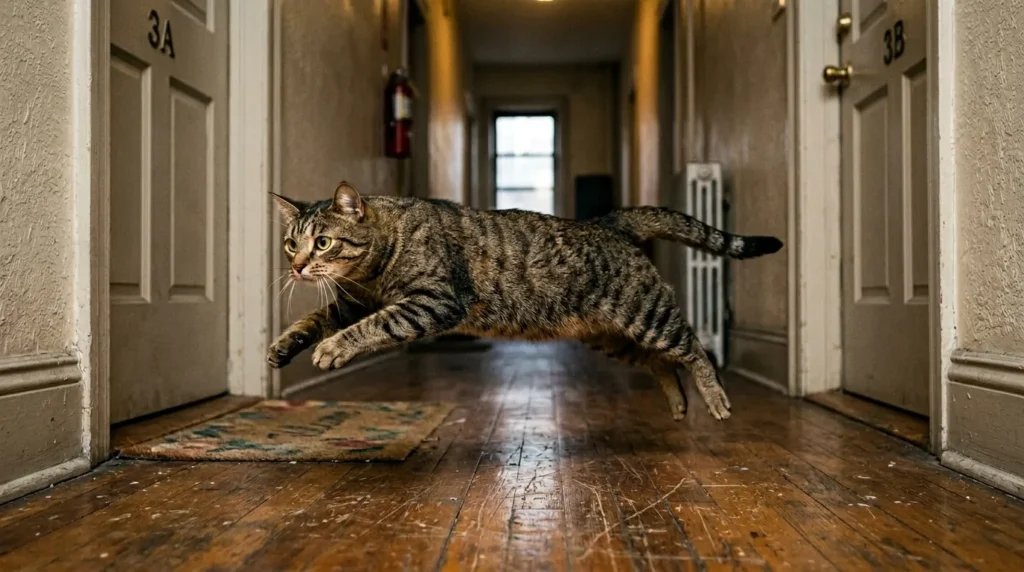
Cats are crepuscular, meaning they evolved to be most active at dawn and dusk, when their prey was moving. Between those windows, wild cats conserved energy hard because a failed hunt was a loss they couldn’t afford. That instinct is fully intact in your apartment cat, even though she has never hunted a day in her life.
Energy conservation is the core mechanism. A hunt burns physical and mental resources fast, so long rests between bursts of activity are plain efficiency. Your indoor cat’s body runs the same program. She rests deeply so that when something triggers her instincts, even a toy skittering across the floor, she can respond at full power.
Diet matters here too. Cats are obligate carnivores, and a high-protein, meat-based diet is built for exactly this pattern: eat a big meal, groom, then sleep it off. That’s why many cats crash for a long nap right after dinner.
The result is a healthy indoor cat who looks like she sleeps constantly, because she does rest for most of the day. Short, repeated sleep cycles are normal across domestic cats, and the Cornell Feline Health Center publishes vet-reviewed material on feline health if you want to read further. Tracking your cat’s indoor cat health gives you a baseline, and a baseline makes any real change in sleep easy to spot.
Why Do Indoor Cats Sleep More Than Outdoor Cats?

Outdoor cats wake up because the world makes them. A bird lands, a rival wanders through, the weather turns or a patrol needs finishing. Indoor cats wake when something in the apartment gives them a reason. When the home is quiet and nothing is changing, sleep fills that space.
| What Wakes Her Up | Outdoor Cat | Indoor Cat |
| Prey and wildlife | Constant | Only what she sees from a window |
| Territory and rival cats | A daily job | Rare |
| Weather, sounds and smells | Always shifting | Mostly steady |
| Exercise | Built into the day | Only what you set up |
That is why the indoor answer differs from the pure-biology answer. A cat in an apartment or small home with few changes across the day can run out of reasons to stay awake. Her environment doesn’t demand the vigilance that outdoor life produces automatically.
Your work schedule feeds into this. A cat home alone for eight or nine hours has a quiet, unchanging house, and she’ll sleep through most of it. That isn’t neglect, but it does mean the hours you’re home are the ones where she needs something to do.
Cats who have access to window perches and vertical space stay awake longer, because the outside world hands them a steady trickle of stimulation. A cat watching birds from a perch is awake and working. A cat facing a blank wall has no reason to stay alert and drifts off within minutes. The layout of your home shapes how much she sleeps.
When Boredom Is the Real Answer to Why Your Cat Sleeps So Much
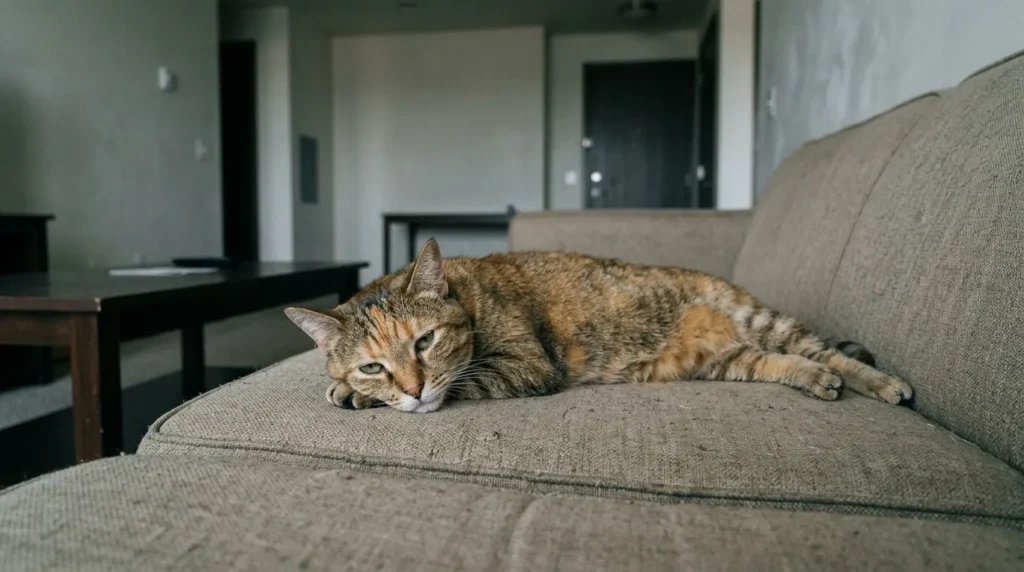
Boredom in indoor cats drives extra sleep, and it’s worth separating from the biological baseline. A cat who sleeps 14 hours because her crepuscular cycle says so is healthy. A cat who sleeps 18 hours because nothing in her day gives her something to chase or investigate is telling you the home needs more going on.
The tell is timing and responsiveness. A bored cat half-sleeps through the day and brightens the second you walk in or pick up a toy. That fast switch says she’s understimulated and waiting. A cat who has had enough activity sleeps deeper and wakes up clear and purposeful.
A structured daily enrichment routine cuts the extra sleep that builds when an indoor cat’s days have no variety. Start with two 10 to 15 minute interactive play sessions a day, rotating toys and open window access. Give it a week, then compare her wake quality and hours against the week before. If it’s working, you’ll see it in how she greets you.
Bored, Tired or Sick? A Quick Comparison
| Signal | Bored | Normally Tired | Possibly Ill |
| Reaction to you or a toy | Perks up fast | Wakes, stretches, joins in after a moment | Slow, groggy or ignores you |
| Appetite | Normal | Normal | Reduced or gone |
| Litter box and grooming | Normal | Normal | Changed |
| What helps | Play and more variety | Nothing, let her rest | A vet visit |
7 Ways to Add Variety to an Indoor Cat’s Day
- Run two wand-toy sessions a day and end each with a “catch” she can bite.
- Rotate toys weekly. Keep the rest out of sight so old ones feel new.
- Put a window perch where she can watch a bird feeder or a busy street.
- Add vertical space with a cat tree or wall shelves.
- Serve part of her meal in a puzzle feeder, or scatter a few pieces of kibble around the room.
- Leave out a cardboard box or a paper bag with the handles cut off.
- Try catnip or silvervine, since some cats respond and others don’t.
[IMAGE PLACEHOLDER: cat working at a puzzle feeder or scatter-fed kibble on an apartment floor | Suggested alt text: “indoor cat using a puzzle feeder for daily enrichment” | Suggested filename: indoor-cat-puzzle-feeder-enrichment.webp]
Age, Season and Stress: Other Factors That Shape Indoor Cat Sleep
Kittens and Senior Cats
Newborn kittens sleep up to 22 hours and wake mainly to eat. By six months they’ve dropped to roughly 16 to 20, with bursts of play between naps. If your kitten crashes mid-zoomie, that’s growth, not a problem. Kittens build bone, muscle and brain on that sleep.
Senior cats sleep noticeably more than they did as adults, and that increase is normal by itself. A 12-year-old who now sleeps 18 hours after years at 14 has shifted with her physiology. What matters is whether she still wakes alert, eats normally and engages when you invite her.
Two age-specific problems hide behind extra sleep. Arthritis makes older cats move less, and they hide pain well, so a cat who sleeps more and quietly stops jumping onto the couch may hurt. Some seniors also flip their schedule, dozing all day and wandering at night. That can be plain aging, and it can point to cognitive dysfunction, so raise it with your vet. Many vets recommend checkups at least twice a year once a cat passes 10.
Season and Weather
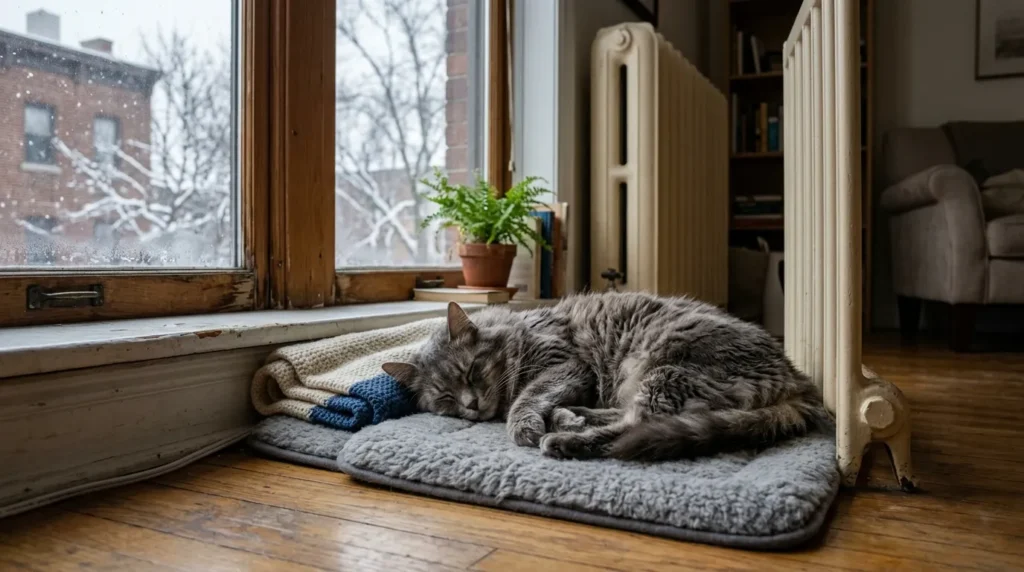
Short days and cold weather push many cats to sleep more, and that includes cats who never step outside. A heated mat near the radiator or a sunny window ledge becomes prime real estate. Many mammals respond to daylight this way, and it isn’t a concern on its own. Watching indoor cat behavior patterns across seasons helps you separate a normal winter increase from something that needs attention. If appetite, litter box habits and alertness hold steady, it’s seasonal.
Stress
Stress raises sleep too. A cat who has just moved, gained a new family member, lost a companion or seen her routine change often sleeps more to withdraw from a home that feels uncertain. If the extra sleep started right after a specific change, that change is the likely cause. When the trigger is a new pet, a slow introduction to a new cat lowers the stress load for everyone.
Look for stress signs beyond sleep: hiding, less grooming, smaller meals. If the extra sleep doesn’t ease as she settles in, or she stops eating, call the vet.
Weight and Fitness
Extra weight and extra sleep feed each other. A heavier cat tires faster, plays less and sleeps more, which keeps the weight on. If your cat has gained noticeably, or you can’t feel her ribs under a thin layer of padding, ask your vet for a target weight before you start changing her food or play routine.
Why Does My Indoor Cat Sleep All Day and Wake Up at Night?
Crepuscular means dawn and dusk, but a cat who dozed through a dull day has a full tank at 3 a.m. Daytime sleep doesn’t disappear. It gets banked, then spent when the house goes quiet and her instincts switch on. She may also peak near dawn, which is why a 5 a.m. wake-up call feels so personal.
The fix is moving activity earlier, not cutting sleep. The routine in the next section handles most night-owl cats. One exception: an older cat who suddenly starts yowling or wandering at night needs a vet check, since pain, thyroid trouble and cognitive changes can all show up that way.
How to Encourage Healthy Activity Without Fighting Your Cat’s Biology
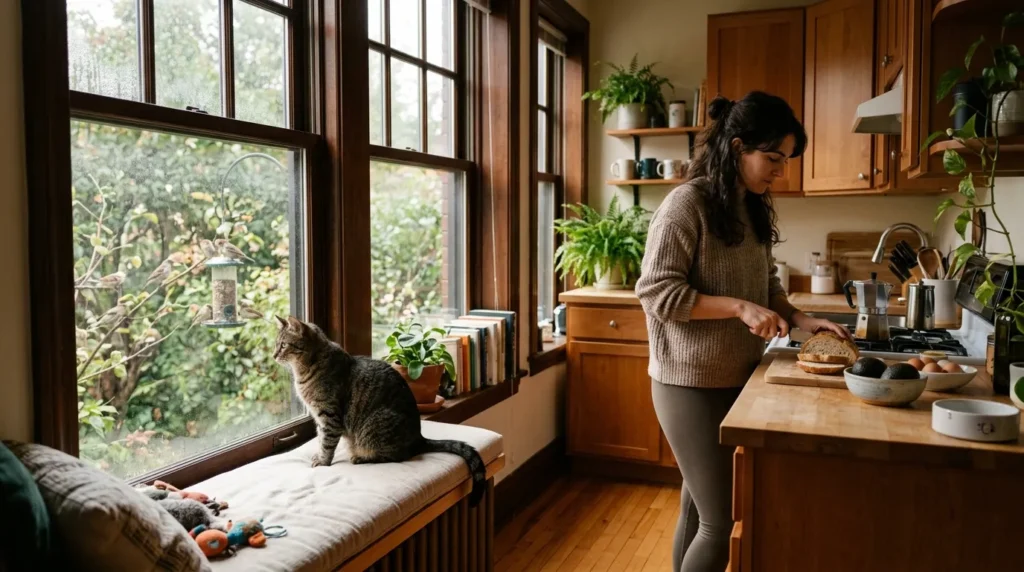
Work with the crepuscular pattern. Your cat is most active in the early morning and evening, so those are the windows when play lands best. A 10-minute wand toy session right before her evening meal mimics the hunt, eat, groom, sleep cycle cats are built for, and she usually settles into deeper rest afterward than she does after random play.
A Daily Routine That Fits Her Schedule
- Morning: play for about 10 minutes with a wand toy, then serve breakfast.
- Midday: leave a window perch, a puzzle feeder or a freshly rotated toy out. This is her natural nap time, so keep it calm.
- Early evening: play for 10 to 15 minutes, finish with a “catch,” then serve dinner.
- Before your bedtime: offer a small snack or a puzzle feeder so she has something to do besides wake you.
Skip the reward for 4 a.m. wake-ups. Feeding or cuddling her at that hour teaches her the alarm works. A closed bedroom door is a fair trade for a quiet night.
[IMAGE PLACEHOLDER: owner playing with a wand toy with a cat in the early evening | Suggested alt text: “evening wand toy play session with an indoor cat before dinner” | Suggested filename: indoor-cat-evening-play-session.webp]
Meal Timing
What and when your cat eats shapes her activity cycle. Cats fed in the morning and evening tend to be more active around those windows and rest more clearly in between. Free feeding removes the energy spike that comes before a meal and flattens the day into a dull baseline. To be fair, free feeding works for some cats, seniors who graze in small amounts especially. The cost is a less structured day.
Make the Sleep Itself Better
- Offer two or three sleeping spots at different heights, including one warm spot in winter.
- Pick a quiet corner away from foot traffic for deep sleep.
- Choose low-entry beds and steps for older cats with stiff joints.
A complete indoor cat care routine combines consistent meal timing, daily play and fresh novelty, such as rotating toys or new textures. Together they give indoor cats the variation they need to sleep well instead of sleeping by default. She will still sleep a lot. The aim is sleep that follows real activity.
If your cat sleeps 16 hours and seems content, curious when awake and responsive to play, she’s fine. If she sleeps 16 hours and seems dull, disengaged and uninterested when you try to interact, the cause is boredom or illness. Fix the environment first if the behavior has been steady for months. Call the vet first if it’s new. Quality of the awake hours matters more than the count of sleeping ones.
When Sleeping Too Much Is Actually a Warning Sign
Any sudden increase in sleep, especially alongside reduced appetite, hiding, less grooming or a change in litter box habits, deserves a vet call within a few days. Lethargy looks different from normal cat sleep. A lethargic cat doesn’t rouse easily when you approach, shows no interest in food or company and may stay in the same position for hours.
Checklist: Is My Cat’s Sleep Normal?
If you can tick every line, she’s almost certainly just being a cat.
- She wakes within a few seconds when you say her name or rattle a treat bag.
- She eats her usual amount at her usual times.
- She uses the litter box as she always has.
- She grooms herself and her coat looks clean.
- She plays, even briefly, when you offer a toy.
- She still jumps onto her favorite perches.
- Her sleep total is close to her own normal from the last few weeks.
Normal Sleep vs. Lethargy
| Sign | Normal Sleep | Lethargy |
| Waking | Responds to a sound or touch within seconds | Hard to rouse or slow to respond |
| Position | Shifts, stretches, changes spots | Same position for hours |
| Appetite | Shows up for meals | Skips or ignores food |
| Interest | Greets you, plays when invited | No interest in people or toys |
| Grooming and litter box | Usual routine | Grooming drops, habits change |
Watching your cat’s litter box habits and grooming patterns alongside sleep gives you the clearest picture of her health. Cats who are unwell sleep more and also stop doing the small things they normally do automatically. Those changes together carry more weight than sleep alone. A cat who oversleeps but still grooms, greets and eats is almost always fine.
[IMAGE PLACEHOLDER: side-by-side graphic of a normal sleeping cat and a lethargic cat with the key differences labeled | Suggested alt text: “normal cat sleep compared to lethargy in cats” | Suggested filename: cat-sleep-vs-lethargy-comparison.webp]
Health Conditions Linked to Extra Sleep
Many illnesses show up first as a cat who sleeps more and does less. This table helps you describe what you’re seeing to your vet. It can’t diagnose anything, and only an exam and bloodwork can.
| Condition | Other Signs to Watch For |
| Arthritis or joint pain | Stops jumping, moves stiffly, hides, hesitates at the litter box edge |
| Diabetes | More drinking and urination, weight change |
| Kidney disease | More drinking and urination, weight loss, poor appetite |
| Hyperthyroidism | Weight loss despite a good appetite, restlessness, occasional tired spells |
| Infection (such as cat flu) | Sneezing, eye or nose discharge, reduced appetite |
| Heart or lung disease | Fast or labored breathing, weakness |
| Injury or abscess | Limping, swelling, hiding, flinching when touched |
| Obesity | Tires quickly, plays less, trouble grooming her back end |
| Cognitive dysfunction (seniors) | Night wandering, yowling, confusion, litter box accidents |
When to Call the Vet and When to Go Now
Call your vet within a day or two if:
- Her sleep has climbed for several days with no clear trigger such as a move or a new pet.
- She’s eating less, drinking more or losing weight.
- She hides more or grooms less.
- Her litter box habits have changed.
- She’s a senior who has slowed down and stopped jumping.
- She started a new medication and seems unusually drowsy.
- Her third eyelid (the pale membrane at the inner corner of the eye) stays visible while she’s awake.
Get same-day or emergency care if:
- You can’t wake her normally, or she seems disoriented.
- She’s breathing with her mouth open or working hard to breathe.
- She’s straining in the litter box or producing no urine, which is urgent in male cats.
- She hasn’t eaten for 24 hours or more.
- She’s vomiting repeatedly, collapsing or weak in the legs.
Track It: A 7-Day Sleep Log
Vets ask when the change started and how it has progressed. A week of notes answers that better than memory does. You don’t need to time every nap. Check in at four points (morning, midday, evening and your bedtime) and jot down:
- Whether she was asleep and roughly how deep the sleep looked
- How she woke when you spoke to her
- Whether she ate her usual amount
- Any litter box change
- Anything unusual, such as hiding or a missed grooming session
[PLACEHOLDER: downloadable printable 7-day cat sleep log (PDF) with the columns above | Suggested link text: “Download the printable cat sleep log”]
This article is for informational purposes only. Always consult your vet if you have concerns about your cat’s health.
Frequently Asked Questions About Indoor Cat Sleep
Is it normal for an indoor cat to sleep all day?
Yes. Adult indoor cats sleep 12 to 16 hours daily as a biological baseline, and some reach 18. The sleep is spread across the full day and night in many short cycles. A cat who sleeps most of the day but wakes alert, eats normally and responds to play or interaction is showing normal feline behavior.
How many hours a day is too much sleep for an indoor cat?
Adults sleep 12 to 16 hours, and kittens and seniors can reach 18 to 20, so 20 hours is the top of the normal range for those two groups. An adult who sleeps 20 hours a day, most of it deep, should see a vet. So should any cat whose sleep jumps well above her own baseline, whatever the number.
Why does my indoor cat sleep so much more than my outdoor cat used to?
Outdoor cats wake up because their environment demands it: territory to patrol, prey to track and weather to respond to. Indoor cats have fewer natural triggers that interrupt rest. When the apartment is quiet and nothing changes, sleep fills that space. The indoor environment creates less forced waking and more voluntary rest.
Can boredom really make an indoor cat sleep more?
Yes. A cat with nothing to investigate, chase or interact with will sleep more as a default state. You can usually see the difference when you offer stimulation. A bored cat brightens immediately, while a truly tired cat needs time to wake up. Daily interactive play and environmental variety reduce boredom sleeping over the following week or so.
How do I know if my indoor cat is sleeping too much or just being a cat?
Watch what happens when she wakes. A healthy sleeper wakes alert and curious, shows interest in food and responds to your voice or movement. A cat sliding into lethargy or illness wakes sluggishly, shows little interest in food and doesn’t engage when invited. Sleep hours matter less than wake quality.
Do indoor cats sleep more in winter?
Yes. Shorter days and colder weather push many cats to sleep more, including cats who never go outside. If appetite, litter box habits and alert waking moments stay normal, the increase is seasonal. If she also eats less or hides, call the vet.
Why is my cat sleeping more than usual all of a sudden?
Start with what changed in the past week or two: a move, a new pet, visitors, construction noise, a shift in your schedule or a cold snap. A clear trigger with normal appetite points to stress or season. No trigger, or extra signs such as hiding, eating less or litter box changes, points to a vet visit within a few days.
Why does my cat sleep all day and stay up all night?
A cat with a dull day banks that energy and spends it when the house goes quiet. Move play and her biggest meal to the early evening, and stop rewarding night wake-ups with food or attention. If an older cat suddenly starts wandering or yowling at night, book a vet visit.
Do cats sleep through the night?
Some do, but many don’t. Cats sleep in short cycles around the clock, so a few hours of night activity is normal, and her peaks tend to land near dusk and dawn. If she wakes you, shift play and dinner later into the evening and keep the bedroom door closed.
Why does my cat sleep so much after eating?
Eating completes the hunt cycle her body expects: hunt, eat, groom, sleep. A big meal makes a nap the logical next step. A short, deep nap after dinner is normal. Heavy lethargy after every meal, or vomiting afterward, is worth a vet call.
Why does my kitten sleep so much?
Kittens sleep 16 to 20 hours a day because they’re growing fast, and much of that growth happens during sleep. Expect bursts of wild play followed by sudden collapse. Call the vet if a kitten is limp, won’t eat or can’t be woken.
Does my cat sleep all day while I’m at work?
Almost certainly. A quiet, empty home is the easiest place for a cat to sleep. Leave a window perch, a puzzle feeder and a rotated toy out, and save a play session for when you get home so her evening has a purpose.
Is it normal for a cat to sleep with her eyes half open?
Yes, it’s common during a light doze, when she’s resting but still monitoring the room. Watch for the third eyelid. If it covers part of her eyes while she’s awake, or she sleeps with eyes partly open and seems unwell, have a vet look at her.
Why does my cat sleep on me?
Warmth, your scent and the rhythm of your breathing all make you a good bed. It also signals trust, since sleeping deeply on someone means she feels safe. If she suddenly starts clinging and sleeping on you far more than usual, check whether she’s cold, stressed or in pain.
Do cats dream while they sleep?
Cats have REM sleep, the stage when whiskers, paws and tails twitch, so dreaming is likely. Nobody can confirm what they dream about. Hunting is a popular guess and an unproven one.
Why does my older cat sleep so much more than before?
Senior cats often sleep 16 to 20 hours as their energy drops, and that is normal on its own. Arthritis, kidney disease, thyroid problems and cognitive changes also show up as extra sleep in older cats, and cats hide pain well. Mention the change at her next checkup, and book one sooner if she’s eating less or moving stiffly.
Is my cat depressed if she sleeps all day?
Cats can withdraw after a loss, a move or a big routine change, and extra sleep is one sign. Look for hiding, less grooming, less appetite and less interest in play. A cat who keeps playing, eating and greeting you is simply resting or bored. Persistent withdrawal deserves a vet check first, because pain and illness look similar.
Should I wake my cat if she sleeps too long?
Leave a healthy sleeping cat alone. Wake her only for medication, a vet appointment or when you can’t tell whether she’s responsive. To check, say her name or tap the floor near her. A normal sleeper opens her eyes or turns an ear toward you within seconds. If she doesn’t respond, treat it as lethargy.
So why does your indoor cat sleep so much? Indoor cats sleep 12 to 16 hours per day on average, with kittens and seniors reaching 18 to 20 and newborn kittens up to 22. Crepuscular biology, predator ancestry and energy conservation drive that number. Indoor cats sleep more than outdoor cats because their environment creates fewer triggers to wake up. Boredom, cold weather, age and stress add extra sleep on top of the baseline. A sudden increase paired with appetite changes, hiding, litter box changes or reduced grooming warrants a veterinary evaluation.

Written by Mishu
A passionate cat lover and indoor living enthusiast, Mishu is the founder and voice behind Indoor Living Cat – a go-to resource for cat owners who want to create the happiest, healthiest life for their feline companions indoors.
View Full Profile