
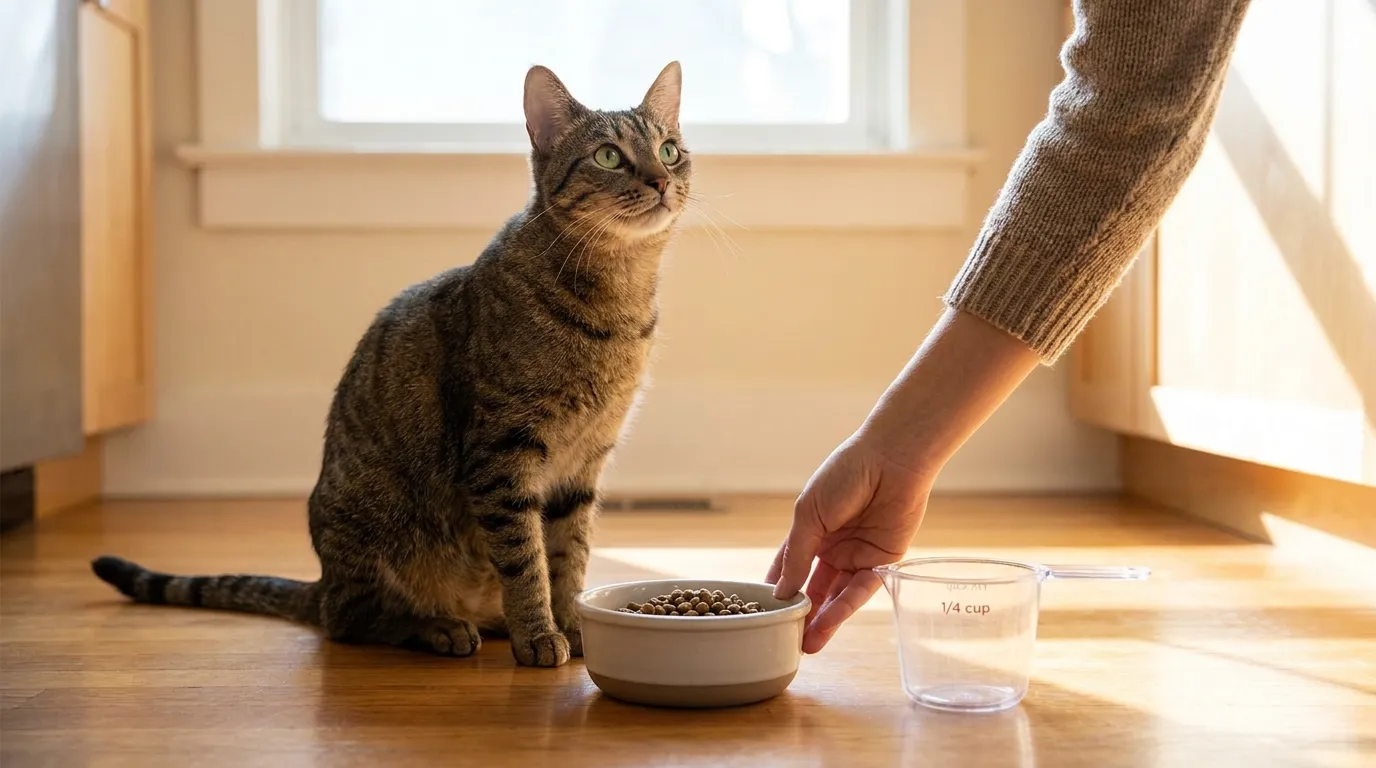
I didn’t realize my cat was overweight until her vet visit, when the vet pressed gently along her sides and explained that she should be able to feel the ribs easily without pressing. She couldn’t. That was the moment I understood that figuring out how to keep indoor cat at healthy weight is not about how the cat looks from the couch. It is about daily habits that most owners never think twice about. This article walks you through exactly what those habits are: the feeding approach, the activity level and the small changes that add up to a genuinely healthier life for your cat.
How to keep indoor cat at healthy weight comes down to three things: measured meals on a schedule, at least 15 minutes of active play daily and no free-feeding from an always-full bowl. Indoor cats need roughly 20 to 30 percent fewer calories than outdoor cats. Start there, adjust with your vet and stay consistent.
Why Indoor Cats Gain Weight So Much Faster Than You’d Expect?
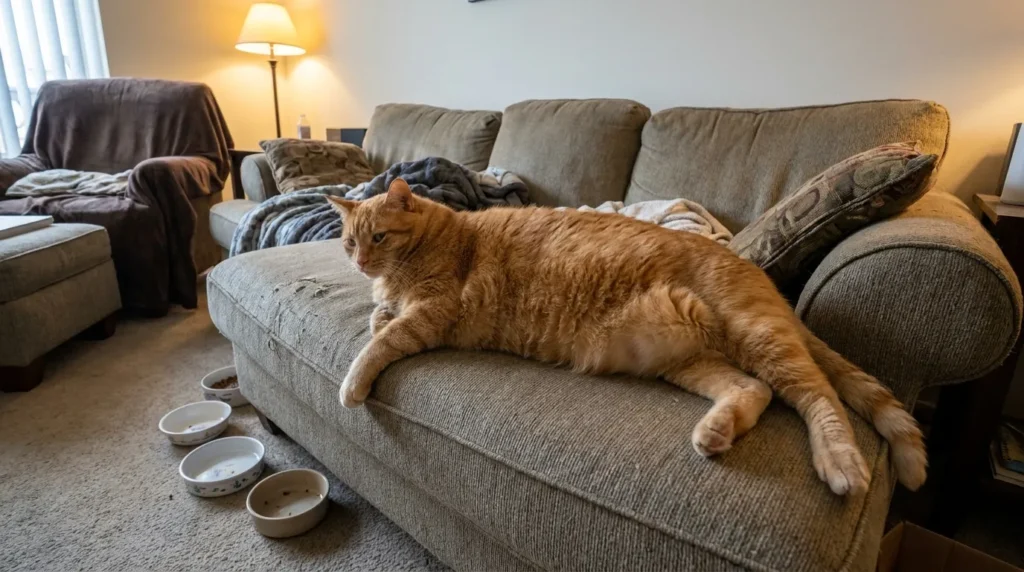
Indoor cats gain weight easily because they were built to hunt and their modern lifestyle gives them none of that. No stalking, no chasing and no effort required between their face and the food bowl. Their bodies still expect to burn those calories so when they do not, the surplus goes straight to fat deposits around the belly, chest and base of the tail.
According to VCA Animal Hospitals, indoor-only cats need roughly 30 percent fewer calories than cats with regular outdoor activity. Most commercial feeding guidelines on the back of a food bag are calculated for active cats, not apartment cats. That gap between the recommended amount and the appropriate amount for your specific cat is where weight gain lives.
Calorie needs for indoor cats are also affected by age, spay or neuter status and breed. A spayed adult cat in a small apartment needs meaningfully fewer calories than the label assumes. Treating the label as a starting point rather than a rule is the first real step.
Body Condition Score: The Full 9-Point Chart
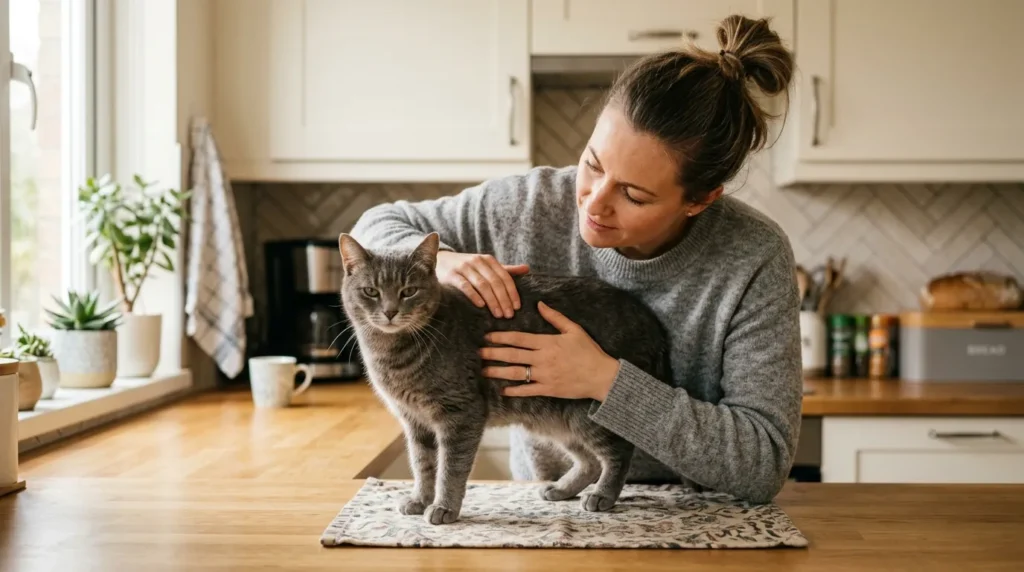
The body condition score is the most reliable at-home tool for assessing your cat’s weight, and vets use a 9-point scale to standardize it. Run both hands along your cat’s sides behind the shoulders. You should feel the ribs easily with light pressure, like running your fingers over the back of your hand.
| Score | Category | What You’ll See and Feel |
| 1-3 | Underweight | Ribs, spine, and hip bones visible; no fat cover; obvious waist and abdominal tuck |
| 4-5 | Ideal | Ribs felt easily with light pressure; visible waist from above; slight abdominal tuck from the side |
| 6-7 | Overweight | Ribs felt only with firm pressure; waist barely visible; abdomen slightly rounded |
| 8-9 | Obese | Ribs hard to feel under a heavy fat layer; no waist; rounded abdomen with fat pads |
A healthy indoor cat sits at 4 or 5 on that scale. Many owners of fluffy cats underestimate their cat’s score because fur adds visual volume that hides the actual shape underneath. Get in the habit of feeling rather than looking, and if you have to press hard to find ribs, treat that as your answer.
Weighing your cat monthly on a kitchen scale gives you an objective number to track alongside the score. Hold your cat while standing on the scale, note the combined weight and subtract your own. Small upward trends caught early are far easier to reverse than five extra pounds caught at the next vet visit.
What’s a Healthy Weight for Your Cat’s Breed?
Weight alone means less than body condition score, but it still helps to know the range your cat’s frame is built for.
| Breed | Typical Healthy Weight |
| Domestic shorthair (mixed) | 8-10 lbs |
| Siamese | 6-10 lbs |
| Maine Coon | 10-18 lbs |
| Persian | 7-12 lbs |
| Ragdoll | 10-20 lbs |
| Bengal | 8-15 lbs |
A 14-pound Maine Coon with a visible waist and easily felt ribs can be at an ideal weight, while a 10-pound domestic shorthair with the same measurements might already be overweight. Frame size matters more than the number on the scale.
Daily Calorie Guide by Cat Weight
Most adult indoor cats need between 200 and 300 calories a day, but the right number depends heavily on current weight and target weight. Use this as a starting point, then adjust based on monthly weigh-ins.
| Cat’s Current Weight | Approximate Daily Calories (Maintenance) | Approximate Daily Calories (Weight Loss) |
| 6 lbs | 150-180 | 120-140 |
| 8 lbs | 190-220 | 150-170 |
| 10 lbs | 220-260 | 180-200 |
| 12 lbs | 260-300 | 200-230 |
| 15 lbs | 300-340 | 230-260 |
These numbers are estimates, not prescriptions. A senior cat, a very sedentary cat, or a cat with a medical condition needs a number your vet calculates specifically for her. Use this table to sanity-check the feeding guide on your food bag, not to replace a vet consult entirely.
How to Keep Indoor Cat at Healthy Weight Through Smarter Feeding?
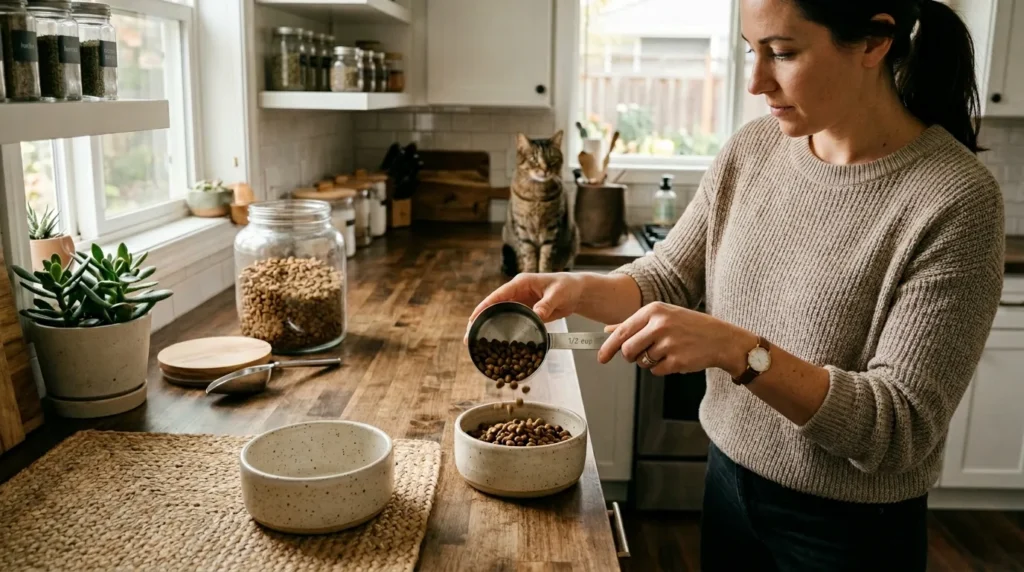
Scheduled meals are the single most effective dietary change you can make for an indoor cat that gains weight easily. Instead of leaving food available all day, feed two to four small measured meals at consistent times. This mirrors how cats naturally eat in the wild and prevents the mindless eating that happens when a full bowl sits available 24 hours a day.
What your cat actually eats matters as much as how much she eats.
| Factor | Wet Food | Dry Food |
| Moisture content | 70-80%, supports hydration | 6-10%, little hydration support |
| Satiety per calorie | Higher, due to protein and water volume | Lower, easier to overeat |
| Typical carbohydrate content | Low | Higher, varies by brand |
| Convenience for free feeding | Not suited to sitting out all day | Easy to over-leave, higher risk of grazing |
A cat eating two small wet food meals a day typically maintains weight better than one eating dry food freely. That doesn’t mean dry food is off the table, but it does mean portioning it matters more if it’s her main diet.
Portion control means measuring every meal rather than eyeballing it. A quarter cup more than needed daily adds up to significant weight gain over months. Most vets recommend starting with the low end of the feeding guidelines and adjusting based on monthly weigh-ins rather than starting at the midpoint and working backward.
Exercise That Indoor Cats Will Actually Do
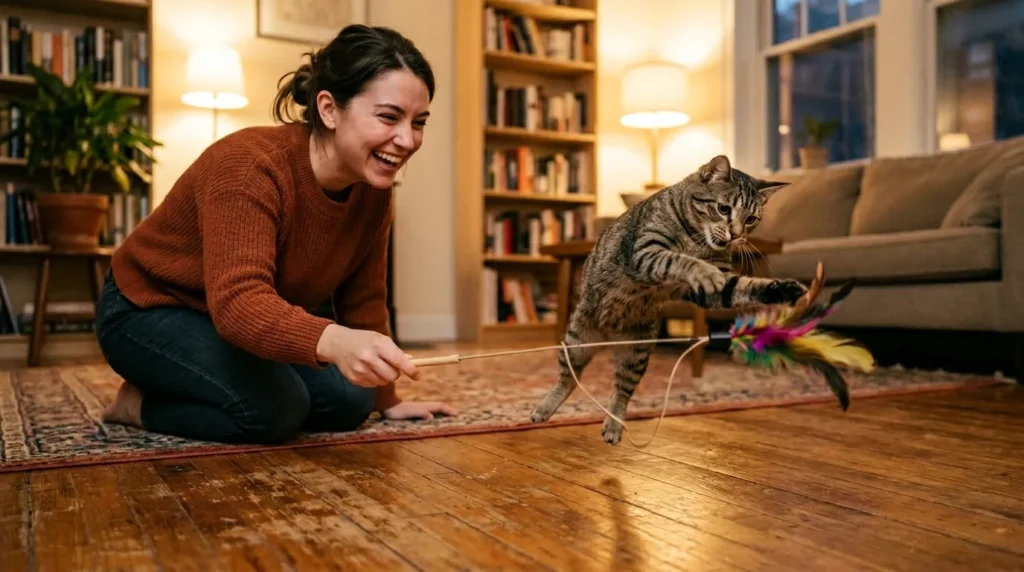
Most indoor cats will not exercise spontaneously to the level their bodies need. You have to create the opportunity. Fifteen minutes of active, chase-style play twice a day burns calories and keeps muscles from the atrophy that comes with sedentary apartment life. This is not optional if weight management is the goal.
Wand toys that mimic prey movement are the most effective play tools available because they trigger the predatory sequence: stalk, chase, pounce and capture. That full sequence gives cats both physical exertion and mental satisfaction. A laser pointer alone skips the catch, which leaves cats frustrated rather than fulfilled, so always end laser sessions with a physical toy your cat can actually grab.
Vertical space and climbing furniture adds passive movement through the day without requiring scheduled sessions. A cat who climbs to a window perch, jumps down to investigate something and scales a cat tree multiple times a day burns more calories than one who only moves between the floor and the couch. Height is exercise disguised as environment.
A cat that’s already showing low motivation to move may also be bored rather than just sedentary. Our guide on signs your indoor cat is bored covers the behavior patterns that overlap with weight gain, since a bored cat and an overweight cat often turn out to be the same cat.
Enrichment That Burns Calories While Keeping Boredom Away
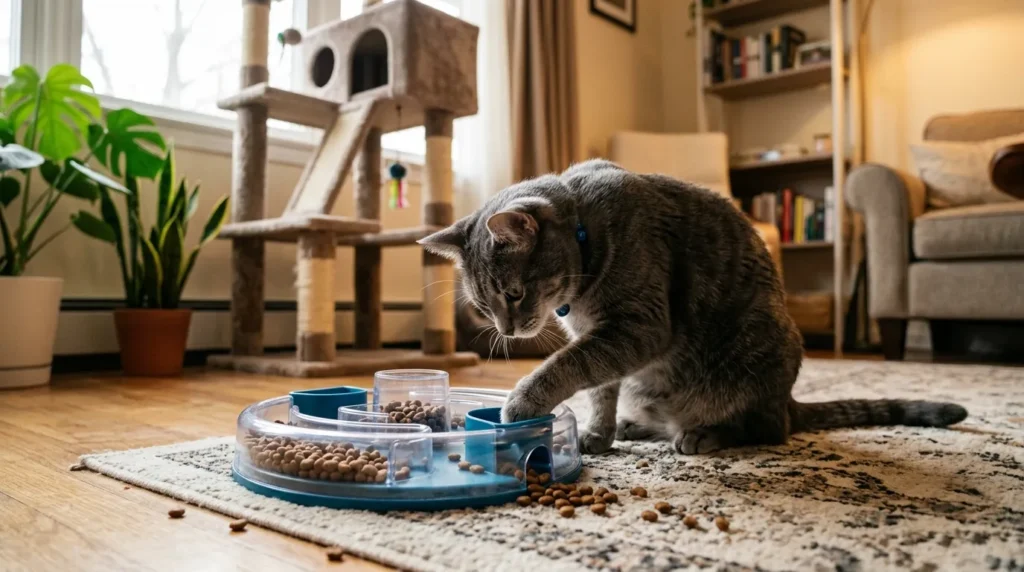
Puzzle feeders slow down eating and require physical effort to access food, which means cats eat fewer calories per meal and burn a small amount doing it. Scatter feeding, where you spread kibble across a mat or on a cat tree for your cat to find, turns meal time into a low-level hunting session. Both approaches work particularly well for cats who eat too fast or who ask for food repeatedly between scheduled meals.
A well-designed enrichment routine reduces the boredom-driven eating that owners often mistake for genuine hunger. A cat who has been watching birds from a window perch, investigating a new paper bag and batting toys across the floor is a cat who is not parked in front of the food bowl lobbying for an early dinner. Mental engagement and physical activity work together to regulate appetite as much as they regulate weight.
Cats living in apartments benefit from rotating toys weekly so the novelty stays high without requiring new purchases. The habits that support healthy weight sit inside the same indoor cat care routine that supports mental health: consistent activity, varied stimulation and a home that gives the cat reasons to move.
Straight Talk: Puzzle feeders are not a toy. They are a feeding tool and a weight management tool. Replacing your cat’s regular bowl with a puzzle feeder at every meal is one of the highest-impact changes you can make without changing the food itself. The limitation is that some cats refuse them. Start with the easiest puzzle level and work up slowly.
The Feeding Mistake That Makes Healthy Weight Impossible
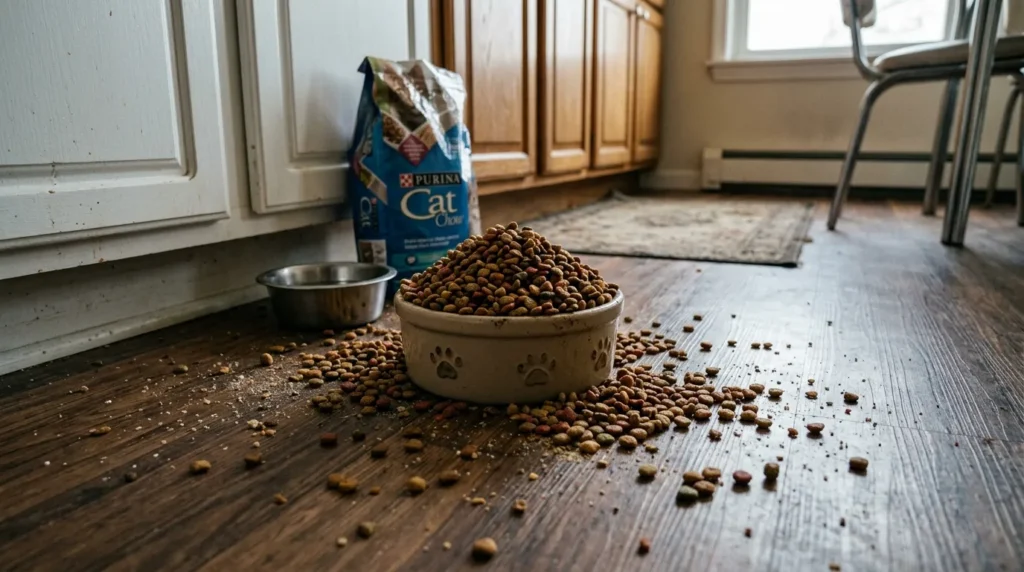
Free feeding, leaving food out all day for your cat to graze, is the single most common mistake that makes weight management nearly impossible. It works fine for some cats but for most indoor cats with low activity levels, it creates constant access to calories that never get burned. The bowl becomes background noise the cat picks at whenever she walks past, which adds up silently.
The second most common mistake is using treats as the primary form of interaction with the cat. Treats handed out freely throughout the day add significant calorie load, especially when they are not accounted for in the daily total. A small cat treat can represent 10 to 20 percent of a sedentary indoor cat’s daily calorie budget. Watching for changes in your cat’s behavior around food, like increased vocalization, pacing or aggression near the bowl, tells you whether hunger is genuinely driving the behavior or habit is.
Straight Talk: If you are going to use treats at all, use them during play as the final reward at the end of a wand session. That way the treat is earned through exercise and associated with activity rather than simply given for existing. It is a small change that genuinely reshapes how your cat thinks about meal time.
Does Neutering Cause Weight Gain?
Indirectly, yes, and it’s worth planning for rather than being surprised by. Neutering lowers a cat’s metabolic rate by roughly 20 to 30 percent while often increasing appetite at the same time. That combination is why so many cats put on weight in the year after the procedure if feeding amounts don’t get adjusted downward.
The fix isn’t skipping neutering, which carries far more health benefits than the weight tradeoff costs. The fix is recalculating calorie needs right after the procedure instead of continuing to feed the pre-surgery amount. Ask your vet for a revised feeding target at the post-surgery checkup, not months later when the weight has already crept up.
When Weight Changes Deserve a Vet Call This Week?
| Sign | Possible Cause | Urgency |
| Rapid weight loss with normal or increased appetite | Hyperthyroidism, diabetes | Vet visit within days |
| Sudden weight gain with a distended belly | Fluid retention, organ issue | Vet visit within days |
| Difficulty breathing alongside weight gain | Cardiac or respiratory concern | Same-day vet or emergency care |
| Resisting jumps she used to make easily | Joint pain from excess weight or arthritis | Schedule within 1-2 weeks |
| Crying when picked up | Joint or abdominal discomfort | Schedule within 1-2 weeks |
Rapid weight loss in an indoor cat that is eating normally warrants a vet visit within days, not weeks. Hyperthyroidism and diabetes both cause unexplained weight loss despite a normal or increased appetite. These conditions are manageable when found early but deteriorate quickly when missed.
Tracking her litter box habits and grooming patterns alongside weight gives you a complete picture of her overall health trajectory. Overweight cats groom their lower backs and base of tail less effectively because reaching those areas becomes physically difficult. Noticing that first is often easier than noticing the weight itself.
Weight also shifts naturally with age. Our guide on indoor cat lifespan covers how metabolism and activity change through each life stage, which helps you tell a normal senior slowdown apart from a weight change that needs medical attention.
This article is for informational purposes only. Always consult your vet if you have concerns about your cat’s health.
Frequently Asked Questions About Indoor Cat Healthy Weight
How much should I feed my indoor cat to maintain a healthy weight?
Most adult indoor cats need between 200 and 300 calories per day, depending on their size, age and activity level. Start at the low end of your food’s feeding guideline, weigh your cat monthly and adjust from there. Your vet can calculate an exact target based on your cat’s current weight and ideal weight. This article is for informational purposes only. Always consult your vet if you have concerns about your cat’s health.
What is a healthy weight for an indoor cat?
Most domestic cats fall between 8 and 10 pounds at a healthy weight, though this varies by breed, ranging up to 18-20 pounds for a large-framed Maine Coon or Ragdoll. Weight alone is less useful than body condition score. A healthy cat has ribs you can feel with light pressure, a visible waist from above and a slight abdominal tuck from the side. Breed standards vary, so check with your vet if you are unsure of your cat’s ideal range.
How do I help my indoor cat lose weight safely?
The safe rate of weight loss for cats is no more than 1 to 2 percent of body weight per week. Faster weight loss risks hepatic lipidosis, a serious liver condition triggered by fat being metabolized too quickly in cats. Work with your vet to set a calorie target, transition to high-protein wet food and add daily play. Never put a cat on a crash diet without veterinary guidance.
Why is my indoor cat always hungry even after eating?
Most cats that beg for food between meals are not genuinely hungry. They are bored, following habit or responding to a diet too high in carbohydrates that does not sustain them. Switching to high-protein wet food, adding puzzle feeders and scheduling play before feeding times significantly reduces food-focused behavior without increasing calories.
Can puzzle feeders really help with indoor cat weight management?
Yes, meaningfully so. Puzzle feeders slow eating speed, which reduces the chance of overeating at each meal. They also convert passive bowl access into light physical activity and mental engagement, which reduces the boredom eating that adds calories between scheduled meals. Start with the simplest feeder design and upgrade gradually so your cat learns to enjoy the challenge rather than refusing it out of frustration.
Does neutering make cats gain weight?
Indirectly, yes. Neutering lowers metabolic rate by roughly 20 to 30 percent and can increase appetite, which is why weight gain often starts in the year after the procedure. Adjusting calorie intake down right after surgery, rather than continuing pre-surgery portions, prevents most of this gain.
Why is my senior cat losing weight even though I haven’t changed anything?
Unexplained weight loss in a senior cat is one of the more common early signs of hyperthyroidism, kidney disease or diabetes, and it deserves a vet visit within the week rather than a wait-and-see approach. Weight loss from aging alone tends to be much slower and comes with an overall drop in activity, not a sudden change over a few weeks.
How to keep indoor cat at healthy weight requires scheduled measured meals two to four times daily, no free feeding and at least 15 minutes of active play twice per day. Indoor cats need 20 to 30 percent fewer calories than outdoor cats. A body condition score of 4-5 on the 9-point scale marks a healthy weight regardless of breed size. High-protein wet food supports satiety better than dry kibble. Puzzle feeders and vertical climbing furniture add passive calorie burning. Neutering lowers metabolic rate and often requires a downward calorie adjustment. Safe weight loss for cats is no more than 1 to 2 percent of body weight per week.

Written by Mishu
A passionate cat lover and indoor living enthusiast, Mishu is the founder and voice behind Indoor Living Cat – a go-to resource for cat owners who want to create the happiest, healthiest life for their feline companions indoors.
View Full Profile