
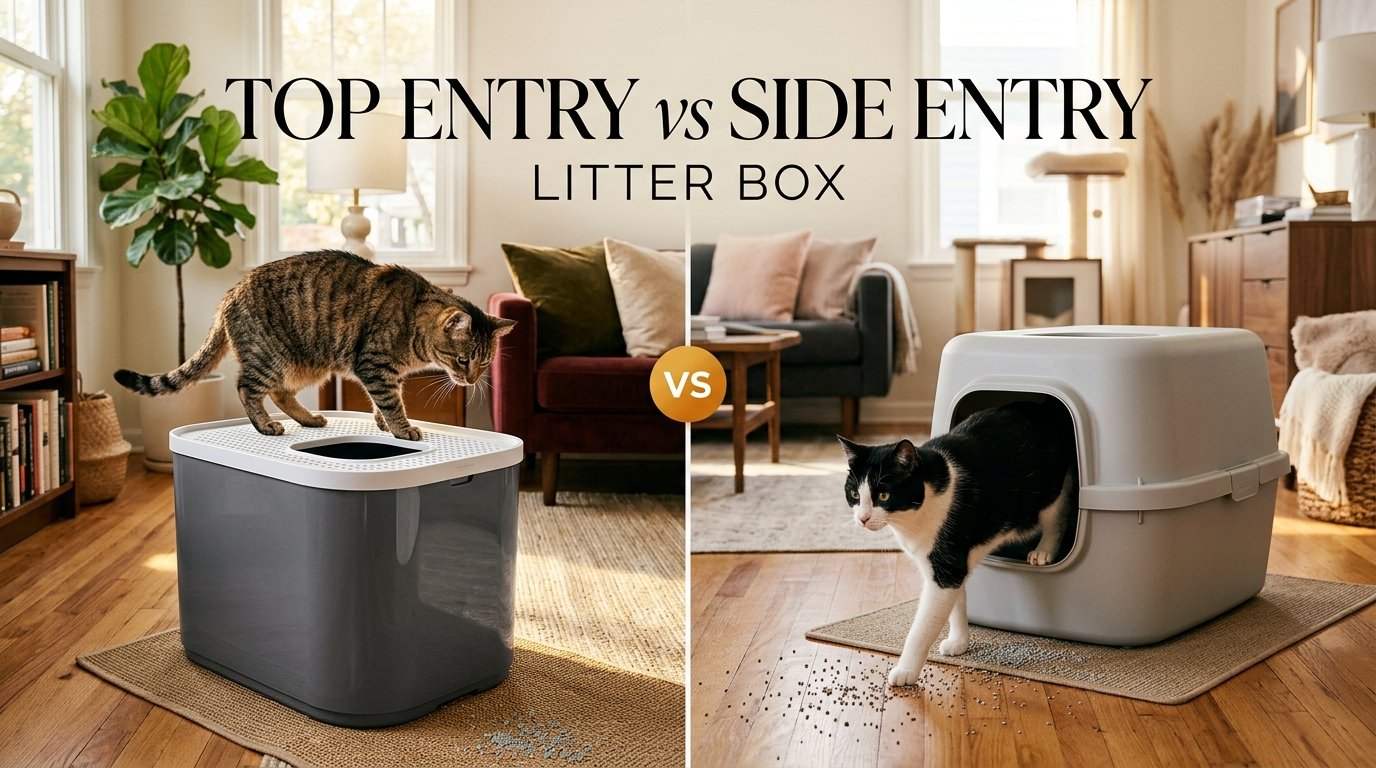
A litter box sounds simple until you’re standing in the pet aisle staring at a wall of shapes you didn’t know existed. This top entry vs side entry litter box comparison puts two real products head to head: the IRIS USA Large Top Entry Cat Litter Box and the IRIS USA XX-Large Side Entry Cat Litter Box. Same brand, same durable plastic build, completely different bathroom experience for your cat. Below, we break down litter tracking, odor control, entry height, cat size, and which design actually gets used instead of avoided in the corner.
Top Entry vs Side Entry Litter Box: Quick Comparison
⚡ Quick Verdict
The IRIS USA Top Entry wins if your priority is keeping litter off the floor and odor out of the room. The XX-Large Side Entry wins if you’ve got a Maine Coon, a senior cat, a kitten, or more than one cat sharing the box. Match the box to your cat’s size and mobility first. Everything else is a bonus.
Analysis: IRIS USA Top Entry Litter Box
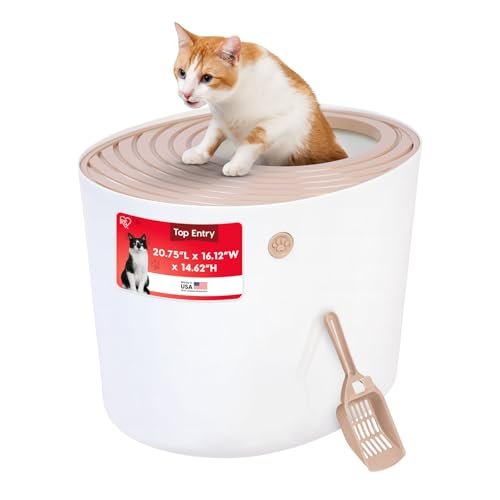
Best for owners who want a tidy home and a hidden litter box. This top-entry model suits agile cats that don’t mind an enclosed space, and it works as a built-in barrier against dogs who treat the litter box like a snack bar.
The IRIS USA Top Entry Cat Litter Box hides everything by design. Your cat climbs in through a 9.25-inch round opening in the lid, does its business out of sight, and climbs back out the same way. Because the unit is fully enclosed, odor stays trapped inside instead of drifting into your living room every time someone walks past.
The tall walls stop spray from reaching the floor, even from cats who don’t fully squat. That same enclosure keeps dogs out, too. If a food-motivated Labrador treats the litter box as a self-serve buffet, this design solves that problem without any extra gear.
Build Quality & Design
The plastic shell holds up to daily scooping without cracking under normal use. At 20.75″ L x 16.125″ W x 14.625″ H, it fits in a bathroom corner or closet without eating up floor space. The beige and white finish is plain on purpose, so it blends into most rooms instead of standing out.
Performance & Speed
Grooves molded into the underside of the lid knock litter off your cat’s paws on the way out. That’s the actual mechanism behind the low-tracking reputation, not magic. Cleaning means lifting the lid off, which takes a few seconds once you know the latch, though it’s an extra step compared to a box with no lid at all.
Features & Functionality
A scoop hangs on a hook built into the lid, so it never disappears under a bathmat. The interior comfortably fits an average adult cat, and the enclosure gives anxious cats a private spot to go, which matters in a loud house with kids or other pets around.
User Experience
You’ll sweep less. That’s the main trade-off you’re buying into with a hooded box. Setup takes a few minutes out of the box, and cleaning is straightforward once the lid is off. The catch: your cat needs the coordination to jump up and in, so this isn’t the right box for a cat with stiff joints or one still growing into its legs.
Value for Money
Typical retail price runs $25 to $40 depending on where you buy it. Less litter on the floor means less vacuuming and fewer wasted grains kicked outside the box. Under normal daily use, the plastic shell lasts for years before it needs replacing.
✅ Advantages
❌ Disadvantages
Analysis: IRIS USA XX-Large Side Entry
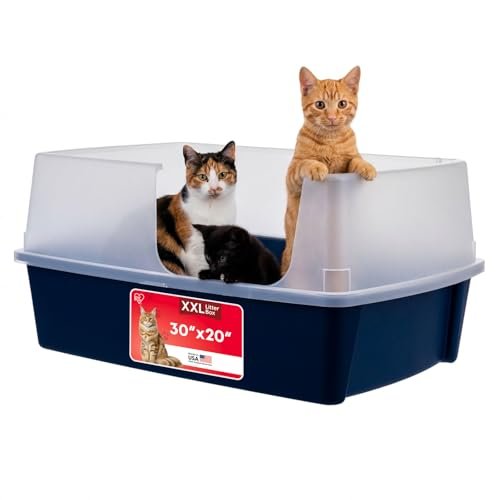
Best for large breeds like Maine Coons and Ragdolls, multi-cat households, and any cat that struggles to jump. The open top means no lid to fight with and an easy view of your cat’s daily habits.
The IRIS USA XX-Large Side Entry Cat Litter Box is built for cats that don’t fit anywhere else. At 30 inches long, it gives a Maine Coon or Ragdoll room to turn around without stepping in their own mess, something a standard 20-inch box can’t do.
Entry sits low, through a 6.5-inch curved cutout on the side. No jumping required. That single detail makes this the better pick for a senior cat with arthritis or a kitten too young to clear a tall lid.
Build Quality & Design
The navy plastic resists scratches better than lighter finishes tend to show. The smooth interior has fewer seams for litter and waste to catch in, which means faster wipe-downs than boxes with ridged or textured interiors.
Performance & Speed
Fourteen-inch walls catch scatter from digging and spray from cats that don’t fully squat. Because there’s no lid, you see exactly what’s in the box every time you walk by. A sudden change in litter habits, straining, blood in urine, or refusing the box altogether, is worth a call to your vet, and this open design makes those changes hard to miss.
Features & Functionality
The curved entrance balances privacy against ease of access better than a straight cutout would. Fewer crevices means less to scrub during a deep clean. Note that no scoop ships with the base model, so budget for one separately.
User Experience
Scooping takes seconds since there’s nothing to lift or remove first. You can tell the box needs attention at a glance instead of guessing. New cat owners tend to get along with this design faster than a hooded box, mostly because there’s less to figure out.
Value for Money
Typical retail price runs $30 to $40, close to the Top Entry model, but you get nearly 50% more floor space. That’s cheap insurance against a large cat refusing to use a box that’s too small.
✅ Advantages
❌ Disadvantages
How Much Space Does Your Cat Actually Need?
Most litter boxes on store shelves are too small for the cats using them. A common rule from vets and shelter behaviorists: the box should run at least 1.5 times your cat’s body length, measured nose to base of tail, not including the tail. A 10-inch cat needs a box at least 15 inches long to turn and dig without hitting a wall on every side.
Large breeds change the math. Maine Coons, Ragdolls, and Savannahs commonly run 16 to 20 inches long, which is exactly why IRIS built the XX-Large Side Entry to 30 inches. If your cat is stepping half out of the box to go, or leaving waste right at the edge, the box is too small. That’s not a behavior problem to correct, it’s a sizing problem to fix.
| Cat Size | Approx. Body Length | Minimum Box Length | Fits This Comparison |
|---|---|---|---|
| Small / average cat | 9-13 inches | 14-20 inches | Both boxes work |
| Large breed (Maine Coon, Ragdoll) | 16-20 inches | 24-30 inches | XX-Large Side Entry only |
| Senior cat / limited mobility | Varies | Entry height matters more than length | XX-Large Side Entry only |
| Kitten (under 6 months) | Varies | Low entry needed until jumping ability develops | XX-Large Side Entry only |
The N+1 Rule: How Many Litter Boxes Do You Need?
Vets and shelter behaviorists use a simple formula: one litter box per cat, plus one extra. Two cats need three boxes, not two. A single cat still benefits from having two, especially in a home with more than one floor.
Mixing entry types is fine and often smart. Put a side entry box on the main floor where quick access matters, and a top entry box in a spare room where odor control matters more. Cats don’t read the rulebook, so watch which box actually gets used and adjust from there instead of assuming the math alone will fix a house-soiling problem.
Major Factors to Consider
Prioritize your cat’s physical needs first, then fit the box to your home’s layout. Here’s what actually moves the needle.
Performance
How well a box contains litter scatter and waste while your cat still uses it comfortably. A box that traps every grain but stresses your cat out isn’t actually performing.
Speed & Efficiency
How fast you can scoop and clean. Fewer crevices and no lid to remove both cut the time the daily chore takes.
Price & Value
Both boxes here land in the same $25 to $40 range, so value comes down to durability and how well the size matches your cat, not sticker price.
Build Quality
Look at plastic thickness and hinge or latch strength. A well-built box resists scratches, handles a heavy cat, and doesn’t hold onto odor after washing.
Design & Aesthetics
Some owners want the box hidden entirely. Others want to see it and monitor it easily. Neither preference is wrong, but it should match your cat’s needs, not just your decor.
Durability
A durable box won’t hold odor, warp from moisture, or crack under a heavy cat’s weight. That saves you from replacing it every year or two.
Feature Comparison
This table lines up the key differences between the top-entry and side-entry designs.
| Feature | IRIS USA Top Entry Litter Box | IRIS USA XX-Large Side Entry |
|---|---|---|
| Top Entry Access | ✓ | ✗ |
| Side Entry Access | ✗ | ✓ |
| Enclosed Design | ✓ | ✗ |
| Open Top Design | ✗ | ✓ |
| Litter Tracking Trap | ✓ | ✗ |
| Suitable for Large Cats | ✗ | ✓ |
| Suitable for Kittens | ✗ | ✓ |
| Accessibility for Seniors | ✗ | ✓ |
| Dog-Proof Design | ✓ | ✗ |
| Easy to Scoop | ✓ | ✓ |
| Includes Scoop | ✓ | ✗ |
Specifications Comparison
These specs help you plan placement and confirm the box actually fits your cat.
| Specification | IRIS USA Top Entry Litter Box | IRIS USA XX-Large Side Entry |
|---|---|---|
| Length | 20.75 inches | 30 inches |
| Width | 16.125 inches | 20 inches |
| Height | 14.625 inches | 14 inches |
| Entry Type | Top | Side |
| Entry Opening Size | 9.25 inch diameter (round, top) | 6.5 inches (curved, floor-level) |
| Target Breed | Average | Large/XX-Large |
| Material | Plastic | Plastic |
| Color | Beige/White | Navy |
| Typical Price (varies by retailer) | $25-$40 | $30-$40 |
| Best For | Mess Reduction | Accessibility |
🏆 Winner: IRIS USA XX-Large Side Entry
Score Breakdown
9.0/10
8.5/10
8.0/10
9.5/10
9.0/10
9.5/10
The IRIS USA XX-Large Side Entry wins on versatility. It fits large breeds, seniors, kittens, and multi-cat homes, groups the top-entry model simply can’t serve. The top-entry box still wins on mess containment, but for most households, size and access matter more day to day.
Choose the IRIS USA Top Entry Litter Box If…
You Live in a Small Space
The compact 20.75-inch footprint and beige finish blend into a small apartment better than a bright, open pan. If floor space is tight, this box takes up less of it.
You Have a Dog
A vertical entry keeps most dogs out entirely. If your dog treats the litter box as a snack bar, this design solves it without a separate barrier.
Your Cat Is Healthy, Agile, and Average-Sized
If your cat has no joint issues and jumps onto counters and furniture without hesitation, the 9.25-inch top entry won’t be a problem.
Floor Mess Is Your Main Complaint
If tracked litter and visible waste bother you more than anything else, the enclosed design and grooved lid solve that specific problem directly.
Choose the IRIS USA XX-Large Side Entry If…
You Own a Large Breed
Maine Coons, Ragdolls, and Savannahs need the extra room to turn around. The 30-inch length handles that; the 20.75-inch top entry doesn’t.
Your Cat Is a Senior or Has Joint Pain
The 6.5-inch floor-level entrance removes the jump entirely. That’s often the deciding factor for cats with arthritis or general mobility loss.
You’re Running a Multi-Cat Household
More cats need more room per box, plus more boxes overall under the N+1 rule. The bigger footprint here works better as a shared box than a standard-size pan.
You Want to Monitor Your Cat’s Health
An open top lets you spot changes in urine, stool, or usage frequency right away, changes that can matter for catching a health issue early.
Litter Box Maintenance Checklist
Switching Litter Boxes Without Triggering Accidents
Cats are creatures of habit, and a new litter box is exactly the kind of change that can backfire if you rush it.
🎯 Final Recommendation
Pick the IRIS USA Top Entry if your floors and odor control matter most, and your cat is healthy, agile, and average-sized. Pick the IRIS USA XX-Large Side Entry if you have a large breed, a senior cat, a kitten, or more than one cat sharing the box. Mobility comes before aesthetics every time.
Summary
- The IRIS USA Top Entry excels at stopping litter scatter and hiding waste from view. It’s a solid pick for owners with curious dogs or small apartments, as long as the cat using it is healthy and agile.
- The IRIS USA XX-Large Side Entry gives large breeds, kittens, and senior cats room and access the top entry can’t offer, at a 30-inch length built specifically for that.
- Top-entry boxes require agile, jumping-capable cats. Side-entry boxes work for seniors, kittens, and anyone in between. Check your cat’s mobility before you check your decor preferences.
- Follow the N+1 rule: one litter box per cat, plus one extra. Box count matters as much as box design for preventing accidents.
- Size the box to at least 1.5 times your cat’s body length. A box that’s too small causes the exact mess problems people blame on “bad” cats.
- Both products use durable plastic construction. The top-entry model’s grooved lid catches stray litter on the way out; the side-entry model’s smooth interior makes deep cleaning faster.
- Consider your home’s layout. A hidden top-entry box saves visual space, but an open side-entry box wins on daily convenience and health monitoring.
Frequently Asked Questions
Which product is better overall?
The XX-Large Side Entry fits more cats and more situations. It works for kittens, seniors, large breeds, and multi-cat homes without any accessibility trade-off. The Top Entry wins specifically when odor and floor mess are your top complaint and your cat has no mobility issues.
Is one worth more money than the other?
Not really. Both boxes typically run $25 to $40 depending on retailer, so there’s no real price gap to weigh. Pick based on your cat’s size and mobility, not budget.
Which has better build quality?
Both use the same durable plastic and hold up well under daily use. The Top Entry’s lid and latch need occasional cleaning of their own; the Side Entry has one less moving part to break since there’s no lid at all.
Which is better for beginners?
The Side Entry. There’s no lid to remove, no latch to figure out, and you can see litter habits at a glance. That visibility helps if you’re still learning your cat’s normal bathroom routine.
Do covered litter boxes trap more odor than open ones?
Yes, inside the box. A covered design holds smell in until you open it, which can mean a stronger burst at cleaning time even though the room smells cleaner day to day. An open box smells fainter overall but more constantly, since nothing traps it.
What are the main differences?
Entry method, size, and lid structure. The Top Entry is enclosed, requires a jump, and prevents scatter. The Side Entry is open, sits at floor level, and prioritizes accessibility and size for large or less mobile cats.
Are top entry litter boxes bad for cats?
Not for a healthy adult cat. They’re a poor fit for kittens under about six months, senior cats, and any cat with joint pain, since all three can struggle with the jump. Hesitation at the entrance or accidents near the box are signs it’s the wrong design for that specific cat.
How many litter boxes do I need for two cats?
Three, following the one-per-cat-plus-one rule. Two cats sharing a single box, even a large one, tends to produce more house soiling and box guarding than two separate boxes would.
What’s the best litter box for a senior cat with arthritis?
Look for a floor-level entry under about 4 inches high, like the 6.5-inch curved cutout on the XX-Large Side Entry. Skip anything requiring a jump, including most top entry designs and boxes with a high plastic lip.
Can kittens use a top entry litter box?
Wait until they’re reliably jumping onto furniture on their own, usually around 5 to 6 months. Before that, a low, open box is safer and less likely to cause an accident from a kitten that can’t climb in fast enough.
How much litter box space does a cat need?
As a rule of thumb, the box should run at least 1.5 times your cat’s length from nose to base of tail. A 30-inch box like the XX-Large Side Entry comfortably fits large breeds; a 20-inch box suits most average adult cats.

Written by Mishu
A passionate cat lover and indoor living enthusiast, Mishu is the founder and voice behind Indoor Living Cat – a go-to resource for cat owners who want to create the happiest, healthiest life for their feline companions indoors.
View Full Profile